Tuesday, February 24, 2004

L.E. Myers and MYR Group: Losing Lives 'While Winning With Safety'

I'm not a lawyer, so maybe that's why I really don't understand this what's going on here.

I reviewed an extremely disturbing article in the Chicago Tribune last November about L.E. Myers, an electrical contractor that seemed to have the habit of electrocuting large numbers of its employees.
Rolling Meadows-based L.E. Myers has a long history of on-the-job deaths, accidents and safety violations. At least 35 employees have died--17 by electrocution--in the three decades the government has been keeping workplace safety records.

The deaths and accidents at L.E. Myers raise questions about the company's commitment to safety as well as about the effectiveness of the U.S. Department of Labor's Occupational Safety and Health Administration, created by Congress in 1970 to prevent workplace injuries and illnesses.

It also underscores the safety problems inherent in an industry that relies heavily on union hiring halls for its workers, often without evaluation of individual job skills or experience.

L.E. Myers is awaiting trial on criminal charges in U.S. District Court in Chicago for allegedly violating job-safety regulations that led to the deaths of Blake Lane and Wade Cumpston. The company has pleaded not guilty.

Prosecutors say it is the first time an electrical contractor has been charged with criminal violations of federal safety rules in connection with the deaths of workers on high-voltage transmission towers.
L.E. Myers is a subsidiary of the MYR Group, which was also indicted in this case because MYR "began a major initiative in the 1990s to improve and expand safety and training programs."

The charges against MYR were dismissed last year because a judge ruled that "MYR Group had no control over the work sites, the specific hazards faced by Lane and Cumpston or their job assignments."

Now, however, OSHA and federal prosecutors are seeking to overturn that decision and have the indictment against MYR reinstated.

Here's where I get confused.

The National Electrical Contractors Association is criticizing federal prosecutors and OSHA because
Defense lawyers have argued that MYR Group should not be held criminally liable because Lane and Cumpston were not directly employed by the parent. MYR Group had no control over the work sites, the specific hazards faced by Lane and Cumpston or their job assignments, the lawyers contended.

"MYR Group had no connection whatsoever with any of these work sites," Corey Rubenstein, a company lawyer, told the appeals court panel.

In a friend-of-the-court brief, lawyers for the electrical contractors association argued that reinstating the charges against MYR Group could have nationwide repercussions.

Contractors often use the services of trade groups or consulting firms to provide safety training and advice to their employees. Those programs would be jeopardized if the firms thought they might face criminal charges, the lawyers said.

The judges seemed troubled by the thought of extending criminal liability to consultants or others who might provide safety training to workers who are not their employees.

"People would be terrified," Judge Ilana Rovner said.
I don't get it. MYR owns L.E. Myers. They're not a consultant or a trade group. They are the corporate parent.

And check out MYR Group's web site. The "About MYR Group" section states that "MYR Group provides support to the subsidiaries in the areas of safety management, equipment procurement, management development, personnel training, marketing, accounting, finance and administration."

Click on the "Safety" page and you'll find:
Safety is the first priority of the MYR Group. It is the cornerstone of our philosophy and fundamental to the success of our projects and our company....

In bringing a strong safety culture to all of our projects, we utilize a corporate safety plan, training program, monitoring system and incentive programs, which are standard for all MYR Group operating subsidiaries.
Yeah, standard on paper, maybe, but not where the rubber hits the road.

Along with their elaborate incentive program, highlighted a couple of years ago in the Wall St. Journal, the MYR Group also has a nifty slogan, "Winning With Safety" and this truly inspiring and educational logo:



Gosh, it kind of get's you all choked up and makes you want to.....PUKE!

So what we have here is a parent company that prides itself on the safety program it has imposed on its subsidiaries. Turns out the safety program may look good on paper and on coffee mugs and posters and shirts and cookouts, but isn't worth a bucket of warm spit when it comes to actually making the workplace safer.

Then when people continue dying and the program is revealed as a sham, MYR suddenly "has no connection whatsoever with any of these work sites."

"Who, me? Never seen 'em before in my life!"

Anyway, it was the dumb workers' fault:
“Neither L.E. Myers nor MYR Group believe there is any criminal wrongdoing with these unfortunate accidents caused by human errors” by the workers who died, says Corey Rubenstein, an attorney for the contractor. Myers carries out extensive safety training, he says. “Obviously, it’s a very dangerous industry and all participants have accidents from time to time,” he says.
Yeah, shit happens. Sounds like a good defense to me.

And if that's not bad enough, MYR and their electrical contractor association buddies seem to be successfully selling the notion that they are just some totally unrelated "trade group" or "consulting firm" that was just trying to be helpful when big, bad OSHA entraps them in their evil web.

Well, again, I'm no lawyer, but personally I say "Give me a break! Throw 'em all in jail."

*****

For more information on the hazards of electrical line work, check out this Engineering News Record article which blames many of the safety problems on the restructuring of the industry:
Electrical industry restructuring also has bred a new bottom-line consciousness among electric utilities and other operators of transmission lines. Many are getting by with fewer workers and are largely abandoning apprentice training, say industry insiders. As a consequence, fewer linemen often perform more work....With experienced journeymen scarce, younger and less experienced hands have been pressed to take more responsibility.

Crews are working longer hours, while promotions to foreman sometimes are made prematurely. One result, some say, is more deadly accidents. And when the voltage is several thousand times that delivered to an average light fixture—sometimes as high as 765,000 v in a transmission line—burns and injuries can be grotesquely severe.
And, as in many other industries, contractors are increasingly being used for the more dangerous work:
Contractors perform much of the line repairs now, as much as 60%, some say. A key Labor Dept. official says contractors also account for a disproportionately high share of the deaths. Contractor personnel “are getting killed at twice the rate of those working for utilities,” says David Wallis, director of the U.S. Occupational Safety and Health Administration’s office of engineering safety. Contractor linemen forget to use personal protective equipment, such as insulated gloves, more often than utility linemen, he says.
Forget?! What, does the job of contractor tend to attract early Alzheimer patients, as opposed to the utility linemen? Could we possibly have a training or management safety system issue here?
But contractors also are hired to do many of the dangerous jobs that utilities or industrial owners prefer not to do, notes H. Brooke Stauffer, executive director for standards and safety at the National Electrical Contractors Association, Bethesda, Md. There also are deeper issues affecting jobsite behavior. At a recent meeting, NECA contractors and federal officials agreed that “a pervasive culture of risk-taking is partially to blame.”
Yeah, but who's taking risks with whose lives? The utilities and industrial owners "prefer" not to do these jobs because they're dangerous and they'd have to hire expensive skilled workers and provide them with expensive training and safety equipment. It's much cheaper to hire more inexpensive contractors who can cut their costs along with a few safety corners and pay cheaper wages to less skilled workers who tend to "forget" to use their safety equipment.

You know what? Maybe those Chinese aren't so far off.

I gotta go.


NIOSH Creates Worker Notification Page

I'm a dry cleaner, what kind of studies have been done about my working conditions? Check out the NIOSH Worker Notification Program page.

While OSHA is busy cutting back access to some of its most useful web pages, the National Institute for Occupational Safety and Heatlh (NIOSH) has produced this nifty web page that notifies workers and other stakeholders about the findings of NIOSH research studies and notification materials. Sorted by Work Exposure or by Industry Group, the page provides an amazing amount of information and does a much better job than any web page I've ever seen in translating complicated information into plain, understandable English.

If you're a dry cleaner, you'll finding listings under percholorethylene and organic solvents. Information includes how the study was done, the findings, limitations of the study, what other studies have found, OSHA regulations, current conditions, how to protect yourself and where to go for more information, including information about related medical problems.

Check this out. It's a fairly major step in translating valuable scientific material into a form that workers can actually use.

Good work NIOSH!

(Yet) More McWane

Some of you more observant folks out there may have noticed in my latest Weekly Toll about a McWane Worker dying "in a fall." Turns out he "fell" into a sand collection machine and was crushed to death when he got caught in a conveyor belt. The worker, Timothy J. Blow, 45, had been working alone.

McWane, as you are undoubtedly aware, became infamous due to a New York Times/Frontline series last year on the horrid health and safety practices at the plant

Getting Serious With Workplace Killers

We Don't Need No Stinkin' Jails

OK, this might be just a little over the top...
China executes official in 2001 mine disaster


By THE ASSOCIATED PRESS

BEIJING (AP) - A former Communist Party official was executed Friday for trying to cover up a tin mine accident that killed 81 people in 2001, the government announced.

Wan Ruizhong, a former county party secretary in the southern region of Guangxi, was convicted of taking bribes from mine managers to conceal the July 17, 2001, accident. Other officials convicted in the disaster have been sentenced to up to 20 years in prison.


DOE Backtracks on Contractor Safety Policy

I've been kind of hard on the Department of Energy (DOE) today (see below), so I want to be the first to compliment them on being brave enough to admit when they've made a mistake.

Earlier this month I wrote about DOE's new policy to allow contractors to develop their own voluntary safety and health programs. It seems now that DOE has seen the error of its ways:
The Energy Department said Monday that it was suspending its proposal to have the contractors who run nuclear weapons plants take charge of planning for how to ensure worker safety.

The Defense Nuclear Facilities Safety Board, an oversight body created by Congress, had complained that the proposal could wipe out 50 years of rule making.

Spencer Abraham, the energy secretary, said in a letter to the chairman of the board that the department would work with the board to redraft the rule and that "any final rule will reflect my policy that safety standards will not be written by contractors." Mr. Abraham said the department would continue to seek a new rule that safety plans be reviewed by its headquarters, not field offices.
Apology accepted.

Monday, February 23, 2004

Silica Cover-Up at DOE Facility in Nevada

Those of you familiar with the history of occupational safety and health in this country may remember the Hawks Nest incident in the early 1930's where hundreds of men died and over a thousand fell ill from acute silicosis contracted during the building of Union Carbide's Hawk's Nest Tunnel through Gauley Mountain in West Virginia.

Thank God, humankind has made progress since then. Or....fast forward 60 years....
Energy Department officials have initiated an investigation into whether Yucca Mountain Project field notes were altered to misrepresent tunnel workers' exposure to harmful silica dust.

The request is expected to form a base for a broader probe into worker health conditions during early excavation and peak tunneling at the nuclear waste repository site a decade ago, Energy Department officials said Thursday.
According to the Department of Labor,
Silicosis is a disabling, nonreversible and sometimes fatal lung disease caused by overexposure to respirable crystalline silica. Silica is the second most common mineral in the earth's crust and is a major component of sand, rock and mineral ores. Overexposure to dust that contains microscopic particles of crystalline silica can cause scar tissue to form in the lungs, which reduces the lung's ability to extract oxygen from the air we breathe.
And it gets worse. It seems that an industrial hygienist assigned to the project, Judy Kallas, alleges that she was ordered to falsify air monitoring records so that the exposures would appear to be much lower than they really were.
Kallas said she was told what to write about the length of time that monitors recorded airborne dust levels inside the tunnel. She said those notes were taken as well and made the basis for official reports.
On paper, the dust concentrations would appear to be diluted by time, or lower than they really were inside the tunnel, she said.

Filters where the dust accumulated inside the monitors were sent to a laboratory for verification and analysis of what type of particles were in the dust.

Kallas said her notes were altered quite often during the four months she worked for project contractor Kiewit Construction, from April 16, 1996, to Aug. 9, 1996. Kiewit constructed the tunnel from 1994 to 1997.

Kallas was fired by the company for "disregard of authority and directions of supervisor," according to a copy of her employee profile.

Kallas said she was told what to write about the length of time that monitors recorded airborne dust levels inside the tunnel. She said those notes were taken as well and made the basis for official reports.

On paper, the dust concentrations would appear to be diluted by time, or lower than they really were inside the tunnel, she said.

Filters where the dust accumulated inside the monitors were sent to a laboratory for verification and analysis of what type of particles were in the dust.

Kallas said her notes were altered quite often during the four months she worked for project contractor Kiewit Construction, from April 16, 1996, to Aug. 9, 1996. Kiewit constructed the tunnel from 1994 to 1997.

Kallas was fired by the company for "disregard of authority and directions of supervisor," according to a copy of her employee profile.

Officials with Kiewit's headquarters in Nebraska have not returned a telephone call placed earlier this week seeking their comment.

When she tried to report concerns to managers about altering her field, Kallas said, notes she was told to follow her supervisor's instructions

"I said what they were telling me to do was illegal. Then they reminded me that the only reason I was there was because DOE required somebody with my credentials to be there," she said.
Mining began in 1992, but it was not until 1996 that better ventilation was installed and workers were provided with appropriate respirators. The Energy Department is investigating and Nevada Senator Harry Reid has called on the Department of Labor and OSHA to investigate. According to Reid, "The DOE's policy of self-regulation, to the extent it enforced worker health standards, has apparently failed to ensure the proper safety of its contractor work force."

DOE had announced a silica screening program at the end of January after first finding that airborne limits of silica had been exceeded.

More here.


DOE's Really Stupid Workplace Safety Policy

Jonathan Bennett at NYCOSH noted that I missed one of the most important parts of last week’s NY Times article about hazardous conditions at the Hanford Nuclear Facility in Washington: the unveiling of the Department of Energy's new safety policy:
The contractors are on notice that they must ensure safe working conditions, said Joseph Davis a spokesman for the Energy Department. "We will not put at any risk any of our workers for the benefit of a faster cleanup," Mr. Davis said. "We can terminate them any time if we think they're doing something really stupid."
Doing something really stupid? How does that work, I wondered? To find out, I hung out at a favorite watering hole of DOE officials and sure enough, along came one of my usual “sources,” who shall remain nameless.

I asked him about this quote.

“Yup, that’s our new safety policy. We’ve essentially enhanced OSHA’s penalty categories: As with OSHA, we start out with "non-serious," then "serious" and "willful." Boring. And no one really knows what all of those mean. So, we developed our own "plain English" version of citation categories and penalties:

Dumb: Tsk, tsk.

Dumber: DOE sends the contractor a letter remind them that workers are their most important resrouces and urging them to do better.

Stupid: DOE sends the contractor a letter (see above) that uses harsh language.

Really Stupid: The contractor risks termination.
"Dude, that’s harsh," I said. "So, like what do you consider 'Really Stupid?'"

“Getting caught,” he said, bursting into laughter. “No, no, seriously, I don’t know, maybe, oh, let’s see…”

“How about sending someone down into an 8 foot deep trench without shoring up the walls,” I asked.

“That would be 'stupid',” he admitted. But not 'really stupid.' The trench would have to be 12 feet deep for it to be classified as “really stupid.”

“Sending someone into a confined space without monitoring first?”

That might be “stupid,” but probably not “really stupid” unless someone died.

“What about exposing someone to radiation or beryllium?”

"If it kills someone, it’s probably “'really stupid.'”

"What if it doesn’t kill them for 20 or thirty years.”

“Then it’s probably just ‘stupid.’”

“That’s really stupid,” I said.

“No, it’s just 'stupid,'” he replied

“No, I mean the policy is really stupid.”

“Really?”

“Stupid.”

Koufax Award Results

The envelope please….

Well the final results are in for the Koufax Awards for Best Lefty Blogs and despite all of your best efforts, Confined Space did not win the award for Best Single Issue Blog.

I want to thank you all for you support, votes and very kind comments. Although the final vote totals were not released, Confined Space appears to have come out somewhere in the middle of the 8 finalists, which his not too bad considering Confined Space has far fewer readers than the other blogs in the finals.

The winner, by the way was Merritt’s Talk Left for coverage of Criminal Law Issues and coming in second was the Daily Howler for coverage of media issues.


You, too may be a terrorist

Secretary of Education Calls National Education Association Terrorists

Note: I am not making this up
Education Secretary Rod Paige called the nation's largest teachers union a "terrorist organization" during a private White House meeting with governors on Monday.
Missouri Governor Bob Holden (D) explained it this way
"He was implying that the NEA has not been one of the organizations that has been working with the administration to try to solve 'No Child Left Behind,"' he said.
Well, now that that's perfectly clear.

Paige assured the Governors that he just meant the NEA itself and not individual teachers. He also denied that there was any truth to the rumor that the Education Department has offered the NEA free convention space in Guantanemo.

Sunday, February 22, 2004

Describing the Lives of Workers

Carlos works for a cleaning company that is subcontracted by the Excel plant, a common arrangement in the Nebraska meatpacking industry. He is paid to sanitize the plant, to clear out the meat left in the machinery, to hose the blood off the kill floor. If he cleans his area by the end of his seven-hour shift he receives a bonus. If he falls behind, even for a night, he can lose his bonus for the entire week. The pressure encourages Carlos and his co-workers to cut corners. They don’t follow the time-consuming machinery-lock-out/tag-out procedure required by OSHA. As the World-Herald explained, “Locking out is the equivalent of turning off a light in your house by going to the basement, turning off the circuit breaker and inserting a padlock that prevents others from turning it back on.” There isn’t time for that.
“Move your ass,” the supervisors have yelled at Carlos as he worked. They know that there are plenty of other immigrants who want these jobs, even at a starting wage of $6.50 an hour. And Carlos thinks it would be tough to find a new job with his forged identity documents and limited English.
This is from an article in the Columbia Journalism Review that told of two Omaha World Herald reporters, Jeremy Olson and Steve Jordon, who courageously compiled a series on the hazards faced by meatpacking plant cleaners -- even after the Nebraska Cattlemen association had organized an advertising and subscription boycott against the paper in reaction to a 1997 series on an E. coli outbreak at a meatpacking plant.

The Review also discussed the difficulty that dedicated reporters -- and OSHA -- have finding information on the injuries of these workers. Because the cleaners are contract workers, they aren't classified with meatpacking workers. Instead they are lumped into an industry category with office janitors and hotel maids. The problem here is that OSHA targets it inspections at those industry groups that have high injury rates. Because these workers are lumped in with workers with a much lower injury rate,
the true danger of their work has escaped the scrutiny of the Occupational Safety and Health Administration. And because the majority of the cleaners, like Carlos, are working with false documents, they don’t complain about conditions that routinely lead to acid burns, crushed bones, amputated limbs. Sometimes to death.
Because these workers slipped under OSHA's radar,
It was ultimately Workers’ Compensation Court files that provided Olson with the bulk of the information he needed to dig into the investigation. The files confirmed the scenes Carlos had described in the plant: hand crushed in rollers when worker tried to catch a scrubbing pad that he dropped; worker cleaning table loses fingers in pinch point of a table; hand crushed between rollers and belt while wiping grease off machine. Olson spent weeks creating spreadsheets that detailed the names of the cleaning contractors, their injured employees and the nature of the injuries. Stacked-up manila file folders crowded his small cubicle. In the end, he calculated that one in every ten cleaners working in the meatpacking industry will suffer a severe work-related illness or injury each year; that the meatpacking cleaners have an injury rate four times greater than those of the jobs they are grouped with; that meatpacking cleaners were more prone to severe injury than the meatpackers themselves.
What makes cleaning so dangerous is that it exposes workers to the “pinch points” of industrial plants. Bits of meat and grease stick to the teeth of grinders; they drip behind safety guards, and they dangle from gears and chains.

The safety barriers that protect daytime workers become impediments at night, because cleaners have to get around and behind them to thoroughly sanitize the plant.
And, as often happens, it took the news articles to make the state government aware of the working conditions of the employees they are supposed to be protecting.
Jose Santos, the worker rights coordinator for the meatpacking industry in the Nebraska Department of Labor, confessed that when he read the story on-line, it was the first time he was made aware of the hazards afflicting the cleaners. He said he is grateful for the important investigation the World-Herald did and is now working closely with OSHA on the issue. Nobody in the industry pulled any advertising.
The series in the World Herald can be found here. Scroll down to "On the job of last resort"

The Weekly Toll

5 Missing as Supply Boat Sinks

VENICE, La. - The Mississippi River remained closed Sunday while dive, boat and air crews began a second day of searching for the crew of a supply boat which sank after hitting a container ship early Saturday.

The 178-foot offshore supply boat Lee III and the 534-foot container ship Zim Mexico III collided in the fog early Saturday near the mouth of the river, in the Southwest Pass seven miles south of Pilottown, the Coast Guard said.

The smaller vessel sank. The missing crew members were identified as Joseph Brown, 44, of Vidor, Texas; Lawrence Glass, 65, of Mobile, Ala.; Daniel Lopez, 31, of Port Arthur, Texas; Ramon Norwood, 27, of Galveston, Texas; and Baldemar Villerreal, 54, of Lake Jackson, Texas.


Pepco Worker Dies From Burns

Washington (AP) - A Pepco worker has died of severe burns he suffered in a fire at a Northeast D.C. substation.

Pepco spokeswoman Debbie Jarvis says the unidentified man suffered third-degree burns over 90 percent of his body in Friday's night's fire. He died Saturday afternoon at Washington Hospital Center.

D.C. Fire and EMS spokesman Alan Etter says the man was working inside the building in the 3200 block of Benning Road in Northeast when he touched a live electrical feeder line.


Sioux Falls school worker dies in fall

SIOUX FALLS, S.D. - A custodian at a Sioux Falls elementary school died Friday after he was injured in a fall.

Tommy Metli, 37, of Sioux Falls, was changing a light bulb Thursday in the lobby of Garfield Elementary School when he fell from a 10-foot ladder and was knocked unconscious, school officials said. He was taken to a Sioux Falls hospital where he died on Friday.

"What we think happened is the light bulb broke in his hand," said Jack Keegan, superintendent of the Sioux Falls School District. "He may have flinched and fell off the ladder."

Keegan said Metli was following procedures and had placed the ladder on a rubber mat so it wouldn't slip.


Two Workers Killed in N.M. Train Crash

CARRIZOZO, N.M. - Two workers were killed when the freight train they were on hit another train in southern New Mexico on Saturday, officials said.

An eastbound Union Pacific train carrying automobiles swiped the side of a train carrying grain as it moved onto a side track, said UP spokesman John Bromley.

The two men, whose names were not released, were on the Union Pacific train, he said.


N.Y. McWane worker dies in fall; officials investigating

A worker in McWane Inc.'s New York foundry died Thursday after the employee fell onto machinery, the Birmingham-based company said.

Timothy Blow, 45, died at the scene, McWane President Ruffner Page said. Details of the circumstances leading to the death were unavailable pending government investigations, Page said.

The death occurred at Elmira-based Kennedy Valve, a fire hydrant maker. It is the 10th at McWane plants since 1995 and the first in four years.


Five Injured in Scaffolding Collapse

SUGARCREEK TWP., Ohio -- The Occupational Safety and Health Administration (OSHA) returned Friday to the scene of a construction accident in Sugarcreek Township.

Thursday, five workers fell more than 20 feet, when scaffolding collapsed at the site of a new Target store on Feedwire Road.

One worker is listed in critical condition and another in serious condition at Miami Valley Hospital. Three other workers suffered minor injuries.


One worker killed, three injured in landfill gas leak

OKEECHOBEE, Fla. - An Ohio man was killed and three other workers were sickened Thursday when overcome by methane gas from a seepage line at a landfill.

Kenny R. Warne, 32, of Cambridge, Ohio, was pronounced dead at Raulerson Hospital, the Okeechobee County sheriff's office said.

Billy Seaborn, 30, of Cambridge, Ohio; Troy Diloreci, 31, of Wintersville, Ohio; and Dana Garno, 36, of Bowling Green, Ohio, were hospitalized in stable condition, The Daily Okeechobee News reported.

"It was a freak accident," said Jeff Sabin, government affairs director for Waste Management, which owns the Okeechobee County Landfill.


Concrete slab crushes man

SEBASTIAN, FL -- A worker from a Jacksonville concrete company was killed Thursday afternoon when he was hit by a 2.5 ton concrete slab while working on a new hotel, Sebastian police said.

Rusty Kirk, 45, of Satsuma, died when he was hit by a concrete slab he had been helping to steer onto the second-floor of the future Best Western Sebastian Hotel and Suites, in the 1600 block of U.S. 1 near Davis Street.

A crane had been toting the 2.5-ton slab, which Kirk and another worker stood on top of while using long poles to help guide it down onto the second floor, police said.

But the slab started tilting and, while one worker jumped off safely, Kirk fell off and the slab landed on him, killing him instantly, police said.

***

Officials from OSHA arrived at the site Friday morning and determined there was "no real reason not to continue" construction of the 54-room, three-story hotel, Marcinik said.

Officials from OSHA still want to review Marcinik's police report, expected Monday, as well as records on safety meetings and personnel of Gate Concrete Products, Marcinik said.

But, "It appears it was just an unfortunate accident," he said

Yeah, come on, let's move along folks, nothing to see here. Just an unfortunate accident.


Postal worker dies after crashing mail truck in Hollywood

A postal worker died in Hollywood, FL, today after he crashed his mail truck into a cement pillar and a tree.

The 52-year-old man, whose name was not released, may have suffered a heart attack, seizure, or other medical problem before the accident, said Hollywood Police Capt. Tony Rode. He was taken to Memorial Regional Hospital, where he died shortly after arrival.


Construction zones turn deadly for two Houstonians

HARRIS COUNTY -- A growing number of people have been killed in work zones, making road construction safety a concern.

Flags are at half-staff at the precinct four Constable's office after deputy Frank "Scotty" Claborn was killed working an extra job.

Little was left of the car he was using to protect a work crew setting out cones on the Sam Houston Tollway.

A driver, allegedly under the influence of alcohol and speeding, rear-ended the deputy.

"Our emergency equipment can often times be a beacon and drivers will focus in on that red light and travel right to it," said Harris County Precinct 4 Constable Ron Hickman.

Less than 10 hours after deputy Claborn died, a construction worker was killed in a work zone on state Highway 288.

A construction worker was killed in a work zone Thursday on Highway 288.
Police said the victim never had a chance.

A driver crossed the yellow line and slammed into him, as a crew was preparing to block off a lane with construction cones.


Fireman killed in bar fire

DIAMOND, Mo. - A Carthage firefighter killed while assisting another department battle a fire at a southwest Missouri bar likely died when the building's roof collapsed, officials said.

Steve Fierro, 40, of Carthage, died Wednesday. He was among several Carthage firefighters who rushed to Bronc Busters Bar near Diamond to assist that town's department put out the blaze.

----

The air tank and protective equipment used by Carthage firefighter Steve Fierro, 40, have been sent to the National Institute for Occupational Safety and Health, a division of the U.S. Department of Health and Human Services, said John Cooper, Carthage fire chief.

The equipment apparently will be checked for defects and malfunctions, and for signs of any other factors that could have contributed to the death.

The tank had been tested recently and was found to contain air, he said.

Newton County Coroner Mark Bridges said initial tests show that Fierro died of smoke inhalation.


Window Cleaner Dies Of Injuries

WINDSOR LOCKS -- A man who fell from a ladder while cleaning windows at Bradley International Airport last week has died from his injuries.

Jan Dziubasik, 57, of West Hartford, an employee of Capitol Cleaning Co., had been working about 15 to 20 feet up outside the ground floor level of Terminal B when he fell to some stairs below, airport officials said. He was taken to Hartford Hospital by emergency helicopter.


OSHA Investigating Fatal Construction Accident

According to police, 43-year-old Leonard Powers was walking across an overpass that was under construction when he fell.

It was Jacksonville's first fatal fall of the year at a construction site.

Powers, who was a foreman, was not wearing a harness according to police.

Leonard Powers worked for Hal Jones Contractor of Jacksonville.


Man Crushed By Bulldozer

KANNAPOLIS, NC -- Authorities have identified a man who was crushed under a bulldozer Tuesday at a work site behind Stanley Works on N.C. 73. But they don't know why it happened.

Joe Clifton Herron, 37, of Denver, was operating the bulldozer when the accident occurred around 4 p.m., said Kannapolis Police Capt. Woody Chavis. He apparently fell off and was run over by the heavy machinery.

"We don't really know exactly how it happened, because nobody witnessed it," Chavis said.

A co-worker of Herron's saw the empty, moving bulldozer and ran over to stop it. When he got the bulldozer stopped, the co-worker saw Herron lying beneath it, Chavis said.

Herron worked for Earnhardt Grading Inc. of Huntersville. More here.


Teen Killed in Construction Accident

Stephen Rutherford, 19, died Tuesday morning from head injuries at Saint Joseph's Hospital in Marshfield. He had been flown to the hospital Saturday afternoon from a construction site in the town of Strongs Prairie in Adams County, according to the Adams County Sheriff's Department.

Rutherford had been working for the Plainfield-based Brewer Concrete since January.

Rutherford had taken a wall form from a rack, and he was pushed to the ground when the rest of the wall forms fell on him, said Brewer, who was at the construction site Saturday when the accident occurred. Rutherford was struck in the head by an object as he fell, he said.

More here.


Mill worker crushed between giant rolls of paper

Houston - An employee was killed at a Pasadena paper plant Tuesday when he was accidentally crushed between two large paper rolls weighing 35 tons each, authorities said.

Jimmy Bailey, 34, of Pasadena, was killed in the mishap, which happened around 5:30 p.m. at the Pasadena Paper Company in the 100 block of North Shaver, according to Harris County sheriff's deputies.

Witnesses reported a crane operator released a large roll of paper along a rack, causing a chain reaction just before Bailey was crushed.


1 killed, 1 critically wounded in failed armored car heist
Follows Shooting of 2 Police Officers

DETROIT -- An armored car employee was killed and his partner was critically wounded during an attempted robbery early this morning at a Comerica Bank branch.

Cmdr. Craig Schwartz, head of the Major Crimes Section, said Guardian armored car employee Jerald Kikkos, 36, of Harrison Township was killed in the shooting about 3:25 a.m. and his partner, Tommie Scott, 29, of Detroit, was critically wounded by the robber who apparently had been waiting for them.

The two men, carrying empty money bags, were going to service the automatic teller machine

The fatal shooting comes just two days after two Detroit Police officers were shot to death during a traffic stop


Four killed in crash

(Honolulu-AP) -- Honolulu police say two cars may have been racing before they crashed into a flatbed truck on the H-One Freeway early today, killing four people and injuring two others.

Police say one of the two cars crashed into the truck owned by a company contracted by the state Department of Transportation to help open the freeway's Zipper lane every weekday morning. That car was wedged under the truck, which burst into flames. The second car came to rest against the first car.

Police said the two people in the first car were burned beyond recognition. Also killed were a passenger in the truck and the driver of the second car. The passenger in the truck was identified by family members as Melvin Salangdron of Wahiawa.

More here.


CVS Clerk Killed Trying To Stop Shoplifter

BOSTON -- Investigators worked with witnesses Tuesday to try to find the person responsible of a fatal stabbing that left an 18-year-old CVS Pharmacy store clerk dead.

Christian Giambrone, of Jamaica Plain, was stabbed to death, and another employee was injured outside the store on Brookline Avenue when they tried to apprehend a shoplifter Monday night.


Man Killed in Plant Accident

Des Moines, February 16th, 2004 -- An update on a deadly accident at a metro packing plant.

The Occupational Safety and Health Administration is investigating the accident. It happened at Pine Ridge Farms on the east side of Des Moines yesterday.

The company was formerly known as the Iowa Packing Plant.

Investigators say Raul Rojas was checking a grinder to make sure it was working when he fell and became trapped.

Just last month, Pine Ridge Farms bought the plant from Iowa Packing. Hundreds of workers were laid off. The new company only hired back enough workers to operate the plant at sixty percent capacity.

Hmmm


Equipment overturns at F&P America

TROY -- A maintenance worker died Thursday after a scissor lift he was operating toppled over on the grounds of an automotive parts manufacturer.

Neale Schneider Jr., 30, of Troy had been working on a light that illuminates an access road outside F&P America, 2101 Corporate Drive, when the lift overturned into an embankment just before 11 a.m., Troy police Sgt. Chris Anderson said. Schneider fell about 30 feet.


Santa Paula man killed at area ranch after water pipe explodes

A Santa Paula, CA man died shortly after a water pipe he was trying to fix exploded, according to the Ventura County Medical Examiner-Coroner’s Office spokesman.

Jose Luis Huizar, 37, was killed Friday after he and two co-workers from Somis Pacific Ag Management, Inc. attempted to fix a broken 4 1/2 inch water pipe on Pepper Tree Canyon Road, two miles north of Foothill Drive in Santa Paula.


Local Worker Killed By Ice

The occupational safety and health administration is investigating the death of a Weirton man killed while on the job...

Yesterday around 10 am, 38 year old Michael Mackey was struck by a falling ice while working on a waste treatment plant at Appleton Papers Spring Mill located in Blair County, Pennsylvania.


Recycling-yard death is probed

McCOOK, IL -- Federal officials Wednesday were investigating the death of a Chicago man who fell off a piece of machinery at a McCook recycling yard.

Victorino Cruz, 38, was working atop a compactor container Monday at Crown Recycling and Waste Management, 8475 W. 53rd St., when he fell, said Vincent Blakemore, assistant area director for the U.S. Occupational Safety and Health Administration.


Track worker killed during race

DAYTONA BEACH - The dangers of racing struck again at Daytona International Speedway.

During a caution of the IPOWERacing 150 Dash sports car race Sunday afternoon, track crew supervisor Roy H. Weaver III, 44, was struck by a car going 100 mph and driven by paraplegic Ray Paprota. Weaver died at the scene, track spokesman David Talley said. More here.


OSHA investigating death of Pittsgrove tree trimmer

WASHINGTON TWP., NJ -- The federal Occupational Safety and Health Administration has launched an investigation into the circumstances that led to the on-the-job death of a 48-year-old Salem County man here Sunday.

Joseph Chester, 48, of Pittsgrove, was approximately 25 feet up in a tree and was struck in the head after he cut through a large branch at a residential home on Pollux Court in the Birches West development late Sunday morning, police and fire department reports said.

Although two co-workers were on the ground at the time of the accident and held a rope that was tied to the branch Chester was cutting, the branch fell toward him instead of falling away from his body. The branch struck Chester on the head, police said, causing severe neck injury.


Mill worker dies in Banks

BANKS -- A 24-year-old millworker died Monday in a Banks Lumber Mill accident. The state Occupational Safety and Health Division will investigate.

According to witnesses, Cory Kepple of Vernonia was working with logs about to go through the barker when he got pinned under the press rolls. He was pronounced dead at the scene.

Friday, February 20, 2004

Smart Thinking, Bush Guys

[Bush] campaign officials said in interviews that they plan substantial positive advertising about the president, focused on his proposals rather than accomplishments.
Gee, I wonder why?

The rest of his campaign, in case you're interested, will be focused on bashing Kerry's anti-Viet Nam war statements 30 years ago. That advertising probably won't be as postive.

Workers At Risk (Still, Yet, Again) at Federal Nuclear Reservation

I wrote recently about the Department of Energy giving its contractors the authority to write their own safety and health standards. A disturbing article in the NY Times today about the health and safety conditions of workers cleaning up the Hanford Nuclear Reservation casts some doubt on the wisdom of that plan.
For almost half a century, the hulking factories across a vast nuclear reservation here churned out the plutonium for most of the nation's nuclear weapons stockpile, including the bomb used on Nagasaki.

But in the last several years, with the cold war long over, the shuttered silence of the nine nuclear reactors on this 586-square-mile site has been followed by one of the world's largest cleanups, costing $2 billion a year.

An army of workers numbering more than 11,000 faces the staggering cleanup task at the Hanford complex in the high desert of southeastern Washington, a project made more daunting with an accelerated timetable that slashed cleanup projections to 35 years from 70. The quicker pace has led to charges among some doctors, experts and lawmakers that speed has taken priority over worker health and safety. And some warn that, in its dormancy, the vast wasteland may pose even more danger to the cleanup workers than it did to those who built the nation's arsenal here when the complex was in full operation.
The Departments of Energy and Labor are already dealing with a generation of workers with cancer and beryllium disease. Now, some say they're creating a whole new generation.
The allegations under review by the state attorney general's office stem from a report by the Government Accountability Project, a nonprofit group that represents some Hanford workers in legal actions. The report said that from 2002 through the middle of last year, there were 45 incidents in which 67 workers required medical attention because they were exposed to toxic vapors from the underground tanks.

"Hanford is in the process of creating a new generation of sick and injured workers," the report said.

Tom Peterson, 51, an ironworker rigger who has worked at Hanford for 25 years, is one of 21 workers with chronic beryllium disease, an illness unknown at the height of the cold war. Dr. Takaro said 84 more have been "sensitized," to beryllium, which means they are at high risk of contracting the full-blown disease.

"I went to work out there figuring I was going to support my family," Mr. Peterson said. "I didn't expect to go out there and be poisoned and nobody fess up to anything. If they would have told me ahead of time what I was getting into, maybe I wouldn't have taken the job."

Electricians, a group not generally thought at high risk, are among those showing symptoms of exposure to asbestos and other hazards, as well as health physics technicians, who help monitor workers' radiation exposure.

Last June, 12 workers inhaled radioactive gas and two also tested positive for skin contamination when they were working on the "tank farms," according to a report by the Defense Nuclear Facilities Safety Board, an oversight panel established by Congress.
And Congress is taking a hard look at the Energy Department's plan to give health and safety authority back to the contractors
Some members of Congress have been urging the department to exert more authority over the site contractors. And the oversight panel set up by Congress does not want to see safety rules relaxed. It has taken issue with a plan by the Energy Department that would allow Hanford contractors and other sites to draw up their own plans for meeting safety rules.

John Conway, chairman of the oversight panel, said the panel objected to the agency's plan because it would mean that many rules and requirements would be softened, or considered merely guidance, without enforcement teeth.

Ms. Roberson, of the Energy Department, disagreed, saying the agency would still control safety standards. But Representative John D. Dingell, Democrat of Michigan and the ranking minority member of the House Energy and Commerce Committee, complained in a recent letter to Secretary Abraham that "there has been very little evidence that D.O.E. contractors have made the interest of their workers a foremost concern."

Mr. Dingell added, "In the past, weapons production took priority over health and safety; currently, accelerated cleanup schedules and reduced cleanup budgets are taking priority."
One hopes that we have learned from the lessons of the past, that the thousands of sick and ill workers, and those that have already died, would serve as a lesson that unless there is strong government oversight, people will continue to get sick and die from preventable hazards.

But it's like those who say "unions may have been a good thing once upon a time...." but now we're so enlightened, etc., etc. We may have made progress over the past century in protecting workers' lives, protecting the environment, consumer safety, etc., but none of this progress has come without a fight, and none of it will last without constant vigilance. Some things may have changed over time, but human nature and the need to make a profit makes strong laws and enforcement as necessary today as they've ever been.

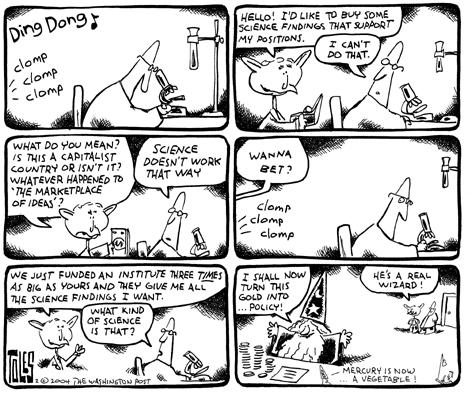
Mercury is now a vegetable


Thursday, February 19, 2004

Coming Soon to a Location Near You: Union Busting, Federal Style

The Terrorists Have Won

Long article in the Federal Times, Union Busting DoD Style, about the new civil service "reforms" at the Department of Defense, and an interview with chief union buster and undersecretary of Defense for Personnel and Readiness, David Chu. Some of the "highlights" include:
  • At least half of the more than 400,00 employees covered by collective bargaining units could lose that right.

  • It would be harder to join a union and easier to drop out.

  • Unions could consult management about big changes to working conditions, but management would have the final say.
The union’s big fear is that
changes would gut workplace protections for employees, fuel labor-management animosity and mistrust, and kick off the dismantling of collective bargaining rights across government.
And make no mistake about it, the Department of Defense labor plan, combined with the attacks on union rights for Department of Homeland Security employees, are just the precursor of their plans for the entire federal government labor force. And as we experienced more than 20 years ago with PATCO, private industry tends to take their labor-relations cue from the federal government. Although, in this case, government may be taking its cue from private sector union busters.

Chu tells unions to chill:
“It’s a starting point. I don’t really think we’re wedded to these ideas in any strong sense,” Chu said. “We’re very hopeful everyone will calm down and enter into this dialogue in the spirit it was intended.”

***

“It would be a hideous mistake to think that this is being poured in concrete,” Chu said. “We’re going to evaluate its performance on an ongoing basis. If it works well in particular areas, then we celebrate that fact and we enforce those successes. If the results are weak . . . then we will all want to readdress the tools we are using and the approach we are taking.”
"If it works well in particular areas" for whom?

One of the most objectionable parts of the plan is a proposal to allow union representation only when a majority of employees in a given bargaining unit to vote for representation. The current standard requires a majority of only those employees who actually vote. But as Colleen Kelley, national president of the National Treasury Employees Union. says, “They have set up a system for union elections that no current elected official could meet in their own elections if they were applied to them.”

Good point. As a matter of fact, the current resident of the White House didn't even get 50% of those voting in 2000.

Although DOD was ordered by Congress to work with the Office of Personnel Management on the changes, OPM has pretty much been ignored in favor of private consultants who don’t appear to be very "enlightened" when it comes to labor relations:
“DoD has hundreds of different unions. To try to do anything systematic across the department in that environment, it’s almost impossible,” said Tim Barnhart, a federal human resources consultant who has worked for several Defense agencies. “They tend to represent a disgruntled minority and they tend to not be in a position to facilitate progress. They tend to be an obstacle.”
Chu betrays his attitude toward unions in an accompanying interview when asked about planned provisions that would allow members to stop paying dues at any time instead of at a specified time during the year.
If the union is successful as an organization, people are going to want to pay their dues. That’s how people pay dues to professional organizations. No one makes you join your professional organization. You pay your dues, often much more substantial dues, because you think you got fair value for that money. I’m surprised the unions feel they can’t pass that test.
Well, yeah David, but when you stop paying dues to a professional organization, you stop getting their benefits. No freeloaders there.

While the unions will attempt to use whatever pressure they can through Congress or demonstrations, they're keeping their eye on the prize:
AFGE held a protest rally at the Capitol on Feb. 11 to call lawmakers’ attention to the proposed changes, but few union leaders or employees seem to believe lawmakers will do anything. Instead, they say the only real option is to march to the voting booth in November and remove President Bush and his Cabinet from office.

“The only way this is going to be changed is if we change administrations,” said Don Hale, president of AFGE Local 2367 in West Point, N.Y.
The disgruntled minority has spoken.

Scientists Say Bush Distorts Science

There has been quite a bit of discussion in Confined Space about the Republicans' misuse of science, labeling as "junk science" everything that doesn't fit in with their pro-business, anti-regulatory, anti-worker, anti-environment message. The Bush administration and its Office of Management and Budget has been leading the charge lately with its so-called Data Quality (sic) and Peer Review Initiatives.

Now scientists have begun to organize and fight back.
More than 60 influential scientists, including 20 Nobel laureates, issued a statement yesterday asserting that the Bush administration had systematically distorted scientific fact in the service of policy goals on the environment, health, biomedical research and nuclear weaponry at home and abroad.

The sweeping accusations were later discussed in a conference call organized by the Union of Concerned Scientists, an independent organization that focuses on technical issues and has often taken stands at odds with administration policy. On Wednesday, the organization also issued a 38-page report detailing its accusations.

The two documents accuse the administration of repeatedly censoring and suppressing reports by its own scientists, stacking advisory committees with unqualified political appointees, disbanding government panels that provide unwanted advice and refusing to seek any independent scientific expertise in some cases.
The report can be found here (although it's hard to get to as traffic has been high.) Excellent commentary's by science blogger Chris Mooney can be found here. And there was a good NPR story last night that quoted former Republican Cabinet officials as saying that they had never seen anything -- under Reagan or Bush I -- like the politicization of science that is ocurring under this Administration.

Wednesday, February 18, 2004

Train Wagon That Killed 4 Secured by Two Small Pieces of Wood

The runaway train wagon that killed four British workers earlier this week was apparently being held in place by two small pieces of wood jammed underneath the wheels.

According to Bob Crow, General secretary of the Rail Maritime and Transport union (RMT), the union that represents the railway workers,
"Our information suggests that two two-inch blocks of wood were placed beneath the wheels of the trolley to stop it moving.

"Apparently loading had just commenced when the trolley crushed the wood and careered downhill."

Mr Crow said there had been claims the workers were not aware that there were colleagues on the line down hill.

"If this information is correct our members will be outraged at the cavalier, reckless and disjointed approach to safety management and safe ways of working on the railways," he said.


(via the Yorkshire Ranter)

Crane Collapse Updates


Fourth Worker Dies From Toledo Crane Collapse

A fourth construction worker, 47-year-old Arden Clark, has died from Monday's crane collapse near Toledo. More here.

Connecticut Crane Collapse Company Had Previous Violations

Seems that Balfour Beatty, the company involved in the death of a Connecticut worker yesterday when the crane he was operating flipped off a construction barge into the river, has had some safety problems before.
Since 1993, Balfour Beatty has been the subject of eight complaints or referrals for possible safety violations. Federal regulators cited the company for violations in four cases: June and August 1993, April 1996 and October 2001. Details of those complaints were unavailable late Tuesday.

Records show one such violation, which resulted in a preliminary $3,825 fine, occurred at the same job site when a piece of heavy equipment fell off another barge and into the water. No one was injured in that accident.

The worker in Tuesday's accident [Charles Jordan, 60] was pulled from the cab of the crane, which had flipped off of a construction barge and landed upside down in the river, police said. Co-workers tried to resuscitate the worker, but he died an hour later at Bridgeport Hospital.

Workers Comp Insurers Show Record Profits

You can barely pick up the paper these days without reading about insurance companies and Republicans complaining about outragious lawsuits and the need for tort "reform" and medical malpractice "reform." Insurers are raising their rates through the roof and blaming it on lawsuits, although evidence shows that it was really their bad investments -- and not huge lawsuits -- that are causing the "crisis" and "forcing" them to raise their rates.

Also high on many states' legislative agenda this year is workers compensation "reform" (a.k.a. cuts in benefits) designed to fight rising premiums, yet workers comp insurers are showing record profits.
Insurance companies are reporting that 2003 was the fattest year on record, while they push to cut meager benefits to injured workers. Many of the insurers writing worker’s compensation policies in California reported “record net income and underwriting income in 2003,” figures in line with other companies’ banner profits.

“The very companies enjoying huge profits from the huge rate increases imposed on businesses are calling for more cuts in medical benefits to injured workers,” said Art Azevedo, president of the California Applicants’ Attorneys Association (CAAA). “Insurance company earnings soared in 2003 – even before the major new reforms took effect this year – as insurers profited from huge rate increases.
Because of rapidly rising premiums, California Governor Arnold Schwarzenegger has made workers comp reform one of his top goals, but most of the "reforms" will serve only to make it harder for workers to get benefits after they've been injured.

California injured workers groups are calling on Insurance Commissioner John Garamendi to put caps on insurance rates.
The Commissioner would reduce benefits to injured workers but allow unlimited profits for insurance companies. Garamendi’s plan includes a floor on rates, but no ceiling, so insurance companies can continue to gouge California employers. That’s not right,” said David Schwartz, President-Elect of the California Applicants’ Attorneys Association (CAAA). “Garamendi’s plan takes away benefits from injured workers, benefits that are already too low. You can cut injured workers’ benefits down to zero, and without regulation insurance companies may not reduce premiums by a single dollar.”
The groups do credit Garemendi's plan with a few good points, however, such as his proposal to accelerate payments to injured workers and to increase penalties for employers who fail to carry workers comp insurance.

Iranian Train Blast

Close to 300 people including 182 fire and rescue workers were killed when runaway train cars carrying a lethal mix of fuel and chemicals derailed, caught fire and then exploded hours later Wednesday in northeast Iran.
The sickening smell of sulphur hung in the air and the corpses of dead farm animals littered the countryside.

Only tattered clothing and patches of blood remained as evidence of the human carnage that had occurred just hours before, when a huge chemical explosion ripped through Neyshabur in northern Iran, killing and injuring hundreds of people.

By last night, the Iranian authorities said the death toll had risen to 295.
More here

Good thing it can't happen here.

Labor and Enviros Together Against Bush, Oh My!

Some of us have been trying for decades to bring labor and environmentalists together, but it seems like President Bush has found the secret -- piss them both off. Here is a column by UAW President Ron Gettelfinger and Sierra Club President Carl Pope that argues that the administration's new fuel efficiency standards will be bad for jobs and the environment.
United States manufacturing is already in deep crisis, with employment having declined every month since President Bush took office — a total of 2.8 million lost manufacturing jobs. The Bush administration should not aggravate the problem with changes in fuel economy standards that could jeopardize the jobs of thousands of workers in the auto industry. Even some automakers have expressed concern about these new standards, preferring the existing rules to uncertain new requirements.

The Sierra Club and the United Auto Workers do not always agree on automobile policy. We do agree, however, that the Bush administration's proposal would destroy American jobs, reduce fuel economy and increase global warming emissions — and add to the burdens of an already struggling auto industry.


Tuesday, February 17, 2004

Wither CalOSHA?

Most people don't realize that almost half of the states in this country run their own OSHA programs and that the effectiveness of these programs is dependent on both federal and state funding. Federal OSHA runs the rest. OSHA law allows federal OSHA to fund up to 50% of the program as long as the state runs a "fully effective" program. To determine whether a state program is fully effective, federal OSHA and the state agree to staffing level "benchmarks."

The California Association of Professional Scientists (CAPS), the union representing CalOSHA inspectors, has released a report questioning whether California OSHA (CalOSHA) is actually running a "fully effective" program. The report found CalOSHA's staffing level to be below its staffing commitment to federal OSHA and and far below what is needed to assure safe workplaces for California workers.

"It's a sorry picture," according to CAPS' Matt Austin.

California is one of 22 states to run its own OSHA program, covering both private and public sector employees. In 1980, when the CalOSHA program was first approved, the state agreed to a staffing level of 805 inspectors to cover over 11.6 million workers in half a million workplaces. CalOSHA never came close to that level and in 1994 renegotiated a much lower level with federal OSHA: 118 safety and 80 health inspectors. At that time, CalOSHA estimated that the safety inspectors would be able to inspect around 12,000 workplaces determined to be high priority, in addition to complaint, fatality and catastrophe inspections. Health inspectors would be able to inspect around 3800 workplaces.

In 1994, California was estimated to have just over a million workplaces, which meant that there was 1 inspector for every 82,822 workers and 1 inspector to for every 4,718 worksites.

Fast forward 10 years. California's labor force has grown 15% and the number of workplaces over 30% since 1994. How is CalOSHA doing keeping up?

Not well, according to CAPS.

Instead of growing in proportion with the number of workplaces covered, the official benchmark has remained at 198. The actual number of inspectors in the field, however, is much less: 176.5 (not including 7 who are on long term leave), making today's ratio of inspectors to workers 1 to 100,181 workers and 1 to 6,464 worksites.

Today, California has more fish and game wardens than workplace safety and health inspectors - 227 vs. 193.

If California was still operating under the 1980 federal OSHA benchmark ratios, the agency would have one inspector to every 15,000 workers and 625 workplaces.

CalOSHA also doesn't seem to be doing well compared to other western states. Washington State, for example, has a ratio of one inspector to 21,655 workers and 1,834 worksites, while Oregon has a ratio of one inspector to 22,286 workers and 1,239 worksites. And just for amusement, check out British Columbia which has a ratio of one inspector to 9,549 workers and 845 worksites.

There is currently a hiring freeze in California and the effect of the current round of budget cuts is not yet known.

CalOSHA is also failing to meet the challenge of keeping up with the changing composition of the state's working population. The non-English speaking workforce of California is estimated to be more than 6 million workers, over one-third of the working population. Yet CalOSHA has only 29 inspectors (or 16% of the total) who are fluent in a language other than English. Twenty of these speak Spanish.

According to Austin, there are several obstacles to fully staffing the program: budget problem, low pay for inspectors and lack of political will. CalOSHA has not been on top of the priority list for either the current or under Democrat Gray Davis. In fact, CalOSHA has not had a permanent Chief since July 2002 when former Chief John Howard was appointed by President Bush to head NIOSH.
It is not surprising, then, that Cal/OSHA staff members frequently complain of overwhelming caseloads. In November 2001 the California Senate Labor and Industrial Relations Committee held a hearing on Cal/OSHA’s response to workplace fatalities. In that hearing, Cal/OSHA was presented with a list of problems, ranging from a lack of bilingual staffing to delayed response times after worker injuries and deaths.18 Cal/OSHA representatives attributed many of the problems to staffing shortages; and they also cited noncompetitive salaries for state-employed engineers, namely, 20 percent lower than the salaries of state-contracted engineers from private consulting firms.
Even the conservative Sacramento Bee came to CalOSHA's defence in December following a fvorable article about CalOSHA in the NY Times:
At a time the state is reeling from a budget crisis of historic proportions, its worker safety law and aggressive enforcement sets California apart and above. That is something to be proud of and to protect. It also is a standard the rest of the nation would do well to emulate.
While most attention is paid to funding and program of federal OSHA, it is important to also focus on the status of workers in the 23 state plan states. Remember, it's not just a Presidential election year. Local elections are where state priorities are made. If you're in one of the other state plan states, check out your state OSHA budget and staffing.

OSHA Training Grant Program: Something Missing?

I wrote last week of OSHA's repeated attempts to replace the highly successful $11 million Susan Harwood Training Program with a $4 million web and electronic training program.

If that's not bad enough, check out OSHA's press release about it's FY 2005 budget.
Revised Training Grant Program

Under the President's proposed budget, OSHA would revise the Susan Harwood training grants program to focus on new technologies and emphasize development of training materials rather than delivery of training. The program would be open to colleges, universities and community colleges; faith-based and community-based groups; and professional organizations. Training products could be delivered through new technologies, such as the web. Developers would track and evaluate the use of the training.
Notice anything missing?

LIKE LABOR UNIONS?

OSHA has been phasing unions out of the worker training grants. Out of the 50 new grants that OSHA announced in 2003, only 4 (or 8%) go to unions or labor-management coalitions, while 14 (or 28%) go to businesses or business associations.

On the other hand, maybe it was just an oversight. Workers are so easy to forget about these days at the Department of Labor.

Four Workers Killed in Two Crane Accidents

Three workers were killed when a crane collapsed in Toledo Ohio, and another was killed when two cranes collapsed in Connecticut.

In the Toledo area’s worst construction accident in decades, three ironworkers died and five other workers were injured yesterday after a 2-million-pound crane collapsed at the southern end of the new I-280 bridge in East Toledo.

Rescue crews spent four hours recovering the dead as fellow construction workers held vigil in 20-degree weather and onlookers stood stunned at a construction project touted for its engineering ingenuity and safety record.

"It just looked like you pulling an erector set apart," witness Lee Timmons of East Toledo said.

Dead from the 2:22 p.m. accident were Robert Lipinski, Jr., 44, of Grand Rapids, Ohio, Mike Moreau, 30, of Lambertville, and Mike Phillips, 42, of South Toledo.
In Connecticut, the cranes collapsed at at the new Sikorsky Memorial Bridge on the Merritt Parkway.
The cranes were lifting a girder at about noon when one crane fell off its barge and into the Housatonic River, said Chris Cooper, a spokesman for the state Department of Transportation. The boom of the other crane snapped back, Cooper said.
Information on crane safety here.

Update here.

Monday, February 16, 2004

EPA Cuts Funding For Cleanup of Asbestos-Contaminated Libby, MT

We have frequently mentioned the tragedy of Libby, Montana, the town contaminated with asbestos-laden wastes from vermiculite mined by the Grace Corporation.
When Grace started losing lawsuits filed by sick residents, the corporation spun off its profitable assets and went bankrupt in 2001, leaving the town and taxpayers holding the bag.

The death toll is 200 so far in Libby, and nearly 2,000 locals have been diagnosed with asbestos-related diseases. Residents fear that the longer the cleanup takes, the more people will take ill.

More than 180 residential and commercial properties have been cleaned, including the mine's old processing plants and the school track. But this budget year, the Bush administration gave the Libby cleanup $4 million less than the $19 million dispersed the year before and $6 million less than the local EPA requested. That means the families of Libby will remain at potential risk -- not for five more years as originally promised, but for as many as 12, residents say.
And to add insult to injury,
In another slap at Libby last month, cleanup workers learned at 4 in the afternoon that their hourly wages would be cut starting the next day, from a minimum of $24 to $14. With workers complaining, the EPA now is considering raising their pay back to $19 an hour. Still, residents are afraid the pay cut will damage morale and undermine the quality of the cleanup.

At the peak of the cleanup last summer, 120 people were working for EPA contractors in Libby, and these were some of the best jobs in the economically depressed town.

“We have a very dedicated workforce,” Sullivan says. “These are people who really give a hoot. Why is the EPA hurting their pride?”
If you somehow missed the Libby story, check here, here and here.

"20 Tonnes of Death Coming out of the Darkness"

4 Railway Workers Killed in England

Four British railway workers were killed when a runaway train wagon weighing several tons and travelling 40 miles per hour rolled downhill for four miles and ploughed into them as they worked on the tracks. No lookout had been posted because the track was "closed."
The wagon is thought to have broken loose at 6am and gathered speed as it rolled down a four-mile sloping section of track, hitting the 10-strong gang at about 45mph.

It rolled another mile before coming to a halt.

The four were killed instantly and three were injured, one seriously. Three others managed to jump clear.

Their 40-year-old friend, too upset to be named, said: "This was the worst nightmare for any railman, an unmanned wagon coming straight at you out of the pitch darkness.
Meanwhile, the wife of one of the dead workers told of her husband's concerns about safety equipment before the accident:
The wife of one of four railway workers killed by a runaway wagon on Sunday has revealed how he had complained before the accident about safety equipment.

Christine Waters, 50, said her husband Chris had told her that he and his fellow workers could not hear when wearing new helmets and feared they were "more of a danger than safety".

Reports on Monday suggested the men could not hear the wagon approaching and also that they could not hear mobile phone calls from colleagues further up the line trying to warn them of the danger.

Travellers: On Vacation From Civility?

Violence Against Travel Industry Employees on the Rise

The New York Times addresses abuse of flight attendents and other travel industry service workers and the stress it causes. And it's not just isolated to the airlines.
In a survey of 875 airline, bus, train and highway employees late last year, the nonpartisan public opinion organization Public Agenda found that 54 percent of travel workers feel that passenger rudeness is a top cause of job-related stress and tension. Nearly half said that they had seen a situation where disrespectful behavior threatened to escalate into a physical confrontation, and 19 percent said they had observed violent acts.
Often, employees don't feel they are getting the support they deserve from management.
"Sometimes it seems like the enemy is not the passengers but senior management," said Ms. Terry, the US Airways customer service agent and union local president. "On the issue of passenger disrespect, management does not want to support us. They prefer to avoid conflict and possible litigation and put their heads in the sand."

Amy Kudwa, a spokeswoman for the airline, disputed that assertion. "We have had a history of supporting both our ground agents and our flight crews when it comes to instances of air rage," she said. "We rigorously pursue and prosecute passengers who engage in such activities."
In one case where an employee was physically attacked, however, the employee had to file charges with the police because airport management refused.

Worker-Owned Home Health Care

Interesting article in the NY Times about a worker owned home-health care company and the difference between the way it treats its employers vs. the traditional for-profit firms
"There were no benefits, no nothing,'' Ms. Pillot said. "They didn't care about you, and if you had a family problem, like my son having asthma, you had to take care of it yourself.''

But she is far happier since she landed a job with one of the nation's most successful worker-owned companies, a home health agency in the South Bronx that has won widespread acclaim for how it treats its 780 employees. Her agency, Cooperative Home Care Associates, is unusual not just because it is employee-owned - workers can buy one share of the company - but also because many management analysts and health care professionals are studying it as a model for other low-wage workers.

"The worker is at the center of everything we do,'' said Michael Elsas, Cooperative's president. "Everything else revolves around that."

Cooperative generally pays its workers 20 percent more than other New York home care agencies do. Its workers get $6.80 to $9.50 per hour, with the average at $8.60. It gives aides comprehensive health insurance and what is considered the best training program in the business, providing at least four weeks of training (most agencies provide two weeks).

Many home care agencies charge new employees $300 for training, while Cooperative provides it free, an important sweetener considering that two-thirds of its aides used to be on welfare.

Cooperative subsidizes its employees if they want to take college courses to become nurses. It guarantees aides at least 30 hours of work a week, while many other agencies give their aides only 15 or 20 hours, far too little for them to live on.

If Cooperative's workers arrive late to their home care cases because of child-care problems, the agency's counselors help employees track down child care. When workers have a complaint, they can easily arrange a one-on-one meeting with Cooperative's president.
And to top it off, they just organized with SEIU, which should prove "interesting."
So now the union representing health workers is supposed to bargain with the company owned by health workers. That makes management uneasy, and not only because Cooperative already provides better wages and benefits than most other agencies. [Board Chairman Rick] Surpin warns that it might be hard for Cooperative to adhere to multiyear pacts and to match percentage raises given by agencies that pay less.

"We present a problem for the union, and the union presents a problem for us,'' Mr. Surpin said. "But the union has come to see that we're dead serious about doing what's best for the workers.''

Officials at 1199 agree that it can be an awkward pas de deux.

Sunday, February 15, 2004

Around The Blogs

Jeanne d'Arc trys to explain to her child about grocery store strikes and the evils of Wal-Mart (via The Mad Prophet).

The Yorkshire Ranter has more on the gangmasters who killed 19 (or more) Chinese immigrant cocklers in Britain. (And check out the comments at the bottom as well.)

rawblogXport has a tragic story about child slave laborers harvesting cocoa that goes into our M&Ms.

Nathan Newman about NY Times Columnist Frank Rich's exposure of the REAL scandal of the Superbowl Half-Time show. And it wasn't Nipplegate.

Tim Lambert writes about right-wing blogger Steve Malloy's definition of "Junk Science"
Unsuspecting visitors might think that Milloy’s site is devoted to criticizing shoddy science, but they would be wrong. If you look at what he “debunks” you will find that the real criterion for deciding what is “junk science” is not the quality of the work, but the political agenda that it might support. Studies that support a right-wing agenda are endorsed, while studies that don’t are harshly criticized.
(Via Chris Mooney)


OSHA Web Page Hours Conspiracy

I've written a couple of times about OSHA shutting down it's Inspection Data website (here and here) on weekends and between the hours of 6:00 p.m. and 8:00 a.m. weekdays.

So last night I'm trying to do a little research (yes, I do actually research some of my stories) and, of course, I got the same message again about the Inspection Data webpage being shut down at night and over the weekend. OK, I'll just do it some other time, like...... Wait a minute. When is the research staff at Confined Space (all of whom have day jobs) supposed to do any research on OSHA's web page? The OSHA webpage hours correspond to the exact times when Confined Space is not posting -- when I'm at work.

I had a comment after my first post on this topic from Sara Markle-Elder saying "They're on to you. They know you do this in your free time." I laughed at the time. But no more.

Coincidence you say?

I think not.

Trench Death an "Accident"

But What's An "Accident?"

The Fire Department of the City of Zanesville, OH, has determined that the death of James Carpenter in a trench collapse last November was "an accident." And they're right, as they define accident.
We handle the criminal portion of the investigation," [Zanesville Fire Chief David Lacy] said. "We determine if the accident was caused intentionally -- such as an employee took a backhoe and intentionally threw dirt into the ditch to bury him. OSHA handles the civil portion of the investigation."
OK, so let's look at the definition of the word "accident." According to Webster, "accident" has several meanings:
1 a : an unforeseen and unplanned event or circumstance
b : lack of intention or necessity: CHANCE
2 a : an unfortunate event resulting especially from carelessness or ignorance
The city is clearly using definition 1b: "lack of intention or necessity." The problem is that the public perusing the headline would generally think of definition 1a: "an unforseen and unplanned event or circumstance." In other words, shit happens, too bad, bad luck, nothing could have been done to prevent it.

We here at Confined Space know better, of course. We prefer definition 2a: "An unfortunate event resulting especially from carelessness or ignorance."

...And punishable by a considerable fine and perhaps jail time, as opposed to the $4,500 penalty that OSHA has issued against the company.

Saturday, February 14, 2004

They're Back....

OMB Again Calls For Review Of Regulations

The White House Office of Management and Budget's Office of Information and Regulatory Affairs is once again asking "the public" to identify regulations (such as OSHA standards) that they believe impede competitiveness in the U.S. manufacturing sector.

This review is allegedly due to the White House's concern about job loss in the manufacturing sector. The White House is particularly concerned about small business.

The National Association of Manufacturers was quite pleased:
"Regulatory compliance costs faced by U.S. manufacturers are generally much higher than those faced by overseas competitors, so we very much welcome OMB's initiative," said Jerry J. Jasinowski, president of the NAM.
Translation: "if only we could run our businesses like they do in China."

(If you're really interested in NAM's reasoning behind this statement, you can check out their report "How Structural Costs Imposed on U.S. Manufacturers Harm Workers and Threaten Competitiveness" which complains about how much it is costing businesses to clean up (the environment) after themselves, assure the public that they are not stealing from their stockholders and employees, and keep their workers alive and healthy...all of which sound vaguely reminiscent of lessons that some of us learned in Kindergarten.)

The Small Business Administration was also quite pleased:
"You have to figure out any possible way to get rid of barriers to job creation," said Thomas M. Sullivan, chief counsel for advocacy at the SBA.
Sullivan, you may remember, was the former Executive Director of the National Federation of Independent Businesses before he was appointed to his current position by President Bush in 2002. He is also a winner of the coveted Confined Space Quote of the Week award for the following statement:
"I am doing the exact same thing as chief counsel for advocacy," Sullivan said, "only NFIB does not have to pay me now."
How nice for them.

OMB has not pleased everyone, however:
Critics of the Bush administration see the review as another attempt to roll back health and safety rules.

"It's an out-and-out appeal to the manufacturing sector to give OMB a wish list of regulations to be undone. It's a call for a new regulatory hit list," said Lisa Heinzerling, a professor at Georgetown Law Center who recently published a book, "Pricing the Priceless," which criticizes how cost-benefit analysis is applied to health and environmental policy.

Thursday, February 12, 2004

Seattle Cab Drivers Stage Work Stoppage Over Safety

More than 200 Kings County, Washington cab drivers staged a two hour work stoppage yesterday to call for better safety conditions. The recent shooting death of a cab driver sparked the protest. Drivers report being routinely shot, threatened, bitten and ejected from their cars.
Some drivers want bulletproof shields, but many said the shields make them feel isolated. Other drivers want video cameras in the cabs. Some want police to investigate crimes against cabbies more thoroughly.

Deb Duggan, a cabdriver for more than 10 years, said she wants more training for drivers in how to defuse a potentially violent situation. She wants cabs to have a sign discouraging robbers, by saying cabbies carry only a certain amount of cash.
Cab drivers are 60 times more likely to be slain on the job than other workers, according to a 2000 study by the National Institute for Occupational Safety and Health.
On Jan. 31, someone got in the Yellow Cab of Hassan Farah shortly after he started his 4 a.m. shift and killed him near Boeing Field. Police have made no arrests.....[Duggan] said she heard that Farah, a 39-year-old husband and father, had gone to a dispatched call from a McDonald's parking lot at 4:30 a.m. With more training, she said, somebody might have red-flagged that call as suspicious.

"You got to wonder why they called from there," said Duggan, an organizer with the Cab Drivers' Alliance of King County, which arranged yesterday's work stoppage.
Minneapolis cab driver staged a protest action last summer following the shooting of a driver there.

Check here and here for more information on cabdriver safety.

Disneyworld Worker Killed

A worker at Walt Disney World in Florida was killed during a parade on Wednesday. Javier Cruz, 38, who was wearing a Pluto costume, was the father of two and had worked at the park since 1995.
Marin, his sister, said someone who worked with her brother told her that he tripped in front of the float and there wasn't enough time for him to move.

'It's not acceptable'

"We believe it could have been prevented. I believe they should have kept a distance between him as a character and the float," she said.

"OK, it's an accident, but it's not acceptable. They should have prevented this."
Employees later reported that
Cruz was facing forward when his foot got caught on the lower part of the float. When the vehicle began to move, his body was twisted around and he fell down. The third section of the vehicle ran him over and trapped him. Other Disney workers used a forklift and hydraulic lift to get the vehicle off Cruz, according to the report from the Orange County Sheriff's Office.

Norman Smith drove the vehicle by electric power from the first section of the float. Smith told investigators he couldn't see the other sections but relied on the guidance of another worker on foot to tell him when to move the vehicle. He also depended on radio contact with other parade marchers.
In 1999, an employee was killed at Disneyworld when he fell from the Magic Kingdom's Skyway ride. OSHA fined Disney $4,500.