Friday, May 09, 2003

READING LIST

Two not to miss articles from The Nation: The first is Pride and Predjudice by Katha Pollitt, who critically looks at highly paid high-tech executives who have been laid off and are now forced into meaningless, ego-sapping, low-paying jobs – the same jobs that are believed to be the salvation for unmotivated, immoral welfare mothers. Pollitt, by the way just won the National Magazine Award in the Columns and Commentary category.

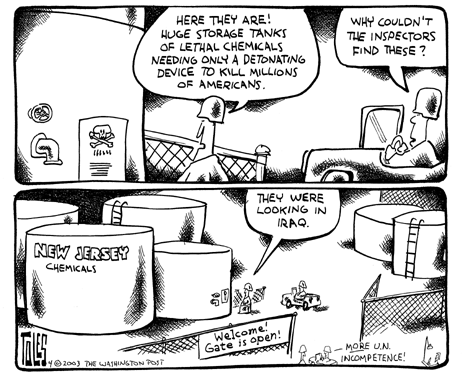
The second is Eric Alterman's Bush Goes AWOL – not from the National Guard – but from his responsibility as President to ensure the national welfare and security in number of areas, including chemical plant security, concern for workers getting smallpox vaccinations, and much, much more. Alterman also writes an excellent Blog which you should read regularly.

Read them. Copy them. Give them to friends. We’ve got a lot of education to do before November 2004.

Thursday, May 08, 2003

Those Pesky Europeans Again!

The New York Times reported today that “The European Union announced a proposal today that would require manufacturers of industrial chemicals to test their products before they can be used.”

This seems to me like a fairly sensible proposition. After all, “Under current rules, about 99 percent of the total volume of chemicals sold on the markets have not been subjected to testing requirements”

Why should chemicals be considered innocent until proven guilty – by cancer, birth defects and other health problems 10, 20 or 30 years from now?

But, of course, the Bush Administration, which fears that such a regulations “could threaten the $20 billion in chemicals that the United States exports to Europe each year,” sees it differently.

Not surprisingly, “The American chemical industry has lobbied hard against the proposal, criticizing it as excessive, bureaucratic and unnecessary.” And the Bush Administration is right there with them:
To the Bush administration, the proposal amounts to unsound science and an abuse of regulatory authority, complaints American officials have already leveled against Europe for its concern about genetically modified food and a plan to require that all such food, known as genetically modified organisms, be labeled to alert consumers.
According to William Lash, assistant secretary of commerce for market access and compliance. "Any benefit they gain from these tests will be outstripped by the cost."

Oh yeah? Who gets the benefit? Who pays the cost?

Taking a lesson from its splendid little war in Iraq, the US is putting together a coalition of the unwilling:
White House officials already have enlisted other trading partners in Latin America and Asia to oppose the European proposal. If enough changes are not made, the administration could consider challenging the rules before the World Trade Organization as a restraint on trade.
The Administration and the U.S. chemical industry like our system better. Wonder why? According to the Times,
The main chemical regulation in the United States is the 1976 Toxic Substance Control Act, which has been widely criticized for being weak and too deferential to industry. The vast majority of nonpesticide chemicals are not subject to any required screening before introduction here. (emphasis added)
If you’ve been reading Confined Space diligently, you will remember a piece I wrote a couple of weeks ago (April 21) about European countries forcing US companies to comply with their much more stringent environmental standards. You can go back and read it again. (My article, not the entire NY Times article because the stupid Times charges for articles more than a week old) But here are some of the best parts:
John T. Disharoon, a lobbyist for Caterpillar who moved to Brussels three years ago from Washington, says policy makers in the United States are generally more accountable to the public than European regulators. "So it basically changes the entire lobbying dynamic," he said. "Traditional pressure points like jobs, economic data, what it will do to industry are not as effective."

Note from the editor: More accountable to the public? The Public? Who do we think Mr. Disharoon considers "the public" here? Three guesses:

(a) Workers
(b) Consumers
(c) Business Interests

If you don't know the answer, read on....


The biggest difference in Brussels and Washington, lobbyists here say, is that American politicians rely far more on corporate donations to finance their election campaigns. Further, the revolving-door phenomenon, a virtual institution in Washington where former officials go to work for the industries they once regulated, is far less common in Brussels.
Maybe we should just trust the chemical companies not to sell anything that might be harmful.

Or, you could learn the lesson of chemical cover-ups of the last century lasting until the present day:
A West Virginia judge has found that a chemical used to make Teflon is toxic and has punished DuPont for destroying documents as it defends itself in a class-action lawsuit involving the chemical.

Where do the Children Play?

At first I wasn’t sure why this article in today’s Washington Post struck me the wrong way as I drank my coffee this morning:
Labor Department Announces Initiative on Child Soldiers

Labor Secretary Elaine L. Chao announced a $13 million initiative to help eliminate the use of children as soldiers in more than 30 countries and to help those who were enslaved.

The forced recruitment and use of children as combatants is one of the worst forms of child labor, Chao said, opening a two-day conference on the issue. "It is a moral outrage and must be stopped."

The initiative includes a $7 million global project by the International Labor Organization to help former child soldiers in Burundi, Congo, the Congo Republic, Rwanda, Uganda, the Philippines, Sri Lanka and Colombia.

An additional $3 million will be spent on education for such children in Uganda. Also, $3 million will go to help child soldiers in Afghanistan through UNICEF. There is a Web site on the initiative, at www.childsoldiers.us.
Then my early morning brain kicked into action: What about all the child soldiers in this country?

No, we may not have armies fighting a civil war on our soil, heartlessly recruiting innocent children to be used as so much cannon fodder, and leaving the survivors to look forward to damaged and violent lives.

What we have is states cutting aid for child care, unable to fund head start (here and here) and the number of black children living in extreme poverty is at its highest level in 23 years. And every week I read articles about children killing children in this country, and praying that my children won't end up in the line of fire. Is it possible there’s a connection?

Now I’m certainly no foreign aid basher. The U.S. spends shockingly little money on foreign aid each year compared to other western countries. And I am as depressed as the next person when I read articles about child soldiers. The point is, we have enough money to tackle the problem of combatant children in this country, as well as abroad – if we put our money into addressing real problems, rather than tax cuts for the wealthy and wars against phantom weapons of mass destruction.

When I was on vacation last year, I got into a lively discussion with a Republican vacationer who was bashing affirmative action. “If you want to help disadvantaged minorities, the time to start is not when they go to college or apply for a job, but when they are children.” “OK, fair point,” I responded. “But did you ever notice that the people who bash affirmative action are the same people saying we can’t afford any more money for head start or health care?”

Think about it. Get back to me (Click that “comments” or “no comments” button down below.)

SARS Strikes Nurses Nurses Harder Than Anyone Else

A rather upsetting article in the NY Times about Hong Kong nurses shouldering much of the burden of not only caring for SARS patients, but becoming victims themselves. One nurse talks about the burden of wearing protective equipment, and being avoided by friends and family.
But the worst by far has been the fear, a constant dread that the slightest mistake, like touching her eyes with a virus-contaminated finger, could leave her as feverish and breathless as the patients she treats, and perhaps even kill her.

"The most difficult part of the job is the psychological, not the physical," she said.
Although clearly the physical part is a problem as well:
While SARS is not quite as terrifying as it was nearly two months ago, when scientists knew almost nothing about it, the disease remains extremely dangerous for nurses. Despite many precautions, hundreds of nurses here and in other cities in Asia and Canada have been infected. Two or three more health care workers, usually nurses, are still being infected in Hong Kong every day.

Indeed, there are signs here that SARS, or severe acute respiratory syndrome, is becoming a disease that strikes nurses harder than anyone else. Doctors accounted for many of the initial patients here, as they became infected while checking the throats of patients and performing other clinical diagnostic tasks. But as blood tests and other means for identifying patients have emerged, doctors have spent less time close to infected patients.

Nurses, however, have been falling sick in large numbers. According to the Hong Kong Hospital Authority, nurses now make up 55 percent of the 368 health care workers who have had confirmed cases of SARS here over the last two months. Doctors now account for just 15 percent of cases, a percentage that is steadily dropping as more nurses fall ill, while the remaining 30 percent of cases are among ward attendants, nursing assistants, cleaners and other workers at hospitals and clinics.
But that's why they make the big bucks, no? No
In addition to facing more risks than doctors, Hong Kong's nurses earn considerably less. The heavily unionized nurses at public hospitals typically earn about $38,000 a year, while staff doctors at the same hospitals earn close to $80,000, said Joseph Lee, the chairman of the Association of Hong Kong Nursing Staff, the union that represents two-thirds of the territory's 30,000 nurses.
One more interesting side note:
The first health care worker to die here of SARS was a nurse, Lau Wing Kai, on April 26. His funeral Wednesday was expected to draw many government officials. Tung Chee-hwa, Hong Kong's chief executive, ordered that he be buried at Gallant Garden, the cemetery for civil servants who die in the line of duty.
A cemetery for civil servants who die in the line of duty. That's an interesting idea. In this country we don't even give public employees the right to a safe workplace.

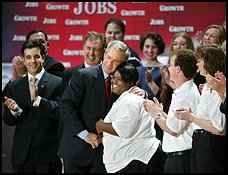
A Texas Air National Guard pilot who has been A.W.O.L. for 31 years dramatically reappeared on the deck of a U.S. aircraft carrier 30 miles off the coast of San Diego, California!

Couldn't resist this...

2 Big Hospital Buying Groups Settle Lawsuit by Needle Maker

Some answers to the question about why it took so long for many hospitals to adopt safer needle technologies – and why we need regulations and the courts
A small Texas company settled a federal antitrust lawsuit yesterday that accused the nation's two dominant hospital buying groups, Premier and Novation, of preventing the sale of its hypodermic needles to many hospitals.

The company, Retractable Technologies, which figured prominently in the fight to reform hospital buying groups, said the terms of the settlement were confidential but that it included cash payments, as well as provisions to make it easier for the company to sell its needles in thousands of hospitals in the United States.

Retractable said its product helps prevent accidental needle sticks among health care workers and that Premier and Novation had essentially blocked its sale to many hospitals. Premier and Novation negotiate supply contracts worth about $35 billion a year on behalf of nearly two-thirds of the country's hospitals.
***
In New York, for example, Premier and Becton, Dickinson were recently named in a complaint to the Occupational Safety and Health Administration by a group of resident doctors at Montefiore Medical Center, based in the Bronx.

The residents gave OSHA data they had compiled that showed what appeared to be a rise in the number of needle-stick injuries at Montefiore over the last two years. They said hospital officials did not take "appropriate action."

The residents also asked OSHA to investigate whether Montefiore's membership in Premier was behind its widespread continued use of traditional needles, which have no safety features. The agency has begun an investigation

Wednesday, May 07, 2003

First Do No Harm

I don’t know if employee health specialist quoted in this article was misquoted or what, but she seems to have taken a few steps backwards in the struggle to fight back injuries in the nursing profession.

Responding to the fact that, as the American Nurses Association quotes, “the occupations of nurse's aide and registered nurse rank first and sixth, respectively, among U.S. occupations at risk for strains and sprains, outranking construction laborers and stock handlers,” Carol Hickey, RN, BSN, and case management specialist for employee health at KU Medical Center misses the boat when it comes to the solution
"Our employees go through safety training every year. We also have an Internet program that presents appropriate lifting techniques and the importance of getting help when necessary.

"And it doesn't stop at the work site - it's important 24/7. A large percent of back injuries occur because people are not in good condition. Being overweight can aggravate a lot of back problems. Good posture and good abdominal muscles can minimize back injuries, and routine exercise is one of the best things you can do for a healthy back.

"Another important issue is the aging population that works in medical professions. The natural aging process causes degenerative changes in the spine, which may contribute to back injuries."
So back injuries are so common among nurses because the don’t know appropriate lifting techniques, they’re in bad shape and they’re old?

In my many years of working with health care workers I’ve met too many young, conscientious, skilled, caring nurses (and who seemed to be in pretty good shape) who have had to leave their profession because they had to lift too much, too often

Even OSHA’s rather anemic nursing home guidelines state that “Manual lifting of residents be minimized in all cases and eliminated when feasible” and that mechanical lifts be used as much as possible.

Hickey admits that the reasons for many back injuries is that nurses “may know good lifting techniques and the importance of using the devices available to assist in lifting heavy patients, but they get busy and rushed, and they try to do it themselves,"

Workers get busy and rushed for a reason and the response is not to work more carefully, but to find the root cause of why they are busy and rushing. In nursing homes it’s generally because they are understaffed and/or they don’t have enough working lifting devices. The solution is more staff, fewer patients and/or more lifiting devices, not learning better lifting techniques.

The problem with this kind of misinformation is not only that it is inaccurate and can lead to more injuries, but it also encourages nurses to blame themselves for back injuries instead of their working conditions. (“I must not have been lifting properly.” “I should have lost weight and gotten in shape.” “I guess I’m just too old for this kind of work.” “I just should have been more patient and waited for help.”

For some real help on preventing back injuries, check here:

A Back Injury Prevention Guide for Health Care Providers, Cal OSHA

Safe Patient Handling and Movement, VHA Patient Safety Center

Preventing Back Injuries, American Nurses Association

Now We’re Talking

California is on the leading edge of using manslaughter charges to force employers to take workplace safety seriously. The case described in the articles cited below involve the February 2001 death of two irrigation workers who drowned in a manure pit, a confined space
Enrique Araisa, 29, was overcome by gases from the excrement as he tried to fix a pump in a large concrete waste pipe. He fell into a pool of liquid manure and drowned. Jose Alatorre, 22, fainted and fell into the waste while attempting a rescue.
The case is among the first to be prosecuted under a 1999 law signed by Governor Gray Davis providing that willful violations of safety standards that lead to death or permanent or prolonged impairment may be prosecuted as either a misdemeanor or a felony. The bill also increased civil and criminal penalties for willful, serious and repeat violations of safety and health standards.

Although the charges were reduced from 20 to three, the judge let the manslaughter charges stand.
The indictment alleges that the workers had not been properly trained to deal with methane gas, did not have the proper equipment, and that air in the pipe had not been tested for the gas.

Methane is a byproduct created when manure decomposes. It can be fatal in high concentrations.

[The employers’] attorney, Michael Fagalde of Merced, said the consolidation of charges was significant. "Neither of these guys (Nunes and Faria) did anything. They're charged with not doing something," he said. "The poor, unfortunate victims made choices on their own."

He declined to say what those choices were.
Choices? Maybe they chose to do the job and feed their families. Maybe they chose to trust that their employer was being responsible for their safety. Maybe they chose to hope that their luck would hold out one more time.

Or, on the other hand, you’ve heard of “suicide by cop?” Maybe this was “suicide by job.”

Tuesday, May 06, 2003

Mining Firm Wins a Ruling, but Loses a Town

An almost Erin Brockovich type story from the Washington Post where a town's main business "helped create the nation's nuclear age," but poisoned the town in the process. But this story doesn't have a happy ending yet.

How Do Republicans Spell "Diversity?"


Monday, May 05, 2003

More on Chemical Plant Security

The NY Times is rather upset about the Administration's weak attempt to address the chemical plant security issue. Reprinted below is an editorial from today's paper. (For an extensive review of the chemical plant security debate, scroll down to Sunday, May 4, 12:10 AM.)


New York Times Editorial: Chemical Security
A draft bill setting forth the administration's ideas for protecting thousands of vulnerable chemical facilities against terrorist attack is now circulating among members of the Senate's Environment and Public Works Committee. The bill is a weak response to an urgent need. The Environmental Protection Agency has identified 15,000 chemical plants, refineries or other sites that store large quantities of hazardous materials. Most of these sites are in relatively unpopulated areas. However, the agency has also identified 123 sites where toxic gases released in a terrorist attack could kill or injure more than one million people in or near each plant, as well as 700 other sites where the death and injury toll could reach 100,000.

The administration bill would require all plants to conduct a "vulnerability" assessment and prepare plans for reducing the likelihood of a terrorist attack and minimizing the damage should one occur. That's a useful first step. But the bill muddies the question of accountability. It does not, for example, require even the most dangerous plants to submit their plans to the Department of Homeland Security for review. The administration says it doesn't have the resources. But without such reviews, the public can never be sure whether company plans meet federal standards.

In addition, the bill asks nothing particularly creative of industry. An alternative measure offered by Senator Jon Corzine of New Jersey would have industry explore new technologies - less volatile chemicals, for example - and require their use where "practical." But even exploring safer technologies appears offensive to the administration, whose bill seems tailored more to industry needs than to those of public safety.

-- May 5, 2003, Copyright 2003, The New York Times Company

ASBESTOS NEWS

As Congress debates what to do about compensation for thousands of victims of asbestos who have still not received compensation, it is useful to remember that the arguments are not really about statistics, or even money, but real people. It's also hopeful to know that we may finally be approaching the day when the use of asbestos will finally be banned in this country.

A Poisonous Legacy


April 29, 2003
By Steve Clark,
Business Report staff
Two sides face off over solutions to 'endless wave' of asbestos litigation
Nobody told Ronald Leleaux the dust he was breathing could hurt him, but it wasn't because nobody knew.

Leleaux, a 68-year-old Coast Guard veteran, worked a variety of industrial jobs from 1954 until 1971, the last six years spent at Baton Rouge's ExxonMobil refinery.

Like countless workers in industrial trades in the decades following World War II, he was routinely exposed to high levels of asbestos while on the job.

Leleaux remembers one of his worst experiences: an 18-month stint working inside a sprawling on-site rubber manufacturing facility dubbed the "finishing building." The corrugated-asbestos roof sheltered massive machines called extruders, which also were covered in asbestos.

"They would be running those big extruders in there, and they also had vibrators, and they had presses," Leleaux says. "That whole building would just tremble and it would be kind of smoky in there. That was nothing but that asbestos. You were breathing all that. We weren't told anything about what it would do."

Scarred and scared

Today, Leleaux, a lifelong nonsmoker, spends most of his day in a La-Z-boy recliner, an oxygen tank by his side, at the Livingston Parish home he shares with Leona Leleaux, his wife of 34 years.

Ronald Leleaux was diagnosed with asbestosis in 1997 after suffering steadily worsening breathing problems for years. Non-malignant yet debilitating, asbestosis is a scarring of the lungs caused by long-term exposure to the fibers from asbestos, a mineral used in thousands of household and industrial applications until being phased out in the 1970s and 1980s.

Eventually Leleaux's breathing got so bad he could sleep only two or three hours a night and some nights awoke in a panic after his breathing stopped altogether.

Leona remembers those nights. She put cold rags on her husband's face, turned on the fan and stayed up with him until he was breathing again. Read more

Panel urges U.S. to ban asbestos imports

BY ANDREW SCHNEIDER
St. Louis Post-Dispatch
Posted on Sun, May. 04, 2003
WASHINGTON - (KRT) - A blue-ribbon panel funded by the Environmental Protection Agency has issued a surprising recommendation calling on Congress to ban the import, production and distribution of products containing asbestos.
The deadly mineral is no longer mined in the United States, yet the government says about 30 millions pounds of the lethal fibers are being imported into the country each year.

The findings come as a shock to some of those who have long advocated a ban because so many of the panel's members have ties to industries involved with asbestos. That gives the panel's recommendations extraordinary weight, those involved with the asbestos issue say, and could aid efforts already under way in the Senate to outlaw the importation of the deadly fibers. Read more

How’s My Driving?

There was an interesting article in Sunday’s Washington Post about the high number of lives saved in the Iraq war due to the increased use and effectiveness of body armor which almost eliminated deaths due to bullet or shrapnel injuries to the chest or abdomen. Buried in the article were a couple of paragraphs that could provide valuable insight into a major workplace hazard: highway accidents.

Highway accidents are the leading cause of workplace fatalities, making up almost 29% of the almost 6,000 workplace fatalities in 2001, according to the Bureau of Labor Statistics.

These figures have been used by anti-OSHA activists to try to minimize the workplace death toll in the U.S, using the excuse that highway accidents are allegedly the result of bad personal driving habits (or drugs or alcohol or whatever), and therefore there driver's fault and clearly not under the control of the employer.

The U.S. military, however, apparently sees it differently. There are measures that can be taken to reduce traffic accidents, and they saved lives in the recent war in Iraq:
Twelve years ago, 50 percent more soldiers died in accidents (235) than in battle (147). In the recent war, there were only a third as many noncombat fatalities (36) as deaths in battle (101). The same pattern appears to hold for nonfatal injuries, with the data on evacuated Army troops showing that 107 had noncombat injuries, compared with 118 who had combat wounds.

[Col. Terry J. Walters, the physician who is chief of health policy in the office of the Army's surgeon general] attributed the steep drop in noncombat deaths and injuries, in part, to the Army's effort to improve driver safety and to ensure that soldiers were well-rested when operating vehicles. In the first Gulf War, motor vehicle accidents alone accounted for about half of all serious injuries. "Because this was such a motorized effort, we expected many more accidents than we actually saw. I think this is a definitive success story," she said.
Perhaps the Department of Transportation should consult with the Pentagon before issuing new rules concerning how long truckers are allowed to drive.

Playing It Safe

The only thing Don Croff and Dan Rotar would like to see climbing in the Ford Van Dyke plant is the facility’s safety score.
That’s why, as the UAW’s health and safety representatives at the Sterling Heights, Mich., plant, they want work brought down to ground level, instead of having skilled-trades workers climb on top of machinery or use harnesses to get the job done. Check out the UAW’s Health and Safety Page
What's good for the goose....

Groups Want 3 Strikes Law for Businesses

Updated: Sunday, May. 4, 2003 - 2:18 PM EST.
By STEVE LAWRENCE
Associated Press Writer
SACRAMENTO, Calif. (AP) - Borrowing from a popular punishment for multiple street crimes, California consumer activists are trying to create a three-strikes-and-you're-out law for corporations.

"If this is good enough for individual felons in California, it's certainly appropriate for the Enrons of the world," says Carmen Balber, a consumer advocate for the Foundation for Taxpayer and Consumer Rights.

The foundation and several other consumer groups, as well as organizations representing environmentalists, labor unions, seniors and trial lawyers, are backing a bill that would bar a corporation from doing business in California if it's convicted of three felonies in a 10-year period.

The measure, by Sen. Gloria Romero, D-Los Angeles, takes its name from the state's three strikes law, which provides sentences of 25 years to life in prison for individuals with two prior violent or serious felonies who are convicted of a third felony. Read more

Meet the New SOL, (Almost) The Same As The Old SOL

Staying to the Right at Labor

From the Washington Post

Liberals and union folks shouldn't look for much change at the Labor Department because Eugene Scalia left after failing to be confirmed as solicitor. The White House said last week it will nominate deputy solicitor Howard Radzely for the post. He has been a law clerk for Scalia's dad, Antonin, who sits on the U.S. Supreme Court, and before that for conservative appeals court Judge J. Michael Luttig. (here Scroll Down)


TOXIC WATER NUMBERS DAYS OF A TRAILER PARK

By Rick Bragg
May 5, 2003
The New York Times

LAQUEMINE, La., May 1 — Before the water went bad, most people in the trailer park never thought of their aluminum-skinned houses as a mobile home, only home. Hard against the rows of sugar cane, not far from the big chemical plants that light up the evening sky, the trailers in the Myrtle Grove park were dented but decent, and the tires rotted in the grass.

Now, staying in the tree-shaded neighborhood just outside the river city of Plaquemine is unthinkable. There is poison in the well water that they used to drink, a chemical used to make plastic called vinyl chloride. The state knew this years ago, but residents were not told. They wonder what it will do to them someday, and what it has done to them already. More


Sunday, May 04, 2003

The War for Chemical Plant Safety

One of my well-traveled colleagues dragged into my office the other day and asked (rhetorically), why does the federal government have mandatory regulations requiring grandmothers to take off their orthopedic shoes before they can get through airport security, and yet our whole system of keeping millions of people safe from terrorism targeted at chemical plants is totally voluntary?

Since then I’d been meaning to write something about the debate over chemical plant safety and terrorism. Last Friday's outrageous Wall St. Journal editorial, seemingly written by the American Chemical Council, has finally gotten me off of my butt. You can’t read it online, because you have to be a subscriber. So either go through the garbage of a nearby office building or trust me.

Question: What does chlorine have to do with terrorism? Answer: Nothing much, but that isn’t stopping new Jersey Democrat and world-class nuisance Jon Corzine from trying to ban it under the guise of homeland security….
Actually, the legislation introduced by Corzine has everything to do with chlorine, other highly hazardous chemical and terrorism. As the Journal itself points out,
The U.S. has at least 15,000 chemical plants refineries or other sites that use or store significant amounts of potentially hazardous chemicals, but no one has fully assessed their security.
Indeed, according to the National Environmental Trust, out of these 15,000 facilities,
in the EPA’s Risk Management Program, of these 110 plants hold enough chemicals that, if released through explosions or other mishaps, could form deadly vapor clouds put more than one million people in danger each. EPA found that each of 700 facilities could put at least 100,000 people at risk, and each of 3,000 facilities could put 10,000 people at risk
Corzine, whom the Journal accuses of “using terror fears to sneak through an environmental agenda that has nothing to do with safety” has introduced a bill for the second year in a row that requires the government to identify facilities that pose the greatest risk, assess their vulnerability to attack, and enforce safety upgrades. Plants would get credit for any voluntary measures already taken, and sensitive information would remain secret.

It would require sites to do a hazard assessment and consider the introduction of inherently safer technologies. Substituting a less hazardous chemical for a more hazardous chemical is one type of inherently safer technology. There are several ways to do this, listed in the Corzine Bill:

(i) use less hazardous substances or benign substances;
(ii) use a smaller quantity of highly hazardous chemicals;
(iii) reduce hazardous pressures or temperatures;
(iv) reduce the possibility and potential consequences of equipment failure and human error;
(v) improve inventory control and chemical use efficiency; and
(vi) reduce or eliminate storage, transportation, handling, disposal, and discharge of highly hazardous chemicals.
Senator Corzines’ bill is about getting rid of chemicals, period. He’d give half of the responsibilities for coming up with new security regulations to the highly trained, highly motivated anti-al Queda special forces at ---the Environmental Protection Agency.
The Journal clearly doesn’t like the idea of Inherently Safety Technologies.
In practice, this means the federal government could require sites to replace chemical it doesn’t like with ones it does – no matter how much more expensive, or less effective.

But as any first-year chemistry student knows, you can’t just willy-nilly substitute compounds…. Even when there is a substitute, the cost would be prohibitive. The millions of dollars that small communities would be forced to spend on a chlorine substitute for water purification is money they wouldn’t use on new fire engines or other first-response equipment.
Well, clearly the Wall St. Journal editors failed first-year chemistry. Replacing highly hazardous chemicals with equally effective less hazardous chemicals is not pie in the sky, either technically or financially. Immediately after September 11, Washington D.C.’s Blue Plains Wastewater Treatment Plant changed from chlorine to sodium hypochlorite, which is a strong version of bleach, but much safer. The change cost about $1 million, which translates into about 50 cents per customer more annually for sewage treatment.

"Needless to say, our neighbors were very pleased that we discontinued that practice," said Libby Lawson, a spokeswoman for the District of Columbia Water and Sewer Authority. "We had to rearrange a few of our economic priorities, but, obviously, it can be done."

This approach makes sense on a number of levels. There clearly may be a terrorist threat to chemical plants. A year ago, the CIA warned of the potential for an al-Queda attack on U.S. chemical facilities. But even if the only threat we had to worry about was terrorism, how much sense does it make to only commit resources to guard a target (with questionable effectiveness) when in most cases it’s entirely possible to shrink or even remove the target completely? As outlaw Willie Sutton explained, they robbed banks because that’s where the money was. Terrorists would be tempted to attack chemical plants because that’s where the greatest potential for terror is. Take the money out of the banks - -or the catastrophic potential out of chemical plants -- and no one cares.

But in reality, terrorism is not the only thing we have to worry about when it comes to chemical plant safety – in fact it’s probably not even the primary concern. Ever since the Bhopal catastrophe at a Union Carbide plant in India that released a toxic cloud of methyl isocyanate, killing more than 3,000 people and injuring 600,000, the American public has been concerned about similar catastrophic incidents happening here—and with good reason.

The legislation passed in the wake of Bhopal set up a process that identified the 15,000 plants of highest concern and created the U.S. Chemical Safety and Hazard Investigation board that investigates chemical accidents, identifies the root causes and recommends measures to prevent future incidents. The CSB's database and a perusal of any news database reveal hundreds of incidents each year, many of which were only kept from becoming large-scale disasters by luck. In other words, if one is concerned about catastrophic chemical accidents, one need not just dwell on terrorism; there’s enough concern with management system and equipment failures.
It’s no accident, therefore that Greenpeace hailed as a “breakthrough” the original Corzine Bill that died last year
The Journal seems to perceive a grand enviro-socialist conspiracy to take over control of the chemical industry, noting that the idea of inherently safer technologies (and for some groups, even phasing out chlorine completely) was on the environmentalists’ agenda prior to 9/11. Given the hazards inherent in chemical plants that use highly hazardous materials, concern about chemical plant safety and interest in inherently safer technologies has, in fact, understandably been on the agenda of environmentalists and communities living near chemical plants ever since Bhopal. The only difference is that they make more sense in this post-9/11 world. In fact, before 9/11 and since that day, we have seen many chemical plant explosion stemming from management system errors and equipment failures, and none related to terrorism.

Another small quibble with the Journal’s word selection. The Corzine bill didn’t exactly “die” last year. It would be more accurate to say that it was assassinated by the American Chemistry Council after the bill passed the Senate Environment and Public Works Committee, unanimously, 19-0. According to the National Journal, “Then the council ramped up its opposition arguing that the bill’s regulatory regime was overzealous and so potentially costly that it risked driving American companies out of business. By the time the full Senate took up the bill in September, most of the committee’s Republicans agreed with the industry’s message. The GOP members backtracked on their earlier vote and the measure died.” (National Journal 4/26/03, p. 1310-1311)

The ACC is concerned that the Corzine bill would “Drive American companies out of business?" Now where have we heard that before? Hint: Check industry testimony on every environmental or health and safety regulation proposed over the past 30 years.

Indeed, one would have that that after 9/11 laws requiring the safety of chemical plants would have been hot on the heals of laws requiring enhanced airport security. But that was not to be. While some chemicals users, such as the Washington D.C. sewer authority, cited above, got the idea quickly, others remaining frighteningly lax. An article in Government Executive magazine reviews a number of reports of lax security at highly hazardous chemical plants.

After 9/11 the ACC assured us that the association and its members were voluntarily taking care of the problem. In June 2002, the ACC announced that it had “made enhanced security activities mandatory for its members, to help assure the public that all member facilities are involved in making their neighbors and America more secure”

According to Government Executive Magazine, however:
The industry’s largest trade group, the American Chemistry Council, now requires member companies to assess their vulnerabilities. Those analyses were completed at the end of last year. By the end of 2003, member companies must develop security plans. The association eventually will require companies to get verification of their assessments and plans from an independent third party, according to Chris VandenHeuvel, an association spokesman.

Results from the assessments are being kept secret. Not even the association sees them. VandenHeuvel says the association does not have a secure location to keep the reports, nor does it have security experts on staff. The association requires that chief executive officers at member companies certify compliance with the mandate to assess vulnerabilities. But an association executive, speaking on the condition of anonymity, acknowledges that the group has no way to verify company results.
Newspapers across the nation are filled with frightening stories of the potential damage that a terrorist attack on nearby chemical plants could do. (Examples here and here and here and here)

The Bush Administration, which was considering having EPA issue chemical security regulations under its existing Clean Air Act authority, last October “abandoned efforts to impose tough new security regulations on the chemical industry to protect against possible terrorist attacks, following months of intense internal fighting within the administration and resistance from the industry....The decision marks a victory for major chemical manufacturers who have argued they can improve security without regulatory intervention.” Instead, the Administration has decided to opt for new legislation that would give all authority for chemical plant security to the Department of Homeland Security.

The Government Accounting Office is not amused. A recent GAO report on chemical plant security found that “''Chemical facilities may be attractive targets for terrorists intent on causing massive damage,'' yet “despite all efforts since the events of Sept. 11, 2001, to protect the nation from terrorism, the extent of security preparedness at U.S. chemical facilities is unknown,"

The GAO report also went after the EPA, charging that the agency had backed off of regulating chemical plant security because of a threatened lawsuit by the ACC.

Even the chemical industry is finally resigned to some sort of legislation. But not the Corzine bill with its talk of inherently safer technology and giving the EPA any authority over chemical plant security.

The ACC has announced that it would favor legislation that will: “Require facilities to conduct vulnerability assessments and address deficiencies, provide oversight and inspection authority by the Department of Homeland Security, and create strong enforcement authority to ensure facilities are secure against the threat of terrorism.”

The Journal and the ACC think that a bill being drafted by Senator James Inhofe, (D-OK), chairman of the Senate Environment & Public Works Committee, is a “good start.” Inhofe’s bill subjects sites to oversight by the Department of Homeland Security (and not EPA) and gives Homeland Security (and not EPA) the power to set standards and then fine any site that doesn’t comply.

There are several problems with this. First, critics charge that it essentially lets the industry decide for itself what those standards will be and so far, the chemical industry’s strategy is confined to increased patrols, vehicle inspections and biochemical training for local emergency personnel. Second, of course, it ignores the whole concept of inherently safer technologies. Third, it ignores EPA, with its obvious expertise in making plants safer, as opposed to just guarding them. Finally, although the bill may require plants to conduct vulnerability assessments, it is unclear if anyone at Homeland Security would ever be looking at them. It is likely that they plan to trust the ACC to monitor compliance.

Inhofe's staff released a two-page memo explaining that Homeland Security should be solely responsible because
"security is separate and distinct from safety at chemical plants, which is the province of EPA and OSHA," the Labor Department's Occupational Safety & Health Administration.

Environmental activists had complained about being excluded from Inhofe's consultations with military experts in the administration and the private sector. "Whom would you trust to protect chemical plants against terrorists, former Navy Seals or Greenpeace?" Inhofe's staff said in the memo.
The bottom line, of course, is that ACC members don’t want anyone telling them how to run their businesses if they can get away with a few higher fences and a few more guards. But it is becoming increasingly clear that communities that live around these plants do not trust the chemical industry to patrol itself, nor do they necessarily have faith that more guards really mean more security. Nor, finally do they have faith that they would be safe even in the absence of terrorism. That's why, according to the National Journal, the ACC is preparing to spend at least $50 million on a "massive media campaign" this year to defeat the Corzine bill. And they'll try to keep it secret. As one chemical industry veteran told the National Journal In some ways, for the chemical industry to be recognized as a powerful lobby would be a disaster for relations with federal regulators and environmentalists."

The Wall St. Journal does finally get one thing right:
Nowadays the first refuge of political scoundrels is “homeland security.”
Hear that Mr. John “Who needs the Bill of Rights” Ashcroft, Mr. Tom “Unions are a Security Threat” Ridge and Mr. George W. “Let’s hold the Republican Convention as Close to September 11 as Possible” Bush?

Saturday, May 03, 2003

The War At Home: Sighs Too Deep For Tears

Short weekend break from health and safety issues. I'm going to put the end of the Washington Post column about the gangs of Washington first:
Think of all the pistols tucked in waistbands across this city. And all the gunshot victims in wheelchairs, and the murders we rack up by the day. With some of the toughest gun control laws on the books and with gun-packing groups like 1-7 roving D.C. streets with the audacity of the 3rd Infantry Division, Washington has the unmitigated gall to demand that the Palestinian Authority disarm West Bank terrorists. Charity begins at home.

Speaking of sighs too deep for tears.
Aside from revealing the gross absurdities of our leaders' priorities -- both nationally and locally -- this article especially touched me because I lived on those blocks in 1980 -- it's where I met my wife. Depressing to see how much "progress" we've made in almost a quarter of a century. But hey, didn't he look great in that flyboy suit? Make's you darn proud.

Friday, May 02, 2003

Attention Farm Workers, Gardeners, Park Workers, Highway Workers, Groundskeepers

Pesticides Linked with Prostate Cancer
Thu May 1,12:03 AM ET Add Science - Reuters to My Yahoo!

WASHINGTON (Reuters) - Farmers who use certain pesticides seem to have a high risk of prostate cancer (news - web sites), U.S. government researchers said on Thursday.

The researchers, who published their study in the American Journal of Epidemiology, confirmed other findings that show farmers have an unusually high risk of prostate cancer.

"Associations between pesticide use and prostate cancer risk among the farm population have been seen in previous studies; farming is the most consistent occupational risk factor for prostate cancer," Michael Alavanja of the National Cancer Institute (news - web sites), who helped lead the study, said in a statement.

Researchers at NCI and at the National Institute of Environmental Health Sciences and the Environmental Protection Agency (news - web sites) studied 55,332 farmers or nursery workers who worked with pesticides.

Between 1993 and 1999, 566 new prostate cancers developed among the men, compared to 495 that would normally be expected in Iowa and North Carolina, the two states studied.

The risk of developing prostate cancer was 14 percent greater for the pesticide applicators compared to the general population.

One pesticide, methyl bromide, increased the risk of prostate cancer in all men.

Six others raised the risk in men with a family history of prostate cancer. They are chlorpyrifos, coumaphos, fonofos, phorate, permethrin, and butylate.

More than 220,000 U.S. men will be diagnosed with prostate cancer this year, according to the American Cancer Society (news - web sites), and 30,000 will die of it.

The biggest risk factors for prostate cancer are age and family history. Black men have higher rates of prostate cancer and men who eat lots of red meat and animal fat also appear to have a higher risk.

Thanks to Rory O'Neil for forwarding this.