Confined Space
News and Commentary on Workplace Health & Safety, Labor and Politics

Monday, June 30, 2003


More Truth About Workers Comp

Linked here is an unpublished letter to the NY Times by Ed Welch, Director of the Workers' Compensation Center at Michigan State University, regarding the workers comp article that I have written about here and here and here.

He makes some very good points:

The rise in workers comp costs averaged over the past ten years is actually not that bad. It looks bad because it was sudden. The WC insurance companies set their rates below cost while making money in the stock market and now they're in trouble, trying to make up for lost earnings. In addition, adds Welch, some of the current cost increase is a result of insurance companies spreading the cost of 9/11 over all carriers. Between these factors and rising health care costs, little of the rate increase actually goes into workers' benefits.

Welch also takes issue with the Chamber of Commerce statement quoted in the NYT article that “The only way to reduce your cost is to reduce your payroll.” And cites research showing that “employers can control their costs through safety. Many employers have dramatically reduced their costs in the last ten years by serious efforts to prevent injuries” as well as return to work programs."
In fact nearly all workers' compensation insurance rates are “experience rated.” That means that an employer’s premiums are based on its own experience. Employers that control losses through safety and return to work programs pay less. Employers that injure more workers and refuse to take them back to work pay more.
Welch concludes by warning that
Sometimes insurance commissioners and chambers of commerce are tempted to tell employers that the only way to deal with high workers' compensation costs is to support politicians and trade associations who will change the law and take benefits away from workers. In fact those employers who are willing to take responsibility for their own experience can control costs themselves.
Politicians should resist the temptation to “lead another bandwagon to reduce benefits further.”
There is a much better solution. If employers will prevent injuries, provide good health care when they do occur and help injured workers back to reasonable productive jobs as soon as possible, they will reduce their own costs and help their employees at the same time.


Nightmare on K St.

I’ve got it made in Hollywood. How’s this for a screenplay? Republicans who are in full control of the Federal government get D.C. lobbying firms to fire any Democrats they may still be employing and hire Republicans. Lobbyists are then so indebted to R’s that they push Republican agenda even harder than they normally would and contribute more money. Republicans then contract out huge parts of the federal government, hiring big business (represented by D.C. lobbying firms) to pick up the profitable slack. Your tax dollars (what’s left of them) are now not just going to the Military-Industrial Complex, but to the growing Government-Industrial Complex. Businesses return the favor (and the money) to Republicans as campaign contributions. Republicans soon control EVERYTHING!

Maybe a little too conspiratorial and far-fetched, but I think it’s got potential in a weird, futuristic, Robocop, Orwellian sort of way.

But wait! It’s already been written (here). Worse, IT’S ALL TRUE! Aieee!! Someone wake me up!!!!


Death by Fraud?

They're Americans. They're doing their jobs. They're dying. For what?

Ten Appalling Lies We Were Told About Iraq"
The young, late O.J. Smith was almost certainly named after the legendary running back, Orenthal J. Simpson, before that dashing American hero was charged for a double-murder. Now his namesake has died in far-off Mesopotamia in a noble mission to, as our president put it on March 19, 'disarm Iraq, to free its people and to defend the world from grave danger.' "


Happy Days Are Gone Again

I somehow missed this very depressing article, but luckily Susan Madrak at Suburban Guerrilla (a funny, informative and irreverent political Blog that you should all read) picked it up. (If you've read Nickel and Dimed by Barbara Ehrenreich, it's kind of like getting trapped in the book with no way out):

A heartbreaking story, one that's all too common these days:
He had been out of work 14 months. His unemployment benefits had long run out. His savings were gone. His retirement account was gone. Three-hundred-fifty résumés. Three responses. Zero jobs. Depression. Overeating. Thirty pounds. In 14 months, he says, he had gone from someone who would accept only a legal position, to someone who swallowed his pride and said he was willing to work for the lowly sum of $25 an hour, to someone willing to take any full-time job, to someone trying to make a skeptical woman at a temporary agency understand that a one-time lawyer would gladly take anything she had.

"I have no money, and I need food," he said that day. "So you give me anything you can."

"So you just need some cash," the woman said.

"Exactly," he said. "Cash."

"Well," the woman said, "we can do that," and soon after he had his first paying job since his layoff.

It was five days, at $8 an hour, in a distribution center. He opened boxes. He took out underwear. He sorted the underwear into piles. "I wasn't going to screw it up," he says of how diligently he did this, hoping that he would be asked back for a second week.

He wasn't.


Hard Week

Losing Atticus Finch and Eleanor of Aquitaine in one week. Almost too much.


Sunday, June 29, 2003


Working Families Locked Out of Labor Department

I thought perhaps a new day of openness, partnership and constructive dialogue was dawning when I saw an announcement this morning in the Washington Post about an AFL-CIO forum on overtime to be held at the Labor Department. Naah! I should have known it was too good to be true.
June 27, 2003

The fight to protect overtime is heating up. At the last minute, the Bush Labor Department barred working family advocates from holding a forum on overtime in the department's Washington, D.C. auditorium. The auditorium had already been booked and paid for but now we've been LOCKED OUT.

So, we're holding our forum anyway--on the sidewalk right in front of the Labor Department and YOU'RE INVITED. Workers and others plan to discuss the Bush administration's outrageous attack on overtime pay at the forum.

What: Forum Opposing Bush Overtime Pay Cuts

When: Monday, June 30, Noon

Where: 200 Constitution Ave., N.W. Washington, D.C. (in front of the Labor Department's Frances Perkins Building)

The Bush administration's move to take away overtime pay from 8 million workers could become law as soon as September of this year. Make your voice heard. Please attend and bring your friends, family and co-workers. Placards and signs are encouraged.
If you're in the neighborhood, come on down.


Workers Compensation Letters to the Editor

Printed below are letters to the editor of the NY Times in response to the article about the current workers comp article that I wrote about last Monday.


To the Editor:
Re "Cost of Insurance for Work Injuries Soars Across U.S." (front page, June 23):

Fraud is a real problem. Rising medical costs trouble Medicare, Medicaid and private insurance as well as workers' compensation. The insurance industry has only itself to blame for speculative investments and ill-advised premium wars.

But readers should know that large numbers of injured workers never claim compensation, out of ignorance or fear of employer reprisals; employers and insurers systematically reject valid claims, hoping workers will abandon them or accept low settlements; and state laws compensate workers for less than their lost wages (typically two-thirds, with a ceiling); death payments are low (often shockingly); and there is no explicit payment for pain and suffering.

Before we rush to reduce workers' compensation, we must address the fact that it neither compensates nor deters employers from creating unsafe workplaces.

RICHARD L. ABEL
Los Angeles, June 23, 2003
The writer is a professor at U.C.L.A. Law School.

To the Editor:
Your report about the soaring cost of workers' compensation insurance (front page, June 23) is yet more evidence that the current malpractice insurance crisis is predominantly a result of the insurance industry and its 10-year roller coaster cycles.

If the sudden substantial premium costs were spread out over a 10-year period, they would look far less remarkable.

While reforming the malpractice system by imposing caps on damages recovery can make the system less costly, the fairness of taming the industry's volatility on the backs of the most seriously injured victims is highly questionable.

Reform of the method by which damages are determined to reduce the substantial variations and extreme awards would be desirable. So would reform of the insurance industry to avoid the cyclical crisis in insurance premiums.

MICHAEL D. GREEN
Winston-Salem, N.C., June 24, 2003
The writer is a professor at Wake Forest University School of Law.


To the Editor:

Re "Cost of Insurance for Workplace Injuries Soars Across U.S." (front page, June 23):

Bad labor relations is a component of employee fraud in many cases. Employees who don't like their jobs or their employers are more likely to fake injuries or exaggerate claims than those who are more satisfied with their jobs. Added to this mix are layoffs and pressure from management on fewer workers to produce more. Speeding up the assembly line has a cost.

STEVEN KALOW
Glenmont, N.Y. June 24, 2003

To the Editor:

Re your June 23 front-page article about the rising costs of workers' compensation insurance:

The California Legislature deregulated the workers' compensation insurance industry in 1993 at the behest of the state Chamber of Commerce. This action spurred a frenzy of predatory pricing among insurance companies that saved employers $3 billion to $5 billion per year during the mid-to-late 1990's, but also drove more than two dozen insurance companies out of business.

These price wars have ended, rates are skyrocketing, and employers are confronting the repercussions of the free-market reforms they pushed through in 1993. Yet California businesses are trying to attribute higher rates to recent benefit increases for injured workers. In addition, a bill sponsored by the state A.F.L.-C.I.O. to curb excessive rate increases has won no business support.

If the free-market ideologues win the current battle in the California Legislature, it will be injured workers and their families who suffer the consequences.

TOM RANKIN
President, California Labor
Federation, A.F.L.-C.I.O.
Sacramento, June 25, 2003


The Weekly Toll

Utility Worker Electrocuted During Maintenance Check

ROCHESUER - Glen A. Hopkins, 41, was electrocuted while performing an annual maintenance check on a high-voltage electrical unit at the Turnkey Landfill on Thursday morning.

Portsmouth man dies from construction accident

YORK, Maine - William Frommer, 49, injured in a construction accident at a local residence died Thursday night at Maine Medical Center. He had been in critical condition after he was pinned beneath collapsed roof rafters 10 days earlier.

Mail carrier shot to death in Ingram

A U.S. postal carrier, Clayton J. Smith, 45, was shot and killed yesterday afternoon as he stood next to his postal van in a shady spot in the Crafton-Ingram Shopping Center, apparently taking a midday break from the heat.

WTC Site Worker Killed
Death in accident is first since 9/11


Hugo Martinez, 36, became the first worker in the rebuilding of the World Trade Center site to die on the job when he was crushed while painting part of a commuter rail station, authorities said.

Martinez was being carried in a construction lift about 20 feet off the ground when he was crushed. He was found dead yesterday morning by other workers.

Construction worker dies in forklift accident

TIGARD -- Noel Lira Sanchez, 32, was killed in a forklift accident at a Bull Mountain home construction site early Monday.

A forklift crane lifting a heavy pallet of lumber and construction products fell forward and hit him.

Worker killed at Rock Hill chemical plant

Emerson Sturgil, a 70-year-old Fountain Inn man was killed early Saturday after authorities say he was struck by a 7-foot-tall metal tank that collapsed at a Rock Hill chemical company. More here.

Construction worker dies of injuries

Sean McDonough, 28, who was pinned under a 300-ton construction crane for more than half an hour Thursday afternoon died yesterday.

OSHA looking into death at truss plant

TAVARES -- The federal Occupational Safety & Health Administration is investigating the death of a 21-year-old Mascotte man who died last week while operating machinery at a Tavares truss plant, authorities said.

Carlos Reyes died Thursday around 11:30 a.m. after getting stuck under a roof-fabrication press at Casmin Inc.'s Tavares plant, according to reports.

Bizarre accident kills construction worker

TIGARD - One man is dead after an accident at a home construction project in Tigard(OR) .

Noe Lira Sanchez was inside the house climbing up a ladder to the roof. At the same time Sanchez was on the ladder, a forklift driver was positioning a pallet of 2-by-6s on the roof.

The heavy load, weighing approximately 3,600 pounds, caused the forklift to become unbalanced. Its back tires came off the ground, and the load shifted forward, pinning Sanchez against the building.

The forklift shifted again, and Sanchez fell 10 to 12 feet to the floor.

Labels:


Who's to Blame?

Female Corrections Officer Killed

Darla Kay Lathrem, a 38-year-old rookie corrections officer, was
beaten to death
with a sledgehammer June 11 by escaping inmates while supervising five male inmates as they worked on dormitory renovations at Charlotte Correctional Institution in Florida.

In an example of profound insight, Governor Jeb Bush stated that "If anyone thinks being a correctional officer is easy work, sadly that's not the case." Nope. Dangerous places. Shit happens. Too bad.

The Governor asked the people not to blame the legislature (or its budget cuts), and presumably not to blame the Governor either. But that wasn't good enough for the Gainesville Sun
And don't go pointing fingers at the $45 million in Department of Corrections budget cuts contained in the new, not-yet-signed state budget. After all, those cuts haven't even kicked in yet.

But what about the cuts already made?

Over the past three years, the Bush administration, in the name of efficiency and to help finance politically popular tax cuts, has reportedly eliminated 1,292 correctional positions. State prisons no longer even keep guards posted in the towers because they are deemed superfluous.

Over that same period, while Bush and the Legislature were "getting tough on crime" by ratcheting up penalties, the state's inmate population increased by 2,320 inmates.
Correctional facilites can probably never be termed totally "safe," but there are always measures that can be taken to make conditions safer: better staffing, "man down" alarms, improved emergency procedures. Much of that takes funding. And if the funding isn't there, there is someone to blame.
We do blame Bush and we do blame the Legislature for making the corrections business more dangerous than ever. These days, the rallying cry in Tallahassee ought to be: Billions for tax cuts, but pennies for public safety.


Friday, June 27, 2003


Workers are From Mars, Environmentalists are From Venus?

Solution: Just Transition

The alleged conflict between people who are tired of polluted air and water and people who need to work for a living -- especially in the energy producing industry -- is as old as the conflict between dogs and cats. And as unnecessary. Do environmentalists and unions need to be on opposing sides fighting over drilling in Alaska, global warming and automobile fuel efficiency standards?

Not necessarily, argues Jim Young in an article about the Just Transition movement in the Sierra Club magazine.

Just Transition "advocates financial support, health care, and retraining for employees displaced by environmental regulation, and would be funded by a tax on pollution." And how does that work?
One recent transition proposal calls for two years of full, unconditional wage replacement and up to four years of full-time training or educational benefits, stipends for another two years for those who remain in training, health insurance, and retirement contributions. The proposal estimates its cost would average $122,000 per worker, or about 150 percent of the average amount lost by a dislocated worker. The tax–on fossil-fuel production and energy-intensive manufacturing–plus a small surcharge on nuclear and hydroelectric power, would be phased in over a five-year period, increasing to $50 per ton of carbon emitted, roughly equal to 13 cents per gallon of gasoline.
Costly? Perhaps, but why should workers be the only ones to pay (with their jobs) for a clean environment that benefits everyone?
It's supported by the Blue/Green Working Group, which includes the United Steelworkers of America, District 11; the Service Employees International Union; and the Union of Needletrades, Industrial, and Textile Employees (UNITE!). It is led on the environmental side by the Sierra Club and the Union of Concerned Scientists.
It won't be easy, but ultimately, it's the only way we will protect the environment, workers' livelihoods AND put workers and environmentalists on the same side where they belong.


Thursday, June 26, 2003


Keep The Stolen Loot, Just Try Not To Let It Happen Again

That apparently is what the Federal Energy Regulatory Commission is telling the nation's largest power companies as they "today rejected a request by California to invalidate more than $12 billion in energy contracts signed at the height of the state's electricity crisis, even though they have determined that widespread manipulation helped drive prices higher. "

The reasoning?
The two commissioners who voted to sustain the contracts, Patrick Wood III and Nora Brownell, both appointees of President Bush, said the state had failed to meet a high standard of proof that would allow for such drastic action.

Mr. Wood said that voiding the contracts was not in the public interest and noted that California officials had said at the time the contracts were signed that they were good deals for the state.
Yeah, well if someone had a knife to my throat, saying "Your money or your life," I'd probably consider it a very "good deal" to give him my wallet. But that doesn't mean that the thief doesn't have to give it back when he's caught.

In addition, the Commission
found that while manipulation helped drive prices higher, the root cause of the crisis was the state's deeply flawed deregulation plan and a severe shortage of electricity. Taken together, the two factors made possible many of the abuses that later occurred, commission officials have said.
So if I accidentally leave my back door open and someone robs me, they don't have to return the loot when they get caught?

I remember when Republicans wanted to be known as the law and order party. That must have been back when they thought the sky would fall if we didn't balance the federal budget.


BACK TO THE YELLOWSTONE AGE

From The Daily Grist

The Bush administration has asked the United Nations to remove Yellowstone National Park from a list of endangered World Heritage sites. "Yellowstone is no longer in danger," wrote the Interior Department's Paul Hoffman in a letter to the World Heritage Committee. There's just one snag: The park staff disagree with Hoffman, saying Yellowstone still faces the kinds of problems -- threats to water quality, bison, and trout populations, among others -- that put it on the endangered list in the first place, back in 1995. But in its recent report to the U.N. committee, the Bush administration diluted or deleted those problems, in a move critics say is emblematic of White House efforts to water down, sugarcoat, or deny environmental problems across the board. "Tinkering with scientific information, either striking it from reports or altering it, is becoming a pattern of behavior," said former National Park Service Director Roger Kennedy.


Chemical Industry Steps Up To the Plate...And Strikes Out

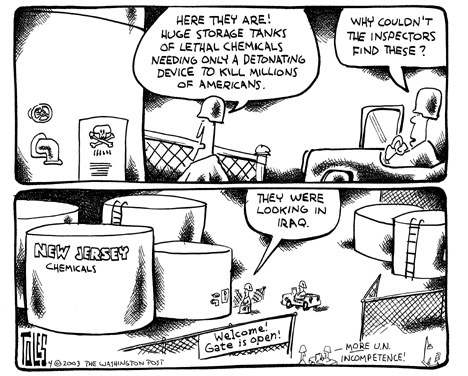
The most effective weapon of mass destruction ever used in the United States was the commercial airliner, with the assistance of a few boxcutters. One way to effectively address that threat would have been to eliminate the source: ban airplanes from the skies. But that probably would have generated some public opposition, So the next best action was to heighten security at the gate (more guns, better inspections, etc.) so that no passenger has the means to hijack a plane.

With chemical plants, however, where the "right" accident could kill many more people than died on 9/11, the situation is different. On one had we can't eliminate chemical plants. But on the other hand, we can (unlike air travel) eliminate much of that hazard at its source by replacing highly hazardous chemicals or processes with less hazardous chemicals or processes, or by storing smaller quantities of hazardous chemicals on site. These and other measures form the basis of what is known as "inherently safer" production. One advantage of this method is that it not only minimizes the effectiveness of any terrorist incident. A bigger advantage is that it also minimizes the existing day-to-day threat of catastrophic chemical plant accidents that may be caused by management system errors or equipment failure.

So it was rather disconcerting to read about a recent chemical plant security summit attended by the largest chemical manufacturers and associations.
Throughout the day, industry leaders agreed, conceding that many of their largest and most dangerous facilities still lack armed guards, perimeter fencing or even nighttime patrols.

But they also insist they have upgraded protections for their workers and neighbors. Dozens of companies told about adding lights, barbed wire, hiring round-the-clock guards and, in a few instances, even substituting less-dangerous chemicals for toxic chemicals.(emphasis added)
Note what is listed last (and probably least) It's not that the attendees don't understand the threat from terrorism. The problem is that they seem to ignore the fact that the hazardous chemicals and unsafe conditions at many of these plants present the same level of threat to U.S. citizens as exists after 9/11 and will continue to exist even if Al Qaeda and their brethren are eliminated. Accidents happen, and as long as the potential is there, we are all at risk. Bhopal, remember, was not a result of terrorism.
An unprecedented national Chemical Security Summit in Philadelphia wrapped up Thursday, with federal counterterrorism experts and corporate executives insisting that, while much has been done to improve security, more must be done, quickly, to protect citizens from terrorists seeking to turn chemical tanks into the "poor man's atomic bomb."

"You've heard about sarin and other chemical weapons in the news. But it's far easier to attack a rail car full of toxic industrial chemicals than it is to compromise the security of a military base and obtain these materials," said FBI Special Agent Troy Morgan, a weapons-of-mass-destruction specialist who spoke at the summit.

Corporate and government leaders worry that terrorist cells could unleash toxins on a major American city -- a disaster that could rival the Bhopal, India, industrial accident that killed more than 20,000 in 1984.

The chief culprits stalling faster reforms, executives and federal counterterrorism experts agree, are a corporate culture that embraces slow, incremental changes rather than sweeping innovations, and an economic downturn that's left little cash for security.
But nothing is likely to be done about the concept of inherently safer production if the American Chemical Council has its way:
The ACC represents the interests of the nation's largest chemical manufacturers on Capitol Hill. In October, it spearheaded a successful drive to crush the Chemical Security Act, a bill that would have federalized securing at nearly 13,000 sites nationwide. Key to the bill was a measure forcing major manufacturers to shift production to "inherently safer" materials and technologies. Without federal legislation, chemical security is being addressed by the new Department of Homeland Security.
I've written previously here, here and here about the legislative battles -- Jon Corzine's bill (S. 157) which requires the chemical industry to consider inherently safer technologies vs. Senator James Inhofe's (D-OK) bill which pretty much leaves it up to voluntary efforts by the chemical industry, its slow corporate culture and the economic downturn.

Congress will soon be bringing up the issue again. Unfortunately, given who is in control and has the largest lobbying budget, the prospects for Corzine's bill are not good -- unless the public decides that eliminating the potential for a "poor man's atomic bomb" at the source will make them feel more secure than more armed guards and higher barbed-wire fences. And then making their opinions known to their Congressional representatives.


Labels:


Wednesday, June 25, 2003


CSB Releases Nitrogen Hazard Bulletin

The U.S. Chemical Safety and Hazard Investigation Board released a new safety bulletin that presents a series of good safety practices to prevent nitrogen-related incidents. Asphyxiations, many of which occurred in confined spaces, cause 80 fatalities in the U.S. over the last decade. In addition to the full safety bulletin, the CSB has developed a one-page safety brochure and a downloadable Powerpoint® presentation on nitrogen hazards.
As part of this project, the CSB reviewed a number of nitrogen asphyxiation incidents that have occurred in the past decade. Findings from this study included the following:

  • 85 incidents occurred in the past decade that resulted in an average of 8 deaths and 5 injuries each year;

  • Causes of the incidents included personnel not knowing they were entering an oxygen-depleted environment or not realizing that the environment had changed, and also mistaking nitrogen gas for breathing air;

  • Incidents occurred in a variety of settings including chemical plants, food processing and storage facilities, laboratories, and medical facilities;

  • Almost half the incidents and over 60% of the fatalities involved contractors, including construction workers;

  • A number of deaths were caused by personnel attempting rescue without proper training and equipment.

Labels:


Daubert, Junk Science and Polluters

Back when I was at OSHA working on ergonomics, the biggest argument we had with opponents of the regulation were allegations by the business associations and conservative Republicans that ergonomics was based on “junk science.” The argument was put most forcefully by soon-to-be Labor Department Solicitor Eugene Scalia who claimed in an article that OSHA was violating the “Daubert Decision.”

Today, a group of experts in the legal and scientific community released a report entitled "Daubert: The Most Influential Supreme Court Ruling You've Never Heard Of" (Full Report here.)

Daubert was originally intended to assist judges in determining what evidence could be admitted into a trial. But as the authors explain:
The 1993 Daubert ruling directed federal judges to act as "gatekeepers" in the courtroom, using a standard that requires expert testimony to be both reliable and relevant before allowing it to be presented to juries. However, over the past 10 years, some judges have misinterpreted and broadened the reach of Daubert. Some have excluded scientific opinions when there is (or appears to be) disagreement among legitimate scientists; while others pick apart each piece of the scientific evidence presented by an expert rather than assessing the evidence as a whole, the way scientists do.
What this means is that when corporate attorneys manage to cloud the science and confuse the judges, the evidence gets labeled as “junk science” and good cases often get dismissed by the judge before they even get to a jury. Victims of toxic chemicals and drugs are the losers.

Or, as in the case of ergonomics, the “junk science” argument is used to obstruct the regulatory process.
One example of how Daubert has kept legitimate science out of the courtroom came from Peter Infante, former director of OSHA’s Office of Standards Review. He was prevented from testifying in Chambers v. Exxon Corp., a lawsuit involving a contractor at an oil refinery in Baton Rouge who was exposed to benzene and then developed chronic myelogenous leukemia (CML), a rare form of cancer. He was to have testified as the author of a 1977 study that confirmed that benzene caused leukemia and as the author of a later analysis that found a four-fold increase in the risk of developing CML from exposure to benzene.

But the judge excluded his testimony (saying it wasn’t strong enough) and issued a summary judgment in favor of the defendant. Dr. Infante said the judge not only made a factual error – his analysis was the first to show a more than two-fold increase in risk plus statistical significance – he asked for more than anyone else in the field would have required for such a rare disease. Benzene was considered a cause of leukemia, including CML, long before any epidemiological study showed a two-fold increase in risk.

"It seems to me the judge was making a scientific determination when he didn’t have the expertise to do that," Dr. Infante said. “It’s a matter of fairness. A worker wasn’t protected from toxic exposure, from a chemical known to cause a disease. He was damaged by the product, and his case wasn’t allowed to get to a jury.”
So what is to be done about this problem? Beyond "becoming aware," or getting better judges (by getting rid of you-know-who) that's not entirely clear.
On the tenth anniversary of Daubert, the scientific community needs to become
much more aware that an obscure procedural decision intended to provide clarity has instead given rise to a serious social imbalance. It has led to unreasonable legal demands of scientific certainty when considering expert testimony that right otherwise demonstrate harm of individual plaintiffs by defendants, often wealthy and powerful companies. At the same time, inappropriate or inaccurate interpretations of science are becoming embedded in legal precedent. Yet in contrast, Daubert has failed to demand from criminal prosecutors better science in the face of weak forensic methods, resulting in the potential conviction of innocent people. And now, the application of Daubert and Daubert-like challenges threaten to paralyze the systems we use to protect public health and the environment.

Labels:


One Big Sector

Harold Meyerson ponders how a bunch of low-paid, immigrant, janitors are gaining health care benefits while the rest of America watches their health care benefits fade away or become unaffordable.
If this runs counter to everything you know about power in America, you probably have forgotten about unions. At minimum, you have forgotten about unions that organize so many workers in a single sector that those workers can win some real power over the conditions of their work.
Meyerson lavishes praise on unions like SEIU, UNITE and the Hotel and Restaurant workers who are working hard to organize and maximize bargaining power in their hard-to-organize sectors rather than go for the easy members like public employees (as some unions are doing.)


Meanwhile, In a Parallel Universe, Somewhere in the Midwest....

John Ashcroft and his Washington acolytes may be winning their war against unions terrorism inside the Beltway (See below), but somewhere in the heartland live a whole bunch of union terrorist sympathizers.

In Jefferson, Wisconsin, UFCW Local 538 is on strike against Tysons Foods. But in these allegedly anti-union times, the people of Jefferson are sticking with the union.

  • A gas station owner "gave strikers and their families 328 gallons of milk from the Shell station and convenience store he co-owns on the south side"

  • The Citgo station near the factory gate keeps its bathrooms open for the pickets.

  • Many merchants, including d.b. Puffins restaurant, offer discounts for the strikers.

  • Oak Ridge Golf Course in Milton charges no green fees for the union members on Tuesdays.

  • The Jefferson Jaycees and Capn's Corner catering recently raised $3,500 for the strikers, serving 600 chicken and fish dinners in the rain at the park next to the factory.

  • Local eateries, including Subway, promote that their food is "Tyson-free."

  • Ken's Towne Inn gives pickets leftovers from catering jobs

  • Because of the strike, the credit union is letting its members defer loan payments.
It's like a bygone era, back when "compassion" still meant something:
"These workers have supported me for 21 years in this community," Dave Lorbecki, owner of Dave's Piggly Wiggly says. Sticking up for the workers has brought him more customers, he says, but like at other businesses, his sales are down because those shoppers have less money to spend.

Lorbecki is part of a campaign to keep a Wal-Mart SuperCenter from coming to Jefferson, and he hopes boosterism for the strikers spills over to that cause.

"This really woke people up to what community spirit is all about," Lorbecki says.
What explains all of the support? According to the article,
the strike has provided citizens here with a rallying point through which they can rail against the inevitable encroachment of global capitalism.
"Railing against the encroachment of global capitalism? Solidarity? If there's any more of that out there, can we bottle it and use it in the next presidential election?


Tuesday, June 24, 2003


Another Victory Over Terrorism

Well, we may not have been able to find Osama bin Laden, Sadaam Hussein, or weapons of mass destruction, but we're succeeding in the fight against terrorism on another front: smashing unions.
The Bureau of Alcohol, Tobacco, Firearms and Explosives (ATF) is considering plans to exempt from collective bargaining 600 inspectors who have been represented by a union for more than 30 years.
ATF employees are represented by the National Treasury Employees Union, which is widely known to have a close personal relationship with Al Qaeda.

Or at least that's what Tom Ridge and Dick Cheney seem to think. And they know stuff.

Of course, this wasn't the first victory of the Bushniks over the evil federal unions
In January 2002, lawyers for the NTEU and the Justice Department were in Miami for a hearing on whether the union could organize assistant U.S. attorneys in three Florida cities. Before the union lawyers got to argue their case, President Bush issued an executive order citing national security concerns and kicking unions out of U.S. attorney offices and four other divisions of Justice.

Union leaders were outraged. Previous presidents had removed unions from federal agencies by citing national security concerns, but the labor leaders said no president had stopped litigation over collective bargaining rights by invoking national security.
Paging John Sweeney. Your one-way flight to Guantanemo is ready to board.


Home of the Fearful, Land of the Imprisoned

The Justice Department Inspector General has found that U.S. authorities overreacted toward immigrants in the wake of 9/11.
These truck drivers, bus boys, janitors, and cabbies have no connection to terror. But their lives are ruined and families shattered because they have the bad luck to be in the wrong place at the wrong time.
So, maybe now things will get better? Hah! These are the Ashcroft times.
One would hope that the recent disclosures of government excesses and apologies by security officials would be a sign that the post-Sept. 11 panic is over and more rational investigative measures that actually prevent terrorism are being implemented. Unfortunately with Operation Landmark, the Special Registration program, and the presidential campaign centered on the themes of national security, it looks like the worst is yet to come.


Workers Comp Fraud

The New York Times article that I highlighted in yesterday's posting about the growing crisis in the workers compensation system contained the following paragraph describing some of the causes of the problem
Prices are escalating, government and industry officials said, because of rising medical and legal costs; a recent devastating price war by insurers; and, many insurers and business executives say, a significant amount of fraud.
What kind of fraud you ask? Well, I'm pretty sure that the insurers and business executives are not talking about the most common and expensive type of workers compensation fraud: Employer fraud.

According to a 1998 article, "Fraud in the Workers' Compensation System: Origin and Magnitude"* by Dr. David Michaels, currently at George Washington University,
In states where the relative importance of worker and employer fraud can be compared, it is apparent that the magnitude of employer fraud greatly exceed that of worker fraud.
And what is "employer fraud?"
It's avoiding insurance payments by underreporting payrolls, manipulating injury and claims data to show move favorable claims experience...and improperly using independent contractor status ...to avoid workers compensation insurance..
But if employer fraud is so much more common and costly than worker fraud, why do we always seem to hear anecdotes and television stories about scandals involving workers, allegedly seriously injured on the job, filmed taking out the garbage? Sexier television or is there an ulterior motive? According to Michaels,
Employers and insurance carriers know that the campaigns against worker fraud rarely identify many actual cases of outright fraud, and they save little or no money In fact, they may lose money. Their primary purpose is not to save money. High profile campaigns that focus primarily on worker fraud are actually public relations campaigns to convince the public and legislators of the demonstrably false asssertion that the workers compensation system is rife with worker fraud. Once this occurs:
  • The public and legislators become more accepting of "reforms" that significantly reduce benefits paid to disabled workers; and

  • workers injured on the job become concerned that they will be stigmatized by neighbors and coworkers if they file legitimate compensation claims. To avoid this stigma, injured workers shift the medical costs of their claims to their group health insurance policies and pay the cost of lost wages themselves, through their accrued sick days and vacation leave, and continue to work while injured.
The winners? Insurance carriers who don't have to pay claims, and employers who don't have their premiums raised. The losers? Workers and their families who bear the costs themselves; other workers, because the employer has even less incentive to make the workplace safe, and of course, taxpayers who ultimately end up paying the bills.

Last week I cited Lisa Cullen's article, "Safety Pays, Or Does It?" about how safety doesn't really pay for those who are able to work the system so that workers and society end up paying the real costs of unsafe workplaces.

Legislatures in many states will be seeking to "reform" the workers compensation system in the near future. And they'll be using worker fraud as an excuse. Print out this article and save it for the upcoming battles.

*Occupational Medicine: State of the Art Reviews, Vol 13, No.2, April-June 1998, Philadelphia, Hanley & Belfus, Inc.

Labels:


Monday, June 23, 2003


Asbestos Compensation Update

Good article on the continuing struggle in Congress over a decent asbestos compensation bill. This is what it's all about: "Between 1965 and 1999, at least 259,000 people died from asbestos-related diseases such as mesothelioma, as well as lung and gastrointestinal cancer. From 1999 to 2030, experts predict an additional 166,000 deaths connected to asbestos."

Labels:


Workers Compensation Crisis

Solution: Screw the Workers (What else?)

The nation-wide workers compensation crisis has hit the big time, if "big time" is measured by its placement in the NY Times. In this case, it's front-page, right hand column news. Its description of the crises is good, the analysis, however, is a bit thin.

Read the article. I only have a few comments, but I'd like to invite any workers comp experts out there in internet land to donate your analysis to be read by the tens of thousands (plus or minus tens of thousands) of Confined Space readers. E-mail me here and I'll be happy to reprint your comments.

First:
Across the country, the cost of workers' compensation insurance is soaring at the highest rate in nearly a decade, adding yet another heavy burden on businesses and the struggling national economy.
Any effect on workers? You wouldn't know it by the number of labor union experts that were quoted (none). But then, why should workers be concerned? The real issues is the profit loss column of the workers comp insurance companies.

There's your requisite bit of job blackmail:
"The only way to reduce your cost is to reduce your payroll," said Allan Zaremberg, the president of the California Chamber of Commerce.
An attempt at analysis:
Part of the problem has been created by the insurers and the boom-and-bust cycle of their industry.

In the mid-90's, expenses for workers' compensation insurers dipped and profits skyrocketed just as the stock and bond markets were at their most exuberant.
Actually, if you talk to many workers comp experts, this was more cause than coincidence. Like many Americans, workers comp companies decided they could make more money in the stock market than from premiums. They invested heavily in stocks, and cut their rates to attract new customers. They, like millions of other Americans, lost their shirts when the stock market crashed, leaving them with no money and rates too low to cover their obligations. Oops. Better raise rates to cover their bad investments, and pressure legislators to cut workers' benefits.

One factor, of course, is the rising cost of medical care. This requires a comprehensive nation-wide solution (like maybe single-payer universal health care?) . In the meantime, it seems to be much easier to hit workers on both ends: raise their health insurance premiums or cut their coverage on one end, then reduce their workers comp benefits on the other.

Another cause mentioned by the article: fraud. The natural inclincation for most people when the word "fraud" is mentioned is to think of workers claiming false injuries. You have to read until the very end of the NY Times article to understand what fraud really means.

According to California Insurance Commissioner John Garamendi:
"There's fraud in every part of this situation," Mr. Garamendi said. "You have a situation where doctors and lawyers and chiropractors are involved in organized crime and ripping off the system. You have workers faking injuries, and you have companies not reporting the nature or the number of their employees," whose jobs are an important factor in determining how much the employer pays. "It's not unusual to see a roofing company paying premiums for one roofer and 30 secretaries."
In fact, most good studies of workers compensation fraud find that fraud by workers is by far the smallest portion.

Hey, I have a another good idea: We could make sure that workers don't get hurt in the first place.

More later (with your help.)


Sunday, June 22, 2003


Be Afraid. Be Very Afraid

This headline in the Washington Post didn't start my day off very well:

GOP Aims for Dominance in '04 Race
Republicans to Seek Governing Majority by Feeding Base, Courting New Voters
Most of the actual article wasn't much better:
Republican strategists see the 2004 election as their best opportunity in a generation to construct a durable governing majority, and they have set in motion a systematic and coordinated strategy designed to leverage President Bush's popularity and break the impasse that has dominated the country's politics since the mid-1990s.
On the other hand, there were signs of hope:

Signs of Close Election

There are good reasons for Bush strategists to anticipate a close election. Given the unsettled state of the world and the still-weak economy, a second Bush term is far from assured -- let alone the goal of making Republicans the country's majority party.

Early polls show Bush receiving the support of less than 50 percent of the public when matched against a generic Democratic nominee. That is far below his approval rating, suggesting a wait-and-see attitude on the part of many voters.

Economic problems could derail hopes for a second Bush term just as quickly as they did for his father in 1992. "If we're below about 2 percent real growth, this [election] could degenerate into a dogfight," said former House speaker Newt Gingrich (R-Ga.). "If we're in a recession, this will be a dogfight. If we're above 2 percent real growth, I just think the Democrats are in a world of hurt."

Instability in Iraq, questions about whether Bush or other administration officials misled the public about the threat of weapons of mass destruction, violence in the Middle East and continued fears about terrorist attacks at home threaten claims of success in foreign policy. That could transform one of Bush's clearest advantages into an arena for challenge by the Democrats.
I like the "wait and see attitude." People with a "wait and see attitude" are open to a little "show and tell." That's where we come in.


Question of the Week

Why does my pop-up stopper stop all pop-up ads except for ads for pop-up stoppers?


The Weekly Toll

Worker dies when found gun discharges

NEW YORK (AP) _ A construction worker died after a shotgun he found in a trash container at a work site accidentally discharged, striking him in the neck, police said.

Orano Stepcic, 52, found the gun in a case he pulled from a container near where he was working on Woodward Avenue in the Ridgewood section of Queens on Friday morning, police said. More here.

Farm worker dies after gate accident

TOWN OF IRVING, Wis. — A 19-year-old farm worker died after getting caught in a mechanical cattle gate Friday morning, according to the Jackson County Sheriff's Office.

Megan L. Queitzsch of Melrose was rushed to Black River Memorial Hospital from a farm on Sunnyvale Road in the town of Irving after the accident was reported about 9:15 a.m. She wasprono unced dead at the hospital, according to a sheriff's press release.

Man working on light switch is electrocuted

A 19-year-old worker, Duane R. Smith, was electrocuted Wednesday while trying to wire a light switch at a Columbia home, Richland County Coroner Gary Watts said.

Explosion claims fairgrounds worker

An adult male employee of the Ozark Empire Fairgrounds was killed Wednesday in an explosion at the fairgrounds, an investigator with the Greene County Medical Examiner's Office said.

Officials identified the victim as Brad Murphy, 34, of Springfield. No other injuries were reported. More here.

Late-night blast at Houston company under investigation

SAN LEON — One worker was killed and four others were hospitalized early Wednesday after a late-night explosion at an offshore gas-drilling rig in upper Galveston Bay.

Houston-based Transocean Inc. said 21 workers were rescued from its gas-drilling barge after the blast was reported about 11 p.m. Tuesday.

Safe door collapses, killing Livermore man

A 31-year-old Livermore man was killed Tuesday at a construction site near the International Marketplace when the door of a walk-in safe he was tearing down collapsed on him.

The coroner's office identified him as Sathaniel Malachai Menzie. He worked for Soil Enterprises Inc. of Byron. More here.

PUC employee killed by trash compactor

A Pacific Union College employee was killed Monday when he apparently was crushed to death in a trash compactor.

Nelson Rivera, 39, was found dead by co-workers at the college's landfill at 12:45 p.m., sheriff's Capt. Mike Loughran said.

More here and here.

Investigation begins into building collapse that killed one worker

Officials have begun investigating the partial collapse of a downtown building that killed a construction worker.

Adam Petruska, 20, of Kent County was crushed under tons of rubble Wednesday morning. He was working inside the 70-year-old Welsh Civic Auditorium which is scheduled for demolition. More here.

Memphis Firefighters Died as Heroes

MEMPHIS -- Two firefighters died braving fire and smoke in a three-alarm fire at a Frayser business, believing they were going in to save trapped civilians, fire officials said Monday.

However, reports that people were inside the burning Family Dollar store at 3732 Watkins proved untrue.

As both experienced firefighters searched for victims Sunday night, a portion of the roof collapsed, trapping them.

Lt. Trent Kirk, an 11-year Fire Department veteran, died inside the store after urging other firefighters to retreat.

It was several hours after the collapse that a rescue team knocked a hole in the north wall of the building to pull him out.

Firefighter Charles Zachary, a 19-year veteran, was pulled from the blaze after 15 minutes, Fire Director Chester Anderson said. He died of his injuries early Monday.

Labels:


Friday, June 20, 2003


Dust to Ashes

The U.S. Chemical Safety and Hazard Investigation Board (CSB) held a public hearing Wednesday to present preliminary findings of its investigation into the catastrophic explosion at West Phamaceuticals last January.
West Pharmaceutical Services created conditions for the deadly blast at its Kinston plant by installing a suspended ceiling that allowed explosive dust to build up out of sight, federal investigators said at a public hearing Wednesday night.

The explosion, which killed six people and injured three dozen others, was strong enough to buckle six-inch-thick concrete floors, fling walls and create a column of black smoke visible for miles. The plant was left a peeled skeleton.
The CSB is also investigating another explosion caused by dust at a factory in Corbin, KY that killed 7 workers.

OSHA has a regulation to prevent grain dust explosions, but otherwise does not address the hazards of explosive dusts. Some experts fear that we may be seeing more catastrophic dust explosions becauses advances in technology are resulting in finer and more explosive dust particles.

More information on the West meeting here, here, here, here and here.

Labels:


The Best Laid Plans....

One of the less well thought-out "homeland security" programs seems to have faded into a well-deserved oblivion.
Government officials said today that both the civilian and military smallpox vaccination programs had virtually come to a halt, the military program because it has vaccinated everyone it can and the civilian program because few people volunteered for it.
Fear of side effects and ignoring compensation issues for health care workers were two strikes against the program.

Personally, I never did see any convincing evidence that there was any threat from smallpox in the first place. But what did I know? I didn't think that Iraq was an imminent threat to the security of the United States and...oh yeah, it wasn't.

Now, as we learn more and more about the lies we were told to justify the invasion of Iraq, one can't help but wonder if the whole smallpox scare was just another Bush administrated ploy to sow more fear throughout the land. Naa!


Thursday, June 19, 2003


PESTICIDE OR SPERMICIDE?

(from Grist Magazine)

Frogs and men, beware: Pesticides are your enemy. Men exposed to pesticides commonly used on crops are far more likely to have defective sperm and low sperm counts than men who are not exposed, according to a study published yesterday in Environmental Health Perspectives. The study is the first to show a link between environmental toxins in men's bodies and poor sperm count and quality. The study is also important because it involved men who