Confined Space
News and Commentary on Workplace Health & Safety, Labor and Politics

Wednesday, August 31, 2005


McWane Guilty Again

Union Foundry, a division of the notorious McWane Industries, has agreed to plead guilty and pay a $4.25 million fine for an environmental crime and safety violation that led to the death of an employee.
In court papers unsealed yesterday in Federal District Court in Birmingham, Union Foundry, a McWane plant in Anniston, Ala., admitted that it had willfully violated federal safety rules, resulting in the death of Reginald Elston, a 27-year-old worker who was crushed in a conveyor belt. There was no required safety guard on the conveyor belt, even though an employee at a McWane foundry in Texas had been crushed to death in another unguarded conveyor belt less than two months earlier.

Union Foundry also admitted that it had illegally handled dust contaminated with lead and cadmium, two substances the federal government has linked to lung cancer.

Causing the death of a worker by willfully violating safety rules is a misdemeanor. Illegally disposing of contaminated dust is a felony. In deciding to plead guilty, McWane agreed to pay a $3.5 million criminal fine. It also agreed to submit a proposal to the United States attorney in Birmingham to spend an additional$750,000 on a community service project in Alabama that either improves workplace safety or protects the environment. No individuals were charged. The plea agreement requires approval by a federal judge.
McWane's criminal and deadly treatment of its workers was the subject of a 2003 Pulitzer Prize winning NY Times/Frontline series. . Union Foundry will pay $3.5 million in criminal fines and $750,000 for federal agencies to spend on services to benefit the Anniston Alabama community.

Last March, Tyler Pipe, another subsidiary of McWane pleaded guilty to "environmental crimes," fined $4.5 million, placed on probation for five years and required to spend an estimated $12 million on plant upgrades. And in June, a federal jury found industrial pipe maker McWane Inc. and two of its executives guilty of environmental crimes, including conspiracy to violate the Clean Water Act. Another McWane executive, the company's vice president for environmental affairs, was found guity of making false statements to the Environmental Protection Agency.

And moving from the tragic to the ridiculous, news of the guilty plea comes just a week after Union Foundry announced that in late June its employees "have surpassed 1,000,000 work hours with no lost time due to injury or illness" Their press release also announced that:
Union Foundry employees are next working towards achieving success in the OSHA, Occupational Safety and Health Administration, Voluntary Protection Program (VPP) Star Program, which promotes effective employee driven worksite-based safety and health. The VPP designation is OSHA's official recognition of the outstanding efforts of the employer and employees who have achieved exemplary occupational safety and health.
If they gain VPP status, they will be joining asbestos-killer W.R. Grace which was granted VPP "Star" status, in the official VPP rogues' gallary.

And in case you were curious,
Founded in 1921, McWane, Inc. is a family-owned business based in Birmingham, Alabama with thirteen iron foundries and related businesses across the United States, Canada and Australia. McWane's divisions focus on the safe, environmentally friendly manufacturing of ductile iron pipe, fittings, hydrants, valves, propane tanks and fire extinguishers.

With fine, upstanding corporate citizens like these, who needs corporate outlaws? After all, it's been almost 8 months since McWane has killed anyone.


Related Stories

Labels:


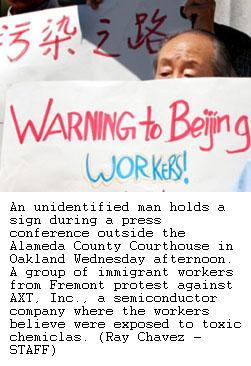
Immigrant Workers Demand Health Screening From Company That Poisoned Them

Last year I wrote about an article in the East Bay Express about the horrendous working conditions of immigrant workers in a facility operated by AXT, Inc, a Fremont, CA, semiconductor company that exposed its employees to airborne arsenic at levels four times the legal limit in 2000. Although CalOSHA issued "Willful" citations and penalties of $313,000 against the company in 2000, the company was cited and fined three times, including another set of "Willful" citations issued in June 2003. Finally, the company closed up shop in Fremont and moved to China.

But the workers that AXT poisoned are still there, still getting sick and still trying to do something about it. They're calling on the company to pay for long-term health screenings and monitoring for gallium arsenic exposures that should never have occurred:
A group of immigrant workers called on the Alameda County District Attorney Wednesday to hold their former employer, Fremont-based semiconductor manufacturer AXT Inc., responsible for knowingly exposing them to toxic chemicals.

The workers, most of them Chinese immigrants who speak little or no English, say they were not informed about workplace hazards and face a growing fear about their health. They say AXT exposed 500 workers to unhealthy levels of gallium arsenic, a carcinogen and reproductive toxin, and want the company to pay for long-term health monitoring.

Tuesday more than two dozen former workers delivered a box of nearly 1,100 postcards calling for the district attorney to take action
Neither the District Attorney's office, nor AXT officials had any comments on the request:
In previous statements, AXT has said it remains "deeply concerned" about the health of current and former workers and that it keeps a "strong commitment to maintaining a safe and healthful work environment" for all employees.

But the employees tell a different story. Until 2003, workers at AXT's Fremont semiconductor substrate plant spent their days polishing and trimming arsenic-based wafers that would end up in voice and high-speed wireless devices, such as cell phones.

Employees described the work as gritty, with vaporized arsenic constantly in the air and arsenic-laced dust coating surfaces. Yet a survey of 209 former employees done this spring by APEN and other community health groups found 7 percent were told by management that the chemicals they were handling could cause cancer or birth defects.

Almost 90 percent said they received no training in how to minimize exposure.


Schwarzenegger's Secret Motives

Mick Arran thinks that there may be more to California's new heat regulation than Governor Schwarzenegger's sudden concern for the health of California's farmworkers:
But it seems I was giving Gov Schwartzenegger too much credit (a mistake I still unaccountably make with Republicans). It isn’t the health and welfare of migrant workers that concerns him, it’s the corporate health of California’s agribusiness industry. Working conditions are so bad now and pay scales so low that even the poorest of the poor are deciding it isn’t worth it.
Hmmm


New Orleans: As If The Water Wasn't Bad Enough...

The worlds biggest Supefund site?
The water that swept through New Orleans' streets in the wake of Hurricane Katrina carried more than continued misery for the storm's victims.

It also brought along a potentially toxic soup of pollution - sewage, chemicals and perhaps human bodies.

***

New Orleans lies between the Mississippi River, nearly a half-mile wide, and Lake Pontchartrain, which is about half the size of Rhode Island.

The lake has long been a dumping ground for local sewer plants and dairy producers, making it off-limits to swimmers until a cleanup effort began at the end of the 1990s.

New Orleans' sewer system is old and in poor condition, Pine said. During Katrina's onslaught, trees that were ripped out of the ground pulled loose underground pipes, local officials told WWL-TV in New Orleans. The uprooting caused breaks in the sewer and natural gas lines, which then leaked.

The city's port is a major hub for the transportation of hazardous cargo, Pine said, so the waters could be contaminated by that, too.

Gasoline, diesel fuel and oil leaking from underground storage tanks at service stations may also become a problem, federal officials have said.

And then there are the storm's uncounted victims. As rescuers work to save survivors from their rooftops, "we're not even dealing with dead bodies," Mayor C. Ray Nagin said. "They're just pushing them on the side."


Hurricane Warning

Every time there's a hurricane, workers die, usually from electrocutions or falling tree branches. The recovery of the Gulf Coast could take months or years, which means that organic material will rot, creating hdyrogen sulfide, methane and oxygen depletion, and in enclosed areas, confined space hazards.

Just because we're dealing with a disaster doesn't mean that OSHA standards, safe working procedures and protective equipment should be overlooked.

OSHA has an alert and a number of fact sheets containing information on avoiding hazards and safely cleaning up after a hurricane.

Check it out if you're working on recovery or know anyone who is.


Tuesday, August 30, 2005


Public Employees: Live Like Slaves, Die Like Dogs (Part 5)

I spend a fair amount of time in this blog ranting about how this country treats public employees as second class citizens -- barely even human. In return for the hard, unpleasant and dangerous work they do, they aren't paid terribly much, don't have the collective bargaining rights in half the states that private sector employees enjoy, and are under constant attack for those benefits they've managed to win by organizing wherever they can.

Public employees, over a third of whom are organized, also provide an example of what America could look like (in terms of pensions, health care benefits and political power) if private sector employers had the same generally passive acceptance of unions that public employers display. In fact, their very organizing success has made public employees and their unions a bigger target for the right wing which fears the example that a well organized sector of the economy makes on the less organized private sector. Their campaigns have focused on reducing the political power of public employees (such as the current "Payroll Protection" campaign in California) and making private sector workers jealous of the benefits that public sector workers haven't yet lost.

But I digress.

What I'm really writing about here is a life and death issue for public employees: the fact that public sector workers in over half the states still are not covered by OSHA -- in other words, they have not legal right to a safe workplace. And it's not just conservative red states, public employees in what is arguably one of the most liberal states in the country -- Massachusetts -- do not have OSHA coverage, often with deadly results:
On the evening of Aug. 3, 2004, Roger LeBlanc was one of nine Massport workers dispatched to restore power to the Hilton Hotel at Logan International Airport. Before beginning repairs, the electricians made sure they de-energized the hotel's switch station. After checking the five cabinets on the right side of the switch station, they turned on the electricity, confident that the five cabinets on the left side were powered separately.

They were wrong. When LeBlanc, 39, touched the top of one of the cabinets on the left, thousands of volts shot through him, and he died hours later. His death has spurred labor unions and workplace safety advocates to unite behind legislation that would strengthen protections for the 150,000 city and state workers in Massachusetts.

City and state workers in Massachusetts are not covered by safety procedures mandated by the federal Occupational Safety and Health Administration, even though private employers have been bound by them since 1970. According to an investigation by the state's Division of Occupational Safety, LeBlanc's death would have been prevented if the Massachusetts Port Authority electricians had followed OSHA rules.
And this statement really pisses me off after 16 years running AFSCME's health and safety program where I almost never made any public statement without mentioning the fact that public employees were not covered by OSHA:

Representative Michael J. Rodrigues, who co-chairs the Legislature's Labor and Workforce Development Committee and has served on the panel for eight years, said he was amazed to learn during a hearing on the bill that OSHA did not apply to public employees.

''I certainly feel that all state employees should enjoy the same protections for health and safety as any private employee in the Commonwealth," the Westport Democrat said last week.

Well, I'm delighted that he's concerned and wants to do something about it, but come on! He never knew? This is something that everyone needs to know, especially state legislators.

Without thinking, most people still view public employees as office workers whose main worries focus on paper cuts, and possibly carpal tunnel syndrome. But, of course, they're wrong:
The dangers that police officers and firefighters face are well-known, but other public employees also contend with workplace hazards. Water and sewer workers have to crawl in confined spaces and breathe contaminated air; airport workers are at risk of hearing loss; and road and bridge crews are threatened by hazardous fumes and dangerous heights. Between 1991 and 2003, at least 94 public employees died on the job, according to statistics compiled by the Massachusetts Department of Public Health and the Coalition for Occupational Safety and Health.

Those figures are comparable to the fatality rate in the private sector. In 2000, a US Department of Labor analysis of workplace injury and death data found that "the public sector poses the same or even greater overall risk of workplace injury and illness as the private sector."
In fact, in its report released last week, the Bureau of Labor Statistics reports that nationwide, 526 government workers lost their lives on the job in 2004.

Although bills requiring public employee coverage nationwide are introduced into Congress every year, the last significant effort was made in the early 1990's when public employee coverage formed part of labor-sponsored OSHA Reform legislation. The interesting thing was that, although the bill never came close to passage, there was considerable support even among Republicans for correcting this clear injustice.

The public employer organizations -- the League of Cities, Conference of Mayors, National Association of Counties -- opposed OSHA coverage. The states and cities were already doing a fine job protecting their public servants employees, thank you very much, and we don't need no stinkin' laws and regulations.

And we're still seeing the same thing in Massachusetts:
Romney spokeswoman Julie Teer said the administration has concluded that applying OSHA rules to public workers is up to the Legislature, but that the administration has taken other steps to strengthen workplace protections, such as designating a safety representative for each agency. Teer said the administration ''is committed to ensuring a safe workplace for all state employees."

Robert J. Prezioso, who has served as commissioner of the Division of Occupational Safety since former governor William F. Weld's administration, praised Romney's efforts and said his agency provides some safety advice to state agencies, as well as cities and towns.

''As the state's worker health and safety agency, we go out and help agencies protect workers every day, even though we currently don't have a mandate to do so," Prezioso said. He declined to comment on the legislation, or whether his agency would be equipped to enforce it.

But a leading workplace safety expert casts doubt on the efficacy of the state's efforts. Chuck Levenstein, emeritus professor of work environment at the University of Massachusetts at Lowell and an adjunct professor of occupational health at Tufts University Medical School, testified on Beacon Hill last spring that, "there is no consistent set of policies across agencies that would provide adequate protection for state workers."

"Serious hazards to public employee could be prevented by extending OSHA coverage to them," Levenstein testified. "The cost of such fairness will be small compared with the great benefits derived from protecting the health and safety of the workers who serve the public."
So what's it going to take?
Unfortunately, it's not until enough momentum is generated around a death that there is action. It shouldn't have taken LeBlanc's death," said Marcy Goldstein-Gelb, who heads the Massachusetts Coalition for Occupational Safety and Health. "It's always called 'tragic' or 'shocking.' In most cases, it's not shocking at all. It's that basic procedures were not put in place."
No, it shouldn't take LeBlanc's death, nor the hundreds of other preventable deaths and thousands of preventable injuries. But they happen, every day, year after year and our state legislators and governors in 24 states still see no reason to do anything about it.

A couple of years ago, I outlined my idea for a public employee coverage campaign in a letter to former Senator Bob Graham (FL) Florida Senator Bob Graham after one of his famous "workdays" when he does the job of an "average" worker. That time, he spent the day in a public workplace. I suggested that on his next workday, he mount a campaign for public employee OSHA coverage and kick it off by

going down in a 12 foot deep trench that is not shored or sloped. Climb down into a manhole or other confined space that has not been monitored for hazardous chemicals or oxygen deficiency. Go work on a locked, understaffed, overcrowded mental health ward or maybe in a high security prison. Go drive around in some old city vehicles with defective brakes. Maybe you could bring a few Florida state legislators and Governor Bush with you.

Assuming you live through the experience and that you think that this nation's public employees don't deserve to work and die under such conditions, please consider spending whatever time you have left in the public eye fighting for OSHA protections for public employees. They do the jobs that this country demand to make life safe and enjoyable. Safe workplaces are the least they deserve.
We should be sending the same letter challenging every state legislator in every state that doesn't provide OSHA coverage to public employees.


Related Articles

Labels:


The Worst Job: OSHA Alliances and the Washington Post

There must be no Purgatory more stressful than writing a column called "The Regulators" during the Bush administration. Due to the low level of regulatory activity, one is forced to write about creatures like OSHA Alliances, where
The Bush administration has stressed cooperation over confrontation and has tried to help companies comply with rules rather than play "gotcha" after an infringement.
In fact, it's gotten so bad, that Washington Post columnist Cindy Skrzicki is forced to interview me (probably because it's my birthday):
Critics say the efforts replace rulemaking and divert resources from enforcement.

"There is no substance to alliances. They have taken the place of standards and making rules," Jordan Barab , former OSHA special assistant who runs a blog on OSHA-related health and safety issues.
Unfortunately, those 16 words are the only part of the entire article that's critical of OSHA's Alliances. So, allow me to expand a bit here:
  1. There's nothing wrong with OSHA helping out regulated industries with technical assistance or even websites. But it's clear from OSHA's action and rhetoric, that these Alliances and other voluntary activities have become the essence of what they want OSHA to be: an advisory, rather than a regulatory body. Voluntary activities have been part of OSHA since the early 1980's, but if you take a look at current OSHA press releases, they've now become most of what the agency chooses to boast about (as opposed to rising fatality rates).

  2. There's nothing wrong with cooperative activities, but it is clear that Alliances have taken the place of rulemaking: witness the number of ergonomics-related alliances, or the reactive chemicals alliance, created as a response to the US Chemical Safety Board's request to modify the Process Safety Management Standard.

  3. It's not just "critics" that say that OSHA's voluntary activities (not just alliances, but also partnerships and Voluntary Protection Program), it's the US. Government Accountability Office that says that the voluntary activities are extremely resource intensive and if they exapnad at the rate that OSHA has planned, cannot help but cut into the enforcement budget.

  4. OSHA's Alliances almost never include labor unions, even in highly unionized industries, guaranteeing that they will miss out on the best and most knowledgeable resource: their workers.

  5. Finally, as I asked the other day, is it really a good use of OSHA's resources to be making alliances with itself?

More later. Gotta run.

Related

OSHA Alliances: Meaningless Media or Bureaucratic Incest?, March 8, 2004

Labels:


Monday, August 29, 2005


Workplace Deaths Up in '04

5,703 workers died from work-related injuries last year according to the Bureau of Labor Statistics' 2004 National Census of Fatal Occupational Injuries (CFOI). This was an increase of 2% over 2003 and the rate also rose from 4.0 per 100,000 workers in 2002 and 2003 to 4.1 last year. This was the second year in a row that the number of workers killed on the job went up, but it was the first increase in the fatality rate since 1994. Fatalities among Hispanic workers also rose sharply after declining in 2002 and 2003.

The report was released last week and I almost missed it. Usually, I'm alerted by an OSHA press release and accompanying fanfare, but it seems OSHA only issues press releases about national workplace fatality statistics when fatalities go down, not up. Last year, for example, then Assistant Secretary of Labor John Henshaw boasted that
American workers remain safer than they were just a few years ago. The BLS data released today show that the fatal injury rate held steady at 4.0 per 100,000 workers - identical to 2002 and the lowest rate recorded since the fatality census began in 1992.

We are also encouraged by our continued progress in reducing fatalities among Hispanic workers. Fatalities among Hispanic workers dropped notably for the second straight year, after several years of increases. Fatalities among foreign-born Hispanics also dropped for the first time ever. There were fewer deaths from falls and harmful environments while deaths as a result of assaults and violent acts rose by 61.
This year, it's more like the Sounds of Silence...and for good reason.

Here are some of the key findings for 2004:
  • Fatal work injuries among Hispanic workers were up 11 percent in 2004 after declining the previous two years.
    The number of fatal work injuries involving Hispanic or Latino workers was sharply higher in 2004 after declining for the two previous years. The number of fatally injured Hispanic or Latino workers rose from 794 in 2003 to 883 in 2004, an increase of 11 percent. The rate of fatal work injuries among Hispanic or Latino workers rose from 4.5 per 100,000 workers in 2003 to 4.9 per 100,000 in 2004. Although homicides to Hispanic or Latino workers were down 27 percent from 2003, increases in the number of fatal work injuries resulting from falls (up 27 percent), transportation incidents (up 27 percent), and contact with objects or equipment (up 14 percent) led to the higher number of fatal work injuries among this population.
  • Workplace homicides were down sharply in 2004 to the lowest level ever recorded by the fatality census.
    The 551 workplace homicides in 2004 represented a 13 percent decline from 2003 and was the lowest annual total yet recorded by the fatality census. Overall, workplace homicides are down 49 percent from the high of 1,080 workplace homicides recorded in 1994
  • Fatal work injuries resulting from being struck by an object rose 12 percent in 2004, and overtook workplace homicide as the third most frequent type of fatal event.

  • Fatal falls increased by 17 percent to a new series high, led by increases in the number of fatal falls from ladders and from roofs.
    The increase in fatal falls was led by a 39 percent increase in the number of workers who were fatally injured after a fall from a roof (from 128 fatalities in 2003 to 178 in 2004) and a 17 percent increase in the number of fatal falls from ladders (from 114 fatalities in 2003 to 133 in 2004). The totals for falls from roofs and for falls from ladders represented new series highs for these events.About 88 percent of the fatal falls from roofs involved construction workers, compared with about 54 percent for fatal falls overall.
  • The number of fatal work injuries in the construction sector rose 8 percent in 2004, but because of employment increases in this sector, the fatality rate for construction was not significantly higher than the rate reported in 2003.
    Construction and extraction occupations accounted for the second highest number of fatal work injuries among major occupational groups in 2004 (1,129 fatalities, up from 1,038 in 2003). Fatal work injuries among construction trade workers rose from 788 in 2003 to 870 in 2004 and accounted for most of the increase for this occupational group. The 94 fatal work injuries involving roofers was a sharp increase from the 55 fatal work injuries recorded in 2003 and accounted for nearly half of the increase among construction trade workers.

    ***

    The construction industry sector recorded 1,224 fatal work injuries, the most of any industry sector, an increase of 8 percent over the number reported in 2003. The increase was led by a jump in fatalities among specialty trade contractors from 629 in 2003 to 752 in 2004.
  • Twenty-seven states reported higher numbers of fatalities in 2004 than in 2003.
    Of those States reporting 25 or more fatal work injuries in 2004, six States reported increases of at least 20 percent (Alaska, Connecticut, Florida, Louisiana, New Jersey, and New Mexico), while two States reported declines of 20 percent (Arkansas and Oregon).
In addition, electorcutions were up. Highway incidents were up slightly, although nonhighway incidents (e.ge. on farms or industrial premises dropped). But more workers died after being struct by vehicles or mobile equipment last year than in 2003.

Finally, just to put this in a bit of perspective:


Congressional Budget Office Says Asbestos Comp Fund May Not Cover Claims

The Congressional Budget Office released a report last week revealing that the $140 billion asbestos compensation fund (S. 852), currently awaiting a vote on the Senate floor, may not be adequately funded.

According to the CBO, the federal government would have to borrow around $8 billion to stay afloat during the first ten years of its existence.
The interest cost of this borrowing would add significantly to the long-term costs faced by the fund and contributes to the possibility that the fund might become insolvent. Under the provisions of section 405, the fund would have to stop accepting new claims (a process known as “sunset”) if its current and future resources become inadequate to fulfillall existing and anticipated obligations, including its debt obligations.
The CBO also says that it is impossible to know whether or not the $140 million will be sufficient over the next fifty years. Maybe yes, maybe no:
CBO expects that the value of valid claims likely to be submitted to the fund over the next 50 years could be between $120 billion and $150 billion, not including possible financing (debt-service) costs and administrative expenses. The maximum actual revenues collected under the bill would be around $140 billion, but could be significantly less. Consequently, the fund may have sufficient resources to pay all asbestos claims over the next 50 years, but depending on claim rates, borrowing, and other factors, its resources may be insufficient to pay all such claims.

A more precise forecast of the fund’s performance over the next five decades is not possible because there is little basis for predicting the volume of claims, the number that would be approved, or the pace of such approvals.
Epidemiological studies of the incidence of future asbestos-related disease and the claims approval experience of private trust funds set up by bankrupt firms can be used to indicate the range of experience of the federal asbestos trust fund might face, but those sources cannot reliably indicate the financial status of the fund over such a long time period.
Dow Jones news service says that both sides will find something to complain about:
Unions opposed to the bill will point to the near-term shortfalls to argue that the trust isn't adequately funded. On the other hand, business groups will note the uncertainty of the trust's long-term viability to argue that payments to victims should be less generous and criteria for making claims should be more strict. Specter and Leahy countered that "even in the range of uncertainty, ... our legislation - with $140 billion - is reasonable and realistically calculated to cover the claims."
That the verdict of the CBO is not completely clear is evident from the headlines over the past couple of days.

US Asbestos Fund could Fall Short - Budget Office , Planet Ark, NY

Analysis Says Asbestos Plan Might Work, Washington Post

US Budget Office Says Federal Asbestos Fund Could Be Insufficent ... Insurance Journal
Related Articles

Labels:


Sunday, August 28, 2005


This One Might Require A Bit Closer Look

There seems to be more here than a simple unavoidable accident.
NT man dies in industrial accident at Frontier Fibres
Eric O’Connor
Sunday, August 14, 2005

North Tonawanda, NY -- An accident at a North Tonawanda business Friday night has left an employee dead.

Lee Wilson, 42, 18 Ransom St., North Tonawanda, was found dead around 9 p.m. by co-workers at Frontier Fibres after he was caught in a cardboard compressor. The machine was shut off as soon as his body was discovered among boxes.

Frontier Fibres was closed for the weekend. An employee who answered the phone Saturday said a manager will be available for comment Monday.

There were four other employees working at the time of Wilson’s death, according to North Tonawanda police. An investigation is ongoing, but all indications point to the death being accidental, police said.

Frontier Fibers Inc. at 22 Mechanic St. is a locally owned and operated waste paper and non-ferrous metal recycling facility that’s been in operation for more than 45 years, according to its Web site.

It specializes in recycling shredded or bailed waste paper.

Gary Snyder, Wilson’s backdoor neighbor at 18 Ransom St., said Wilson would sometimes complain of dangerous equipment at the factory. Snyder and his wife moved into the house in December but already were close friends with Wilson.

But that's not all. The Tonawanda News also provides space for readers' comments. Most are condolences. But check this one out:

Debbie (8/15/2005)

To the Wilson family. Please dont allow this to go without investigation. Lee told Dan how dangerous this place was to work at. Where were the safety guides? Why didn't they supply the employees with a harness to tie off on so that something like this could never have happened. Where were the safety checks before this machine ran? Why when someone was up on the top of the machine was it not locked out? Doesn't anyone watch this machine when it is running? Perhaps the owners of this place better start giving some answers. We send our deepest sympathy to all of you. Lee he was not only our tenant but our FRIEND for many years.
Hmm


Weekly Toll

Another couple of weeks of senseless workplace deaths. It's funny, but after doing these for a while, you note patterns from time to time. This week, there seem to be quite a few (seven) double fatalities, also eight public employees -- JB

***
Accident kills worker in Colonial Heights

Richmond, VA -- A Colonial Heights city employee died yesterday at VCU Medical Center after being struck in the head by a metal hose coupling while trying to unstop a clogged drain.

Mills D. Boyette, 60, who had worked seven years as a utility technician for the city's utilities department, was one of four employees trying to unclog a drain at a public restroom in White Bank Park about 1:40 p.m. Friday, Fire Chief A.G. Moore said.

A high-pressure hose burst, and a coupling struck Boyette in the back of the head. Boyette was initially taken to Southside Regional Medical Center in Petersburg and was later transferred via helicopter to VCU Medical Center, Moore said.


Second KDOT Employee Killed Sparks Concerns

Monday’s fatal accident in Lyon County was the second KDOT worker killed along Kansas highways in the last two months.

Cars on Kansas highways often travel at speeds in excess of 70-miles-per-hour, even in construction zones, and if the driver is distracted, there's little margin for error.

24-year-old Shawn McDonald worked with this crew. In June, Shawn McDonald lost his life in when he was struck by a driver who'd lost control on Highway 75. Yesterday 46 year old Richard Cunningham of Emporia was killed when a KDOT dump truck and a semi-trailer hauling rock collided.


Construction worker dies after fall from house

A construction worker fell to his death on the morning of Aug. 18 while working in Vernondale Village, a new housing community being built on post by private developer Clark Pinnacle.

Antelmo Francisco Lira, 38, fell from a 2-foot-wide opening on the second floor and was found unconscious on the first floor.

Lira was an employee of a Clark Pinnacle sub-contractor. The Army’s Criminal Investigation Division and representatives from the Occupational and Health Safety Administration conducted separate investigations of Lira’s fall.


Employee killed in explosion at Michigan racetrack

BUTLER TOWNSHIP, Mich. (AP) -- A fuel building exploded and burned at a stock car race track in southern Michigan, killing one employee and injuring two others, the Branch County Sheriff's Department says.

The explosion happened about 5 p.m. Saturday at Butler Motor Speedway in Butler Township, near Coldwater and about 30 miles south of Battle Creek, the department said. It said about 1,000 people were temporarily evacuated from the area.

It said two people received minor injuries but Rudy Corsini, 49, of Michigan Center was critically injured. He was taken to Coldwater Hospital, then flown by helicopter to the burns unit at Bronson Methodist Hospital in Kalamazoo, where he died Sunday.


Courthouse worker falls, dies

TAMPA, FL - A 28-year-old man removing asbestos from the old Hillsborough County courthouse in downtown Tampa fell from the third floor Thursday morning, landing on his head and later dying at Tampa General Hospital.

Roberto Velazco Lopez, a worker for Cross Environmental Services, was working in the third-floor ceiling at 9:23 a.m. when he stepped on an area that did not support his weight, said Tampa Police spokesman Joe Durkin.

Lopez, of Tampa, fell through the ceiling to the floor 18 feet below.


Delivery driver dies of injuries after rollover

TECOPA, NV - A well liked Schwan's delivery truck driver died from injuries sustained outside of Tecopa on Tuesday when he lost control of his vehicle and it rolled several times, ejecting 24-year-old Anthony 'Tony' Schmitz, destroying the truck and scattering frozen food all over the roadway.

Schmitz had been through Tecopa Hot Springs and Shoshone and was heading toward Tecopa Heights on California Highway 127 at about 2:45 when he tried to make the left hand turn onto Tecopa Hot Springs Road at a high rate of speed. "We don't know exactly how fast he was going," said California Highway Patrol Officer Tim Huldermann, who responded to the scene, "but speed was definitely a factor."

Schmitz lost control of the vehicle when the heavy load shifted and the truck rolled at least twice, breaking into pieces.


Owner, 42, dies in robbery at doughnut shop

Houston, TX -- A 42-year-old Houston man was stabbed and beaten to death early Saturday during a robbery of the Baytown doughnut shop he owned, Baytown police reported.

At about 4:40 a.m., Bonrith In, owner of Dina's Donuts in the 3700 block of West Baker, complied with the robber's demands and gave him an unknown amount of money, police said.

When the robber demanded more, the pair struggled, and In was stabbed multiple times and suffered several blows to the head, police said. He died at the scene. The attacker remains at large.


Marathon County worker killed when dump truck hit by train

SPENCER, Wis. - A Marathon County worker was killed Tuesday when a freight train collided with the small dump truck he was backing across the railroad tracks, authorities said. Michael Mathwich, 55, of Marathon, who worked for the county Highway Department, was hauling a load of rocks at the time of the crash along Hoff Road south of Spencer, the sheriff's department said.


NT man dies in industrial accident at Frontier Fibres


North Tonawanda, NY -- An accident at a North Tonawanda business Friday night has left an employee dead.

Lee Wilson, 42, 18 Ransom St., North Tonawanda, was found dead around 9 p.m. by co-workers at Frontier Fibres after he was caught in a cardboard compressor. The machine was shut off as soon as his body was discovered among boxes.


Body of worker found day after trench cave-in

The body of a Blount County construction worker, buried Tuesday afternoon when a trench caved in on him in Clay, was found Wednesday morning.

Jacky Blackwood, 21, of the Nectar community had worked for a Leeds construction company about three weeks. He was in a ditch making connections to a sewer main about 3:30 p.m. Tuesday when the walls collapsed.

Center Point Battalion Fire Chief Robert VanHooser said the trench was on a hillside. The uphill side of the trench collapsed, which caused the other side to collapse.

He said there was nothing to indicate the walls of the trench had been shored up.

"Shoring is required on ditches deeper than 5 feet," said Robert Sanchez, area director of the Birmingham office of the Occupational Safety and Health Administration. The trench was 6 feet wide and at least 16 feet deep. Efforts to reach the owner of O'cet Inc. were unsuccessful Wednesday. (More here)


Mobile man dies in three-story fall

Mobile, AL- A 63-year-old man was killed Tuesday when he fell three stories while installing an air-conditioning unit at a hotel under construction near the Eastern Shore Centre. Lonnie Poole of Mobile was standing in a window or doorway, guiding a crane operator who was lifting the unit into a Holiday Inn Express near the Interstate 10 Malbis exit around 11 a.m. Tuesday, according to J. David Greene, a Mobile attorney who said his law firm was investigating the incident.


Teens Allegedly Kill Delivery Man For Money To Party

KANSAS CITY, Kan. -- Four teenagers are accused of killing a Chinese food delivery driver for money to party with. The suspects were in juvenile court Tuesday.

Kansas City, MO -- Benjamin McReynolds, Brandon McReynolds, Brandon Johnson and Cortez Ennis are charged with first-degree murder, conspiracy and aggravated battery. They range in age from 14 to 17. The youngest was allegedly found with bloody money in his pockets.

Zhihai Cui, 42, worked for the New Town China Buffet. He was found stabbed to death Friday night. He was new to the area and had no family in town.


Security Guard Fatally Shot at Nightclub Door

A nightclub security guard was killed late Friday after an altercation with a group of men who tried to enter the club without identification, the Sheriff's Department said.

Lloyd Gadlin, 39, of Los Angeles was working the door at Jeftys Nightclub in the 12800 block of Avalon Boulevard when the group approached just after 11 p.m., said Sheriff's Deputy Luis Castro.

An argument ensued and one of the men shot Gadlin in the upper torso, Castro said. He was pronounced dead at the scene.


Back hoe accident kills paving worker

A worker for a Butler County paving company was killed Monday when he was struck in the head by the bucket of a back hoe that was being loaded onto a trailer, a spokesman for the Allegheny County Coroner's Office said.

Douglas A. Wikert, 20, of Sarver, was pronounced dead at the scene after the accident, which occurred at 3:15 p.m. along Way Hollow Road in Edgeworth. Wikert was an employee of Brandt Paving, Inc., of Harmony.

Allegheny County homicide detectives are trying to determine how the accident occurred.


Michigan man dies in accident aboard tugboat

HURON, Ohio - A tugboat crewman was killed yesterday afternoon in an accident aboard his vessel on Lake Erie several miles off shore, the Erie County Sheriff's Office said.

Charles F. Grout II, 32, of Lansing was pronounced dead by rescue personnel when he was brought to a dock at the River's Edge Inn, a hotel and restaurant in Huron.

Mr. Grout apparently injured his head when he was struck by a broken cable while aboard his tugboat, the Kurt Leudtke, which was towing a barge, according to U.S. Coast Guard PO Matthew Schofield.

The barge had been in open water unloading mud, the petty officer said.


Explosive crash kills driver, officer injured

SANTA FE, NM -- A tanker truck hauling thousands of gallons of fuel overturned and exploded on Interstate 25 just south of Santa Fe, killing the driver and forcing the closure of the northbound lanes for hours, authorities said.

Witnesses told police flames from Wednesday's early morning crash rose 100 to 150 feet into the air, according to Peter Olson, a spokesman for the state Department of Public Safety.

Roger Harris, 46, of Albuquerque died in the accident.

Harris had picked up a load of fuel in Albuquerque about 3 a.m. Wednesday and was headed to Espanola, said Jim Polk of Polk Oil Co. Harris was hauling 7,500 gallons of gasoline and 1,000 gallons of diesel fuel.


Farmer killed in tractor accident

DOWAGIAC, MI - A 58-year-old man was killed early Wednesday in a farming accident in Cass County. The accident happened at around 3:30 a.m. on School St. in Silver Creek Twp. west of Dowagiac. According to the Cass County Sheriff's Department, 58-year-old Joseph Egger was killed when his tractor overturned and pinned him underneath. It appears the tractor struck an object and then rolled over. The accident remains under investigation.


Hub taxi driver killed in crash that closes Mass. Ave. bridge

Boston, MA -- The Massachusetts Avenue bridge into Cambridge was closed last night after a four-car wreck that killed a Boston taxi driver, police and fire officials said.

Just how the crash happened is still under investigation, but police said a cab driver was stopped on the bridge with car trouble and was outside of his taxi when he was struck about 9:30 p.m.

A green Mazda sedan rolled over, injuring a person inside, a late-model Oldsmobile screeched to a halt behind it and a second taxi driver was injured when his Metrocab company car was hit. But the Top Cab taxi driven by the only person killed appeared untouched. The cabbie's pants and shoes lay in the road, covered in powdered quick-dry that firefighters use to clean up liquid spills. (More here.)


Cotton workers killed in collision

Two men were killed and two others injured about 9:30 a.m. Saturday near Chapman Ranch when a pickup plowed under a semi-tractor cotton module that didn't stop at the crossroads, police said.

The module flipped onto its passenger side and skidded about 55 feet from impact after the collision, and the roof of the 2001 Dodge Ram crushed three cotton harvest workers before peeling off, said Department of Public Safety Trooper Gilbert Villarreal.

The pickup driver, David Austin Gass, 19, and front-seat passenger, Cornelio Peters-Groening, 20, both of Odonnell, died at the scene, Villarreal said. A back-seat passenger, Joseph Michael Martinez, 22, of Paint Rock, was taken by HALO-Flight to Christus Spohn Hospital Memorial and is in critical condition with head trauma, according to reports


Worker Dies Stuck in Cobb County Manhole

POWDER SPRINGS, GA -- A 43-year-old construction worker has died after being overcome by gas fumes in a manhole in Cobb County. Police say the victim, who has not been identified, was working at a subdivision in Powder Springs yesterday when he climbed down the nine-foot-deep manhole. Investigators also say he may have fallen into the manhole accidentally.


DHL Delivery Driver Killed After Truck Flips

A delivery driver died Thursday night when his truck blew a tire and flipped onto its side. Troopers said Robert Baysinger wasn't wearing a seatbelt and was thrown from the DHL delivery truck then hit by a car.

The incident took place just after 6 p.m. on Southbound I-75 at the ramp to Cincinnati-Dayton Road.

A CareFlight medical helicopter rushed Baysinger to the hospital, but doctors couldn't save him.


Worker Falls Into Vat Of Molten Lead

WALLKILL, N.Y. A worker was killed when he fell into a vat of molten lead at an Orange County company. State Police say 24-year-old Jose Sartillo of Middletown worked at the Revere Smelting and Refining Corporation in Wallkill. Police say Sartillo was working near the smelting kettle when he fell in at about one a-m yesterday and was severely burned over his entire body. Orange County Coroner Tom Murray says death was probably instantaneous. He says the lead was nine thousand degrees Fahrenheit. The federal Occupational Safety and Health Administration is investigating how Sartillo fell into the vat.


Bluffs worker killed under train

A Council Bluffs man died Thursday, after the locomotive he was working on rolled backward.

The Council Bluffs Police Department was notified of an accident at 11:30 a.m. at Alter Trading Corp., 2603 Ninth Ave. When officers arrived on the scene, they learned that Lynn Knauss, 55, an employee of Alter's, was working underneath a locomotive when it began to roll backward.

Knauss became pinned between the undercarriage of the locomotive and an object described as a 250-pound rubber slab used between railroad tracks at intersections. Knauss was pronounced dead at the scene.


Essex County deputy killed by truck during traffic stop

MORIAH, N.Y.--n Essex County sheriff's deputy was killed early Wednesday when he was hit by a tractor-trailer while standing along the Adirondack Northway during a traffic stop.

Deputy Eric Loiselle, 31, had stopped a vehicle for speeding in the northbound lanes of Interstate 87 just before 1 a.m. when a truck driven by Jacek Bujalski of Quebec drove off the road and onto the shoulder, state police said.

Loiselle tried to avoid the truck by leaping over the hood of the vehicle he had pulled over, but was struck and killed, according to police. After hitting Loiselle, the truck slammed into the vehicle the deputy had stopped, slightly injuring its driver, Jonathan Roy of Quebec.


Ala. Gas Station Owner Killed During Theft

FORT PAYNE, Ala.-- A gas station owner was run over and killed when he tried to stop a driver from leaving without paying for $52 worth of gasoline, police said.

The driver had not been apprehended Sunday, and police Chief David Walker said the case was being investigated as a robbery-homicide.

Witnesses told police that Husain Caddi, owner of Fort Payne Texaco, "grabbed onto the vehicle" Friday when the driver began to drive off.

Caddi was dragged across the parking lot and onto a highway, where he fell to the pavement and was run over by the late model sport utility vehicle's rear wheel, Walker said.

"Other vehicles were leaving the station's lot and there was a great deal of traffic on the roadway near the station at the time," Walker said. Caddi, 54, later died at a hospital, Walker said.


Construction worker dies after fall from Kilgore shell building

Kilgore, TX- A construction worker was killed Tuesday when he fell from the roof of a shell building at Kilgore's Synergy Park. Sgt. Ron England with the Kilgore Police Department said the 28½-foot fatal fall was the second accident within a week at the 80,000-square-foot structure being built by the Kilgore Economic Development Corp. Martin Alfonso Torres, 53, an immigrant from Mexico who worked for H&H Coating of Kilgore was pronounced dead at Laird Memorial Hospital shortly after noon Tuesday.


Worker crushed to death, another injured at Port Everglades

Port Everglades, FL -- A heavy machine that loads propane tanks onto barges broke loose Thursday morning, crushing to death a man servicing it and injuring another. Timothy Murphy, 37, was showing his apprentice, Marshall Bowles, 30, how to change a seal on the machine for the Dynegy company about 10:30 a.m. at Berth 11, said Veda Coleman-Wright, spokeswoman for the Sheriff's Office. During the maintenance, a 15-foot lifting arm weighing about a ton came loose and crushed Bowles, said Capt. Dave Erdman, spokesman for Broward County Fire Rescue. Murphy, who was knocked aside and slightly injured, was treated and released from Broward General Medical Center.


New Jersey Firefighter Killed by Suspected Drunk Driver

Keansburg, NJ -- A Keansburg, New Jersey firefighter was struck and killed Wednesday by a suspected drunk driver while directing traffic at the scene of a hazardous materials incident, officials said.

Joseph F. Walsh, age 76, served the Keansburg Fire Department for 54 years, said Capt. Albert Scott.

The department had responded to a minor hazardous materials incident at Keansburg High School, where Walsh was acting as a fire police officer.

"He was standing at the entrance to the high school and he was getting the vehicles out of the parking lot," Scott said. "While he was directing the traffic on Port Monmouth Road, a suspected drunk driver hit him and continued to flee the scene."


Cow tramples man to death

CHRISTOVAL, Texas -- A 72-year-old Central Texas ranch foreman was trampled to death by a cow while he was feeding some cattle Wednesday morning, authorities said.

The cow inflicted severe injuries to Eugene Barber's chest, said Russell Smith, Tom Green County justice of the peace.

"It's not uncommon," Smith said of the incident. "Once in a while you have a cow that is cantankerous." The cow turned on Barber as he was feeding it, then it bowled him over, said ranch owner Mary Lee Butts. "She just mauled him," Butts, who witnessed the attack, said in a story in Thursday's San Angelo Standard-Times.


Two ambulance workers killed in train collision

FALKVILLE, Ala. — An ambulance collided with a train in north Alabama Thursday, killing two ambulance workers. State troopers said the vehicle from American Ambulance Service in Hartselle was responding to a non-life-threatening call when the collision occurred on U.S. 31 about 10:30 a.m. The impact flipped the ambulance into a ditch. A male ambulance worker died at the scene, and a female worker died later at a hospital, troopers said. Their names were not immediately released.


Arrest made in death of cab driver

CASPER, Wyo. -- Police have arrested a man in connection with the shooting death of a cab driver.

Keith Jordan Booth, 18, of Casper, is in custody on suspicion of committing aggravated robbery and homicide in the commission of a robbery. The latter charge is treated as a first-degree murder and is punishable in Wyoming by the death penalty in certain cases.

Police found Gregory Clarkson, 25, a new employee of R.C. Cab Co., dead behind the wheel of his cab shortly after 6:30 a.m. Thursday. He had been shot in the chest, according to police. The vehicle's engine was still running when investigators arrived at the crime scene.

Booth was arrested Friday. He is expected to make an initial court appearance on Monday.


Two roofers killed by lightning strike in Fort Myers

FORT MYERS, Fla. -- Lightning from a fast-moving thunderstorm struck and killed two roofers atop a town house as they were preparing to leave for the day, officials said.

Carlos B. Guillen, 28, and Gaspar Garcia, 20, were pronounced dead at the scene Thursday afternoon, officials said.

They were the second and third fatalities from lightning strikes in Lee County this year. A 39-year-old man died when he was struck by lightning on a Bonita Springs golf course in April.


ONE DRIVER DIES, ONE HURT IN CRASH

Schroeppel, PA -- A Hannibal man was critically injured early Tuesday when his sport utility vehicle crashed head-on into a tractor-trailer in Schroeppel, killing the driver, state police said.

Robert M. Collins, 49, of 1435 Gifford Road, was driving his 1998 Ford Explorer northwest on county Route 57 about 3:15 a.m. when he drifted into the oncoming lane, state police said. His vehicle slammed into the tractor-trailer, which overturned and caught fire.

The truck driver, Robert Bond, 58, of Brodheadsville, Pa., was pronounced dead at the scene, said Investigator Terry Bauer, of the Fulton state police station.

Bond, who worked for Cloverleaf Transportation, had just left the company's Route 46 terminal with a load of bottled beer destined for Jersey City, N.J. He had worked for Cloverleaf more than 20 years, a spokesman said.


Company says helicopter accident kills 2 in Gulf of Mexico

LAFAYETTE, La.-- A helicopter accident in the Gulf of Mexico killed two employees (Bill Dvorak and ?) of Air Logistics, a company that provides transportation to offshore oil and gas platforms, the company said Friday in a news release.

The accident happened Thursday but the company released few details, including the approximate location of the accident in the Gulf.


2 officers shot dead, Motorcyclist held after Southeast Heights manhunt

Albuquerque, NM- A motorcyclist with mental health problems may be at the center of one of the deadliest nights in the history of the Albuquerque Police Department. Detectives this morning were questioning the man, captured less than two hours after two police officers were shot and killed in a Southeast Heights neighborhood near Roosevelt Park, an Albuquerque Police Department spokesman said. An arrest warrant issued this morning identified the policemen as officers M. King and R. Smith. The warrant named John Hyde as the suspect.


N.M. Transportation Worker Found Dead in ABQ

Albuquerque, NM-Police are investigating the death of a New Mexico Department of Transportation employee who was found dead outside a state warehouse. Police said another employee arriving at work Thursday morning discovered the man's body. The man, whose name was not immediately released, suffered injuries to his torso, police said. "We are saddened and shocked by this senseless act of violence that took the life of one of our longtime employees," Transportation Secretary Rhonda Faught said in a statement issued Thursday. "Our prayers and thoughts are with the employee's family and friends during this difficult period."


Worker crushed at bridge site

Lansing, IL- Demolition workers will begin cutting through 40-ton iron bridge support beams Saturday in an effort to recover the remains of a construction worker killed Friday on Illinois Highway 394 in Lansing. Daniel Lopez, of Munster, Ind., was trapped when a section of ramp being built to connect the Bishop Ford Expressway to Interstate Highway 80/294 collapsed about 5 p.m., said Mike Claffey, spokesman for the Illinois Department of transportation. Construction workers had spent the week attaching five massive iron girders, each 9 feet high and weighing up to 40 tons, to two large concrete piers of the overpass, said Claffey.


MOWING MISHAP KILLS BOYNTON LANDSCAPER

Palm Beach, FL -- For years Maxo Pierre worked with his wife, Marie, to build a family-run grocery business even as he worked part time for others as a landscaper. And he saved his money so that he could buy his own landscaping business.

Only two months after Pierre fulfilled that ambition, his Boynton Beach family was tending to funeral arrangements on Sunday after he was killed on the job.

According to Boca Raton police, Pierre, 49, was cutting grass Saturday morning in a gated community called The Seasons when the riding mower he was driving overturned on the slope to a lake.

Pinned in the water under the machine, Pierre was unconscious when pulled from the water by paramedics and his son Max, who was working away from the lake and was unaware of the accident until the emergency crew arrived. Pierre was pronounced dead at Delray Medical Center.


2 killed, 2 hurt as dump truck strikes building

MIDDLESBORO, Ky. -- Two workers were killed and two were injured yesterday when a truck rolled into a building at a Bell County coal operation. Suzy Bohnert, spokeswoman for the U.S. Mine Safety and Health Administration, said the accident occurred at a coal-washing plant owned by the Bell County Coal Corp. about three miles west of Middlesboro. She said a parked dump truck suddenly rolled down a hill and demolished a building. Oliver Beve Gregory, 51, of Pineville, and Donald J. Slusher, 56, of Hinkle, were killed when the 1988 Mack truck slammed into the building, according to state police.


Man Dies In Detroit Trench Collapse-Victim's Father Hospitalized In Temporary Serious Condition

DETROIT, MI -- A 24-year-old man has died after being pulled from a trench that collapsed on him on Detroit's west side. Daniel Howard was buried up to his chest for about six hours after the 1 p.m. accident. Authorities said he had no vital signs for several hours afterward. His father, Ken Howard, was removed from the trench shortly after the accident. He's hospitalized Friday night in temporary serious condition.

The men reportedly were replacing a sewer line in a trench about 8 to 10 feet deep. A homeowner said her basement had flooded and she called the private contractors for repairs, WDIV reported.


Farmer dies after truck rolls in pond

Mobile, AL- A farm accident apparently contributed to the death of a Powell man Thursday. Waylon Hunter, 67 of Powell, died Thursday afternoon after apparently suffering a heart attack after the quarter-ton dump truck he had been operating rolled over into a pond. The accident happened around 10:30 a.m. at Hunter’s farm on county road 158, according to Powell Police Chief Charles Centers.


Heat May Have Played A Role In Death

ARDMORE, Okla. -- State and federal investigators don't know what caused the death of an employee at an Ardmore warehouse, but heat may be a factor.

The man, whose name and hometown weren't released, worked at the Dollar General Corp. distribution center but was an employee of a temporary agency contracted by Dollar General.

The 43-year-old was taken to Mercy Memorial Health Center, where he died Aug. 13.

The cause and manner of death are pending, and a possible connection to heat hasn't been ruled out, said Kevin Rowland, chief investigator for the state medical examiner. Toxicology tests are being done.


Worker dies in 10-story plunge at Phoenix Civic Plaza

PHOENIX, AZ - An ironworker at the Phoenix Civic Plaza construction site plunged more than 100 feet to his death Monday, prompting officials to halt work for the day. Authorities did not release the worker's name.(The worker's name was Peter Joseph Martinez of Florence) Details about the late morning accident were hard to come by Monday. Phoenix public information officials referred all media calls to Hunt-Russell-Alvarado, the company managing the $600 million city project. And Hunt officials declined to talk about the circumstances under which the worker fell - including whether he was wearing a safety harness - and said only that there was an incident that resulted in a "tragic loss of life." (More here.)


Roof collapse kills worker

JOLIVUE, VA — A roof collapse of a building under construction at the Victory Worship Center on Hammond Lane left a North Carolina man dead and two injured Monday night. The Augusta County Sheriff's office cannot release the name of the deceased until his family has been notified. Five men were at the site putting up trusses on a new sanctuary for the center when a set of between 35 and 40 trusses collapsed, striking three men. One man was hit in the head and killed, and the two others were injured, said Augusta County Fire Capt. Alivin Mace.


Motive sought in slayings of Wal-Mart workers

Glendale, AZ -- A northwest Valley man seething with anger turned a Wal-Mart Supercenter parking lot into a shooting gallery Tuesday, police said, leaving two store employees dead and investigators stumped for a motive.

"He just went crazy," said Chuck O'Leary, 26, of Peoria, whose wife, Kara, 28, witnessed part of the mayhem as she walked into the store shortly after 1 p.m. "She said the guy just went ballistic and starting firing off shots."

The suspect, identified by police as Ed Liu, 53, was tracked to a nearby retirement community and arrested a few hours later.

Dead at the scene of the fusillade were Anthony Spangler, 18, and Patrick Graham, 36. Both Glendale men were collecting grocery carts in the parking lot near 83rd Avenue and Union Hills Drive when, according to police, Liu drove into the parking lot and angrily pumped them full of bullets without any known motive. Witnesses said one of the men appeared to have tried to crawl under a car for protection before being shot.


West Contra Costa School District employee dies in shooting

RICHMOND, Calif. - Richmond police say a school district employee was shot and killed after he tried to stop a teenage boy from beating up his pregnant girlfriend. Investigators say Terence Martin died yesterday after the 17-year-old he was trying to stop from beating the girl, pulled out a handgun and shot him. The 40-year-old Martin was an employee of the West Contra Costa School District. Police say he died late yesterday afternoon at John Muir Medical Center in Walnut Creek.


Worker dies in fall down elevator shaft

MARYVILLE, Tenn. - Authorities in Maryville say a construction worker fell to his death down an elevator shaft. The man was part of a crew installing an elevator at Blount (BLUHNT') Memorial Hospital when he fell several floors, then a heavy pulley fell onto him. The worker was brought to the hospital's emergency room, then transferred to the University of Tennessee Medical Center, where he died. The victim's name wasn't immediately released after the accident yesterday.


Worker dies after fall from old Charleston bridge

CHARLESTON, S.C. - A worker helping to demolish an old bridge across the Cooper River died from injuries sustained in a fall when part of the structure collapsed, the Charleston County coroner's office said Wednesday. Chris Wareham, 28, of New Hampshire died Tuesday when he fell along with part of the Silas N. Pearman Bridge that is being dismantled, said chief deputy coroner Rae Wooten.


Truck driver killed in fiery three-vehicle wreck

DECATUR, Ala.--Authorities have not been able to identify a truck driver who was killed in a three-vehicle wreck that went ablaze on Alabama 20.

Morgan County authorities said the man, who was pronounced dead at 9:40 p.m. Monday, was severely burned and hope to identify him through medical or dental records.

The other two drivers survived.

According to witness reports, the unidentified driver was driving an eastbound red truck owned by U.S. Xpress Leasing Inc. of Oklahoma City, Okla., which veered into the oncoming lane and skidded, colliding with a westbound white truck.


Wellman Inc. worker dies after being electrocuted

Johnsonville, SC- A Coward resident died Tuesday morning after he was electrocuted at his job at Wellman Inc. in Johnsonville. Waymond Roger Haselden, 56, of Old Georgetown Road died just after midnight, Florence County Coroner M.G. "Bubba" Matthews said. EMS personnel responded to a call at Wellman about 10:10 p.m. Monday night and took Haselden to a local hospital, where they continued life-saving measures, Matthews said.


Woman crushed to death in worksite accident

Oceanside, NY- A Whitestone woman died after being crushed under the massive tires of a 15-ton construction machine outside the counseling center where she worked in Oceanside, Nassau police said Tuesday. Lauren Ludwig, 53, assistant director of the South Nassau Communities Hospital Counseling Center, was accidentally struck by the orange front-end loader about 11:30 a.m. Monday, police said.


Man killed setting up at State Fair

Aubrun, NY- A worker setting up for the New York State Fair was killed Tuesday when a ride he was helping set up fell and crushed him. State police in North Syracuse said Eric M. Frigin, 29, of Orlando, Fla., was assisting with setting up The Enterprise ride on the west end of the midway at about 3 p.m. when he crawled under the ride to place wooden blocks to stabilize it. The ride shifted and slipped off the stabilizing blocks, onto Frigin's chest. He was transported to Upstate Hospital, where he was pronounced dead. The State Police and the Occupational Safety and Health Administration are continuing their investigations. Frigin was an employee of the James E Strates Shows.


Worker Dies from Heat-Related Illness

Auburn, GA- Lee County Coroner Bill Harris says a heat-related illness is blamed in the death of a Georgia man who collapsed at a rock quarry near Auburn. 32-year-old Stephen Eric Horne of Gray, Georgia, told co-workers Wednesday morning that he wasn't feeling well after working all night. He was found unconscious a short time later.


Grain elevator worker dies in train accident

UNION CITY, Tenn. A grain company worker in Union City was killed when he fell from a rail car and was run over by its wheels. Forty-three-year-old Jose Luis Molina of Union City died in the accident Tuesday when he fell as the rail car was being moved with a front-end loader by fellow employees of Union City Grain Company. He was pronounced dead at the scene.

.

Labels: , ,


Thursday, August 25, 2005


Live Like Slaves -- Part III (Public Employees Threaten Democracy)

I know I shouldn't let the Wall St. Journal get to me. They just write these stupid articles to make me mad.

This article hearkens back to those thrilling days of yesteryear when men were men and public employees were public servants in the truest sense of the word. Today's contribution to turning-back-the-clock comes courtesy of Terry Moe of the Hoover Institution, who, writing in today's Wall St. Journal, portrays evil public employee unions as powerful, anti-democratic, opposed to the public interest, and just plain bad for America.

Public Employees are Too Powerful:
No other interest groups can match their potent combination of money, manpower, and geographic dispersion. Ask Arnold Schwarzenegger. He has proposed reforms (of public employee pensions, of teacher tenure) that California's public sector unions fiercely oppose. And they have responded with onslaughts of negative ads, combined with noisy demonstrations at his public appearances, that have caused his popularity to plummet from stratospheric highs to abysmal lows.
And this is a bad thing? Actually, I think he gives public employees much too much credit. Arnold has managed to alienate almost everyone in California. After all, brining his approval rating a down to 34% -- down 31 points from this time last year -- is even more than powerful public employee unions can pull off.

The troubling thing is that the only initiative on the Governator's special election this coming November that is winning is the "Paycheck Protection Deception" which would curb the ability of public employee unions to use members' dues for political campaigns. The initiative currently has the support of 58% of likely voters.

Public Employees are Enemies of the People:
On the surface, these unions may come across as a benign presence in our midst. After all, they represent teachers, nurses, and other government employees who perform services that are valuable, sometimes indispensable, to all of us. What's good for them would seem to be good for us -- right? The problem, however, is that this is not even close to being right. What's good for them is sometimes quite bad for us.
Say again? What's good for public employees is quite bad for "us?" Let's put aside for a minute the question of who "us" is. Good for public employees would be...decent pay, safe working conditions, good health care plans, secure pensions, treated with respect at work, consulted during reorganizations....

OK, I'm a bit biased, having worked for AFSCME, the largest public employee union for 16 years. I ran the health and safety program, which means I was quite knowledgable about what public employees actually do every day. And most of it ain't pretty (nor is it well paying, especially where there's no union): wading through raw sewage in sewers and wastewater treatment plants, taking care of our mentally ill in understaffed, underequipped overcrowded institutions, watching over our society's most dangerous individuals in understaffed, overcrowded prisons, dealing with angry social service clients in understaffed, underfunded agencies, dealing with abused children or inspecting housing in neighborhoods that the police won't even go into, taking care of this society's poorest, sickest populations in understaffed, overcrowded public hospitals, and I could (and often do) go on and on and on....

In return, they don't have collective bargaining rights in over half the states, and even in those states only by state law or executive order that can be rescinded at any moment. Public employees in over half the states don't even have a legal right to a safe workplace. A public employee in Ohio or Massachusetts gets killed in a 25 foot trench collapse and it's "Dig him out and get back to work." End of story. Unions aren't just important for public employees, they're often a matter of life and death.

So why is treating them like real people instead of second class citizens bad for "us?" Where does society not benefit from decent treatment of those who do the jobs that this great society needs to function?

Public Employee Unions Are Enemies of Democracy:
At the heart of this problem is a genuine dilemma of democratic government: As governments hire employees to perform public services, the employees inevitably have their own distinctive interests. They have interests in job security and material benefits, in higher levels of public spending and taxing, and in work rules that restrict the prerogatives of management. They also have interests in preventing governmental reforms that might threaten their jobs. To the extent public employees have political power, therefore, they will use it to promote their own job-related interests -- which are not the same as, and may easily conflict with, what is good for the public as a whole.
How dare they be interested in jobs security and material benefits! How selfish can you get? Why can't they just accept their lot in life and assume the position? Interested in "reforms" that might threaten their jobs? What do they think? They have some right to try to keep their jobs?

Their interests may conflict with "what is good for the public as a whole". I guess "good for the public as a whole" is making sure we have a underclass to perform all of those unpleasant jobs that we can't do without and would rather not pay too much for (especially if it means more of the "T-word.") And they whine so much when we allow them to have unions.

The fact is that any time state or local governments are reorganized, it alway works out better when the front line employees are involved -- in an organized fashion. Not that it's appreciated. The irony here is that the state where public employee unions worked best with management to reorganize government most effectively and (relatively) painlessly was Indiana, which then elected Mitch Daniels as governor, who immediately eliminated collective bargaining rights for public employees.

Teachers are bad for children:
Because of union power, it is no accident that removing low-performing teachers from the classroom is virtually impossible, even though this nation has been trying to improve the public schools for decades.
Yeah, take a look around our inner city schools and tell me that teachers are the problem.

Public Employee unions are a bunch of commies:
Nor is it an accident that police officers in San Francisco may retire in their 50s and receive retirement pay equal to 90% of their final salaries for the rest of their lives, when most workers have no employer-provided retirement benefits at all.
It would really be much better for "us" if we just shot them all when they're too old to work.

The solution? Castration:
There is no way to eliminate the conflict of interest between government employees and the public at large. So the solution must focus on weakening the power of public sector unions. A Catch-22 quickly emerges here, because the unions will use all their existing power to defeat any attempts to take it away. Yet for reformers there is no alternative but to try -- by pursuing legislation that prohibits collective bargaining by government workers, for example, and pressuring for "paycheck protection" laws that require unions to get their members' permission before spending dues money on politics.

Success will not come easily, if at all. But for those who believe that democracy should represent the public interest, the fight is a good and noble one. It needs to be fought.
Paging Jerry McEntee and Ed McElroy. Your rooms at the Guantanamo Hilton are ready for check-in.

Related Articles

Labels:


Wednesday, August 24, 2005


Will BP Execs Go To Jail?

The Houston Chronicle reports that the US Department of Justice is looking into whether to file criminal charges against BP Amoco in response to the March 23 explosion that killed 15 workers and injured more than 170.

The US Chemical Safety Board has found that that key alarms and a level transmitter failed to operate properly and to warn operators of unsafe and abnormal conditions within critical plant equipment. Highly flammable hydrocarbons had escaped from the tower into the blowdown drums where they overflowed and ignited, causing the explosion, but the indicators and alarms that should have warned the workers were not functioning properly.In addition, BP admitted that it knew the blowdown drums weren't safe and had bypassed numerous opportunities to replace them with safer flare systems.

BP was also aware of malfunctioning pumps, indicators and alarms that caused the problem.New findings announced last week included evidence that BP had known since at least two weeks before the March 23 incident that the alarms and transmitters weren’t functioning and that a critical pressure-control valve did not function in pre-startup equipment checks. The CSB also revealed in the preamble of the recommendation that BP had been having problems with the process for five years before the explosion.

Based on the report, Tom Sansonetti, former U.S. assistant attorney general for environment and natural resources, predicted that investigators for both the Occupational Safety and Health Administration and the Environmental Protection Agency would refer the case to the Department of Justice. He said the case would likely be handled by lawyers who work for the Environment and Natural Resources Division, or ENRD, which Sansonetti ran until he returned to private practice in April.

A referral does not mean that charges will necessarily be filed. Justice Department lawyers are likely to focus on how much BP officials knew about the problems with the unit before it exploded.

"Sounds to me like the folks back at my old Justice Department shop will be kept quite busy on this one," said Sansonetti, an attorney who also has served as solicitor of the Department of the Interior and is now a partner in the Holland & Hart law firm in Wyoming.

The Chronicle reports that it is unlikely that OSHA will be able to bring criminal prosecutions because the law limits the agency to criminal charges that result from willful violations that lead to the death of an employee. Although there may be evidence that BP’s violations were willful, all of the workers killed worked for contractors and not directly for BP.

It may be possible, on the other hand, to prosecute under the Clean Air Act (CAA), which has much stronger penalties. The CAA states that a person “negligently places another person in imminent danger of death or serious bodily injury” can be sentenced to one year in jail, and a person who who at the time knowingly places another person in imminent danger of death or serious bodily injury can serve up to 15 years in jail.

The Chronicle notes that the CAA could be used because “the March 23 explosion also resulted in the release to the air of more than 19,000 pounds of hexane, among other toxic substances, according to a report filed by BP to the Texas Department of Environmental Quality. Hexane is one of the pollutants regulated under the Clean Air Act.”

Last February, the Justice Department and EPA brought charges against WR Grace for attempting to hide the fact that asbestos was present in vermiculite products at the company’s Libby, Montana plant. In addition, OSHA, EPA and the Justice Department have been working together recently to look at the possibility of criminal charges in a number of other cases.

The Chronicle also notes that the Justice Department files charges against a Motiva refinery resulting from a 2001 explosion that killed a worker
In one high-profile case, the Justice Department announced in March a $10 million criminal fine against Motiva Enterprises, an oil refining and retail business owned by Shell Oil Co. and Saudi Refining, which is based in Houston. Eventually, Motiva officials pleaded guilty to negligently endangering workers and to knowingly discharging pollutants into the air and water in connection with a fatal explosion at a Delaware refinery in 2001.

In that case, investigations by various regulatory agencies as well as by a homicide detective from the Delaware State Police determined Motiva managers did not heed ample warnings about the tank, which exploded July 17, 2001.
OSHA’s report on the BP explosion and proposed penalties must be issued before September 23. The Chemical Safety Board, which is working on a comprehensive investigation of the incident, will probably not release a report for another year. The CSB, however, has no power to levy penalties, although it has recommended that BP Amoco set up an independent panel to investigate problems with the corporate safety culture and management safety systems behind the March 23 and other incidents at BP refineries in the U.S.


Related Stories

Labels: ,


At OSHA: Truth Stranger Than Fiction

Oy.

So last night I write a story about OSHA awarding "Star" status to W.R. Grace, one of the country's biggest corporate outlaws, a company that has knowingly sentenced thousands of workers, their families and their neighbors to painful illness and early death from asbestos exposure.

But the wierdness over at OSHA continues. In March 2004, I wrote a spoof on OSHA's drive to create an Alliance with every existing life-form on the planet. I thought this was one of my funnier lines: "Two weeks ago, OSHA announced the formation of 134 new Alliances when each of OSHA's ten regions formed alliances with every other region."

Apparently someone at OSHA didn't know I was joking:


8/24/2005

The Occupational Safety and Health Administration’s Columbus, Ohio office is the Department of Labor’s first Voluntary Protection Program site, OSHA announced Monday.

The VPP emphasizes combined effort from management, employees and union representatives to identify and eliminate unsafe working conditions and practices to reduce the number and severity of job-related injuries and illnesses.

OSHA’s Columbus-area office is a “shining example of excellence attained in safety and health in the workplace. OSHA’s mission echoes that of [this] VPP participant, which is to strive for continuous improvement in occupational safety and health,” said Jonathan L. Snare, deputy assistant Secretary of Labor for Occupational Safety and Health.

OSHA’s Columbus-area office is a “shining example of excellence attained in safety and health in the workplace????

WELL I SHOULD HOPE SO!!!

I mean, come on guys, you must have better thing to do than this. I mean while than 5,500 workers are dying in accidents every year in American workplaces and tens of thousands more die from occupational diseases, it would currently take federal OSHA 108 years to inspect each workplace under its jurisdiction just once.

And you all are out inspecting each other for VPP status???

Labels:


Smithfield Foods Under Investigation For Illegal Retaliation

Corporate outlaw Smithfield Foods is being investigated by the National Labor Relations Board (NLRB) for retaliating against two workers who stood up for safer working conditions. In June, Smithfield fired Angel Santos Muriel and indefinitely suspended Jesus Munoz Marquez after the two workers took part in a work action for improved safety on the job.
In March, workers, including Santos Muriel and Munoz Marquez, voiced concerns to management for their safety due to the working conditions and line speed. A majority of workers in the loins boning section of the production line refused to return to work until management either slowed the production line or hired more workers. The company initially responded to the workers' concerns, but conditions quickly began to deteriorate when Smithfield forced workers to work too close together wielding knives.

The United Food and Commercial Workers (UFCW) filed a charge with the NLRB on behalf of Santos Muriel and Munoz Marquez, alleging Smithfield engaged in unlawful action in retaliation against them for speaking out about safety conditions.
Smithfield is not a nice company:
Smithfield has a long history of exploiting workers and creating a climate of fear, intimidation, and abuse at its hog kill and processing plant in Tar Heel, N.C. In April, the NLRB found the company and its cleaning contractor, QSI, Inc. guilty of violating workers' rights by threatening arrest from federal immigration authorities, physical assault, and falsely arresting a worker. Human Rights Watch, an internationally renowned human rights organization, issued special reports in 2000 and 2004 citing Smithfield's record of worker abuse and utter lack of disregard for workers' rights and human rights.
As a reward for their model behavior, Smithfield executives received very generous bonuses in fiscal year 2005


Related Stories


Tuesday, August 23, 2005


Parallel Universe: OSHA Reconizes W.R. Grace For "Exemplary Occupational Safety and Health"

If you were to take the time to draw up a corporate Hall of Shame, high up on the list would be WR. Grace. Seven of Grace's current or former executives and department heads were indicted last February for attempting to hide the fact that asbestos was present in vermiculite products at the company’s Libby, Montana plant. Approximately 1,200 residents of Libby had been identified as suffering from some kind of asbestos-related abnormality. And that's not all. The asbestos laden vermiculite was processed at factories all across the country, exposing workers and contaminating communities like Hamilton, NJ and then they lied about cleaning it up.

Given Grace's history, I generally expect the word "Grace" to be associated in the media with words like "death," "fatal illness," "crime," "criminal," and "outlaw." So imagine my traumatic mental whiplash when I saw this headline: Grace Plant Awarded Star Certification By OSHA.

Read it and retch:
New Orleans -- The Grace Davison Lake Charles, Louisiana plant of W. R. Grace & Co. (NYSE:GRA) has earned membership in the prestigious "Star" Voluntary Protection Program (VPP) of the Occupational Safety and Health Administration (OSHA).

According to OSHA, the VPP recognizes and promotes effective workplace safety and health management. Membership in the VPP Star is OSHA's official recognition of exemplary occupational safety and health. VPP Star worksites must submit annual self-evaluations and undergo periodic onsite reevaluations every three to five years to remain in the program. The Lake Charles plant is one of approximately 1,143 VPP Star worksites out of more than 20 million worksites in the United States.
No, this did not come out of the Onion. They wouldn't be so ridiculous.

Back when I worked for OSHA, we had a vetting process. When the Secretary or Assistant Secretary of Labor was going to appear publicly with a company representative, or give them some kind of award, DOL worker-bees would quickly and thoroughly research the company to make sure there were no skeletons that would embarrass the government of United States of America (or any of its officials). I remember one time we were checking up on a company and someone found that they had a branch in South Korea where one of the company's employees had intentionally set himself on fire on the company steps. Being politically sensitive individuals, we decided that if working conditions were so bad that workers were killing themselves, it probably wasn't the kind of company that we wanted to recognize in any way.

So what the hell's going on over there? Have they at long last no sense of decency? Are they completely politically tone deaf? I mean, I know they won't rest until they've given VPP status or established a partnership or Alliance with every company in America, but you'd think they'd draw the line somewhere.

Yeah, I know, I'm still an innocent, a hopeless idealist. I still believe that despite everything, people are really good at heart. I want my virginity back.

Alas....

Labels:


APHA Letter To Homeland Security Protesting Fake OSHA Sting

Georges Benjamin, Executive Director of the American Public Health Association, has sent a letter to Secretary of Homeland Security Michael Chertoff expressing the APHA's "deepest concern" about the July 6, 2005 sting where Immigration and Customs enforcement (ICE) officials misrepresented themselves as Occupational Safety and Health Administration (OSHA) officials as part of a roundup of undocumented immigrant workrs at Seymour Johnson Air Force Base in North Carolina.
We believe this action was both inappropriate and counterproductive. It will significantly damage the credibility of OSHA and undermine citizen confidence in government. By making workers fearful of attending workplace safety programs it will set back our efforts to prevent injury and death on the job. This is a national goal, which we have worked tirelessly with employers, unions and government agencies, to ensure.
Benjamin also noted the broader public health impact of the ICE's action:
This action also has the serious potential to undermine your efforts to ensure the biosecurity of our nation, as well, by driving underground individuals who may be exposed to infectious diseases or prohibiting the occupational health personnel from providing critical preventive services that protect all Americans from new and deadly infectious diseases.

Sting operations of this type have the serious potential to damage national efforts to prevent workplace illness and injury, to improve access to health care services, and to protect the public health.
The letter called on the ICE to "take broad and prompt action to ensure this does not happen again" and to "adopt and publicize department policy prohibiting ICE from misrepresenting itself as OSHA or other public health and safety agencies in future operations."

Related Stories


Positive Reaction To Chem Board's BP Amoco Recommendation

The press in Texas and across the Atlantic are responding favorably last week's urgent recommendation from the U.S. Chemical Safety and Hazard Investigation Board that BP Amoco set up an independent panel to study the company’s safety culture and management safety systems.

The Houston Chronicle thought it was high time:
First came the horrific blast at BP's Texas City refinery that killed 15 and injured more than 170. That was in March. In July, fire broke out at another unit of the refinery. On Aug. 10, a high pressure valve sprang a leak, releasing 100 barrels of gas oil and 100 pounds of hydrogen sulfide. The latter two incidents caused no injuries, but nearby residents were advised to shelter in place. Hours after the leak at the Texas City facility, an explosion occurred at BP's petrochemical plant near Alvin.

That series of accidents, following others that have plagued BP plants for years, demands a thorough, independent examination of BP's safety features and operations, followed by decisive action to correct deficiencies. Last week, that is what a federal agency recommended.

***

BP CEO John Brown promptly accepted the investigation board's recommendation and promised to implement any changes the independent reviewers identified. The safety of BP's employees and that of the many nearby residents and schoolchildren depends on it.
The Austin American Statesman points out that it’s not just lives at stake, but refining capacity as well:
The United States can ill afford to lose any refining capacity these days, given the tightness of petroleum supplies and rising prices. But it is more dangerous in the long run to let refineries operate until they blow up, killing and injuring dozens of workers as well as losing the productive capacity of the refineries themselves.

The board was right to act, and it should be ready to take the same quick action if similar problems develop with other refiners.
Meanwhile the CSB’s action has stirred up some attention across the pond where British Petroleum is headquartered, Jason Nissé at the London Independent says that BP Chair Lord John Browne has not been putting its money where its mouth is. Eight years ago, Browne “became the first head of a major polluter to admit that his company was harming the environment, and committed BP to doing something about it.” Between the accidents at US refineries, the loss of an oil rig in the Gulf of Mexico, drilling in environmentally sensitive areas in Asia and plans for the Alaska Nationa Wildlife Refuge, and opposing tougher controls on pollutants in the recently passed US energy bill, BP’s environmental and safety consciousness leave something to be desired
People should be judged by what they do, not what they say. And by that measure, BP's reputation is unravelling.

The US Chemical Safety and Hazard Investigation Board accused it last week of "systemic lapses" in safety at its Texas City plant, where an explosion in March killed 15 people and injured 170. It called for a review of safety at all five of BP's US refineries.

Reports after the Texas City disaster appear to reveal a culture of poor controls - not only to do with safety but also in the environmental area that BP has staked out as its "unique selling point".
.And then there’s the London Sunday Herald:
IF you chose to drive an ageing car at breakneck speed on a critical journey, you would scarcely be surprised if you were involved in a nasty accident. There are parallels with the oil refining industry where ageing plants are working at 95% of capacity and struggling to keep pace with soaring demand. The refining industry has flirted with danger for too long, cutting costs and corners and failing to learn the lessons from accidents.

Last week, the US Chemical Safety & Hazard Investigation Bureau accused BP of “systemic” safety lapses following a series of incidents at its Texas City refinery, the most serious of which occurred in March, when an explosion killed 15 workers and injured a further 170. It was the most serious US industrial accident for 15 years and BP was ordered to form an independent panel to examine its safety culture. Also last week BP reported another accident in Texas City, the third since March. Across the US the picture is grim, with estimates of at least 20 refinery accidents and stoppages in the past month alone. They have not all involved loss of life, but they have reduced output at a time of runaway demand. Ageing infrastructure is a serious problem and the issue of fresh investment in refining capacity to maximise efficiency and address critical safety concerns must be tackled urgently.

There has not been a single new refinery built in the US since 1976 and none in Europe for a decade. That means too much creaky plant is struggling to operate at full throttle. There is worrying evidence of failure to invest in modern systems such as safety flares and failure to follow safety protocols. Blaming workers, as BP has done on more than one occasion where safety has been questioned, is an inadequate and reprehensible response from management.

Labels: ,


Sunday, August 21, 2005


If A Worker Dies of Asbestos Related Disease and No One Tells, Does Anyone Care?

This is for those of you who still think that someone other than workers gives a shit about workers health.

Since 1980, at least 29 Minnesota taconite mine workers have been diagnosed with mesothelioma, a fatal lung disease caused exclusively by exposure to asbestos. So did the mine's owner, LTV Steel Mining Company or Cleveland-Cliffs, which managed the LTV mine for 15 years before it closed, tell the Mine Safety and Health Administration when it discovered the disease? Of course not.
A loophole in a 1977 agency rule requires companies to report possible work-related illnesses only among active workers, said Carol Jones, MSHA's former Health Division chief. Because it takes 20 to 40 years after asbestos exposure for mesothelioma to strike, the deadly disease mainly strikes retirees, she said.

The taconite companies say their employees' health and safety is their foremost priority, yet none of the 29 mesothelioma cases was reported.
And if the regulation says they don't have to report, then why should they?

Of course, it turns out that the companies probably knew about the disease even before some of the workers retired:
Family members of two of the victims -- Tony Plevell and Jim Stanisich -- say companies knew of their illnesses before they retired.

Jill Plevell, an Arizona psychologist, said managers of the LTV Steel Mining Company's pit near Babbitt "absolutely knew" her father had mesothelioma because he was on disability for weeks before he retired on March 1, 1996. He died two months later.
And LTV wasn't the only evil-doer:
U.S. Steel Corp. did not notify MSHA of the December 2003 mesothelioma death of Jim Stanisich, a 47-year-old maintenance worker who was employed for more than 29 years at its Minntac plant, according to the records. Stanisich "was working in the mines when he was diagnosed" and "retired after he died," said his widow, Judy Stanisich, of Eveleth.

Citing privacy reasons, U.S. Steel spokesman John Armstrong said he could not comment.
Boy, I guess they're in trouble, right? Think again. Maximum penalty for failure to report an illness: $60.

Labels:


Where Computers Go When They Die (And who pays the consequences)

I spent part of last night packing up an old computer to send back to the manufacturer of my new computer. For only $25 they'll take the CPU and the old, scratched monitor off my hands and send them to the great computer graveyard in the sky.

Recycling my computer is agood thing, right?

But then, by coincidence, Rory over across the pond, sends me an article from the China Labor Bulletin about The Plight of China's E-Waste Workers about the men, women and children in China who spend their days pounding apart computer parts and separating out the valuable components without any sort of protection:
The health hazards faced by Li Xiu Lan and other workers in the E-waste trade are as numerous as the list of toxins found inside an average PC. Metal plates inside the chassis are often coated with hexavalent chromium. Circuit boards and their components usually contain a toxic mixture of beryllium, mercury and cadmium, with individual components held together with lead solder. Old-style cathode ray tube monitors contain barium, phosphorus, hexavalent chromium, and a substantial amount of lead in the radiation shielding of the glass and lead solder used on wires and connections.

It's because of the recognized dangers of handling these components that E-recycling is more costly in the first world, and this is why the bulk of electronic waste is shipped to the developing world. Though China has specific and detailed laws designed to protect workers in hazardous industry, enforcement is either lax or non-existent. E-waste workers in Guiyu use bare hands to disassemble hazardous electronic detritus, soaking circuit boards in tubs of acid and heating motherboards over open fires to recover trace metals. Safety equipment is rarely present, and images of workers melting plastic off an IBM motherboard using a coal brazier, and sorting cathode tubes and microchips into plastic buckets, present an ironic juxtaposition of low and high-tech.

The health consequences to workers involved in processing high tech waste are many and varied. The toxic effects of lead to the kidneys, nervous and reproductive system are well known. Exposure to mercury contributes to brain and kidney damage, as well as being linked to birth defects. Barium can cause brain swelling, muscle weakness and damage the heart, liver and spleen, and dioxin is a known carcinogen. And then there are other elements found in E-waste; phosphorus, branded by the U.S. Navy as 'extremely toxic', and beryllium, recently classified as a human carcinogen, are both found inside of computer hardware.

Long-term health studies of China's E-waste workers have yet to be conducted. However, according to a report from the Medical Sciences College of Shantou University, health checkups of Guiyu's E-waste workers revealed that 88 percent of them suffered from skin diseases or had developed neurological, respiratory or digestive ailments. Furthermore, Greenpeace China reports that the majority of workers they spoke to while doing environmental studies in Guiyu complained of illnesses ranging from respiratory ailments to skin disease.
Oy. Maybe I should just bury the damn thing in the back yard.


Saturday, August 20, 2005


Unions Outlived Usefulness? Write a letter!

Last weekend I responded here to an anti-union letter to the editor in the Hampton Roads (VA) Daily Press. I also sent roughly the same response to the paper as a letter to the editor. Lo and behold, the paper not only published my letter, but two even better letters as well.

There's a lesson here: Small papers will print your letters.

I write about ten letters to the Washington Post every year and I'm lucky if I get one published every two years. Hampton Roads is a relatively small city deep in a red state. One anti-union letter to the editor spawned three pro-union letters. I write frequently about the poor reporting (with occasional exceptions) about unions and worplace safety in this country. We need to be not just talking with reporters, but also monitoring and responding to letters to the editor and writing op-ed columns.

Come on, us bloggers can't do all the work.


Friday, August 19, 2005


After A Death: Better Vests For Officers Becomes a Priority

It's a general truth in the health and safety field that nothing much changes until you've got a body count -- and not even then, unless you're organized.

True to form, a week and a half after officer Wayne "Cotton" Morgan was shot and killed by the wife of an escaping prisoner, Kentucky governor Phil Bredeson announced yesterday
that he will work to make sure all Tennessee corrections officers are properly equipped.

"That is something that I am going to look at, to see how we can get the proper equipment into the hands of the people," Bredesen told reporters after delivering a speech to an education conference. "I took that away as a to-do from this whole experience."
Morgan wasn't wearing a vest when he was shot. According to his partner, officers had stopped wearing the vests because they were too bulky.

Morgan was Secretary-Treasurer of AFSCME Local 2173 and AFSCME is also getting involved:
The American Federation of State, County and Municipal Employees union, which represents correctional officers in Tennessee and around the country, plans during a convention tomorrow in Albuquerque, N.M., to call for federal correctional officer safety legislation in response to Morgan's death.

"When a department mandates a policy and a procedure for our officers to follow, we should have the equipment that is necessary to follow through with that policy," said Mike Marette, the union's assistant director for corrections.
One other issue this story raises: Personal protective equipment (PPE) -- respirators, gloves, ear plugs, etc -- , while often necessary, are considered to be the least effective means of protection. This is partly because PPE is not generally as effective as engineering controls or eliminating the hazard. But part of the problem with PPE is that workers often don't like to use it because its uncomfortable or presents other hazards, such as goggles that fog up, earplugs that make it hard to hear warnings, or bulky vests that make it hard to maneuver. This leads to employers complaining about careless, lazy, pigheaded workers who refuse to use their safety equipment, when actually it's often a rational choice that workers make given the problems with the equipment and the (often correct) feeling that there are better ways to control the hazard.

When PPE is necessary, as bulletproof vests generally are, the least they can do is find some that fits properly.


Wednesday, August 17, 2005


Chem Board Tells BP To Form Independent Safety Panel

As George Bush might ask: "Rarely is the question asked, is our refineries learning?"

Well, the US Chemical Safety and Hazard Investigation Board is asking. Today the CSB issued an urgent recommendation to BP Amoco to commission an independent panel that would review a range of safety management and culture issues stemming from the March 23 Texas City explosion that killed 15 and injured 170, as well as a number of other incidents at BP facilities in the United States. It's the first time in the CSB's history that the Board has issued an urgent recommendation.

CSB Chairman Carolyn Merritt
cited the Columbia Accident Investigation Board, which investigated in the 2003 Space Shuttle reentry disaster, as one of the models for the independent panel.

She said the CSB was requesting that BP develop an implementation plan for the recommendation within 30 days and complete all work within six to twelve months. The CSB will not serve on the panel but will track and evaluate progress in implementing the recommendation, with periodic reporting to the public.
The Board recommended that the panel appoint an independent chairperson and include a diverse membership, including employee representatives, as well as experts from aviation, space exploration, nuclear energy, and the undersea navy, as well as the process industries.

BP owns five refineries in the U.S., two of which, like Texas City, were acquired in the late 19990's when the company purchased Amoco and Atlantic Richfield Co. Since the March explosion, BP's Texas City plant suffered two other serious incidents which caused no injuries or deaths, but the CSB maintains that all three incidents, as well as a fatal incident that occurred before the March explosion raised questions about the adequacy of BP's safety systems.

BP has announced that it would accept the recommendation. BP Group chief executive John Browne stated that

Today’s recommendation from the CSB is a welcome development and we take it seriously.

"We will move speedily to appoint an independent panel and offer it every help to do its job. When it reports, we will act with equal speed to deal with its recommendations."

BP cautioned, however, that its acceptance of the recommendation "does not mean the company agrees with all of the information or conclusions contained in the preamble to the CSB recommendation.”

The preamble that Lord Browne is having problems with contained several findings by the CSB investigative team, some of which had been presented previously, including the finding announced by the CSB at the end of June that key alarms and a level transmitter failed to operate properly and to warn operators of unsafe and abnormal conditions within the raffinate tower and the blowdown drum. Highly flammable hydrocarbons had escaped from the tower into the blowdown drums where they overflowed and ignited, causing the explosion, but the indicators and alarms that should have warned the workers were not functioning properly.

In addition, BP admitted that it knew the blowdown drums weren't safe and had bypassed numerous opportunities to replace them with safer flare systems. Nevertheless, BP, blamed the explosion on "surprising and deeply disturbing" mistakes made by plant workers who did not follow proper procedures, instead of poor maintenance or malfunctioning pumps, indicators and alarms that caused the problem.

New findings announced today in the preamble of the CSB's recommendation included evidence that BP had known since at least two weeks before the March 23 incident that the alarms and transmitters weren’t functioning and that a critical pressure-control valve did not function in pre-startup equipment checks. The CSB also revealed in the preamble of the recommendation that BP had been having problems with the process for five years before the explosion.
The majority of 17 startups of the raffinate splitter tower from April 2000 to March 2005 exhibited abnormally high internal pressures and liquid levels – including several occasions where pressure-relief valves likely opened – but the abnormal startups were not investigated as near-misses and the adequacy of the tower’s design, instrumentation, and process controls were not re-evaluated.
Gary Beevers, Director of United Steelworkers Region 6 that represents the workers at the Texas City refinery, announced that the
"urgent" call leaves little doubt that BP’s firing of three union members in the aftermath of the March 24 explosion that killed 15 contract workers “was little more than a shameless ploy to cover up its corporate-wide failure to deal with safety issues that routinely put our members in harms way.”
What Are Safety Management Systems and Workplace Culture?

The CSB recommended that BP “assess and report on the effectiveness of BP North America’s corporate oversight of safety management systems at its refineries and its corporate safety culture.”

So what does this mean for BP, especially considering that the company has announced that they have already made quite a few “corrective actions ” at the Texas City plant? Since the March explosion, BP has replaced a number of managers (and fired several line workers, an action not mentioned in BP’s report), re-emphasized who’s responsible for what, announced that it would replace the blow-down drums with a safer flare system, and prohibited the occupancy of office trailers within 500 feet of blowdown drums or flares. (All 15 workers killed were contractors working in or near the trailers.)

Among the references cited in its recommendation, the CSB cites the 2003 Report of Columbia Accident Investigation Board. Chapter 7 of that report, “The Accident’s Organizational Causes” leads one to believe that BP may be missing the boat in addressing the root causes of the incident and appropriate responses. It warns that
Many accident investigations make the same mistake in defining causes. They identify the widget that broke or malfunctioned, then locate the person most closely connected with the technical failure: the engineer who miscalculated an analysis, the operator who missed signals or pulled the wrong switches, the supervisor who failed to listen, or the manager who made bad decisions. When causal chains are limited to technical flaws and individual failures, the ensuing responses aimed at preventing a similar event in the future are equally limited: they aim to fix the technical problem and replace or retrain the individual responsible. Such corrections lead to a misguided and potentially disastrous belief that the underlying problem has been solved.
Regarding BP's personnel changes and firings, Chapter 8, "History as Cause: Columbia and Challenger
Changing personnel is a typical response after an organization has some kind of harmful outcome. It has great symbolic value. A change in personnel points to individuals as the cause and removing them gives the false impression that the problems have been solved, leaving unresolved organizational system problems.
So what is “organizational culture?”

The Columbia report defines it as
the values, norms, beliefs, and practices that govern how an institution functions. At the most basic level, organizational culture defines the assumptions that employees make as they carry out their work. It is a powerful force that can persist through reorganizations and the reassignment of key personnel.
Experts in organization safety culture note, however, that "assumptions that employees make when they carry out their work" should not be confused with "behavioral safety," which assumes (as BP has suggested) that most accidents are caused by the improper behavior of employees. Organizational culture, on the other hand, explores why, for example, employees don't follow written procedures (outdated, poorly written, inaccurate?) and how management responds to employee complaints about unsafe conditions.

As an example taken from NASA, Vaughn notes that “NASA culture allowed flying with flaws when problems were defined as normal and routine” and that NASA was operating like a business, with “schedules, production pressures, deadlines, and cost efficiency goals elevated to the level of technical innovation and safety goals."
At the same time that NASA leaders were emphasizing the importance of safety, their personnel cutbacks sent other signals. Streamlining and downsizing, which scarcely go unnoticed by employees, convey a message that efficiency is an
important goal.
All of this makes particularly chilling reading considering the pressures and temptations that rising gas prices (and windfall profits) put on the refinery business. Acording to the Financial Times
With oil prices at record highs, refineries are running at full capacity, and many other oil companies have suffered accidents and disruptions at their plants. Analysts warn that it is tempting to skip routine maintenance on ageing facilities at the top of the cycle.

"It's not surprising that you run into more accidents, explosions, outages when things are running full-out," says John Thieroff from Standard & Poor's, the ratings agency.
BP may have a lot to learn from the investigation. A recent article in the Wall St. Journal, describing previous cost cutting at BP facilities, noted that

BP has denied any connection between cost-cutting and plant fatalities. It contends that overall safety at its American refineries has improved since it acquired them.

"I think the culture of safety, in terms of policies and procedures, was there," said Ross Pillari, president of BP Products North America. "But the implementation of these policies and procedures was clearly not there, because if it was, the accidents wouldn't have happened."

Why it's not possible to have a well-functioning safety culture when your policies and procedures aren’t being implemented is a puzzle that the new panel will hopefully clarify for BP management.

More BP Stories from Confined Space here.

Labels: ,


Rod Blagojevich: Workers' Best Governor?

When my daughter got her first job as a wage slave last summer, she was upset that she only got two 15 minute breaks in here 8-hour work-night. "Isn't there a law that says I get more?"

"Honey," I told her. "The law doesn't even give you that much." And the next half-hour was taken up with a little American history lesson about the "folks that brought you the weekend."

Well, thanks to Governor Rod Blagojevich, the state legislature, and UNITE-HERE, hotel attendants in Illinois have finally entered the 20th century with not one, but two paid 15-minute rest breaks per day. Last week, Blagoyevich signed the "Humane Treatment of Hotel Room Attendants Act."
Thousands of women who clean hotel rooms will benefit from a new law passed by the Illinois General Assembly this spring.

The law requires hotels to give two, paid 15-minute rest breaks per day. Room attendants - overwhelmingly female - have been struggling with increased workloads as hotels upgrade their bedding and amenities.

The signing ceremony [featured] room attendants representing their co-workers, who come from Chicago and all over the globe - Latin America, Eastern Europe, Asia and Africa - to provide for their families.
Blagoyevich is getting a name as workers' best friend. Less than two weeks ago he signed a series of bills aimed at addressing the nursing shortage partly by making nurses jobs safer, including bills protecting nurses from workplace violence and eliminating mandatory overtime.


Workers Comp Insider - Falls and human fall traps: Fatalities in the construction industry

Workers Comp Insider discusses one of the leading causes of injury and death, both on and off the job: Falls.

Part of the discussion focuses on falls that workers can't avoid, because they don't know the hazard is there. He cites an expert
that appeals to architects, engineers, and building contractors to be aware of and eliminate these hazards at the work site. Graphic examples of some of the hazards Ellis discusses are illustrated in a 2004 NIOSH alert that presents five case studies of worker fatalities from falls through skylights and roof and floor openings.


Smoke and Work

Susie Madrak at Suburban Guerrilla reminds the blogosphere that smoking is a workplace safety issue and that links a story about
The woman who won the first successful workers compensation claim for lung cancer caused by second-hand smoke is now losing her long battle with the dreaded disease.


Tuesday, August 16, 2005


New Mexico Petroleum Marketers Seek To Overturn Workplace Violence Standard

In January 2002, Elizabeth Garcia, age 26 and a mother of three was abducted from Allsup's store in Hobbs, NM, raped and murdered. Garcia had been working alone at night, her first night on the job. The store was not equipped with a security camera. From 1998 through April 2003, a study found there had been 16 murders, 24 rapes, 37 kidnappings and tens of thousands of other crimes reported at convenience stores in New Mexico.

Correctly determining that multiple rapes, murders and kidnappings on the job was a workplace safety hazard, the New Mexico state Environmental Improvement Board, which issues occupational safety and health standards, issued a regulation last February that requires convenience stores open between the hours of 11 p.m. and 5 a.m. either to have two workers on duty, or one clerk and a security guard, or to install bulletproof glass or other safety features to limit access to store employees. The regulation also requires safety cameras, panic alarms and adequate lighting, and making sure that clerks have a clear line of sight outside the stores. They also require either time-lock safes or some sort of money-drop and limit cash in the register to $50. Employees must receive crime prevention and safety training by the employer or a "knowledgable representative" in a language that is understood by the employee.

Now the New Mexico Petroleum Marketers Association has filed a suit to have the regulation overturned. The state is not backing down:
State Environment Secretary Ron Curry said Wednesday, "Our worker-safety regulations are well-grounded and well within the state's powers to promulgate."

"These safety regulations have been in place for seven months now, and the industry has reported that their stores have already made the necessary upgrades to comply," Curry said. "We are very disappointed that some in the industry are continuing to fight these important, life-saving guidelines."
According to the Bureau of National Affairs (no link), the Petroleum Marketers Association argues that
New Mexico's Occupational Health and Safety Act does not grant the board the authority to adopt regulations to protect convenience store workers and patrons from third-party criminal actions. The appeal contends that the regulations at issue are, therefore, invalid.

In adopting the act, the appeal states, the New Mexico Legislature sought to regulate hazardous materials and processes in the workplace, not to enact a crime-prevention measure.
This takes health and safety practice back about twenty years. I remember in the mid-1980's bringing up the bizarre idea of an OSHA bloodborne pathogens standard and being told that the OSHAct was only intended to deal with machines and chemicals and that kind of stuff. It wasn't until the mid 1990's that we convinced federal OSHA that because workplace violence injured and killed so many workers, and because there were recognized and feasible means to prevent much of the violence, it was an issue that OSHA had to address. In fact, in 1998, OSHA issued Guidelines for Late Night Retail Workers.

Admittedly, federal OSHA isn't knocking itself out enforcing against employers who put their employees into situations where they are vulnerable to violence, but claiming that workplace violence is not an issue that OSHA was intended to address is, well, so last-century.

Labels:


Shocking! OSHA Says Inspections Prevent Accidents

Reading speeches by OSHA officials is generally a deadly boring activity these days. Witness a speech at the National Maritime Safety Association by my old buddy, and current acting Deputy Assistant Secretary, Steve Witt.

Page after page after page of coma-inducing verbiage about the strategic management plan, variations and permutations of partnerships and alliances (and more alliances and patnerships), and other voluntary programs, outreach (oops, did we forget to mention we're trying to eliminate OSHA's worker training grant program?) He even talks about OSHA's standards program (although the text didn't state whether it was done with a straight face.)

But hidden deep in the speech, for those who were still conscious, was a little nugget abou OSHA's Site Specific Targeting Program (SST). Under the SST program, OSHA sends letters to 14,000 sites in high hazard industries that have been determined to have higher than average injury and illness numbers The letter warns them that "their rates are significantly higher than average and suggests strategies for reducing injuries and illnesses among their workers." Several thousand of these are then inspected over the year.

And guess what? Turns out that actual inspections work better than warning letters.
A study in 2004 of Site Specific Targeting shows that it is making a difference. That evaluation, sponsored by the Department, found that companies that received our letter, but were not inspected, reduced injuries and illnesses about 5 percent over the three years following the letter. But the sites that were actually inspected had injury and illness declines ranging from 12 to 13.8 percent over the three years following our inspection.
This may seem obvious to most of you reading this, but for an administration that insists that voluntary programs and compliance assistance -- training, fact sheets, webpages, conferences -- are superior to the heavy hand of government inspection and enforcement, this is interesting stuff.

Maybe OSHA should take a look at its budget pie and start transferring more money from voluntary programs into enforcement, and maybe the White House and Congress should think seriously about significantly increasing OSHA's pie if they're serious about workplace safety.

If they're serious....


Labor, Politics and Republicans, Oh My!

It seemed odd at first that eight months after the newly elected Governors of Missouri and Indiana took collective bargaining rights away from public employees, the Wall St. Journal is getting around to reporting it, along with other transgressions by Republican governors against their states' public employees.
Several Republican governors are trying to weaken organized labor in the one place it has remained strong: representing public employees.

First-term Missouri Gov. Matt Blunt rescinded collective-bargaining rights for state employees this year, undoing an executive order issued by a Democratic predecessor, and has eliminated a state board overseeing union elections for public employees. Indiana Gov. Mitch Daniels, a former Bush White House budget director, overturned an executive order that for 15 years provided collective-bargaining rights for that state's public employees. And Maryland's Robert Ehrlich, backed by the state Supreme Court, suspended a 2% pay increase unions had negotiated for state employees with his predecessor.

The three governors, following earlier moves by Kentucky's Republican governor, Ernie Fletcher, say that their actions are warranted in an environment where state budgets are just beginning to recover from severe stress, and that public employees' unions waste resources and block government restructuring efforts.
State, county and city employees do not have the right to bargain collectively under the National Labor Relations Act. Those rights have to be provided on a state by state basis. Only 25 states and the District of Columbia have passed comprehensive public-sector labor-relations laws which provide collective bargaining rights to public employees at state and local levels.

The reason for the sudden interest in the right of public employees soon came clear: the discussion was actually about the alleged rift between the "Change to Win" coalition (primarily SIEU), and the AFL-CIO (primarily AFSCME) over how much support labor should give to Republicans.

The media -- somewhat with assistance of the Change to Win (CtW)coalition -- loves to portray the rift as if one side only wants to organize (CTW) and the other (the AFL-CIO) only wants to play politics.

They also love to point out that SEIU and the Teamsters have given money to Republican politicians and talk of reducing labor's dependence on Democrats, increasing the rift between the two factions.
Last year, SEIU sparked controversy within organized labor by donating more than $500,000 to the Republican Governors Association, one of several ways that its strategy diverged from some other AFL-CIO unions. Organized labor -- particularly public-employee unions -- generally has been more generous to Democrats. Mr. McEntee excoriated the SEIU for funding an association that backs some antiunion governors, including Gov. Blunt. "You have no control over where the money goes," he says.
But generally the media focuses on the issue of labor support for Republicans as a "democracy" issue -- as if it's unfair for unions to strongly support Democrats because there are sizable numbers of members who are Republicans. (This is the alleged reason behind California's upcoming anti-union "Paycheck Protection Deception" initiative, or Proposition 75 which would require public empoyees to annually authorize the use of dues for political purposes.) Of course these articles ignore the fact, highlighted by the Wall St. Journal, that Republicans, with a few notable exceptions, tend to be anti- worker and anti-labor, and that unions would be betraying their members' interests --even Republican members -- by giving money to politicians that attacked their rights. And we're notnot just talking anti-union. We're talking anti-worker, as in opposed to workers -- especially public employees' -- right to bargain collectively, to have a role in their worklife, to have safe workplaces and to be respected as equal partners.
"Missouri taxpayers ought to determine how state employees are compensated, not some arbitrary arrangement between a government bureaucrat and a labor union," Mr. Blunt told the Associated Press shortly after his decision.

Public-employee union leaders are "just concerned with their own welfare," says Spence Jackson, spokesman for Gov. Blunt. "The governor believes that state employees have the best employer in the world -- the taxpayers of this state."

"That's bull," says Gerald McEntee, president of the American Federation of State, County and Municipal Employees. "We have reached out in almost every state to address [efficiency issues]. Who better knows the problems in the states besides public employees?"
AFSCME is often villified as a union too focused on politics because, after all, critics say, they get to elect their bosses. Of course, having worked for AFSCME for many years, the fact is that AFSCME often supports politicians who turn out to forget that support when they're finally elected, and AFSCME will support Governors and Mayors -- Republican or Democrat -- when they treat the unions with respect, and just as vigorously oppose Mayors and Governors -- Republican or Democrat -- when they don't.
Mr. McEntee rejects claims that AFSCME can't work with Republicans; it is the type of Republicans that matters. "We're going to support moderate Republicans, if we can find them," he says, citing relationships with "fair-minded" Republican former governors such as George Voinovich of Ohio, James R. Thompson of Illinois and Tom Ridge of Pennsylvania. Those governors presided over states that have been union strongholds. Almost half of the nation's 15.5 million union members live in six states: California, New York, Michigan, Illinois, Pennsylvania and Ohio.
After all, for all the media's talk of SEIU shunning politics in favor of organizing, the union was no piker in the last election, spending an estimated $65 million to get John Kerry elected. Nor are they avoiding electoral politics now.

The fact is that while there are always going to be questions about how to split the pie, all unions need to organize and be involved in politics at the same time. The real issue may be more of emphasis. Both sides admit that both politics and organizing are important. CtW argues that you can't be politically effective if you don't organize more members, whereas ASFCME and the AFL-CIO argue that until we straighten out the political situation, we'll never be able to organize enough members to make a difference.

And the fact is -- and there is little disagreement between either union group -- that Democrats are generally more pro-labor than Republicans. Of course, as usual, real life is more complicated than that. While it's undoubtedly better for labor to have Democrats in power than Republicans, to what extent do you punish Democrats for supporting anti-labor issues like CAFTA or repeal of the Ergonomics standard? Do you punish Democrats who vote wrong even though it may make it harder to win a Democratic majority? Do you reward Republicans that have supported you even if you're making it harder for Democrats to regain a majority? Do you contribute to entities like the Republican Governors Association because maybe it will earn you some good will after the election even if they use the money to support clearly anti-labor candidates?

These are not easy questions, and union continue to struggle with them, although there seems to be new resolve to punish Democrats who don't support labor on such issues as CAFTA. Nor are the issues so black and white between the AFL-CIO and Change to Win. Both have to play politics -- during elections and in Congress -- if they're going to represent their members well. There are far too many vital legislative issues -- on all levels of government -- that directly affect their members to ignore politics. So both the AFL and CtW are going to continue to wrestle with these issues discussed above -- at the same time they try to organize new members. The decisions will be interesting to watch -- between coalitions, between unions and within unions. One thing is true, however -- no union and no group of unions is swearing off politics or organizing. They've all got to do both to survive.


Monday, August 15, 2005


The War At Home

Readers of the New York Times yesterday may have seen this article about the shortage of effective body armor for our troops in Iraq:
For the second time since the Iraq war began, the Pentagon is struggling to replace body armor that is failing to protect American troops from the most lethal attacks by insurgents.

The ceramic plates in vests worn by most personnel cannot withstand certain munitions the insurgents use. But more than a year after military officials initiated an effort to replace the armor with thicker, more resistant plates, tens of thousands of soldiers are still without the stronger protection because of a string of delays in the Pentagon's procurement system.

The effort to replace the armor began in May 2004, just months after the Pentagon finished supplying troops with the original plates - a process also plagued by delays. The officials disclosed the new armor effort Wednesday after questioning by The New York Times, and acknowledged that it would take several more months or longer to complete.
Turns out its not just a problem over there. You may recall the corrections officer, Wayne "Cotton" Morgan, who was shot and killed last week by the wife of a prisoner who was helping him escape.

Morgan, who was also Secretary-Treasurer of AFSCME Local 2173, was not wearing a bullet-proof vest. The other officer with Morgan when he was killed, Larry Harris
said the vests were bulky and ill-fitting. Brushy Mountain supervisors put in an order to outfit the guards with personally-sized vests a month ago. The guards are still waiting to be measured, Harris said.

[Correction spokeswoman Amanda] Sluss said TDOC officials always work to make job conditions safer. She said security precautions have not changed in the wake of Morgan's shooting, noting that the department has strict policies in place now.

But, she said, officials review those policies every three years.


The Wrath Of Immigrant Farmworkers in California

Looking for something to depress you? Check out this must-read article by Marc Cooper in the LA Weekly about the plight of immigrant farmworkers in California. It discusses in depth the wretced conditions they live and work under, and the decline of the United Farm Workers over the past four decades. You need to read the whole thing. But here are some tastes.

Breaks:
“In my work, it is also very hard,” Felipa continues. “The foreman demands that each team of three people produce 72 tubs of grapes per day.” A tub holds 23 pounds of grapes, sorted, cleaned, bunched and packed in plastic ready for supermarket shelves. “Sometimes it goes up to 96 tubs,” Felipa says. “We don’t have time to take our breaks. If you turn in less than they ask for, they run you out after three days.”

I ask her if she knows that the law requires farm workers be given at least two 10-minute breaks a day, apart from a 30-minute lunch. Unmoving and silent, she merely smiles back at me — as if to say, “What kind of idiot are you?”
Decline of the UFW and Worker Protections:
Family ranchers and corporate growers have shirked legal and moral responsibilities by outsourcing more and more employment through unscrupulous middleman contractors who feast on the undocumented and the desperate by routinely shortchanging them, forcing them to work unpaid overtime, ignoring safety standards, bilking them for rides and rental of tools, and, more frequently than one can imagine, straight-out stiffing them on payday.

The confluence of labor-contracting schemes, hostile Sacramento administrations, historic strategic mistakes by the UFW, and the flood of ever more desperate undocumented workers have, meanwhile, eroded unionization to the minuscule level of less than 2 percent of the work force.

While the 30-year-old pro-worker provisions of the ALRA still look great on paper, field enforcement by the state has become less than lax. Whether through indifference or through sheer lack of resources — including an almost total absence of representatives who can speak the indigenous languages of many workers — the result is grim. “Nowadays, it takes about nine months for a worker to even get a state wage hearing,” laments Fresno-based CRLA lawyer Alegria de la Cruz, whose grandparents were key players in the UFW. “By then the contractor is usually out of business. It’s basically, ‘Fuck you, I’m not going to pay you.’” For that majority of workers who hold no legal immigration status, there are no hearings, no legal remedies whatsoever.
Pesticides:
[California Rural Legal Assistance lawyer Jeff] Ponting is currently leading a fight on behalf of locals who got doused in a massive pesticide drift. There’s been at least one major drift incident in each of the last four years in this area — most recently last May, when 27 people fell ill. The worst case was in October 2003, when a cloud of the fumigant chloropicrin — the same active ingredient that’s used in tear gas — floated off the Yaksitch Farms and enveloped scores, including 165 who are now suing. "People were vomiting, throwing up on the streets, kids were crying and screaming," Ponting says. "It was chaos. And this happens every year. But medical people don’t know how to deal with it. They don’t speak the language of the workers. The clinics don’t know how to recognize the symptoms. They give the workers aspirins and send them back to work."
And much, much more. Read the rest.


Avian Flu: One If By Land, Two If By....Oh, nevermind

Still hanging out at one of my favorite blogs, Effect Measure, where my friend Revere spends quite a bit of his time and energy riding through the streets of America warning people that the Avian Flu is coming and, to put it mildly, we're not ready.

Unfortunately, those who have the power aren't doing what they should to protect and defend the people of the United States, especially when it comes to finally realizing that we can't rely on the private sector to make sure we have adequate supplies of an effective vaccine.

Now he's getting pissed off.

We need a better Administration. One that would recognize that if the market doesn't work (and everyone agrees in this case it hasn't) we would have taken the necessary steps to do the research, development and manufacture of an influenza vaccine (an ongoing need) with public funds and for an overriding public purpose: the safety and security of our citizenry. The President doesn't mind spending incredibly large amounts of our money for what he thinks is necessary in that regard. Let him do it with a far smaller sum for what everyone else recognizes is necessary.


(Not So) Intelligent Design

Following the "debate" between evolution and "Intelligent Design"?

Cervantes (normally of Staying Alive), who is subbing over at Effect Measure for a while, has the best and funniest perspective on "Intelligent Design (ID) that has ever been written.

He starts off being somewhat reassured that ID means H/She is watching out for us poor humans.

But....
Then there's the whole question of the human body. It has a lot of great features, but a few of them just seem -- sorry to have to say this, but it's true -- not very intelligent. To begin with, there's that stupid appendix, that doesn't seem to do anything except get infected. Then there's the birth canal. It's not a problem for me personally but it is for at leat half of my friends. It's too small for the baby's head, causes no end of trouble. I could go on and on with that. The lower back. I don't expect perfection, everything has to wear out and break down eventually, but there are some pretty obvious improvements you could make there.
Go read the whole thing.


Sunday, August 14, 2005


Court Strikes Down Administration's Anti-Labor Plan

I was going to write this great story about how the courts have struck down personnel rules adopted by the Department of Homeland Security -- rules that Democrats had objected to, objections that the Republicans used in the 2002 elections to produce scandalous Karl Rove-inspired advertisements that led to the defeat Georgia Senator -- and disabled Viet Nam veteran -- Max Cleeland, advertisements that pre-saged the scandalous Karl Rove-inspired Swift Boat ads against John Kerry.

But Jonathan Tasini beat me to it.

So go read him instead.

.


Weekly Toll

Before starting this week's toll, I want to take a moment to mention that September 9 will mark the first anniversary of the death of Scott Heilert in a workplace incident. Scott's wife, Kelly, has put countless hours over the past few months into helping out with the grim work of the Weekly Toll. I hope you'll all join me in offering our prayers and best wishes to Kelly and their children, Dylon and Bailey. (More on Scott here and here.)

-- Jordan


****


Worker killed at construction site

Las Vegas, NV -- A 45-year-old construction worker was killed Wednesday when he was struck by an earth moving vehicle at a North Las Vegas construction site.

The worker, who was tentatively identified by other construction workers as Greg Andreoli, was killed about 11:30 a.m. at a construction site at McCarran Street and Rome Boulevard.

He was killed when the earth mover struck him, said Sean Walker, spokesman for North Las Vegas Police. Andreoli reportedly worked for Pipes Paving, a North Las Vegas-based heavy construction company.


Officer killed, assailant dead

A Pine Lake police officer was shot and killed Thursday after he stopped a car on Rockbridge Road.

Witnesses said officer Francis Ortega struggled with a man before he was shot in the head at point-blank range. DeKalb County Police spokesman Cory Hughes confirmed that Ortega had died.

The apparent gunman ran into a nearby post office. When DeKalb police SWAT team members later entered the post office, they found the man dead from a gunshot wound.


Worker Crushed To Death By Cargo Container

TACOMA, WA - An empty 4-ton shipping container fell from a ship Saturday afternoon, killing a port worker, authorities said.

Kim Miles, a 40-year-old Sumner woman, was walking along a dock Saturday afternoon when a crane knocked the empty container from a ship it was unloading, police said.

"For some reason, this crane at one point picked up a larger amount of containers than usual," Tacoma police spokeswoman Tracy Conaway said. "That knocked this lone one off the ship."

Miles was walking to a break with several co-workers when the container began falling. They shouted a warning, but she was unable to get out of the way, Conaway said.

Police said Miles died on impact at about 2:30 p.m. Police ruled the death accidental, but state and federal workplace safety officials were expected to investigate.

Conaway said Miles was a member of Local 23 of the International Longshore and Warehouse Union.


Construction Worker Dies On UNC Campus

CHAPEL HILL, N.C. -- A man died Saturday on the campus of UNC-Chapel Hill while working on a construction project after a grader rolled over him.

Workers with Bailey Contracting said Charles Robertson, of Raleigh, was standing behind a motor grader when the grader backed up and rolled over him near the Cobb Residence Hall at about noon Saturday. The driver of the grader did not see Robertson, who died at the scene, investigators said.

A similar accident killed a soil inspector in the U.S. 1 and 64 work zone on August 3. Investigators said a grader somehow went into reverse and rolled on top of David Ryback, who died at the scene. The driver was not charged in the accident.


Driver Sought After Central Fla. Officer Killed In Crash

Police in New Smyrna, Fla., are searching Sunday for the driver of a pickup involved in a crash that killed an officer, according to Local 6 News. Florida Highway Patrol troopers said the driver of a white Ford 150 pickup swerved in front of New Smyrna officer Roy Nelson as he traveled on the South Causeway in New Smyrna Beach at about 11:45 p.m.


Worker electrocuted in Monument

An electrical worker in Monument died Friday morning at a job site. The man was working on an electrical box outside a home that is under construction on Buffalo Valley Path when he was electrocuted.

The unidentified man was 45 years old and an employee of First Rate Electrical for the last nine years. "As far as exactly what happened, we don't know," said Sgt. Steve Burk of the Monument Police Department. "At some point, somehow, he came in contact with an exposed wire."


Man dies after roof trusses collapse

GRAYLING, MI - State inspectors investigated a Grayling Township construction site where a 31-year-old Roscommon County man died after falling from the rafters.

Kristopher Ryan Vogt, 31, fell when a set of trusses collapsed Tuesday along West M-72 where the new DuBois Do-It-Best Lumber Company is being built.

Witnesses told police Vogt landed headfirst on a concrete surface. Crawford County sheriff Kirk Wakefield said one of the walls shifted and several men fell from the rafters. Only Vogt was seriously injured and unresponsive at the scene.

No safety harnesses, helmets or safety equipment were being used by workers in the construction area, according to the police report. Vogt was rushed to the local hospital and then airlifted to Munson Medical Center in Traverse City, where he later died. He worked for a number of years for Ripke Construction Co. of Houghton Lake, which was hired to build the new hardware store and lumberyard.


Police: Motorist Shoots, Kills Road Worker, Injures Another

PAISLEY, Fla. -- An angry 66-year-old motorist shot and killed one road worker and wounded another after getting into an argument with them Friday in Paisley, according to police.

Detectives say several men were working on a road-widening project in Paisley, Fla., when a vehicle pulled up to the construction site and the driver opened fire.

Detectives said several men were working on a road-widening project in Paisley on state Road 439 when a vehicle pulled up to the construction site Friday. The man inside the vehicle allegedly harassed the construction crew.

Witnesses said the driver, who police believe was Gary Monroe, allegedly pulled out a gun and shot at the workers when he was asked to leave the site. Foster Lee "Pete" Maloy, 71, died in the shooting. Jeremy Evans, 32, was flown to Orlando Regional Medical Center with a gunshot wound to the lung.


Man hurt on job dies unexpectedly

A Smithsburg man who was injured in a construction accident at a Rouzerville plant last week died unexpectedly Monday night when a blood clot traveled to his heart.

David P. "Weasel" Blickenstaff Sr., 58, of 11209 Crystal Falls Drive did not suffer life-threatening injuries when he fell from the roof of a modular home while working at Homes by Keystone, 13338 Midvale Road, at 1:40 p.m. Monday, Aug. 1.

He shattered both his wrists and suffered fractures to his nose, the bones underneath both eyes and other parts of his head, according to his family. His daughter, Bobbi-Jo Stine of Hagerstown, said Thursday he had tripped over plastic on the roof and fell face first off the modular home. Blickenstaff developed the blood clot after surgery to repair his wrist.


Crop-dusting helicopter crashes

LANCASTER -- A crop-dusting pilot was killed when his helicopter crashed into an onion field in east Lancaster.

The pilot died at the scene of the crash, which occurred just after 6 a.m. near Avenue I and 55th Street East. The Bell OH-58 came to rest on its side in a field just off a dirt road, behind a cluster of farm buildings.

"The pilot was doing some agricultural spraying when he crashed," FAA spokesman Donn Walker said.

Los Angeles County firefighters said the helicopter was carrying pesticide but that the crash caused no health hazard.

Killed was pilot Rick Manning, 49, of Bakersfield. The helicopter was owned by Delano-based San Joaquin Helicopters. Helicopter company employees at the scene said they were told not to talk about the crash.


Road worker crushed by steamroller

Deltona, FL -- A 41-year-old construction worker was crushed to death by a steamroller Thursday just after 6 p.m. as he worked on a project near State Road 44 outside DeLand, authorities said.

Ronald Lee Fox of Deltona was shoveling material from a bulldozer bucket onto the road's surface near S.R. 44 and Prevatt Avenue, Volusia County sheriff's officials said.

A steamroller was following Fox, but apparently the victim did not notice how close the equipment was. According to witnesses, Fox's feet got caught by the steamroller and he was trapped as it kept moving forward and crushed him against the bulldozer bucket, Sheriff's spokesman Brandon Haught said.

Haught said when the brakes are applied to a steamroller, the apparatus does not stop instantly, but comes to a halt a few seconds later.

"After it stops, it then rolls backward," Haught said.


Fourth farmworker dies


SACRAMENTO, CA – In the wake of a fourth farmworker death, the state has launched emergency regulations to protect outdoor workers from California’s extreme heat.

Constantino Cruz Hernandez was a 24-year-old farmworker who died July 31, 10 days after he collapsed while harvesting tomatoes in 100-degree weather in a field near Shafter.


Second Body Found in Collapsed Ky. Mine


CUMBERLAND, Ky -- Cadaver dogs helped locate the body of mine foreman Russell L. Cole, 39, of Partridge. He and Brandon Wilder, 23, were killed when a large section of mine roof collapsed without warning late Wednesday.

Wilder's body was recovered Thursday, but search teams were hindered by two more rock falls that injured two searchers during the search. Cole's body was recovered Sunday morning, according to a statement by the state Environmental and Public Protection Cabinet.

The two miners were part of a crew of about eight who were retreat mining - a process of removing coal pillars that support the roof. Workers spent much of Saturday bracing the mine shaft by installing roof supports.

Four Kentucky miners, including Cole and Wilder, have been killed during retreat mining in the past 13 months, and a state official said an engineering firm would be hired to study its dangers.


Motor grader runs over, kills inspector on U.S. 1


Cary, NC -- An engineering inspector died Wednesday after being run over by construction equipment at a highway work site in Cary. David Ryback, 35, of Hope Mills died shortly before 5 p.m. in a construction area near the northbound lane of U.S. 1 near Tryon Road, said Susan Moran, spokeswoman for the town of Cary.

A motor grader ran over him.

Ryback worked for S & ME Inc., a local engineering firm contracted by the state transportation department to monitor soil testing, according to Moran and Bob Shultes, the engineer overseeing the widening and improvement project under way on U.S. 1 and 64.


Officer killed in Tenn. court shooting

KINGSTON, Tenn. -- An inmate considered "extremely violent" escaped yesterday after his wife fatally shot a guard who was escorting the shackled prisoner outside a courthouse, authorities said.

The bloody escape set off an extensive search for George and Jennifer Hyatte. Helicopters circled over this eastern Tennessee town, and schools, open for registration, were locked down.

Wayne "Cotton" Morgan, 56, a corrections officer who was not wearing a protective vest, died at University of Tennessee Medical Center in Knoxville, about 30 miles east, said Lisa McNeal, a hospital spokeswoman. (Morgan was Secretary-Treasurer of AFSCME Local 2173)


Cargo plane pilot dies in pre-dawn crash

ENGLEWOOD, Colo. -- A twin-engine cargo plane that vanished from radar before dawn Thursday on approach to Centennial Airport crashed in rugged terrain, killing its pilot, rescue officials said.

Authorities believed only one person was on board, said Becky O'Guin, public information officer for the Parker Fire District. Authorities identified the pilot as Sam Hunter, of West Valley City, Utah.

The plane was registered to a Flight Line Inc., of Watkins. It had been flying from Salt Lake City to Centennial Airport, O'Guin said. The plane was carrying canceled checks, Lyon said.


Buried trucker dead after rescuers dig through hay in vain

OSHKOSH, WI, Rescuers dug for hours in vain to try to save a truck driver buried in hay after he crashed his semitrailer into a barn in Fond du Lac County on Tuesday. A back hoe was used to dig through thousands of pounds of hay after the accident on State Highway 26 near Rosendale around 1 p.m.

Three hours after the crash, rescuers reached the man (Daniel Smolen, 51, of Portage )but he was pronounced dead.


Explosion kills man at sinking boathouse;

PORT CLINTON, OH - A Walbridge man was killed and a Toledo man working with him was hurt yesterday when a plastic pipe they were filling with compressed air to raise a sunken corner of a boathouse at Yacht Port Beach near here exploded, authorities said. William J. Shank, 66, of 701 North Main St., Walbridge, was pronounced dead at the scene, said Detective Joe Vidal of the Ottawa County Sheriff's Office. Joe A. Silas, 64, of 24 West Oakland St., was flown to Medical University of Ohio Medical Center for a cut on his leg, Detective Vidal said.

The two men were among a group of people trying to raise a corner of the boathouse that had begun to sink. The boathouse has a steel frame and sides, but has flotation material under the docks that supports the entire structure. Some of that flotation material apparently had begun to fail, the detective said.

The men were using the pipes - 13 feet long and 12 inches in diameter - to augment the flotation material and raise the sinking corner. The pipes had caps on either end, and the men were filling the pipes with air via hoses attached to the caps from an air compressor, the detective said.

Investigators determined that the compressor the men were using had 80 pounds of pressure in its air tank, but believe the men may have been trying to put a higher amount of pressure into the pipes.


Truck brakes suspect in accident

Floyd County, KY -- Floyd County authorities are trying to determine whether deficient truck brakes contributed to a fatal truck-train accident Wednesday afternoon.

Ronnie Thompson, 59, a truck driver for D. Andres Enterprises, died of blunt-trauma injuries and burns after a Norfolk Southern train struck his dump truck, which then caught fire. The accident occurred near the intersection of Corydon Pike and Highwater Road.

A state inspector found that the truck's brakes were in such poor condition that it would have been ordered off the road.

Floyd County police Officer Rodney Clark said investigators are still looking into other aspects of the accident, including the fact that Thompson's commercial driver's license restricted him to driving trucks with automatic transmissions. The truck he was driving Wednesday had a manual transmission.


Worker Killed Falling of Garbage Truck

Ossining, NY -- John Rodriguez, 24 was killed after falling off the back of a garbage truck. Rodriguez was a laborer for the Village of Ossining DPW. They were picking up garbage on a residential street and then turned around to head back. Halfway down the street, the other 2 employees noted that he was not on the truck anymore (riding on the back on the platform). Looking back, coworkers saw him lying in the road and bleeding profusely. They immediately called DPW crew and called an ambulance. The police were first on the scene and tried first aid. He was not breathing at the scene and was taken by ambulance to Phelps hospital immediately into the OR where he was pronounced dead.


Maintenance Worker Dies of Bee Sting

Lyon Mountain, NY -- Andrew Rock, age 43 was stung by a bee outside of the facility's maintenance garage yesterday morning while on duty. The garage is located on Lyon Mountain. After being stung by the bee, Rock went to his office inside the garage and used an epi-pen that he had in his desk. He informed one of the correction officers of the incident and asked the CO to get a second epi-pen because the first injection had no effect.

Meanwhile 911 was notified and an ambulance arrived shortly after to take Andrew to Plattsburgh Hospital. CPR was performed on Rock while on route to the hospital. Andrew was pronounced dead at the hospital from cardiac arrest .


Worker dies after trench collapses

Cincinnati, OH -- A trench collapse at a construction site in suburban Cincinnati left a worker from Brooksville dead Sunday. The worker, identified by the Hamilton County coroner's office as Timothy Roark was working in the trench near the 3700 block of East Galbraith Road in Deer Park before 9 a.m. The trench was about 30 feet deep, which prevented the trench box, designed to prevent collapses, from being effective, said Kevin Rogers, master chief for the Deer Park/Silverton Fire Department. "They had a trench box, but the hole was deeper than the box," he said.


State transportation worker killed in Lyon County

NEOSHO RAPIDS, Kan. - A state highway worker was killed Monday when a tractor-trailer hauling rock slammed into a state vehicle in Lyon County, authorities said. The Kansas Highway Patrol identified the victim as Richard Cunningham, 46, of Emporia. He and a co-worker were standing by a Kansas Department of Transportation dump truck on Kansas 130 when a northbound tractor-trailer hit it from behind. The dump truck was pushed into a ditch, pinning both men underneath.


Jack slips, car kills garage worker

ARCHBALD, NY — A 26-year-old Jessup man died Monday after a Chevrolet Cavalier he was working on slipped off a floor jack and fell on his chest. Archbald Police Chief Tim Trently said Peter Howey, of 122 Kinback St., was working underneath the car at Boccadori’s Service Station, 552 Main St. in Eynon, when the car fell from a hydraulic floor jack. Mr. Howey, who was pronounced dead at the scene, was likely killed instantly, said Deputy Lackawanna County Coroner Tim Rowland. An autopsy will be conducted today.


Tree-cutter falls to death in Milltown

Milltown, DE - A 40-year-old tree-cutter fell to his death Monday while cutting down a tree in the rear yard of a Milltown home. Authorities are withholding the victim's name pending notification of his family. County paramedic spokeswoman Sgt. Kelli Starr-Leach said when paramedics arrived at the home, in the 2700 block of E. Riding Drive in the Highlands of Heritage Park, they found the man sprawled on the ground next to a large tree and several large branches. He was pronounced dead at the scene.


Man killed while setting up State Fair bumper car ride

Milwaukee, WI -A 50-year-old Texas man setting up a bumper car ride at the upcoming Wisconsin State Fair was killed Monday night when he fell from nearly 10 feet and hit the asphalt, said Kathleen O'Leary, the fair's director of marketing and communication. Dennis Mitchell, of Houston, had worked since November for Reed Expositions, one of two companies setting up the more than 60 rides at the fair, which opens Thursday. At 10:40 p.m., Mitchell and Ricky Bailey were constructing the roof framework of the Scooter, a bumper car ride, when the structure collapsed, O'Leary said. Both men fell, and Mitchell died at the scene as a result of a broken neck, a medical examiner's report found, said Tony Rossi, a safety inspector contracted by the ride companies.


Worker dies after foundry incident

DE PERE, WI — A worker died after being crushed between a crane and a roof beam at De Pere Foundry Inc. on Tuesday morning. Fire crews and police found the man, Harvey Ponozzo, 51, on an elevated crane when they arrived at the scene at 805 S. 6th St. and had to lower him to the ground. The man died after being transported to St. Vincent Hospital, according to De Pere police. The Occupational Safety and Health Administration was contacted and brought into the investigation. The man’s name was not available Tuesday evening.


Manhole where worker died was low in oxygen

Heath, TX --Luis Martinez had taken about three steps up out of a 19-foot deep, 3-foot-wide manhole in Heath on Thursday when he told a co-worker he couldn't make it. "He just fell back unconscious into the hole," said Heath Public Safety Director Bruce Ure. Chief Ure said another worker tried to go down after the 37-year-old Dallas man but became lightheaded.


Metro bus pulling into parking bay kills 1 worker, seriously injures 2 others

Houston, TX -- A Metropolitan Transit Authority employee was killed and two others were seriously injured overnight when they were crushed between two buses inside a southeast Houston bus barn, authorities said. Myesha Thomas, a 33-year-old mother of two, was killed about 11:30 p.m. Wednesday in a bus-washing bay at the Polk Street Transit Operations Facility, 5700 Polk St.


Tree worker's death under investigation

WINTER SPRINGS, FL -- Seminole County deputy sheriffs are investigating the death of a 25-year-old landscape worker pinned by a front-end loader while removing trees in the 1100 block of Oak Creek Court on Wednesday. The worker was identified as Jeffrey Atkins of Longwood, who worked for Orlando Scape and Sod. A co-worker got a neighbor's attention for help and called 911, Seminole sheriff's Lt. K.E. Starr said. The investigation will likely be turned over to the U.S. Occupational Safety and Health Administration, which investigates deaths and serious injuries at job sites.


Sewer worker dies at job

Dearborn, MI - A South Dearborn Regional Sewer District employee found dead Monday, Aug. 1, at the district’s Lawrenceburg wastewater treatment plant died of a heart attack, according to Lawrenceburg Police Detective Jeremy Shepherd. Robert “Bo” Kippler, a 13-year employee of the district, was found dead at 11:10 p.m. by a fellow employee, said SDRSD Superintendent Dennis Feichtner. Kippler, 38, Dillsboro, had taken on the 3 p.m. to 11 p.m. shift about two years ago because it meant a promotion, said Feichtner.


City worker dies after ship docks

Monterey,CA --The arrival of the Mexican navy's tall ship, the Cuauhtémoc, was marred Thursday morning by the death of a Monterey harbor worker. City representatives were preparing for the gangplank to be lowered when Jon Doubek, maintenance supervisor for the city's harbor division, collapsed on Municipal Wharf No. 2. Doctors from the ship rushed to Doubek's side to start resuscitation efforts. The medical staff was "amazingly fast," said Carl Anderson, director of public facilities for the city. "I just turned around... and the crew was there."


Police make arrest in fatal Laramie workplace shooting

LARAMIE, WY -- A Laramie man was arrested on a homicide charge after a construction worker was shot and killed at his job site. Aaron E. Smith, 31, was arrested at his home Thursday night, police said. He was being held in the Albany County Detention Center, pending his initial court appearance. Police said Henry McCone, 57, of Laramie, died from a gunshot wound to the head. Police Commander Dale Stalder said authorities received a call Thursday afternoon that a man had fallen off a ladder while working at an apartment complex. It wasn't until rescue workers arrived that they found McCone had been shot. McCone was taken to a hospital, but was pronounced dead.


DOT worker killed in Norwalk crash

NORWALK, Conn. -- A state Department of Transportation worker was killed Friday when he was struck by a limousine while placing cones to close a lane on Route 7, state police said. Robert Mugford Sr., 58, of Stratford, was killed in the crash shortly before 11 a.m. Mugford, a DOT worker for 12 years, was one of several state employees working in the left lane of the highway. The left northbound lane was closed to traffic. Mugford, who was on foot in front of an orange DOT truck, was placing additional orange cones on the road to extend the left lane closure pattern.


Pima deputy, 2 others die after hit by truck

TUCSON, Ariz. -- A Pima County sheriff's deputy, Timothy Graham, a man he was trying to arrest and a good Samaritan, taxi driver, Dawud Abusida, trying to help were all killed Wednesday night when the three were struck by an oncoming truck.

The deaths occurred just before 8 p.m., when the deputy was called to a Circle K in response to a 911 caller who reported a "crazed man" at the store, said sheriff's Capt. Rick Kastigar.

Kastigar said the deputy was struggling with the man and managed to place a handcuff on one of his wrists when the man broke free and ran away.

The deputy gave chase, finally catching the suspect in a median, but the two began struggling again. Kastigar said that's when a man driving by stopped and came to assist the deputy as he struggled with the man. All three somehow went into the street and were struck by a pickup truck driven by a man in his 60s, Kastigar said.


Police officer shot to death in Baton Rouge

BATON ROUGE, La. -- Three police officers were shot, one fatally, after going to a Baton Rouge home with a search warrant Wednesday afternoon.

The suspected gunman who opened fire on the officers as they entered the house was also hit and died after being taken to the hospital, police said. His name was not released.

Det. Terry Melancon, 31, died at the scene after being shot in the head. Dets. Dennis Smith, 41, and Neal Noel, 35, were taken to the hospital where they were being treated late Wednesday night, police said.

"We will not forget. We will focus. We will honor our hero and we will carry on," a visibly emotional Police Chief Jeff LeDuff said.


Electrical worker dies in fall from light pole

Auburn, AL -A 40-year-old electrical worker is dead after falling from a concrete utility light pole. Lee County Coroner Bill Harris said James Edward McCormick fell approximately 40-to-50 feet last night at Duck Samford Park in Auburn. The accident occurred about 10 p-m. The coroner said McCormick suffered multiple internal injuries and died about 30 minutes later at East Alabama Medical Center. Harris said a preliminary investigation determined that McCormick was not wearing a safety harness when the accident occurred. He was employed by Walker County-based Titan Electrical in Dora.


Man Crushed Beneath Construction Equipment

Durango, Co -- Government safety investigators were due in Durango, Colo., Monday to look into the circumstances the led to the death of construction worker.

The 24-year-old man, who has not been identified, was crushed under a five-ton road-maintenance vehicle that that flipped on top of him. The man was driving the pneumatic roller in a subdivision when the machine's left wheels went off the edge of a dirt road, causing it to roll over. The man who died was driving the roller, according to the sheriff's office.


Hastings worker dies on the job

HASTINGS-ON-HUDSON — A popular and well-known village employee was killed yesterday morning while working on a streetlight on the Warburton Avenue bridge. The first police officer to respond said it appeared that Charles B. Murray, 29, had been electrocuted, but the cause of death was still under investigation, pending the autopsy results, police Lt. David Bloomer said. Police responded to a call for a man in distress on the bridge at 9:42 a.m., Bloomer said, and tried to restore Murray's heartbeat with a defibrillator before taking him to the hospital.


Worker crushed to death at IP landfill

JAY, Maine (AP) — A fatal accident at the International Paper Co. landfill is being investigated by the U.S. Occupational Safety and Health Administration. William Haynes, 52, of Livermore Falls, was crushed to death Monday when the dump body of a truck came down on him while he was on the frame, greasing some fittings. Police Chief Larry White Sr. said Haynes was employed by E.L. Vining & Son of Farmington.


Worker killed in construction accident

Cape Coral, FL - A construction worker died Monday after pieces of concrete fell on him while he worked on a condominium project in Cape Coral. Felton Kinchen, 62, of Fort Myers, died at the scene, a release from the Cape Coral Police Department stated. Another crew member suffered minor injuries from the falling concrete, said Jeff Haston, chief of operations for the Cape Coral Fire Department. The other crew member's name and address were not available, Haston said. Both men were employed by subcontractor Cement Industries of Fort Myers.


Worker killed in equipment

LATHROP, CA -- A 24-year-old worker was killed when he reportedly got caught in a conveyor belt while unloading gravel for rail cars at the start of the morning shift on Monday. The unidentified man was working at Van-G Logistics on West Louise Avenue next to the Union Pacific Railroad tracks on Seventh Street. He was pronounced dead at the scene. Emergency crews from the Lathrop-Manteca Fire Department on J Street, just a few blocks away from the accident scene, found the man already dead when they arrived at the site shortly after 8 a.m.


Worker Dies at Fort Jackson

COLUMBIA, S.C. - A civilian worker (Frankie Scheffield) was killed at Fort Jackson Tuesday after a crane came into contact with some power lines. Base spokesman Jim Hinnant says a second worker was injured. Military officials have not released the workers' identities. They were employed with Bulldog Office Contractors. Hinnant says the workers were on the ground guiding a temporary building into position about 5:50 p.m. Tuesday when the crane apparently touched power lines. Military officials are investigating but Hinnant says foul play was not suspected.


Officer Dies During Training Exercise

WASHINGTON -- D.C. Police Chief Charles Ramsey said an officer who died during a training course may have been drinking too much water. Police said 25-year-old Officer James McBride got sick on Tuesday and died Wednesday. Too much water consumption can lead to an abnormally low concentration of salt in the blood, which can lead to swelling in the brain, police said. McBride was a two-year veteran of the force.


Dumbwaiter falls, kills repairman

Branson, MO-A 46-year-old maintenance worker was killed when a dumbwaiter he was repairing at a motel fell and struck him in the back of the head, Branson Police Chief Caroll McCullough said Wednesday. After emergency personnel were called to the Travel Lodge Motel on Falls Parkway about 3:30 p.m. Tuesday, Jeffery Paul Cleveland of Hollister was taken to Skaggs Community Health Center, where he was pronounced dead, McCullough said.


Big rig hits van on 165, kills five

STEVINSON, CA — Five construction workers died on their way to work Wednesday morning when a big rig collided with their van on Highway 165, the California Highway Patrol reported.

Omar Ramirez, 38, of Atwater; Jose Velasquez, 51, of Winton; and Aniceto Trujillo, 40, Gerardo Cervantes, 34, and Javier Ortiz, 32, all from Merced, were pronounced dead at the accident scene, said CHP officer Mike Panelli.

Ramirez, Velasquez and Cervantes were not wearing their seat belts; the other two men were.

The five men were part of a concrete-pouring crew for G & G Construction of Atwater.

They were riding together in a 1994 Dodge Ram van to a construction site in Los Banos when the collision occurred, said Gino Graziano, general partner at G & G Construction. The 6:30a.m. accident happened about four miles south of Highway 140.

"They were at the wrong place at the wrong time," Graziano said. "They were just going to work."


MAN ELECTROCUTED WHILE WELDING

WINTER HAVEN, FL -- A Winter Haven man was electrocuted while welding a trailer frame at Emerson Trailers in Lake Wales, the authorities said Friday.

Aaron Shupe, 25, of 5677 Dundee Road was pronounced dead at Winter Haven Hospital after police responded to 740 E. Lake Alfred Drive about 8:45 a.m. Thursday, Lake Wales Police Chief Art Bodenheimer said.

The Medical Examiner's Office determined Shupe died of low voltage electrocution. Bodenheimer said Shupe was found unconscious at a component room at the plant.

Labels: ,


Leading Cause of Death For Police? Car Crashes

You wouldn't know it from watching T.V. or movies, but the leading cause of death for police officers is not being shot by bad guys. It's car crashes and the deaths are increasing.
In 1999 and 2003, car crashes topped guns as the No. 1 killer of on-duty officers.

The National Law Enforcement Officers Memorial Fund said that in the decade ended last year, 477 officers died in auto accidents, up from 369 in the previous decade and 342 in the decade before that.
Some of the possible causes: more officers on the road or more civilians using cell phones. But a bigger factor may be inadequate training and lack of protective equipment.
Nearly all law enforcement officers receive driver training, but standards vary, and refresher courses are rare. [National Law Enforcement Officers Memorial Fund spokesman Bruce] Mendelsohn said that leaves some officers ill-prepared for dangerous situations.

"High-speed driver training, certainly, is expensive," he said, "but that cost is nothing compared to the death of an officer."


Mr. Mendelsohn also said officers could help themselves by buckling up and wearing body armor.

He recommended the kind of seat belts racecar drivers use. They latch in front of the chest, not at the hip, allowing more movement.

Mike Robb of the Federal Law Enforcement Training Center of the Homeland Security Department, in Glynco, Ga., helps run a training program for federal officers.

Officers train in the vehicles they will use on the job to get comfortable driving the powerful machines, which might differ significantly from their civilian cars. Mr. Robb also prepares officers to pursue criminals safely. "There's a stress that goes with these responses," he said.


CalOSHA Finalizes Heat Regulation. More Show Than Substance?

The CalOSHA standard board approved emergency regulations Friday requiring employers to train workers how to avoid heatstroke on hot days and provide breaks in the shade.

Meanwhile, my pleas for more comments last week paid off as I was (correctly) taken to task in the comments about California's new standard for reflecting the rosy news stories of the emergency regulation and neglecting the fact that the regulation is more political than real. I'll be writing more on this later, but here are the points that the commenters made:

  • Once a worker is feeling the symptoms it is medical attention NOT just a shady break that is needed.
  • Where does it say that a worker must NOT be worked during the 5 minute break i.e. taking the "break" in the shade while still doing some labor?
  • Why did the Governor allude to the fact that he needed a week to recover from heat illness when he was stricken but he only gives workers 5 minutes?
  • Why is the definition of "acclimatization" in the standard worse than that in the current OSHA Heat guidelines?
  • Where in the training is it required to tell workers that they won't be retaliated against for taking their 5 minute break?
  • This temporary emergency order only covers outdoors workers.
  • The standard will only be in effect for 120 days.

As I wrote before, there are efforts underway to pass legislation that would include indoor workers and make the CalOSHA standard permanent. In addition, Worksafe and other organizations are working on a permanent standard with significantly improved protections that take into account humidity and other factors.

More to follow.


Iraq

Iraq? Yes, we're going off topic for just a moment -- just to show that I'm a well-rounded person not trapped in single issue politics.

Isn't it "funny" that we invaded Iraq to fight terrorism and the threat of Saddam's chemical weapons. Except that there weren't any terrorists or chemical weapons in Iraq when we invaded. But there are now.

And weren't our goals in Iraq (once we realized there were no WMDs) to establish a model new democracy, funded by a self-supporting oil industry, and based on a society where people have personal security and a functioning economy?

Nevermind.

The United States no longer expects to see a model new democracy, a self-supporting oil industry or a society in which the majority of people are free from serious security or economic challenges, U.S. officials say.

"What we expected to achieve was never realistic given the timetable or what unfolded on the ground," said a senior official involved in policy since the 2003 invasion. "We are in a process of absorbing the factors of the situation we're in and shedding the unreality that dominated at the beginning."

Oops.

Luckily, things are quieting down over there:

Killings of members of the Iraqi security force have tripled since January. Iraq's ministry of health estimates that bombings and other attacks have killed 4,000 civilians in Baghdad since Prime Minister Ibrahim Jafari's interim government took office April 28.

Last week was the fourth-worst week of the whole war for U.S. military deaths in combat, and August already is the worst month for deaths of members of the National Guard and Reserve.

Attacks on U.S. convoys by insurgents using roadside bombs have doubled over the past year, Army Brig. Gen. Yves Fontaine said Friday. Convoys ferrying food, fuel, water, arms and equipment from Kuwait, Jordan and Turkey are attacked about 30 times a week, Fontaine said.

Well, at least people are living better now than before we invaded, right?
The most thoroughly dashed expectation was the ability to build a robust self-sustaining economy. We're nowhere near that. State industries, electricity are all below what they were before we got there," said Wayne White, former head of the State Department's Iraq intelligence team who is now at the Middle East Institute. "The administration says Saddam ran down the country. But most damage was from looting [after the invasion], which took down state industries, large private manufacturing, the national electric" system.
And finally, there's the fate of women in the newly forming modern democracy Islamic Republic of Iraq. After all, didn't President Bush just say the other day:
The way to defeat "a hateful ideology" in Iraq and elsewhere, the president said, is to promote "a hopeful ideology" that says to young girls, for example, "you can succeed in your society and you should have a chance to do so . . . that says to moms and dads, you can raise your child in a peaceful world without intimidation . . . that says to people from all walks of life, you have a right to express yourself in the public square."
So things going according to plan there too?
The current draft of Iraq's constitution, which is expected to be finalized by Monday, is a threat to women's human rights worldwide.

In the most dangerous provision in the draft, Article 14, Iraq's 1959 personal status laws would be replaced with Shariah, or Islamic law. Such a move would roll back five decades of struggle by the Iraqi women's movement as well as dash hopes for democratic secularism in the country.

If passed, Article 14 could give self-appointed religious clerics the authority to sanction Iraqi women, including denying them the rights to freedom of movement and travel, inheritance and child custody.

Clerics - and others - could interpret religious law to legalize forced marriages, nonconsensual polygamy, compulsory religious dress, domestic abuse, execution by stoning as punishment for female adultery and public flogging of women for disobeying religious rules.

The 1959 laws are among the most progressive in the Middle East and an important victory won by the Iraqi women's movement. They apply to all Iraqis. The new constitution would allow different laws to be applied to different people, depending on gender and religious affiliation.
So why are we there? We're there because we're there. We bought it, we own it. Stay the course.

Now back to our regularly scheduled program

.


Endless BP Accidents: Terrorist Plot?

BP Amoco refineries seem to be having so many accidents that I don't even report them all anymore. Some might say there's a problem with BP's "safety culture" or their management safety systems.

According to the Galveston Daily News, the FBI suspects there may be more going on here than traditional money-saving, life-threatening short cuts, corner cutting, staff reductions and general negligence.
You don’t have to be a conspiracy buff to think the recent spate of incidents at BP facilities was maybe a little much to comfortably call coincidence.

The FBI’s not going near that, but did confirm it was conducting what it called routine investigations of the incidents.

Bureau officials said there was no evidence or indication that any of the incidents might involve deliberate acts, and that such probes had become routine since the 9/11 terrorist attacks.

BP’s Texas City oil refinery and a subsidiary’s chemical plant at Chocolate Bayou have been at the center of six large incidents in the past 15 months.

Those include explosions in three separate cases, one of which had mass casualties. They also include a pipe rupture that killed two workers and severely injured a third, a late night leak of Gasoil that put a city under a shelter-in-place order and a large explosion and fire at the Innovene Chemical plant.

Special Agent Al Tribble said the bureau was looking into the incidents to see if there is a connection. He said the agency was involved not so much because there appears to be a link or evidence of wrongdoing, but because of the climate that has existed since the terror attacks of 9/11.

And it's true. Ever since 9/11, for example, the first agency on the scene -- even before OSHA or the US Chemical Safety and Hazard Investigation Board, is ATF: The Bureau of Alcohol, Tobacco, Firearms and Explosives -- to rule out terrorism.

OK, you can laugh, but I think there's something here we can use. For example, isn't it possible that:

  • Repeal of the ergonomics standard which halted the battle atainst the epidemic of back injuries facing health care workers is really a terrorist plot to undermine our health car system in preparation for a bioterrorism attack?


  • The failure of OSHA, the EPA or Congress to ease the process of updating archaic standards toxic industrial chemicals is really a terrorist plot to spread cancer and other diseases through the American public, weakening our health and resolve?
I'm sure there are other examples. But I think the FBI should get busy investigating these plots and transport everyone responsible down to Gitmo.

Labels: ,


Have Unions Outlived Usefulness?

This is a fundamentally stupid letter to the editor, but to the extent that he may not be the only person in the country to feel this way, there are a couple of points I want to make.

First, the writer states that
Union workers are finally beginning to wake up. A July 26 article ("Two unions leave AFL-CIO") depicted the "bolting" of the Teamsters and the Service Employees International Union from the parent union of the AFL-CIO as a "stunning exodus." In fact this isn't "stunning" at all. It is simply individuals waking up and realizing that it is their skills and drive that dictate their worth in the work force, not a union that convinces them that they are nothing without joining its ranks and paying a fee or "dues."
Reality Check: The Teamsters, SEIU (and UFCW) didn't leave the labor movement; they left the AFL-CIO. And the intention of their action (without judging the wisdom of it) was to organize more, not fewer workers into unions.

Then there's this:
A business is in business to make a reasonable profit, not for the purpose of providing workers with a paycheck. That is simply a cost of doing business in pursuit of profits. There is no entitlement in the law of supply and demand. If workers do not possess the skills the business needs, they are not employed. Can it be any simpler?
That's right. A business is not in business to offer jobs (benefits, safe workplaces, bathroom breaks, vacations etc., etc.), which is exactly why unions have been needed and are still needed today.

And finally,
Partially due to union efforts, fair labor practices and the Occupational Safety and Health Administration were born. However, they have now basically outlived their usefulness in providing real benefits to the working force of America.
You're right, fair labor practices, OSHA and much more wouldn't have existed without unions. But you know what, they won't survive much longer without unions either.

Thanks, just had to get that off my chest.

Labels:


Saturday, August 13, 2005


National Coalition on Ergonomics: Still Crazy After All These Years

Anyone remember the National Coalition on Ergonomics? That was the business coalition formed to prevent -- and then repeal -- the federal ergonomics standard.

After their lies succeeded in convincing Congress to repeal the federal ergonomics standard and Washington state voters to repeal their state standard, one would think they'd quietly slither back under their rock to await the next battle with an administration that actually gives a shit about workers. In fact, being as the last entry on their website is from 2003, I thought they actually had gone back to the underworld.

But no. As I reported last April, the NCE petitioned OSHA to revamp its ergonomics guidelines for the poultry processing, retail grocery and nursing home industries, claiming that OSHA had violated the Information Quality Act (IQA) by asserting there is not adequate science to support the guidelines. The IQA allows "affected parties" to challenge and recommend corrections of information produced by agencies.

In other words, as I wrote then:
What they’re really trying to say, if we can read between the lines of their ravings, is that there is no science behind ergonomics. No science that says lifting 37,000 pounds a day might cause shoulder injuries, no science that says lifting ten thousand live chickens above your head every day might cause some kind of repetitive stress injury. (On the other hand, one labor observer remarked that it’s really much ado about nothing; OSHA didn’t bother to actually put any science into the wishy-washy guidelines.)
Well, OSHA has finally responded, according to the Bureau of National Affairs (no link) and not in the Coalition's favor:
OSHA pointed out that the information provided in the guidelines is supported by analyses conducted by the National Academy of Science and the National Institute for Occupational Safety and Health, as well as other sources.

The NAS study is especially important, the agency said, because it was congressionally mandated and is a comprehensive analysis of available studies from many disciplines, including epidemiology, tissue mechanobiology, biomechanics, and intervention studies.

Additionally, OSHA said, NAS standards are rigorous enough that the Office of Management and Budget has declared that NAS studies presumptively meet the performance standards of its Peer Review Bulletin.

The NAS report, OSHA said, represents the most comprehensive review of MSD scientific literature, while the NIOSH report looked at over 600 peer reviewed epidemiological studies. The NAS report, alone, OSHA added, lists over 50 pages of references.
This ringing defense of NIOSH's science is rather ironic considering that the Congressional repeal of the federal standard, supported and signed by the White House, was based on their alleged lack of confidence in the science behind ergonomics, as described in the NIOSH report.

One wonders why they're bothering. It's not like OSHA ergonomic citations are shaking the underpinnings of American business. In five years, federal OSHA has handed down less than twenty ergonomics citations -- not bad considering musculoskeletal injuries account for one-third of all work-related injuries and illnesses.

Maybe they won't rest while there's a single person left alive who still believes that there is even the remotest connection to heavy lifting and back injuries.

Labels:


Friday, August 12, 2005


Yucca Mountain: All You Can Do Is Laugh

From the Bureau of National Affairs Environment Reporter (no link):

EPA PROPOSES YUCCA MOUNTAIN RULE TO PROTECT HEALTH FOR 1 MILLION YEARS

The Environmental Protection Agency proposes revised standards to protect public health at the radioactive waste repository at Yucca Mountain in Nevada for 1 million years.

The proposed rule would set a maximum dose level of 15 millirem per year for the first 10,000 years after the repository stops accepting waste, including spent nuclear fuel from power plants, and a standard of 350 millirem per year for the following 990,000 years.
We'll be watching...


Surprise! Business Supports John Roberts

We've reported a couple of times (here and here) about probability that Supreme Court nominee John Roberst will be good for business and bad for workers. David Sirota notes that the National Association of Manufacturers has announced its official support of Roberts and the Chamber of Commerce is soon to follow. According to the NAM President John Engler, local NAM affiliates would be expected to lobby undecided senators to support the nomination.

Shocked at this unprecidented involvement of the business community in a Supreme Court nomination. Don't be, says Sirota:
The fact is, this shouldn't be a surprise - Roberts' nomination is a sign that Big Business sees its chance to not only own the Presidency and the Congress, but now the judicial branch. After all, it was these same groups who have spent months literally ordering the White House to consider certain nominees, and to discount others, based on the potential nominees' willingness to sell out ordinary Americans and whore for Corporate America. And it was these exact same groups who the Financial Times notes Roberts "represented or filed briefs on behalf of" during his illustrious legal career as Big Business's "go-to lawyer."

Not surprisingly, most of the attention on Roberts continues to focus on his views on social issues - not economic ones, which the Supreme Court is increasingly getting involved in. That is, of course, the way Corporate America likes it - keep the focus off Roberts' controversial career gutting workplace laws, and shafting workers, and that way the idiots in the mainstream media will continue to bill him as a "moderate" and thus he can get through the corporate-owned U.S. Senate.
I can hardly wait.


Smithfield Foods: Rewarded For Abusing Workers

It's probably no surprise to readers of this blog, but it turns out that in corporate America, the bad guys get rewarded, according to the Institute for Southern Studies. You may recall last January, Human Rights Watch issued a report called Blood, Sweat, and Fear: Workers’ Rights in U.S. Meat and Poultry Plants which reported that "workers in the U.S. meat and poultry industry endure unnecessarily hazardous work conditions, and the companies employing them often use illegal tactics to crush union organizing efforts."

One of the chief villians of the report was Smithfield Foods, which "fired union supporters, threatened plant closure, stationed police at plant gates to intimidate workers, and orchestrated an assault on union activists."

Their punishment reward:
You may have missed it, but on July 30, Smithfield Foods -- the world's largest hog producer and pork processer, based in North Carolina -- made some very generous gifts to their corporate leadership:
Smithfield Foods chairman and chief executive officer Joseph W. Luter III got a $9.86 million bonus for the fiscal year 2005.

The bonus tops the $6.6 million bonus he received last year [...]

Fiscal 2005 was good for the other Smithfield executive officers, too. President and chief operating officer C. Larry Pope received a $4.9 million bonus. Joseph W. Luter IV, president of Smithfield Packing Co., got a $2.5 million bonus.

Jerry H. Godwin and Joseph B. Sebring, presidents of Murphy-Brown and John Morrell & Co., respectively, got $1.4 and $1.5 million bonuses.
What did these execs do to earn these riches? It's true that in 2005 the hog and pork giant earned a record $297 million in profits, based on a staggering $11.4 billion in sales.
Good to know that justice always triumphs.


Freak Accident: New Comic Genius Is Born

Susie Madrak found this great site where you can make your own comics. Here's my first try (it's clearer if you click on it):


And another one here.

.

Labels:


Wednesday, August 10, 2005


After Two Deaths, Kentucky Goes After ‘Retreat Mining'

Bad times in Kentucky mines.
Cadaver dogs helped locate the body of mine foreman Russell L. Cole, 39, of Partridge. He and Brandon Wilder, 23, were killed when a large section of mine roof collapsed without warning late Wednesday.

Wilder's body was recovered Thursday, but search teams were hindered by two more rock falls that injured two searchers during the search. Cole's body was recovered Sunday morning, according to a statement by the state Environmental and Public Protection Cabinet.

The two miners were part of a crew of about eight who were retreat mining - a process of removing coal pillars that support the roof. Workers spent much of Saturday bracing the mine shaft by installing roof supports.

Four Kentucky miners, including Cole and Wilder, have been killed during retreat mining in the past 13 months, and a state official said an engineering firm would be hired to study its dangers.
At one point last year, Kentucky Coal Association executive Bill Caylor observed that retreat mining accidents occur despite operators' best efforts. "These things are really flukes," according to the Louisville Courier Journal.

But after two deaths form retreat mining last summer, even Caylor decided something had to be done and former Assistant Labor Secretary Dave Lauriski announced that the Mine Safety and Health Administration would organize safety seminars in Kentucky and West Virginia on retreat mining.

After two more deaths this year, the state has decided the still more needs to be done, much to the Courier Journal’s approval:
Confronted again this summer with two retreat mining deaths, the state could have taken refuge in the notion that such operations are safe if they are "done right." Instead, Environmental and Public Protection Secretary LaJuana Wilcher said, "Four deaths are simply unacceptable." She decided , "It is time to re-examine retreat mining to ensure these operations are being conducted as safely as possible and determine if the human costs are too great a price to pay to extract a few more tons of coal."

Good for her. In the mine safety business, action saves lives.
Wilcher said the state would conduct a study that would look at issues such as Kentucky's unique geological features, regulatory programs in other states and the possible use of newer mining techniques. These would supplement the agency's on-site inspections of retreat mining operations.


Why Does the NLRB Hate Freedom?

Thinking about heading out for some brewskies with a couple of co-workers after work today? Think again.

Articles about this National Labor Relations Board (NLRB) decision has been floating around the internet (here and here) and the blogosphere (here and here)for a while now, but I was avoiding writing about it in hope that someone would reveal it as a hoax or one of those urban myths. But now that Harold Meyerson is writing about it in the venerated Washington Post I figure it must be real and I should probably write about it before your employer makes it illegal to read certain ‘hostile’ blogs, even on your free time.

What the hell I blabbering about now, you ask?
On June 7 the three Republican appointees on the five-member board that regulates employer-employee relations in the United States handed down a remarkable ruling that expands the rights of employers to muck around in their workers' lives when they're off the job. They upheld the legality of a regulation for uniformed employees at Guardsmark, a security guard company, that reads, "[Y]ou must NOT . . . fraternize on duty or off duty, date or become overly friendly with the client's employees or with co-employees."

The board majority held that the guards probably would interpret this to be a no-dating rule, pure and simple. In her dissent, member Wilma Liebman wrote that the rule plainly specifies both dating and fraternizing, a term that covers a range of activities that go well beyond (or fall well short of) dating. That certainly was the reason that a San Francisco security guard local of the Service Employees International Union brought the case to the NLRB in the first place: The rule as written could preclude any attempt by the guards to meet to form a union, or even to talk about work-related issues.
It’s a fact well known to many workers, but not admitted by those “in power,” that certain basic American rights – e.g. freedom of speech and freedom of assembly – only apply until you enter the workplace. Then, as Meyerson says, you go from 21st century America to feudal times:
The brave new world that emerges from this ruling looks a lot like the bad old world where earls and dukes had the power to control the lives of their serfs -- not just when the serfs were out tilling the fields but when they retired in the evening to the comfort of their hovels. But then the Bill of Rights in America has never reached very far into the workplace. And now, the strictures on workers' rights within the workplace are being extended without.
But "feudal" sounds so quaint. This actually sounds more Orwellian or a story we would have used not so long ago to scare Americans into fearing Communism. In fact, if Saddam had done this it would have fit nicely on the Bush Administration’s list of “Reasons We Had To Invade Iraq (now that we can’t find those weapons of mass destruction.)”

So what’s the next step? Restricting who workers can talk to even if they’re not co-workers, restricting what workers can read after work, how late they can stay up, what they can eat?


The Politics of Heat In California: Lessons of the Predator

Headline after headline in California has been highlighting California Governor Schwarzenegger as the hero of working people for courageously pushing through an emergency OSHA standard that will protect outdoor workers from death by sun after the death of at least five workers from heat-related illness this summer.
The new rules would require employers to provide a quart of water per hour for each employee working outdoors. Workers feeling ill would be entitled to at least five minutes in the shade to recover. Employers and workers will be trained to recognize and treat heat stress.

As part of a separate crackdown on businesses that evade labor laws, the state is adding 64 inspectors who will enforce the heat regulations along with other workplace rules.

The governor has made a mini-campaign of the issue. On July 23, Schwarzenegger devoted his weekly radio address to the topic. Tuesday, he held a news conference with growers, workers, senators from both parties and state labor officials to encourage the California Occupational Safety and Health Administration to adopt the stricter rules on an emergency basis, and then permanently.

Wednesday, he went to a farm in Walnut Grove, in the delta, to talk to workers about their rights to speak up when they feel ill and about how to recognize heatstroke.
So what has spurred the Governator to suddenly change stripes into a hero of working people and Hispanics? Mainly his plummeting ratings -- particularly among those groups. Over the past few months, Schwarzenegger has alienated labor by attacking public employee pensions, delaying safer nurse-patient staff ratios, slashing education funding, pushing through a disasterous workers comp "reform" and briefly supporting a new rule on lunch breaks friendlier to employers.

And alienated Hispanic citizens with his praise of the "Minutemen" vigilantes who are planting themselves along the Mexican border to deter illegal immigrants.

Of course, we can be cynical about Schwarzenegger's political motives (as with most politicians), but the fact remains that although this summer was hotter than most, death by heat is not a new phenominon in California and no other governor has issued regulations.

Phil Yost of the Mercury News surmises:
I don't doubt the governor's sincerity when it comes to working in the heat. Schwarzenegger often relates policies to his personal experience. Discussing the dangers of working in the heat, he told of falling ill while filming "Predator" in Puerto Vallarta. He was in bed six days, had to be fed intravenously and lost 15 pounds.

Whatever his motives, if the governor wants to advance his political prospects by easing the lives of farmworkers, he ought to be applauded.
Schwarzenegger has said he wants to make the emergency regulations permanent. The next test for the Governor will come soon when he has to decide whether or not to support HB 805 a broader bill that passed the Assembly and now sits in the Senate The bill is opposed by the state's powerful agricultural interests and every Republican member of the assembly voted against the measure.

AB 805 also includes indoor workers and imposes more rules on employers, such as a mandatory 10-minute break each hour during heat waves. The emergency rules depend on the worker asking for relief.


Jockeying for a Safer Workplace

Workers Comp Insider has a fascinating account of the struggle by jockeys for safer working conditions and better workers comp.

.


Flash! I Agree With The Cato Institute

Generally I don't care for the Cato Institute, a libertarian think-tank that opposes almost all regulations and thinks that (OSHA actually causes more deaths than it prevents.

So imagine my surprise when I read this Washington Post op-ed that made a lot of sense to this very experienced parent of three teenagers. And then realized that it was written by a policy analyst for Cato.

Not that I would probably do this, but it does make sense, given the teen environment:
Imagine for a moment that you're a parent with a teenage son. He doesn't drink, but you know his friends do. You're also not naive. You've read the government's statistics: 47 percent of high school students tell researchers they've had a drink of alcohol in the previous 30 days. Thirty percent have had at least five drinks in a row in the past month. Thirteen percent admitted to having driven in the previous month after drinking alcohol.

So, what do you do with regard to your son's social life? Many parents have decided to take a realist's approach. They're throwing parties for their kids and their friends. They serve alcohol at these parties, but they also collect car keys to make sure no one drives home until the next morning. Their logic makes sense: The kids are going to drink; it's better that they do it in a controlled, supervised environment.
Makes sense to me, but not to Mothers Against Drunk Driving who want to throw the parents in jail.

Not only do such uncompromising approaches do little to make our roads safer, they often make them worse. The data don't lie. High school kids drink, particularly during prom season. We might not be comfortable with that, but it's going to happen. It always has. The question, then, is do we want them drinking in their cars, in parking lots, in vacant lots and in rented motel rooms? Or do we want them drinking at parties with adult supervision, where they're denied access to the roads once they enter?


.


Monday, August 08, 2005


Konopacki On Immigration Impersonation of OSHA


Send Letters To Your Senator

I've been accused of being too one-sided, so I'm letting the other guys make a contribution to this blog. From an unnamed NAM member:

I've been eagerly monitoring my e-mail for the past couple days, impatiently awaiting the exciting August issue of the National Association of Manufacturers' Workplace Watch. They always contain vital information for the survival of America's greatest engine of growth, the small employer.

Finally, at 2:20 this afternoon, my wait was over. I eagerly clicked, looking for the latest news about the neverending battle against the greatest threat to the American dream, the Occupational Safety and Health Administration.

And I wasn't disappointed. Midway down was a message encouraging small businesses to write their Senators urging them to introduce and support passage of the four OSHA bills passed in the House earlier this month. They even provided a handy link with a draft message that you can modify. That was a good idea, because I thought their sample letter was much too wimpy. This is what I wrote instead to my Senators:
Four key bills that would weaken the Occupational Safety and Health Act, but help the bottom line of small businesses were passed by the House in July and I strongly urge you to vote for all four:

1) H.R. 739, the Occupational Safety and Health Small Business Day in Court Act;
2) H.R. 740, the Occupational Safety and Health Review Commission Efficiency Act;
3) H.R. 741, the Occupational Safety and Health Independent Review of OSHA Citations Act; and
4) H.R. 742, the Occupational Safety and Health Small Employer Access to Justice Act.

Small companies like mine have trouble dealing with lazy, careless workers. These bills are a good first step in weakening their protections. None of these proposals would have a positive impact on workplace safety and health protections, but these reforms will lead to improved business profits by making it easier for employers to inimidate and avoid compliance with OSHA standrd and ensure that workplaces are as free from government interference as possible.

Obeying whatever safety and health conditions the employer thinks are reasonable is good for workers and enhances the profits of employers, especially small businesses that are the real engine of economic growth and job creation in today’s economy. Frivolous worker complaints diminish the competitiveness for employers both at home and abroad. This legislative package will reduce unnecessary worker interference and attorney’s fees by ensuring that OSHA focuses on meaningless alliances and harmless web pages.

All of these bills are common sense fixes that would help reduce the costs of business and lead to greater corporate profits. I urge you to support all four bills, as passed by the House, and oppose any debilitating amendments or additions that would empower workers.

Sincerely,


Mr. John Doe
Acme Widget Company
2730 Wilson Blvd
Arlington, VA 22201

Email: jdoe@email.net
You should try it too. Is this a great organization or what?


Sunday, August 07, 2005


The Finnish Formula: OSHA Fines Company $20 Billion For Worker Deaths

Well, not yet, but maybe if we take some lessons from Finland....

The Washington Post had a fascinating article about Finland, a country that actually takes seriously the vow "to provide equal opportunities in life for everyone," (unlike some countries I can think of.) You should read the entire article, but there was one paragraph that really hit me.

First, a little background.

As some of you long time readers may recall, I often complain of the insignificant fines assessed by OSHA on companies who kill workers, knowing full well that they are violating clear safe practices and OSHA standards. And even those government agencies that are permitted to assess significantly higher penalties (such as EPA) can't come close to even scraping the bottom line of America's largest corporations.

Last March I wrote a piece recalling a rather hefty fine ($230) that I had received for a minor traffic infraction in the fine city of Eugene, Oregon. I compared the percentage of my income that the traffic fine represented with the percentage of Wal-Mart's profits represented by an $11 million penalty that the company was assessed for hiring illegal immigrants.

After doing the math, I concluded that
If the Labor Department wanted to have the same impact on Wal-Mart that Eugene's finest had on me, Wal-Mart's fine would have been somewhere in the neighborhood of $650 million rather than $11 million.
So I was pleasantly surprised today to read that in Finland,
Finnish authorities know how much everyone earns, and they pro-rate traffic fines depending on the wealth of the malefactor. Last year the 27-year-old heir to a local sausage fortune was fined 170,000 euros, about $204,000 at the time of the fine, for driving at 50 miles per hour in a 25 mph zone in downtown Helsinki.
Just think of the possibilities....

Last month I wrote of how corporate giant Tyson Foods, with a 2004 profit of $403 million was fined a whopping $60,000 for the 1999 deaths of two workers at its animal feed plant in Robards, Ky.

So, using the Finnish formula, how does, say, $100 million per death sound? Think that would make them sit up and take notice in the Tyson corporate boardroom?

Moving on down to Texas City, BP Amoco the company whose plant exploded killing 15 and injuring 17 last March made $5.6 billion in profits during the second quarter of 2005. Doing the math -- 15 dead (divide, multiply, carry the 2...), 170 injured (add, subtract, carry the 5), I'd say a penalty of somewhere in the neighborhood of $20 billion would be fair.

Now, OSHA is required to issue citations in the BP explosion by the end of next month. So, I'm going to take this opportunity to announce The Great Confined Space BP Penalty contest. That's right, if you can guess the penalty that OSHA will assess BP, you win a prize (yet to be determined). We'll make the guesses public. Just use the comment link below. (And we're talking about just the BP penalty, not the other companies involved)

I'll go first. I'm going out on a limb and guessing that OSHA is going to be serious about this incident: $832,350 .

That's my guess. Go ahead, OSHA (and all the rest of you out there in the blogosphere), prove me wrong. Make my day.


OSHA to BP: "Enough is Enough"

OSHA is required to issue citations against BP Amoco by the end of September for the March 23 explosion that killed 15 and injured 150. We'll see then what the penalty will be, but the signs are that OSHA is none too pleased with the conditions its seen at BP:
In April, OSHA put BP’s operations on a national watch list. That list, which is not released publicly by the agency, is a compilation of safety violators in all industries the agency regulates.

OSHA regional director John Miles said BP is one of only two oil refiners on the list of 700. The other is a refinery in Kansas.

"The fact they are on that list says a lot," said Miles, who has oversight on workplace safety in a five-state region that includes Texas. "You have had four major incidents at that facility since (March 2004), and that is a concern."

In addition to the March 23 blasts and an explosion last week that did not result in any injures, but put the city under a Level 3 shelter-in-place order, the refinery has had two other incidents Miles referred to. In March 2004, a faulty ignition switch on a furnace at the refinery led to a blast and large fireball that had the city on edge.

No one was hurt in that incident.

But a pipeline burst in September resulted in the death of two BP workers and a third suffered severe burns.

OSHA cited BP for a willful violation and seven serious violations and fined the company $109,005 for the September incident. BP is contesting the findings.

Miles said BP needs to go beyond finding out what happened to cause the March 23 explosions that killed 15 people and injured more than 170. He believes the company needs to consider a fundamental change in its safety culture.

“At some point BP has to say, "enough is enough,’" said Miles. "I think that facility for BP (in Texas City) is at that point."
Better Late Than NeverMeanwhile, BP has announced that it will replace the type of equipment that caused the explosion at all five of the company's U.S. refineries.
By the end of the year, BP will replace three vent stacks — emergency systems that take in vapors and vent them to the atmosphere when pressure in a unit builds — with flares, a more modern technology that burns off the material, reducing the possibility that it could ignite.

On March 23, a 50-year-old vent stack on the company's isomerization unit — which boosts the octane content of gasoline — erupted into a geyser of flammable vapor that ignited, killing 15 and injuring 170.

BP's internal investigation into the blast found that the company had two opportunities to replace the stack — in 1995 and 2002. Had the company done so, the incident would have been less severe, the report found.

Related Stories

  • More on Second BP Incident, August 3, 2005
  • Another Day, Another Explosion at BP, August 1, 2005
  • Unsettling Questions at BP Texas City -- Wall St. Journal, July 27, 2005
  • BP's Bottom Line OK; Not So For Workers, July 5, 2005
  • Lessons From Texas City, June 29, 2005
  • BP Pays Off, Big and Fast, June 23, 2005
  • BP Scapegoats Aren't Taking It; Sue Company, June 22, 2005
  • Preventing Future Refinery Disasters: Real Sanctions or More Voluntary Alliances?, June 13, 2005
  • BP To Incompetent Workers: “Nevermind … or Not? May 25, 2005
  • BP: Corporate Scapegoating? May 23, 2005
  • Blaming The Worker: In Texas City and On the Rails, May 18, 2005
  • Refinery Deaths and Injuries Hidden By Flawed OSHA Recordkeeping Rules, May 16, 2005
  • BP Kills More Than Any Other Refining Firm, May 15, 2005
  • "I Should Have Been Killed" -- Survivors of Texas City BP Blast, April 19, 2005
  • BP Amoco Texas City Update: Plant Owners Aware of Venting and Trailer Location, Hazards, April 10, 2005
  • Workplace Safety Enforcement: A Tale of Two Countries, April 5, 2005
  • Transparency? Or PR Savvy?, March 26, 2005
  • BP In California: "callous and intentional noncompliance purely for economic reasons", March 24, 2005
  • BP, site of fatal explosion, is Nation's Leader in Accidents, March 24, 2005
  • At Least 14 Dead, Hundreds Injured In Huge Refinery Explosion, March 23, 2005

  • .

    Labels:


    Justice Strikes: Whistleblower Wins $1.5 Million

    There's a saying in Washington D.C. that the cover-up is always worse than the crime itself. Apparently that's not just true in Washington.

    The City of Honolulu has been ordered by a jury to pay Howard Tom Sun, a painter in the Department of Enterprise Services, $1.5 million for retaliating against him for complaining about health and safety conditions.
    In 1997, Tom Sun complained about public health violations while working at the Blaisdell Arena. He said employees and the public were exposed to dust from lead-based paint and asbestos.

    Tom Sun said hazardous materials were stored and disposed of improperly, and he also reported that he and other employees worked without proper training and safety equipment, which he said was required by federal and state law.

    After going public with his concerns, Tom Sun said he was the target of retaliation by his bosses. [Sun's Lawyer, Venetia] Carpenter-Asui said Tom Sun was written up by his supervisor, isolated and not given job duties.

    Tom Sun also was denied leave and his co-workers were warned that if they helped him they "would be held accountable," she said.

    In June 2000, Tom Sun filed the federal lawsuit and charged that the city violated his First Amendment rights and the state's Whistleblowers Protection Act. He sought an undetermined amount in general damages.
    Probably would have been cheaper to just clean the place up.

    Labels:


    Saturday, August 06, 2005


    Immigration Scam Causing Concern in Texas

    Houston, Texas, is home of one of the country's most innovative efforts to ensure that the safety and rights of immigrant workers are not compromised. Local labor unions, OSHA, EEOC, the consulates of Mexico, El Salvador, Honduras and Guatemala all work together to reach out to workers using billboards, fliers and videos to advertise a central telephone number for immigrants to call if they are being mistreated or become aware of violations. The tips are then passed along to the EEOC's Houston office, the Labor Department's Wage and Hour Division and OSHA. The Houston Initiative for Worker Safety, a Houston COSH group,has trained about 200 low-income, immigrant and young workers in Houston.

    But now there's fear that the scam run by the Immigration and Customs Enforcement (ICE) Bureau who lured 48 undocumented immigrant workers lure them into a sting operation organized by impersonating OSHA officers.
    Richard Shaw, former chairman of the Justice and Equality project, said it's too early to gauge the local impact of the sting. But there's a lot of chatter on the Internet, with immigration groups sending out alerts.

    "It's making the rounds," said Shaw, who is also secretary-treasurer of the Harris County AFL-CIO, which participates in the program.

    News of the sting comes at a critical time for groups like the OSHA-funded Houston Workers Safety Initiative, which has trained about 200 low-income, immigrant and young workers in Houston. The group's most recent training session was at the day labor site in the East End of Houston and focused, in part, on knowing health and safety rights on the job.

    Shaw is worried employers will use the news of the sting as a way to warn employees from reporting safety problems to OSHA.
    But after being pounded by several articles in Confined Space (as well as a front page NY Times article), the ICE seems to have gotten the idea."
    ICE understands the concerns raised by the Occupational Safety and Health Administration about the use of its name during the arrest of illegal aliens at the military base," the agency said in a prepared statement. "ICE has put in place new procedures to ensure that appropriate coordination is completed before future operations."
    We'll see.

    Related Stories


    Friday, August 05, 2005


    We Get Comments (But not enough)

    One of my biggest disappointments with this blog is that it's not more interactive. I look forward to each and every one, and I often use your suggestions. (And I also welcome those who disagree with my rants. I may respond or others may respond, using spirited language, but I always enjoy the exchange nevertheless.)

    But while the quality of the comments is high, the quantity is low, very low. And more rare than single comments are multiple comments that actually approach a conversation. Is it because you're all too busy, or you've never noticed that little "Comment" link below each post? Or maybe you don't have much to say (which I sincerely doubt, knowing my readership as I do.)

    So to inspire more commenting (both reading them and writing them), I've listed a few of the most recent comments below. Read them, and then try a few yourselves. Who knows, you might like commenting so much that you'll be inspired to start your own blog.

    *****

    From the story Jail! about the killing of a construction worker in a trench collapse. The construction company, Sunesis Construction was under contract for the City of Cincinnati.
    The freakish thing about this is that the newspapers and media cannot seem to get it into their heads that these things are not accidents, freak or otherwise, but unforgiveable, concious omissions made for the sake of a few dollars more.

    When I was an AFSCME member at the City of Portland Oregon in the early 80's, one of the public works inspectors - not an AFSCME member - was proud(?!) to tell me that the City had won a court ruling that held that the City could NOT be cited when a contractor under its control was violating state OSHA regs - that the city did not have to "enforce" OSHA regs nor had any leal responsibility to call OSHA when a city inspector could not get compliance.

    I imagine the ruling still stands and could be similar in other states. Pretty shameful.

    Of course, the fear municipalities have of lawsuits for failing to pick the lowest bidder, no matter their safety record, is also a factor.


    Regarding my disappointment that so many Democrats had voted for the Energy Bill givaway to the Bush Administration's corporate friends.
    Democrats? We got VERY FEW goddamned DEMOCRATS left in the party. I am mad as hell...sad and mad...thanks for a great post. I blogged a link back here...

    -- Joe | Left Edge North


    I have to agree with the first post. There are damned few Democrats out there worth a damn. It is time to take our country back and many of the useless democrats have got to go. The talk a good story, but are ineffective.

    It is going to take some of us putting our foot down and running for congress ourselves. If Dean can raise as much money as he did using the internet and get his message across on line, these offices are open to us working people.

    We need to take back our government and our country.

    -- Frank Shiflett


    And then my post about whether the two safety and health resolutions passed at the AFL-CIO convention were just a bunch of hot air.
    Good point Jordan, and it does seem somehow doubtful that the national AFL-CIO will be able to do much in regard to health and safety with tens of millions of dollars less a year than it had before. I can't help but wonder, as a handful of folks speculate on what the Change to Win folks are going to do and what it means for labor, if you or any of your readers have heard a thing from the IBT, SEIU or other Coalition members on resurrecting health and safety in organizing drives?

    -- brendan, The Coyne Spin


    The attacks are coming on health and saefty? Every Monday we have a safety meeting at our work site. We talk about no screaming, taking things slow, and so on. But as soon as the meeting breaks the foreman is screaming work is balls out and all the official rules go out the window. There are two sets of rules and what is said in safety meetings and what happens on the worksite seem to belong in two diffrent galaxies. It seems like they just want us to put our John Hancock on a piece of paper saying you understood company policy to cover their own rear ends.

    -- Chris Snyder, Citizen Chris


    I work in the health and safety realm for SEIU and I work with our health care organizing campaigns to integrate health and safety.

    And it's high time we stopped looking to Washington. D.C. to do our health and safety work. All the action is in the states now. Fed-OSHA is dead, comrades.

    -- John Mehring

    This comment elaborated on my post about the difficulty training programs are having attracting Hispanic trainees.
    Employers need to take into consideration that there are many Latinos who are illiterate or read at an elementary school level. When I worked as the safety manager of a plant with mostly latinos, I also learned that often those who are less-educated don't always grasp concepts in the same way as those who are used to classroom situations, tests, etc. Safety quizes and tests were especially difficult for many of the workers and we had to come up with other ways of learning. A regular training/classroom atmosphere that most Americans are used to is intimidating to a lot of these workers. Oregon OSHA has created a great program of simple trainings that can be used in English and Spanish, it's called the PESO program and you can find it on their website www.orosha.org. I used it several times.

    -- Alicia


    These comments were inspired by one of the many posts on heat-related deaths in California and the state's efforts to issue an emergency regulation.
    Why not just arrest the employer for reckless endangerment? It is a crime in most jurisdictions to recklessly put people's lives in danger, so why not enforce it? A good criminal action would clearly indicate that impunity will no longer be tolerated (especially if derivative tort suits followed).

    -- jalrin


    It's hot every summer, every day in the Central Valley of CA, and other southwestern states for that matter. In Caifornia there's been talk of a heat standard for years, and years, and years. When I was on the Cal-OSHA Advisory Committee (on behalf of SEIU) during the 1990s I remeber talk about a once again considering a heat rule and the convening of a rulemaking advisory committee on heat. It was just talk. And each year a few workers die. And finally more than a few die in a short span of time, and they are actually recorded as heat-related, and we get the appearance of DOING SOMETHING with this proposed emergency standard. Even if it passes, the emergency rule must then go into the regular rulemaking progress to be made final/permanent. I don't see much reason to believe the same forces that prevented a rule for all these years in CA and nationally will not effectively stop a final rule once more, once summer is over and deaths out of the news.

    -- Maggie in California

    Then there were several comments on my review of the Wall St. Journal article raising Unsettling Questions at BP Texas City
    At the same time this WSJ article ran, BP announced its 2nd quarter results for shareholders: the company profits exceeded $4.9 BILLION for the quarter, which included at $700 million charge to settle claims from the March explosion at the Texas City plant which killed 15 workers. Sadly, just another cost of doing business, but obviously a $700 million hit is not big enough to compel BP to change their practices and PREVENT similar incidents. At 6:00 pm on Thursday, July 28 another huge blast occurred at the plant.

    -- Celeste Monforton


    Indiana regulators fined BP $1,625 over the incident.
    That oughta do it. Sigh.

    -- Savage


    "If BP has a culture of safety," WHY SURE...it's like the Bush/Cheney gang's "culture of life"! The dark days are NOW. Reagan and his crew were chumps compared to THIS gang of criminals!

    -- Joe, Left Edge North


    And let's remember that BP likes to portray itself as the tree-hugging oil company in its ads and statements. They're against global warming the same way they are for worker safety.

    -- Henry
    And the prize for the shortest (and pithiest) comment goes to "la" who commented on my review of the Washington Post op-ed on the lives of meatpacking workers:

    Where is Upton Sinclair when you need him?
    -- la
    Touché

    Labels:


    Illinois Governor Signs Nurse Overtime and Violence Bills

    Illinois Governor Rod Blagojevich signed a series of bills aimed at addressing the nursing shortage partly by making nurses jobs safer.

    Among the bills signed were House Bill 399, the Healthcare Workplace Violence Prevention Act, which will allow for a pilot program to protect nurses, other hospital staff and patients from violence in state facilities. The bill requires designated state facilities to create a 2-year pilot program to implement a violence protection plan and staff education program by July 1, 2006. After 2 years, a task force will evaluate the program.

    Blagoyevich also signed SB 201 which which eliminates mandatory overtime for nurses, Although the bill allows hospitals to require overtime in an unforeseen emergency circumstance, nurses are not allowed to work more than 4 hours beyond their regularly scheduled work shift. In addition, nurses may not be punished for refusing to work overtime, and if a nurse works 12 hours there must be an 8-hour rest period before working again.

    Labels:


    "Lucky" WR Grace Worker Dies of Asbestos-Related Diseases

    Curtis Williams, a former employee at W.R. Grace & Co.'s fireproofing and insulation plant in Hamilton, NJ dies last Friday of asbestos-related lung disease

    Williams, 76, was a cheerful, well-liked man who rarely complained about his physical ailments, former co-workers said, but instead counted himself lucky that he did not develop asbestosis until his later years.

    "I consider myself fortunate, because I'm 76. Most were much younger than I am," Williams said this past March, when talking about former friends at the Grace plant who developed lung disease in their 30s, 40s and 50s after years of exposure to the asbestos-tainted vermiculite that was mixed into the company's insulation and construction materials products.

    Labels:


    Thursday, August 04, 2005


    My Basket Is Empty

    I have nothing to say.


    Wednesday, August 03, 2005


    Government Contractors Who Kill: Where Does The Buck Stop?

    We have a problem here and almost no one seems to be doing anything about it.

    Earlier this week I reported on the preventable death of Timothy Roark in a 25 foot deep trench outside of Cincinnati, OH. Roark was working for the Sunesis Construction company which was operating under a contract from the Metropolitan Sewer District of Greater Cincinnati. It appears that Sunesis was in flagrant violation of OSHA's trenching standard.

    Today I read about the preventable death of Luis Martinez in an unventilated, unmonitored manhole. Martinez worked for Utility Environmental Services of Dallas, apparently under contract with the City of Heath, Texas.

    That unventilated manholes can kill shouldn't have come as too much of surprise to companies in the Dallas-Ft. Worth area. Just last May, two workers in The Colony, just 40 miles from Heath, died in a similar incident.

    But the main issue that I want to raise here (aside from the fact that all of these guys should be tried for corporate homicide and thrown in jail) is that both Martinez and Roark died working on projects contracted out by municipalities. The question is what responsibility public authorities have (or should have) for ensuring the safety or the projects they pay for?

    Not much, according to Heath Public Safety Director Bruce Ure:
    Chief Ure said that the city engineer oversees the legal regulations of the work contract. but that the city does not assume liability to monitor contract work and ensure it's carried out in compliance with Occupational Safety and Health Administration regulations.
    Earlier this year, I reviewed a series of articles about the Walnut Creek, CA pipeline explosion that killed five workers. Two of the contract companies, working for the East Bay Municipal Utilities District, had poor safety records, but California law does not require public agencies to request or review bidders' safety histories before awarding multimillion-dollar contracts. We've seen a lot of other companies working under government contracts who have killed their workers (here, here, here, here, and here for example).

    There is someone who seems to be doing something about this problem. When Lanzo Construction was given "probation" for killing a worker in an 18 foot deep trench, Michigan Governor Jennifer Granholm issued an executive order barring the company from receiving any state contracts until 2013. Seems to me that more cities, counties and states should start doing the same thing. As I said before, maybe these companies shouldn't have the privilege of living off taxpayer dollars anymore. And maybe some association like the National League of Cities, the National Conference of State Legislators, the National Association of Counties and the National Governors Association the should take the lead and let these contractors know that if they don't work safely, they don't work.

    The final irony of these incidents is that they both took place in states (Ohio and Texas) that have no OSHA coverage for public employees. In other words, if the city had been doing its own work, instead of contracting it out to a private contractor, the workers wouldn't even have been covered by OSHA standards.

    Labels: ,


    GAO, NY Times & Wall St Journal: US Chemical Policy Needs Fixing

    It was 1976, just a few optimistic years after the first Earth Day that Congress passed the Toxic Substances Control Act to provide EPA with the authority to obtain more information on chemicals and regulate those chemicals that pose an unreasonable risk to human health or the environment. Now, almost thirty years later, a Government Accountability Office report reveals how far we have -- or have not -- come.
    • EPA has used its authority to require testing for fewer than 200 of the 62,000 chemicals in commerce when EPA began reviewing chemicals under TSCA in 1979.

    • EPA does not routinely assess the human health and environmental risks of existing chemicals and faces challenges in obtaining the information necessary to do so.

    • TSCA does not require chemical companies to test new chemicals for toxicity and to gauge exposure levels before they are submitted for EPA’s review, and chemical companies typically do not voluntarily perform such testing.

    • In the absence of industry data, EPA must predict potential exposure levels and toxicity of new chemicals by using scientific models and by comparing them with chemicals with similar molecular structures (analogues) for which toxicity information is available.

    • TSCA authorizes EPA to require chemical companies to develop test data only when the agency finds that a chemical (1) may present an unreasonable risk of injury to health or the environment or (2) is or will be produced in substantial quantities and (a) there is or may be significant or substantial human exposure to the chemical or (b) it enters or may reasonably be anticipated to enter the environment in substantial quantities.

    • Estimates of a chemicals’ production volume and anticipated uses provided in the premanufacture notice, which EPA uses to assess exposure, can change substantially after EPA completes its review and manufacturing begins. These estimates do not have to be amended by companies unless EPA promulgates a rule determining that a use of a chemical constitutes a significant new use.

    • EPA has limited ability to publicly share the information it receives from chemical companies under TSCA because TSCA prohibits the disclosure of confidential business information, and chemical companies claim much of the data submitted as confidential.

    Shortly after the GAO report was issued, the NY Times made use of its conclusions to describe the continuing saga of DuPont's contamination of the water near its factory in Parkersburg, W.V. with PFOA or C8, an important ingredient used in processing Teflon. I've already written a couple of times (here and here) about the EPA proposing millions of dollars of fines against DuPont for failing for two decades to report possible health and environmental problems related to PFOA. DuPont has denied that PFOA causes harm to human health, although it paid $100 million to settle a lawsuit due to its contamination of the water supplies near Parkersburg.
    But that was before a group of scientists advising the Environmental Protection Agency determined earlier this month that the ingredient, perfluorooctanoic acid, also known as PFOA or C8, was a "likely carcinogen," or cancer-causing agent. That finding could compel the E.P.A. to formally regulate the chemical.

    ***

    Increased regulation or a successful class-action suit would be a heavy blow to one of DuPont's most successful and profitable businesses. According to the suit, which was filed in several states by two Florida law firms, DuPont nets an estimated $200 million in profit a year from sales of Teflon. The scientific panel's finding could also be bad news for the chemical industry in general if it fuels debate over the use of chemicals in industrial and consumer products, and their potential link to diseases like cancer and to reproductive disorders.

    It could also complicate DuPont's position in two matters: a criminal investigation into whether it hid tests showing a public health threat, and a class-action suit filed last week on behalf of people who bought Teflon-coated cookware.
    Finally, the Times uses the example of asbestos to point out how difficult it would be for EPA to ban PFOA. In the late 1980's, EPA banned the use of asbestos in this country. Some manufacturers of asbestos products filed suit against EPA, arguing, in part, that the rule was not promulgated on the basis of "substantial evidence" regarding "unreasonable risk." In October 1991, the U.S. Court of Appeals for the Fifth Circuit agreed with the chemical companies, concluding that EPA had failed to muster substantial evidence to justify its asbestos ban and returning parts of the rule to EPA for reconsideration.

    David M. Ozonoff, a professor of environmental health at Boston University's School of Public Health sums up where are thirty years after the passage of TSCA: "The system does not work, and our blood and bodies and tissues are proof."

    Meanwhile, that radical tree-hugging enviro paper called the Wall St. Journal raises alarming evidence of how “even minute traces of some chemicals, always assumed to be biologically insignificant, can affect such processes as gene activation and brain development in newborns.”

    Much of this effect comes from a group of chemicals called “endocrine disrupters.” These are chemicals that mimic or interfere with the effects of hormones in the human body.

    Some of the most common chemicals that may have effects at extremely low levels are bisphenol A (used in polycarbonate platic baby bootes and resins in food cans), phthalates (used in toys, building material, drug capsules, cosmetics and perfumes), perchlorate (used in munitions) and the weed killer atrazine. Japan and the European union have already moved to ban some of these substances.

    Meanwhile, at home here in the U.S., chemical industry groups “have attacked low-dose research as alarmist,” and the White House “plays down the issue.” While regulators at EPA and the Department of Health and Human Services forge ahead with research, “the administration has proposed funding cuts for EPA research on suspected endocrine disrupters, but Congress has kept the funding roughly level at about $10 million a year.”

    At the same time, legislatures in California and New York are considering bills that would ban phthalates in toys, child-care products and cosmetics, and a bill in California would restrict bisphenol

    Just to make matters worse, while EPA has trouble regulating high use chemicals with good toxicological evidence, and scientists struggle to identify the health effects of tiny amounts of chemicals, there is more and more evidence that combinations of chemicals can cause problems over and above the effects of single chemicals alone.
    Environmental chemicals don't exist in isolation. People are exposed to many different ones in trace amounts. So scientists at the University of London checked a mixture. They tested the hormonal strength of a blend of 11 common chemicals that can mimic estrogen.

    Alone, each was very weak. But when scientists mixed low doses of all 11 in a solution with natural estrogen -- thus simulating the chemical cocktail that's inside the human body today -- they found the hormonal strength of natural estrogen was doubled. Such an effect inside the body could disrupt hormonal action.
    "In isolation, the contribution of individual [estrogen-like chemicals] at the concentrations found in wildlife and human tissues will always be small," wrote the scientists, led by Andreas Kortenkamp, who directs research on endocrine disruptors for the EU. But because such compounds are so widespread in the environment, the researchers concluded, the cumulative effect on the human endocrine system is "likely to be very large."
    The GAO recommended that Congress grant EPA explicit legal authority to force companies to test chemicals for toxicity. The report also recommended that EPA be authorized to share information about potentially toxic chemicals with states and other countries which is difficult now because more than 60% of the information submitted for new chemicals is declared confidential business information.

    The GAO also recommended that EPA require companies to provide information to EPA that it is required to provide to foreign governments.

    The American Chemistry Council argues that TSCA is just fine as it is and that voluntary programs have been working to protect Americans from chemical hazards.

    Although the US chemical industry and their wholly owned subsidiary in the White House and Capitol Hill fight the emerging science and resist regulations, they may be dragged, kicking and screaming, into a sensible chemical policy by their chief trading partners. I've written quite a bit about the European Community's REACH proposal which would require chemical manufacturers who produce or sell chemicals in Europe to required to gather and report the quantity, uses and potential health effects of approximately 30,000 chemicals. Essentially, REACH would end the U.S. practice of assuming chemical to be innocent until proven guilty.

    Some think the the PFOA controversy points out how the proposed European system makes a bit more sense than the current American system which considers chemicals to be innocent until proven guilty:
    "It's been produced for 50 years," said Jane Houlihan, vice president of the Environmental Working Group, an environmental organization based in Washington that has been a leading critic of DuPont. "Why only now are we studying it? That is a system that's completely backwards."


    Related Articles

    .


    The Daily Toll Of Meatpacking Workers

    Lance Compa and Jamie Fellner have written an excellent op-ed in the Washington Post today that succinctly sums up the serious health and safety problems faced by this country’s meatpacking workers. The article is so good, you just have to read the whole thing, but here’s a taste:
    But meatpacking and poultry workers face more than hard work in tough settings. They perform the most dangerous factory jobs in the country. U.S. meat and poultry employers put workers at predictable risk of serious physical injury even though the means to avoid such injury are known and feasible. In doing so, they violate the right of workers to a safe place of employment.
    "Faster, faster, get that product out the door!" is the industry byword. The results are cuts, amputations, skin disease, permanent arm and shoulder damage, and even death from the force of repeated hard cutting motions. When injured employees seek workers' compensation claims for their juries, they are told, "You got hurt at home, not on the job."

    The workers who face these hazards are, increasingly, immigrants, most from Mexico and Central America but also from many other parts of the world. Companies exploit their vulnerabilities: limited English skills; uncertainty about their rights; alarm about their immigration status if they are undocumented workers.
    Compa and Fellner are authors of a report by Human Rights Watch issued last January entitled “Blood, Sweat, and Fear: Workers’ Rights in U.S. Meat and Poultry Plants.”

    The authors also discuss how little the federal government is doing to prevent the back, shoulder and other “ergonomic” injuries faced by meatpacking workers.
    the Occupational Safety and Health Administration has "no specific standard that allows OSHA to cite employers for hazards" relating to line speed and repetitive stress injuries. Indeed, job safety enforcement officials do not even have data "to assess the appropriate speed at which the lines should operate." This information does not exist because companies refuse to let government regulators or independent researchers measure line speed, examine workers' knife-cutting motions or study musculoskeletal injuries from repeated hard cutting.
    And they point out how injuries in these plants are undercounted, partly because many of the injured are contract workers whose injuries don’t get counted as part of the meatpacking industry. (This is the same problem that has been identified in the refinery industry.


    Finally, there’s the same old problem facing millions of American workers today. The most effective way to address these problems is to organize and act through labor unions. But the meatpacking industry has been successful blocking unions as well:

    When workers seek to organize to protect themselves, meatpacking companies use tactics of fear, intimidation and interference to block union organizing efforts. For example, Smithfield Foods fired union supporters and threatened to close its massive hog slaughtering plant in Tar Heel, N.C., when workers there tried to form a union. Company police have targeted union supporters for harassment, arrests and beatings. Some of these violations of workers' organizing rights go back eight years, but National Labor Relations Board remedies have not been enforced.


    More on Second BP Incident

    It was apparently contractors who installed the wrong pipe that caused last Thursday's explosion at BP's Texas City refinery.
    BP officials investigating last week's explosion at the Texas City refinery said Monday that contractors accidentally put the wrong kind of pipe spool on a line containing highly flammable hydrogen gas, and company inspectors failed to detect the mistake.

    Because a carbon steel spool was installed instead of a more heat-tolerant chromium alloy, the spool could not handle the extreme heat and pressure generated in the line, causing it to explode Thursday.

    BP spokesman Ronnie Chappell said the mistake apparently was made during routine maintenance of the so-called resid hydrotreating unit by contractor JV Piping in February.
    True to form, BP seems to be trying to blame the workers for the incidetn again:
    [Chappell] added that BP workers are generally required to check units for such mistakes before they are restarted.

    "When a unit has been down there is a checkout procedure that is followed by a BP person," Chappell said.
    Three identically sized pipe spools were removed during maintenance of the hydrotreating unit -- one carbon steel and two chromium alloy. A carbon steel pipe came from a low heat area, but was replaced in the high heat area instead of the chromium alloy pipe. Workers were not even aware of the two different kinds of pipe spools, according to Chemical Safety Board investigators.

    Luckily, no one was injured in this incident, although highly pressurized hydrogen heated at about 600 degrees shot out at least 75 feet from the pipe in the refinery's resid hydrotreating unit. This incident follows the March 23 explosion that killed 15 and injured 170 at the same plant.

    Workers Comp Insider gets to the root problem at the plant and askes the important questions:
    Whose mistake?

    The wrong pipe was installed by a contractor, La Porte based J.V. Piping. They performed the work under the supervision of BP staff. As with any good accident investigation, you have to keep asking "why"? We know that the wrong piping was used. Why was this piping installed? Were the proper specs provided to the contractor -- or did BP fail to specify the use of chromium alloy steel? Could the BP supervisors overseeing the work have identified the problem? Or is the root cause further upstream, in the procurement process?

    Safety: Stand Down or Fall Down?

    The article quotes BP spokesman Hugh Depland as saying that the company was conducting a series of “safety stand downs” whereby workers and safety directors meet individually about safety protocols, procedures and checks.

    “It’s about looking everybody in the eye and getting a one-on-one commitment to operating safely,” said Depland. “We have had an incident here, an unfortunate incident, (but) we need to stay committed and stay focused to avoid creating a situation (that could result in another incident).”

    You can look people in the eye as long as you like, but if you use the wrong materials to construct your refinery process, no safety drill is going to catch it -- and your employees are constantly at risk. Faced with a number of serious incidents over the past months, BP's management has an enormous challenge: operating and at the same time upgrading an aging facility to meet stringent safety standards. They have to make sure that every aspect of their volatile process is engineered properly and that safety procedures are followed every step of the way. I have the sinking feeling that we will see more damage control in the coming months, as BP tries to get a handle on what is clearly a very hazardous and unstable situation.

    .

    Labels: ,


    Monday, August 01, 2005


    Another Day, Another Explosion at BP

    So what else is new?

    Another explosion rocked the Texas City BP plant last Thursday night -- the same plant that exploded killing 15 workers and injuring 170 last March. No one was injured, although the U.S. Chemical Safety Board sent two investigators in to determine the cause. The CSB is also investigating the March explosion.

    This time the problem seems to be installation of the wrong type of pipe:
    Installation of the wrong type of steel pipe contributed to the Thursday night explosion at BP’s Texas City refinery, company officials said.

    A section of carbon steel pipe was installed during a maintenance shutdown at the Resid Hyrotreating Unit in February, spokesman Ronnie Chappell said.

    The pipe should have been chromium alloy steel pipe, the company said.

    Investigators were trying to determine whether BP employees or contractors did the work, Chappell said.

    Contractors do most such maintenance work in the industry.

    “The investigation team will review the February 2005 RHU maintenance effort in order to determine how the mistake occurred and what steps can be taken to prevent a recurrence,” BP said in a prepared statement.

    The failed line is between a compressor and heat exchanger on the RHU, Chappell said.

    High-pressured gas, primarily hydrogen, was released when the pipe broke, U.S. Chemical Safety and Hazard Investigation Board officials said in a statement.
    The United Steelworkers of America, which represents the workers at the plant, were none too happy with the state of safety at the company:
    United Steelworkers (USW) President Leo W. Gerard said today that yesterday’s explosion at BP’s Texas City facility – the fifth serious accident there in recent years – “raises grave doubts about the company’s commitment to taking the urgent steps necessary to make that refinery safer for our members and the Texas City community.”

    Yesterday’s explosion came on the heels of a massive explosion at the facility on
    March 24 that killed 15 contract workers. Ever since the March accident, the USW has been pressing BP to disclose crucial information that it says is essential for improving safety for both its members and the community.

    "If BP spent as much time working on safety as it does on blaming workers and stonewalling our union on information we need to address the scope of the problem, we’d be seeing real progress instead of more explosions," said Gary Beevers, Director of USW Region 6.
    And in one of the understatements of the year,
    "We are very concerned that there has been another explosion," said Carolyn Merritt, chairman of the CSB in Washington. "The first thing that goes through your mind is that these may be indicators that there are some systemic problems at this facility."
    May be....

    Labels: ,


    Death in the Workplace; Families Left Behind

    OSHA fined Acetylene Service Company $237,600 for an explosion in January that killed three Perth Amboy men and severely injured a fourth. It was a fairly substantial fine for a small company, including three $42,000 willful penalties.

    But it also turns out that the Hispanic workers killed in the explosion were not just disembodied names and statistics, but actually real people with families and dreams. The wife of one of the workers is even clerking for a New Jersey Superior Court Judge

    Who woulda thunk it?


    Google Groups Subscribe to Confined Space
    Email:
    Browse Archives at groups.google.com


    Google
    Search WWW Search Confined Space


    DISCLAIMER: The views expressed in this Blog are my own and do not, in any way, shape or form, reflect or represent the views or policies of my employer. Links to or from other websites of individuals or organizations do not constitute an endorsement of these views.
    Looking for Confined Space Safety Information?
    Click Here

    Google
    Search Web Search Confined Space

    Greatest Hits


    BP Texas City Explosion Stories

    2006 Mine Disaster Stories

    Popcorn Lung Stories

    Speech on Receiving the APHA Lorin Kerr Award
    by Jordan Barab, November 9, 2004


    Acts of God, Acts of Man," by Jordan Barab, Working USA

    Lies, Partisanship Caused Ergo Standard to Crumble, by Jordan Barab, Safety + Health, February 2002

    A Week of Death, by Jordan Barab, Hazards, February 5, 2003

    Archives


    March 2003
    April 2003
    May 2003
    June 2003
    July 2003
    August 2003
    September 2003
    October 2003
    November 2003
    December 2003
    January 2004
    February 2004
    March 2004
    April 2004
    May 2004
    June 2004
    July 2004
    August 2004
    September 2004
    October 2004
    November 2004
    December 2004
    January 2005
    February 2005
    March 2005
    April 2005
    May 2005
    June 2005
    July 2005
    August 2005
    September 2005
    October 2005
    November 2005
    December 2005
    January 2006
    February 2006
    March 2006
    April 2006
    May 2006
    June 2006
    July 2006
    August 2006
    September 2006
    October 2006
    November 2006
    December 2006
    January 2007

    Recent Posts


    FINALIST

    Koufax Award

    For Best Single Issue Blog of 2003 and 2004