Showing posts with label 9/11 World Trade Center Workers. Show all posts

Sunday, October 08, 2006

Immigrants Veterans of Ground Zero: Suffering, Forgotten and Dismissed

The more you peal down the layers of tragedy from 9/11, particularly of the tens of thousands who worked on the World Trade Center rescue and cleanup following the 9/11 attack, the more depressing it gets. Aside from the mounting evidence of serious health effects being suffered by the veterans of the "pile," more and more information is coming out about the thousands of undocumented immigrants who are now experiencing 9/11-related health problems, but who are not getting help, and who remain under continued attack due to their immigration status.

One was Jose Moncada, an immigrant from Honduras who worked for a contractor retrieving human remains and removing toxic debris.
Working on the pile for 10 days, Moncada breathed in thick dust, grainy asbestos and foul-smelling gases driven by an angry downtown wind. Now, five years later, he suffers from a hacking cough, nosebleeds, wheezing breath and life-threatening respiratory illnesses that also trouble thousands of legal U.S. residents who worked there.

***
Moncada said fires were still burning on the streets when he showed up to volunteer in September 2001. "No one asked for papers or anything," he said. He worked with others who spoke Spanish.

***

Two years later, Moncada started to feel tired. Then he felt pain.

"My nose hurts every time I breathe," he said. "My vision is very bad. My breathing is very bad. A doctor gave me Tylenol and Advil.

"I don't want to speak to anybody. I want to stay home. I feel depressed. I can't sleep very well at night. Every day I wake up and I do nothing. I don't know what is happening to my system, my body."
Anti-immigrant activists have little sympathy:
Mark Krikorian, director of the Center for Immigration Studies, which opposes immigration increases, expressed regret for illegal immigrants who fell sick after working at Ground Zero but said they should not have been allowed to enter the country illegally.

"It tells us how harmful it is to have a policy that winks at illegal immigration and gives status to illegal aliens,"
Krikorian said. "If they present themselves to authorities, they should be sent home. It makes people squeamish to say this because of what happened. But this is a result of the ridiculous situation we've put ourselves in."
Carmen Calderón, coordinates the Sept. 11 immigrant outreach for the New York Committee for Occupational Safety and Health, which has been spearheading an effort to reach out to the victims of the cleanup.
when a backlash developed against the huge wave of illegal immigration, "they changed the DMV laws, and a lot of asbestos workers lost their licenses because they couldn't get a picture ID," Calderón said. "A lot of them are sick now, without work. They've lost their insurance. They lost their incomes. They lost everything."

***
Workers were paid about $19 an hour, toiling for up to 16 hours a day. They were given buckets, mops, rags and little protective equipment as they cleared away glass, metal, dust and waste from downtown buildings that were not destroyed, advocates said.

"The ladies were smaller, so they put them in the air ducts, huge pipes," Calderón said. "They crawled in to wipe down the pipes with no masks, no gloves, nothing, not even a change of clothes."
NYCOSH estimates that thousands of immigrants from China, Honduras, Russia, El Salvador, Guatemala and Mexico worked at the site.
"For low-income immigrant communities where health insurance is scarce . . . this disaster magnified an already desperate situation," Calderón said. "Their choice is concrete. Do I pay my rent? Do I buy medicine? Do I put food on the table? These choices are obviously choices that some victims of Sept. 11 have to make."
Others have moved or gone back home.

Monday, September 18, 2006

Whitman Lied About Ground Zero Danger, New Documents Reveal

I never thought much of former EPA Administrator Christie Todd Whitman, especially regarding EPA's fatally weak warnings about the hazards of the smoke and dust coming off the collapsed World Trade Center towers, and her inability to stand up to the White House's orders to soften the initial 9/11 press releases about the safety of the air in lower Manhattan.

But disappointment and anger is turning to outrage with newly released documents showing that Whitman actually conspired with the White House to falsely reassure New Yorkers that the air was safe.
In 2003, Whitman's then-spokeswoman, Tina Kreisher, was asked by an Environmental Protection Agency internal investigator "whether there was a conscious effort to reassure the public [in the fall of 2001].

"Ms. Kreisher said there was such an effort. This emphasis 'came from the administrator [Whitman] and the White House,' " according to newly released quotes from EPA papers.

Hugh Kaufman, an EPA senior policy analyst, told The Post yesterday, that Kreisher "blew the whistle not just on the White House, but on Whitman as well,"
Not only that, but Whitman apparently had financial interests in reassuring the public that all was well and that lower Manhattan could safely be reoccupied.
Meanwhile, Whitman's newly released financial-disclosure forms show that she said seven months before 9/11 that she would not get involved in any issue related to the finances of the Port Authority - which owns the WTC site - because she or her family owned PA bonds. Its finances could be impacted by lawsuits growing of the cleanup.

"I understand the following interests that belong to me, my spouse or my children present a conflict of interest," Whitman wrote at the time. She then listed various investments, including the bistate agency.

But Whitman was involved at Ground Zero despite that recusal, although she or her family also owned shares of Citigroup, whose insurance-company subsidiary, The Travelers, paid out hundred of millions of dollars in claims to downtown residents displaced by the attacks.

Critics said the documents indicate Whitman encouraged people to move back to near Ground Zero and work on the cleanup despite a health threat, which could have bolstered the bottom line of both the PA and Travelers.

That's because both the PA and Travelers now can argue in civil suits that they believed there was little or no danger from the air around the Trade Center based on statements made by the EPA.
Congressman Jerry Nadler (D-NY), one of three Congressmen who last week demanded a Justice Department investigation that could lead to criminal charges again blasted Whitman:
"She conspired [with the White House] to convince people to go into an unsafe environment . . . For that, she ought to be prosecuted," Nadler said. "People are dead because of her."
An 2003 EPA Inspector General's investigation had revealed that the White House had pressured EPA into changing its press releases to add more "reassuring" language, but Kreisher's quote revealing Whitman's participation was not included in the IG's report.

According to Kaufman, who accused Whitman and the White House of manipulating information and deceiving the public, ""Until we fix the broken government, none of us is safe."

A recent study by the Mount Sinai Medical Center in New York of thousands of Ground Zero workers confirmed that "that the impact of the rescue and recovery effort on their health has been more widespread and persistent than previously thought, and is likely to linger far into the future." Recovery workers are getting sick and dying from the effects of inhaling smoke and dust containing a toxic burning brew of asbestos, PCBs, jet fuel, and plastics, lead, chromium, mercury, vinyl chloride, benzene, human bodies, thousands of other toxic substances and concrete dust that was as caustic as lye.

Whitman insists that she warned of the dangers of the air at Ground Zero and that her more reassuring comments only applied to areas outside of the pile itself. New York officials were to blame for misinformation, according to Whitman.

If what these documents reveal is true, there are people who need to be punished. But of more concern to me is that these disturbing revelations will make it increasingly difficult for Americans to ever again have any confidence in government information about hazardous conditions following any future disasters. Even if people go to jail over this affair (which is highly unlikely), that confidence is something that will be hard to regain.

All of which makes for a very insecure homeland.

Related Stories

Saturday, September 16, 2006

Congress To Ground Zero Victims: Just Go Away

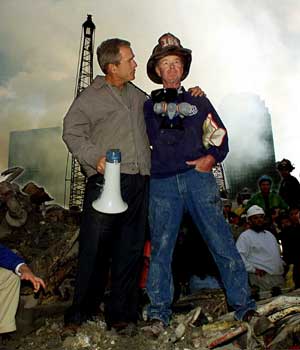
They were heros then, even deserving hugs from the President for putting their lives on the line to rescue their fellow Americans and spending countless hours, days and weeks cleaning up the remains of the two of the world's greatest skyscrapers, but now that thousands of them are coughing their lungs out and need help, a greatful nation no longer seems to care, if the actions of Republicans in the US Congress last week are any indication.
Senate Republicans killed a bid for nearly $2 billion to help sick 9/11 responders yesterday - blocking the measure without letting it come up for a vote.

Senate leaders invoked parliamentary rules, saying Sen. Hillary Clinton's (D-N.Y.) amendment to a measure funding port security was not "germane."

People suffering the effects from 9/11's toxic dust were outraged by the move.

"How could they just throw this out?" said Laura Picurro, of Toms River, N.J., whose husband, Joe, became disabled after doing volunteer iron work at Ground Zero.

"Maybe they should talk to these sick and dying workers," she said. "I find it absurd they didn't even consider it."

Clinton's amendment would have provided $5,800 a year for five years for each person sickened from Ground Zero exposure. She vowed to resubmit the measure or propose other legislation to help responders and nearby residents. "Their country should answer their calls for help," Clinton said.

Although Clinton got stiffed on money for the sick, she did obtain passage of a measure to create a national monitoring system to keep tabs on people who suffer from responding to future attacks or disasters. (Clinton's full remarks can be found here)
So far, Congress has authorized only $227 million for monitoring, workers' compensation and treatment, but no Congressional funds have actually been spent on treatment yet. The National Institute for Occupational Safety and Health hopes to have $75 million flowing by next month.

The Mount Sinai Medical Center in New York released the largest study yet of thousands of Ground Zero workers confirms "that the impact of the rescue and recovery effort on their health has been more widespread and persistent than previously thought, and is likely to linger far into the future."

Some of the excuses for voting against the assistance boggle the imagination:
Sen. Susan Collins, chair of the Senate Homeland Security Committee, said she was worried the bill may leave out rescuers who responded to the Pentagon or the United Flight 93 plane crash in Shanskville, Pa., on that fateful day.
Even worse, some federal officials estimate that the number of affected Ground Zero responders may be more than twice the number previously estimated:
Federal World Trade Center health czar Dr. John Howard recently hiked the estimate of Ground Zero responders to 100,000 from 50,000 - suggesting many more people could get sick from WTC dust and toxins.

"Nobody at this point has a firm number," Howard's spokesman Fred Blosser said, noting the revised figure was based in part on new information from the city Health Department.

"As we learn more, the number may go up," Blosser said. "This is, to a large extent, trying to make an educated guess."

The widely accepted estimate of 40,000 recovery workers was based on surveys conducted by the Mount Sinai Medical Center, which is monitoring and treating those responders.
Hug 'em, chew 'em up, spit 'em out and forget about them.

Thursday, September 14, 2006

Root Cause of Ground Zero Illnesses: No Cojones?

Curiouser and Curiouser.

The Record newspaper of New Jersey contributes its interpretation of the relative guilt of Christie Whitman and Rudi Giuliani in the health crisis affecting thousands of workers who helped clean up the remains of the World Trade Center.

The paper reviews Whitman's many statements declaring the safety of the air in lower Manhattan, as well as the EPA Inspector General's Report showing how "negative" information was removed from the EPA's press releases by the White House.

They note how Whitman admits that she recognized that there was something terrible going on -- workers laboring in a toxic stew without wearing respirators -- but she was handcuffed, impotent, powerless to act because NY City Hall -- Rudi Giuliani -- was in charge.
As for Ground Zero workers, Whitman acknowledges that they were laboring in air that was a toxic stew of chemicals. She says that EPA representatives repeatedly urged city officials to require workers to wear respirators, but she could see on news broadcasts that many of them were not complying. She was powerless to do anything about it, she says, because Ground Zero work was supervised by City Hall, not by her agency.

Jerrold Nadler, the Democratic New York congressman whose district includes Ground Zero, has asked why she did not assert the power of the federal government and just assume control of the work.

The short answer is another comparison of the Hurricane Katrina and World Trade Center disasters. The mayor of New Orleans was the ineffectual, gaffe-prone Ray Nagin. The mayor of New York was the truculent, formidable Rudy Giuliani. No one, not Christie Whitman, not even the president, was going to mess with Hizzoner, the only politician to be celebrated as a Sept. 11 hero.
So let me get this straight. And the Bush administration, which was soon to go to war in Afghanistan, invade Iraq, and launch a neverending war against terrorism -- didn't have to balls to stand up to Rudy Guiliani and force him to protect Ground Zero workers?

I'm not buying it. But I guess it sounds better than "Hey, we had more important thing to worry about, like re-opening Wall St."

Wednesday, September 13, 2006

Kean Drags Ground Zero Victims Into Election Season

Three New York and New Jersey Congressmen are demanding a Justice Department investigation that could lead to criminal charges against former Environmental Protection Agency Administrator Christie Whitman, who is accused of misleading Ground Zero workers into believing that the air they were breathing was safe. Thousands are now suffering serious health effects from their work on the pile.

At hearings last week in New York, Whitman was the most frequent target of lawmakers who charged that ground zero workers were not protected as they worked to clear the pile of toxic debris. Whitman, a former Republican governor of New Jersey, declared in the days after Sept. 11 that the air in lower Manhattan was
safe for workers and residents. But she has said she and the EPA always differentiated between the air quality in lower Manhattan and at ground zero.
And to add insult to injury, former NJ Governor Tom Keane is accusing the Congressmen of playing politics.
Former Sept. 11 Commission Chairman Thomas Kean, also a former Republican governor of New Jersey, said it was troubling that the Democratic congressmen "would misuse the heroic service of thousands for their political gain in an election season."

The congressmen — New York Reps. Jerrold Nadler and Anthony Weiner and New Jersey Rep. Bill Pascrell Jr. — said the health of their constituents, and not politics, was their concern.
Never mind that the three Reps have been fighting for years to get help for the Ground Zero victims and ensure that this never happens again. (And where has Tom Kean been all this time?)

Never mind that all three Reps are in perfectly safe seats and have little "political" to "gain" this election season (as opposed to Kean's son, who is trying to unseat New Jersey Senator Robert Menendez.)

Kean Sr., until recently portrayed in the media as a fair-minded, bi-partisan centrist, seems to be intent on setting a new world record for the fastest self-destruction of a reputation. In addition to the current slime he's wallowing in, he's come under attack in recent days for serving as a consultant for the "Path To 911" docudrama, ABC/Disney's recent error-ridden, Republican inspired attack piece on the Clinton administration.

Related Stories

Tuesday, September 12, 2006

It's War: Whitman vs. Giuliani Over 9/11 Air

When we last met, former EPA administrator Christie Todd Whitman blamed former New York Mayor Rudi Giuliani for spread false information that the air at Ground Zero was safe, and not enforcing the use of respirators.

Well, Rudi ain't buying it, according to New York CBS Channel 2:
It's now war. In an exclusive interview with CBS 2, Giuliani slammed Whitman for making people believe the air at ground zero was safe.

"The reports we had on air quality from the EPA was the air quality was healthy or at least it wasn't dangerous," Giuliani told CBS 2's Dave Carlin.

***

Giuliani maintained Sunday that he was honest and open about air quality issues.

"I put out all the reports that existed," Giuliani said. "Of course the reports that I put out were the same thing that Christie Whitman was saying publicly."
But Channel 2 says Rudi ain't playing straight:
One report the city apparently didn't put out was an explosive memo from the EPA to the city Health Department dated Oct. 5, 2001. It didn't mince words, stating of ground zero: "this site...poses threats to workers related to potential exposure to hazardous substances." Three weeks after the EPA memo, Giuliani's environmental commissioner, Joel Miele, was still saying the air was safe. "For the residents and people who are working in the open area that has been created downtown there is no realistic danger to the health," Miele said.
Rudi, on the other hand, says:
"We certainly gave people instructions that they should wear masks." "I was here five, six times a day for four months," Giuliani said. "I kind of thought of it as living here. And there were times when I wore a mask when you got near the pile. Times when I didn't. Those were the instructions. I don't remember that from EPA, though. What I remember from Christie Whitman is her saying that the air was fine."
(The instructions were to wear a mask sometimes, and sometimes not?)

Meanwhile, Rudi -- a man of the people -- says "his health and that of his wife and aides could have been affected from exposure to toxic smoke." So there.

And then we have this:

EPA Regional Commissioner Jane Kenny told CBS that her agency had told the Giuliani administration every day at daily briefings that the air at Ground Zero was bad.

"EPA made a distinction between working on the pile, which was toxic soup, and the air in lower Manhattan, where all the readings showed no long-term health issues," Kenny said.

(Yes, there was a magic fence around the site. The air on one side was perfectly safe, but the air just to the other side was "toxic soup." Stupid workers for not figuring that out.)

Anyway, we're all being petty, venal and hurtful:
Kenny also told CBS that she finds the blame game hurtful. "Everyone responded with their hearts and souls," she said, "and we shouldn't be in the position of blaming and second-guessing."
Hearts, souls and lungs.
Finally, in an attempt to broker a peace agreement, Rudi admitted:
"In retrospect, I guess we all should have done it differently: the city, the state and the federal government," Giuliani said on CBS' "The Early Show."

"Everybody bears responsibility for it."
Tune in next week when the winner will duke it out with OSHA.

Monday, September 11, 2006

OSHA After 9/11: Air At Ground Zero Is "Safe"

Although the piece I wrote last night mostly focused on EPA's public announcements following 9/11, OSHA"s may have been even worse. This is from a press release on September 25, 2001:
OSHA is also testing daily for asbestos, silica, lead and other contaminants. Test results continue to show no cause for concern in areas immediately surrounding ground zero and in public areas.

"I'm proud that OSHA staff are contributing directly to the protection of the search and rescue workers," said OSHA Administrator John L. Henshaw. "Our goal is to provide as much help as we can; we are not there in an enforcement role."

OSHA took immediate steps following the Sept. 11, 2001, disaster to coordinate with other federal, state and local agencies. After initial contact with the Environmental Protection Agency, the Federal Emergency Management Agency and various New York City agencies, OSHA sent industrial hygienists and safety officers to the Financial District and some rescue locations.

The agency took its first air and bulk samples on Sept. 13. The monitoring program is continuing, according to Pat Clark, OSHA's New York Regional Administrator, and now includes air sampling directly at the debris pile.

"We have taken over 200 air and bulk samples," Clark said. "Though the levels have been consistently safe, it is important that we continue to make sure the sampling continues through the various stages of the operation."(emphasis added)
Now there are more than a few problems with this statement. You can find your own, but I'll start with these:
  1. First, obviously, the statement was wrong, as confirmed by last week's Mount Sinai study that shows that 80% of those who worked at Ground Zero have suffered severe respiratory problems.
  2. Whatever OSHA's intention was here, this press release certainly give the impression that not only is the air safe "in areas immediately surrounding ground zero and in public areas." but also at Ground Zero where bulk samples "levels have been consistently safe" .
  3. Everyone knows that OSHA standards only cover a very small number of toxic chemicals in existence, so the fact that OSHA limits aren't exceeded does not mean that the air is "safe."
  4. OSHA is not taking into account unknown synergistic effects of the thousands of pulverized, burning substances. No one knows (yet) what the possible health effects could be, but it doesn't take an industrial hygienist to suspect that they're bad -- possibly very bad. And because you don't know exactly what the effects of the toxic brew were unknown, does not give OSHA the license to say that the air is "safe."
  5. Given all this, one wonders what the point of air monitoring was anyway. Finding something bad (high asbestos levels, for example) might have been meaningful and helped focus on appropriate protections and surveillance. But finding nothing "of concern" is meaningless, and does not mean that conditions are safe.

Now, of course, people can (and often do) argue quite legitimately than hindsight is always 20-20. Things that seem completely obvious once we know the outcome were really not so clear at the time. Choices that seem incredibly dumb now, made perfect sense at the time given the knowledge that people had.

Maybe.

But other people and organizations didn't have to wait for 20-20 hindsight. Compare OSHA's press release with a fact sheet issued by the New York Coalition for Occupational Safety and Health (NYCOSH) less than a week after the attack, which warned that

Contaminants in the air, including toxic dust and chemicals, can cause serious illness or death. Dust and ash anywhere in the vicinity of the World Trade Center site is likely to contain asbestos, cement, drywall and polyvinyl chloride (PVC) combustion products.

and that
Respirators are designed to provide protection from specific air contaminants. If you are wearing a respirator for protection from one substance, do not assume that it provides protection from any other substance. A respirator does not provide any protection if it does not fit properly, or if the seal is compromised by dirt.

A 'DUST MASK' IS NOT A RESPIRATOR and does not provide protection from asbestos, silica or other hazardous particulates.

And this is from a September 19, 200 1 news article

There were initial fears that a toxic cloud of asbestos fibers had been released when the buildings collapsed, but air and dust sampling by the Environmental Protection Agency (EPA) and the Labor Department's Occupational Safety and Health Administration since Sep. 13 has revealed either no asbestos in the air, or relatively low levels -- from 2.1 to 3.3 percent, compared to a one-percent threshold.

A fleet of huge vacuum trucks was deployed over the weekend to suck up much of the dust. Still, some office workers returning to the financial district yesterday wore paper face masks -- although these are ineffective in blocking ultra-fine asbestos fibers.

Doctors stress that permanent health damage from asbestos fibers, once used as an insulation material but now banned, almost always results from long-term exposure.
More difficult to assess are the numerous other chemical compounds released during the iniktial jet fuel inferno and the susequent explosive collapse. Benzene, formaldehyde, polychlorinated hydrocarbons, andcountless other carcinogens were, and still are, present at the site, as are poisonous gases containing carbon monoxide and cyanide.

Aside from the known hazards, the fusing of glass, concrete, electronics parts, plastics and countless other materials in the towers created new and potentially deadly compounds.

"We have a unique situation that can produce some unique combinations of chemicals," said Cynthia Wilson, executive director of the Chemical Injury Information Network, a non-profit advocacy group.

***

Experts said the long-term consequences for the thousands of people who were massively exposed when the buildings came down, and for workers now at the site, are impossible to gauge at this point.

"If someone is ill now, they'll probably be okay. If they're still ill in three months, they have something to be concerned about," Wilson said.

Now, I've gotten some mail criticizing me for blaming the government for everything when thousands of respirators were handed out and workers simply chose not to use them. Just a few responses to that. First, there is lots of testimony from workers saying that, especially at first, there weren't enough respirators. But even afterwards, it takes more than just a respirator to be safe. OSHA requires fit testing, training and medical examinations before workers can use respirators. In addition, respirators are hot and uncomfortable, particularly when they have to be worn all day, and they impede communication. In order to make sure that workers use them, there needs to be enforcement -- from the employer, and if that doesn't work, from OSHA.

The other problem, of course was that OSHA wasn't "in enforcement mode," as I've discussed before, choosing instead to "provide guidance and assistance." No one would expect (or tolerate) OSHA taking the time and trouble to write out citations to employers in the initial, frantic life-saving period immediately after the attack (although one hopes that today, five years later, first reponders would be better equipped). But OSHA's "guidance and assistance" mode lasted far beyond the initial rescue efforts -- all the way to the end of the nine-month cleanup.

The bottom line is that the law requires the employer to provide a safe workplace -- and that should mean that no one works without respirators, just as no one should be working at any heights without fall protection, or in a trench without shoring. If the employer is not doing that, it is OSHA's responsibility to ensure that workers are safe. Citations are only one tool that OSHA has to fulfill its mandate to ensure worker safety. As I've written before, workers at Fresh Kills (where the debris was taken) and at the Pentagon were not allowed to work without respirators.

And even those mistakes might have been fine if there was some evidence that the federal government had learned from its mistakes. But just the opposite has occurred. OSHA and the Department of Homeland Security have essentially decided that it would be inappropriate to enforce emergency response safety regulations during actual national emergencies. In fact,
federal National Response Plan determines that OSHA must defer to Joint Field Office Coordination, and that OSHA’s role is to provide “advice and support,” not to enforce the law.

And, in fact, the same mistakes were made following Hurricane Katrina. OSHA did not resume regular enforcement in the area south of Interstate 10 in Mississippi until June 28, 2006. The agency has still not resumed regular enforcement in the hurricane ravaged areas of Louisiana. And much of OSHA's effort in the Gulf, according to observers, was to provide assistance for government contractors, not the day-laborers hired by homeowners to mostly do demolition work on the thousands of homes that need to be torn down.


Finally, on this fifth anniversary of 9/11, I want to add one more thing. Although I find the government response to the potential health effects of the twin towers to be inadquate (to put it mildly), I do want to recognize the dedication and heroic efforts of OSHA and EPA staff throughout the clean-up effort. They were there 24/7 focused on one goal: making sure no one got killed -- and, in fact, no one was killed in any accident while the pile was being removed.

That meant extreme hardship, weeks and months away from families, and dealing with the same trauma that the recovery workers had to deal with. And, although I'm sure they were all wearing respiratory protection, I wouldn't be surprised if some of them may also be suffering health effects or post-traumatic stress disorder from the work they did there. And while the criticism here and elsewhere may be somewhat demoralizing, one hopes that in the end, OSHA and EPA will learn from their errors should such a horrific even ever occur again.

Sunday, September 10, 2006

Scoundrel Time: Whitman, Giuliani and the Victims of Ground Zero

The blogosphere and mainstream media have been abuzz the past few days over ABC/ Disney's "Path To 9/11," the right-wing attempt to rewrite the history of that day. But the Bush administration's invitation to Fantasyland will actually begin one hour earlier tonight with the airing of a 60 Minutes Katie Couric interview of former EPA Administrator Christine Todd Whitman about the Bush administration's role in the disease that is now plaguing thousands of Ground Zero cleanup workers and residents.

For those of you just tuning in, the Mount Sinai Medical Center in New York released the largest study yet of thousands of Ground Zero workers confirms "that the impact of the rescue and recovery effort on their health has been more widespread and persistent than previously thought, and is likely to linger far into the future." In a nutshell, former recovery workers are getting sick and dying from the effects of inhaling smoke and dust containing a toxic burning brew of caustic concrete dust, asbestos, PCBs, jet fuel, and plastics, lead, chromium, mercury, vinyl chloride, benzene, human bodies and thousands of other toxic substances. The pulverized concrete alone has been characterized as so alkaline it is like inhaling lye.

The immediate problem was that recovery workers didn't wear respirators -- because OSHA didn't enforce the law, because Whitman's EPA had assured New Yorkers that the air was safe to breathe, and because the White House put more emphasis on politics than on public health, removing "alarming" language from EPA press releases and rushing the re-opening of Wall St.

Whitman claims that the EPA had warned the city of the toxic dust and blamed city officials for the ongoing disaster. "We never lied," she said.

Whitman claims first that the city had been warned about the toxic nature of the dust, and that EPA statements that the air was safe referred only to the ambient air around lower Manhattan, not Ground Zero itself.
"The readings (in lower Manhattan) were showing us that there was nothing that gave us any concern about long-term health implications," she tells Couric. "That was different from on the pile itself, at ground zero. There, we always said consistently, 'You've got to wear protective gear."
Let's look at some of Whitman's quotes:
"There is no reason for concern," referring to asbestos measurements at Ground Zero and elsewhere in lower Manhattan.
-- Christine Todd Whitman, September 15, 2001

"New York is safe."
-- Christine Todd Whitman, September 16, 2001

"We are very encouraged that the results from our monitoring of air quality and drinking water conditions in both New York and near the Pentagon show that the public in these areas is not being exposed to excessive levels of asbestos or other harmful substances. I am glad to reassure the people of New York and Washington, D.C. that their air is safe to breathe and their water is safe to drink."
- Christine Whitman, Sept. 18, 2001
If she was only referring to Ground Zero, it's not hard to see why people didn't get it. A 2003 report of EPA's Inspector General found that although EPA press releases made some distinction between assuring the safety of the general public combined with more concern for the Ground Zero site itself, overall the communication was unclear and was one of the major factors contributing to the failure of many workers to wear respirators:
A significant factor [why respirators were not worn]was the desire to save lives without regard for personal safety in the immediate aftermath of the disaster. Other reasons appeared to include the respirators’ interference with the ability of emergency workers to communicate, lack of training, lack of enforcement of safety measures at the site, and conflicting messages about the air quality at Ground Zero
Many of the air measurements taken by OSHA, for example, were within "acceptable limits," while for others there were no limits or no ability to measure. In addition, there was no ability to determine the synergistic effects of chemicals -- the health effects of exposure to multiple chemicals at the same time instead of each one individually:
Thus, on one hand workers had information suggesting that the air quality was not bad, but a message to wear respirators on the other. This report also noted the poor example set by political figures, celebrities, and even supervisors who visited the site but did not wear respirators.
In addition, the IG interviewed numerous consultants and contracting firms were were under the impression that EPA assurances applied to Ground Zero, as well as the general population.

One of the most upsetting findings of the IG was its conclusion that White House officials had instructed the agency to be less alarming and more reassuring to the public in the first few days after the attack than EPA officials originally wanted to be. In fact, the White House Council on Environmental Quality ordered EPA to add reassuring information and delete cautionary information from at least one press release.
The title for the original version of one news release was, "E.P.A. Initiating Emergency Response Activities, Testing Terrorized Sites For Environmental Hazards." In the final version, the second clause was changed to read, "Reassures Public About Environmental Hazards." In the same release, a section that said, "Even at low levels, E.P.A considers asbestos hazardous in this situation" was deleted and replaced with a section that read, in part, "Short-term, low-level exposure of the type that might have been produced by the collapse of the World Trade Center buildings is unlikely to cause significant health effects."
Ultimately, according to the IG, the content of EPA's press releases were based more on politics than on science.
The draft of the inspector general's report also says the agency "did not have sufficient data and analyses" to make a "blanket statement" when it announced seven days after the attack that the air around ground zero was safe to breathe. "Competing considerations, such as national security concerns and the desire to reopen Wall Street, also played a role in E.P.A.'s air quality statements," the report said.
The IG also found that
a federal emergency response team prepared a report on the day of the attacks recommending that respirators be used at ground zero.

But the report was never issued because it was decided that New York City, and not the federal government, should handle worker protection issues.
And earlier this year, Judge Deborah A. Batts of Federal District Court found that Whitman had deliberately mislead the public when she reassured the people of New York after the collapse of the World Trade Centers that the air was safe to breathe in lower Manhattan and Brooklyn. The result of Whitman's lack of concern was devastating for recovery workers, according to Dave Newman of the New York Committee on Occupational Safety and Health who argues that after Whitman's statement, employers "had a green light to say, 'We don't need to use respirators because the E.P.A. says the air is OK.' "
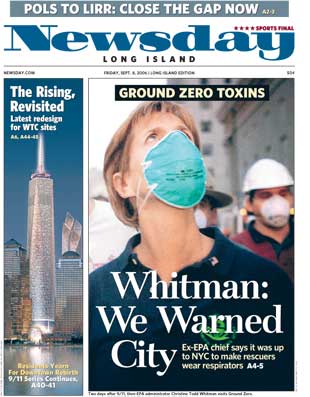
Whitman testified last week about the EPA's response and received a hostile reaction from New York's Congressional delegation as well as from Joseph Zadroga, the father of NYPD Detective James Zadroga, who died at age 34 next to his 4-year-old daughter in January after fruitlessly seeking treatment for months for his failing health. Zadroga had worked over 500 hours on the pile and he was the only Ground Zero worker officially linked to work at Ground Zero. Referring to Whitman's testimony, the elder Zadroga said "I think she should go to jail."

In addition to denying that EPA's assessments of the hazards at Ground Zero mislead the public and the workers, Whitman blames the city of New York for the fact that few workers wore respirators. The problem, according to Whitman, was that the EPA didn't have the authority to force workers to wear respirators. The city of New York was in charge and they bear the responsibility.
"We did everything we could to protect people from that environment and we did it in the best way that we could, which was to communicate with those people who had the responsibility for enforcing," says Whitman. "We didn't have the authority to do that enforcement, but we communicated (the need to wear respirators) to the people who did," she tells Couric. "(In) no uncertain terms (city officials were warned of the danger). EPA was very firm in what it communicated and it did communicate up and down the line."

"Who had ultimate authority over the site?" asks Couric.

"Really, the city was the primary responder," replies Whitman.
Whitman is partially correct in that the City of New York, and specifically Mayor Rudi Giuliani, bear their share of responsibility for putting politics over public health. In a letter to New York officials dated October 5, 2001, the EPA expressed concern over the air at Ground Zero:
"In addition to standard construction/demolition site safety concerns, this site also poses threats to workers related to potential exposure to hazardous substances," including building materials, hazardous materials stored in the buildings and combustion products emitted from the smoldering rubble, the letter states.
The next day
a top city Health Department official wrote a three-page memo raising "critical environmental issues" related to the disaster.

Associate Commissioner Kelly McKinney wrote that there were deep disagreements between the city's Office of Emergency Management and the Department of Environmental Protection over whether the air was safe enough to allow people back into the zone.

"The mayor's office is under pressure from building owners and business owners in the red zone to open more of the city to occupancy," McKinney wrote. "According to OEM, some city blocks north and south of Ground Zero are suitable for reoccupancy. DEP believes the air quality is not yet suitable for reoccupancy. I was told the mayor's office was directing OEM to open the target areas next week." McKinney, now with OEM, did not respond to a written request for comment.
And on September 29, 2001, Mayor Giuliani assured New Yorkers that "Although they occasionally will have an isolated reading with an unacceptable level of asbestos … it's very occasional and very isolated. The air quality is safe and acceptable."

Dropping The Ball On Respirators

But in the interview, Whitman seems to suggest that it was actually the workers themselves who were to blame for not paying attention:
Whitman understands that among first responders at ground zero, some may have been confused over that message.

"It's hard to know … when people hear what they want to hear and there's so much going on, that maybe they didn't make the distinction," says Whitman. But city officials were clearly made aware of the danger on the pile, she says.
Ultimately, of course, the US Congress gave neither EPA nor the City of New York the responsiblity for worker safety. The agency tasked by Congress to ensure the health and safety of American workers is the Occupational Safety and Health Administration, and the Occupational Safety and Health Act of 1970 made no exceptions for federally declared disasters.

But OSHA didn't see it that way:

As the magnitude of the recovery operation grew clearer, attempts were made to bring order to the operation. On Sept. 20 the city issued its first safety plan, and it asked the Occupational Safety and Health Administration to take charge of distributing respirators. In what would become a controversial move, OSHA used its discretionary powers to decide not to enforce workplace safety regulations but to act in a supportive role that would not slow down operations.
According to OSHA's official report of the agency's response, Inside the Green Line:
Early on, Assistant Secretary [of Labor for OSHA, John] Henshaw determined that the best role for the agency at the WTC was to provide guidance and assistance with a sound safety and health plan.

"When we worked out that plan with the site command staff, we agreed that the rescue effort must not be hampered," explained [OSHA Region II Administrator Patricia] Clark. "Given that the site was operating under emergency conditions, it was normal that we should suspend our enforcement action and assume the roles of consultation and technical assistance." Enforcement takes time and can affect the speed of abatement. OSHA's goal from the start was protection, not citation.
Now, reasonable people can argue about the precautions that rescue workers can be expected to take in the immediate aftermath of a mass disaster where lives are at stake and very hand is needed. In the case of the World Trade Center attack, that period of time lasted for perhaps a few days. After that, the rescue became a recovery that went on for nine months -- without any OSHA enforcement.

And similar "emergency conditions" didn't stop the Pentagon from escorting workers off the site if they weren't wearing proper respiratory gear and more than 90 percent of the workers at the Fresh Kills landfill on Staten Island, which was overseen by the Army Corps of Engineers, wore respirators, according to the Times.

The result, was of course, disastrous. As the Sierra Club points out in a recent report,
New York City lost at least twice as many firefighters from active duty after 9/11 because of respiratory health impairments from 9/11 dust exposure as it lost on the day of the attack
The Fire Department of New York lost 341 firefighters and two paramedics on September 11, 2001. As of May 2004, 325 firefighters affected by Ground Zero reportedly still were on restricted light duty, 69 were on medical leave, and 320 with lung impairments had retired.

Unfortunately, this "advisory" role for OSHA has now been permanently incorporated into Homeland Security's National Response Plan as the Sierra Club report explains:
Yet, despite the illnesses that arose among Ground Zero workers, both OSHA and the Department of Homeland Security (DHS) have incorporated lack of enforcement into new federal plans for emergency response. And in national emergencies, OSHA does not have the final word on safety. Apparently our first responders are brave but expendable.
And, in fact, the same mistakes were made following Hurricane Katrina. OSHA did not resume regular enforcement in the area south of Interstate 10 in Mississippi until June 28, 2006. The agency has still not resumed regular enforcement in the hurricane ravaged areas of Louisiana.

OSHA's report on the World Trade Center disaster boasted that there were only 57 serious injuries during the 3.7 million hours of work on cleaning up the pile at Ground Zero, significantly lower than similar projects, and credits the "WTC partnership" for this work. The final sentence, in bold in the original, is particularly chilling after the release of last week's Mt. Sinai report:
After September 11, 2001, not one life was lost inside the green line during the recovery effort.
Would that that was still true today.

Related Stories

Friday, September 08, 2006

9/11: Giuliani's Dumb and Deadly Decisions

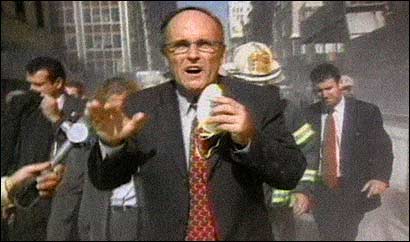
If there was one hero of 9/11, it certainly wasn't President Bush, flying to and fro around the country in Air Force One, or Dick Cheney, hiding deep in some secret bunker. No, if there was any real hero for most people, it was certainly Rudy Giuliani -- rallying his people through the worst, saying just the right thing at just the right time -- and then there was that most vivid and lasting image of the Mayor running through the streets of lower Manhattan as his city collapsed around him.

But it was exactly his presence in lower Manhattan and his need to flee the falling World Trade Center buildings that symbolize the reality of his failure to prepare for that day.

Think about it. If you were the Mayor of New York, where would you place your central emergency command center? In secure, technologically advanced city facility just across the Brooklyn Bridge, or walking distance from City Hall, on the 23rd floor of the symbolic center of the nation's greatest city -- in a building that had already been attacked by terrorists -- 7 World Trade Center?

But it was to be the World Trade Cener because Rudy wanted to be able to walk to the command center. And, according to an article in this month's American Prospect (paid subscription), no amount of reasoning by his advisors could change his mind. (And the fact that there were some wealthy corporate types -- and Giuliani contributors -- who stood to make a few bucks off the deal probably didn't hurt either.)

And would an in-tact command center have made a difference on 9/11? Would it have saved any of the 341 firefighters and two paramedics who died that day?

Definitely, according to The 9-11 Commission’s senior counsel, John Farmer:
If the center had been located elsewhere and thus able to remain operational that day, he says, “I really think it would have made a difference. Maybe the failure to communicate among the agencies doesn’t happen that day because that thing is functioning. That’s the point of it. I’ve never been convinced that they could have done that much better with civilians, but I think the number of responder deaths could have been greatly reduced.”
Farmer continues:
To start with, the towers were “configured in such a way that the fire chiefs told us they had no idea about the conditions on the upper floors,” while the command center “would’ve had video to relay directly to the lobby.” With every departmental radio frequency available and OEM [NY Office of Emergency Management], police, and fire brass with the mayor, Farmer says that “they would have had access to ongoing reports” from police helicopters, including a pilot’s warning that the South Tower looked like it would partially collapse nine minutes before it did. The 9-11 Commission, the National Institute of Standards and Technology, and a McKinsey & Company report all found that this “potentially important information,” as McKinsey put it, “never reached the Incident Commander … or the senior FDNY chiefs in the lobbies.”
But of course, maybe Giuliani knew something that his aides didn't Remember that before the "heroism" of 9/11 Guiliani was best known as the Mayor who had folded his campaign for the Senate against Hillary Rodham Clinton due to a rather messy and very public divorce:
It was at once the dumbest decision he ever made, and the one that made him a legend. If the center had been elsewhere, all the dramatic visuals that turned Giuliani into a nomad warrior would instead have been tense but tame footage from its barren press conference room, where reporters had been corralled prior to 9-11 for snowstorms and the Millennium celebration. The closest any cameras would’ve gotten to Giuliani-in-action would have been shots of him with 100 officials, working over monitors, maps, mikes, and phones.
The good news is that if he runs for President, he may yet have to answer for this mistake and many more:
Some of the 9-11 family leaders who have raised the most troubling issues about the city’s preparations have vowed to stalk him in the primary states. Their focus is on firefighters whose lifeline link to unheard evacuation orders was the same radio that failed in the same towers during the first terrorist bombing in February 1993. They can’t understand why the city never performed an interagency drill in the towers, had no plan or command-and-control protocol for a floor-consuming high-rise fire, and was indifferent, even after the 1993 warning, to rooftop, elevator, and handicapped rescues.

The gross failures of building- and fire-code enforcement, the stark ineptitude of the mayor’s vaunted Office of Emergency Management (OEM), the tolerated insularity of Fire Department command, the stay-put death knell of the 911 operators and fire dispatchers -- they all continue to haunt the families. They hold Giuliani himself responsible for the decision that morning to split the police and fire command posts, when the first rule of emergency response is unified command. Their separation contributed to communication gaps that every official inquiry has said caused casualties.
Rudy got his walk that day, his photo and his legend. Others didn't make out so well.

Wednesday, September 06, 2006

9/11 Anniversary: Don't Forget The Workers

Next week will be filled with media reports about the fifth anniversary of the 9/11 attacks and report cards on "homeland security." President Bush will be seeking to win back the mantle of great protector of the American people that has served him so well in past elections.

But there is another story that should accompany each and every 9/11 commemoration report:

The official death toll from the 9/11 attacks is placed at 2,819. But as the fifth anniversary of the attack approaches, a study released today confirms that the real toll of 9/11 is actually much higher and still growing.

Exposure to a toxic burning brew of caustic concrete dust, asbestos, PCBs, jet fuel, and plastics, lead, chromium, mercury, vinyl chloride, benzene, human bodies and thousands of other substances has seriously damaged the health of thousands of workers who worked to clean up the remains of the World Trade Center. In fact, it may be decades before we know the true toll of the World Trade Center in illness and early death.

But the true tragedy is that much of this additional pain, illness and death could have been prevented, if it hadn't been for the lies and inaction -- lasting half a decade -- of the federal government, and to a lesser extent, the government of New York city.

Yesterday, the Mount Sinai Medical Center in New York released the largest study yet of thousands of Ground Zero workers that confirms that "the impact of the rescue and recovery effort on their health has been more widespread and persistent than previously thought, and is likely to linger far into the future." Only one worker is confirmed to have died from the effects of the smoke, although several others should probably be added to the list as well.

The study covered 9,442 workers and focused only on respiratory problems, although workers also suffered from severe gastrointestinal and psychological effects such as depression and post traumatic stress disorder as well. Later studies will focus on psychological effects.

According to the head of the study,


“There should no longer be any doubt about the health effects of the World Trade Center disaster,” said Dr. Robin Herbert, co-director of Mount Sinai’s World Trade Center Worker and Volunteer Medical Screening Program. “Our patients are sick, and they will need ongoing care for the rest of their lives.”
The results, in brief:


  • Roughly 70 percent of nearly 10,000 workers tested at Mount Sinai from 2002 to 2004 reported that they had new or substantially worsened respiratory problems while or after working at ground zero.

  • One-third of the patients in the new study showed diminished lung capacity in tests designed to measure the amount of air a person can exhale.

  • Of those studied, 46.5 percent reported symptoms like chest tightness, shortness of breath and dry cough that generally affect the lower airways of the lungs.

  • 62.5 percent reported upper-respiratory symptoms like sinusitis and nose and throat irritations.

  • Among nonsmokers, 28 percent were found to have some breathing impairment, more than double the rate for nonsmokers in the general population.

  • Firefighters and others who arrived at the sight earlier, had the worst problems

The full text of the study can be downloaded here

Long Term Effects

Most workers interviewed about the health effects of working on the pile tell of their symptoms getting worse, and the doctors agree.

The doctors said that the persistent nature of the respiratory symptoms raised troubling questions about the workers’ long-term health. Dr. Philip J. Landrigan, a founder of the screening program at Mount Sinai and an author of the new study, said that the toxic nature of the trade center dust had led doctors to conclude that there would be serious health issues for years to come, especially for workers who were exposed to the heaviest concentrations in the early days after the terrorist attack.

“This was extremely toxic dust,” Dr. Landrigan said, noting that some samples showed the dust to be as caustic as drain cleaner. The dust also contained innumerable tiny shards of glass, which could get lodged in the lungs, and a stew of toxic and carcinogenic substances, like asbestos and dioxin, that could potentially lead to cancer decades from now.
Other serious problems plague the victims as well. For example, 40 percent of those who went to Mount Sinai for medical screening did not have health insurance, and will thus not get proper medical care. And as they become sicker and unable to work, more will lose their health insurance.

In addition, many workers received incorrect treatments because their physicians weren't aware of the protocols for treating patients. Although Mt. Sinai established a protocol, or guidelines for treating the responders who were already showing characteristic signs of illness in 2002, the city of New York Health Department didn't issue diagnostic guidelines until last week, almost five years after the buildings' collapse.

Only the mayor of New York didn't seem too impressed with yesterday's study:


Mayor Michael R. Bloomberg, speaking at a news conference at City Hall yesterday, questioned the conclusiveness of the study, saying that statistics could suggest a connection between events, but not prove a direct link.

“I don’t believe that you can say specifically a particular problem came from this particular event,” he said. Nonetheless, Mr. Bloomberg announced that the city would create a screening and treatment program for anyone exposed to the trade center dust or fumes.

The mayor did, however announce the establishment of a $37.5 million city monitoring and treatment program that will offer its services at no charge to residents of Manhattan or Brooklyn, office workers, city employees and volunteers, and people involved in debris removal and cleanup.

In order to understand the full magnitude of this study, it's important to understand some recent history.

EPA's False Assurances That The Air Was OK

Three days after the buildings collapsed, then-U.S. Environmental Protection Administrator Christie Whitman issued a press release: "Monitoring and sampling conducted on Tuesday and Wednesday have been very reassuring about potential exposure of rescue workers and the public to environmental contamination." Two weeks later, Mayor Rudy Giuliani said rescue workers faced minimal risk because the air quality was "safe and acceptable."

But in August, 2003 and internal EPA Inspector General's report found that White House officials had instructed the agency to be less alarming and more reassuring to the public in the first few days after the attack, even though they didn't have the information to support that assurance.

Earlier this year, federal judge found that former Environmental Protection Agency administrator Christie Todd Whitman deliberately mislead the public when she reassured the public after the collapse of the World Trade Centers that the air was safe to breathe in lower Manhattan and Brooklyn.

And last month documents and memos obtained by Newsday revealed that New York city officials, pressured by building and business owners to open up downtown New York in the vicinity of the collapsed World Trade Center buildings following 9/11, ignored advice from experts, possibly dooming thousands to illness, shorter lives and death. The documents show that city officials may have opened up hazardous areas prematurely, even though they were warned by other officials at the New York Department of Environmental Protection that the air may have still been hazardous.

The false assurances of EPA and the city of New York served as a preamble to one of the biggest scandals of this tragedy:


OSHA's Failure To Enforce The Use of Respirators

Although New York Times writer Anthony DePalma didn't go into the whole respirator issue in today's article about the study, last June he wrote a long piece in the Times about the "botched opportunities, confused policies and contradictions that failed to ensure [workers'] safety."

As bad as EPA was, I wrote then in reviewing DePalma's article, the real culprit was the Occupational Safety and Health Administration, the agency tasked by Congress to ensure the health and safety of American workers. And there's no exception for federally declared disasters:

As the magnitude of the recovery operation grew clearer, attempts were made to bring order to the operation. On Sept. 20 the city issued its first safety plan, and it asked the Occupational Safety and Health Administration to take charge of distributing respirators. In what would become a controversial move, OSHA used its discretionary powers to decide not to enforce workplace safety regulations but to act in a supportive role that would not slow down operations. "Given that the site was operating under emergency conditions, it was normal that we should suspend our enforcement action and assume the roles of consultation and technical assistance," Patricia Clark, OSHA regional administrator for New York, said in a 2003 OSHA publication.
What we're dealing with here is a traditional conflict between production (in this case, cleaning up the site as quickly as possible) and worker safety, along with the additional political push by the can-do Bush administration to get things cleaned up quickly.

It has been argued that the World Trade Center site (as well as the post-Katrina Gulf) were emergencies and, at least in the immediate, chaotic aftermath, there may have been nothing OSHA could have done to enforce respirator use. But the cleanup of the site went on for nine months beyond the initial emergency. In addition, similar "emergency conditions" didn't stop the Pentagon from escorting workers off the site if they weren't wearing proper respiratory gear and more than 90 percent of the workers at the Fresh Kills landfill on Staten Island, which was overseen by the Army Corps of Engineers, wore respirators, according to the Times.

And then, of course, it probably didn't help much that our Commander In Chief didn't feel the need to worry about the air. (Of course, he left quickly)

The Current Situation

The federal Government has finally started to take the situation seriously. Following the first confirmed death of a rescue worker, President Bush appointed John Howard, Director of The National Institute for Occupational Safety and Health to coordinate the federal government's 9/11 health efforts. But even Howard admits "that costly delays and missed opportunities may have shattered responders' trust in government." Although many are relieved that someone is in charge, the problems continue:


Dr. Howard, who was trained as a pulmonary specialist and is the director of the National Institute for Occupational Safety and Health, has not assigned a single one of his 1,300 employees to work full time on ground zero medical issues, though about 20 work on such issues part time. And though the institute has a budget of about $285 million, he has not received any additional money to address the complex medical issues involved.

“I’m a czar without a budget,” he said.

Money continues to be a serious problem. Although money has been available for screening and monitoring programs run by Mt. Sinai, until last year, almost no money was available for treatment. Last year, New York's Congressional delegation convinced the Bush administration to restore $125 million in unused workers comp funds that it had threatened to take back, but that still doesn't come close to what will be needed.

Finally, a new law was passed in New York making most people who performed rescue, recovery or cleanup work after the collapse of the World Trade Center eligible to register with the Workers’ Compensation Board. Anyone who is registered who develops a 9/11-related illness at any time in the future will be eligible to file a workers’ compensation claim. Failure to register by August 14, 2007 will make it impossible to file a claim, even if the worker develops a 9/11-related illness.

What does it all mean?

Finally, take a look at this article by public health historians David Rosner and Gerald Markowitz, authors of the just published Are We Ready?: Public Health Since 9/11. Rosner and Markowitz note that the New York public health system worked when 9/11 happened. Emergency health services were ready to go, measures were taken to prevent food from rotting, vermin infestations and mosquito outbreaks. But that was soon to end:

It took no time at all for the administration to start systematically undercutting the efforts of experienced health administrators in New York and at the national Centers for Disease Control. By pressing them to return the city to "normal" and feeding them doctored information about dust levels -- ignoring scientific uncertainties about the dangers that lingered in the air -- the administration lied to support a national policy of denial.

Putting in place a dysfunctional bureaucracy would soon undermine the public's trust in the whole health system in downtown Manhattan. In the process, it also effectively crippled systems already in existence to protect workers, local residents, and children attending school in the area. As a result, what promised to be an extraordinary example of a government bureaucracy actually working turned into a disaster and later became the de facto model for the Federal response to Hurricane Katrina.
The next step was the starvation of the national public health system while money was wasted on wild goose chases like smallpox immunizations and the war in Iraq instead of "laboratories, well-baby clinic care, and inoculation campaigns. " And here we are today:

In the wake of September 11th, the public health community saw its sanest initiatives stifled and its priorities distorted. While money is now less available for the inoculation of babies from the real threats of rubella, mumps, and measles, as hoped-for funds to prevent as many as 350,000 children from getting lead poisoning are no longer on anyone's agenda, as federal funds to support health education have been rescinded, and as (unbelievably enough) money needed to protect U.S. ports from dirty bombs or bioterrorism have all-but-vanished, Katrina victims still wander the nation wondering whether they will be able to see a physician.

For the next 9/11, when it comes to public health, don't think New York, Ground Zero, 2001; think New Orleans, August 29, 2005. Think: "Brownie, you're doing a heck of a job..." Then sit back amid the disaster and wait for the private charities to appear, wait for FEMA to send in the mobile homes.

Finally, let's return to the numbers. The main result of the Mt. Sinai study was that 70% of the Ground Zero workers studied had serious respiratory problems. An estimated 40000 persons worked at Ground Zero during those months. Given the fact that these symptoms are getting worse for many, that many symptoms have not yet been studie, and that we've already seen some deaths, and that we have not begun to see the long term effects of the smoke, what kind of numbers will we be looking at in 30 years and how will they compare to those lost on 9/11 itself? I shudder to think.

NOTE: "9-11 Toxic Legacy" airing on DiscoveryTimes Sept. 9 at 5 p.m. and Sept. 12 at 10 p.m. (Produced by Susan Teskey, Canadian Broadcasting Corporation) Excerpts can be seen here.

Related Stories

Wednesday, August 30, 2006

New Law Provides Benefits For 9/11 Workers and Volunteers: Spread the Word

I'm republishing this article by New York Committee for Occupational Safety and Health (NYCOSH) Communications director Jonathan Bennett to make sure it gets wide distribution. If you know anyone who might be affected, please pass it on or reprint it.

In short, New York State has just passed a law making tens of thousands of people, including volunteers, eligible for workers’ compensation. The law went into effect on August 14 and those who are eligible have one year to register.

NYCOSH is a non-profit educational advocacy organization that has been active in fighting for medical treatment for workers and volunteers who have become sick as a result of exposure to toxic substances in the aftermath of the collapse of the World Trade Center. They are concerned that many of those eligible will not register because they are unaware of the new legislation that extends the time limits for filing claims.


New law provides benefits for 9/11 workers and volunteers: Registration open for a year


By Jonathan Bennett

Thanks to a new law, most people who performed rescue, recovery or cleanup work after the collapse of the World Trade Center are now eligible to register with the Workers’ Compensation Board. Anyone who is registered who develops a 9/11-related illness at any time in the future will be eligible to file a workers’ compensation claim. Failure to register by August 14, 2007 will make it impossible to file a claim, even if the worker develops a 9/11-related illness.

"Now all those who did rescue, recovery or cleanup work after 9/11 have an opportunity to ensure that if they ever become ill as a result, their medical expenses will be covered one hundred percent," said Joel Shufro, Executive Director of the New York Committee for Occupational Safety and Health. "But for that to happen they need to register within a year. I urge anyone who did paid or unpaid work in Lower Manhattan after 9/11, whether sick or healthy, to find out about eligibility requirements and register. Working in partnership with the National Disaster Ministries of the United Church of Christ we have launched a major campaign to inform all workers and volunteers about the new program."

The new law permits workers and volunteers who worked in lower Manhattan after the attack on the World Trade Center who are ill, and those who were exposed to toxic substances and may become ill in the future, until August 14, 2007 to register with the New York State Worker’s Compensation Board.

Some workers and volunteers have been prevented from getting compensation because they only began to become sick after the 2-year deadline for filing a claim. Others who were exposed to the toxic atmosphere in Lower Manhattan are healthy now, but may develop a 9/11-related disease in the future. Under the old rules, they would also have been prevented from receiving benefits.

The law applies to most people who did paid or unpaid rescue, recovery or cleanup work in Lower Manhattan south of Canal or Pike Streets between Sept. 11, 2001 and Sept. 12, 2002. It also applies to rescue, recovery or cleanup workers who worked at the Staten Island landfill, the barge operation between Manhattan and Staten Island or the New York City morgue, and temporary morgues. The only workers who are not covered are those who are not in the workers’ compensation system: NYC uniformed services (firefighters, police, sanitation workers), NYC teachers and federal employees. But those workers are eligible if they performed any rescue, recovery or cleanup work off-duty, as a volunteer.

Anyone who has already filed a claim for 9/11-related workers’ compensation and been turned down because the claim was filed after the 2-year filing deadline had passed can register and file a new claim under the new law.

Workers who have already filed for workers’ compensation for injuries suffered during the rescue, recovery or cleanup operation should register in case they develop a 9/11-related condition that is different from the basis of their established claim. An already-established claim does not cover the new condition.

The registration must be notarized and indicate the dates and locations of the rescue, recovery or cleanup work performed and the employer’s name, or the organization for whom the volunteer worked, if applicable.

"It is imperative that anyone who worked within the boundaries or at the sites detailed in the law register with the New York State Workers’ Compensation Board whether they are sick or not," said Shufro. "By joining the registry before the deadline, a year from now, workers and volunteers will preserve their rights to benefits. Failure to register within the next twelve months will prevent individuals who may develop cancer or other slow starting diseases some years from now receiving benefits."

Monday, August 28, 2006

Ground Zero Workers: The Continuing Cost Of A Cover-Up

"I am glad to reassure the people of New York and Washington, D.C., that their air is safe to breathe and their water is safe to drink." - Christie Whitman, U.S. EPA administrator, September 19, 2001
It's one thing when people are exposed to hazardous conditions in the heat of a crisis, or because no one is aware of the hazard. In the case of World Trade Center ground zero workers, plenty was known early on about the toxicity of the dust they were inhaling, and little was done to ensure that workers were protected -- especially by those agencies -- the City of New York, OSHA and EPA -- who were responsible for worker safety. One only hopes that, should something like this ever happen again, we've learned our lesson.

Now documents and memos obtained by Newsday reveal that New York city officials, pressured by building and business owners to open up downtown New York in the vicinity of the collapsed World Trade Center buildings following 9/11, ignored advice from experts, possibly dooming thousands to illness, shorter lives and death. The documents show that city officials may have opened up hazardous areas prematurely, even though they were warned by other officials at the New York Department of Environmental Protection that the air may have still been hazardous.

The documents revealed that:
  • City, state and federal officials failed to enforce workplace safety laws - for example, fining or expelling workers who did not wear respirators. Use of respirators remained below 45 percent for most of the recovery project.

  • The city's Department of Environmental Protection, which conducted tests for asbestos in the days immediately after Sept. 11 that showed dangerously high levels of the fibers, did not reveal those test results to the public. The results were later disclosed by the state in response to a Freedom of Information request.

  • A U.S. Geological Survey study found that the dust was as caustic as drain cleaner. That study was not disclosed to the public until February 2002.
And the failure to enforce the use of respirators becomes even more troubling. Associate Commissioner Kelly McKinney
suggested that the health department should start issuing violations to enforce the safety rules. The idea went nowhere. It wasn't until February 2002 that the city's Department of Design and Construction began to issue fines to companies whose workers disregarded the safety rules, records show.

Neither McKinney, now with OEM [Office of Environmental Management], nor health department officials responded to a written request for comment.

Early on, the federal, state and local officials running the site decided that the federal Occupational Safety and Health Administration, which enforces workplace safety rules, would only act in an advisory capacity, records show.

Kenneth Holden, the city official in charge of Ground Zero until June 2002, believed that the guidelines in place were sufficient. "We knew that the air quality was less than ideal, but I was also repeatedly and regularly informed that the protection those employees had was sufficient to protect their health," he said in a deposition in the pending class-action suit.

But Ground Zero workers routinely flouted rules requiring the use of respirators. An OSHA summary spanning Sept. 11 to March shows that respirator use among construction workers rarely exceeded 45 percent and was often much lower. The rate among police officers and firefighters was only slightly better.

Safety inspectors who roamed the site consistently reported the failure to use respirators. "We have observed very inconsistent compliance with our recommendations," the EPA's Bruce Sprague warned in an Oct. 5 memo.

On Oct. 15, Stew Burkhammer, an official with Bechtel, the firm initially in charge of safety, complained to city safety official Robert Adams: "They [contractors] are either refusing to take corrective action or are giving our team excuses as to why we have no authority to tell them anything. Our team members are not used to taking abuse like this and are getting very discouraged."

In January and February 2002, the failure to use respirators remained a serious problem. On Jan. 3, for example, DDC official Bruce Rottner wrote that just 20 percent of workers were wearing their respirators.

"Throughout the entire site tonight and last night use of respiratory protective equipment . . . was terrible," Rottner wrote.

There were several reasons for the problems. The masks were difficult to wear. It was hard to breathe and hard to talk in them. And it was a lot to ask workers, on exhausting 12-hour shifts, to wear them at all times, according to memos at the time.

Though OSHA said it had trained thousands of workers, some Ground Zero workers claimed that they either never received respirators or did not receive adequate training in using them.


Several officials have acknowledged in depositions that there was no one person in charge of enforcing the safety guidelines. In hindsight, Sam Benson, a city OEM official, testified: "I certainly would have had more of an overhead team ... and to have a more disciplined process."
And it's not like the damage showed up years later. Within two months of 9/11, almost 1000 Ground Zero workers reported lung injuries.

Monday, July 31, 2006

Ground Zero Workers: Neglected Victims of "The Largest Acute Environmental Disaster That Ever Has Befallen New York City"

I wrote last week about the attempt of a couple of labor unions to deal with the slow-motion disaster of "popcorn workers lung." Today, we return to another slow-motion American disaster -- one that sickening, and probably shortening the lives of thousands of American heroes -- World Trade Center clean-up workers. It's been a while since I've written about this continuing American tragedy, and I'm astonished about the expanding scope and depth of the disaster that is seemingly hiding below the radar of the news media of this country -- with the exception of the New York City area.

***

When most of the country thinks of 9/11 and the destruction the World Trade Centers, they think of the planes, the people jumping from buildings, and those crushed to death when the buildings collapsed. The entire world recognizes that day as a disaster, but most of the world fails to not that the disaster that began on 9/11 continues to this day, as the victims of the "the largest acute environmental disaster that ever has befallen New York City" continue to get sick and die horrible painful deaths, while federal and state officials are only now -- five years later -- beginning to respond adequately.

The New York Daily News has published a multi-issue special report about the suffering of World Trade Center cleanup workers:
Ground Zero workers were sent into 'the largest acute environmental disaster that ever has befallen New York City' without proper respiratory protection - and thousands are paying the price.
Christopher Hynes is but one among thousands:

For Christopher Hynes, life as a forgotten victim of 9/11 is a battle for breath.

Five years ago, Hynes was a 30-year-old, healthy, nonsmoking New York City police officer. Then, in September and October 2001, he was assigned to Ground Zero duty, spending more than 100 hours patrolling the perimeter of the smoldering rubble of the twin towers. The air was thick with dust and smoky particles.

Today, Hynes, married and the father of a 4-year-old son, has sarcoidosis, a disease that scars lung tissues, and asthma, a disease that inflames and obstructs the airways of the lungs. He coughs constantly and cannot exert himself without losing breath. He survives with the help of steroids and performs restricted duties for the Police Department.

"I will probably have this for the rest of my life," he says.

The tragedy is human, and, like most workplace illness, it's also political:
They gasp for air with asthma or illnesses that scar deep in the lungs. They lose their breath from exertion. They endure pain from persistently swollen sinuses and constant burning from acid reflux. At a minimum, they cough and cough, hacking with a syndrome known fittingly as World Trade Center cough.

And, beyond all doubt, at least four responders - Firefighter Stephen Johnson, Police Officer James Godbee, Detective James Zadroga and Emergency Medical Service paramedic Debbie Reeve - died as a direct consequence of their service.

The magnitude of the epidemic has worsened for five years as every level of government has failed to face the reality of what happens when large numbers of people without proper respiratory protection are exposed for long periods to air thick with toxic substances.

Responsibility runs from the federal government, where then-Environmental Protection Administrator Christie Whitman falsely assured 9/11 responders that the air was safe, to the New York State Health Department, which abandoned a program designed to monitor the health of 9,800 state and National Guard personnel, to the New York City Health Department, which has yet to issue treatment guidelines for physicians.

One article highlights several additional case studies among 40,000 "who stepped forward for New York and America after 9/11, and they speak here of the price they paid for serving." There are many stories here that you should read, but here's just one:
Running out of time

As an American, as a New Yorker, I thought I had an obligation to help. Somebody demolishes a building in my city, it's my duty to clean it up. I'm a union worker. But now, I'm living through a nightmare. The city employees got taken care of, but we didn't get anything.

Each time I go to Mount Sinai Medical Center, I lose more of my lung. The first time, it was 21% gone. The next, 33%. Now they say I've lost 44%. I can't even walk up a flight of stairs. I've got three kids and can't afford to take time off work, but I'm worried about the future, about my wife and my children. The lung specialist I went to couldn't diagnose my problem. He didn't know what to say to me, except to guarantee that in 10 years I wouldn't be walking around.

Daniel Arrigo, 51, Staten Island
The individual stories are tragic, but the sheer numbers are staggering:

In the Fire Department, more than 600 firefighters - soon to be 700 - have been forced into retirement because they were deemed permanently disabled. Most suffer from asthma that disqualifies them from battling blazes. And fully 25% of the FDNY's active fire and EMS forces have lung-related conditions - more than 3,400 people in all.

At the Mount Sinai program, where physicians are monitoring the health of 16,000 cops, construction workers and others, Dr. Stephen Levin estimates that from half to two-thirds of the patients are similarly sick. That works out to at least 8,000 people and pushes the tally of the ill over 12,000.

The count goes up from there among the thousands of responders who are not enrolled in either program. How far up, nobody knows. But doctors are all too aware that the general prognosis for the sick is not good. While treatment has helped many to improve, few have regained their health.

"I think that probably a few more years down the road we will find that a relatively small proportion will be able to say, 'I am as good as I was back on Sept. 10, 2001,' " said Levin.

Betrayal: "Safe and Acceptable"

It all began with a betrayal, the big lie:

The betrayal of the 9/11 responders began with a lie that reverberates to this day.

When the twin towers collapsed, the remains of 200,000 tons of steel, 600,000 square feet of window glass, 5,000 tons of asbestos, 12,000 miles of electric cables and 425,000 cubic yards of concrete crashed to the ground and then spewed into the air. To the mix were added 24,000 gallons of jet fuel burning as hot as 1,300 degrees.

At The Pile, the air was "darker than a sealed vault and thicker than pea soup," in the description of one deputy fire chief. But officials pronounced that would-be rescuers were safe.

As then-U.S. Environmental Protection Administrator Christie Whitman put it in a press release on Thursday, Sept. 14, 2001: "Monitoring and sampling conducted on Tuesday and Wednesday have been very reassuring about potential exposure of rescue workers and the public to environmental contamination." Two weeks later, Mayor Rudy Giuliani said rescue workers faced minimal risk because the air quality was "safe and acceptable."

Twelve Years Of Age-Related Decline

Another recent study has confirmed the extent of the damage caused to WTC workers:
The analysis of fire and Emergency Medical Technician workers conducted by the FDNY and Montefiore Medical Center-Albert Einstein College of Medicine could make Bloomberg reconsider his position. It found that firefighters in The Pit suffered a loss of lung power "equal to that of 12 years of age-related decline."

"Those who had more exposure, those who arrived earlier, had a more severe loss," said Montefiore's Dr. Gisela Banauch, also a co-author of the study, parts of which were released in May and all of which will be published next week in the American Journal of Respiratory and Critical Care Medicine.
Early Warning, Delayed Action

The effect of inhaling the dust were very clear, very early:

Thirteen firefighters contracted pneumonia in the first three months, and by month six more than 30 firefighters had come down with reactive airways dysfunction syndrome, the asthma that struck Jeffrey Endean. An additional 332 firefighters and one EMS worker had a severe enough cough to require four weeks of sick leave - the first medical definition of what became know as World Trade Center cough.

All of them had coughed up black or gray phlegm containing pebbles or particles in the first days after the attack, and one year later, more than half of those 332 showed only partial improvement. Almost nine out of 10 also suffered from persistent, severe heartburn or acid reflux, an ailment common among the forgotten victims of 9/11.

As early as November of 2001, doctors at the Mount Sinai Medical Center had established a protocol, or guidelines for treating treating the responders who were already showing characteristic signs of illness, according to Dr. Robin Herbert, co-director of Mount Sinai's World Trade Center Health Monitoring Program.
But the officials declined, saying there was no clear consensus that the respiratory ailments were related to exposure at the site.

Almost five years later, with hundreds of former Ground Zero workers suffering from respiratory, gastrointestinal and mental ailments that doctors say resulted from their work there, city health officials are finally preparing the protocols, which they expect to be published this summer. But doctors who observed these medical problems right from the start are upset that it's taken the city so long.


"It's tragic that it's taken public health officials of New York almost five years," Herbert told me. "It's better late than never, but it's pretty late." She said there's no doubt that the lack of citywide guidelines has resulted in some patients' not being treated properly.<
The result was misdiagnosis and mistreatment.

Now, five years later, the city has finally developed its own protocols, but is still denying any connection between cleanup work and the illnesses suffered by responders.
With at least one class-action lawsuit pending against the city on behalf of plaintiffs claiming illnesses and even deaths as a result of Ground Zero exposure, the city has denied any deaths were related to exposure there. Some say the reason the city is moving on the protocols now is because John Howard, the federal official in charge of 9/11-related health issues, has asked for them. But the city can't waste any more time. How many people could have been spared prolonged discomfort and worsening illness if they had been available earlier?
State and federal authorities have also been excruciatingly slow in determining cleanup eligibility of sick and broke cleanup workers for workers compensation.
Getting relief from the workers' comp system is a grueling ordeal. And New York still hasn't received $56 million that was appropriated by Congress in December to pay the medical expenses of sick Ground Zero responders. Given his recent good news, Picurro considers himself lucky.
In fact, one attorney is claiming that the city is using federal funds to fight workers comp claims:
David Worby, who is waging a suit on behalf of 8,000 WTC responders and their survivors, said $20 million has been "spent on city lawyers to deny the claims of cops, firefighters and others who were sickened."

"That money should be used to help these people," he said. "Take $100 million from the billion, Mr. Mayor, and set up a proper registry" to monitor the health of those who toiled at Ground Zero.

There was no immediate response to Worby's accusation from Mayor Bloomberg, but the city contends it is allowed to tap funds from the World Trade Center Captive Insurance Company to defend itself against claims. The federally funded entity was set up after the 9/11 attacks because no commercial insurance company would take on the risk.

Bloomberg promised to look into whether the city stiffed its 9/11 heroes after being prodded to do so by hard-hitting Daily News editorials that described the plight of 12,000 ailing Ground Zero workers.

So far, he hasn't acknowledged that the deaths of at least four first responders - and the illnesses of thousands more - were directly related to their toiling amid the toxins of Ground Zero.
Why?

The problem was certainly not lack of information and evidence:

To read the studies is to confront both governmental inaction and a question: Why? Why were recovery workers put in harm's way, falsely assured they were safe and lacking respiratory protection? And why has so little been done to aid them? The answers, it seems certain, were, first, ignorance; second, a determination to get New York moving at all costs; third, bureaucracies that let everyone dodge responsibility, and fourth, a desire to minimize liability.

All of which should have been swept aside as scientists reported their findings; all of which must be swept aside today. Too many people have gone without proper monitoring and treatment, and too many are threatened by worse illnesses, to allow further denial and lethargy.

The reports are available in publications such as the New England Journal of Medicine, the Journal of Occupational and Environmental Medicine, the American Journal of Respiratory and Critical Care Medicine, Chest, and the Centers for Disease Control and Prevention's Morbidity and Mortality Weekly Report. Many were written by the Fire Department's own doctors, who are among a handful of officials who have performed in exemplary fashion since 9/11.

As the Daily News series concludes:
They served New York and it cost them their health and even their lives. They deserve nothing less than long-term, gold-standard health care - now.