| Confined Space |
I have three pictures side by side in my house: John L. Lewis, Franklin Delano Roosevelt and Jesus. I draw Social Security on account of FDR. I draw a pension on account of John L. Lewis, and I'm going to Heaven because of Jesus.
-- Jack McReynolds, 70, retired miner, West Frankfort, KY
AFL-CIO Now News From The AFL-CIO Altercation By the Nation's Eric Alterman Blue Collar Blog Firefighter, IAFF Member and CWA Staffer Sounds Off Chris Mooney The politics of science Communicate or Die American Labor Unions and the Internet Crooks and Liars Political hypocrisy n The small screen Daily Kos A must read for all political junkies DMI Blog Politics, Policy and the American Dream Edwize The blog of New York's United Federation of Teachers Effect Measure A forum for progressive public health discussion FireDogLake A Group Political Blog -- Always Something Interesting GoozNews Who's Watching Now That The Cameras Have Left? Gulf Coast Reconstruction Watch SHOCKED that there's corporate influence on public health policy? Impact Analysis A portal for your adventure in environmental health Liberal Oasis On a mission to reclaim the good name of liberals because America was founded on liberal beliefs of freedom and justice for all. MaxSpeak Economics deciphered by "Max" Sawicky Mine Safety Watch Health and Safety in the Mines Mother Jones On Top Of The News Nathan Newman Politics, economics and labor issues Political Animal Keeping up on Washington Politics by veteran blogger Kevin Drum The Pump Handle A water cooler for the public health crowd rawblogXport Labor news Seeing the Forest ...for the trees: A Political Blog Sirotablog David Sirota's online magazine of political news & commentary for those who really can't get enough politics Stayin' Alive Discussion of public health and health care policy, from a public health perspective. Suburban Guerrilla Wit, wisdom and politics by a reformed journalist Talking Points In-depth politics by Josh Marshall Tapped A group blog from the writers of the American Prospect Tom Tomorrow Politics and passion from the cartoonist Workers Comp Insider Good and fairly enlighted resource Working Immigrants The business of immigrant work: employment, compensation, legal protections, education, mobility, and public policy. Working Life By a veteran labor and economics writer Jonathan Tasini The Yorkshire Ranter The scene from across the ocean You Are Worth More Labor issues in the retail trades
Hazards Magazine Deceit and Denial eLCOSH (Electronic Library of Safety & Health) NYCOSH COSH Network UCLA-Labor Occupational Safety and Health Program (LOSH) A Job To Die For ILO Encyclopaedia of Occupational Health and Safety Grist Magazine Drum Major Institute For Public Policy International Right To Know Campaign Labor Occupational Health Program (UC Berkeley) Maquiladora Healthand Safety Support Network OSHA Worker Page NIOSH Canadian Center for Occupational Safety and Health ACT Workcover (Australia) Health & Safety Executive (Britain) Worksafe British Columbia United Support & Memorial For Workplace Fatalities US Labor Against the War LaborNotes Labor Arts The Occupational Safety and Health Act of 1970 The Mine Safety and Health Act of 1977
AFL-CIO United Electrical Workers (UE) AFSCME AFSCME DC 37 United Auto Workers Center to Protect Workers Rights Communications Workers (CWA) Laborers LabourStart ICEM
|
Tuesday, September 09, 2003
PERMALINK Posted
11:41 PM
by Jordan
Asbestos Crimes: A Just PunishmentIt's nice sometimes to see someone get what they deserve. (Interesting article, but some journalists need to educate themselves. There's no mention in this article that asbestos can cause cancer.)In one of the most severe punishments ever handed down for a federal environmental crime, a former Rensselaer businessman was resentenced to 14 years in prison for violating asbestos removal laws and jeopardizing the health of hundreds of employees.So this guy operated for 10 years, grossly violating asbestos standards in over 1,000 buildings -- including schools? Who's minding the store up there? Labels: Asbestos PERMALINK Posted 7:18 AM by Jordan
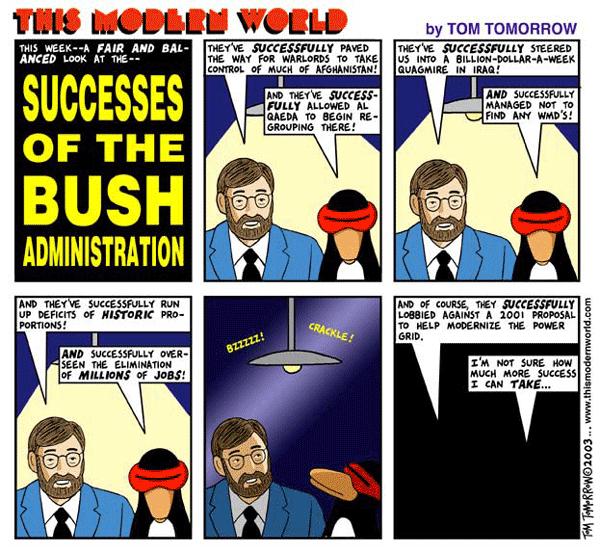
A Day Without Krugman Would Be A Day Without....The TruthIf Mr. Bush had admitted from the start that the postwar occupation might cost this much, he would never have gotten that last tax cut. Now he says, "We will do what is necessary, we will spend what is necessary. . . ." What does he mean, "we"? Is he prepared to roll back some of those tax cuts, now that the costs of war loom so large? Is he even willing to stop urging Congress to make the 2001 tax cut permanent? Of course not.Read the rest and an article about Krugman's new book here in Salon, although you have to do their "Day Pass" thing if you're not a subscriber. Monday, September 08, 2003
PERMALINK Posted
11:13 PM
by Jordan
Love That Dirty Water...Yes, I'm sure this is exactly what Congress had in mind when it passed the Clean Water Act:EPA Analysis Finds Clean Water Act Changes Would Cause Major Setback PERMALINK Posted 10:20 PM by Jordan
Blogging Into the FutureHere's an article by Matt Welch in the Columbia Journalism Review about how blogs like Confined Space are the single most significant journalistic phenomenon of the 21st century. (Well, almost...). Although he fails to list Confined Space as one of the best blogs (an all-too-common, if unforgivable oversight), it's an interesting article that is guaranteed to make many of you want to start your own blogs.Come on in, the water's fine! Labels: Blog, Journalism PERMALINK Posted 10:14 PM by Jordan
The Victims of Silicon Valley, cont'dAnother column by the New York Times' Bob Herbert on the victims of Silicon ValleyThe pristine environment is for the sake of the products, which can be ruined by even a speck of dust. At the same time, the hazardous chemicals used in the process are capable of doing devastating physical damage to the workers PERMALINK Posted 1:17 AM by Jordan
"In every case the business community got what it wanted..."First the bad news:In the past few weeks, the administration diluted federal rules governing air pollution from old coal-fired power plants; emissions that cause global warming; ballast water on ships contaminated with foreign species of plants and animals; sales of land tainted with PCBs; drilling for oil and gas on federal land; and scientific studies that underpin federal regulations.The good news is that this is from an article that appeared in the Fort Wayne News Sentinel and other Knight-Ridder outlets. Why is this good news? Because I know, and most of you who read Confined Space and similar authoritative media sources know, that the current Administration is totally under the control of the ideologues in the business community and Republican party who are, not to mince words, trying (and succeeding) to screw workers and the environment, while lying to us about every conceivable aspect of their domestic and foreign policies. But most people don't have time to read enough sources to figure out what's really happening. Which is why I'm happy to see an article like this in a middle-American newspaper. The article also explains a little about how the Bushniks like to operate in Washington: Experts say the timing of the changes wasn't accidental.Unfortunately, the author lets the Chamber of Commerce get away with this as the concluding quote: Kovacs of the Chamber of Commerce said Bush was simply borrowing a tactic that the Clinton administration routinely used.Now let's look at that. First, by definition, every President controls the agencies. That's why they're called Executive Branch agencies. Clinton didn't figure that out. Every single President in American history has known that if you're President, you control the agencies. That's part of the reason people want to be President. The issue is not that Presidents are controlling the agencies, but what they're doing with that power. The difference between the Clinton Administration and the Bush II (and to a slightly lesser extent Reagan) is that Clinton was using the regulatory power of the agencies to implement the laws that Congress passed, whereas the Republicans and their business allies are using the agencies to undermine the laws that Congress passed. Just take a look at their actions just over the past few weeks: Are they really trying to say that it was the intent of Congress when it passed the Clean Air Act that carbon dioxide, the chief cause of global warming, isn't a pollutant that the EPA can regulate? Or that Congress didn't really ever intend for old power plants to significantly reduce the pollution they generate after decades of upgrades? Or that when Congress passed the Clean Water Act they really didn't intend that scooping off the tops of mountains and dumping them into valleys, burying mountain steams, might be a violation? To put it in as simple terms as possible: They are the bad guys. We are the good guys. They need to go as quickly as possible. But for that to happen, many more people need to understand the facts that are contained in the News Sentinel and similar articles. ++++++++++ P.S. Let's play a little game, just for fun. The purpose is to show how the Republicans deliver for the business community, but the Democrats are a bit less grateful to their friends. Here's how the game works. For every reference to a business initiative or spokesperson in one of the paragraphs above, substitute "labor." Then imagine how unlikely it would be for you to ever see such an article. In the past few weeks, the administration strengthened federal rules governing organizing, issued an ergonomics regulation, along with several others, stenghtened overtime regulations, beefed up wage-and-hour enforcement, restricted government contracts to businesses that have broken the law, and [add more here]. Labels: Ergonomics PERMALINK Posted 12:13 AM by Jordan
McWane Fined AgainOSHA has fined McWane Inc. another $103,000 for 21 serious and three repeat violations at the M&H Valve fire hydrant plant in Anniston, AL. According to the Birmingham News:In the spirit of cooperation, we have agreed to settle this matter rather than dispute OSHA's determination," Thomas Walton, the plant's general manager, said in a written statement. "We realize that our company is under intense scrutiny at this time, and that we will be held to a higher standard than other companies as a result."McWane, you will of course recall, was the subject of a scating NY Times Frontline series earlier this year. If we keep this up, maybe we can finance the war. Labels: McWane PERMALINK Posted 12:02 AM by Jordan
Late Labor Day Gift: Molly Ivins Gets It, Wish More DidIt's so nice to occasionally read a column where a journalist -- in this case Molly Ivins recognizes what working people are dealing with in this country, and how the Bush administration is dissing them right and left -- actually just right.And icing on the cake is that she hasn't forgotten the first high crimes of George the W and his Republican friends: the repeal of the ergonomics standard, followed by the appointment of ergo foe Gene Scalia to Solicitor of Labor, and then deciding to solve the ergonomics problem by just not counting the injuries. Another insulting episode came when Bush named Eugene Scalia (son of the Supreme Court justice) as solicitor of the Department of Labor, apparently as a cruel joke. Scalia's specialty as a K Street lobbyist was fighting ergonomic regulations.Now can we make sure our Democratic presidential candidates don't overlook this little bit of history as well? Labels: Ergonomics Friday, September 05, 2003
PERMALINK Posted
8:42 PM
by Jordan
9/11 Coverup: Shorter James Inhofe:This is my shorter version of a press release issued by Senator James Inhofe (R-OK) rejecting a request for a hearing into why the White House ordered EPA to delete warnings to New Yorkers that the post-911 air might be hazardous.INHOFE ISSUES STATEMENT ON EPA IG REPORT Rejects request for hearing, denounces political attacks on the President In times of crisis it’s OK to lie about health hazards as long as you offer free medical screening to the With apologies to Busy, Busy, Busy More Information here and here and here and here. PERMALINK Posted 7:14 AM by Jordan
Bush Lied and Jobs DiedOK, maybe he didn’t know he was making stuff up. Maybe it was his speechwriters. His Secretary of Commerce. Anyway, it doesn’t matter. He made headlines on Labor Day, and the truth is appears several days later hidden in the back pages of the Washington Post and probably no where else.Not So 'New' After AllP.S. Read down further in the Post column: Condi Lied and Americans didn't die. PERMALINK Posted 1:04 AM by Jordan
Corrupting the Social ContractSee how many small business myths you can find in this one short article. And then ask yourself what century these guys think they're living in? (I've provided hints and heated commentary at the end.) How much would you wager that they were "briefed" by NAM or NFIB before the meeting?Small businesses speak up By Jane Hodges Times Snohomish County bureau MONROE — The state just created a $3 billion incentive package to keep its biggest employer, Boeing, but what can it do to improve the economic climate for small businesses? That was the question that state Rep. Dan Kristiansen, R-Snohomish, asked small-business owners and managers at a round table in Monroe last week. The feedback, he said, would help him create a small-business to-do list for the next legislative session in Olympia. "I was raised in a family of small-business owners, and I'm very concerned about the small-business environment," he said, noting that he once ran a small construction business. "Most of the employees in the state are employed by small businesses." Many owners and managers lamented the state's traffic snarls and inadequate road network. They also said the state needs to address tort, or liability, reform in order to reduce the potential for frivolous lawsuits. A tort-reform bill that addressed liability in construction, in medical practice and for employer references failed during the last legislative session. The small-business people also cited costly and time-intensive permitting processes and complex regulations. Deanna Taylor, a co-owner of a Ben Franklin variety store in Monroe, said she and her husband had wanted to expand their business but hesitated because of concerns about the permitting process. "We have grown with this community since 1975," she said. "It's not that we don't want to invest in the future." Business owners also provided Kristiansen — and representatives from the state Department of Community, Trade and Economic Development — with some additional concerns they'd like the Legislature to address during its next session. Among them: • Reducing fees associated with workers'-compensation and unemployment insurance. "We're one of three or four states in the union that don't let employers buy private insurance," said John Dacy, vice president and controller of Monroe-based Canyon Creek Cabinet. "This (insurance industry) is a state monopoly." • Clarifying or eliminating a state requirement that businesses secure "UL" (Underwriters Laboratories) certification on electrical machinery. Though business owners said they wanted to comply with safety standards, they said stringent UL codes and inspections can require them to rip out and rewire new machinery just to comply with UL codes. Ken Boyer, senior vice president of operations at Canyon Creek Cabinet, said he thinks only a handful of states require manufacturers to follow UL codes. He said his company will spend $350,000 on UL-related upgrades to equipment worth $1 million, even though some of that equipment is new. • Considering loosening or altering forthcoming ergonomics regulations that could raise operating costs at some businesses. Ron Wise, a supervisor at 35-year-old State Roofing in Monroe, told Kristiansen that ergonomics laws scheduled to go into effect next July would prohibit individuals from lifting weights more than 50 pounds from off the floor — a problem because State Roofing's materials are typically packaged in parcels that weigh more. Wise said the new rules would mean the company would have to double its staff to handle the same workload, reducing its profits. "This will kill the small companies first and then the big ones," Wise said. "All the roofing companies we've dealt with over the years feel the same way." • Improving economic-development programs. Douglas Roulstone, senior vice president at Thomas James International, which owns machining companies in Monroe and Wenatchee, noted that the state loses tourism business to Canada and Idaho every winter during snow season — despite the state's popular slopes — because Washington lacks the resort-style lodging those other locations have. To satisfy concerns of environmental groups, Roulstone said, developers could temper new construction with commitments to offer proportional preservation efforts, perhaps funding preservation of a set amount of forest acreage for every acre of new construction on rural land. "In the long run, you get the environmentalists and preservationists to support you," Roulstone said. "Maybe you give them a percentage of the profits (to further preservation work). "When somebody articulates a clear vision, it's easy to get behind it." Copyright © 2003 The Seattle Times Company ****** Give me a break: Not only have they bought into the ergonomics lies, but they can't even deal with UL certification. And of course we need to get rid of unemployment insurance and we sure as hell can't afford workers comp (especially with all of those musculoskeletal injuries once we get rid of the ergonomics standard). And we can't have anyone suing us, no matter what hazardous products we may produce. And we sure don't need no stinkin' permits! Only the ski guy makes the slightest bit of sense. These are almost all of the elements of worker and consumer protection that this "civilized" society has produced over the past 100 years. In this day and age, ALL of these should be considered a normal cost of doing business. And most small business people probably would consider them to be normal costs of doing business if they weren't indoctrinated by the ideological warfare being waged by the punch-drunk Bush-era business associations and right-wing Republicans who think they can get away with anything as long as they sound compassionate and keep saying how concerned they are with all of those poor, unemployed working stiffs. And speaking of lies, check out this article (found in Tapped) by David Greenberg in the Washington Monthly about why journalists, who usually love to pounce on lying politicians, seem to let Bush get away with whoppers. Here's a taste. Read the whole thing: To the axiom that journalists love lies, however, there's one important corollary -- and it helps explain Bush's Teflon coating. Reporters like only certain lies. Perversely, those tend to be the relatively trivial ones, involving personal matters: Clinton's deceptions about his sex life; Al Gore's talk of having inspired Love Story; John Kerry's failure to correct misimpressions that he's Irish. Here, the press can strut its skepticism without positioning itself ideologically. Labels: Ergonomics Thursday, September 04, 2003
PERMALINK Posted
10:29 PM
by Jordan
The Revolving DoorBushie EPA politicos make out well. But it has nothing to do with their "services" while at the EPA. Oh no. No, no, no.The Natural Resources Defense Council attacked the plans of John Pemberton, chief of staff to EPA's assistant administrator for air and radiation, to go to work for Southern Co. just "a week after the Environmental Protection Agency issued a final rule gutting a key Clean Air Act provision."But that's not all: Greg Wetstone, the NRDC's advocacy director, said the group is also concerned about Edward D. Krenik, EPA's associate administrator for congressional and intergovernmental relations, who started Tuesday at Bracewell & Patterson. The law firm represents the Electric Reliability Coordinating Council, a utility advocacy group that lobbied for the rule change.Now this pisses me off. I was a Clinton Administration official and wasn't exactly flooded with high-paid job offers when I left the administration at high noon, January 20, 2001. That's the problem with being a Democrat. Republicans have countless businesses and business associations they can get high-paying jobs at when their government "service" ends. Or there are several very well endowed right-wing think tanks. For us Democrats, there's uh, well, unions, most of whom are generally straining to avoid layoffs (and aren't exactly expanding their health and safety departments these days), or a few underfunded think tanks. Some higher level officials (higher than I) go to work for the big public affairs/political consulting firms, but most of them are "bi-partisan" these days -- which means they're hardly on the cutting edge of progressive politics. Such is life inside the beltway. PERMALINK Posted 8:52 PM by Jordan
Former IBM Employees: There are not many of us still around...The irony is that computer manufacturers are commonly thought to be the "clean" industries. The environment may be safe and clean for the computer chips, but not for the workers:Sick and Suspicious PERMALINK Posted 1:15 AM by Jordan
All The Experts Money Can BuyA colleague provided me with this article by and interview with confessed serial corporate “expert witness” Steven Moss where Moss admits to being part of a group of highly paid “expert witnesses who who are hired and paid by one side in a case, and get compensated for saying what the lawyers want to hear.”The lawyers invite potential witnesses to their offices for interviews and pepper them with questions, but the question they care most about is "Can you prove my case?"I had seen this article a while back (the article was written in March), but someone recently informed me that Moss was principal investigator for M.Cubed, the California based consulting group that wrote the critique of the proposed Washington State ergonomics rule that estimated that it would cost the state's employers $725 million a year. Now why do I find this article upsetting? I mean, any of us who have lived through the process of an OSHA regulation becoming law recognize these guys. We have suffered numerous musculoskeletal disorders as a result of repetitively shaking our heads, rolling our eyes, and raising our dropped jaws every time we heard these flacks lie and distort the scientific evidence and workers' actual experiences. And then they accuse us of using “junk science.” Moss justified his actions for a while by reasoning that both sides had their experts, so they balanced each other out. The problem, as he admits, was that It almost never does. And for a couple of reasons. One is one expert is almost always better than the other. And so, in our society economic power tends to get that expert. So it's to the highest bidder. Not always, but oftenIt is true that the huge amount of money that the industry spends on "expert" witnesses is a problem, but not always because of the quality of the opposing experts. During the OSHA’s ergonomics hearings in 2000, OSHA had its own experts (these were real experts), generally from universities around the country, most of whom had done the original research on which the ergonomics proposal was based. They were willing to offer their services, but they were not well funded enough to spend their own time and money writing testimony for the hearings or traveling to Washington to testify. Nor did anyone expect it to be a fun experience. Unlike court hearings, in administrative hearings anyone who signs up to testify can question any witness. Most of the OSHA witnesses knew that they would be up against the best attorneys and "expert witnesses" that corporate America could buy. OSHA, as it had done throughout its history, provided a stipend and expenses to those who were willing to be experts. Needless to say, the money they received was nowhere near the sums that the industry experts received. Nevertheless, the industry representatives cried foul all the way to their Republican friends in Congress who were shocked, SHOCKED! that OSHA had used tax dollars to buy "hired guns" and screamed that these amounted to procedural crimes that were alone worthy of scuttling the entire ergonomics standard. As the witch-hunt grew, Republican congressional staff began harassing OSHA’s witnesses about whether or not they were coached and demanded to inspect the e-mail on their personal computers. (Several told me later that they’d think twice about ever agreeing to testify for OSHA again.) These same arguments about OSHA improperly using witnesses came up again on the floor of Congress during the “debate” on repeal of the standard. According to a report by Congressman Henry Waxman (D-CA), one witness, Dr. Laura Punnett, an ergonomics expert and professor at the University of Massachusetts at Lowell, was rejected by the Bush Administration as a witness on NIOSH's study section that provides peer review of applications for research grants to study workplace injuries. She had been nominated by the Director of NIOSH. Dr. Punnett said upon her rejection, "I think it conveys very powerfully that part of the goal is to intimidate researchers and limit what research questions are asked.” I guess it’s OK for the industry to spend unlimited amounts of money trashing protections for workers, but not OK for the federal government to spend any money justifying its proposals. But the problem of unequal resources is even worse than that. While intimidating OSHA's witnesses, industry can – and did during the ergonomics hearings -- bring dozens of highly paid experts in from around the world to testify in Washington against worker protections. Aside from OSHA’s witnesses, the workers’ side was represented by the unions who have a shockingly small number of overworked and underpaid staff who do the research, write the briefs and testimony, organize and pay for injured workers to come to OSHA to testify, show up for weeks of hearings to cross examine the industry “experts” – while at the same time almost single-handedly running their unions’ health and safety programs. The money that the industry opponents to regulations have access to not only skews the regulatory hearings, but warps the entire policy process by (mis)informing Congress and the media about the facts. And if the lies about "junk science" and bankrupted industies don’t work, they’ve even had some success falling back on the argument that we can’t issue such a bit regulation because there’s too much controversy and not enough consensus – when their money is what’s creating the controversy and lack of consensus in the first place. Steven Moss has made his confession and said publicly that he’s sorry. Today he spends most of his time “trying to reduce the pollution from power plants in low-income communities in San Francisco." That’s nice. Really. But his past actions and the vast number of his co-conspirators means that hundreds of thousands of American workers continue to suffering preventable musculoskeletal injuries. What we have here is not just a bunch of morally challenged "experts," but corruption of the entire public policy process by corporate money. And their crimes are not just limited to OSHA regulations. Highly paid “expert witnesses" also influence wrongful-death cases; medical malpractice suits, legislative hearings, environmental regulations, utility rates and many more of the issues that are supposed to be addressed through some kind of open, democratic process. Maybe in addition to campaign finance reform, we need regulatory finance reform: at very least revealing how much “expert witnesses” are paid before they are allowed to testify. Labels: Ergonomics PERMALINK Posted 12:06 AM by Jordan
Immigrant Workers: Rest in Peace (NOT!)Immigrant workers in this country must occupy thier own special circle of hell. Often risking their lives to come here to work in dangerous, low paying jobs so that they can send a little money back home, they hope to be lucky enough to come home alive every day. Too often they aren't so lucky. They are killed on the job.But, as described in the NY Post, the abuse continues even after death: According to a report by the New York Committee for Occupational Safety and Health, of the 111 people who died on the job [in New York City] in 2000, 74 - or 67% - were immigrants, many of them here illegally.The stories are tragic and the victims and their families continue to fall through the legal cracks: Take the case of Rogelio Daza Villanueva, 43, of Sunset Park, Brooklyn. He was crushed to death on April 30, 2001, when a wooden beam came crashing down from an upper floor of a Williamsburg building he was gutting. Wednesday, September 03, 2003
PERMALINK Posted
9:19 PM
by Jordan
New Blog: Open Source PoliticsCheck out this new blog: Open Source Politics -- a group blog addressing a variety of different political issues written by a number of political bloggers. The first edition has an article, Are we safe at work? by your favorite blogger.PERMALINK Posted 7:19 AM by Jordan
A Modest ProposalThe NY Times helps connect the dots:Things are looking bad. Census Shows Ranks of Poor Rose in 2002 by 1.3 Million WASHINGTON, Sept. 2 — The number of Americans living below the poverty line increased by more than 1.3 million last year, even though the economy technically edged out of recession during the same period, a Census Bureau report shows. The spike in economic hardship hit individuals and families alike. The report indicated that the total percentage of people in poverty increased to 12.4 percent from 12.1 percent in 2001 and totaled 34.8 million. At the same time, the number of families living in poverty went up by more than 300,000 in 2002 to 7 million from 6.6 million in 2001. The number of children in poverty rose by more than 600,000 during the same period to 12.2 million. The rate of increase in children under age 5 jumped a full percentage point to 19.8 percent living below the poverty line from 18.8 percent a year earlier What is to be done? Considering that over 80,000 jobs have been shed for each month of his incumbency, President Bush's announcement that he is creating a new undersecretary of commerce post devoted to job creation is notable for its feebleness. The only detail yet clear is that the post is to be devoted to the "needs of manufacturers," and that is hardly a confidence builder for the 9 million trying to find work plus the millions more who have given up. Maybe we should just let nature take its course. One way: Emergency Rooms Get Eased Rules on Patient Care WASHINGTON, Sept. 2 — The Bush administration is relaxing rules that say hospitals have to examine and treat people who require emergency medical care, regardless of their ability to pay. Under the new rule, which takes effect on Nov. 10, patients might find it more difficult to obtain certain types of emergency care at some hospitals or clinics that hospitals own and operate. Or another E.P.A. Relaxes Restrictions on Sales of Contaminated Land WASHINGTON, Sept. 2 — The Environmental Protection Agency has relaxed restrictions on selling some land contaminated with PCB's for redevelopment, reversing a 25-year-old policy. *** PCB's, or polychlorinated biphenyls, are toxic substances that take a long time to break down in the environment. They are known to cause neurological and immunodeficiency development disorders in children. PERMALINK Posted 12:49 AM by Jordan
Why Unions Keep the Workplace SafeNathan Newman is running a series this week on "Why Unions?" where he talks about "unions promote higher wages, a stronger economy, more progressive and democratic politics, and how unions have been key to fighting race and sex discrimination."One issue he seems to be leaving out is how unions promote safer workplaces. If he wants more information on that, he need look no further than the Hazards site on the "union effect" on health and safety. As the health and safety director for AFSCME, I got to witness "the union effect" first hand, from a better vantage point than most. About half of our members weren't covered by OSHA. A good number didn't even work in states where public employees had collective bargaining rights. So I got to witness workers with unions and OSHA, workers with unions, but without OSHA, workers without unions, but with OSHA and workers with nothing (no OSHA, no union). The workers that were best at protecting their health and safety were those with an active, well educated health and safety committee, whether or not they were covered by OSHA, and whether or not they were covered by collective bargaining laws. Organized workers, who know what hazards they are facing, who can document the problems in their workplace and back them up with some evidence, and -- most important -- who have the workforce behind them, willing to take collective action -- refusing to work, going to the press, informational picketing -- made the most progress against unsafe working conditions. It's great to have OSHA standards and OSHA enforcement to back you up. But without the union, and without an active health and safety committee, OSHA might as well be a town in Wisconsin for most workers. You might also want to check out the Economic Policy Center's new publication How unions help all workers. Let me count the ways: • Unions raise wages of unionized workers by roughly 20% and raise compensation, including both wages and benefits, by about 28%.Regarding health and safety in particular, the report cites two studies of OSHA and unions in the manufacturing and construction industries (1991a and 1991b), Weil found unions greatly improve OSHA enforcement. In the manufacturing industry, for example, the probability that OSHA inspections would be initiated by worker complaints was as much as 45% higher in unionized workplaces than in nonunion ones. Unionized establishments were also as much as 15% more likely to be the focus of programmed or targeted inspections in the manufacturing industry. In addition, Weil found that in unionized settings workers were much more likely to exercise their "walkaround" rights (accompanying an OSHA inspector to point out potential violations), inspections lasted longer, and penalties for noncompliance were greater. In the construction industry, Weil estimated that unions raise the probability of OSHA inspections by 10%. PERMALINK Posted 12:33 AM by Jordan
Organizing AND Health & SafetyI wrote the other day about the alleged conflict between organizing and health and safety. UNITE’s campaign to organize Cintas shows over and over again, that organizing and health & safety go together like corned beef and rye (or like rice and beans). UNITE has made health and safety issues a central part from the beginning of its campaign to get the Cincinnati-based laundry services company to recognize the union.Focusing on health and safety is not just a matter, as some would allege, of exploiting a non-existent issue to fire up pro-union passions, but a process of educating workers about their right to a safe workplace and their right to complain to OSHA if their safety is being threatened. And they’ve begun to see some results: OSHA accuses area Cintas of 30 violationsMore Labor Day articles on the Cintas campaign here and here and here. Tuesday, September 02, 2003
PERMALINK Posted
10:51 PM
by Jordan
Out of Sight, But Never Out of DangerRunning AFSCME's health and safety program was never dull. You were always dealing with hazardous work that no one ever saw or thought about. The deadliest jobs among AFCME members were in highway work zones, most often for those who worked at night -- getting hit by oncoming traffic, or too often, getting hit by work equipment.This article in the Tampa Tribune addresses many of those hazards: Before midnight, under a span of Interstate 275, a bulldozer and 160-foot crane belched diesel fumes as work crews labored to widen the highway.But there's one major difference between these workers and the ones I used to work for. These aren't public employees, they're private contractors. More and more of the fatalities I see in roads and public works are private contractor employees, rather than public employees. Like refineries and other manufacturing jobs, employers seem to be contracting out the most dangerous work. Ironically, in some states, contracting out public employee jobs can theoretically make them safer. In Florida, for example, public employees aren't covered by OSHA. It's perfectly legal for a public employee to dig a 15 foot trench without any shoring, whereas a private contractor could be cited by OSHA. Of course, this is only theoretical, as most of the contractors aren't organized and probably have less health and safety consciousness than more unionized public employees and are less likely to file an OSHA complaint. And then there's this factor that I never knew about: Andy Carroll, a civil engineer, has worked on the I-275 widening since it began in October. Although he generally works days, Carroll switches to nights when those projects require engineering.What kind of incentive system is this? The less safe the job, the more money the company makes. I wonder if the guys working out on the highways, inches away from speeding traffic in the middle of the night know about the terms of the contract. Labels: Public Employees PERMALINK Posted 7:15 AM by Jordan
Violence Against Federal Lands Employees on the RisePublic Employees for Environmental Responsibility (PEER) report that violence and threats of violence against Forest Service employees, BLM rangers, range specialists, and U.S. Fish and Wildlife Service employees were up in 2002 over the previous year."When park rangers are 10 times more likely to be assaulted than agents of the DEA [Drug Enforcement Administration] and 12 times more likely than FBI agents, a reasonable person would say the agency needs immediate change," said Randall Kendrick, director of the U.S. Park Rangers Lodge of the Fraternal Order of Police."These numbers may only be the tip of the iceberg, as many people in the field are discouraged from reporting threats and assaults," PEER's Eric Wingerter said. Source: Grist Labels: Public Employees, Workplace Violence PERMALINK Posted 12:02 AM by Jordan
Quote of the Week"Changing the attitude at OSHA (the Occupational Safety & Health Administration) ...We made them advisory."-- Congressman Cass Ballenger (R-NC), when asked about his proudest accomplishment as an elected official. Monday, September 01, 2003
PERMALINK Posted
11:02 PM
by Jordan
It's Labor Day, and many American workers seem pretty angryThis is the first line of an article in the Minneapolis Star Tribune. And, as my kids would say, "Well, duh!" Why are American workers angry? Let me count the ways:Too Much Work The Star-Tribune article deals with the Administration's overtime regs that will take away overtime from millions: Faced with the possible loss of overtime pay, more than 76,000 workers have flooded the U.S. Department of Labor with reactions to proposed changes in the Fair Labor Standards Act.That's a hell of a lot of comments. The Washington Post yesterday deals with the same issue. And here's a fact that most Americans don't realize: In the United States, unlike many other industrialized countries, there are no federal laws limiting the number of hours that employees are compelled to work. But the Fair Labor Standards Act of 1938 set a workplace standard of 40 hours a week by requiring employers to pay non-management workers time-and-a-half for every extra hour worked in one week.The problems is that in times when the economy is slow and unemployment is high, employers tend to take advantage: Business groups and labor activists agree that many companies, pressured to hold down costs in a globally competitive environment, often ask employees to work longer than the standard American 40-hour workweek. And when the work is voluntary and fairly compensated, they say, that's a good thing -- for the employees who want the extra income and for the economy in general.The result? Americans work more than many other people in developed economies, according to a recent report by the International Labor Organization, a United Nations agency that monitors workforce conditions. The ILO found that American workers put in an average of 1,825 hours per year, far more than workers in most European nations. French workers, by contrast, are employed an average of 1,545 hours per year, and German workers about 1,444 hours.Too Few Jobs UNITE'S President Bruce Raynor talks about the loss of manufacturing jobs in the context of the bankruptcy of Pillowtex Every manufacturing industry in the United States -- apparel, textiles, metals, paper, electronics -- has lost jobs in the past year. Over the past 36 months manufacturing employment has declined by 2.7 million. This is the longest decline since the Great Depression. The job crisis is not only in manufacturing. Since the economic recovery began, more than a million jobs have disappeared. Apparently the economy is doing well. Only workers are suffering.The result: More fodder for Wal-Mart and McDonalds: The workers are now desperate. They received no severance payments. Their health insurance is gone. Mortgages, car payments and taxes aren't being paid. Kannapolis, N.C., where Pillowtex is located, has always been a textile town. There are no other jobs available. And while the union is still trying to find a buyer for the company, the local government's response for economic development is to buy an ad in USA Today or the Wall Street Journal asking Bill Gates, Oprah Winfrey or Warren Buffett to consider moving some of their business operations to Kannapolis.Even the NY Times seems to have noticed: Even though the recession ended nearly two years ago, polls show that American workers are feeling stressed and shaky this Labor Day because the nation continues to register month after month of job losses and wages are rising more slowly than inflation.Too Few Grownups in Charge Bob Herbert at the NY Times thinks the problem is that there is not enough adult supervision: And then in a take-off riff from John Lennon's "Imagine" Imagine if we had done some things differently. If, for example, instead of squandering such staggering amounts of federal money on tax cuts and an ill-advised war, we had invested wisely in some of the nation's pressing needs. What if we had begun to refurbish our antiquated electrical grid, or developed creative new ways to replenish the stock of affordable housing, or really tackled the job of rebuilding and rejuvenating the public schools? PERMALINK Posted 10:37 PM by Jordan PERMALINK Posted 8:57 PM by Jordan
The Weekly TollThis one is too sadDreams of success die with immigrant Fulgencio Sosa Cortes’ dream died with him on June 12, one day before his one-year anniversary in America, when a felled tree fatally injured him while he was on a job site at a private home in Jackson. He leaves behind a beloved wife, two adoring children and an unfinished dream. Weather/Construction Collapse Kills Worker Jose Arellano, 29, of Irving died and four other unidentified men were injured when they became trapped for nearly an hour under a construction site at 3200 block of Guildford Lane near Hardin Boulevard. Sudden straight-line winds rolled into the area, causing the second story of an adjacent construction site to blow on top of the two-story wooden frame the men were working on, said McKinney police Capt. Robert Dean. Death of 18-Year Old in Fall Palm Beach County sheriff's deputies and OSHA agents are investigating the death of an 18-year-old Broward County construction worker who fell down an elevator shaft at Delray Medical Center Tuesday morning. Salvador Cruz of Fort Lauderdale fell three stories down a hole in the roof of the building, investigators say. Bridge worker drowns A worker on the Fort Pitt Bridge construction project drowned in the Monongahela River Friday afternoon after falling out of a boat used to transport workers from a pier work site. The Allegheny County Coroner's Office identified the victim as James Warren, 29, of Conneaut, Ohio, an employee of Cleveland-based L.M. Lignos Enterprises. Logger killed by falling treetop Thursday, August 28, 2003 WALLINGFORD, Vt. - The Vermont State Police are investigating the death of a logger who has hit by a treetop that fell on top of him. Raymond Petrossi, 53, of Wallingford was pronounced dead late Tuesday night at the remote scene in the woods off Hartsboro Road, police said. Electric Worker Killed in Mishap Another worker hurt in Auburndale power pole accident. AUBURNDALE, FL -- An electrical worker was killed and a second employee injured when a power pole became electrified and shocked both men at their job site off of U.S. 92 in Auburndale on Wednesday afternoon, Tampa Electric workers said. Antonio Severson, an employee with Mastec of Asheboro, N.C., died at Lakeland Regional Medical Center, said Milton Little, a lead supervisor for TECO. Lewisville man killed in construction accident A Lewisville, TX, man was crushed to death while he worked on the construction of a new Home Depot in Carrollton during the brief thunderstorm that passed through the area on Sunday night. The worker who died was 25 years old. His name is being withheld pending the notification of his next of kin. "We suspect his family lives in Mexico, and we're trying to find them," Sponhour said. What is this? Yet another unkown worker killed by an unknown cause. Police give construction site death case to OSHA LAWRENCEVILLE — Police have turned over the investigation of a man who died Friday at a construction site to the Occupational Safety and Health Administration (OSHA). The unnamed victim died while working at a construction site near Jimmy Carter Boulevard and Peachtree Industrial Boulevard, where a shopping center is being built. He was dead when fire officials arrived, said Gwinnett Fire spokesman Chief Randy Robinson. Gwinnett Police handled the incident but did not have any details about the death as of press time, said police spokesman Cpl. Dan Huggins. Georgia trucker dies in forklift accident COLUMBIA, S.C. -- A trucker from Ocilla, Ga., has died after he was struck by a forklift at a paper plant, authorities say. Arnold Wayne Southard, 64, was hit by the forklift at Paper Stock Dealers around 3 p.m. Monday and died from multiple trauma less than six hours later, Richland County Coroner Gary Watts said. Accident in N.Ky. kills Bell lineman PETERSBURG - A Cincinnati Bell worker died Wednesday in western Boone County after becoming entangled in a spool of telephone wire. Cletus Charles Woeste, 58, of Villa Hills was pronounced dead at the scene. The official cause of death was severe head injuries. Woeste was hanging lines along a gravel road when his clothing or safety belt was caught in a winding spool of wire, said Boone County Coroner Doug Stith Labels: Weekly Toll Sunday, August 31, 2003
PERMALINK Posted
11:47 PM
by Jordan
Public Employers: Free From Ideological B.S?I wrote the other day about a city in North Carolina that had received an OSHA citation and used it as inspiration to improve their health and safety program. Now we have another town in Kentucky that is forming an "OSHA Compliance Committee" to bring the city into compliance with the state's OSHA regulations. This action was also in response to an OSHA citation that resulted from an employee's complaints.County to form OSHA compliance groupI'm not sure if this is a pattern, but it is interesting that public employers often seem to be far less hostile to OSHA than private sector employers, just as they seem to be generally much less hostile to unions and organizing than private sector employees. My hypothesis is that many private sector companies have been led astray (contaminated) by the government affairs people either in the Washington office (of large companies) or (for smaller companies) in the associations they belong to, like the National Association of Manufacturers or the National Federation of Independent Businesses. In other words, in a better world, the behavior of small businesses might be similar to the constructive behavior of these municipalities if it wasn't for the fact that the small (and large) businesses were ideologically contaminated by the assocations, the Republican party and their Government Affairs types. Why, you ask? Is it because the Republicans get more support if the business community thinks the sky is falling? Is it because business associations get more members if they scare the shit out of small businesses? Good questions! To be explored more later.... Labels: Public Employees Saturday, August 30, 2003
PERMALINK Posted
4:30 PM
by Jordan
Workplace violence in the health sectorGlobal service sector union federation PSI and the ILO, International Council of Nurses (ICN) and the World Health Organisation (WHO) have, as part of a Joint Programme oan Workplace Violence in the Health Sector, published Framework guidelines for addressing workplace violence in the health sector. The organisations say workplace violence is a global problem affecting all sectors, but the health sector is at major risk. Violence in this sector may represent a quarter of all violence at work, and more than half of health workers may be affected. (From Hazards)PSI World News. Full report: Framework Guidelines for addressing workplace violence in the health sector Labels: mental health workers, Workplace Violence PERMALINK Posted 12:02 AM by Jordan
They Say It's My BirthdayThey say I'm turning 50 today. (I know, I don't write like I'm a day over 30). One thing about having your own blog is that occasionally you can be self-indulgent and write about whatever you feel like.I find this very hard to believe.... That it's my 50th birthday. Twenty years ago I was only 30, an age I still feel very close to. But 20 years from now, I'll be....Well, I don't really want to think about it. I mean, I'm still a very young, cool dude...despite what my teenage children think. At this age, you finally have to admit that you're starting to approach the dawn of early middle age. And it's at this time in life that I really start to realize that: -- I will probably never play center field for the Dodgers. -- It's becoming increasingly unlikely that I will ever be President of the United States. Even my senatorial aspirations are looking a bit shakey. -- I probably won't be the lead singer in any band playing RFK Stadium -- My academy award chances may be slim -- even for one of those lifetime achievment awards. So what do I have to show for myself? If "It's a Wonderful Life" were made about me, what would the world have looked like without me? And what can I contribute for the rest of my productive years? How will my children see me? Is it time to finally face my deepest fear. Actually my deepest fear is that by the time we get another Dem in the White House, I'll be 55 (or if we have another Reagan-Bush three term thing, I'd be.....Well, I don't really want to think about that either. This is the time to put all of those day-to-day issues aside and try to find the answers to these and other difficult existential questions. But this is also the time when a Sopranos rerun is on T.V. I can always contemplate again on my 55th birthday. P.S. If your really want to get me a present....All I'm asking for is to GET GEORGE BUSH OUT OF THE WHITE HOUSE NEXT YEAR. Friday, August 29, 2003
PERMALINK Posted
9:06 PM
by Jordan
Yet Another Reason That Unions Are Security RisksBush Holds Federal Pay Raise to 2% in 2004George the W has decided that federal employees (other than the military) should only receive 2% raises next year, as opposed to the 4.1% that the President has proposed for the military and that the House Appropriations Committee last month backed for all federal employees. The reason? In a letter to congressional leaders, Bush said the larger increase "would threaten our efforts against terrorism or force deep cuts in discretionary spending or federal employment to stay within budget."Does this mean that those who advocate for a larger federal payraise are "threatening our efforts against terrorism?" If so, John Sweeney better start packing his bags for Guantanemo: AFL-CIO President John Sweeney said the president's action was "shameful, and makes clear that Bush is making federal employees pay for his own fiscal recklessness."And, of course, there's the obvious point made by Tapped: Tell us, Mr. President, do massive tax cuts for the wealthy, which balloon federal deficits and starve the government of needed funds, also threaten our efforts against terrorism? By your logic, yes. PERMALINK Posted 12:26 AM by Jordan
That's the Proper Spirit!If only all employers would take OSHA citations in such good spirit!In response to both of the violations, [town manager Jim] Fatland said, “Learning from our mistakes will make us stronger tomorrow,” and he added, “the Town of Tryon is very appreciative to OSHA for working with us to improve the safety for our employees.”I'm nominating them for Employer of the Week. Thursday, August 28, 2003
PERMALINK Posted
12:36 AM
by Jordan
Labor Day at the AFL-CIOCheck out the AFL-CIO's Labor Day Web page. And send some "e-cards" to friends and relatives.Labels: AFL-CIO PERMALINK Posted 12:30 AM by Jordan
Who's To Blame?The big news yesterday was the release of the Columbia space shuttle disaster report. Check it out here. It makes for fascinating reading, especially Chapter 8, which was written by Dianne Vaugh, who wrote the classic work on the original Challenger disaster. In Chapter 8, "History as Cause: Columbia and Challenger" she explores the systemic failures of the NASA safety system and how the problems uncovered after the Challenger disaster reappeared to cause the Columbia's problems.The most interesting parts of the report focuses on the management system problems rather than individual failures. Vaughn cautions however that the Board's focus on the context in which decision making occurred does not mean that individuals are not responsible and accountable. To the contrary, individuals always must assume responsibility for their actions. What it does mean is that NASA's problems cannot be solved simply by retirements, resignations, or transferring personnel.The footnote accompanying this paragraph states Changing personnel is a typical response after an organization has some kind of harmful outcome. It has great symbolic value. A change in personnel points to individuals as the cause and removing them gives the false impression that the problems have been solved, leaving unresolved organizational system problems.Which makes the following headline from the New York Times "interesting": Human Error Likely Cause of Blackout, Timeline Says So, let me get this straight. Does this mean that a simple human booboo resulted in the gigantic blackout that swept parts of eight states and eastern Canada, cost billions of dollars and darkened the homes of millions of people? And does this imply that a slap on the hand (or maybe even jail time) will fix the electrical grid problem? The only "substance" behind that headline is a quote from an unnamed investigator: "Had all of the existing policies been followed, this would not have developed into a cascading event," the investigator said. "What we see are institutional breakdowns, not a breakdown of the system itself."Those who do incident investigations realize, however, that the fact that procedures were not followed are rarely due to human failure. It is far more likely that the procedures were confusing or didn't anticipate the situation that the operators found themselves in. Some people also blamed the Three Mile Island accident on the plant operators: If proper procedures had been followed, the near-disaster would have been a small unnotable incident. But the failure at TMI can more accurately be blamed on the fact that the information that the operators had available to them at the time was confusing, conflicting and inaccurate, and they had not been trained to address the specific situation they were facing. In other words, given the knowledge they had, the "standard operating procedures" were almost useless. It may be theoretically possible to trace everything that happens in the world to humans (or nature). But in reality, barring sabotage or horseplay, there are few, if any, cases where the root cause of an incident -- workplace injury, space shuttle disaster, or huge blackout -- could be blamed on "human error." Human error may be one of the "direct causes" of an incident. A direct cause is the action that directly results in the occurrence, while root causes are usually management system problems which, if corrected, would not only have prevented that specific problem, but other similar problems as well. Rather than focusing on the operators who make the errors, modern accident analysis looks for the conditions -- or root causes -- that made the errors possible. And now check this out: AK Steel suspends 11 workers after fatal accident MIDDLETOWN, Ohio - AK Steel Corp. has suspended 11 workers in connection with an overhead crane accident that killed a worker last month at the company's Middletown Works mill, a union official said. Now I don't know any more about the details of this incident that what you can read from this article, but let me just suggest that you go check out that footnote above again. Labels: Blame the Worker PERMALINK Posted 12:15 AM by Jordan
Union Health and Safety Programs: Organize and Die?Last April, in one of my first postings, I opened a debate about whether the almost exclusive focus of several AFL-CIO unions on organizing was a threat to union health and safety programs.The March 9 New York Times quote by John Wilhelm, president of the Hotel Employees and Restaurant Employees (a union that has chosen not to have a health and safety program), sent shivers up the spines of union health and safety activists: "the A.F.L.-C.I.O. was spread too thin and should devote more of its money and energy to organizing. Mr. Wilhelm said he would even consider ideas like eliminating the federation's respected health and safety department to channel more money into organizing.This statement has caused quite a bit of concern among union health and safety staff, as well as rank and file activists about the role of health and safety programs in unions, especially in the context of the obvious need to increase resources dedicated to organizing. Is there, or should there be a conflict between health and safety programs and organizing? Is it a zero-sum game? Harold Meyerson has written an excellent article in the American Prospect entitled "Organize or Die" about the struggle within the AFL-CIO over organizing strategies. He highlights the labor movement's left wing organizing "stars:" SEIU's Andy Stern, Hotel & Restaurant Workers' John Wilhelm, and UNITE's Bruce Raynor, and also discusses the efforts of Carpenter's President (and AFL-CIO dropout) Doug McCarron and Laborers' President Terry O'Sullivan. Stern, Raynor and Wilhelm rose through the union ranks on their organizing successes and continue to show how to build a union even in these tough political and economic times: SEIU under Stern has grown by a stunning 535,000 new members so that it is now, at 1.5 million members, the largest union in the federation. The SEIU has had notable successes organizing home-care, nursing-home and hospital workers, and has continued to organize the janitors who clean America's office buildings.Meyerson discusses the debates within the federation about how best to organize (focusing on sectors as HERE and SEIU are doing, using students and outsiders as SEIU tends to do, or rank and file union members as CWA favors), the idea of complimentary unions working together (e.g. janitors and hotel workers) instead of fighting over the same territory (e.g. public employees), the success or failure of John Sweeney, etc . While health and safety issues are not mentioned in the text of the article, the debate over the role of labor health and safety programs in an "organize or die" environment can be read between the lines: Just as notable as the SEIU's success is the way it's been achieved. At Stern's prodding, the union now devotes about half its budget to organizing. The SEIU has hired hundreds of young people off college campuses or from community organizing groups to staff its campaigns. As existing staffers have been reassigned to organizing, locals have often had to train members to do the work of servicing their fellow members that the paid staff had previously performed.Labor health and safety activists remember well that when Andy Stern took over SEIU he decimated one of the labor movement’s largest and most active health and safety programs, leaving only one Washington representative to address the giant union’s abundance of health and safety issues. As mentioned above, Wilhelm has been quoted as advocating elimination of the AFL-CIO's health and safety department. At a 2001 AFL-CIO Executive Council Meeting, Wilhelm suggested reallocating federation resources to address the problem: 75 percent of the AFL-CIO's budget should be split equally between politics and organizing, with the remaining 25 percent allocated to other programs that contributed to those goals.(Transferring services from the AFL-CIO to the individual unions is a rather ironic statement considering the cuts that Stern has made in SEIU's program and that Wilhelm has no health and safety program. Both unions rely on the AFL-CIO health and safety department for health and safety assistance.) In addition to sowing fear into the hearts of those who have dedicated their careers to developing labor health and safety programs, this debate has forced to address one basic question: Why do unions need health and safety programs? Are they necessary for a vibrant labor movement or are they a remnant of the old “servicing model” of unions? Aside from the obvious issue of saving lives and preventing injuries and illnesses, building the union and organizing new members is a pretty good reason to have a health and safety program. PACE activist Diane Stein discussed this issue on winning NYCOSH’s Silwood award, People join unions because they need better work lives. Safety and health is a huge part of that struggle…. People join unions because they know that unions are the only institution who really put forward their agenda. We cannot abandon that agenda because we need resources for organizing. It simply doesn't make sense.As one health and safety activist pointed out to me, fabled organizer Mother Jones’ famous line, “Mourn for the Dead, Fight like hell for the living” was all about workplace safety. In other words, potential union members need a reason to join a union. Respect and better pay and benefits certainly lead the list of reasons in most cases, but saving lives and preventing injuries and illnesses are compelling reasons to to join a union in workplaces where health and safety problems exist. Most health and safety staffers are anxious to get involved in organizing campaigns, but complain that it’s often difficult to convince the organizers that health and safety is a good organizing issue and to involve health and safety issues in the initial conceptualization of organizing campaigns. On the other hand, some of the fault may lie within. When I first engaged in this debate last April, one long-time union health and safety activist responded that “Workers have always organized unions for better working conditions. This is not a diversion from organizing; it is its essence.” But she went on to criticize her (former) self and other health and safety “nuts” who had gotten so immersed in health and safety issues that they had “ gotten fat and lazy and forgot to organize.” These are problems that we have failed to acknowledge and address. How are the structures we are building around health and safety building our unions? What role are the leaders who are first organized around health and safety issues taking in building bigger and stronger unions? What changes do we need to make to tie health and safety issues more closely to organizing a big, powerful and progressive Labor Movement?Others are critical of many unions’ dependence on government grants which prohibit health and safety trainers from getting involved in organizing campaigns and tend to skew health and safety activities toward grant targets which may or may not be in tune with the union’s organizing targets. Although without the grant programs, many union health and safety programs would practically cease to exist. Some unions have gotten the idea. AFSCME’s health and safety manual takes an organizing focus. Chapter 1, “ORGANIZING FOR A SAFE AND HEALTHY WORKPLACE” starts with the factors that make health and safety a good organizing issue: · Health and safety affects all workers. · Health and safety issues can be won. · Health and safety concerns can move workers to take action. Throughout the handbook, basic organizing principles are applied to health and safety problems. UNITE’s organizing drive at Cintas is one of the few that integrates health and safety issues into the campaign. Unfortunately, campaigns like Cintas are more the exception than the rule, despite the efforts of union health and safety to integrate health and safety into organizing. Aside from building the union and assisting in organizing campaigns, there are a few other reasons why unions need health and safety programs: 1. Health and safety programs save lives, prevent injuries and illnesses. If unions can’t save your life, what good are they? And when it comes to protecting workers’ safety and health, a knowledgeable, well-organized local union is better than all the regulations in the world. It’s hard to count workers who don’t die or who don’t get hurt or sick. But they exist. While union activists may see unions as an inherently good things, most workers want some good, concrete reasons to organize and pay their dues to unions. For many union members, union resources that are used to train rank and file activists in how to investigate and organize around health and safety issues is a service well worth paying some dues money for. And some health and safety problems – fatality or health hazard investigations need the expertise provided by experts in a national union program. The “servicing model” of many unions may ultimately be a dead end, but that doesn’t mean that in some cases, workers don’t need services that only professional union staff can offer. (For information on how unions help to protect workers health and safety check out Hazards.) 2. Health and safety programs provide organizing and health and safety skills to rank and file activists. Local rank and file activists may run organizing campaigns and health and safety programs better than union staff, but many of the skills and much of the knowledge need by health and safety activists can be intimidating for newbies without training sponsored and conducted by union health and safety professionals. 3. Need for coordination between workplace conditions and local/national political battles. Forcing OSHA to issue health and safety standards or to enforce the law is no longer a simple administrative process. To be successful, unions need to organize massive grassroots political action campaigns. It takes coordination from the AFL-CIO and national unions, it involves organizing the victims of health and safety problems on the local and national level and it takes political action in Washington and in the states. It took over a decade of nationwide organizing to get OSHA to issue its ergonomics standard in 2000, yet in a matter of hours, the labor movement was out-organized by the business community in Congress and the ergonomics standard was lost. To achieve future gains and to prevent future losses, health and safety issues have to be integrated with organizing and political action programs. 4. Union Health and safety programs stimulate and support research into illnesses and injuries caused by work. It is well known that workers are the proverbial canaries in the coal mines: Almost every major workplace health problem was initially discovered by workers and their unions, and then brought to the researchers and government regulators. The state of health and safety research in this country may not be as popular or well funded as we might wish, but imagine what it would be like without unions to detect the problems and provide the populations to study. ++++ These are not easy issues, but they need to be addressed by health and safety activists. Within a couple of years, the AFL-CIO may elect a new president. If it’s one of the organizing "stars," what will become of the AFL-CIO’s health and safety department, and departments in the individual unions? Can the case be made that health and safety programs are an integral part of organizing, rather than a costly distraction? These are my thoughts. I encourage you to support or slam them. E-Mail me. Let me know if I can post your thoughts, and whether or not you want to remain anonymous if I decide to publish them. Labels: AFL-CIO, Ergonomics Wednesday, August 27, 2003
PERMALINK Posted
7:18 PM
by Jordan
PERMALINK Posted 7:25 AM by Jordan
Attention Walmart Workers: Go to HellGood article in today's Washington Post by the American Prospect's Harold Meyerson contrasting Walmart encouraging the downward slide of wages in this country, as opposed to the effect of the early auto industry which pushed workers' wages up to the point where they could buy houses.The nation's largest employer, with 3,200 outlets in the United States and sales revenue of $245 billion last year (which, if WalMart were a nation, would rank it between Belgium and Sweden as the world's 19th largest economy) doesn't pay its workers -- excuse me, "associates" -- enough to buy decent cars, let alone homes.Actually, Meyerson doesn't go far enough. As other authors have pointed out, Walmart "associates" don't even make enough money to shop at Walmart. Meyerson points out that Walmart's practices threaten not only the wages of Walmart workers and other service employees, but also the ability of workers to organize: Wal-Mart's expansion into non-southern metropolitan areas, the company poses a huge threat to the million or so unionized clerks who work at the nation's major supermarket chains.And finally, what does this say about democracy (economic and political) in America? It may just be me, but I don't recall the moment when the American people proclaimed their preference for an economy driven by Wal-Mart to the one driven by General Motors. It is, after all, one thing to live in a nation where the largest employer wants workers to make enough to afford its cars; quite another to wake up in an America where the largest employer wants workers to make so little they'll be compelled to buy low-end goods in a discount chain. Indeed, polling has consistently showed that a clear majority of the American people have been dubious about the benefits of free trade -- but these are the only polls that the political elite, so poll-driven on other questions, has consistently ignored. By the same token, polling also shows that Americans believe workers should have the right to join unions free of intimidation, yet that has not been the case in the American workplace for at least the past three decades.Update: Check out Carter Wright for more on Walmart's anti-union campaign.
| | |||||||||