Showing posts with label Mine Safety. Show all posts

Thursday, January 04, 2007

New Mine Safety Laws Slowww To Take Effect

Boy those mine companies are really busting their balls to provide rspirators for miners. They can't help it if there aren't enough respirators to go around. But Charleston Gazette reporter Ken Ward writes that something's rotten in the state of West Virginia.
A year after the Sago Mine disaster, thousands of West Virginia coal miners are still waiting for the additional emergency breathing devices promised by Gov. Joe Manchin and the coal industry.

Many of the state’s mine operators have placed orders with the nation’s largest manufacturer, CSE Corp., and could be waiting until late 2007 for delivery. CSE’s biggest competitor, Ocenco Inc., has an even longer waiting list.

“My sense is that there is a tremendous backorder,” said Chris Hamilton, a vice president for the West Virginia Coal Association.

Turns out Hamilton's "sense" is "nonsense."
At the same time, another supplier, the German company Draeger, has thousands of self-contained self-rescuers, or SCSRs, sitting in a warehouse.

“We don’t have a backlog at all,” Wes Kenneweg, president of Draeger’s North American operations, said in an interview earlier this month.

At Draeger’s warehouse near the Pittsburgh airport, more than 6,500 of its OXY K-Plus units fill row after row of shelves.

“We haven’t had that many orders,” Kenneweg said.
Uh, maybe they could try leafing through the phone book.

And what's wrong with this picture? It seems that although the West Virginia and federal mine safety laws require mining companies to provide more rescue respirators throughout the mines, and provide a plan by last August for how many respirators must be provided and where they'll be located, Ward reports that
neither state nor federal officials have actually required companies to buy the devices and give them to miners.
Of course, not everyone is happy to wait:

Phil Smith, a spokesman for the United Mine Workers, said that the union is concerned about delays in getting SCSRs into the nation’s coal mines.

“They need to have these units, and it’s obviously better to have them sooner rather than later,” Smith said.

***

In his report on the Sago disaster, former MSHA chief Davitt McAteer urged the mining industry not to delay safety improvements waiting for complete answers or perfect technology.

“The unmistakable message of the Sago Mine disaster is that we cannot afford to wait,” McAteer wrote.


And it's not hard to understand why no more time should be lost. The need for improved respirators is nothing new. The Federal Coal Mine Health and Safety Act of 1969 required rescue respirators that would provide at least one hour of air, but the regulations that actually implemented the requirement were not finished until 1981. It became clear very soon that one hour of air was not enough, and the Clinton administration began the process of developing regulations to requre more respirators and better technologies. But -- and how many times have we heard this before? --

the effort wasn’t completed, and the Bush administration scuttled the proposal after taking office in 2001.

Reform of SCSR rules gained political traction again only after 12 miners died in the Jan. 2 Sago disaster, two more in the Aracoma fire and five in the Darby disaster.

Now, we have laws reqiring more and better respirators, but the companies seem to be shopping only at the establishments that have backlogs. And you don't want to interfere with their freedom to shop where they want:

Terry Farley, administrator for West Virginia’s mine safety office, said that his agency continues to accept purchase orders to show compliance. Soon, he said, inspectors may start asking to see letters from SCSR supplies showing estimated delivery dates.

“Our folks have been told to check and make sure nobody is stalling,” Farley said.

Still, there’s little the state can do to force companies to switch to another company that has units available, Farley said.

“At this point, we cannot tell people what brand to buy,” Farley said.

Bruce Watzman, a lobbyist on safety issues for the National Mining Association, was surprised to hear that Draeger had so many units on hand.

“I thought the available units were being purchased and utilized,” Watzman said. “But that boils down to individual company decisions about what unit is the best for the needs of their employees.”

I'm sure miners don't mind waiting....at least until the next fire.

Friday, November 24, 2006

Aracoma Mine: Forgetting The Lessons From The Dead?

New information has emerged on the causes of the fire at the Aracoma Alma No. 1 mine last January that killed two miners. Ken Ward of the Charleston Gazette reports that because of understaffing, the West Virginia Office of Miners’ Health, Safety and Training did not complete its sheduled inspection of the mine in the quarter preceding the fire. By law, West Virginia mines are supposed to be thoroughly inspected four times a year. In addition the state inspector was not able to see many parts of the mine because Massey, the mine's owner, refused to provide transportation to the inspector, in violation of state law.

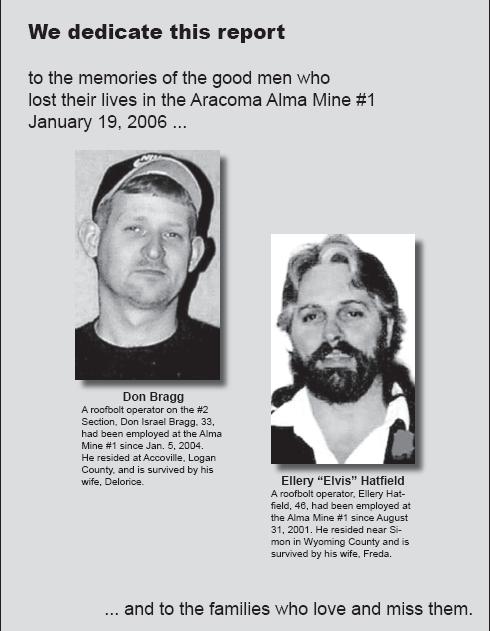
A report earlier this month found that a missing wall contributed to the deaths of miners Don Bragg and Ellery Elvis Hatfield
The missing ventilation wall, called a stopping, allowed smoke from a conveyor belt fire to enter the Aracoma Mine’s primary escape tunnel.

By law, such escape tunnels are supposed to be kept isolated from conveyor belt tunnels because of the dangers of fire and smoke that belts create in underground mines.

During the Jan. 19 fire, a crew of workers hit smoke during an attempted escape and had to find an alternate route
Brag and Hatfield became separated from the group and died of smoke inhalation.

In another Gazette article, Ward reveals that two Massey foremen knew about the missing wall before the fire. The two foremen, in addition to a number of other Massey supervisors received citations from state authorities for not evacuating the mine in a timely manner, allowing non-certified workers to perform safety examinations in the mine, failing to provide an accurate mine map, and not reporting the fire to state authorities for two-and-a-half hours.

Finally, a Charleston Gazette editorial explains how overlooking mine safety laws means we're forgetting the lessons from those who have died in the mines:
Richard Stickler, new head of MSHA, talks smart and tough on mine safety. He says America has more safety laws than it now uses, that it has tools to shut down unsafe mines, get the attention of bad operators and straighten them out. Also, Congress has added money to MSHA’s budget to restore inspectors that the agency needs. We hope Stickler carries out these strong plans.

Every safety rule was passed because of miners’ deaths. Every law about ventilation, roof supports, spreading rock dust to prevent explosions, building walls to block poisonous fumes — all were created after miners died by tens or hundreds.

Each time a mine operator or the larger society, represented by state and federal regulators, fails to practice these lessons from the past, they forget the people who died before.
More mine stories here.

Sunday, November 19, 2006

November 19, 1968: Today In Workplace Safety History

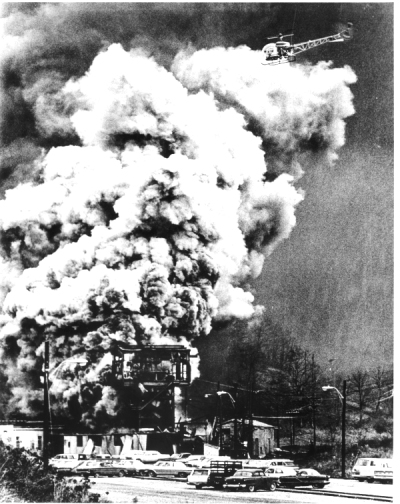
November 19, 1968, an explosion in the Farmington, West Virginia, Consol No. 9 mine kills 78 miners. More information here and here, and a recent NPR report here.

Major mining disasters such as the Farmington coal mine explosion in 1968 and the Sunshine Mine fire in 1972 led to the Federal Coal Mine Health and Safety Act of 1969 and the Federal Mine Safety and Health Amendments Act of 1977.

Friday, November 17, 2006

Stickler ReReRenominated To Head MSHA

No, my computer is not stuttering. Welcome to "Night Of The Living Dead Bush Nominees."

Like a punch drunk fighter whose who thinks he's winning the fight even when he's lying bleeding on the mat, President Bush -- for the fourth time -- nominated Richard Stickler to head the Mine Safety and Health Administration. Stickler, you may recall, is the former mine industry official with less than sterling safety record who was rejected by the Senate and twice sent back to the White House only to be renominated again.

Stickler was finally put into the position last month by a recess appointement, which the President is able to do when Congress is out of session. The only problem is that a recess appointment only lasts one year -- hardly long enough to unpack the boxes.

Stickler was joined in the same announcement by the renomination of Wal-Mart attorney Paul DeCamp to head the Wage and Hour Division at the Department of Labor. The only problem, as the AFL-CIO Today points out, is that DeCamp's record
includes urging the weakening of the Fair Labor Standard Act’s (FLSA’s) overtime pay and other protections. He even argues for changing the law to prevent millions of workers from becoming eligible for overtime pay. Strangely enough, he also said that it would not be “in the interest” of the workers to obtain overtime eligibility.
Stickler and DeCamp join the other doomed nominees like John Bolton (recess appointed to UN Ambassador) and Ken Tomlinson to head the Broadcasting Board of Governors which oversees Voice of America and other American oversees radio networks. Tomlinson, who was first apponted to the Board in 2001, was found to have abused his position and effectively defrauded taxpayers. Tomlinson was was forced to resign from the board of the Corporation for Public Broadcasting Corporation last year after he was found to have engaged in highly unethical behavior. Stickler's in good company.

As the AFL-CIO blog says, "this is a very puzzling and odd way to demonstrate bipartisanship. Isn’t it?"

Indeed.

John L. Lewis, Franklin Delano Roosevelt and Jesus

Must-read article in the Washington Post today about the difficulty the United Mine Workers are having organizing young miners in today's "second coal rush."

The older miners understand the value of retirement benefits like health insurance and pensions, as well as the job protections that come with unionization.

Middle-aged union supporters say younger workers are naive to think they won't face supervisors who underestimate danger or play favorites in assigning work, or try to deny their rights if they are injured or lay them off without explanation. They say they've seen all this and more.

The younger workers, on the other hand, are so pleased with the good money they're suddenly making that they don't want to rock the boat. That and high unemployment in the coal fields puts them a world away from the older miners:

The miners here come not only from different generations but different worlds. Those in their 50s mostly began mining as union men from union families, following grandfathers, fathers and uncles.

Their towns erected memorials to men who died in mine accidents alongside memorials for fallen soldiers. They relied on the union to protect them in a dangerous workplace and were raised to revere John L. Lewis, the longtime UMWA president.

"I have three pictures side by side in my house: John L. Lewis, Franklin Delano Roosevelt and Jesus," said Jack McReynolds, 70, a retired miner eating lunch recently at Lola's Uptown Restaurant in West Frankfort, once home to seven coal mines, all now closed. "I draw Social Security on account of FDR. I draw a pension on account of John L. Lewis, and I'm going to Heaven because of Jesus."

The UMW's current stuggle to organize Peabody coal is symbolic of the problems the union is having. In the 1980's Peabody was 80% union. Then the highly unionized eastern mines close as mining moved to the non-union west. Now that the eastern mines are reopening, Peabody is 85% "union free." They pay union wage, provide 401(k) plans and pay generous bonuses.

With all that, union organizers have their work cut out for them:
Back at Lola's Uptown Restaurant, [27 year old Carl "Bubba"] Vincelette recalled that he had listened with an open mind when a UMWA organizer visited him recently. The organizer said union coal miners elect safety committees that have authority to shut a mine if they judge it unsafe. But Vincelette said he trusted Peabody to be vigilant about safety.

The organizer also said that with 20 years in a union mine, Vincelette would get retiree health insurance for life. But 20 years sounded like an eternity.

"The way everything's going -- wars and stuff like that -- it's hard to think long term," he said.

McReynolds, the retired UMWA miner with John L. Lewis's picture in his living room, listened from across the table in pained silence.

When the young miner left, McReynolds rose slowly from his chair and straightened his Mason's hat bearing a UMWA pensioners' emblem and a gold pick-and-shovel pin the union gave him. "That young man has no idea what he's talking about," he said.
More on the Justice At Peabody organizing campaign here.

Saturday, November 11, 2006

Mine Officials Go To Jail For Lying

Kathy Snyder at Minesafetywatch reports on three mine officials who are on their way to jail for lying to MSHA officials about a 2003 death at a southern Illinois coal mine.

And while you're in the neighborhood, check out this post which describes the support that incoming Virginia Senator Jim Webb received from the southern Virginia coal fields.

Massey Energy At Fault For Aracoma Mine Deaths

Massey Energy company was ultimately to blame for the two coal mining deaths at the Aracoma mine last January, according to a report by J. Davitt McAteer, who conducted the investigation for West Virginia Governor Joe Manchin.
"It is the operator's responsibility to comply with the laws," McAteer, a former director of the federal Mine Safety and Health Administration, said at a news conference Friday.

Don. I. Bragg, 33, and Ellery Elvis Hatfield, 47, got separated from their crew in the smoke-filled Aracoma Alma No. 1 Mine in Logan County and were unable to escape the Jan. 19 fire.

McAteer wrote in a report released Friday that Massey couldn't alert miners about the fire and the need to evacuate. The mine's system for detecting fires and telling miners to evacuate was flawed, and water to the sprinkler system and fire hoses was shut off, he wrote.

He also noted that the state did not conduct a required annual electrical inspection for two years before the fire.

"The two victims' lives could have been saved with early intervention and a fire suppression system that worked," McAteer wrote.
Last week, the West Virginia Office of Miners’ Health, Safety and Training, released a report finding that the fire and deaths were caused by missing walls that control air flow and water lines for fire hoses and sprinklers that had been shut off and fire hoses that couldn't be connected because of incompatible fittings.

Lack of training and instructions to shortcut safety by Massey's owner also may have contributed to the deaths, according to McAteer's report:
According to the report, dispatcher Mike Brown -- the person in charge of monitoring mine alarms and the computer that regulates equipment underground -- was new in the job and had not been adequately trained on what to do when the fire alarm went off. He reset the alarm several times without understanding that the carbon monoxide alert was an indicator of a fire breaking out.

"He didn't think he had the authority to order the mine evacuated, and he certainly lacked the experience and knowledge to take it upon himself to do so," the report states.

Mr. Hagy, the foreman, also mentioned an Oct. 19, 2005, memorandum from [Massey CEO Don] Blankenship to ignore requests by anyone to do anything other than "run coal." The requests to be ignored, according to Mr. Blankenship's memo, included to "build overcasts (overhead conduits needed to carry fresh air), do construction jobs, or whatever."

Mr. McAteer's report makes clear that, instead of immediately evacuating the mine after a fire broke out along a defective conveyor belt line, igniting coal and coal dust, mine officials tried to fight the fire.
McAteer also noted that severe understaffing at West Virginia's mine safety agency may have led to inspectors overlooking many of the safety violations at the mine.
In the 63-page report, McAteer said a "severe manpower shortage" prevented state inspectors from properly enforcing safety rules at the mine. At the time of the fire, two inspectors at the state agency’s district office were off work because of illness and injuries, the report said.

However, even when the office is fully staffed, just 12 inspectors are responsible for completing quarterly inspections of 83 underground mines and 40 preparation plants.

Also, four electrical inspectors are required to conduct annual examinations. In order to do so, each would have to make 123 inspections every three months, the report said.

"This is a tremendous workload — the math would suggest an almost impossible task," McAteer said in the report.
But understaffing doesn't explain all of the problems with oversight, according to McAteer:
"The bottom line, however, is that while manpower shortages may have been a contributory factor, they do not provide an adequate explanation for the breakdown in regulatory oversight on the part of both federal and state officials," the McAteer report said.

McAteer recommended a joint study of how state and federal inspectors could do a better job.

"Some of the most urgent and troubling questions about accountability that the fatal fire raised will inevitably remain unanswered until and unless such a review is conducted, either by the agencies involved or by an independent entity," McAteer wrote.
The full report can be found here.

Sunday, November 05, 2006

Coal Mine Deaths Reach Double Of Last Year

With the death yesterday of a Kentucky coal miner, 44 coal miners have been killed on the job so far in 2006, double the 22 who were killed in all of 2005, and the most coal miners that have been killed in one year since 1995.

Kentucky Miner Dies in Accident

Underground mine section foreman dies after being struck on the head.

ELKHORN CITY, Ky. -- A Kentucky coal miner died on the job Saturday.

Tony Swieney, 44, an underground mine section foreman, was struck on the head by a large electrical plug

It happened Saturday afternoon at the McCoy Elkhorn Number 23 mine near Ashcamp-- that's in Pike County.

Swieney died on the way to the hospital. His death is the 15th coal-related fatality in the BlueGrass state this year.

Tuesday, February 28, 2006

US Mines: Good or Bad or Who Knows?

Can both of these statements be true?

U.S. mines called safest in world, but can do better

U.S. miners say safety gear lags behind that of other countries


On one hand, other countries seem to do better keeping their miners alive:
Dennis O'Dell once believed U.S. coal mines were the world's safest. Now he's not so sure.

Lately, he's seen an Australian device that can track miners underground and another that can send them messages. He's read about Canadian potash miners who survived a fire inside an airtight chamber packed with food, water and oxygen.

U.S. companies use the world's most sophisticated equipment to dig coal, but O'Dell, health and safety administrator for the United Mine Workers of America, now wonders if the same can be said of the gear used to keep the miners themselves safe.
But on the other hand, at least we're better off than China:
Coal mine accidents in China, the world's top producer, kill an average of 16 workers a day.

"Overall, U.S. mine health and safety - it's still the envy of the world," says Raja Ramani, a professor of mining engineering at Penn State University.

"In many ways, experts say the U.S. coal industry is the model to emulate, with safety laws on the books, a federal agency charged with enforcing them and well-funded, health-oriented research."
But on the other hand, no one really knows what's going on.

According to an article in today's Wall St. Journal (paid subscription), MSHA recordkeeping makes it difficult to monitor trends in mine hazards.
  • According to the Government Accountability Office (GAO), MSHA doesn't collect injury or enforcement data on "independent contractors" who work in mines, although fatality data is collected. And the problem is growing. The GAO said 18% of underground coal miners worked for contractors in 2002, up from 13% in 1993.

  • Safety information is organized by individual mine operators instead of by parent companies, making it hard to judge a company's performance.

  • MSHA's website lists proposed penalties, but figuring out what is actually assessed is tough.

  • MSHA's databases contain "information on accidents that were investigated, not all mine accidents," according to GAO

Sunday, February 12, 2006

USA Today: Coal Miners' Lives Not Worth Much

USA Today is jumping on the crusade to value miners' lives more than JANET JACKSON'S BREAST:
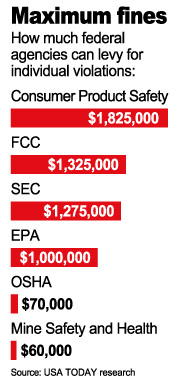
The federal government levied a larger fine — $550,000 — for the 2004 Super Bowl showing of JANET JACKSON'S BREAST than it did for the 2001 deaths of 13 Alabama miners in one of the deadliest mine disasters in a quarter-century. And the $435,000 fine against mine operator Jim Walter Resources was cut by a judge to $3,000.
We here at Confined Space can only praise those who insist on bringing up JANET JACKSON'S BREAST in this context, because every time I write about JANET JACKSON'S BREAST, my Google hits skyrocket. Now some may accuse me of dishonestly attracting web traffic by gratuitously mentioning some of the most searched-for words on the web (like SEX, BREAST, JANET JACKSON). But this isn't a totally exploitative thing for me to do because every time a sex-starved young man does a search for photos of JANET JACKSON'S BREAST, he may also find himself enlightened about the fact that coal companies pay some of the smallest fines of any industry for federal violations.

That can't be a bad thing. Right?

Of course, those looking up the Environmental Protection Agency or the Federal Communications Commission or the Securities and Exchange Commission may also find their way to this USA Today article where they would discover that while MSHA' highest possible fine is $60,000 for each violation of a mine health and safety standard, the EPA, FEC and SEC can levy fines of $1 million or more for a single violation.

The fact that MSHA is allowed to reduce fines by 30% if the company quickly fixes the problem is also not without controversy:
"That doesn't make any sense," says Steve Webber, who oversaw mining penalties for the federal government from 1999 to 2003, when he retired. "You're rewarding (mine) operators for correcting conditions that should not have existed in the first place."

The Bush administration has said that higher fines are not as effective as forcing companies to close unsafe areas until they are fixed.

Tim Biddle, an attorney for coal companies, said higher penalties won't improve safety. "I really don't think any responsible mine operator makes any decision about safety based on civil penalties," he said.
No, especially when the penalties are far less than actually fixing the unsafe conditions. Wouldn't be responsible to your stockholders, wasting money on fixing the place up, when you can just get away with paying insignificant fines?

Another USA Today article the same day illustrates why violating black lung dust standards makes sense to the bottom line:
"It's like fining you or me 25 cents for a speeding violation," says Tony Oppegard, a mine-safety adviser in the Clinton administration. The $268 fine is equal to the price of 4 or 5 tons of coal.

"You can mine 4 tons of coal in a couple of minutes," Oppegard says. "It's cheaper to exceed the dust limits, expose a miner to black lung and pay the fine than it is to do the right thing."

And anyway, did the network get its fine reduced because Justin Timberlake quickly covered up JANET JACKSON'S BREAST? Is the FCC going to reduce fines for FULL FRONTAL NUDITY ON TELEVISION as long as actors cover themselves quickly? I think not.

And here's another thing you horny young men should think about when your brains get back to serious business:
Mining fines are particularly small compared with recent record profits in the coal industry. The 10 largest publicly held coal companies reported combined profits of $2.4 billion last year on $24 billion in sales.

"The price of coal has increased dramatically and the price of penalties has not," Davitt McAteer, mine-safety chief in the Clinton administration, told a Senate panel recently. Increasing fines "needs to be done and it needs to be done immediately."
And yes, Virginia, elections do matter. Bill Clinton may have been having SEX IN THE OVAL OFFICE, but...
When Congress rewrote mine-safety laws in 1977, fines barely changed. Lawmakers toughened coal mine inspections and required rescue teams at the mines.

The maximum fine stayed at $10,000 until 1993 when Congress raised it to $50,000. It's risen to $60,000 in recent years to account for inflation.

Maximum fines have been imposed in just 12 violations in the last five years, according to Mine Safety and Health Administration records. In the Clinton administration's last six years, maximum fines were levied following 72 violations, agency records show.
Now, if I can just figure out a way to connect the PARIS HILTON VIDEO to fatal trench collapses...

Wednesday, February 01, 2006

Breaking News: W.Va. mines shut down after two more deaths (6:06 pm)

This just in:

W.Va. mines shut down after two more deaths (6:06 pm)
The Associated Press

Two mine workers were killed in separate accidents in West Virginia on Wednesday, prompting Gov. Joe Manchin to call on all coal companies to cease production until safety checks can be conducted.

"We're going to check for unsafe conditions, and we're going to correct any unsafe conditions before we mine another lump of coal,'' Manchin said.

A miner was killed at an underground mine when one of the supports along the wall popped loose, said Caryn Gresham, a spokeswoman for the state Office of Miners' Health Safety and Training.

A bulldozer operator at a surface mine died after the machine struck a gas line and sparked a fire, said Dirk Filpott, a spokesman for the federal Mine Safety and Health Administration.

The deaths brought to 16 the number of mining-related fatalities in West Virginia since Jan. 2, and the first at a surface operation.

Two other miners have been killed this year as well, one in Kentucky, and one in Utah Sunday night.

More here:
While Manchin's call was voluntary, he also ordered the state's mine inspection schedule speeded up so that all 229 surface and 315 underground mines are examined by regulators as soon as possible.

"We're going to check for unsafe conditions, and we're going to correct any unsafe conditions before we mine another lump of coal," Manchin said.

He was later joined by David Dye, acting U.S. assistant secretary of labor for mine safety and health, who urged coal mines nationwide to conduct a brief "time out" Feb. 6 to discuss hazards and safety precautions with workers.
Oh yes, discussing hazards and precautions will certainly make things safer. Who needs oxygen, communications equipment or fire-resistant conveyor belts when you can fix things much more inexpensively by just taking a "time out" to discuss hazards and safety precautions?

"Mourn for the dead, discuss safety precautions with the living."


More mine stories here.

Tuesday, November 16, 2004

Whistleblower Fired For Warning of Mine Contamination

Poor fool. Doesn't he know worker and environmental protection lost the election. What was he thinking?
RENO, Nev. -- A former project manager for a contaminated mine site said Wednesday he was fired for refusing to keep silent about dangers posed by radioactive and other toxic wastes at the site.

In a federal whistleblower complaint seeking more than $1 million in damages, Earle Dixon said he was fired by the Bureau of Land Management in October in retaliation for his aggressive research and public comment on the health and safety risks to workers and residents near the former Anaconda copper mine bordering Yerington, an agricultural town in northern Nevada.

A copy of the administrative complaint obtained by The Associated Press said Dixon refused to go along with repeated attempts by BLM management and the Nevada Division of Environmental Protection to downplay the issues.