Sunday, June 12, 2005

Jury To McWane: It's Not Nice To Pollute Mother Nature

McWane Inc continues to live up to its reputation and one of the country's leading corporate criminals. Unlike Enron, however, which robbed peopal of their jobs and life savings, McWane robs people of their lives and health.

A federal jury found industrial pipe maker McWane Inc. and two of its executives guilty of environmental crimes, including conspiracy to violate the Clean Water Act. Another McWane executive, the company's vice president for environmental affairs, was found guity of making false statements to the Environmental Protection Agency.
McWane was found guilty of 20 counts in all. James Delk, 37, the former general manager at McWane Cast Iron Pipe Company, the plant in Birmingham, was found guilty on 19 counts. Michael Devine, 44, the former plant manager at McWane Cast Iron Pipe, was convicted on seven counts. Mr. Delk and Mr. Devine continue to hold positions at other McWane plants. McWane faces potentially millions of dollars in criminal fines, while the three managers face fines and possible prison time.

During a trial that lasted five weeks, numerous McWane employees, including two former plant managers, testified that McWane managers had ordered them to discharge industrial wastewater into storm water drains, which emptied into Avondale Creek. Prosecutors asserted that McWane managers then engaged in an elaborate subterfuge to hide the discharges from regulators.
Last March, McWane Corporation pleaded guilty to "environmental crimes" for knowingly violating the Clear Air Act by making major modifications at its Tyler Pipe plant in Tyler, Texas, without installing the necessary air pollution controls. The compay was fined $4.5 million, placed on probation for five years and required to spend an estimated $12 million on plant upgrades.

McWane was the focus of a 2003 NY Times/Frontline series about the high number of workplace injuries and fatalities at that company's facilities. The company is also accused of conspiring to violate environmental and workplace safety laws at its plant in Phillipsburg, N.J.

.

Saturday, June 11, 2005

Company That Killed Worker Banned From Working For State

I wrote last January about the dismissal of manslaughter charges against Angelo D’Alessandro of Lanzo Construction for the 1999 death of Robert Whiteye who was buried in an unprotected 18 foot deep trench. Michigan OSHA had issued a willful citation to Lanzo and brought criminal charges against D'Alessandro.

At the time, Michigan Department of Consumer and Industry Services (CIS) Director Kathy Wilbur stated that “Lanzo Construction Company has shown a complete disregard for protecting their employees, as evidenced by their past history and the significant number of alleged wilful violations in this incident” and the MISOHA Newsletter reported that the investigation revealed that D’Alessandro "knew of the substantial risk of injury to employees engaged in trenching work, and failed to provide trenching support to prevent injury to their employees."

(A 2004 inspection of Lanzo, which had by then changed its name to D'Alessandro Construction, found that the company was continuing to expose workers to the same dangerous trenching conditions that killed Whiteye.)

Despite dismissal of the manslaughter charges against D'Alessandro, the judge found the company, Lanzo Construction, criminally responsible and put Lanzo "on probation," although no one seemed to know what it meant to put a company (as opposed to a person, on probation.)

Well, apparently it means you don't get to play the game anymore -- at least for the state of Michigan.
Gov. Jennifer Granholm has issued an executive order barring Lanzo Construction Co. from receiving any state contracts until 2013, after the company was found guilty of violating state rules and safety procedures in the 1999 construction site death of a worker.

"The state of Michigan and its corporate partners are held to high standards to protect our workers, citizens, environment and laws," Granholm said. "Those who don't play by the rules won't win state business."

***

Lanzo had received state contracts from the Michigan Department of Transportation in 1999, 2000 and 2001. The company has also performed extensive sewer construction work for numerous municipalities and other government agencies.

The 8-year ban, made possible by a 2003 policy initiated by the governor shortly after taking office, only applies to state contracts.

The Granholm administration rules allow companies to be banned from doing business with the state if they: are associated with a conviction on embezzlement, fraud or bribery charges; lose their state license; or are found guilty of violating state laws pertaining to worker safety, consumer protection, public health or environmental protection.
D'Alessandro says the ban is unjust because the company's conviction is still under appeal. Boo hoo.

The Granholm rules sound like a good idea that should be more widely adopted, especially as long as winning criminal convictions remains so difficult. We've seen a lot of companies working under government contracts who have killed their workers (here, here, here, here, and here for example). Maybe they shouldn't have the privilege of living off taxpayer dollars anymore.

.


.

Thursday, June 09, 2005

Why We Need Labor Unions, Part Deux

Harold Meyerson has a column in the Washington Post today describing how public employees have managed to resist Republican attempts to repeal the New Deal, as well as the Wal-Martization of the American workforce:
Policemen, firefighters, teachers, hospital nurses -- they still belong to the one part of the U.S. economy where the New Deal hasn't been repealed. Fully 90 percent of them have defined-benefit pensions as of old. In the private sector, just 60 percent of employees have retirement plans, and a scant 24 percent still cling to defined-benefit plans. Fully 86 percent of public employees are covered by on-the-job health insurance; in the private sector, the rate has fallen to 66 percent.

According to the Employee Benefit Research Institute, public employees make on average $49,275 a year. A sub-princely sum, that, but better than the $34,461 that is the average annual income of private-sector workers.
What's the secret to their success? Unions, of course:
While 37 percent of public-sector workers are unionized, just 8 percent of private-sector workers are. Through their power at the ballot box, public employees have maintained the ability to bargain with their employers, who are either elected officials or their appointees. For all intents and purposes, their private-sector counterparts have lost the power to bargain collectively.
The problem is that Republican politicians who don't generally earn the support of public employee unions are out to get them. It's not too hard to understand why public employee unions are generally hostile to Republicans, especially considering the war against public employees in Missouri and Indiana.

Now, California Governor Arnold Schwarzenegger, having failed in his recent attempt to roll back public employees' pensions, as well as losing battles against nurse patient ratios and funding for schools is about to get on the bandwagon supporting a initiative that would curtail the ability of public-sector unions to fund political campaigns. He's hoping that the growing numbers of Californians who don't have the pensions, health care and salaries enjoyed by public employees will grow to resent the privileges that "public servants" are enjoying on their tax dollars.

Meyerson points out that even if the Governator loses this battle,
the problems faced by public-sector workers as the private sector grows steadily meaner aren't going away, whatever the outcome of the immediate battles in California. When public-sector workers were first joining unions in the '60s, they were largely playing catch-up with private-sector employees. But as Wal-Mart has supplanted General Motors as America's largest private employer (and GM announced a cutback of 25,000 more workers Tuesday), it's the teachers and their public-sector cohorts who have emerged as the relatively more advantaged -- and politically exposed.

From the period of the three decades after World War II, when the long boom in the American economy was felt in every class and quadrant, we have devolved into a nation of separate economies -- increasingly insecure private-sector workers, a public sector where the guarantees of the New Deal order still pertain and a stratum of mega-rich whose investment income is taxed at lower rates than the incomes of those who work for a living. If we can't create more security in the private sector (and universal health insurance would be a good start), the modest security of a work life in the public sector will surely be eroded, too.
In other words, just as "globalization" and Wal-Mart are dragging down the standards and benefits once enjoyed by private sector workers, the increasingly non-unionized private sector is threatening to drag down the well-unionized public sector to their level.

And as far as I can tell, there's one and only one way to "create more security in the private sector" and avoid the race to the bottom: Organize the private sector.

.

Wednesday, June 08, 2005

Whistleblowers: Modern American Heros

Merrill Goozner of GoozNews covers a NY Times story about a former petroleum industry lobbyist, now working for the Bush administration, who watered down his office’s reports on the need for near-term action to halt global warming.

Goozner makes an important point in his post:
There’s a big difference between blowing the whistle and being a leaker. Whistleblowers take responsibility for their actions and suffer the career consequences, as today’s news amply points out.
The whistleblower in this case, Rick S. Piltz, was a former high official in the government’s Climate Change Science Program who resigned after the report was watered down.
Piltz could have remained in the shadows and leaked his information to the press. But instead he went to the Government Accountability Project, which provides legal assistance to government employees who want to go public with knowledge about government wrongdoing. In today’s New York Times story documenting his allegations, Piltz not only attached his name to the allegations that Philip Cooney, a non-scientist who previously lobbied for the American Petroleum Institute, added equivocating language to a 2002 global warming report, but he provided the documents that proved the allegations.
We are living in a political environment that more closely resembles the late Soviet Union than the democracy we once cherished. Republicans in the House of Representatives tolerate no wavering from the party line by the shrinking body of Republican moderates. The Senate is moving quickly to imitate the House by shutting down any minority rights. The courts are being taken over by right-wing ideologues and all public policy is determined in the White House and dictated to political appointees in the Cabinet agencies, leaving increasingly frustrated government employees to simply carry out Karl Rove's orders.

In times like these, our only hope may lie in the whistle blowers who have the courage to reveal what's really going on behind the scenes and who's pulling the strings.

And by the way, check out GoozNews, which I'm adding to my blogroll.

Fox News On Asbestos Comp: Old Politics Creates New Legal License to Kill

As you know, the Senate Judiciary Committee approved Asbestos Compensation legislation last month and sent the bill to the full Senate for a vote. Fox News covered the story the other day in its usual "fair and balanced" fashion. I present below the version that actually aired on T.V. But thanks to an confidential source (Deep Lung) located somewhere in the New York area, Confined Space has acquired of the original Fox report before the fair and balanced police got to it.

First the official version:

FOX SPECIAL REPORT WITH BRIT HUME

June 3, 2005
Byline: Jim Angle, Major Garrett, William Lajeunesse

ANGLE: More Special Report in a moment, but first, let's get a check on the day's other headlines and a preview of tonight's FOX Report from Shepard Smith in our New York newsroom -- Shep?(NEWSBREAK)

Hundreds of thousands of Americans have been sickened or even killed by diseases related to asbestos. In fact, more than 70 companies who made asbestos have gone bankrupt paying damages. And other companies fear a similar fate. So the court system, groaning under still more asbestos cases, is urging Congress to intervene.

FOX News correspondent Major Garrett has more.

(BEGIN VIDEOTAPE)

MAJOR GARRETT, FOX NEWS CORRESPONDENT (voice-over): Asbestos, discovery of it in its dangerous fibrous form at a work site like this one in Montana often leads to closure, clean-up and a lawsuit. Asbestos is only manufactured now in safe, encased forms.
But exposure to free-floating spear-like asbestos fibers can lead to severe lung ailments, such as asbestosis. The worst form, mesothelioma, a fatal cancer in the lining of the lung. At least 2,000 new cases of mesothelioma are diagnosed each year.

As a result, asbestos litigation clogs the courts. Real victims seek damages, but phony ones do, too. Seventy-seven companies have gone bankrupt paying damages to real victims and to frauds.

SEN. ORRIN HATCH (R), UTAH: We know that there have been a lot of injustices that have occurred over the years.

GARRETT: Thousands of other asbestos cases are pending. Ten U.S. companies alone face $25 billion in projected liability.

WAYNE BROUGH, FREEDOM WORKS VP: We clearly have a system that's being exploited for opportunistic reasons. And I think, in the process, you're having real people being harmed.

GARRETT: Congress wants to reduce corporate liability and compensate real asbestos victims. The proposed remedy? A bipartisan Senate bill that creates a $140 billion trust fund financed by asbestos companies and insurers. A special court would grant awards on a no-fault basis.

The goals: Eliminate lawsuits, speed up compensation, and use specific medical criteria to weed out phony claims.

SEN. ARLEN SPECTER (R-PA), CHAIRMAN OF THE JUDICIARY COMMITTEE: It will enable thousands of victims of asbestos, deadly diseases who have been able to collect nothing, to collect now from this fund. They've been unable to collect anything because their companies are bankrupt.

GARRETT: Big U.S. manufacturers like auto companies support the bill, preferring predictable trust fund payments to years of unknown liability. When senators unveiled their bill, companies with asbestos-related liability saw their stocks soar. Evidence, liberal critics say, that the bill is a big corporate give-away.

FRANK CLEMENTE, PUBLIC CITIZEN CONGRESS WATCH: Many companies that are liable, that have caused this problem, are going to be let off the hook. They're only going to be paying pennies on the dollar into this trust fund.

GARRETT: Senators concede the trust fund could only work as long as it remains solvent, and there's one huge variable. How many victims will qualify for payments? Right now, 100,000 damage claims over asbestos are filed every year.

SEN. DIANNE FEINSTEIN (D), CALIFORNIA: This is an unprecedented fund. We don't know how many victims there really are out there.

GARRETT: Critics fear the trust fund won't last and Congress will be too timid to go back to big business to foot additional costs.

CLEMENTE: They always underestimate the number of claims that come in, how much gets paid out. And in the end, the taxpayers end up paying for it.

GARRETT (on-screen): The Senate bill, which passed out of the Judiciary Committee in May by a wide margin, also caps lawyers' fees at 5 percent, down from the 40 percent typically applied in asbestos cases.

The White House sees this as another potential tort reform victory. But conservative critics are pushing a house bill that's an alternative. It spells out what constitutes an asbestos-related disease. This approach, they say, protects companies, victims and the taxpayers.
In Washington, Major Garrett, FOX News.

(END VIDEOTAPE)


And now the unexpurgated, unedited, unfair and badly balanced orginal piece:

FAUX SPECIAL REPORT WITH BRIT HUME

June 3, 2005

Byline: Jim Angle, Major Garrett, William Lajeunesse

ANGLE: More Special Report in a moment, but first, let's get a check on the day's other headlines and a preview of tonight's FAUX Report from Shepard Smith in our New York newsroom -- Shep?(NEWSBREAK)

Hundreds of thousands of Americans have been sickened or even killed by diseases related to asbestos. But in fact, only around 70 companies who knowingly exposed their workers to one of the most deadly materials on the planet have been held fully accountable. Other companies, fearing they might suffer a similar fate have spent millions lobbying susceptible politicos to ensure that would not happen. The court system, led by attorneys fighting on behalf of dying workers, have objected to no avail as the well-trained Congressional yes-men have moved in with nails and hammers to close the coffin lid on equitable settlements.

FAUX News correspondent Major Garrett has more.

(BEGIN VIDEOTAPE)

MAJOR GARRETT, FAUX NEWS CORRESPONDENT (voice-over): Asbestos, known for over 50 years as a killer of men at work sites like this one in Montana, has avoided disclosure, clean-up and lawsuits by sheer force of its economic power.

But exposure to free-floating spear-like asbestos fibers can lead to severe lung ailments, such as asbestosis. The worst form, mesothelioma, a fatal cancer in the lining of the lung. At least 2,000 new cases of mesothelioma are diagnosed each year. But even more shocking, more than seventy-seven companies have gone tragically bankrupt when they were forced to actually pay damages to victims.

In spite of the total lack of control and responsibility on the part of the employers, some workers have survived long enough to undertake litigation.

SEN. ORRIN HATCH (R), UTAH: We know that a lot of injustices have occurred over the years, but as a Republican Senator proud to be supported by American business, I can’t stand by and let good American businesses face a long, painful death because of irrelevant issues like ethics, murder, and deceit. That’s not why they elected me.

GARRETT: Thousands of other asbestos cases are pending. Ten U.S. companies alone face $25 billion in projected liability, although pigs will fly before Congress allows them to pay out that much.

WAYNE BROUGH, FREEDOM WORKS VP: We clearly have a system that's being exploited for opportunistic reasons. We built this system, and we’ll be damned if were going to let it get taken over by a frivolous trial lawyer witch hunt on behalf of few sick people who are going to die soon anyway. We can't let the bad luck of a few guys (and their wives and children) bring down the institutions that are creating jobs and protecting the value of the people’s stock market. I understand people are suffering, but surely the fate of Dow Jones is more important than the life any one individual.

GARRETT: Some in Congress want to reduce corporate liability and compensate real asbestos victims. The proposed remedy? A bipartisan Senate bill that creates a $140 billion trust fund financed by those we trust most - the asbestos companies and insurers. A special court would grant awards on a no-fault basis. “No fault,” because after all, everyone knows that the asbestos tragedy was really no ones’ fault.

The goals: Eliminate lawsuits (where embarrassing details might be revealed,, speed up compensation (so the sick will shut up and go away), and use specific medical criteria (that helpful industry officials have developed in order to weed out phony or expensive claims). While everyone admits there are lots of asbestos workers out there who have lung cancer, it’s clear that some are just slouching off and could really go back to work anytime they want.

SEN. ARLEN SPECTER (R-PA), CHAIRMAN OF THE JUDICIARY COMMITTEE: It will enable thousands of victims of asbestos, deadly diseases who have been able to collect nothing, to collect almost nothing now from this fund. True, they've been unable to collect anything because their companies that gave them cancer have managed to find ways to hide behind corporate bankruptcy laws. But surely we don’t want these companies going bankrupt when they could be setting up new businesses, investing in real estate, keeping the engine of commerce going and, of course, participating in our great political system.

GARRETT: Big U.S. manufacturers like auto companies support the bill, preferring not to admit in court that they knew asbestos was deadly and that they didn't really want to invest in worker protection or safer alternatives. Senators were SHOCKED (wink, wink) that their stocks soared when the bill passed out of committee. Evidence, liberal critics whine, that the bill is a big corporate give-away.

FRANK CLEMENTE, PUBLIC CITIZEN CONGRESS WATCH: Many companies that are liable, that have caused this problem, are going to be let off the hook. They're only going to be paying pennies on the dollar into this trust fund.

GARRETT: Senators concede the trust fund could only work as long as it remains solvent, and there's one huge variable. How many victims will qualify for payments? Right now, 100,000 damage claims over asbestos are filed every year. But the way things are going, after Republicans get rid of Social Security, Medicare and Medicaid, the program should be able to pay for itself.

SEN. DIANNE FEINSTEIN (D), CALIFORNIA: This is an unprecedented fund. We don't know how many victims there really are out there. True, if terrorists plotted to slowly kill 100,000 Americans a year we would probably be enlisting 5 year olds. That is just so grim. I really can't think about it. Hey, did you hear that the landslides stopped in LA. Now there's some good news!

GARRETT: Critics fear the trust fund won't last and Congress will be too timid to go back to big business to foot additional costs. We all know how timid those Congress people can be – especially when it comes to making business foot the bill for the damage they have caused.

CLEMENTE: They always underestimate the number of claims that come in, how much gets paid out. And in the end, the taxpayers end up paying for it, just like they paid for the Savings and Loan scandals of the ‘80s, oil in Iraq, Wal-Mart’s low pay and lack of benefits ...

GARRETT (on-screen): The Senate bill, which passed out of the Judiciary Committee in May by a wide margin, also caps lawyers' fees at 5 percent, down from the 40 percent typically applied in asbestos cases. That means that trial attorneys won't have the funds to investigate claims, get good medical opinions, document what happened, or have the funding to start any costly lawsuits over the thousands of other chemicals poisoning Americans that remain unaddressed by OSHA or the EPA.

CLEMENTE: ...lousy workers comp laws, a prescription drug bill that benefits drug companies, subsidies for nuclear power…


GARRETT (on-screen): Thank you, Frank, that will be enough.

The White House sees this as another potential tort deform, er, reform victory, ensuring that the Democrats have a smaller pot of financial support from radical trial lawyers. But conservative critics are pushing a House bill that's an alternative. It spells out what constitutes an asbestos-related disease. According to insiders, "Caused By Asbestos" will have to be stamped on your lung X-ray by God herself. This approach, they say, protects companies, the politicians and the shareholders.

In Washington, Major Garrett, FAUX News.

Tuesday, June 07, 2005

Changes to MSHA Diesel Rules Threaten Miners' Health

By Guest Blogger Celeste Monforton

Meanwhile, back in the real coal mines...

When Bush Administration officials team up with greedy mining companies, the result is usually a bad deal for miners. Today, it's not just a bad deal, it could be deadly.

On June 6, MSHA published a revision to a Clinton-administration health standard designed to protect underground non-coal miners from diesel exhaust and particulate matter (DPM) in diesel fumes. As Leo Gerard, president of the United Steelworkers (USW)
said, "Without good controls, working in an underground mine can be like working in the tailpipe of a bus."

MSHA's scientists and career staff clearly understand the serious health risks faced by underground miners, who have the highest exposures to DPM of any occupation. In this latest
Federal Register notice they highlight the enormous body of scientific evidence linking Diesel Particulate Matter to adverse health effects, including lung cancer. Yet, in a reversal of the earlier rule, the Bush Administration turns the traditional "hierarchy of controls" on its head, expanding situations in which miners must wear respirators, instead of implementing more effective engineering controls.

The industrial hygiene "hierarchy of controls" states that engineering controls, like exhaust ventilation, are always the preferred means of controlling hazards. Respirators are always a last resort because they not as effective.

The most egregrious part of this rollback, however, is MSHA's failure to require mine operators to provide medical tests to ensure that a miner can safely wear a respirator. Breathing through respirators puts an extra burden on the heart and lungs, and wearing a respirator can be deadly for workers with undiagnosed heart conditions As noted by the USW, all OSHA standards require medical testing before workers wear respirators, and every major industrial hygiene and occupational health organization, as well as NIOSH, recommend such testing. .

Yes, this is a bad deal for miners. Now, if the diesel exhaust doesn't make them sick, the respirator might do them in.


Load 16 Tons And What Do You Get? Sex & Hot Bods

Anyone out there know what "ecomagination" is? According to GE, it's something about their "commitment to imagine and build innovative solutions that benefit their customers and society at large." In other words, according to Slate writer Seth Stevenson, "GE has been getting all enviro on us."

All well and fine. More companies should be fighting for cleaner air, although I think the jury is still out on how "clean" burning coal can get.

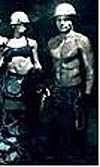
But check out this GE ad. GE has gone way beyond "ecomagination" all the way to "ecofantasy." This is how Stevenson describes it, but you can't really get the whole flavor unless you view the video yourself here (scroll down to Model Miners)

The Spot: We're in a coal mine, dank and dark. But wait—what's with these coal miners? They're sexy! Toned bods and tank tops. Dudes with cinder-block pecs. Ladies with come-hither stares. One of these chicks is wielding what looks to be a pneumatic jackhammer. As the models preen with their pickaxes and helmet lamps, an old mining folk song plays: "You load 16 tons and what do you get? Another day older and deeper in debt."
And Stevenson manages to hit my personal "nail" on the head:

Even if coal processing gets cleaner, that coal will still need to be mined. And unless I'm mistaken, there will be actual coal miners doing that. Now: Guess who still gets black lung? Guess who still gets killed when mines collapse? It isn't sexy supermodels.

You won't be shocked to learn that the models appearing in this ad never actually entered any mines. That would be dirty, unpleasant, and dangerous. Instead, according to the ad agency, a replica coal mine was built on a soundstage. That way the models could strut in comfort.

And then there's the song over which the miner models gyrate:
Several of my readers were even more galled by the ad's use of "Sixteen Tons"—a folk song about the miserable futility of mining and the evils of controlling corporations. Merle Travis wrote the song in 1946, drawing on the experiences of his father, a coal miner from Kentucky. More sample lyrics: "St. Peter don't you call me 'cuz I can't go. I owe my soul to the company store."

Not a positive take on the mining experience. So what's it doing here, in a piece of pro-coal propaganda? The only thing comparably weird would be to use Bob Dylan's "The Times They Are a Changin'" in an ad for, say, a giant, corporate bank. Oh, wait—never mind.


GE's miners

GE's miners


.


GE's miners

GE's miners


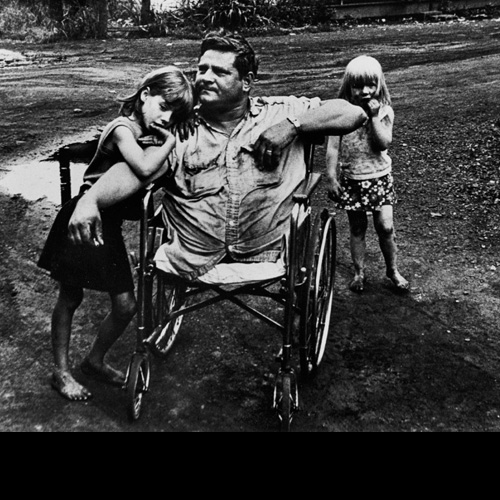
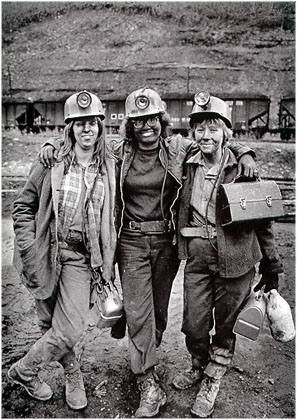
Real Coal Miners

REAL Coal Miners


Real  Coal Miners


OSHA whistle-blower Adam Finkel, who sent me this article (and, as usual is not speaking on behalf of OSHA or Princeton University where he is employed) notes the following:

So coal mining is glamorous, not to mention healthful, as none of the models was using any kind of respiratory protection. I’ve never lost a loved one to a cave-in or black lung, so others have far more right to be offended by this latest ‘they don’t get it’ moment than I do. But to me these sorts of ads offer a mirror to how differently we treat environmental versus occupational issues. There are no ‘Times Beach Diet’ commercials extolling the benefits of oiling roads with PCBs, or tourism ads for what remains of the Aral Sea, and yet the dangerous trades continue to be fodder for parody.
Finkel seems to have an eye for inappropriate parody when it comes to workplace safety. Last Fall he contributed a couple of stories to Confined Space, one in which the Charlotte Bobcats basketball team created a commercial where an opposing player gets buried in sand in a construction accident, and another where Mike's Hard Lemonade created a television commercial that featured a construction worker who falls and impales himself on a steel rod and then retreats to a nearby bar for a glass of hard lemonade.

But if may be allowed to carry the inappropriate metaphor too far, I think we all need to chill a bit and learn to make lemonade out of lemons. I mean, if GE can use sex to sell clean coal, why can't John Sweeney and Andy Stern put their heads (or some other appropriate part of their anatomy) together and use sex to sell unions.

With commercials like these, I could get even get my Madison Avenue-wannabe daughter to join. She's probably heading down to apply for a mining job as we speak.

.

Labor Unions: The Folks That Brought You The Middle Class

File this under "Why We Need Unions."

The Wall St. Journal had a front page article yesterday about how it's becoming increasingly difficult for workers with limited education to start a job at an entry level and use in-house training opportunities to gain promotions that would eventually push them into the middle class. (The article is for registered WSJ subscribers only.)

The article itself was interesting, but probably most interesting was the positive things the Journal had to say about unions:
The MTA was once full of jobs like motor inspector or turnstile repairman -- jobs that a person with limited education could jump to with some training. As in the corporate world, many of those jobs have disappeared, often because technology upgrades mean fewer people are needed. At the MTA, for example, new subway cars last 138,000 miles between overhauls, compared with 8,000 miles in 1982. Around the system, the jobs that do open often require a college education and computer skills.

Overall, the pace of hiring has slowed since the 1980s, as the MTA reduced its staff by 13%, to 48,000. When the MTA does fill new jobs, it is less likely to promote from within because it believes it will attract better talent on the outside. In the 1990s, insiders got half the new jobs; today they get fewer than 40%. Car cleaners used to have the inside track for promotion to motorman, tower operator and token-booth clerk. Since 2001, those jobs have been thrown open to outsiders.

"For too many of our people, entry-level no longer means entry-level. It means dead-end," says Rodney Glenn, director of training for Transport Workers Union Local 100, to which 30,000 MTA employees belong.
Part of the reason that the advancement opportunities are disappearing is that the power of labor unions is disappearing.
Traditionally, unions helped unskilled workers attain middle-class lives. But organized labor now represents only 11% of the work force, down from one-third in the 1950s. The fastest-growing unions, in the service industries, represent both low-wage workers and skilled professionals, but it's hard for members to move from one category to the other. On-the-job training may turn an orderly into a nurse's aide, but not into a nurse.

New York's MTA, with an annual operating budget of $8 billion, has been a haven for African-Americans seeking upward mobility since the 1940s, when Adam Clayton Powell Jr. joined other Harlem activists in pressing city-owned and private transit lines to hire more blacks. The Transport Workers Union's legendary president, Michael Quill (1905-66), was active in the civil-rights movement and once brought Martin Luther King Jr. to address workers, then mostly white, on the subject. Today, about half of the membership of the union's Local 100 are either African-Americans or West Indians. The local's president, Roger Toussaint, arrived in New York from Trinidad in 1974 and started at the MTA as a subway cleaner, as did several of the top MTA managers with whom he negotiates.
Even in their weakened state, however, unions are still about the only means for workers to move up:
In 2002, the MTA started requiring that new entrants in the subway-car maintenance program either have a recent degree from a vocational high school or a community-college degree in technology because so many jobs demand electronic skills. Ms. Beatty, with her 20-year-old diploma from a regular high school, probably wouldn't make the cut today.

Over the past four years, the training center has graduated just 40 apprentices for various skilled jobs, with fewer than a dozen of those graduates coming from the Transport Workers Union. Three months ago, under pressure from the union, the MTA started a new subway-inspector training course with 13 students, all from the union's ranks. Of the 13, six are former cleaners, and all of them have the technical degrees. The others came from skilled jobs such as forklift operator or signalman's assistant.

***

Both sides agree that improved productivity at a system that was once notorious for breakdowns and graffiti has reduced the pool of new jobs to which cleaners and security guards can aspire. Staff at a big maintenance depot in Coney Island has been cut to 650 workers from 1,000 over the past five years. When the MTA replaced subway tokens with prepaid Metro Cards, 120 skilled-machinist positions were eliminated, estimates the union. It persuaded the MTA to retrain the workers to repair card-vending machines.
The distressing thing is that at the same time that rising health care costs, globalization, the disappearance of well-paying industrial jobs, and bankruptcy legislation are all consipring to knock more and more people out of the middle class, more barriers are being raised to keep people from climbing up into the middle class. Meanwhile, the historical force that knocked down those barriers -- the labor movement -- is itself declining into ineffectiveness.

I think if I was the President, or a congressional representative, I might be concerned about some of these issues.

And speaking of those who are really concerned, check out speeches by Bill Moyers and John Edwards at the Taking Back America Conference last week. And while you're at it check out the other speeches too.
.

Monday, June 06, 2005

Nothing To Lose But Your Latte: Organizing Starbucks!

Workers Comp Insider has an interesting article about an attempt by the International Workers of the World (IWW) -- yes, the good old Wobblies -- to organize Starbucks.
The IWW press release raises some classic issues of poor working conditions, some of which will ring true with those who study the ergonomics of fast food. Starbuck workers serve an enormous volume of beverages, many of them extremely hot. The union claims that in order to save money, management refuses to schedule enough workers to do the required work safely. Instead, workers are forced to perform their duties at unsafe speeds with an undue level of physical exertion.

"A Starbucks coffee shop is an ergonomic minefield. The stores are supposed to mimic an Italian cafe without considering the uncomfortable bending and reaching we have to do, " explained Barista Anthony Polanco. "This is not your mom and pop coffee shop. We are talking McDonalds busy every day. Starbucks talks about "Creating Warmth" but the only warmth I feel is the heat pad at the end of the day."


.

Deborah Byrd Chrysostomides: One Year Later

Last August, I wrote an article about the death of Deborah Byrd Chrysostomides, a Chesapeake General nurse, from an undiagnosed tuberculosis infection. As I said then, "although I hate to say "I told you so," OSHA's decision last year to withdraw the tuberculosis standard is looking dumber and dumber as the number of TB cases in many states creep up."

I also cited a Virginia Pilot article that asked a few pressing questions:
Questions linger about her case and whether more could have been done to prevent it –certainly, from the more than 100 patients and visitors who have since tested positive for TB, and also from those closest to her.

Tim Peluso, the fiance of the once-vibrant and compassionate nurse, questions whether the hospital could have done more to detect her illness when she displayed TB symptoms. Hospital and public-health officials wonder whether Chrysostomides ever sought medical help, as she claimed to friends and a supervisor. If so, why didn’t a doctor diagnose her sooner?

And why can’t public-health officials find the doctor who supposedly treated her?

Two questions that loom largest for the general public: How could her illness have gone undetected in a hospital, of all places, and should anything be changed to keep such cases from occurring again?
Today I received the letter from Debbie's friend:
Thank you for asking the questions that Debbie's friends are still wondering one year after her death. I can't understand why Chesapeake General Hospital did not follow procedures and save the life of their devoted nurse and our beautiful friend. In a few days, it will be one year since her terrible death and I feel that Chesapeake General didn't do anything to save her life. I, along with others, lodged a complaint with the Virginia Health Dept. The Virginia Dept of Health did cite Chesapeake General with violations. Changes in hospital policies are to take affect.

The reason that Debbie's illness was not addressed, according to Chesapeake General, was due to the fact that their person in charge of monitoring the nurses and reporting cases of possitive TB from the annual testing of nurses was on leave in Dec 2003. Meaning, the two positive tb conversions in Dec were overlooked. When this person returned from leave no one had reported the unusual number of positive TB cases. And even after another positive Tb result of a nurse in Feb and a couple more in March nothing was done. They said they didn't have enough information.

In April 2004 Debbie could not work any longer because she was so terribly ill and decided to resign. In May 2004, one month before Debbie's death, the hospital claimed that they were getting ready to report the cases to the health dept but had not yet done this. Even in June 2004 the month when Debbie died, the hospital had not yet reported the TB problem. They reported them after Debbie had died. My friend's life could have been saved if the hospital reported their nurses positive Tb test.

In the past I had been told that most hospitals don't care if their nurses are sick. They just want them at work. I was told that they work their nurses to death. It turns out to be true.

Debbie's Loving Friend,

Angela
Anything to add, John Henshaw, Roger Wicker, George W. Bush?

.

Sunday, June 05, 2005

Weekly Toll

Accident kills elevator installer

WESTFIELD, MA - A 42-year-old Spencer man, installing an elevator at The Arbors assisted-living complex on Court Street, died from injuries Thursday after it started to move.

Glenn Martin, a Bay State Elevator Co. employee, was pronounced dead at Noble Hospital shortly after the accident, which was reported at 2:05 p.m., police said.

Martin's death, the city's second workplace death in as many days, is being investigated by the federal Department of Labor and the Occupational Safety and Health Administration, police said.


Steamroller flips, killing operator in Salem

SALEM, MA - A 23-year old Beverly man died Friday morning after being crushed by the steamroller he was operating.

Josue Villatoro, 43 Roundy St., was piloting a blacktop roller at Hillcrest Chevrolet on Highland Avenue shortly after 9 a.m. Friday when the vehicle rolled over, crushing Villatoro.


Man dies following accident at rock quarry

Winchester, KY -- A Mt. Sterling man employed by The Allen Company Inc., 131 Jefferson St., died Tuesday after an accident at the Boonesboro Quarry, Madison County.

The victim was identified as James Edward Woosley.

Allen Company secretary and treasurer Bob Beam said no information on the accident could be released because an investigation by the Mine Safety and Health Administration, a division of the U.S. Department of Labor, is pending.

Villatoro was working for Middleton-based contractor Pavement Inc. at the time of the accident. Coworkers attempted to revive Villatoro, who was clear of the machine after it flipped, according to police, but the man subsequently died of his injuries shortly after being transported to North Shore Medical Center.

"Initial investigation shows that the roller came close to the edge and rolled over, crushing Villatoro," said Salem Detective Tom Brennan.


MILL VALLEY GOLF COURSE WORKER DIES IN MOWER ACCIDENT

MILL VALLEY -- Mill Valley police said today a Mill Valley Golf Course groundskeeper died Thursday when a grass mower he was riding went off a 20-foot embankment into a creek bed at the golf course.

Police identified him as 36-year-old Earl Milligan of Rohnert Park. The accident was discovered around 11:11 a.m. near the ninth tee, police said.

Milligan was found beneath the mower and was pronounced dead at the scene. He worked for the city-owned course for 15 years, according to the Parks and Recreation Department. He leaves a wife and middle-school-age daughter.

Lt. Hipolito Nunez said yesterday that Martin was working underneath the elevator when "for some reason it started" to move and Martin somehow got caught.

A co-worker inside the elevator unsuccessfully tried to shut off the power, jumped off the moving car and ran downstairs to the main power shut-off, Nunez said.


Worker dies from second-story fall at apartment construction site

THE WOODLANDS, TX - A construction worker died Thursday morning after falling from the second floor of an apartment complex under construction on Texas 242.

The man, whose identity was withheld by the Montgomery County Sheriff's Department pending notification of next of kin, was an employee of Global Construction Company L.L.C. of Houston.

The company declined comment about the incident Thursday afternoon.
Rescue workers were called to the Pine Creek Apartments on Texas 242 at 8:06 a.m. Thursday.

"When we arrived on scene, we found a Hispanic male lying in the parking lot area with an obvious head wound," said Lt. Jimmie Springer, with The Woodlands Fire and Rescue.

Springer said the man was attempting to breath when rescue workers arrived on the scene, but he went into cardiac arrest as Montgomery County Hospital District paramedics loaded him into the ambulance.


Construction diver dies in drainage pipe in Boca Raton

BOCA RATON, FL — A 29-year-old laborer who apparently became trapped as he worked in an underground drainage pipe Thursday died inside the water-filled culvert despite the efforts of dozens of rescue workers.

Ciro Cardenas Jr.'s family watched divers and rescue crews work for nearly five hours to try to locate him in the 215-foot pipe and adjoining retention pond.

Rescue crews stand by as divers enter the water. A co-worker said Cardenas planned a 10-minute dive, possibly to clean out the pipe.

At about 11:40 a.m., Cardenas, equipped with scuba gear and a wet suit, descended into the 36-inch-diameter pipe at the construction site of Vistazo of Boca Raton at Spanish River Boulevard and Northwest Fifth Avenue, Boca Raton Fire-Rescue spokesman Frank Correggio said.

A co-worker told officials Cardenas had planned a 10-minute dive, possibly to clean out the pipe. The co-worker called 911 after 20 minutes.

At 4:25 p.m., rescue workers glimpsed his lifeless feet and hands on video captured by an underwater camera they had manipulated into the pipe. He was about 26 feet in, but divers couldn't reach him because a mound of silt and sand had accumulated between Cardenas and the mouth of the pipe, according to diver Tony Ojea, a Delray Beach fire-rescue lieutenant.


Accident kills Chicopee man

WESTFIELD, MA - A worker at a manufacturing company on Apremont Way died Wednesday as a result of head injuries suffered when he was caught in a machine, police said.

Qui Nguyn, 37, of 34 Ednsons Court, Chicopee, was pronounced dead at Baystate Medical Center in Springfield following the accident, which was reported at about 8:30 a.m.

Nguyn was an employee of Berkshire Industries Inc., at 109 Apremont Way.

Lt. Michael A. McCabe of the Westfield Police Detective Bureau said Nguyn suffered extensive injuries when his head got caught in a machine.


Abandoned pipe packs deadly blast

ZAPATA, TX — It was one of thousands of abandoned pipes in one of the state's leading natural gas production areas. And it needed to be cut.

The workers thought the pressure had bled outbbb, managers said, so they attached the manual cutters onto the pipe and moved it around and around. That triggered a force so massive it blew the clothes off of some laborers and launched Augustine Alaniz a distance of about 40 feet, killing him instantly.

Two other workers are being treated in nearby hospitals for broken bones and abrasions from the explosion Wednesday in a remote natural gas field near here, said Luis Gonzalez, partial owner of Kobra Sales and Services Inc., the contractor Alaniz worked for.

Alaniz, 31, of Zapata, who was known as Augie, earned about $7 an hour as a laborer. He is the seventh person killed in a South Texas oil or natural gas field since October, according to the Occupational Safety and Health Administration, which is investigating this incident.

Kobra, a 2-year-old company, hasn't been cited previously by OSHA.


Area man killed when dirt wall collapses at construction site

Benton, Arkansas -- A Traskwood man employed by Nalco Construction Co. of Benton was killed Wednesday afternoon when a dirt wall collapsed as workers were digging a ditch for a sewer line.

The victim was identified as Cecil Griffin, 35, of 7918 Highway 299. Griffin's wife, Jo Ann, is an employee in the Benton Courier mail room.

Hobby said he was "digging at the site when I turned around to take another scoop, and then the bank fell in on him and I started to dig him out to get to him."

Price, the backhoe operator, said he was setting gravel when he turned around and saw the ditch cave in. At that point, he said he and other employees "started to dig Cecil out."

Other witnesses reported that the employees had not used a steel brace designed to prevent dirt from caving in. The police department report does not include any reference to this equipment.


Methane Drill Rig Blast Kills 2 in Kansas

Montgomery County, KS -- A methane drilling rig exploded Thursday, killing two workers and seriously wounding another, authorities said.

Drillers had reached only 20 feet when a pipe at the rear of the rig exploded, said Nancy McPherson, co-owner of the family company that owned the rig.

The two men who were killed apparently were working on the pipe at the time. The injured man was hit by shrapnel, but McPherson said he was able to shut down the equipment and call for help. The rig was being used to drill for coalbed methane gas.


KDOT worker killed

A Kansas Department of Transportation worker picking up trash alongside US-75 highway just south of N.W. 35th Street was struck by a car and killed Wednesday morning.

Marvin Scott McDonald III, 24, of Topeka, was a temporary employee of KDOT who began working as an equipment operator at the Area Four office in Topeka in December, said KDOT spokesman Joe Blubaugh.


Alabama coal mine shut down after fatality

A west Alabama coal mine was shut down Thursday following a late-night accident that killed an electrician who was working underground.

Robert A. Patilla, 42, of Fayette was the first worker killed at the North River Mine, operated by the Pittsburg & Midway Coal Mining Co., since at least 1995, according to records from the U.S. Mine Safety and Health Administration.

Tyron Hicks, the mine's personnel director, said it was unclear what occurred in the accident, which happened after the start of a shift at 10 p.m. Wednesday.


Steelworker dies in fall at Saline site


A steelworker died after falling nearly three stories at a construction site on Saline's west side Tuesday morning, officials said.

Gregg Creech, 36, of Livonia, was fatally injured when he fell from a steel girder atop a car dealership under construction at Michigan Avenue and Austin Road about 7:45 a.m., said Saline Police Chief Paul Bunten.

Several witnesses either heard Creech hit the ground or saw him fall head first, Bunten said, including one who said Creech was walking alone on a steel beam and he lost his balance when his foot hit one of the bolts.

Creech was employed by the Acker Steel Co.


Moorpark construction worker killed in trench collapse

MOORPARK, Calif. Authorities say a construction worker was killed today in Moorpark when a trench he was digging collapsed.

It happened shortly before noon. Ventura County fire officials say the equipment operator was digging a 17-foot-deep trench for a sewer line when it collapsed, burying him.

Officials say the sewer line was being installed for the offices of Sharma Construction.


Cement worker killed in misshap

A cement truck driver was killed in an industrial accident within the 2800 block of Wagon Trail Road when he was struck in the head by the truck's rotating cylinder while he was checking his cargo.

Pearland Police reported that Clinton Brown, 48, had climbed onto a ladder on the rear side of the vehicle to check on the concrete's consistency, when his head was "caught and pinned, killing him instantly."

Brown was an independent contractor and was not an employee of the Alfa Ready Mix and Material, where the accident occurred.


Washington County Worker Crushed By Sheet Of Steel

TOWN OF KEWASKUM, Wis. -- A worker at a Washington County gravel quarry died Monday after he was crushed by a sheet of steel. Sheriff's authorities said the 57-year-old Berlin man was working at Michaels Materials quarry when the steel fell from a truck that was being loaded. The medical examiner said the man died at the scene.


Carnival Worker Struck by Ride Dies

Los Angeles, CA- Walter Vofrei, 43, of Colton died of massive head injuries when he was struck by machinery at 9:42 p.m. at a street fair on Reseda and Victory boulevards, according to the Los Angeles County coroner's office, the Los Angeles Police Department and the Los Angeles Fire Department. The California Occupational Safety and Health Administration is investigating the cause of the accident, police said. "It was ruled an industrial accident," said LAPD Officer Sandra Escalante.


Parsonsburg farmer killed in forklift accident

PARSONSBURG, MD -- A 59-year-old Parsonsburg farmer was killed in an accident with a forklift early Monday morning at his property on Seymore Lane, according to police. William Albert Riall was struck by a forklift at his farm shortly after 1 a.m., said 1st Sgt. Lee Fisher of the Maryland State Police in Salisbury. Fisher said the incident is being ruled an industrial accident. "He was run over by a forklift that was removing the chickens from his chicken house," she said. Riall was pronounced dead at the scene, according to police. Law enforcement officials weren't releasing the identity of the forklift operator Monday.


Apartment worker shot

KANSAS CITY, KAN.- A tenant of the Wyandotte Towers shot and killed an employee of the high-rise apartment building that is home to elderly and disabled persons, police said Tuesday. Police identified the victim as Robert Floyd Sr., 53, of Kansas City, Kan. The shooting occurred about 7:35 a.m. inside the building at 915 Washington Blvd. When police arrived, they found Floyd dead from an apparent gunshot wound. Police had taken a female resident into custody.


Porterville Officer Killed in Accident

Porterville, CA -- An officer with the Porterville Police Department is dead after an accident early Monday morning.

The CHP says the deadly crash happened before 5:00am Monday morning near Lindsay.

Authorities say officer Michael Zamora was driving down the road in his own car, when he swerved and hit a farm labor van head-on. Zamora, along with two in the labor van, were killed and four others were critically injured.

Police are not sure what caused Zamora to swerve.


Worker dies after falling from building

Charlotte,NC- A construction worker died Tuesday afternoon after falling from an apartment building roof in the University City area, according to Charlotte-Mecklenburg police. Police said Fidel Loera Ornelas fell from a roof at 419 Michelle Linnea Drive near Mallard Creek Church Road about 4:30 p.m.The man was part of a roofing crew working on the apartment complex, police said. Ornelas, who suffered a severe head injury, was pronounced dead at Carolinas Medical Center, they said.


Worker's death at quarry under investigation

Kewaskum, WI--Berlin man, 57, killed when metal slab falls on him at pit in Town of Kewaskum. Federal officials on Tuesday were continuing their investigation into the death of a 57-year-old Berlin man at the Michels Materials gravel quarry here a day earlier. According to a preliminary accident report released Tuesday by the Washington County Sheriff's Department, a chain used to lift a sheet of steel onto a flatbed trailer was unhooked just moments before the metal slab toppled off the side of the trailer and onto the victim, identified as David A. Randall.


Two Dead Following Accident In Darke County

OSGOOD, Ohio -- Two people are dead following an accident that happened late Tuesday night on Sherman Road in Darke County. Authorities said shortly before midnight a driver stopped to help a farmer who was working on his broken-down tractor. Investigators said a car slammed into the farmer, killing him. The driver of the car was also killed in the accident. Authorities said the person helping the farmer jumped out of the way and did not suffer any injuries.


Driver killed in Interstate 93 crash

THORNTON, NH — A 34-year-old Vermont man was killed instantly Wednesday afternoon after losing control of a tractor-trailer while traveling north on Interstate 93 just before the Thornton/Woodstock town line. Steven R. Seaver of White River Junction, Vt., was pronounced dead at the scene just after 12 p.m. when the tractor-trailer he was driving rolled into the guardrail. The 2005 Freightliner truck was towing a semi-trailer full of garbage. Seaver was an employee of Justin Excavation of West Lebanon, the company that owned the truck. In a preliminary on-scene investigation, State Police said they believe Seaver tried to correct truck's path as it began to veer toward the shoulder of the road. Police said the attempt was unsuccessful and the truck then rolled over and crashed into the guardrails.


Krystal manager dies months after being shot

Savannah,GA- A Garden City woman died Friday from injuries sustained during an armed robbery more than nine months ago. Fe Hope Ricord, 54, was shot during a robbery at the Krystal on Ga. 21, Garden City Police Chief David Lyons said. Police now are investigating the incident as a homicide.


Suspect arrested in jewelry-shop owner's killing

Orlando, FL- The highly publicized killing of a jeweler on Thursday produced tips from the public that helped lead to the arrest of a supsect, the Orange County Sheriff Office said today. Detectives found the teenager sitting outside the county jail waiting to surrender and face charges for the shooting death of Greg Puzon, Cpl. Carlos Torres said. Rodrigo Burgues, 19, told detectives he shot Puzon in a struggle while trying to rob Orlando Custom Jewelers on South Orange Blossom Trail, Torres said. Burgues said he fled without taking anything.


Feds probe fatal accident at Paulding County plant

HAVILAND, Ohio - The federal Occupational Safety and Health Administration is investigating the death of a Van Wert man who was injured Wednesday at a Paulding County factory. William Thomas, 59, died at Parkview Hospital, Fort Wayne, Ind., after an accident at Haviland Drainage Products. Witnesses said Mr. Thomas was driving a lift truck that skidded off a loading dock and trapped him underneath.


Worker dies in Charleroi accident

A 45-year-old Butler County construction worker died yesterday from injuries he suffered during a workplace accident in Charleroi. Bobby Allan Jordan II was found unresponsive in the bottom of a ditch at a construction site where he was working. He was pronounced dead at Allegheny General Hospital about 12:35 p.m., said the Allegheny County coroner. His death was ruled accidental.


DPS trooper struck in head during drill dies

AUSTIN, TX — A Texas Department of Public Safety trainee died Friday, more than a week after he was struck in the head during a training exercise. Trooper trainee Jimmy Ray Carty Jr., 29, of Grand Saline underwent emergency surgery May 19 following his injury during an arrest and control tactics drill. DPS spokesman Lisa Block said she did not know how or what Carty was struck with. Block did not know the cause of death. An official at Brackenridge Hospital, where Carty was admitted, would not release any details.


Small plane crashes at Oklahoma City airport

YUKON, Okla. A ground crew member at the Oklahoma airport where a small airplane crashed during an air race today has died.

A spokesman for the Federal Aviation Administration says the worker was killed when he fell out of the back of a pickup truck racing to the single-engine plane that lost power and crashed.


Trench collapse leaves man dead, Simpsonville subdivision without water

A 24-year-old man was killed when a trench collapsed, burying the man and leaving one Simpsonville subdivision without water or sewer service for at least part of the weekend.

Lester Millwood was doing sewer line work Friday in a nearly 15-foot deep trench with his uncle when the walls apparently collapsed and buried him under four feet of dirt.

Rescuers tried to reach Millwood, but he was pronounced dead five hours after the trench collapsed Friday afternoon. Millwood's uncle, Roy Millwood, was treated and released from Greenville Memorial Hospital.

The men were working for Whitesides Construction of Duncan.


Courtesy Patrol driver killed while helping stranded motorist


WESTOVER, W.Va. -- A West Virginia Courtesy Patrol driver was killed and a tow truck driver was critically injured about 5 a.m. Thursday after they were hit by a vehicle on Interstate 79 while helping a stranded motorist.

Witnesses said that as the men were securing a car onto the tow truck, a minivan ran off the highway, hitting the Courtesy Patrol vehicle, the tow truck and the two victims.

The courtesy patrol driver, Roy Wayne Fancher of Thornton, was pronounced dead at the scene. The tow truck driver, Gary Joseph of Morgantown, was transported to Ruby Memorial Hospital, where he was in critical condition Thursday.


Trucker fell asleep before hitting tunnel

WHEELING , WV- State Police identified the trucker who was killed when his tractor-trailer exploded at the entrance to the Wheeling Tunnel on Tuesday morning as Pedro Neri, 58, of Pacoima, Calif.

Investigators believe Neri fell asleep then struck the wall near the entrance to the westbound lanes of the tunnel on Interstate 70, but they are waiting for the results of an autopsy, Trooper Scott Zimmerman of the Wheeling Detachment said.

Neri's rig, which was pulling an empty trailer, burst into flames at the entrance, killing him and damaging the tunnel.


Trucker killed on I-64 near Sandstone exit

SANDSTONE, WV - A Jackson County man was killed when his tractor-trailer wrecked on Interstate 64 early Tuesday morning, a Summers County dispatcher said.

Eddie Myers, 44, of Cottageville, was killed when his eastbound tractor-trailer ran into the median and flipped about 3:45 a.m. near the Sandstone exit, the dispatcher said.


TRUCK CRASH KILLS TIRE FIRM DRIVER

MOJAVE, CA - A Bakersfield tire company employee was killed when his heavy-duty pickup truck failed to negotiate a curve on Highway 58 and drove off an overpass onto the roadway below.

David Junior McCants, 43, of Bakersfield was dead when rescue crews reached site of the crash, which happened about 9:30 a.m. Wednesday about 10 miles west of Mojave, investigators said.

“He was thrown from the vehicle because he was not wearing a seat belt,'' California Highway Patrol Officer Robert Kloss said.

The 1999 Ford F-450 truck owned by Parkhouse Tires Inc. had been eastbound on Highway 58 at 75 to 90 mph, weaving in and out of lanes and occasionally drifting into the center divider, CHP officers said.


TREE SLAMS INTO CRANE, FATALLY INJURING OPERATOR

MIDDLE SMITHFIELD TOWNSHIP, PA -- A tree slammed into the cab of a crane clearing flood debris Tuesday at Delaware Water Gap National Recreation Area, fatally injuring the operator.

Elmer R. Possinger, 51, of 261 Rim Rock Road, Hamilton Township, was pronounced dead shortly before 6 p.m. Tuesday at Lehigh Valley Hospital in Salisbury Township, said Lehigh County Coroner Scott M. Grim.

Possinger was the owner of E.F. Possinger and Sons, a Snydersville excavation and paving company under contract with the National Park Service for tree removal and excavation work.

Possinger was operating a crane removing an uprooted tree that fell on a historic springhouse on Freeman Tract Road in Middle Smithfield Township, said Bill Halainen, a park service spokesman.

Workers attached a chain to the trunk, and Possinger gave the go-ahead to cut the tree at its base. When it was cut it swung around, crashed through the glass of the crane's cab and hit Possinger in the head, Halainen said.


Crumbling wall kills construction worker


Salt Lake City, UT -- Whether it was caused by the pounding from his sledge hammer or something else isn't yet known. No one saw the cinder-block wall collapse onto Tomas Hernandez, though someone heard it.

By the time the wall was removed and Hernandez freed, it was too late. The 29-year-old construction worker from Salt Lake City was pronounced dead at a hospital.

The accident occurred about 9:30 a.m. Thursday at the Swenson Building on the Weber State University campus in Ogden. Hernandez was working for MKP Enterprises, an interior demolition subcontractor.

Dan Pratt, vice president of Hughes General Contractors, said Hernandez was alone using a sledge hammer to remove a cinder block wall in the faculty locker room. Pratt estimated the wall was 7 feet tall, 8 feet long and 10 inches thick. The wall broke in half horizontally, and the top half fell onto Hernandez.

"It just virtually toppled over and pinned him to the floor," Pratt said.


Trucker dies in Rt. 287 accident

BERNARDS TWP., NJ -- A truck driver was killed in a fiery crash with another tractor-trailer on Route 287 early Wednesday morning.

State police in Somerset said a truck owned by Ser Max Express, of Quebec, Canada, struck the rear of another truck owned by Kinard Inc., of York, Pa., which was disabled on the right shoulder at milepost 28.8 on the southbound side of the highway. The accident was reported at 1:21 a.m.

Police said the cab of the truck that struck the disabled tractor-trailer burst into flames, trapping the driver and burning him beyond recognition. Police are trying to confirm his identity through dental records. He was pronounced dead at the scene by the Somerset County medical examiner.


Worker killed on 23rd birthday while installing power lines

WRIGHT, Wyo. -- A Sundance man who was working on his 23rd birthday died when he apparently touched a power line.

Leslie Wallace Sipe was pronounced dead at the scene of Tuesday's accident, Campbell County undersheriff Scott Matheny said.

Matheny said Sipe was working for a company that was installing power lines along Savageton Road a few miles north of Wright on Highway 50, but authorities didn't immediately know the name of the company.

Matheny said Sipe had climbed a power poll and was working on one line when he apparently touched the charged line.


DUMP TRUCK DRIVER DIES IN COLLISION ON TURNPIKE

WEST PALM BEACH, FL -- Dump trucker driver Eugenio Benito Moreno, 60, of West Palm Beach died early Tuesday when his truck collided with another truck on Florida's Turnpike, three miles south of PGA Boulevard, according to the Florida Highway Patrol.

Moreno was not wearing his seat belt and was partially ejected from his truck's passenger-side window, said Lt. Pat Santangelo, FHP spokesman. His truck hit a semitrailer in the southbound lanes and struck and broke a concrete median wall about 5:30 a.m. He died at the scene.


Three construction workers killed as bus careens through work site in upstate New York

CASTLE CREEK, N.Y. -- Three construction workers were killed in the chain-reaction crash of a bus that careened through a highway work site in upstate New York. Police believe speed played a role in the accident.

The bus, carrying a college choral group, struck a motorcycle in front of it on Interstate 81 north of Binghamton on Friday morning. The bus then struck the rear of a tractor-trailer and veered into the right-hand lane, which was closed and under construction. There, it hit a cement mixer, and together the vehicles traveled about 75 feet across a bridge where the cement mixer struck another construction vehicle, state police said.

Construction workers Jason Pessoni, 30, of Cininnatus, and Jonathan Randall, 32, were killed Friday. Wayne Bonsell, 39, of Binghamton, died Saturday at Wilson Memorial Regional Medical Center, hospital officials said.

The bus driver, Robert Smith, 57, of Ozark, Mo., was trapped in the wreckage for nearly two hours before he could be extricated. He was listed in critical condition Saturday.


Trooper killed in Sumter County crash

SUMTER, S.C. -- A state trooper was killed in a crash Monday when his cruiser was rear-ended by an armed robbery suspect on the run, authorities said.

Senior Trooper Jonathan W. Parker, 29, died in the crash about noon on state Highway 527 in Sumter County, according to a release from the South Carolina Department of Public Safety.

Sumter County Sheriff Anthony Dennis said the suspect, Eric Shawn Ridel, would be charged with murder after he is released from a Columbia hospital. Dennis told The (Sumter) Item that the charge would be based on witness statements that Ridel intentionally crashed into Parker's parked patrol car, Dennis said.

Police began pursuing a robbery suspect in a red Thunderbird on Interstate 95. The chase came off the interstate and onto state Highway 527 in Sumter County, investigators said. The trooper's car was on the side of Highway 527 when it was hit by the suspect's car.

The trooper's car was pushed into trees and caught fire, investigators said.


Vigil held in Durham for slain store owner

DURHAM, NC -- Friday evening, Ahmed Raja was on a plane bound for Pakistan. He wanted to return to his wife and teenage son, but not this way.

Raja, 44, was fatally shot Tuesday inside the Hilltop Food Mart at 204 Hardee St. As his body moved over the ocean and home to the town of Gujar Khan, family and friends held a vigil.

"[The robbers] never gave him a chance," said Raja's cousin Muhammed Sajjad, pressing fingers over his eyes. "Not to speak. Not to give up."


Schnucks clerk killed by truck -- Pinned between semi and loading dock wall

Southaven, MO -- A receiving clerk for Schnucks in Southaven was killed Thursday morning when she was pinned between an 18-wheeler and a loading dock.

Rita Carol George, 56, was receiving a delivery from a Schnucks truck at the chain's supermarket at Goodman Road and Swinnea about 5:20 Thursday morning.

DeSoto County Coroner Jeffery Pounders said that as George removed the plastic seal from the rear door of the truck, the seal fell between the truck and the dock.

"The driver went ahead and unloaded the truck," he said. "The plan was that the driver would pull the truck up so the seal could be retrieved, then the truck would back up again so that George could re-seal the door.

"But unknown to the driver, George had gone out a side entrance and was behind the trailer when the driver backed up. The driver quickly pulled forward again after he had hit George, but attempts to revive her failed."


Parking lot worker's shooting a mystery

San Diego, CA -- A parking lot employee found shot last night died a short time later at a hospital, police said.

The wounded man was found about 11:10 p.m. in a parking lot at Kettner Boulevard and Vine Street in Midtown. Paramedics took him to a hospital, where he was declared dead about 20 minutes later, San Diego police said.

The victim was believed to be about 50 years old. Officers found no witnesses to the shooting, had no description of the shooter and did not immediately know a motive for the assault.


New York trucker dies in I-294 crash

THORNTON, IL -- The driver of a semitrailer truck involved in a multiple vehicle accident on southbound Interstate Highway 294 near Thornton was killed Wednesday when some of the steel beams he was hauling pierced the cab of his truck.

The driver from New York, who was not identified pending notification of his family, was in the last vehicle in a chain-reaction crash involving at least four semitrailer trucks, Illinois State Police said.

The impact was so great that the beams in the victim's truck went completely through the front of the cab and onto the flatbed truck ahead of it, police said. There were no immediate reports of additional injuries, and details of how the accident occurred were unavailable.


Chronicle vendor fatally hit by trailer

Houston, TX -- A Houston Chronicle newspaper vendor was fatally struck by a trailer in northwest Harris County early Tuesday morning.

Michael Wathen Carrico, 61, was working at the corner of Veterans Memorial and North Sam Houston Tollway about 5:30 a.m. when a man on Veterans Memorial who was stopped at a red light with other traffic waved him down for a paper.

Carrico, trying to make it past a heavy-duty truck hauling an open-bed trailer in the first of two southbound lanes at the intersection, ducked under the oversized gooseneck trailer hitch pulling the trailer. Just as he did, the light turned green and the driver of the truck proceeded southbound.

Carrico, who worked for an independent Chronicle distributor, was run over, officials said.


Two shot fatally in separate robberies -- Suspects sought in deaths of hotel clerk, bystander

A hotel clerk and a bystander at a flea market were killed in separate robberies Sunday.

About 7:30 p.m., a man entered the Deluxe Inn at 3733 Jackson and asked the clerk, Keshavbhai Patel, about weekly rental rates.

When Patel said rooms were not rented by the week, the man pulled out a pistol and demanded money, police said.

Patel, 44, ran to a rear office and shut the door, but the gunman fired through the door and hit Patel in the back of the head, killing him.


Trucker killed in hit-and-run

SAN BERNARDINO, CA -- A man officers allege was driving while drunk struck and killed a trucker early Sunday as he stood on a highway shoulder helping his brother, a fellow trucker, repair his big rig, officials said.

Martin Tora, 28, of LaMont, in central California, was hit about 5 a.m., near the Waterman Avenue exit off eastbound Highway 30, officials said. He had pulled over his semi an hour earlier when the truck he was following - driven by his brother - was involved in a minor accident, California Highway Patrol Sgt. Rick Ortiz said.


Shooting suspect charged in officer's slaying

Genail Q. Postley Jr. is today charged with the murder of Battle Creek Police Department Detective LaVern Brann and assault on Detective Greg Huggett.

Calhoun County Prosecutor John Hallacy on Friday issued warrants charging Postley, 21, of Battle Creek, with open murder, assault with intent to murder, possession of a short barreled shotgun, being a felon in possession of a firearm, disarming a police officer and felony firearm.
The charges stem from the shooting death Monday of Brann and injury to Huggett in a hallway of Forest Hills Apartments on Battle Creek's south side.

Postley, 21, is alleged to have shot the detectives as they went to his mother's apartment to talk to her and her daughter about the investigation into the stabbing death April 26 of City Cab driver Unice Sharp. Postley is a suspect in that murder and could be charged as early as next week, Battle Creek Chief David Headings said.


Tipmont lineman is killed

WINGATE, IN - A lineman for Tipmont REMC died late Friday when he came in contact with a charged power line while repairing storm-damaged equipment.

Todd R. Smith, 34, of Lafayette died instantly when he touched a live wire while working in a boom on a Montgomery County road about 11:30 p.m., said Darren Forman, county coroner.

One co-worker was at the scene working on the ground nearby when the accident occurred, said Ken Ritchey, general manager for Tipmont.

Co-workers immediately began CPR and ambulance crews continued efforts to revive Smith, but he was pronounced dead later at St. Clare Medical Center in Crawfordsville.

"Todd was just a super guy," said Ritchey. An investigation is under way to determine exactly how Smith came in contact with the live wire. Smith worked for Tipmont for 10 years and leaves a pregnant wife, two sons and stepson.


Contractor for CU electrocuted

Springfield, CT -- A City Utilities contractor trimming a tree Thursday afternoon in southwest Springfield came in contact with a live power line, killing the man and raising safety questions.

Clint H. Harris, 30, of Seymour was pruning branches close to the live wire behind a home in the 700 block of West Whiteside Street when he was jolted by a line carrying 7,620 volts, CU spokesman Ernest DeCamp said.

"We don't know how this happened," DeCamp said Thursday afternoon. The contact may have been indirect, DeCamp added.

Harris worked for Springfield-based Trees Inc. The company could not be reached.

.

Saturday, June 04, 2005

Around the Blogosphere

Traveling a bit lately, for work and for family, so not much time to write. And, as usualwhen I don't have much time to write, I refer you to some interesting posts by other bloggers:

Revere at Effect Measure points to a little noticed Supreme Court decision at the end of April that may "the courthouse door open to citizens whose lives, property and well-being have been harmed by negligent or fraudulent actions of a pesticide manufacturer."

And then he has a rather troubling post about the lessons of SARS -- that the US has failed to prepare rank and file health care workers for an influenza pandemic. He thinks that
maybe a good first step would be to replace the leadership of the US federal health establishment, who, to use a phrase from the last election, has been a miserable failure with respect to preparing the country for the most foreseeable, palpable and dangerous public health threat in decades.
Nathan Newman at Labor Blog has a story about a slew of pro-labor legislation passed in the state of Illinois. (Yes, you read it correctly: PRO-labor legislation.) Two laws help nurses, one by "facilities to implement violence prevention training and formal violence prevention plans" and another by prohibiting mandatory overtime for nurses.

Impact Analysis looks into the different options being considered to phase out perchloroethylene, a carcinogenic solvent used to dry clean clothes -- and exposes not only dry cleaning employees, but also any of you who take your clothes to be cleaned.

.

Wednesday, June 01, 2005

Water, Water Everywhere, And Don't You Dare Drink A Drop!

It’s not like there aren’t real hazards in hospitals: cancer-causing sterilents like ethylene oxide and formaldehyde, cancer-causing anticancer drugs, communicable diseases, contaminated syringes and sharps. And then, of course, there are the back injuries from lifting patients and violence from patients and their families. And it’s not like hospitals have been particularly cooperative in advocating for prevention: fighting the bloodborne pathogens standard, the ergonomics standard, the tuberculosis standard, and currently fighting annual fit testing for health care workers who have to wear respirators to prevent exposure to tuberculosis.

But put a bottle of drinking water on your desk, and suddenly they're very concerned about their employees’ safety.
Water, water, everywhere - except on the desks of the city's biggest employer.

Supervisors at UMass Memorial Medical Center are being deluged with the fallout of a newly enforced policy that bans food or beverages, including bottled water, from the work areas of employees who have any contact with patients. Coupled with a recent crackdown on personal pictures and drawings in workstations, the policy has drawn the ire of everyone from dietitians to doctors.

"Please provide me with a rationale for this policy, which I find inhumane, unnecessary and terrible for morale," wrote Dr. Michael J. Thompson, associate professor of medicine and director of the diabetes clinic, in an e-mail last week to administrators.
The hospital says its because of Joint Commission for the Accreditation of Hospitals standards, but JCAHO says they don’t have such a standard. Well, it’s not really a JCAHO rule, but JCAHO has a rule that says that hospitals have to follow their own policies and the hospital has a policy that employees can’t have water on their desks, so they’d be in violation of a JCAHO rule if they didn’t enforce their own stupid policy. Then they say it’s because of an OSHA regulation that’s “designed to protect the staff from contracting an illness or infection from patients”. But the bloodborne pathogens standard is the only communicable disease regulation that OSHA has and the last I heard you can’t get AIDS or hepatitis B from the water bottle on your desk. Then there’s OSHA’s laboratory standard that prohibits eating around lab specimens and toxic chemicals, but doesn’t say anything about workers' cubicles.

Curiouser and curiouser.

Florida Farmworkers Continue To Suffer Behind Window Dressing Regulations

Last May, Florida Governor Jeb Bush passed the Alfredo Bahena law designed to clamp down on abuses of Florida farmworkers. Passage of the law followed a 2003 Miami Herald series called Fields of Dispair. But things don't seem to have gotten much better. In fact, Lisa Butler, a Florida Rural Legal Services lawyer has had to file a lawsuit aginst Hastings' Byrnes Farms and its Crescent City contractor, Sinclair T. Smith, who provided laborers to pack and grade the farmer's cabbage and potatoes.
Among the allegations: Smith unlawfully charged workers 100 percent interest on wage advances, housed them in a camp with broken toilets and a defective fire exit, lacked proper licenses to house and transport them, understated their hours worked, forced an injured laborer to continue working, and battered and threatened others into staying.
The problem with the law, advocates claim is that it "puts the focus on contractors who hire the laborers, not the growers who own the land."
"The truth of the matter is that the state law is flawed very badly,'' said Gregory Schell, a lawyer with Florida Legal Services in Lake Worth who has tangled with the industry for decades.

"What happens when they take their license? The wife, brother, father, whatever takes the license and the job goes on without any real change."

He and other advocates say the state law should mirror federal law, which can hold both the grower and the labor contractor liable for abuses.

"It's like arresting all the street-level drug dealers doesn't end the drug problem. You have to arrest the kingpin," Schell said. "The grower has to tell the crew leader to stop."

Kristen Ploska [the Department of Business and Professional Regulation] said her state agency "doesn't have any statutory authority over the growers," but added: "When a farm labor contractor is fined thousands and thousands of dollars, which the law allows us to do, I think it hurts the grower as well."
Farmworker advocates aren’t so sure:
"From where we're sitting, I have not seen any change in behavior because of that law," said Lisa Butler…. driving through North Florida farm country this month to visit housing camps and inform workers of their rights. "Whatever sweeps they did had little or no impact, long-term."
So why is the law so weak?
Laborers who toil in North Florida's camps are one sliver of the state's second biggest industry, after tourism. More than 200,000 do the seasonal work, with about 4,000 licensed farm contractors.

The state's crops carry a $60 billion economic impact, and the companies behind it are big political players.

Worker advocates say the connection between growers and politicians is one reason that reforms have only begun to tame the abuses.
Meanwhile, farm laborers continue to suffer through third world working conditions.

And the struggle continues.

Related Stories