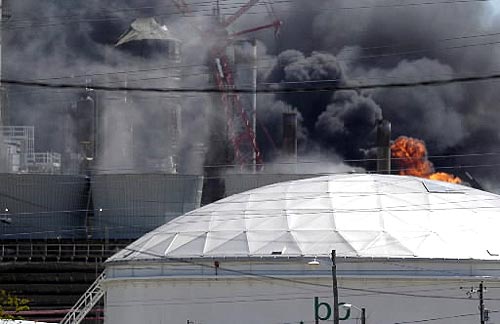
The Baker Panel, investigating the "safety culture" at BP's five North American refineries, issued its 374 page report today blasting the giant oil company for putting production targets, operational goals and budgets ahead of workplace safety.
The report's origin was an urgent safety recommendation issued by the Chemical Safety Board which is conducting an extensive investigation of the March 23, 2005 Texas City refinery explosion that killed 15 workers and injured 180. It was the biggest American workplace disaster in a decade.
The panel found serious problems throught BP's facilities:
While some refineries are far more effective than others in promoting process safety, significant process safety culture issues exist at all five U.S. refineries, not just Texas City. Indeed, the refineries show some similar process safety cultural weaknesses, even though they do not share a unified process safety culture. The Panel found instances of a lack of operating discipline, tolerance of serious deviations from safe operating practices, and apparent complacency toward serious process safety risks at eachAmong the findings of the report were BP's emphasis on "personal safety" (a.k.a. slips, trips, and falls) over process safety
refinery.
BP has not provided effective leadership in making certain its management and U.S. refining workforce understand what is expected of them regarding process safety performance. BP has emphasized personal safety in recent years and has achieved significant improvement in personal safety performance, but BP did not emphasize process safety. BP mistakenly interpreted improving personal injury rates as an indication of acceptable process safety performance at its U.S. refineries. BP’s reliance on this data, combined with an inadequate process safety understanding, created a false sense of confidence that BP was properly addressing process safety risks.The panel emphasized the importance of process safety over personal safety
Not all refining hazards are caused by the same factors or involve the same degree of potential damage. Personal or occupational safety hazards give rise to incidents—such as slips, falls, and vehicle accidents—that primarily affect one individual worker for each occurrence. Process safety hazards can give rise to major accidents involving the release of potentially dangerous materials, the release of energy (such as fires and explosions), or both. Process safety incidents can have catastrophic effects and can result in multiple injuries and fatalities, as well as substantial economic, property, and environmental damage. Process safety refinery incidents can affect workers inside the refinery and members of the public who reside nearby. Process safety in a refinery involves the prevention of leaks, spills, equipment malfunctions, over-pressures, excessive temperatures, corrosion, metal fatigue, and other similar conditions. Process safety programs focus on the design and engineering of facilities, hazard assessments, management of change, inspection, testing, and maintenance of equipment, effective alarms, effective process control, procedures, training of personnel, and human factors. The Texas City tragedy in March 2005 was a process safety accident.One of the more interesting parts of the report dealt with the resources that BP invested in safety. Preliminary findings of the Chemical Safety Board determined that cost cutting had led to safety problems at the Texas City plant. Yet BP claimed vindication in this area, citing the Baker Panel's conclusion that
it did not develop or identify sufficient information to conclude whether BP ever intentionally withheld resources on any safety-related assets or projects for budgetary or cost reasons.The report went on to say, however, that
The Panel does not believe that BP has always ensured that the resources required for strong process safety performance at its U.S. refineries were identified and provided.At the Texas City refinery, for example
From 1992 to the 1998 merger with BP, Amoco consistently and significantly cut costs in the Texas City refinery. Between 1992 and 1999, total maintenance spending fell 41 percent; from 1992 to 2000, total capital spending fell 84 percent.24 Notwithstanding this sustained period of budget cutting, after the merger BP issued a company-wide challenge to each of the refineries to cut their budgets an additional 25 percent without jeopardizing the integrity of the facility. According to at least one senior manager, progress toward meeting that challenge to cut costs 25 percent became a milestone in each refinery plant manager’s performance contract. Pursuant to that corporate challenge, Texas City continued to cut costs, 25 and some data indicate the refinery came close to meeting the 25 percent target.The report accused BP of eliminating thousands of critical jobs after its merger with Amoco, , not replacing experienced workers who retired, losing engineers and other personnel with with valuable operating and technical expertise. There were also serious understaffing and fatigue problems at BP's North American refineries.
The panel also found safety management problems:
BP has not demonstrated that it has effectively held executive management and refining line managers and supervisors, both at the corporate level and at the refinery level, accountable for process safety performance at its five U.S. refineries.In a response to the report, BP's Chief Executive, Lord John Browne announced that the company will implement the panel's recommendations. The BP response noted that the report did not put blame on any individuals, that no one acted in anything but good faith, that BP's not the only company with serious safety problems, and that the company has already implemented a number of the recommendations. And in a not necessarily unrelated development, Lord Browne announced last week that he will retire 18 months earlier than expected. Browne claimed that his early retirement was unrelated to the report.
The panel also made a number of recommendations focused around improving its process safety management system, and to improve its methods of measuring safety performance. The panel also recommended an independent monitor to report to the company’s board over a five-year period.
The Baker panel will not have the last word on the Texas City disaster.
The Chemical Safety Board expects to issue a report in March. Daniel Horowitz, a spokesman for the board, said yesterday that the Baker panel's report showed that many things contribute to accidents like the one in Texas City. "It is a very significant finding that BP does not effectively investigate incidents throughout the corporation," he said. "If you're not learning from near misses, you're not in a position to prevent major disasters like the one in Texas City."More BP stories here.

