Wednesday, November 12, 2003

New Jersey Steps into Chemical Plant Security Debate

Governor James McGreevey of New Jersey is reportedly on the verge of issuing a memorandum of understanding between the state and three chemical industry organizations that would address chemical plant security and allow chemical companies to avoid state regulation.

Senator Jon Cozine (D-NJ), who has introduced legislation into the Senate requiring stronger federal regulations, is not pleased. A spokesman for Corzine stated that "Senator Corzine believes we need a strong regulatory approach with strong requirements and serious teeth."

Environmental and worker advocacy groups are also unhappy:
The memorandum would require chemical plants to adhere to the Responsible Care Security Code, a set of guidelines crafted by the American Chemistry Council. The DEP would develop a program to inspect facilities and determine whether they are living up to those standards, a draft of the memo said. Any companies choosing not to participate would be subject to state security regulations, which have yet to be created but presumably would be harsher.

Jamie Conrad, a lawyer for the American Chemistry Council, said the Responsible Care standards run hundreds of pages, providing extensive guidance on plant security.

"There's an enormous amount of detail in these guidance documents as to how to do it," Conrad said.

But Rick Engler of the Work Environment Council, a group that links organized labor and environmental issues, said industry should not be able to write its own rules.

"We think it's outrageous," Engler said. "It's kind of ironic that this secret deal is being cooked up in the home state of Senator Corzine, who is leading the fight for national standards."


AFSCME/SEIU Endorse Dean

A number of good articles today in the Washington Post , LA Times, NY Times and Christian Science Monitor on the endorsement and the reasons behind it.

More blog commentary on AFSCME/SEIU endorsement here and here and here.

Association of Washington Business Continues to Lie and Distort

"A level of despicableness beyond imagining"

Even as they celebrate their victory over workplace safety -- a campaign based on lies -- the Association of Washington Business (AWB) still can't seem to tell the truth.

Check out their post-election Press Release.

“We believe that employers and workers should address injuries related to ergonomics,” AWB President Don Brunell said. “Our problem is with L&I’s rules which were wide open to interpretation and which no one fully understood.”
No one? Well maybe not 53% of the voters who actually believed your distortions.
“While Gov. Locke provided a six-year phase-in period, the fundamental problem was with the ambiguity and sweeping impact of the rules themselves,” Brunell said. “There are extensive federal, state and local laws and rules on the books today which protect worker safety. Therefore, if someone is willfully violating laws or regulations, they will be penalized.”
Lies, lies, lies. There are no federal, state (with the exception of a weak California regulation) or local ergonomic laws or rules on the books. And they know they're lying.
By delaying the implementation of the rules as the Governor did, there were some questions about which rules could be enforced when it came to ergonomics and worker safety. AWB believes the passage of I-841 clarified that issue.
Bullshit. There was no question in anyones' mind except the ones you dishonestly planted there.
AWB also believes the passage of I-841 strengthened the court challenge the “We Care Coalition” filed to suspend the rules. We Care believed the regulatory process in which the rules were adopted was flawed. “We feel the courts now will have a clearer sense of the public’s mood toward the regulatory process and that will help employers, workers and citizens in general.”
Oh yeah, since when does any self- and law-respecting court base its decision on the public mood? If the U.S. Supreme Court had done that, Al Gore would be president today (and we'd still have a national ergonomics standard).
AWB is launching an ergonomics education effort through its foundation (Institute for Workforce Development and Sustainability) and scheduled its first Ergonomics Solutions Workshop for Nov. 20 in Olympia.
Yeah, and O.J. is hot on the trail of the real murderer.

Think I'm exagerating about their evilness? Judge for yourself. I received this note from a friend in Washington after the election:
Saturday before the election I was getting my hair cut. I asked the guy who cuts my hair if he had voted yet. When he said no, I asked him if he knew about the initiative related to ergonomics. He asked, "Oh, is that the one about kids' health insurance?" I thought I had heard him wrong, but as this was the only initiative on the ballot, I didn't pursue his confusion, and just launched into my discussion of what ergonomics is all about, what the rule did/didn't do, etc.

Much to my amazement, when I mentioned this to my husband, who had been sick one afternoon, came home early and watched the local evening news--that was the tag line on the TV ads!!!! The ad never explained how they reached that conclusion. (Presumably it was linked to the allegation that people would lose jobs due to the ergo rule, or maybe that the ergo rule would cost so much employers would no longer provide health insurance to employees.) The ad was full of cute kids swinging on swings, and there was apparently a banner at the bottom of the screen that warned voters that if they didn't repeal the ergo rule that thousands of kids in Washington state would lose their health insurance coverage! (Like anyone in the residential construction industry, which sponsored the initiative, provides any employee with health insurance....even if you were persuaded that the rule would put anyone out of business, which we all know it wouldn't have.)

It seems to me they have stooped to a level of despicableness that is beyond imagining.
Amen

Tuesday, November 11, 2003

Chemical Plant InSecurity

More on chemical insecurity from the Progressive. I've written several times before about Senator Jon Corzine's (D-NJ) attempt to pass a bill address chemical security issues. Corzine's bill, initially introduced following 9/11, would have required companies using large amounts of dangerous chemicals to consider "inherently safer technologies.

As you may recall, following unanimous Senate committee approval of the Corzine bill,
An alarmed chemical industry sprang into action, "mounting daily assaults on the Republican members of the [Environment and Public Works] committee throughout August," reported John Judis in The New Republic last January. An August 29, 2002, letter, signed by thirty members of the chemical and oil industry lobby and sent to Republican members of the committee, deplored the new bill, particularly its proposal to "grant sweeping new authority to EPA to oversee facility security." The lobbyists objected strongly to a particular provision that would have required plants to use "inherently safer technologies." This would "allow government micromanagement in mandating substitutions of all processes and substances," the letter stated, adding that it could "result in increased security risks."

By September 10, seven out of the nine Republican members on the committee bowed to the pressure, issuing a letter against the Corzine bill, claiming it "severely misses the mark" (emphasis in the original).

During that same summer, members of the American Chemistry Council (ACC) "gave more than $1 million in political contributions, most of it to Republicans. Eight Senators who were critical of the Corzine bill have received more than $850,000 from the ACC and its member companies," according to a Common Cause report dated January 27, 2003.
Not only did the EPA, the White House and Congress succumb to chemical industry pressure, but the Department of Transportation caved as well.

Toxic chemicals are regularly transported through well-populated areas. DOT had proposed to address this problem through a regulation stating that "Routes should minimize product exposures to populated areas and avoid tunnels and bridges, where possible."

The chemical and petroleum industry successfull lobbyed to remove this language:
"There's nothing really in there that says anything about restricting transport at any time," says Hind. He expected the rule at least to require constraints on dangerous chemicals in heavily populated areas during orange alerts. "But they didn't even do that," he says.

In September, the Sierra Club photographed a rail tank car carrying chlorine near the U.S. Capitol. Greenpeace took notice. "We are formally requesting immediate action by the Secret Service to address a near and present danger to the President, Vice President, Speaker of the House, and all other national leaders living and working in Washington, D.C.," Rick Hind, legislative director for the Greenpeace Toxics Campaign wrote to the Secret Service. By the EPA's own worst-case estimates, a leak from one ninety-ton rail car of chlorine could kill or injure "people in the Congress, the White House, and any of 2.4 million local residents within fourteen miles," Hind wrote.

Greenpeace isn't the only one raising alarms. On June 20, FBI Special Agent Troy Morgan, a specialist on weapons of mass destruction, addressed a chemical security summit in Philadelphia. "You've heard about sarin and other chemical weapons in the news," he said, according to the Pittsburgh Tribune-Review. "But it's far easier to attack a rail car full of toxic industrial chemicals than it is to compromise the security of a military base and obtain these materials."


Supermarket Workers: They're Striking For All of Us

This about says it all: "For the cashiers and stockers on the picket lines, the fight to fend off large-scale concessions is a struggle to avoid being thrown into one of America's lowest castes, the working poor." Check out the article.

And, as the headline says, they're striking for all of us:
"The stakes are enormous," said Ruth Milkman, chairwoman of the University of California Institute for Labor and Employment. "If the employers succeed in their effort to extract large concessions, they will turn these into low-wage jobs, and other employers across the nation will see this as a green light to try to do the same thing."
Check out the UFCW strike page for more information about the strikes and some things you can do (like send e-mails to Safeway, or send money to the strike fund.)


Monday, November 10, 2003

Safety Training Offered

AFL-CIO George Meany Center

Attention union activists, staff, and local union health and safety representatives who would like to teach their membership about workplace health and safety issues. The George Meany Center for Labor Studies will offer two six-day Train-the-Trainer health and safety programs next year.

The first is a Train the Trainer Program on Workplace Health and Safety For Bi-Lingual (Spanish-English) Union Trainers February 8 – 13, 2004. Click here for flyer and here for application.

The second class, for English speakers runs from May 2 – 7, 2004. Click here for flyer and here for application.

Topics of both classes include
  • Worker and Union Roles in Workplace Safety and Health
  • Identifying Hazards in the Workplace
  • Legal Health and Safety Rights of Workers and Unions
  • Recordkeeping (OSHA 300 Log) Requirements
  • Introduction to Ergonomics
  • Effective Health and Safety Committees
The costs of the classes are $1000, which includes a single room for six nights (Saturday-Thursday) and all meals (cost per person for a double room is $730). For commuters, the cost is $250, which includes lunches and dinners. There is no charge for tuition or materials.

For more information, Sharon Simon at the George Meany Center at 301- 431-5414, or at ssimon@georgemeany.org.

Sign up soon. Space is limited.

Workers Sensed Danger Before Collapse of Parking Garage

This is chilling:
ATLANTIC CITY, Nov. 7 — They are construction workers, not engineers or safety experts. But George Tolson, Norman Williams and John Pietrosante Jr. found themselves focusing on a common thought: something unsafe or at least unsettling was going on as they rushed to complete a $245 million expansion of the Tropicana Casino and Resort.

The job had gotten off to a slow start, given bad weather last winter. As the April 2004 deadline approached to complete the new 502-room hotel, a 10-story, 2,400-space parking garage and a sprawling retail and entertainment complex called the Quarter, each could feel the pressure building to quicken the pace. But not just the pace of work disturbed them.

Mr. Tolson and Mr. Williams, laborers who helped install so-called pole shores — metal pogo-sticklike devices that temporarily hold up the concrete floors until they harden enough to support themselves — could see that half a dozen or so of these poles had somehow been bent out of shape. The implication was unmistakable: the floors, even if just so slightly, were moving.

"The concrete was too green," Mr. Tolson, 60, said he told his foreman, using slang to describe concrete that has not fully hardened. Mr. Williams, 49, recalled thinking: " `There is too much weight on those shores.' "

Mr. Pietrosante, 25, saw a similarly disturbing condition: cracks in the concrete floors and columns he was helping to build, at an unusually rapid pace. "Usually you pour one floor of concrete every three weeks, but we were being pushed to do a floor a week," he said. "This job was rush, rush, rush."
Hmm. "an unusually rapid pace," "rush, rush, rush." Maybe this is that "productivity" they've all been talking about (see below.)


Unemployment Down. Good News?

So unemployment is now down. Good news for American workers? Not necessarily:
Even though economic growth surged at a rapid annual rate of 7.2 percent in the third quarter of this year, business executives around the country say they are still cautious about expanding their work forces and building factories.

And a new economic study, prepared for the United States Conference of Mayors, concludes that wages are significantly lower in the service sectors that are adding jobs than in the manufacturing industries that have been losing jobs.

According to the study, prepared by the economic consulting firm Global Insight, the biggest job growth over the next two years will be in the areas of administration and support services, health care, travel and tourism.

The average wage in those sectors over the next two years is expected to be $36,000, the study concluded. By contrast, the average wage in manufacturing sectors that lost jobs is $43,000.
Individual companies also aren't as optimistic as the Administration:
The Union Pacific Corporation, the big freight rail company, is preparing for a year of strong growth. But although the company is hiring, it expects productivity gains to allow it to keep its overall work force around its current size of 46,300 people or somewhat fewer.

"We're going to handle more business with fewer people," said Jim Young, Union Pacific's chief financial officer.

In its regular survey last month of chief executives at large companies, the Business Roundtable found that 71 percent of the executives expect their sales to increase in 2004 but only 12 percent expect to expand their work forces.

"Productivity continues to astonish everybody," said Henry A. McKinnell, chief executive of Pfizer Inc., the pharmaceutical producer. While executives are far more optimistic about next year than they were just a few months ago, he said, their mood is still "not ebullient."

In themselves, the new job numbers are not that impressive. By comparison with the rebound in jobs after other recessions, including the so-called jobless recovery of 1991, the pace of job creation now remains anemic.
Happy days are here again.

Better than a Political Novel

Major environmental disaster. Government investigates. Cabinet Secretary overseeing agency conducting investigation married to Senator from that state. Official in investigating agency alleges whitewash, no bid contracts, etc. Agency threatens to fire whistleblower.

Plot of the latest political novel? No, according to the NY Times, the latest alleged scandel of the Bush Administration.
The Bush administration has notified a mine safety official who has sharply criticized federal mining policies that it intends to fire him, according to documents and the official's lawyers.

The official, Jack Spadaro, the superintendent of the National Mine Health and Safety Academy in Beckley, W.Va., has been an outspoken critic of a federal investigation into a huge spill of coal sludge in eastern Kentucky three years ago. The accident, at the Martin County Coal Company, is considered one of the biggest environmental disasters in the Appalachian region.

Mr. Spadaro accused political appointees in the Mine Safety and Health Administration of cutting the investigation short, playing down the coal company's culpability and not holding federal regulators accountable for weak oversight. He was a member of the team investigating the spill before he resigned in protest in 2001.

Mr. Spadaro has also raised questions about no-bid contracts that he contends were awarded to friends and former business associates of David D. Lauriski, the assistant secretary of labor for mine safety and health, and other senior mine safety officials. His complaints led to an investigation by the Department of Labor's inspector general.

The dispute has become a flashpoint between the Bush administration and critics of its mining policies, who contend the administration has tried to weaken environmental and safety regulations to help big coal companies that contribute heavily to the Republican Party. Mr. Spadaro's firing, the critics contend, is retribution for his outspokenness.
Hmmm. First OSHA goes after one of its Regional Administrators who turned whistle blower, now MSHA. Yawn. So what else is new?


Saturday, November 08, 2003

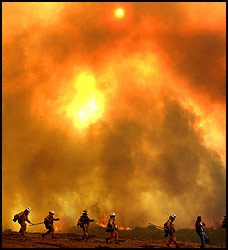
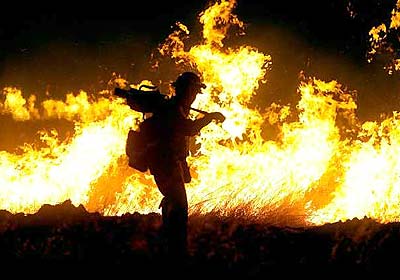
California Fire Photos

Many more amazing photos can be found at the L.A. Times.


Mark Boster / LAT

Gina Ferazzi / LAT


The Weekly Toll

Another long list of workers killed on the job over the past couple of weeks.

I also want to point out another group who lost large numbers in the past two weeks on the job. Those are the military men and women just doing their job in Iraq. I've already written a long article about the fact that astronauts and the military get so much more attention than the larger numbers of regular workers who die every day on the job.

This week, for example, there has been much attention paid (and rightfully so) to the high number of soldiers lost in Iraq (over 30) even though many times more men and women were killed in American workplaces over the same period of time with much less press attention.

Construction worker dies in fall from condo project

A construction worker fell to his death from the eighth floor of The Waterfront on Venice Island condominiums Friday. The incident happened at 8:26 a.m.

Killed was William J. Molinaro, 44, 1000 block West Baffin Drive, Venice. He is survived by a wife and three children, according to Venice police investigators. Molinaro worked for Associated Interior Drywall, Sarasota.

Venice police Sergeant Mike Treanor said the man was putting drywall in an eighth-floor unit.

"He stepped out and apparently leaned against the two cables stretched across the balcony," he said. "The lead anchors holding the cables pulled out of the wall when he leaned on them." More Here.


Power Line Kills Man


Queens, NY -- A worker was killed and two others injured yesterday when they were electrocuted in a construction accident, police said.
The incident occurred shortly after 3 p.m. when three employees of CAC Industries were attempting to secure a metal cable swinging from a crane at a construction site.

Authorities suspect that while performing that task, either the crane or its cable somehow came into contact with a nearby power line, sending a powerful electrical current through the cable and shocking the workers.

Thomas Tierney, 35, was rushed to Peninsula General Hospital, where he died an hour after suffering burns throughout his body. Anthony Nelson, 42, was standing in a puddle of water at the time and was injured. Mitchell Gust, 40, was also shocked. Both men are in stable condition.


2 workers killed when crane touches power line

St. Clair Shores, MI -- The St. Clair Shores construction company that was involved in a double fatality Wednesday morning has no previous safety violations in the three years it has been in business, according to state records.

Two workers were electrocuted and a third injured when a crane they were working on either came near an overhead power line or touched the line, sending a powerful electrical current through them.

The incident happened as a Klee Construction crew was lifting roofing trusses with an estimated 100-foot crane on a canal in the area of 10 Mile Road and Jefferson, investigators said.

The victims were identified as Edward Spaccarotelli, 25, and Ryan Surant, 19, both employed by Kree Construction. Company workers said the men were "like family."

A preliminary report issued by the Michigan Occupational, Safety and Health Administration indicated the men were erecting a truss for a two-story house when the crane being used to lift the trusses into place made contact with an overhead energized electrical line.

Apparently Surant was holding a metal cable lifting the truss while Spaccarotelli was the crane operator.

Witnesses told reporters that Surant was unable to release the energized equipment as Spaccarotelli desperately tried to pull him away, only to be electrocuted himself.

More here.


Local man killed in Wallingford industrial accident

WILLIMANTIC CT— The Occupational Safety and Health Administration is currently conducting an industrial investigation into an accident that caused the death of a local man.

Philip F. Hopkins, 55, of Pennywood Lane, died Monday as a result of the workplace accident in Wallingford.

According to Lt. Marc Mikulski of the Wallingford Police, Hopkins was working at Infra Metals when a chain-driven crane in the plant was exchanging a Dumpster filled with scrap metal for an empty Dumpster.

For some reason, the filled Dumpster tipped over and fell off the crane and spilled its cargo, causing Hopkins’ death.

Mikulski said he believes Hopkins was struck by both the Dumpster and its contents.


Worker Killed in Plant Explosion


At the Chippewa Valley Ethanol Co., workers and managers are repairing their plant, damaged in a deadly explosion on Oct. 22, in hopes of resuming production of ethanol -- and their prized product, Shakers vodka -- within a couple of weeks.

But no one wants to celebrate when the next batch of the hot-selling Shakers Original American Vodka, now being marketed coast to coast, rolls off the line.

The Benson, Minn., plant is mourning the death of a welding contractor in the blast while opening its doors and records to Minnesota safety inspectors who will determine whether the plant was at fault.

The explosion killed Robert Olson, a 20-year-old welder from Granite Falls, Minn., who worked for Lundin Construction of Hanley Falls. At the request of Benson plant officials, Olson was cutting into the roof of a corn-mash storage tank when a flammable vapor inside ignited, according to the state Fire Marshal Division in St. Paul. More here.

Worker Dies In Fall At Louisville Airport
Victim Employed By Oklahoma Company


LOUISVILLE -- A man was killed early Thursday while working on a construction project at the Louisville International Airport. The man fell through the framing of a skylight in Concourse B at about 2:30 a.m. and landed on the floor below.


Source of plant blast eyed in Huntington


Huntington, IN -- Investigators continue to look for the origin of a fatal explosion at a Huntington wheel manufacturer.

About 8:30 p.m. Oct. 29, an explosion ripped through the Hayes Lemmerz International factory on Huntington's western edge. One worker was killed and two others were seriously injured.

A maintenance worker, David Ripplinger, remains in critical condition in the St. Joseph Regional Burn Center, said Geoff Thomas, spokesman for Lutheran Health Network.


Death inquiry may take a month

No witnesses in MMNA fatality

BLOOMINGTON, MI -- Results of a federal investigation into the Oct. 23 suffocation death of a Mitsubishi Motors North America worker likely won't become public for at least a month.

John Foster, 42, of Metamora was killed when he was pinned between pieces of equipment while he was performing preventative maintenance. He had worked at the plant for 15 years.


Worker Dies in Fall

(Janesville-AP) -- A worker who died in an accident at the Janesville General Motors plant is identified as 44-year-old Douglas Mellom.

An autopsy by the Rock County Coroners office conducted today found Mellom died yesterday morning when he fell from the top of an elevator shaft.

Mellom was working on repairing equipment when he fell down the shaft 18 feet.


Four Killed In Casino Parking Garage Collapse

ATLANTIC CITY -- Engineers and safety inspectors are beginning the delicate and dangerous work needed to stabilize the ruins of a parking garage that collapsed in New Jersey.

Crews worked through the night using steel cables to stabilize the building because they feared another collapse.

The garage was under construction at the Tropicana Casino in Atlantic City when the top five floors on the 10-story structure collapsed Thursday, like a house of cards. The collapse occurred while workmen poured concrete on the top floor of the structure. Four construction workers died, and 20 people were injured. More here, here and here.


Ohio man killed in plant accident

WINFIELD, W.Va. -- A welder died Friday after falling at least 70 feet from a catwalk at the John Amos Power Plant.

Tim Siders II fell at about 7:30 a.m., said Sharyn McCaulley, a spokeswoman for The Babcock & Wilcox Co. of Barberton, Ohio, a contractor installing a pollution control system at the plant, which is operated by American Electric Power.

Siders, 27, of Gallipolis Ferry, was taken to a Charleston hospital but died during surgery, McCaulley said.


Salem man dies after hitting wire

A heavy-equipment operator was killed Thursday when the machine he was operating touched a live wire near Bonneville Dam.

Luther Stinson Jr., 34, of Salem was operating a piece of machinery with a large boom that drives guardrail posts into the ground. Oregon State Police Lt. Dale Rutledge said Stinson was putting rail posts in the park area, near exit 40 on Interstate 84, when the pile driver touched a live wire about 2 p.m.

Explosion at oil production site in Donna kills 1
OSHA investigators called in to look into the blast

DONNA, TX — An explosion at an oil production site north of the city killed one person Thursday morning and seriously injured another.

Ernesto Garza, 22, died en route to McAllen Medical Center after sustaining injuries from an explosion involving a compressor, officials said.

The other man, whose identity was not released, remained in critical condition late Thursday at the hospital.


OSHA Launches Probe into Workers' Fatal Fall from Ladder

Northport, Alabama-- Investigators with the Occupational Safety and Health Administration are looking into the death of a Tuscaloosa man who fell while working on a restaurant sign.

OSHA said 40-year-old Robert Daniel Stone, an employee of Knight Sign Industries, was changing bulbs at a McDonald's restaurant in Northport when the extension ladder he was using collapsed.


Road worker killed in construction zone

Pittsburgh -- A motorist struck and killed a construction worker Wednesday morning along a busy stretch of Painters Run Road in Mt. Lebanon.
James Vena, 48, of Meyersdale, Somerset County, was taken to St. Clair Hospital, where he was pronounced dead at 9:20 a.m., about a half-hour after the accident near the road's intersection with Cedar Boulevard. An autopsy is expected to be completed today.

Authorities identify worker who died after fall

FARGO - A man who fell about 40 feet to his death while working on power poles has been identified.

Cass County authorities say Toby Windels, 21, of Sebeka, Minn., died after he fell from a bucket truck near Horace, south of Fargo.

Indiana County Power Plant Worker Killed

NEW FLORENCE, Pa. -- A man working at an Indiana County power plant was killed when he slipped or was dragged by suction into a coal stock pile.

Officials from the Conemaugh Generating Station in West Wheatfield Township say 36-year-old Michael Kuhns, of Fairfield Township, was found buried beneath the coal in a bin that feeds a conveyer belt. Kuhns, a subcontracted painter, was trapped in the bin around 3 p.m. Monday.


Construction worker dies when dump truck backs over him

STUART, FL — A construction worker died this morning when a dump truck loaded with fill dirt backed over him at a building site on Central Parkway.

Stuart Police said the worker was doing some surveying work and he didn't notice the truck. It wasn't known Tuesday morning if the truck was equipped with backup warning signals.

OSHA probing Ark. man's cell-tower death

LEOMINSTER -- State police and the federal Office of Occupational Safety and Health Administration (OSHA) this week are continuing to investigate the death of a man who fell from a cell tower Friday.

"Cell tower work is particularly dangerous because the elevations are so high and there are so many of them going up because of consumer needs," said regional OSHA director Ronald E. Morin. (Ed. Note: Did that statement provide any useful information?)

William R. Clist, 24, of Yellville, Ark., died Friday when he fell from high atop a Sprint PCS cell tower under construction in west Leominster, according to Elizabeth Stammo, spokeswoman for District Attorney John Conte's office.

Safety officials review fatal fall in new arena

Federal workplace safety authorities are looking into the death of a Florida man who fell from a ladder last week while preparing a fireworks display in Toyota Center for the Houston Rockets' home opener on Thursday.

Christopher Boyd Spang, 47, of Auburndale, Fla., was working on a rocket to be fired from the scoreboard when the accident occurred about 5 a.m. Friday, said a report by the Harris County medical examiner's office.

For tree-removal workers, Isabel's dangers persist

VIRGINIA BEACH -- It should have been a routine job, one that Ed Monroe had seen done hundreds of times before.

But it wasn't.

Thursday's job for Green Tree, a local tree-removal company, would claim the life of one of Monroe's employees. He was one of four tree-trimming and logging professionals to die on the job in Virginia this year. With cleanup from Hurricane Isabel continuing, officials fear more such accidents.

Omar Garcia, 19, a crew member of three years, was killed Thursday afternoon while taking down a tree in Virginia Beach. Garcia's best friend was in the tree, as a climber, when a piece of the tree came down and struck Garcia.

Garcia's brother was also on hand, the site's CPR Supervisor, but there was little he could do to save his badly injured brother.

Garcia is the second local professional with a tree-removal company to be killed within the past two months

Mining accidents: 'Alarming trend'--Deaths of supervisory personnel raise red flag

Two mine-related fatalities in the state within a four-day span, including one at Holly Hill's Holcim Inc. plant, have Mine Safety and Health Administration officials digging for answers and clues as to the underlying causes for the back-to-back incidents.

Most disturbing, officials say, is the nature of the fatalities. Both involved experienced employees in supervisory roles.

"We have had a number of fatalities this year, and about 50 percent have involved supervisors," said Mike Davis, district manager of the southeast region MSHA, metal and non-metal division. "This has caused the greatest amount of concern this year. It is an alarming trend."

The first metal and non-metal fatality occurred Sept. 22 at Holcim when Antonio Gonzalez, 39, of Ridgeville was using a back-hoe to dig out along the side of a building to replace a retaining wall. The victim and the two co-workers were in a 15-foot-deep hole when the bank caved in, burying the victim. A second employee received minor injuries while a third co-worker escaped injury.

The fatal accident was the second at the plant in under two years. A worker was killed in February 2002 during the construction of a cement kiln at the site.

American Military Killed in Iraq Since October 26. There are 33 names here, and at least six more have died since. Photos and additional information can be found here.

James Anderson Chance III
Paul Fisher
James R. Wolf
Jose A. Rivera
Robert T. Benson
Francisco Martinez
Daniel Bader
Ernest G. Bucklew
Steven D. Conover
Anthony D. D'Agostino
Darius T. Jennings
Karina S. Lau
Keelan L. Moss
Brian H. Penisten
Ross A. Pennanen
Joel Perez
Brian D. Slavenas
Bruce A. Smith
Frances M. Vega
Paul A. Velazquez
Joe N. Wilson
Benjamin J. Colgan
Joshua C. Hurley
Maurice J. Johnson
Todd J. Bryant
Algernon Adams
Michael Paul Barrera
Aubrey D. Bell
Steven Acosta
Rachel K. Bosveld
Charles H. Buehring
Joseph R. Guerrera
Jamie L. Huggins



Friday, November 07, 2003

Our Their government at work.

Rejection of 'Earmarks' Angers Democrats
GOP Subcommittee Chairman Says He Won't Honor Party's Projects in Bill
Rep. Ralph Regula (R-Ohio), who chairs the subcommittee that controls spending on education, health and jobs programs, recently stunned Democrats by announcing plans to reject every "earmarked" project they are seeking in the final, compromise version of the bill, which funds the departments of Education, Health and Human Services, and Labor.

His reason: When the House passed the bill on July 10, all 198 Democrats present voted against it, several of them saying it shortchanged education programs. The bill passed, 215 to 208.

***
Democrats say the real victims of Regula's policy will be the poor. Of the nation's 50 poorest congressional districts, 42 are represented by Democrats. Democrats say schools and community groups in these districts often need help from their member of Congress for worthwhile projects.
Hoyer had hoped to get $400, 000 -- the same as last year -- for a group called Rebuilding Together. The nonprofit organization works with volunteers to rehabilitate homes of the poor, elderly and disabled.
White House Puts Limits on Queries From Democrats

The Bush White House, irritated by pesky questions from congressional Democrats about how the administration is using taxpayer money, has developed an efficient solution: It will not entertain any more questions from opposition lawmakers.

For La. Lobbying Firm, a Victory on Workers' Comp

A Louisiana firm scored a quiet lobbying victory this week when House and Senate negotiators decided not to transfer a compensation program for ill weapons-lab workers from the Energy Department to the Labor Department.
***
Sens. Charles E. Grassley (R-Iowa) and Lisa Murkowski (R-Alaska) inserted language into an energy and water spending bill that would have transferred control of the DOE program to Labor, which they say has more experience working through such claims. They said the DOE has not properly implemented the program, creating a seven-year backlog of claims.

They wrote the top Senate negotiators, Sens. Pete V. Domenici (R-N.M.) and Harry M. Reid (D-Nev.): "Based on DOE's own publicly available data and the General Accounting Office's evaluations so far, it is plain that this program is failing."

But Science and Engineering Associates -- which in 2001 obtained a non-competitive contract worth more than $15 million to process the DOE claims -- fought back. It brought in heavy hitters such as former House Appropriations Committee chairman Bob Livingston (R-La.) to make its case on Capitol Hill. It also increased its political contributions between 1998 and 2002 from $4,000 to nearly $50,000, according to the Center for Responsive Politics.

(Ed. Note: By “their,” government, I don’t necessaryliy mean the R’s as much as I mean business money. In this case the “good guy” was a Republican, and those bought off were Democrats.)

White House to End Power Plant Probes
Move Follows EPA Easing of Enforcement


The Bush administration confirmed yesterday that it will close pending investigations of 70 power plants suspected of violating the Clean Air Act and will consider dropping 13 other cases against utilities that were referred to the Justice Department for action, following the Environmental Protection Agency's decision in August to ease enforcement rules.

Thursday, November 06, 2003

QUOTE OF THE WEEK

NFIB's Agent In Government

Sometimes you have to admire the Republicans for their candor.

Check out this quote from the Small Business Administration's Chief Council for Advocacy, Thomas Sullivan. Sullivan was executive director of the National Federation of Independent Business Legal Foundation, "which guides small businesses on legal issues and promotes their interests in the court," when he was appointed SBA by President Bush in 2002.

Even while in government, however, Sullivan is keeping his eyes on the prize:
"I am doing the exact same thing as chief counsel for advocacy," Sullivan said, "only NFIB does not have to pay me now."
Isn't that nice.

The fact that the Bush administration is doing the business of the business assocations is not exactly shocking news to us, but it's always nice to have someone come right out and admit that NFIB has just switched it's office over to government housing, and is billing the taxpayers for its payroll.

In an interview with the San Antonio Express News where he was in town to address the effects of immigration policy on small business, Sullivan boasted about the clout of the SBA:
The office always had clout. It helped stem the burdensome ergonomics rule from the U.S. Occupational Safety and Health Administration that could have bankrupted many companies several years ago.
Well, not exactly. He seems to be confusing the SBA with his previous job at NFIB. Which is easy to do these days. Business. Government. Business. Government.

NFIB, the parent organization of the Legal Foundation, was one of the main forces behind repeal of the federal OSHA standard and behind the Washington State initiative repealing their ergonomics standard.

In fact, NFIB likes to boast that in the week before the vote against the federal standard, they
sent 70,000 fax alerts against the ergonomics regulation to its members outside of Washington, asking them to turn up the heat on undecided lawmakers.

"Our fax machines have been running almost nonstop, printing letters that small business owners sent to their elected representatives and then shared with us," Senior Vice President Dan Danner told The Washington Post the week before the vote.
The NFIB Legal Foundation's website boasts that the Foundation
was recently part of a full-court press that successfully challenged the Occupational Safety and Health Administration's (OSHA) ergonomics rule. Responding to the NFIB Legal Foundation lawsuit against OSHA and an intense lobbying campaign by NFIB, Congress repealed this law that would have cost small business owners more than $40 billion.
Even before Bush, small business had a "special place" in government, although not quite this special. A bit of background might help explain.

The Gingrich Congress of the mid-1990's, responding to their deep concern about contributions from the fate of small business in this country and the risk that overburdensome regulations may hurt their profits drive them into wreck and ruin, thoughtfully passed the Small Business Regulatory Enforcement Fairness Act (SBREFA) in 1996.

SBREFA gave small business, represented in government by the Small Business Administration, an early bite at the regulatory apple even before the regulatory proposals were issued, which is when the rest of the public gets to comment. ( Editorial Note: We here at Confined Space have always wondered why workers don't get a similar early bite at the apple, but the answer to that question is probably too obvious for us to figure out.)

Selected small businesses, as well as small business associations, chosen jointly by OSHA and the SBA, would participate on the SBREFA committee that would comment on the pre-proposal, or "SBREFA Draft" of OSHA regulations. And "frank and candid" discussions would continue throughout the process as SBA representatives played the role of "the loyal opposition."

Of course having the NFIB right inside the bureacracy makes things so much more efficient.

P.S. Sullivan's quote has been unanimously selected by the entire staff here at Confined Space as the

QUOTE OF THE WEEK
,

entitling him to a Confined Space T-Shirt, if such a thing existed. Congratulations Tom


Green Labor

This is an article by Dave Foster, Director of United Steelworkers of American District 11, about his trip to the Artic National Wildlife Refuge:
I came to the conclusion, as have many others, that drilling in the Arctic Refuge is bad energy policy (all the oil in the refuge would supply the nation's oil needs for only six months), disastrous environmental policy to the land, and a serious human rights violation. I arrived at this conclusion, not apart from the concerns for jobs and workers' rights that fill my daily life, but as an outgrowth of them. Preserving and equitably distributing our planet's dwindling resources, honoring the diversity and history of our planet's many cultures, and working to create a society where waste is minimized, not pursued, are values that guide my work at the United Steelworkers.
And while you're at it, check out the latest edition of Green Labor, a newsletter dedicated to building coalitions between labor and environmentalists. The first edition, which also contains and article by Foster, can be found here.

Nurses: Long Hours = Danger for Patients

Bush, Nursing Home Industry: 'No Problem'

The National Academy of Sciences is picking up on something that those of us who work with (or as) nurses have known for a long time.
Many hospitals and nursing homes are endangering patients by allowing or requiring nurses to work more than 12 hours a day, the National Academy of Sciences said on Tuesday.

Such long hours cause fatigue, reduce productivity and increase the risk that the nurses will make mistakes that harm patients, the academy said in a new report commissioned by the federal government.
NAS recommended that nurses work no more than 12 hours in any 24-hour period or more than 60 hours a week, yet over one quarter of nurses work more than 13 consecutive hours at least once a week.

As usual, the Bush Administration has come down on the wrong side of this issue
The Bush administration said last year that it had no plans to set minimum staffing levels for nursing homes, in part because such requirements would generate billions of dollars in additional costs for Medicaid, Medicare and nursing homes.

But the National Academy of Sciences said the administration should do what it declined to do last year: set "minimum standards for registered and licensed nurse staffing in nursing homes."
The American Hospital Association and the American Health Care Association (which represents the nursing home industry) see now problem either.
Pamela Thompson, chief executive of the American Organization of Nurse Executives, a subsidiary of the American Hospital Association, said it was "an accepted practice" for nurses to work 12-hour shifts.

Alan E. DeFend, vice president of the American Health Care Association, which represents nursing homes, said: "The shortage of nursing assistants has reached crisis proportions. Sometimes there's just no alternative to overtime."
To address the problem, the report came up with a radical solution, one that's also no surprise to those familiar with work in nursing homes (or any other workplace): "To reduce such errors, the panel said, nurses should be more involved in the day-to-day management of hospitals and nursing homes."

Washington Ergo Initiative Post-Mortem (1)

Jobs, Demagoguery and Cash

Why happened? Several observations.

From an SEIU Organizer:
in a statewide election, TV seems to be decisive. The industry really carpetbombed the airwaves the last week. I rarely watch television but in the few moments I did I saw their spots about four times. I never saw any of our spots.
And the Seattle Post Intelligencer agreed:
Washington state's sweeping workplace ergonomics rules - which survived lawsuits and a multiyear assault in the Legislature - succumbed to a million-dollar initiative campaign....After paying signature-gatherers to get the measure on the ballot, the BIAW spent heavily on a television campaign that portrayed the rules as job-killing regulation run amok.
The observations of John Gastil and Ned Crosby, Seattle Post Intelligencer columnists, bring back a whiff of Florida, November 2000:
Initiative 841 spurred more than $2 million in campaign spending, but after hearing the initiative's full ballot statement, 39 percent of voters surveyed had no idea what its effect would be and 8 percent had it backward ("enact ergonomics regulations"). Given its apparent margin of victory, if 8 percent made that error statewide, correcting that misunderstanding alone would have changed the fate of this initiative. Many of those who described its impact relied on messages they had heard from one side or the other ("It will reduce workplace safety" or "It will cost us jobs")....

The vast majority did not know the initiative's estimated fiscal impact, despite its prominent appearance in the official voters pamphlet. Only one in four voters knew that the federal government lacks similar rules, even though this is a key pro-841 argument. Forty-nine percent of voters believed that the regulations directly limited the hours spent at hazardous jobs, a misconception that the anti-841 campaign tried to address.
One pollster argued that the success of initiatives in Washington was a sign of frusted voters taking back the political process. But as one article pointed out:
But the initiatives aren't exactly coming from the voters these days.

Ergonomics was the only subject forced to the ballot by a statewide petition drive this year. The Building Industry Association of Washington spearheaded the drive, deriding as "job-killing regulation" the rules aimed at limiting injuries caused by heavy lifting, repetitive motion and awkward work positions. The campaign started with a paid signature drive and ended with an expensive flood of television commercials.

Initiative 841, which has drawn 53 percent of the vote so far, marked the second year in a row that the politically powerful homebuilders' association used its financial muscle to force a vote rolling back an action of state government that it disapproved of. Last year it forced a referendum vote on an unemployment tax overhaul imposed by the Legislature, which helped prompt lawmakers to craft a more business-friendly rewrite of the system this year.

More initiatives are likely in the works, said Tom McCabe, the association's executive vice president.

"We've got to keep fighting," McCabe said. "I don't think we're going to stop now."

Among the possible subjects: limiting lawsuits, or even a "dismantling of the Department of Labor and Industries," McCabe said.
Ultimately, what we have is a combination of legitimate concern over jobs, fueled by demagoguery and supported by lots of money. And as unfair and dishonest as that may be, that's the field we need to learn to play on:
"I think what's making the difference is you have small business owners who say, 'We can't take this; this is the ultimate regulatory nightmare.' Then they're telling their friends and neighbors ... who listened," said Carolyn Logue, state director for the National Federation of Independent Business, which backed I-841 on grounds that it was too expensive for businesses.

The Building Industry Association of Washington led the I-841 coalition to raise $1.4 million. Randy Gold, a Wenatchee homebuilder and president of the BIAW, said the initiative was leading because "we had a better message and because I think our message was the truth. We can't afford this regulation."

But Rick Bender, president of the State Labor Council, blamed BIAW's television ads, which he said were rife with scare tactics about job losses.

"They probably did three or four times the TV we were able to afford to do," Bender said. "The economy is tough right now. People are scared about losing their jobs."
But this headline gives me an idea......
Initiatives batting 1,000 since 2000

OLYMPIA, Wash. -- Every citizens' initiative that has reached the statewide ballot in the past three elections has passed, despite knotty, opaque subjects such as the repeal of workplace ergonomics standards that voters embraced on Tuesday.
Hmmm.... If you can't beat 'em, join 'em.

Wednesday, November 05, 2003

The Wonders of Wal -i- World

Latest in a long string of recent articles about Wal-Mart. This one about the foreign workers imported into the country, working seven days a week without a day off, then kicked out of the country.

The "up"side
The use of illegal workers appeared to benefit Wal-Mart, its shareholders and managers by minimizing the company's costs, and it benefited consumers by helping hold down Wal-Mart's prices. Cleaning contractors profited, and thousands of foreign workers were able to earn more than they could back home.
And the downside:
But the system also had its costs — janitors said they were forced to work seven days a week, were not paid overtime and often endured harsh conditions. Foreigners got jobs that Americans might have wanted. And taxpayers sometimes ended up paying for the illegal workers' emergency health care or their children's education in American schools.
And of course, there's no workers comp:
One night, he recalled, a co-worker sliced his hand open on a floor-scraping blade and was rushed to a hospital in Red Bank. He had problems paying the $800 bill because his job did not provide health insurance and his employer shunned the workers' compensation system. The hospital swallowed the cost.
(Actually, we, the taxpayers, covered the cost that should have been borne by Wal-Mart.)

But then there's the bottom line
Robert, a Czech who runs a Web site to attract Eastern Europeans to janitorial work, said using foreign cleaners was good for Wal-Mart and for American consumers.

"No American wants to do this job," he said. "If they hired Americans, it would take 10 of them to do the work done by five Czechs. This helps Wal-Mart keep its prices low."
And low prices are what America's all about. Of course, we could always get rid of the minimum wage entirely. And while we're at it, maybe we should re-institute slavery. That would keep the prices really low.

Here's another good Wal-Mart web page: Wal-Mart Watch, sponsored by the UFCW.

Job Watch and Job Blackmail

The Washington State ergonomics standard was defeated largely because people believed the job blackmail arguments of the business associations -- that the ergonomics standard was a job killer.

Well, they were lying about ergonomics regs costing jobs, but peoples' fears about job loss are very real. Bush has succeeded in exploiting those fears by using the promise of job creation to justify his tax cuts for the rich.

I'm not one to criticize someone for creating jobs, but how do we know whether the Pres is telling the truth? Are his tax cuts really creating jobs? Enquring minds want to know.

To the rescue rides the Economic Policy Institute with its Job Watch web page.
JobWatch tracks job growth and measures it against the number of jobs the Bush Administration said would be created when their 2003 tax cut proposal was passed by Congress. Specifically, the Bush Administration has claimed that when the cuts went into effect the economy would create 5.5 million jobs from July 2003 through the end of 2004.
Oh, and to answer my question...I was shocked, SHOCKED to find out that Bush was lying wrong. From June through September instead of the 918,000 new jobs that were promised, 41,000 jobs were lost.

So that means, let's see...carry the one...that he's off by only 959,000 jobs.

And here's what the leader of the repeal of the Washington State ergonomics standard said yesterday:
"It absolutely means more jobs," said Tom McCabe, executive vice president of the Building Industry Association of Washington, repeating the theme the powerful homebuilders group used so often during the campaign. "Jobs was the message here, that message resonated with the voters."
Anyone want to volunteer to keep track?

Washington Ergo Initiative on Lehrer

For what it's worth, here is a segment on the Washington State ergonomics referendum from last night's Lehrer Newshour on PBS.

What Is To Be Done?

Any brilliant ideas for the future, silver linings, groundbreaking strategies re. ergonomics? E-Mail Me. Maybe I'll get out of my funk and be able to pull it all together and write something at some point.