| Confined Space |
|
Home Who Am I? Why Am I Here? E-Mail Me jbarab@starpower.net THE TIP JAR Even Bloggers Need Love
I have three pictures side by side in my house: John L. Lewis, Franklin Delano Roosevelt and Jesus. I draw Social Security on account of FDR. I draw a pension on account of John L. Lewis, and I'm going to Heaven because of Jesus.
-- Jack McReynolds, 70, retired miner, West Frankfort, KY
AFL-CIO Now News From The AFL-CIO Altercation By the Nation's Eric Alterman Blue Collar Blog Firefighter, IAFF Member and CWA Staffer Sounds Off Chris Mooney The politics of science Communicate or Die American Labor Unions and the Internet Crooks and Liars Political hypocrisy n The small screen Daily Kos A must read for all political junkies DMI Blog Politics, Policy and the American Dream Edwize The blog of New York's United Federation of Teachers Effect Measure A forum for progressive public health discussion FireDogLake A Group Political Blog -- Always Something Interesting GoozNews Who's Watching Now That The Cameras Have Left? Gulf Coast Reconstruction Watch SHOCKED that there's corporate influence on public health policy? Impact Analysis A portal for your adventure in environmental health Liberal Oasis On a mission to reclaim the good name of liberals because America was founded on liberal beliefs of freedom and justice for all. MaxSpeak Economics deciphered by "Max" Sawicky Mine Safety Watch Health and Safety in the Mines Mother Jones On Top Of The News Nathan Newman Politics, economics and labor issues Political Animal Keeping up on Washington Politics by veteran blogger Kevin Drum The Pump Handle A water cooler for the public health crowd rawblogXport Labor news Seeing the Forest ...for the trees: A Political Blog Sirotablog David Sirota's online magazine of political news & commentary for those who really can't get enough politics Stayin' Alive Discussion of public health and health care policy, from a public health perspective. Suburban Guerrilla Wit, wisdom and politics by a reformed journalist Talking Points In-depth politics by Josh Marshall Tapped A group blog from the writers of the American Prospect Tom Tomorrow Politics and passion from the cartoonist Workers Comp Insider Good and fairly enlighted resource Working Immigrants The business of immigrant work: employment, compensation, legal protections, education, mobility, and public policy. Working Life By a veteran labor and economics writer Jonathan Tasini The Yorkshire Ranter The scene from across the ocean You Are Worth More Labor issues in the retail trades
Hazards Magazine Deceit and Denial eLCOSH (Electronic Library of Safety & Health) NYCOSH COSH Network UCLA-Labor Occupational Safety and Health Program (LOSH) A Job To Die For ILO Encyclopaedia of Occupational Health and Safety Grist Magazine Drum Major Institute For Public Policy International Right To Know Campaign Labor Occupational Health Program (UC Berkeley) Maquiladora Healthand Safety Support Network OSHA Worker Page NIOSH Canadian Center for Occupational Safety and Health ACT Workcover (Australia) Health & Safety Executive (Britain) Worksafe British Columbia United Support & Memorial For Workplace Fatalities US Labor Against the War LaborNotes Labor Arts The Occupational Safety and Health Act of 1970 The Mine Safety and Health Act of 1977
AFL-CIO United Electrical Workers (UE) AFSCME AFSCME DC 37 United Auto Workers Center to Protect Workers Rights Communications Workers (CWA) Laborers LabourStart ICEM
BartCop Whitehouse.org The Onion Huck-Konopacki Labor Cartoons The Complete Bushisms Advertise on blogs Looking for a Union Hotel?
![]()
| Wednesday, January 03, 2007
PERMALINK Posted
8:14 PM
by Jordan
"Egregious Delay" -- Unions Sue OSHA For Protective Equipment Standard
Seems like common sense.When workers are required to use gloves or boots or hardhats in order to do their jobs safely, the employer should pay for that equipment. Seemed like common sense to OSHA, as well, eight years ago when it began the process of issuing a standard codifying OSHA's previous practice of requiring employers to pay for workers' personal protective equipment. Common sense, that is, to everyone except George Bush's OSHA which seems to be filled with very studious types who never have their fill of studying "complicated" issues. Never. David James, a spokesman for the Labor Department, said, "The case has not fully been reviewed by the department and it deals with complicated issues that will affect different employers and employees in a variety of ways."Those would be public comments from the last century. America's workers, however, are fed up with what the AFL-CIO and the United Food and Commercial Workers union call an "egregious example of unreasonable delay" The labor organizations filed a lawsuit today in the US Court of Appeals in Washington DC to force OSHA to issue its "Payment for Personal Protective Equipment Standard" within 60 days. The standard, initiated in 1997, would require employers to pay the costs of protective clothing, lifeines, respirators, face shields, gloves, boots, hardhats and other equipment used by an estimated 20 million workers to protect them from job hazards. The failure of the Bush administration to issue the standard has been devastating: The lawsuit asserts that the Bush Administration's failure to act is putting workers in danger. By OSHA's own estimates, 400,000 workers have been injured and 50 have died due to the absence of this rule. The labor groups say that workers in some of Americas most dangerous industries, such as meatpacking, poultry and construction, and low-wage and immigrant workers who suffer high injury rates, are vulnerable to being forced by their employers to pay for their own safety gear because of OSHA's failure to finish the PPE rule.OSHA began work on the standard eight years ago in response to a court decision that said that OSHA's previous policy of requiring employers to pay for PPE was not legal because it was not specifically stated in OSHA's PPE standard. Many OSHA standards (such as lead, benzene, noise, respiratory protection, bloodborne pathogens, confined spaces, asbestos, and laboratory safety) already require emloyers to provide and pay for PPE, but where PPE is not required by a standard, OSHA's policy since its creation has been to require employers to pay for the PPE. The tragedy of this situation is that this should have been a relatively short and simple standard to issue. OSHA issued a proposal in 1999, held four days of hearings which generated widespread support from safety professionals and unions, and almost no opposition from the business community. OSHA had originally planned to issue the standard in 2000, but missed that deadline. The Bush administration has set numerous deadlines since then and missed them all. In 2003, the AFL-CIO, UFCW and numerous other unions petitioned the agency for a standard. According to the lawsuit, OSHA's failure to require employers to pay for PPE falls most heavily on immigrant workers: In some jobs, including many low-wage jobs dominated by immigrant workers, PPE is a worker’s principal protection from harm. Poultry workers wear protective gear such as wire mesh gloves to protect their bodies from cuts and rubber boots to prevent them from slipping on wet floors. Welders wear face shields, welding aprons and gloves to protect them from hazards of the welding arc. Construction workers wear hard hats and steel-toed shoes to prevent injury from heavy objects falling on them. They rely on lifelines or lanyards to prevent falls from roofs and other high places. Other workers wear gloves, goggles, face shields, protective clothes and shoes, and other PPE.Despite its importance, personal protective equipment is the least effective means of protecting workers, behind eliminating the hazard or using engineering controls (such as ventilation) to separate the hazard from the worker. But the lawsuit notes that OSHA itself had expressed concern that the current situation could also lead to perverse incentives for employers. Given a choice between engineering controls that the employer must pay for, and PPE that would be paid for by employees, employers would have a strong incentive to use PPE even though engineering controls would be more protective and might even be cheaper.The lawsuit also points out that the failure to require employers to pay for PPE has created an "inconsistent and confusing enforcement landscape." Workers covered by many specific OSHA standards like asbestos and benzene receive PPE to protect them from these hazards at no cost, but workers who are exposed to hazards that are not covered by a specific rule can be required to pay for their own PPE. Thus, workers on the production line in a battery plant who are exposed to lead are provided protective clothing that is paid for by the employer, 29 CFR § 1910.1025(g)(1). But workers in the same facility on the charging line, who are filling batteries with sulfuric acid, can be required to pay for their own protective clothing, because sulfuric acid exposures are covered by the general PPE rule.The lawsuit argues that the court should force OSHA to issue the standard because the Administrative Procedure Act (APA), which governs the development of regulations directs agencies to conclude matters presented to them “within a reasonable time,” and authorizes courts to “compel agency action . . . unreasonably delayed.” OSHA’s failure to complete the PPE rule almost eight years after it was first proposed represents an egregious instance of unreasonable delay. This is an uncomplicated rulemaking on a straightforward, but significant, issue of importance to worker safety and health. This Court should direct OSHA to complete the PPE rule within 60 days after the Court’s order.The lawsuit called OSHA's failure to act an "egregious example of unreasonable delay." "Nothing is standing in the way of OSHA issuing a final PPE rule to protect worker safety and health except the will to do so. It is long overdue that the agency take action on protective equipment. Now, we are asking the courts to force OSHA to act," said Joseph Hansen, UFCW International President.Related Documents Text of the Lawsuit Press Release in English Press release in Spanish Labels: AFL-CIO, OSHA, Payment For PPE Standard, UFCW Saturday, October 14, 2006
PERMALINK Posted
1:33 PM
by Jordan
Jay Power: On The Side Of The Angels
That was how AFL-CIO lobbyist Jay Power would end his presentations at strategy meetings. He was the AFL's chief lobbyist on health and safety issues, as well as other topics. After 26 years at the AFL-CIO, Jay died last week at age 60. He had colon cancer. The AFL-CIO's blog describes Jay's contributions: Lots of Capitol Hill lobbyists are merely hired guns. Not Jay Power. He believed in the union movement with his heart and soul. No one had a greater passion for protecting workers’ interests. For a full generation, he was the lobbyist for every worker who needs safety and health protections in America’s workplaces, and for every construction worker who depends on Davis-Bacon guarantees to receive a decent wage and for every underpaid worker who needs an increase in the minimum wage.I had the pleasure of working with Jay for almost 20 years, two of which just down the hall at the AFL-CIO. As Senator Edward Kennedy said when learning of Jay's death, Everyone who knew Jay knew he was an Irish storyteller at heart. They say that continual cheerfulness is a sign of wisdom. Jay had both in abundance, and he’ll be deeply missed. And it's that Irish storyteller that I'll remember best. You never came out of meeting with Jay without a smile on your face, a better understanding of the strategy you had to follow, and a great story (that generally couldn't be repeated in polite company) about some current or former politician or labor leader. The AFL-CIO's piece notes that Jay was able to walk his daughter Bevin down the aisle at her wedding just days before he died. But there was another dream that Jay often talked about -- it had to do with the "other woman" in his life (aside from Bevin and his wife, Joyce). Jay would often talk wistfully of his dream to see Nancy Pelosi sworn in as the first woman Speaker of the House of Representatives. He didn't quite live to see that happen, but I'm sure he'll be watching and smiling as we all make it happen next month. Labels: AFL-CIO Saturday, September 09, 2006
PERMALINK Posted
12:31 PM
by Jordan
Workplace Safety Is Most Important Reason To Join Unions, Poll FindsWorkplace safety is the most important issue encouraging employees to join unions, according to a poll sponsored by the new survey conducted by the Employment Law Alliance, an organization of management employment and labor lawyers. Sixty three percent of those polled cited workplace safety first, followed by getting better benefits (60%), obtaining higher wages (57%), and increasing job security (54%). (pdf charts here) According to ELA CEO Stephen J. Hirschfeld, In light of recent corporate scandals, news reports indicating executive manipulation of stock options and continued outsourcing of work overseas, executives had better wake up and fast. If management doesn't get its act together, you will see an increase in unionization.We can sure hope so. Anyone over at the AFL-CIO listening? The poll also found that more than 40% of those polled believe that unions have had a substantial impact on improving the working conditions of average American workers. Thirty percent believe that unions really care about improving working conditions for American workers. I'm not sure what to make of the following result: 35% of Americans believe that unions need to focus more on organizing new members and less on electoral politics. This finding is significant in light of last year's rift within the AFL-CIO which saw key unions including the Teamsters and SEIU reportedly breaking away out of frustration that the AFL-CIO was not spending sufficient money and attention on aggressively recruiting new members.This is spun to indicate that Americans are unhappy about the fact that unions spend so much money on politics. But I'm not sure. Where are the other 65%? If 35% think unions need to focus more on organizing than politics, does that mean that 65% think that they need to focus more on politics? And even if there are a lot of Americans who think that unions spend too much time on politics, that may be more a reflection of the fact that most Americans don't think that politics has any effect on their working lives. A basic theme of Confined Space since the beginning has been that Politics matters, voting matters -- in national and local elections. It matters in big ways and small way, but it also matters in how safe their workplaces are going to be. It matters whether their children are going to grow up with unhealthy injured parents, or no parents at all. People need to understand that everything is connected. Tax cuts, growing deficits, appropriations, executive orders, regulatory "reform" -- it all affects our safety every day.The report also finds that issues like lack of respect for employees, poor communication by employer to its employees, inconsistent discipline, having a union representative to speak to management on your behalf, and managers playing favorites fall much further down the list. The poll was divided up between current union members, former union members and workers who never belonged to a union. Most of the pro-union attitudes were stronger among current union members, although all three groups were roughly similar on most questions. The only question where union members were significantly stronger than former members or those who had never belonged to unions was "Having union rep to speak to management on your behalf." Whereas 27% of former union members and 25% of those who had never been members thought this was important, 60% of current members considered this right to be important. Labels: AFL-CIO Wednesday, June 28, 2006
PERMALINK Posted
10:30 PM
by Jordan
Collective Bargaining News For Labor LeadersThe AFL-CIO Collective Bargaining Department is offering a new service, the Collective Bargaining Digest, a daily newsfeed and commentary sent to over 700 AFL-CIO union leaders. The Digest includes general labor news, news by industry sector and other bargaining related news including "Organizing, Bargaining Rights and Union-busting" as well as "Health Benefits, Workers Compensation and Safety & Health." You have to be a local union leader to sign up. If you're interested, click here and fill out the form, or send an e-mail to Bargaining@Work . When you're information is verified, you'll be added to the list. Labels: AFL-CIO Monday, May 01, 2006
PERMALINK Posted
10:19 PM
by Jordan
AFL and Change To Win: Back To The Future, or Something....I'm ust getting around to writing about this mildly amusing and ironic story. NY Times labor reporter Steve Greenhouse reported last week about a proposal by Change to Win (the unions that broke away from the AFL-CIO last year) to get together with the AFL-CIO to form another labor federation that would do many of the things they criticized the AFL-CIO for spending too many resources on: political action, grass-roots mobilization, member education, legislative initiatives, and health and safety. Change to Win Chair Anna Burger sent a letter to AFL-CIO President John Sweeney on April 11 suggesting they work together on common issues: Several important pending issues, including immigration, health care, retirement security, labor law reform and the looming 2006 election cycle make it imperative that we coordinate our strategies and resources in the interests of all working people in this country.She suggested creating a "permanent structure" In a response, Sweeney declared himself "mystified" at Burger's proposal to create "a third federation," and although he supports coordinating strategies and resources, the last thing we can imagine doing -- less than ayear after SEIU, UFCW, UNITE HERE and the Teamsters voluntarily left the Federation -- is investing time and resources in "cofounding" yet a third labor federation, with all the bureacracy, expense and additional staffing that would entail. And we cannot ignore the irony that the united federation of all unions that you propose...precisely describes the work of the AFL-CIO before the disaffiliations last July.Now I'm not privy to all the inside plotting and planning of all the different sides, but on the surface it looks like Change to Win is figuring out that while greatly increased organizing is essential to ensuring workers' rights, it's not sufficient: you also need to translate some of that energy into policy and political power in Washington where many of the programs are developed and implemented that can help -- or hurt -- working people. One of those important issues, of course, is workplace safety and health. And although Change to Win unions are doing a good job integrating workplace safety with organizing (in their hotel campaign and University of Florida, for example), they have no political program equivalent to the dearly departed AFL-CIO health and Safety Department (R.I.P.) or even the activities of the remaining AFL-CIO health and safety staff. So here's my suggestion: Both federations should take note of the life and death struggles that workers are facing every day on the job, and both should establish well-staffed and fully funded health and safety departments -- which could then coordinate their activities in Washington and in workplaces around the country. Now there's a crazy proposal I could get behind. Labels: AFL-CIO Friday, April 28, 2006
PERMALINK Posted
12:04 AM
by Jordan
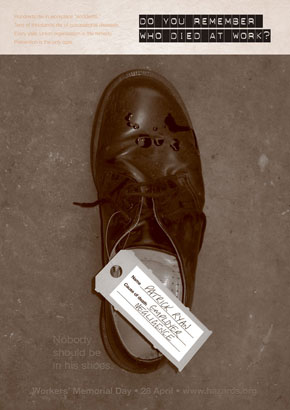
Workers Memorial Day 2006Today is Workers Memorial Day; a day dedicated by the labor movement to “pray for the dead and fight for the living,” in the words of fabled labor organizer Mother Jones. This year we’re hoping that while the praying goes forward as usual, the fight for the living may be making more headway. The focus of this year’s commemoration is the Sago mine explosion in which 12 West Virginia coal miners died last January, as well as the subsequent Alma Aracoma fire that killed two miners. As traumatized as Americans were by the deaths of these men, the revelations of the Bush administration’s weak enforcement efforts, low fines and withdrawal of proposed regulations that could have saved the lives of the Sago and Alma miners have prompted citizens, labor advocates and politicians to take a serious look at this nation’s waning commitment to ensuring safe workplaces. Mineworkers President Cecil Roberts, speaking at the AFL-CIO Wednesday evening, reminded us that only one Sago miner was killed in the initial explosion; the other 11 died from lack of oxygen. If they had had enough extra air or a means to communicate, the 11 miners would still be alive today. If the Bush administration hadn’t withdrawn a proposal to make coal belts fireproof, the two Aracoma miners would be alive today. This country created the Mine Safety and Health Administration, Roberts continued, because mine owners were not ensuring the safety of miners. Now, however, the Bush administration has handed MSHA back to the mine owners. And they’re not doing a very good job. Twenty-six coal miners have been killed so far this year, compared with 22 for all of 2005. But Sago was not an isolated event. Few Americans realize that if the 12 miners who died at Sago were the only American workers to die on the job that day, it would have been a good day in the American workplace. Every day in this country, more than 15 workers are crushed in trench collapses, shot in convenience stores, mangled in machinery, killed in vehicle accidents, or fall to their deaths from scaffolds and cell towers. And the problem is getting worse. The number of workplace fatalities has risen in each of the past two years and the national workplace fatality rate rose in 2004 for the first time since 1994. The rate also rose for manufacturing, construction and Hispanic workers. But the workplace dead are largely invisible souls. You can find the names, birthdates and hometowns of every American killed in Afghanistan or Iraq with only a few moments of web searching, but no amount of searching will identify more than a fraction of the almost 6,000 Americans killed in the workplace every year. Most die one at a time, noted only by their families, friends, co-workers, and possibly, a small article in the local paper. Despite the rising workplace death rate, the Bush administration boasts about the falling number and rate of injuries and illnesses. “Only” 4.3 million injuries and illnesses were reported in the private sector in 2004, compared with 4.4 million in 2003. But in fact, no one really knows how many workers are injured or made ill in American workplaces. A recent study published by Michigan State University researchers confirms previous research showing that the federal government may miss up to two thirds of all workplace injuries and illnesses. Does anyone find it curious that the number and rate of workplace deaths is rising while the number of injuries and illnesses is allegedly falling? Could it have something to do with the fact that dead bodies are harder to hide than back injuries, cuts and burns? Most of these deaths, injuries and illnesses could, of course, have been prevented if employers had simply complied with workplace safety standards issued by MSHA or OSHA. But the message has gone out from the Bush administration that employers don’t have to worry about OSHA or MSHA anymore. The overt hostility and unceasing attacks from the business community and Republican politicians has turned OSHA into a shadow of the tough enforcement agency originally envisioned by Congress. One of the first actions of the newly elected President George W. Bush and the Republican-controlled Congress was the repeal of OSHA’s ergonomics standard in March 2001. That standard, which would have addressed the largest health and safety problem facing American workers, had been ten years in the making. Today, one-third of workplace injuries and illnesses still come from ergonomic problems, and despite the administration’s promises to take ergonomics seriously, the agency has issued only three guidelines and 17 General Duty Citations over the past five years. In fact, OSHA has issued only one other major standard since Bush took office – covering the cancer-causing chemical hexavalent chromium -- and that was done under court order. The standard was issued with permissible exposure limit (PEL) five times what was originally proposed by the agency; a level exposure which by OSHA’s own admission will leave workers at a significant risk of developing cancer. Only one week before, a study reported that the chromium industry had covered up evidence that the chemical caused cancer at extremely low levels. Meanwhile, standards to protect workers from silica, beryllium, noise and confined spaces in construction, and a requirement that employers pay for employees’ personal protective equipment make little progress at the agency. “New” issues like pandemic flu and other communicable diseases, stress, workplace violence and thousands of unregulated, uncontrolled chemicals are not even on the drawing table. And OSHA isn’t even doing a very good job enforcing the standards it has on the books. American employers who are well aware that they are far less likely to be inspected by OSHA at work than they are to be pulled over for speeding on the way home from work. The AFL-CIO has found that it would take 117 years for OSHA to visit every worksite in those states covered by federal OSHA. Even if a workplace is inspected and violations are found, the fines levied by OSHA or MSHA are often absurdly small. Although the maximum penalty for a willful violation of an occupational safety and health standard is $70,000, most penalties are far smaller – even when a worker is killed. An exhaustive review of OSHA enforcement actions by Mike Casey of the Kansas City Star last year found that in 80 fatal and injury accidents, half of the fines Kansas City area employers paid were $3,000 or less. Even where fines are large, they are rarely high enough to present an effective deterrent. BP North America was fined $21.3 million for the 2005 Texas City refinery explosion that killed 15 workers and injured 170, but even that record penalty comes to only a few hours of profit for the giant corporation. But Republican administrations and business hostility toward tough enforcement are only part of the problem. Most experts think that even with the most pro-worker administration, available resources and current penalties are not sufficient to force employers to take workplace safety more seriously. The Republican solution to this problem is to be less confrontational and leverage OSHA’s limited resources by promoting more partnerships, technical assistance, alliances and other voluntary programs under the theory that if you provide employers with relevant health and safety information, they will naturally do the right thing. Instead of an ergonomics standard, OSHA has formed 70 voluntary Alliances with industry associations ranging from he National Chicken Council and National Turkey Federation to the International Society of Canine Cosmetologists. Yet ergonomics remains the biggest problem facing American workers. OSHA persists in expanding these voluntary programs despite a 2004 Government Accounting Office report that revealed that there is no evidence that these programs are effective in improving the safety of American workplaces. Further, the GAO warned, the growth of these expensive programs threatens to reduce the share of OSHA’s static budget pie dedicated to enforcing the law. The continuing carnage in our nation’s workplaces proves the bankruptcy of the Republican voluntary approach. Labor unions and workplace safety advocates may have a better idea. Backed by studies that show that holding corporate heads personally liable for workplace crimes can be much more effective than monetary fines, they are arguing for more aggressive criminal prosecutions of employers who knowingly put workers in deadly environments. Although rarely used, OSHA has the ability to criminally prosecute employers when a willful violation of a standard leads to the death of a worker. (“Willful” means violations in which the employer knew that workers’ lives were being put at risk.) OSHA was embarrassed in 2003 by a New York Times investigation that revealed that from 1982 to 2002, OSHA declined to seek criminal prosecution in 93 percent of more than 1200 cases where a worker was killed due to a willful violation of an OSHA standard. At least 70 employers willfully violated safety laws again, resulting in scores of additional deaths. Even these repeat violators were rarely prosecuted. Fewer than 20 employers have ever gone to jail despite well over a thousand cases involving work deaths that involve “willful” OSHA violations over the past twenty years. The problem is that a conviction under the Occupational Safety and Health Act is only a misdemeanor with a maximum penalty of six months in jail. By comparison, the penalty for harassing a burro on federal land is one year in jail. In fact, a chemical release that kills fish and crabs draws a much larger penalty from the Environmental Protection Agency than killing workers. Although the agency has signaled renewed interest in pursuing criminal convictions following the New York Times series, the small penalties make federal prosecutors reluctant to dedicate the energy and resources to prosecuting cases unless the workplace death can be linked to the violation of an environmental law that carries higher penalties. Edwin Foulke, the new head of OSHA, has indicated that the administration has no interest in strengthening the laws criminal penalties, even for the worst violators. But there is a small glimmer of hope that change may be on the way -- if not in Congress or at OSHA, then at the local level. Last November, New York prosecutors charged a Staten Island construction company owner, Ken Formica with second degree manslaughter for the 2003 death of his employee, Lorenzo Pavia who was crushed to death under tons of earth when a 15 foot deep unprotected trench collapsed on top of him. Pavia was then decapitated in the rescue attempt. Formica had received a trenching citation nine months before Pavia's death. OSHA fined the company $15,000 for Pavia’s death. But if convicted of manslaughter, Formica faces 15 years in jail. In Arizona, the Far West Water and Sewer Company was found guilty last year on five felony charges filed against it by the state prosecutors office. The company was found guilty of violating a safety standard causing the death of an employee and two counts of endangerment in the deaths of James Gamble, 26, and Gary Lanser, 62, who were overcome by toxic sewage gases while working on an underground sewer tank. The conviction resulted in a $1.8 million fine. The OSHA citation was only $31,000. Far West president Brent Weidman will be tried for manslaughter, aggravated assault and endangerment at the end of April. Some prosecutors, like New York State Attorney General Elliot Spitzer, aren’t even waiting for workers to die before jailing employers who put workers at risk. A Bronx jury recently found John Chiapperino and his company, Bronx Auto Venture, guilty of one count of Endangering Public Health, Safety or the Environment in the Second Degree, a felony, and two counts of Endangering Public Health, Safety or the Environment in the Fourth Degree, a misdemeanor, for sending one of its employees, Anselmo Alfaro to clean out pipes in a tank containing thousands of gallons of automotive petroleum waste products released during vehicle dismantling and crushing, without any protective equipment. Alfaro, who had objected to going into the tank, passed out and had to be rescued by the fire department. OSHA had fined the company $750, later reduced to $562. What Is To Be Done How can we make employers and the Bush administration take workplace safety and health more seriously. We could (and often do) go on all night coming up with ideas, but in the short term, there are two areas on which we can focus. First, let’s make every workplace fatality a “teachable moment.” Write a letter to the newspaper, or call the local T.V. station if they don’t report about how a workplace death could have been prevented. Talk to local prosecutors about filing manslaughter charges. Talk to the press about talking to the prosecutors. If you’re not a family member, get in touch when the time is appropriate. Talk to them about how workplace deaths can be prevented, and how they can talk to the medial and local politicians. Second, get the families who have experienced workplace tragedies involved. As a result of the "Weekly Toll" which lists workers who have died on the job in the previous two weeks, I hear from a lot of people who have lost loved ones to needless, preventable workplace tragedies. They're angry that the death of their son, daughter, husband, wife, mother or father could have been prevented. Their one wish is that somehow the death of their loved one will help to prevent similar tragedies from ever happening again. But, most of all, they're frustrated that nothing is being done, that the news media has glossed it all over with a short article implying that it was just a terrible freak accident, that OSHA has handed down an insignificant fine, that this tragedy that changed their lives forever had no impact, that it teaches no lessons. There's a lot of energy there to be harnessed and channeled into the political process. Let's not lose it. Third, we’ve got an election coming up. Candidates will be crisscrossing their districts from now until November to talk to potential voters. Well, let’s make sure we talk to them. Workplace safety may never be a major issue in a national election, but it also doesn’t have to be a dead issue. If a politician hears once from an angry worker or family member who has lost a loved one, it’s a fluke. The second time, their ears may perk up. By the third or fourth time, they’re asking their staff for a report on who all these people are and what the hell do they want?! And the same goes for union members who don’t feel their unions are doing enough about workplace safety and health conditions. Stop muttering to yourself and start nagging and complaining to your elected officials. They'll start nagging and complaining to headquarters. As flawed as many of our institutions are, we still live in a democracy. Squeaky wheels eventually get greased – if they squeak enough. Go forth and squeak. Labels: AFL-CIO, Coal Mining Thursday, April 27, 2006
PERMALINK Posted
10:51 PM
by Jordan
Oops. A Few Extra Deaths In '04Just in time for Workers Memorial Day... The Bureau of Labor Statistics reported its revised 2004 fatality data yesterday. The revised data show 61 deaths more than previously reported, bringing the death toll in 2004 to 5,764. Many of these deaths (19) were Hispanic workers, pushing the number of fatalities among Hispanic workers in 2004 to 902 - the highest number of fatalities ever reported for this group in the Census of Fatal Occupational Injuries survey. More here on the AFL-CIO blog. Labels: AFL-CIO Tuesday, April 25, 2006
PERMALINK Posted
10:32 PM
by Jordan
AFL-CIO Releases 15th Annual "Death On The Job" ReportThe AFL-CIO has issued its 15th annual Death On The Job report (.pdf), an impressive piece of work (particularly considering that they're operating on half the staff they had a year ago.) The purpose is to report on the state of workers' safety and health. First the good news: Workplace safety has improved dramatically in the 35 years since OSHA was created. Now, the bad news. According to the report: Progress in protecting workers’ safety and health is slowing, and for some groups of workers jobs are becoming more dangerous....As the economy, the workforce and hazards are changing, we are falling further and further behind in our efforts to protect workers from new and existing problems.Here are the "highlights", if you want to call them that. Workplace Injuries, Illness and Death
The problem is not new, nor is it going away, despite the fact that the problem is well known:Cost of Workplace Injuries And DeathYear after year, all of these factors known to contribute to significant underreporting are ignored as the statistics are rattled off and administration officials take credit for policies that drove the numbers down. Yet it is these same policymakers who are responsible for ensuring a clear and accurate picture of injury and illness in our nation’s workplaces. The Liberty Mutual Insurance company estimates that workplace injuries cost U.S. employers $50.3 billion – nearly $1 billion per week – in direct costs alone (medical and lost wage payments). Liberty Mutual data indicate businesses pay between $150.9 billion and $301.1 billion annually in direct and indirect (overtime, training and lost productivity) costs on workers’ compensation losses. OSHA Enforcement and Coverage Staffing: OSHA continues to be seriously understaffed. In FY 2005, there are at most 2,117 federal and state OSHA inspectors responsible for enforcing the law at approximately eight million workplaces. At its current staffing and inspection levels, it would take federal OSHA 117 years to inspect each workplace under its jurisdiction just once. Things are slightly better in the 21 state-plan states that run their own programs. It would only take them a combined 65 years to inspect each worksite under state jurisdiction once. Fewer inspections were conducted in FY 2005 than in FY 2004. Penalties remain low with serious violations of the OSH Act carrying an average penalty of only $883. Although the number of willful violations issued by federal OSHA increased from 446 in FY 2004 to 726 in FY 2005, 303 of these willful violations were against the BP Texas City Refinery where a March 2005 explosion killed 15 workers and injured 170. In FY 2005, the Department of Labor referred ten enforcement cases to the Justice Department for criminal prosecution. Under the OSH Act, an employer may be subject to criminal prosecution in cases where a willful violation results in a worker’s death. Regulatory (In)Action This is a short section. OSHA issued only one major regulation last year, covering hexavalent chromium, and it was only done under court order. We've written a bit about this already (here, here and here), but in case you're still catching up, the standard was issued with permissible exposure limit (PEL) five times what was originally proposed by the agency; a level exposure which by OSHA’s own admission will leave workers at a significant risk of developing cancer. The final standard also failed to cover hexavalent chromium found in Portland cement, weakened worker access to exposure monitoring results, scaled back worker training requirements, and gave employers four years to implement engineering controls to protect workers. Otherwise there's not much going on. OSHA still refuses to issue a standard requiring employers to pay for employees' gloves, boots and other personal protective equipment -- a standard that has been hanging around since the later days of the Clinton administration. OSHA says its working on five economically significant regulations (Crystalline Silica, Confined Spaces in Construction, Beryllium, Hearing Conservation for Construction Workers, and Electric Power Transmission and Distribution), but I wouldn't hold my breath. The Job Safety Budget To sum up: President George W. Bush’s proposed FY 2007 budget for worker safety and health programs reflects the administration’s policies toward worker protection—it includes priorities and policies that favor employers over workers and voluntary compliance over enforcement.OSHA: Bush proposed $484 million for FY 2007. Adjusting for inflation, this is about the same as FY 2006, but in real dollar terms (adjusting for inflation), in represents a $14.5 million (3%) cut since FY 2001 when the Bush administration took office. As might be expected, more money is going to voluntary effort for employers and compliance assistance, while standard setting and state enforcement programs have taken major hits, and every year Bush tries to eliminate the $10.3 million Susan Harwood Training Grant Program. MSHA: The Bush administration is proposing $287 million for FY 2007, a 1.4% increase over 2006, adjusting for inflation, but representing a $13.6 million (9%) cut, since FY 2001 after adjusting for inflation. NIOSH: Bush proposed a $250 million budget for NOISH, cutting NIOSH's funding by $4.5 million over FY 2006. Challenges Hispanic and Foreign Born Workers: Immigrant workers face an epidemic of workplace injury and death and are at far greater risk of being killed or injured on the job than native born workers. Although the share of foreign-born employment has increased by 22 percent between 1996 and 2000, the share of fatal occupational injuries for this population increased by 43 percent. ,” Hispanic men have the greatest overall relative risk of fatal occupational injury of any gender or race/ethnicity group. 22 percent higher than the relative risk for all men. Ergonomics: Ergonomic injuries still are the biggest job-safety hazard faced by workers, accounting for one-third of all injuries and illnesses. Yet despite Administration promises of a "comprehensive plan" for ergonomics following their 2001 repeal of OSHA's ergonomics standard, only three guidelines have been issued, and the agency has issued on 17 General Duty Clause citations over the past five years. Pandemic Flu: Despite legitimate fears that the avian flu may develop into a pandemic that could make 30% of the entire population of the United States sick and kill 1.9 million persons, the federal government is failing to plan effectively how to protect the millions of health care workers, firefighters, emergency medical services personnel, home health care workers and other responders will be needed to care for those who are ill from the virus. The Pandemic Influenza Plan, issued by the Department of Health and Human Services, dangerously recommends the use of surgical masks instead of NIOSH certified respirators, and HHS is also pushing the idea to reuse diposable respirators. Surgical masks will not protect workers against the flu, plus they are illegal under OSHA's respiratory protection standard. Gulf Coast Hurricane Response Hazards: OSHA’s presence in the Gulf has largely been providing information and it has yet to enforce any of its health and safety standards and carry out its core responsibilities in the areas most heavily destroyed. This lack of enforcement will put workers at increased risk of injury and illness. Work Organization: Workers in the United States now work more hours than workers in most of Western Europe and Japan. Evidence is growing that long hours of work cause more injuries and illnesses such as heart attacks, increased blood pressure, unhealthy weight gain, increased alcohol use and smoking. The ways in which work is performed and is being restructured are also emerging as a potential safety and health hazard for workers. Machine-paced work, inadequate work-rest cycles, time pressures and repetitive work are associated with musculoskeletal disorders, increases in blood pressure and risks of cardiovascular mortality. The nurse shortage is resulting in long hours of work and high patient-to-nurse hospital staffing ratios which have been linked to increases in needle injuries and near misses, nurse burnout and elevated surgical patient mortality. In response, nine states have passed legislation placing limits on the amount of mandatory overtime nurses or health care workers can be forced to work (Connecticut, Maine, Maryland, Minnesota, New Hampshire, New Jersey, Oregon, Washington and West Virginia). And finally, What Needs To Be Done? Very simply, workers need more job safety and health protection. The Bush administration’s lack of regulation and increased attention to employer assistance and voluntary compliance comes at the expense of worker safety and health. The OSH Act needs to be strengthened to make it easier to issue safety and health standards and to make the penalties for violating the law tougher. Workers need to be given a real voice in the workplace and real rights to participate in safety and health as part of a comprehensive safety program to identify and correct hazards. Coverage should be extended to the millions of workers who fall outside the Act’s protection. Labels: AFL-CIO, Ergonomics, OSHA, Recordkeeping PERMALINK Posted 12:39 AM by Jordan Workers Memorial Day In Washington
If it's Spring, it must be time for Workers Memorial -- the day where we re-energize ourselves for another year of fighting for safer workplaces.Well, spring has sprung in Washington D.C. -- the dogwoods are blooming, the thunderstorms are coming, and George W. Bush's approval ratings are scraping the bottom of the septic tank. For those enjoying the spring here, drop in at the AFL-CIO building (815 16th St. N.W.) Wednesday afternoon at 5:30 for for a discussion with United Mine Workers President Cecil Roberts and photojournalist Earl Dotter about safety and health in the nation's mines and what must be done.![]() A reception and viewing of the photo exhibit "Our Future in Retrospect: Coal Miner Health in Appalachia" will follow, with a welcome by AFL-CIO Secretary-Treasurer Richard Trumka. The exhibit, sponsored by the Appalachian Institute of Wheeling Jesuit University, combines Dotter's present-day look at health and safety issues in America's coalfields with Russell W. Lee's 1946 documentary photography on the hardships of coal communities. If you're planning on dropping in, please RSVP to pseminar@aflcio.org or call 202-637-5029. And if you're not in the DC area, hopefully you've hooked up with Workers Memorial Day events in your area. Contact your local union or COSH group to find out what's happening in your neighborhood. The AFL-CIO's Workers Memorial Day page is here. And no matter where in the world you are, you can find out what's happening at the Hazards Workers Memorial Day events page. And, of course, all kinds of posters and fact sheets on the Hazards Workers Memorial Day main page. Labels: AFL-CIO Friday, March 17, 2006
PERMALINK Posted
2:58 AM
by Jordan
Stickler Nomination To Head MSHA Held Up By Senator ByrdWest Virginia Senator Robert Byrd has put a hold on the nomination of Richard Stickler to be Assistant Secretary of Labor for Mine Safety and Health. Byrd said Tuesday that he wants to meet with Richard Stickler before he allows the Marion County native’s confirmation to move forward.Stickler was Director of the Pennsylvania Department of Deep Mine Safety after spending 30 years working for coal companies. His nomination is opposed by the United Mineworkers union, the AFL-CIO and the Charleston Gazette. Labels: AFL-CIO, Richard Stickler Tuesday, March 14, 2006
PERMALINK Posted
11:04 PM
by Jordan
Workers Memorial Day Is ComingPeople get ready. April 28th is Workers Memorial Day, where unions around the world remember those who have suffered and died on the job and to renew the fight for safe workplaces. This has the potential of being a special Workers Memorial Day -- it follows the mine disasters earlier this year that revealed the bankruptcy of our workplace safety agencies -- and it's an election year. The AFL-CIO is the lead organizer in the United States, but it's up to you to organize or join local events: Within just a few weeks' time, the disasters at the Sago mine and five other mines claimed the lives of 18 miners. These tragedies focused the nation's attention on the dangers faced by workers and the weakness in job safety protections. But the Sago disaster was not an isolated event. Before this year is over, thousands of more workers will be killed on the job and millions will be injured or diseased. Organizing materials and information on American events can be found here. The AFL-CIO is also working on a new Death on the Job report, although the 2005 edition is still on their website. Events are also being organized around the world. Check out the Hazards Workers Memorial Day website for more information. So let's get organized and invite those politicians to your events. Make them earn your votes by sponsoring and working for the Protecting America’s Workers Act (S944 and HR2004), or explaining to you why they're not. (Right now the bills only have 5 cosponsors in the House and 10 in the Senate. Go to http://thomas.loc.gov/ for more information on the bills' status.) Labels: AFL-CIO Wednesday, February 15, 2006
PERMALINK Posted
9:41 PM
by Jordan
Opposition to Stickler As MSHA Head GrowsThe AFL-CIO and the Charleston Gazette are publicly opposing the nomination of Richard Stickler to be Assistant Secretary of Labor for Mine Safety and Health. In a letter sent to members of the United States Senate earlier this week, AFL-CIO President John Sweeney pointed out that the recent mine disasters: Make clear that the next director of the Mine Safety and Health Administration (MSHA) needs to be someone with a history of advocating for miners' safety and health, not someone with a history of advocating for the interests of mine operators.A Charleston Gazette editorial picked up on the same themes. The Gazette has been meticulously identifying multiple the multiple failurs of MSHA and the Bush administration that led to the conditions that have caused the deaths of 18 miners this year, 16 in West Virginia alone:
The United Mineworkers also announced last month that they would oppose Stickler's nomination.
Labels: AFL-CIO, Coal Mining, Richard Stickler Tuesday, February 14, 2006
PERMALINK Posted
8:37 PM
by Jordan
Anti-Union Forces Running Ads, Running ScaredChange to Win, AFL-CIO health care organizing campaigns, janitors, hotel workers, meat packers, disasters in the nation's mines and refineries, "card check" organizaing campaigns. Oh my! The anti-union folk must be getting a tad nervious. What is to be done? Run a bunch of ads and form another corporate-backed union busting association. And who can they find to run it? How about someone who's been busy forming corporate-backed associations to defend mercury in fish (FishScam.com), challenge Mothers Against Drunk Driving and its efforts to lower the legal blood alcohol content limit, to dismisses concern about obesity as "hype," to defend the tobacco industry against smoking curbs in restaurants and the beverage industry against restrictions on alcohol use,and to argue against raising the minimum wage forthe Employment Policies Institute? The so-called Center for Union Facts (UnionFacts.com) a group created by Richard Berman, a lobbyist behind all of these organizations, ran a full page ad in the Washington Post, New York Times and Wall Street Journal yesterday show that "so many of the things that the union leadership accuses business of and demonizes business for probably can be turned around, and the unions can be shown to be duplicitous and two-faced about their accusations."Berman clearly hasn't been following the recent mine disasters or reading about meatpackers in North Carolina or hotel workers or....well, he hasn't be reading Confined Space: "The way unions are presently structured is often anachronistic," said lobbyist Rick Berman, who started the group. "They don't want to recognize that the world has moved on. Management isn't treating employees like they were in the 1930s or '40s. Unions don't have anything to sell anymore."And who's funding this noble effort? Mr. Berman said various companies and a foundation had contributed to his nonprofit group, but he refused to identify them. He said he hoped to spend more than $5 million a year on the campaign.And what's the real purpose behind the campaign? The center was founded as several unions had grown more aggressive about unionizing workers, often pressuring employers not to fight organizing drives. In addition, many unions are pressing companies to agree to recognize them, not through representation elections, but through a process known as card check, in which companies grant recognition as soon as a majority of workers sign cards saying they want a union.It all makes perfect sense to the AFL-CIO: A spokeswoman for the A.F.L.-C.I.O., Lane Windham, said: "It's clear that corporations are fighting back against workers' efforts to roll back corporate power. It's no accident that corporations are doing this against us when unions are trying to make sure that employers pay their fair share on heath care and when we're taking on giant corporations like Wal-Mart."Well, Dickie old boy, all I can say is keep running those ads, every day -- until you're out of money. I'm sure the miners, meatpackers, hotel workers, health care workers and janitors of America are listening carefully. Update: Nathan Newman writes on the same subject, noting that the "400 million in labor racketeering fines and civil restitution in the last five years" on Berman's site comes from a Department of Labor list -- and, lo and behold most were businesses that defrauded the unions-- ie. the union leaders were the victims not the criminals....In fact, almost all of the big money associated with the $400 million figure in labor racketeering was committed by private industry AGAINST unions, not by union officials. Labels: AFL-CIO, Coal Mining Monday, January 09, 2006
PERMALINK Posted
9:11 PM
by Jordan
Unions Petition OSHA For Pandemic Flu StandardThere has been much discussion in recent months about the threat of an Avian flu pandemic. But according to a group of unions, not enough serious attention has been given to protection the nation's health care workers, and by extension, the entire health care system. The American Federation of State, County and Municipal Employees (AFSCME) and several other labor organizations petitioned the Occupational Safety and Health Administration (OSHA) for an emergency temporary standard to protect health care workers against pandemic flu. The unions have several problems with the nation's current pandemic flu plan. First, it calls for voluntary guidance instead of mandatory requirements, which means that employers can choose to ignore them. In addition, the plan lacks a comprehensive exposure control plan that would require worker training, communication of hazards to employees, medical surveillance and recordkeeping, all of which are typically contained in OSHA workplace standards. OSHA's highly successful Bloodborne Pathogens standard, for example, contains all of these elements. The labor petition seeks not only to protect health care workers, but also to protect the nation's health care system in light of a recent Congressional Budget Office report that predicted that hospitals, clinics and doctors offices would be overwhelmed and the system would be strained as health care workers became sick or stayed home ito take care of sick family members or to protect themselves. The unions' biggest problem the Centers for Disease Control and Prevention’s main Web site for pandemic flu preparedness features the Department of Health and Human Services’ “weak recommendations for protecting workers, including advice to use a surgical mask:” Surgical masks will not protect wearers from exposure to respirable airborne droplets that contain pandemic flu virus for two important reasons. First, surgical masks are designed to provide a barrier to large droplets that are not respirable. Unlike respirators, masks are not designed to capture respirable particles and thus they are not respirators. Secondly, they do not provide a sufficient seal against the wearers’ face to prevent significant leakage into the workers’ breathing zone. Surgical masks are NOT certified by NIOSH as respiratory protection devices. Therefore, surgical masks must NOT be used to protect workers from exposure to respirable droplets that will be generated by patients infected with pandemic influenza. Only NIOSH approved respirators should be worn.On the other hand, the unions point out, the Centers for Disease Control and Prevention (CDC) Interim Recommendations For Infection Control In Health-Care Facilities Caring For Patients With Known Or Suspected Avian Influenza, May 21, 2004, and OSHA’s Guidance For Protecting Workers Against Avian Flu recommend, at a minimum, NIOSH approved N95 filtering facepiece respirators, and that OSHA’s respirator standard (1910.134) be followed. The path to a mandatory standard will be rocky, however. First, OSHA has not successfully issued an Emergency Temporary Standard (ETS) in 25 years. If the Assistant Secretary determines that "employees are exposed to grave danger from exposure to substances or agents determined to be toxic or physically harmful or from new hazards," OSHA can issue an Emergency Temporary Standard, which also serves as a proposed standard until the final standard is issued which must be done within six months. OSHA has rarely used this provision of the act, even in the rare case that the agency has issued an ETS, the courts have often overturned it. It has now been 15 years since OSHA first ventured into the area of infectious diseases with its bloodborne pathogens standard, designed to protect workers against hepatitis B and AIDS. That standard was also a product of a petition by AFSCME and a number of other unions. The standard has been highly successful in protecting health care workers. In 1987, for example, there were 8,700 cases of Hepatitis B infection among health care workers. In 1995, just four years after publication of OSHA's standard, only 800 new cases related to occupational exposure were reported by the Centers for Disease Control and Prevention (CDC). Despite the standard's success, however, OSHA has not issued another communicable disease standard since, aside from a revision of the Bloodborne Pathogens standard in 1999. The agency was on the verge of issuing a standard to protect workers against tuberculosis at the end of the Clinton administration, but that proposal was withdrawn by the Bush administration after strong opposition from the American Hospital Association (AHA)and the Association of Infection Control Practitioners (ACIP). The AHA and ACIP have more recently ganged up with Congressman Wicker (R-MS) to pass language in OSHA budget bills that prohibits enforcement of annual fit-testing for health care workers who wear respirators to protect themselves from tuberculosis, leaving health care workers highly vulnerable to air-borne diseases if the hospital chooses not to fit test employees to ensure a tight-fitting respirator. The other unions joining the petition are the American Federation of Labor and Congress of Industrial Organizations (AFL-CIO), American Federation of Teachers (AFT), Communications Workers of America (CWA), United American Nurses (UAN), and United Steelworkers (USW). Last November, the United Food and Commercial Workers union, which represents poultry workers, asked the Bush administration "to initiate coordinated protection for poultry workers on the front lines by initiating a Cabinet-level meeting to discuss worker issues and the potential pandemic." The poultry industry is a major force in the U.S. economy, generating more than $35 billion per year in revenue. The nation's 200,000 poultry workers produce 500 million pounds of chicken every week. We must have a plan to protect these workers-the chicken catchers and those that slaughter, process, and package the millions of chickens and turkeys that Americans eat each year. AFSCME's pandemic flu page can be found here. Also, check out Effect Measure and the Flu Wiki for much more pandemic flu information. Labels: AFL-CIO Monday, December 19, 2005
PERMALINK Posted
8:49 PM
by Jordan
AFL-CIO Opposes Alito
|