Showing posts with label Behavioral Safety. Show all posts

Sunday, September 24, 2006

Cooking The Books, Part IV: Partnerships and Underreporting -- What It Means In California and Nationwide

Note: The entire four-part series can be read here.

In the last three installments of "Cooking the Books," we've described how KFM cooked the books by using "the carrot" to discourage workers from reporting injuries or illnesses, "the stick" to punish workers who do report injuries, how KFM's doctors and industrial hygienists collude with the company to ensure that injuries and illnesses don't get put on the Cal/OSHA Log, and how KFM benefits from the coverup.

Today, Part IV concludes the series by discussing how Cal/OSHA can't decide whether KFM's actions are good or bad, and what implications these underreporting has nationally.


Cal/OSHA: A Schizophrenic Enforcer/Defender

KFM’s creative accounting with worker injuries has been enabled by Cal/OSHA’s schizophrenic jumping between worker protector and employer defender.

Normally, federal OSHA would have jurisdiction over the parts of the job that were done on floating platforms. Federal OSHA would not give up its jurisdiction on work done on barges in the bay until Cal/OSHA agreed to.a “compliance assistance partnership” with KFM. Rick Rice, undersecretary of Cal/OHSA’s parent agency, defended the partnership in his reply to the scathing Bureau of State Audit (SBA) report by saying that “federal OSHA encourages them [partnerships] and expects State Plan states to engage in them.”

As guest-blogger ERM wrote in a series on recordkeeping problems last May,
Federal OSHA has been promoting voluntary partnerships for years, in an effort to induce companies to make safety improvements. OSHA lacks the resources to enforce everywhere, the reasoning goes, so the more it can encourage companies to comply voluntarily, the better for everyone. Being kinder and gentler to business is also in line with the political program of the Republican administration.
The compliance assistance agreement with KFM allows Cal/OSHA complete access to the work site, with prior notice to KFM, in return for KFM’s agreement to correct identified hazards found during a visit.

But a written partnership agreement, with explicit roles and rights for workers and their unions, was never formalized with KFM, which balked at signing any of the seven versions of the partnership text prepared by Cal/OSHA. Eventually Cal/OSHA gave up on a written agreement and has been operating on a “handshake” basis with KFM, but without any direct role for workers or any additional resources for monitoring the giant construction site.

The problem with the agreement, as CAPS, the union representing Cal/OSHA inspectors, noted in February 2006, is that
The Bay Bridge is an enormous, 10-year project that could keep a full-time team of inspectors busy morning, noon and night. Instead, Cal/OSHA has only had the resources over the last three years to send out individual inspectors on pre-announced, rotating visits about once every other week. The eight inspectors involved, and their supervisors, all have major responsibilities in their home offices, and none were dedicated full time to the bridge.
Moreover, bridge workers interviewed by the Cal/OSHA enforcement inspector in 2006 said that advance notice of Cal/OSHA compliance assistance visits prompted a rapid clean-up of the areas to be visited by the compliance assistance personnel, who were then treated to a “dog-and-pony show” substantially different from the work site’s normal activities.

At the same time that Cal/OSHA was citing KFM for recordkeeping violations, the agency was making a considerable to defend KFM in the media and with state auditors and legislators.

For example, when the willful citations against KFM were issued on the morning of Thursday, June 1st, 2006, Cal/OSHA did not issue a press release until the next day, a Friday, when media coverage would be minimal. The Cal/OSHA press release itself never mentioned that the citations issued were classified “willful” and most of the one-page release praised KFM.

When the Oakland Tribune ran another set of articles in August 2006 providing specific details on how worker injuries were under-reported by KFM, Cal/OSHA officials again leapt to the consortium’s defense.

Dean Fryer, spokesman for Cal/OSHA’s parent agency, told the Tribune:
This type of project involves extremely hazardous work and is very prone to causing serious injuries. The low rate of fatalities and serious injuries, which cannot be hidden and no one has alleged to have been hidden,
Actually, hiding the actual injury rate was exactly what Cal/OSHA says happened at the Bay Bridge and precisely why it issued willful citations to KFM. These are not just “minor paperwork violations,” but citations for a deliberate, willful suppression of reporting of serious injuries, at least four of which required major surgeries.

At the same time, KFM has appealed all three sets of citations issued by Cal/OSHA in enforcement inspections generated by two injury accidents and one complaint, as well as the June 2006 Willful Log 300 citations. The consortium has hired an expensive, very aggressive management law firm to fight all citations issued by its “partner.”

Cooking the Books: A National Problem

The problem of deliberate employer under-recording has become so serious that even George Bush’s partnership-crazy Fed OSHA has issued Willful citations to major Fortune 500 companies:

  • In June 2004, Federal OSHA issued a Willful citation (later changed to “unclassified”) and $70,000 fine to Weyhaeuser’s Truss Joint facility in Buckhannon, WV, for failing to record at least 38 injuries and illnesses on its Log 300. The citations “paint a picture of an organization where under-reporting of injuries and illnesses appeared to be a routine practice that was tolerated, and even rewarded, by company vice presidents,” according to Occupational Hazards magazine.

  • In October 2004, Southern California Edison under-reported workplace injuries and illnesses for the previous seven years and had to return $35 million in safety-related bonuses to the California Public Utilities Commission. “Edison found evidence that supervisors contacted outside medical personnel to influence treatment, change medical records or downgrade the seriousness of an injury. Other times, Edison said, its managers encouraged employees to dodge safety reporting requirements by undergoing physical therapy or using vacation days during recover,” the Los Angeles Times reported.

  • Also in October 2004, Federal OSHA issued two willful citations and $140,000 in fines to General Motors Powertrain Corp. in Massena, NY, for failing to record 98 instances of work-related noise-induced hearing losses and other injuries and illnesses. Eight other citations with $20,000 in fines were issued.

  • In November 2005, Federal OSHA issued three willful citations and $165,000 in fines to Fraser Paper’s Madawaska, ME, paper mills for Log 300 violations between 2003 and 2005. Fed OSHA found 59 instances of injuries and illnesses that were not records, 77 instances where recordable entries were not made within 7 days, and two years (2003 and 2005) for which incomplete annual injury and illness log summaries were certified as being complete.
In April 2006, the Wall Street Journal reported on a Michigan State University study that indicated the current method the government uses to track on-the-job injuries and illnesses may miss up to two-thirds of the total number of cases. “Researchers estimated that 869,034 work-related injuries and illnesses occurred on average each year in Michigan from 1999 to 2001, compared with the BLS [Bureau of Labor Statistics] estimate of 281,567 per year. Dr. Rosenman estimates that 75% of the injuries and illnesses missed by BLS resulted from employer underreporting,” the Journal noted.

Accuracy in Log 300 reports is important because these, along with other workers comp information, are used by employers to identify hazardous operations needing attention on the job, and by government agencies to set priorities for their limited research and enforcement resources. Moreover, injured workers, whose injuries or illnesses are not acknowledged by their employers, often cannot obtain needed medical treatment, rehabilitation and compensation.

As the publisher of the Oakland Tribune noted in its September 3rd, 2006 editorial:
If the safety record constructed by KFM is built on doctored injury reports, a facade of safety is created. If other firms follow the same practice, it means that an unknown number of work-related injuries and illness go unreported. That inflates safety and downplays injuries and risks. It’s deceptive, giving state officials and the public a false picture of workplace safety, which in turn can lead to more hazardous conditions and injuries.
What’s Next for KFM and Cal/OSHA?

Although KFM lost its bid to build the second phase of the Bay Bridge’s eastern span, the consortium will be working on site for several more years. The “compliance assistance partnership” with Cal/OSHA is still in effect, as are KFM’s various safety incentive plans.

Cal/OSHA, for its part, will now have to divide its limited resources between defending its citations against KFM’s “scorched earth” attorneys, and attempting to maintain a sporadic presence of non-enforcement personnel at the bridge to assist its “partner.”

One of the key findings of the February 2006 BSA report was that Cal/OSHA clearly needs additional field inspectors and resources to meet its mission and legal mandate at the Bay Bridge and throughout California.

In July, the state legislature passed a very modest $1.5 million budget augmentation to hire an additional 15 Cal/OSHA inspectors. But in August, Governor Arnold Schwarzenegger eliminated the funds earmarked for hiring on the grounds that new inspectors are “not necessary” as “workplace injuries and fatalities in California are well below the national average.”

Related Articles

"Cooking the Books" Series

Cooking the Books, Part I: Underreporting Worker Injuries at the San Francisco Bay Bridge, September 19, 2006
Cooking the Books, Part II: The Stick and The Doctor, September 20, 2006
Cooking The Books, Part III: The Industrial Hygiene Consultants and How KFM Benefits, , September 21, 2006


OSHA Recordkeeping Series by ERM


Part I: Learning From Enron: Why Accurate OSHA Recordkeeping Matters, May 15, 2006
Part II: At AK Steel, as at Enron, the Numbers Don’t Add Up, May 23, 2006
Part III: OSHA Recordkeeping: Who Will Audit the Auditors?, May 27, 2006

Confined Space Bay Bridge and Related Stories

Wednesday, September 20, 2006

Cooking the Books, Part II: The Stick and The Doctor

Note: The entire four-part series can be read here.

Yesterday, we described how KFM cooked the books by using “the carrot” to discourage workers from reporting injuries or illnesses. Monetary incentives were given to every level of employees for meeting quality and completion timeline goals, but only if no Log 300 recordable injuries are reported.

Today, Part II discusses how KFM used “the stick” and its own doctors to cook the books.


****************

Cooking the Books: The Stick

When the financial incentives were not enough to suppress reports of recordable injuries and illnesses, Bay Bridge threats of discipline, suspensions and layoffs were used by supervisors to maintain an accident-free record, according to statements given y workers' to Cal/OSHA.

KFM’s formal policy states that workers are required to report each and every injury, from simple first aid cases to recordable injuries and illnesses needing medical treatment. Failure to report any workplace injury or illness could be the basis for disciplinary action against workers.

As Daniel Otto, a fit-up and welding crew foreman, told Cal/OSHA, the KFM “safety program was organized to look good on paper, but actual practice on the job was different.” Combined with the incentive system, workers were left feeling as if “they got you coming or going – if you report, then everyone loses the money; if you don’t report, then they can use that against you in a disciplinary action,” according to the Cal/OSHA file.

Mechanic Keith Bates told Cal/OSHA:

Everyone was on ‘pins and needles’ all the time because everyone wanted to keep their jobs, but it was clear that if any injury or illness was reported, there would be adverse consequences…KFM discouraged reporting of accidents because it threatened crew cash bonuses and crew barbeques. Workers were individually warned by foremen and superintendents, but we were never threatened at the mass safety meetings. Employees who made safety suggestions or expressed concerns were ‘black-balled’ by supervisors…definitely a disconnect between the stated policy and what really happened on the job.
Otto told Cal/OSHA he was

personally involved with superintendents [Dave Polette] and foremen [Doug Silverwood, Jim Belcher and Tim Peeler] who discouraged the reporting of injuries. This happened in my own case, and with Fernando Rivera, Francisco Aguirre, Dave Dixon and Chris Hallstrom.
Otto said that superintendents and foremen “conducted reprisals against employees in the form of verbal humiliation in public,” and also in “laying off injured workers, such as Fernando Rivera, Dave Dixon and Chris Hallstrom, to send a message to the crew.”

Welder Chris Hallstrom reported to Cal/OSHA that

Randolph got hurt when he was struck on the head, and he insisted on getting a medical evaluation [which means an injury report is filed]. [Foreman] Jim Belcher told everyone on the boat going out to the pile – welding and fit-up crews together, more than 30 workers – “here’s the guy who lost you the incentive.”

Jim Belcher was then the welding foreman and Belcher hounded Randolph after his injury. He [Randolph] got fired for something Belcher made up. It was made clear that this would happen to everyone,
Later on, when Hallstrom wanted to get a medical evaluation of his swollen knee, “Jim Belcher said to me, ‘do you want to be another Randolph?”

David Roundtree, a welder who left KFM on his own initiative in June 2004, told Cal/OSHA that
the incentive plan works against reporting injuries. Everybody trying to keep their jobs – don’t make waves. When you reported injuries, they treated you as a criminal…KFM created an atmosphere where you didn’t want to report. They called everyone ‘whiners’ and ‘crybabies’…There was self-generated pressure not to report, especially among Latino workers. Almost no Latinos ever reported any of the injuries they had.
Francisco Aguirre, an apprentice welder at the bridge, confirmed the harsh atmosphere in the KFM work site to Cal/OSHA:
There was a lot of pressure from supervisors (Dave Polette, Jim Belcher and Tim Peeler) not to report injuries because they will lose safety cards for themselves and cash bonuses for the crew…The pressure from above was very intensive – we had to finish by some time and no accidents.
An investigator for the Bureau of State Audits wrote up his interview notes with welder Mario Armani as follows:
he [Armani] said that he raised his concerns but was told to ‘find another job.’ One time, he was boxed in by KFM management, after he had raised concerns, and was told that he had better weld very fast or they would fire him for working too slow.”
The BSA report issued in February 2006 noted
of 139 current and former KFM employees who responded to our survey, 52 indicated that they had been injured while working on the Skyway project, and 24 of these injured employees indicated they felt pressure to not report their injury. Although we did not specifically ask about safety incentives in our survey, five workers mentioned them as a reason why injuries were not reported. However, a more frequent concern, expressed by 14 of the workers, was that they believed they would lose their jobs or face lesser forms of retaliation if they reported an injury.
Cooking the Books: The Doctors

Another key to maintaining miraculously low injury and illness rates at the Bay Bridge was careful management of the “work status reports” received by KFM from its contract first-aid personnel on site, from the three occupational health clinics under contract to diagnose and treat injured workers, and from the third party administrator of its self-insured workers compensation insurance.


Treatment for injuries that only require “first aid” is not recordable, but lost or restricted workdays are. Work status reports are a key trigger for recording “lost work days” and/or “restricted work days” on the OSHA Log 300. KFM’s safety staff spent a lot of time, according to Cal/OSHA’s investigative file, riding herd on the diagnosis and treatment of injured workers to ensure that they didn’t turn into “lost” or “restricted” work days.

Former Field Safety Manager Winston Peart, who worked for KFM between April 2003 and March 2004, gave a written statement to BSA investigators in the fall of 2005.

KFM had an on-site first aid office in which contract nurses who were on call would treat injured workers. It was my experience with KFM, and with other companies that I have worked for, that these nurses are aware of the criteria defining what is a first aid and what is "medical treatment beyond first aid." To help an injured patient, these nurses sometimes conduct "medical treatment beyond first aid." However, they know to document the procedures as first aid to avoid making the injury recordable…I saw numerous embedded object eye injuries, and frequently these injuries required medical attention beyond first aid. However, I do not believe that all of these injuries were reported on KFM’s 300 logs…

It is my understanding that Mr. Hughes [KFM Safety Director Robert Hughes] would accompany the victim to the clinic because Mr. Hughes knew the doctors there and had some degree of influence in persuading them to classify injuries in a way as to not make them either reportable or recordable, depending on the severity of the injury....In essence, the clinic is selected based on its willingness to classify most injuries as return-to-work injuries. From my conversations and experience with Robert Hughes, I believe that he selected the Skyway Project’s medical clinic based on this criteria.
Welder Chris Hallstrom told Cal/OSHA that when he
was being seen by Dr. Stephen Nord at Premier Care Medical Group in Pleasanton, he was always accompanied into the exam room by safety managers Rob Hughes or Chuck Chartrey. "The safety guy would bargain with Dr. Nord. They would bargain over the wording of the work status report and the job restrictions." Hallstrom asked to see Nord alone, "but Chuck Chartrey would not permit it. The safety people would sit there saying "no problem, he’s on [unofficial] light duty" so that the doctor would not write up any official days of RWD [restricted work days] on the work status reports.
Employer knowledge of the diagnosis and work status is a key determinant of any Log 300 entry. Under California’s workers compensation law, the employer has the right to “designate” the physician treating work-related injuries and illness for the first 30 days of treatment, unless the worker “pre-designates” a physician prior to any accident. The employer’s designated doctor keeps control of injury treatment and work status reports after the first 30 days, unless workers formally ask to be treated by another physician.

But Foreman Daniel Otto told Cal/OSHA that injured workers were “extremely discouraged to go to their own doctor.” And it appears the discouragement worked: the Cal/OSHA case file indicates that not one injured worker had pre-designated a non-KFM doctor.

Specialty Risk Services (SRS) is the third party administrator of KFM’s worker compensation self-insured insurance policy. When KFM workers did not pre-designate their own doctor for the first 30 days of treatment, and if the workers did not ask to transfer their treatment after 30 days to their own physicians, then SRS would only pass on to KFM the work status reports of KFM's “designated” doctors, as allowed by law.

The Cal/OSHA case file indicates that SRS acted as a “knowledge screen,” blocking the transfer of information from non-KFM physicians to KFM managers responsible for Log 300 entries. Even when workers decided to go to their own doctors after the first 30 days of treatment, it appears that SRS did not transmit the non-KFM physicians’ work status reports to KFM. If KFM didn't see the reports, then they could not be the basis for any lost or restricted work day entries on the Log 300.

Foreman Paulson told Cal/OSHA that after his knee injury at work, he was sent to a KFM-designated clinic, U.S. Health Works,
who prescribed him aspirin and sent him back to work. [Paulson] then went to Kaiser immediately after work, where the MD prescribed crutches and RWD [restricted work days] for 14 days as well as Vicodin. [Paulson] "could not report [his visit to Kaiser] to KFM or I would have been fired or laid off right away."
At Paulson’s next visit to U.S. Health Works, the doctor there told him he did not need crutches and sent him back to work with a “return to full duty” work status, which would not trigger a Log 300 entry, according to the Cal/OSHA files.

Carpenter Steve Swanson, who suffered a hernia working at the Bay Bridge, said
KFM is so paranoid about injuries – ‘do not go to your own doctor, go to our doctor.’ They are set up with their own doctor – he works for them – it’s an insurance thing to keep down workers comp cases.
Swanson’s hernia was declared to be “non-industrial” by the physician at U.S. Health Works in Berkeley, so the injury was not entered onto the Log 300, and Swanson did not qualify for workers comp medical coverage, according to the Cal/OSHA files.

Welder Venture Ochoa told Cal/OSHA that KFM
safety staffer Chad Hoople threatened to "send me home for telling On-Site [contract first aid provider at the worksite] that [he] should be sent to a doctor at the clinic," [even though] KFM doesn’t want any records of injury and they doesn’t have a real doctor....The company doctor is on KFM’s side; he doesn’t care about the workers.
Tomorrow -- Cooking the Books, Part III: The Industrial Hygiene Consultant, the Real Decision Makers and Why KFM Does It.

Tuesday, September 19, 2006

Cooking The Books: Underreporting Worker Injuries at the San Francisco Bay Bridge: Part I

Note: The entire four-part series can be read here.

Confined Space has often covered stories of chronic undercounting of workplace injuries and illnesses by employers, as well as violations OSHA’s recordkeeping rules. More specifically we've covered the systematic falsification of injuries and illness numbers by KFM – Kiewit Pacific/FCI Constructors/Manson Construction, A Joint Venture, on the project to rebuild the eastern span of the San Francisco Bay Bridge. The consortium had never missed a chance to brag about worksite injury and illness rates that they claimed were one-fourth to one-third those of other California bridge builders -- until Cal/OSHA and the Tribune documented the real story based on interviews with two dozen Bay Bridge workers – that KFM had “cooked the books” on injury rates.

But now, thanks to KFM worker interviews from Cal/OSHA's casefiles, we're able to present for the first time a series of posts that paint a detailed and vivid picture of exactly how KFM used a sophisticated combination of strategies to “cook the books” of worker injuries and illnesses.

KFM’s cookbook includes:
  1. cash incentives to workers and supervisors who do not report injuries;
  2. reprisals and threats of reprisals against those employees who do report injuries;
  3. selection and use of employer-friendly occupational health clinics and workers comp insurance administrators;
  4. strict limits on the activities of contract industrial hygiene consultants; and, ultimately,
  5. a secretive management committee which decides whether reported injuries and illnesses are legitimate and recordable.

But the problem is much bigger than KFM. The consortium's deliberate under-recording of workplace injures and illnesses is part of a growing national problem that has resulted in repeated “willful” citations by Federal OSHA and has important adverse impacts on hazard prevention by employers, resource allocation by government agencies, and the accuracy of safety in the nation’s workplaces. The KFM story also presents a searing indictment of controversial “behavioral safety” programs which punish workers for injuries and reward workers for not reporting injuries or unsafe conditions.

Background

Since 2004, the Oakland Tribune has run an extended, award-winning series of articles about safety and production problems at the bridge, and has posted the Cal/OSHA citations and key witness testimony on its website. In August 2006, the newspaper ran another series of articles on the specifics of KFM’s injury reporting suppression program.

In June 2006, Cal/OSHA issued “willful” citations against KFM for deliberately failing to record at least 13 worker injuries at the bridge, as well as two more citations for failing to investigate reported accidents and failing to record injuries within the time period set by law. The citations followed a report by the California Bureau of State Audits that accused the agency of not having procedures necessary to verify the accuracy of injury and illness reporting, and noting that the Cal/OSHA's compliance assistance/partnership approach with the company made it even more difficult to uncover unsafe conditions and faulty reporting.

KFM was accused of violating laws that require employers to record on an “OSHA Log 300” all injuries and illnesses on the job that result in death, days away from work, restricted work, medical treatment beyond first aid, or loss of consciousness.

Cal/OSHA considered KFM’s violations “willful” because evidence showed

that the employer committed an intentional and knowing (as contrasted with inadvertent) violation and the employer is conscious of the fact that what he is doing constitutes a violation of a safety law.
KFM had originally claimed that it had zero lost work days and zero restricted work days for more than 1 million man-hours of work at the Bay Bridge in 2004. KFM’s recorded injury rate was 1.47 injuries per 100 workers, as compared to another major bridge project in the San Francisco Bay, which had a rate of 12.43 injuries per 100 workers. But some things in life are just “too good to be true.”

As a result of two state investigations in 2005 – one by Cal/OSHA and one by the Bureau of State Audits (BSA) – KFM revised its 2004 Log 300 to add one “newly recognized” case with 14 days away from work. However, the consortium claims the 13 cases identified by Cal/OSHA were either fraudulent or exempted under Log 300 regulations.

Cooking the Books: The Carrot

The centerpiece of KFM’s strategy to suppress reporting of worker injury and illnesses is its “Safety Incentive Programs” designed to
to motivate employee and supervisory safety performance to achieve zero injury results in an environmental that sustains teamwork, open communication, and total involvement.
Monetary incentives are given to every level of employee – hourly, foremen, supervisors and managers – for meeting quality and completion timeline goals, but only if no Log 300 recordable injuries are reported. Any reported injury or illness that is “Log 300 recordable” loses the worker, his or her crew, the foreman, other supervisors and managers the monetary bonus.

The monetary incentives for workers as a crew and for foremen are substantial:
  • The “Pile Head Welding Incentive Plan” provided the individual crew members with $200, $400 or $600 in bonuses over every 26-36 day period – only if there is “no recordable accident” – and crew foremen “receive double the award amount.” The crews consisted of 8 employees – 1 foremen and 7 welders and helpers;

  • The “Pier 10W – 7 W Access Casing Incentive Plan” provided – only with “no reportable/recordable accident” – “possible incentive for entire crew achieving target is $3,150 ($5,544 total pay off with gross up) with maximum award incentive for entire crew can be $6,750 ($11,880 total pay with gross up).” The crews consisted of 6 employees – 1 foreman, 4 carpenters and 1 laborer);

  • The “Pier 9W-7W Pier Column Formwork Incentive Plan” provided – only with “no reportable/recordable accidents” – “maximum award incentive for entire crew is $6,400 ($11,264 total payoff with gross up).” The crews consisted of 13 employees – 3 foremen, 8 carpenters and 2 laborers;

  • The “Pier 10W – 7W Misc. Metal & Set Casing Pre-Cast Slab Incentive Plan” provided – only with “no reportable/recordable accidents” – “maximum award incentive for entire crew is $3063.” The crews consisted of 2 employees – 1 foreman and 1 ironworker journeyman;

  • The “Skyway Concrete Placement Incentive Plan,” whose “approximate maximum award for entire crew is $37,560,” clearly stated “any reportable accidents will eliminate the entire crew for the current award period. Any recordable accidents will eliminate the entire crew for a minimum of two award periods and up to elimination from the entire program as determined by the Job Superintendent.” The crews consisted of 11 employees – 2 foremen, 7 laborers and 2 masons.
General foreman, superintendents, craft superintendents, job superintendents and project managers also received monetary awards and “merit cards” essential for salary increases and individual career advancement. The time periods for these awards were determined by the collective number of hours worked by all crews under the salaried employee’s supervision, ranging from 5,000 to 100,000 hours of work.

As always, the awards were dependent on no injuries or illnesses being reported. Section 11 of KFM’s 2004 Safety Plan on the “Recognition and Rewards Program” stated:
Employees will forfeit their recognition/reward on a crew-by-crew basis for any OSHA recordable injury or when directly involved in a general liability accident. When an employee suffers a restricted duty or lost-time accident case, the entire job will forfeit the recognition/reward for the current period.”(emphasis added)
Rewards for supervisors and managers, depending on the number of accident-free hours worked, ranged from a “Merit Care and $100” to a “Merit Card and $3,000,” with a variety of gifts along the way including an “engraved billfold,” “engraved watch,” “trip not to exceed $2,500,” and a “gift decided by the District Safety Manager.”

Welders told Cal/OSHA that during the first six months of the incentive plan, from November 2003 to June 2004, they received their monthly $200-$600 incentive awards in the form of crisp, new $100 bills tucked neatly inside their pay envelopes.

But any “OSHA recordable injury” resulted in everyone up the chain losing their cash incentive, and perhaps not just for the current bonus period but for future award periods as well. Thus the cash incentive plan was self-policing – no worker wanted to lose their own cash bonus, or make their foreman, general foreman, superintendents and project managers lose their bonus money.

Pile excavation crew foreman Arne Paulson told Cal/OSHA:
It was known by everyone not to report any injuries because that would mean no BBQ, no tool prizes, no tool box prizes. Everyone would know who ‘lost’ the prizes for the crew, so everyone was terrified to report anything.
Welder David Dixon reported to Cal/OSHA that supervisors “downplayed reporting of accidents. If you reported an injury, ‘you are hurting the team’ or ‘you are screwing the crew.’”

Another welder, Mario Armani, said the cash
bonus program keeps guys away from reporting accidents, many injuries are not reported, many employees would clean out their own eyes [of metal slivers from grinding] or have their co-workers do it.
According to the Cal/OSHA case file, an injured welder, David Laniohan, did not report his injury on the daily time card so as to stay in the good graces of the foreman,
because no foreman wants to have a ‘yes’ answer [time card asks whether an injury occurred that day]. The foremen get bonuses for no injuries. There is a general pressure not to say ‘yes’
Paulson told Cal/OSHA that as a foreman,
whenever I tried to report an injury in the crew, I could not get anyone (superintendent or manager) to sign the form…salaried employees received bonuses for production, which also include safety goals, so any reported injuries mean no bonus.
Paulson himself was injured on the job, but for months was literally carried by co-workers onto the tug boats going out to the work barges to do paperwork in a make-shift office so that there was no “lost time” or “restricted work” duties to record. “The whole reason they were carrying me out to the barge was to avoid putting my injury on the Log 300,” Paulson told Cal/OSHA.

Tomorrow: Part II -- Cooking the Books: The Stick and The Doctor

Sunday, August 27, 2006

Incentives To Cheat: OSHA Recordkeeping And Its Toll On Workers

Injury and illness recordkeeping is one of those seemingly boring, but extremely important topics. Who OSHA targets for inspections, funding for workplace safety programs, companies' insurance rates and their ability to secure contracts all depend to some extent on where the injury and illness numbers are. And as with any such system, when significant finanical implications are matched with inadequate oversight you have a predictable result: lots of cheating.

The Contra Costa Times takes a deep look into how KFM, during its project to rebuild the Bay Bridge, systematically lied about workers' injuries on the project:
Doctors who scanned Bay Bridge skyway carpenter Ramon Martinez's brain prohibited him from working with machinery after he was struck on the head.

They declared mechanic Keith Bates totally disabled after he fell from a truck on the bridge construction site.

Workers had to lift pile driver Arne Paulson, hobbled by a knee injury, onto a boat daily for months to transport him to a bridge pier.

According to injury records provided to state worker safety authorities, none of these workers missed a day of work or required anything more than first aid. Many injury victims, including Bates and Paulson, were fired shortly after they received independent medical care.

The contractor building the Bay Bridge's $1 billion replacement segment concealed worker injuries behind a sophisticated curtain of bonuses, pliant medical workers and a don't-ask-don't-tell policy of handling workers' compensation claims and safety conditions, a review of state records shows.

Workers for KFM, A Joint Venture, were routinely fired when their injuries were too severe to hide, according to official interviews with workers, foremen and safety officers, as well as a state Division of Occupational Safety and Health (Cal/OSHA) review of injury logs and medical records.
How did they do it? First, KFM has a classic safety program that rewarded workers who had not experienced (or reported) an injury, and punished those who were injured on the job. Even when workers reported injuries, the company made sure that no one missed a day of work -- no matter how serious the injury -- and if the injury was too severe, the worker was simply fired.
Whenever Cal/OSHA safety inspectors arrived on the bridge site, KFM safety managers would offer up a "dog and pony show" during which they withheld their own misgivings about worker safety, according to a statement by Winston Peart in the state audit. He is a former KFM safety manager and former Arizona state worker safety compliance officer.

Peart, a 40-year safety veteran, told a state auditor in October that he "witnessed a pattern of deliberate underreporting of injuries," which were routinely minimized as requiring only first aid so workers could return to work. Missed work is one of the criteria for determining that an injury is severe enough to include in logs kept for state authorities.

When injuries occurred, Peart reported, his supervisor "would accompany the victim to a KFM-controlled medical clinic" where he "knew the doctors there and had some degree of influence in persuading them to classify injuries in a way as to not make them either reportable or recordable, depending upon the severity of the injury."

***
Cal/OSHA investigators cited the company for failing to record the back injury of carpenter Darrell Hall, whose company-contracted doctors prescribed increasing levels of "modified work" until he could not stoop or bend, or lift anything heavier than 5 pounds and could work only while seated.

Five days after seeking outside medical help, Hall was fired, according to the record accompanying the Cal/OSHA citation.

Cal/OSHA noticed these injuries only after the state audit criticized the agency for failing to properly police the skyway worksite.

(Another story of a worker fired due to his injuries here.)

KFM had once boasted about its immaculate safety record, five times safer than the average heavy construction project, "even safer than your average flower shop." But last June Cal/OSHA issued three citations against KFM, fining the company $5,790 fine - including $5,000 for the willful violation, the maximum penalty allowed. Cal/OSHA accused the company of deliberately failing to record 13 injuries on their OSHA Log 300 report. The citations followed a report by the California State Auditor that accused the agency of not having procedures necessary to verify the accuracy of injury and illness reporting, and noting that the Cal/OSHA's compliance assistance/partnership approach with the company made it even more difficult to uncover unsafe conditions and faulty reporting.

In 2005, an Oakland Tribune article reported that KFM's amazing safety record was likely due to the $100 to $2,500 bonuses that depended on the number of worker hours logged without reporting a recordable injury, rather than safe working conditions. KFM and its lead firm, Kiewit Pacific Company, also used the stick: suspending workers without pay for reporting injuries.

And why cheat? Because it pays.
A contractor's safety is not among the main factors used to award construction contracts or bonuses for completing work early, said Bart Ney, spokesman for Caltrans, which is paying for the two main segments of the Bay Bridge eastern span.

But if a contractor had a poor safety record, "then their insurance goes sky-high and they can't bid. It's sort of market-controlled," he said.

Safety records might also come into play if other factors, such as the amount of money bid for a contract, were equal, he said.
In addition, in order to "leverage" its scarce resources, OSHA has a system for targeting the most dangerous workplaces. And what is this targeting system based on? These same self-reported injury and illness statistics.

Last may, we ran a series about OSHA recordkeeping by guest-bloggers ERM who alleged that even state enforcers may have an interest in perpetuating the bankruptcy of the recordkeeping system. If injury and illness statistics are dropping, OSHA (or CalOSHA) can point to the number as proof of their programs' success. And then there was this "benefit" described in the Contra Costa Times article:
Those figures, which show California with a lower-than-average injury rate, were used by Gov. Arnold Schwarzenegger to help justify vetoing $1.5 million from the state budget to hire 15 safety inspectors for Cal/OSHA.
(More on Scharzenegger's budget priorities here.)

The union representing CalOSHA inspectors has complained that understaffing of the agency restricts their ability to oversee safety conditions or accurate reporting. The understaffing is caused by the failure to maintain CalOSHA's budget, a situation that the Governor justifies by citing the (undercounted) injuries and illnesses. The undercounted statistics also justify the partnerships that further reduce the oversight CalOSHA is able to exercise over workplace safety and accurate recordkeeping. It's a nice tidy little circle -- a win-win situation -- unless you happen to be a worker.

And the problem is much bigger than just the Bay Bridge project:
Collecting accurate data on workplace injuries and illness is a significant problem in California with effects that reach far beyond the Bay Bridge project, said Fran Schreiberg, acting director of WorkSafe, an Oakland-based nonprofit group that promotes workplace safety policy.

When statistics are skewed by chronic underrecording, she said, "the whole thing becomes a downward spiral: 'Gee, everything's fine, nobody's reporting anything, so let's give employers greater freedom.'"
The most amazing (and disturbing) thing throughout this whole affair is how, even after the devastating articles in the Oakland Tribune and Contra Costa Times, even after the California State Auditor's report, and even after the citations, Cal/OSHA officials continue to stick to their defense of the company and their own failed programs:
Cal/OSHA spokesman Dean Fryer said the agency views the partnership as a success, and that KFM agreed to it after the discovery that welders were exposed to hazardous levels of manganese fumes.

Focusing on the accuracy of the injury logs, which "has been in question since the requirement to keep these logs was first adopted," Fryer said in an e-mail, "is a classic case of missing the forest for the trees.

"This project is now close to logging over 3.5 million worker hours without a fatality and with very few serious injuries. This is an extraordinary accident record," he said in response to an e-mail query asking the agency to rate its oversight of the skyway project.

"This type of project involves extremely hazardous work and is very prone to causing serious injuries. The low rate of fatalities and serious injuries, which cannot be hidden and no one has alleged to have been hidden, is the kind of result the partnership set out to accomplish." (emphasis added)
Finally, just to add illness to insult to injury, the 13 injuries that OSHA cited KFM for not reporting were apparently just the tip of the iceberg, according to another Contra Costa Times article:
The welders connecting the foundation of the new Bay Bridge to the rest of its structure labored in confined spaces up to 40 feet below the waterline in 150-degree temperatures while inhaling fumes measured above the legal limit for manganese.

But when the California Division of Occupational Safety and Health (Cal/OSHA) slapped KFM Joint Venture with 17 citations last June, the state agency declined to cite the contractor for ignoring the claims of as many as 48 sick welders who blamed their illnesses on manganese overexposure, leaving them to fend for themselves in Bay Area clinics and courts.
Despite a report from a research that the workers "had increased respiratory problems, and their working memory was impacted from the manganese,"
Len Welsh, acting Cal/OSHA division chief, said theevidence linking Bay Bridge manganese levels to illness "was a little too problematic" to issue citations.

"They found manganese in their blood," Welsh said. "There are lots of things in the blood — that doesn't mean you have a disease."

According to state regulations, work-related illnesses "involving chronic irreversible disease" are required to be recorded in the Log 300 — the document at the core of the other citations — even when the illness does not lead to missed days of work or restricted duty.
In May 2005, forty-three Bay Bridge welders filed a lawsuit against KFM and a number of other welding rod manufacturers and other companies, accusing KFM and the other defendants of failing to alert workers to the hazards of manganese exposure and failure to address their illnesses.

One final note. When the media starts piling on one or two bad companies -- such as KFM or McWane Industries, for example -- there is a tendency to think of these companies as uniquely evil. In fact, however, the problem of underreporting is chronic not just to California, but throughout the country. A recent study by Michigan State University researchers, for example, found that the current national surveillance system for work-related injuries and illnesses may miss two-thirds of the total number of occupational injuries and illnesses.

Until the system is cleaned up, we need to take OSHA's annual self-congratulating boast-fest about declining injury and illness statistics with several grains of salt.


Related Stories

OSHA Recordkeeping Series by ERM

Part I: Learning From Enron: Why Accurate OSHA Recordkeeping Matters, May 15, 2006
Part II: At AK Steel, as at Enron, the Numbers Don’t Add Up, May 23, 2006
Part III: OSHA Recordkeeping and KFM: Who Will Audit the Auditors?, May 27, 2006


Confined Space KFM/Bay Bridge and Related Stories

Thursday, July 20, 2006

Europe To OSHA's VPP: Thanks, But No Thanks

Sometimes it takes someone on the outside (in this case outside the country) to get an honest perspective on the problems we have in this country. In this case, Laurent Vogel, a researcher with the European Trade Union Institute, has written an article about OSHA's Voluntary Protection Programs. Why? Because the United States is trying to export this program to the rest of the world.

VPP, for those of you who don't know, is a voluntary safety program originally developed during the Reagan Administration that allows firms that maintain good health and safety records to escape routine OSHA inspection, other than worker complaints, large number of injuries or fatal accidents. Companies must have a health and safety management system, then OSHA audits the program, and a team of specialists conducts a full onsite evaluation. Thge participating companies must show that their recorded injuries and illnesses say below the industry average for the past three years.

Vogel notes OSHA's enthusiasm for this program:
OSHA's appetite knows no bounds. Since 1998, VPPs can now be run in the federal civil service. In October 2004, an agreement was reached between OSHA and the army to extend VPPs to military sites, among other things. In August 2005, an OSHA official, Jonathan Snare, floated the possibility of extending the programme to US armed forces' combat operations in Afghanistan.
We've written here about how OSHA has even established a VPP program at one of its own offices.

One of the most important points that Vogel makes is that even though a VPP program requires "worker participation," there's no requirement that "worker participation" means that VPP programs must have unions. (Although "direct participation" schemes that often involve disciplinary control mechanisms are smiled upon.) He also cites OSHA's figure that only a quarter of VPP participating sites and barely 15% of sub-contracting firms have trade union representation, which is particularly troubling considering that about half employ more than 200 workers.

One of OSHA's biggest selling point for VPP is that it allegedly saves money. But this "hard sell" raises a series of issues:
  1. It is not easy to determine whether VPPs make firms perform better , or whether it is firms that already run better-performing HSW systems who sign up to VPPs.

  2. The figures come from the firms themselves. There is no enforcement action to address under-reporting of work-related accidents and diseases.

  3. Long-term health effects are all-but absent from the VPP indicators. The main indicator is total sick days due to work injuries and occupational diseases, which excludes long latency health damage and that which does not necessarily involve time off (reproductive health disorders, for example). That may add to pressure on workers to make the earliest possible return to work.

  4. There is no assessment of preventive practices as such. More workers in industrialised countries now die of work-related cancer than work accidents. Evaluating cancer prevention practices would involve assessing the priority given to replacing carcinogens with safer substances. But there is no such indicator anywhere in the VPP literature. These voluntary programmes leave employers a generally free hand in setting prevention priorities. The business case emphasis is not really apt to promote long-term risk prevention.

  5. There are cases of firms being awarded VPP Star status despite being in flagrant breach of their prevention obligations.
Regarding the last point, we've written in Confined Space about OSHA giving VPP status to W.R. Grace, which is under criminal indictment for knowingly exposing hundreds of workers and an entire community to asbestos. OSHA also gave TropicanaBeverages in Bradenton, Florida its VPP Star award (reserved for exemplary worksites with comprehensive, successful safety and health management systems.) OSHA later issued two willful citations to the company, with proposed penalties of $126,000, after two mechanics were seriously burned by a flash fire that occurred during maintenance operations. Yet OSHA allowed the company to keep its Star status.
"I have met with officials of Tropicana and parent company, PepsiCo, and believe this event was a wake-up call. I am convinced of their commitment to the high standards of the Voluntary Protection Programs," said Cindy Coe Laseter, OSHA's Atlanta regional administrator.
Vogel also points out that VPP is heavily tied to behavioral safety programs. Behavioral safety advocates argue that workers' misbehavior is the cause of most accidents and injuries. By punishing workers for not following rules or providing incentives for not getting hurt (or not reporting injuries), workplace safety is supposed to improve. OSHA's VPP system provides for disciplinary measures against workers who do not follow the safety directives, but does not require a thorough investigation of why they did not do so. The problem, as Vogel points out is that
"Behavioural safety" tends to steer away from any holistic analysis of work organisation. Faced with a discrepancy between actual work and prescribed work, it shies away from asking key questions like "were the instructions doable?", "did they conflict with production requirements?", "were they in line with the actual work?"
OSHA's VPP program also absorbs an enormous portion of OSHA's resources, a problem that the Government Accounting Office identified in 2004. Yet, as Vogel notes, most of these resources go to those who need them least:
Available figures for 2003 suggest that 2.3 million workers are affected by VPPs, the Strategic Partnership Program and States Consultation Program. But OSHA is meant to give coverage to more than 100 million workers, which raises reasonable questions about OSHA's budget priorities. The policy commitment to promoting an inspection system favourable to employers' interests has in fact produced an indirect wholesale subsidizing of big business. Pace their propagandists, VPPs do not help redirect resources towards the sectors most in need.
As if their workplace activities weren't troublesome enough, Vogel also points out the growing political influence of the
the VPPPA, the powerful VPP Participants Association, which systematically intervenes to see that OSHA policymaking reflects the employers' agenda. The VPPPA's role is illustrated by the thwarting of any attempt by OSHA to call time on practises that encourage the non-reporting of work injuries.
OSHA has planned during the Clinton administration to cite employers for safety incentive and disciplinary programs when it could be shown that they discourage workers from reportign injuries. Largely due to the influence of the VPPPA, that initiative was withdrawn.

What worries Vogel most, however, is the potential export of the VPP program to other countries, especially those with large American multinational companies. The US is not exactly seen as any friendlier to workplace safety issues abroad than it is at home. It has lead the charge to weaken the European Communities more preventive approach to chemical reguilations (REACH) and
In June 2005, the United States government voted against the adoption of an International Labour Organisation Convention for a Promotional Framework for Occupational Safety and Health 7, one strand of which is the need for a management systems approach to health and safety. The US government wanted a simple non-binding declaration.
The great fear from overseas, if the US is successful in exporting VPP is the creation of
a system shaped by the US labour relations model: low trade union participation (or even a non-union shop), a business case-based health and safety policy that tends to disregard long-term health problems. The extension of VPPs is also an argument for "relaxing" national regulations, portrayed as potential roadblocks to foreign investment. VPPs could be instrumental in the creation of "free zones" where multinationals are partially relieved of labour inspections.
There's much more good stuff in the article. Go read the whole thing before VPPA makes its way to your worksite (if it hasn't already).

Monday, July 10, 2006

Behavior Problems Killing Miners?

Are the coal miners killed this year victims of bad behavior? Depends on whose behavior you're talking about.

Bill Caylor, president of the Kentucky Coal Association says we don't need any new laws:
:"I would argue we have enough laws," said Bill Caylor, president of the Kentucky Coal Association. "Once the dust settles, you'll see if there was a series of occurrences that resulted in Darby and Sago. More than likely these were violations of current existing laws -- I don't think the new laws would have much impact."

Caylor said regulators should put more weight on the "behavior modification" of miners -- changing bad, unsafe habits to prevent future disasters.

"Probably, more laws would not have prevented the Sago or Kentucky Darby disasters," he said.
Miners say there's something else going on:
Leon Napier was a hardworking man, but he admits that sometimes he and his buddies cut corners while mining underground. Maybe a ventilation curtain wouldn't stay up, maybe a coal-cutting machine was driven through a shortcut instead of on a safe pathway.

Mostly, he says, the shortcuts were taken to speed up production.

"To run coal the right way -- the safe way -- you won't run as much coal,"
says Napier, 46, who retired three years ago after working 28 years in eastern Kentucky's coal fields.

After two major coal mine disasters this year, new federal and state laws have been passed to save miners from explosions, fires, rockfalls and other hazards. But some longtime miners, like Napier, say it's going to take more than doubling up air packs and escape drills to create a safer working environment.

It's going to take a change in attitude.

"Until we get mine managers to take the responsibility for their employees and start caring about human lives, that's not going to matter," said Carl Potter, an Oklahoma-based mine safety consultant.
Meanwhile, speaking of behavior problems, inspectors from the Kentucky Environmental and Public Protection Cabinet have identified 119 self-contained self-rescuers that are not functioning. But Bill Caylor, who is so concerned about miners' behavior, doesn't seem to be concerned if the self rescuers aren't behaving properly. According to Caylor,
the findings are not alarming, although he said they suggest that miners, mine companies and inspectors need to check the devices more frequently.

"I don't think it indicates a problem, no," he said.
Some miners would disagree. "That's 100-and-some lives that could have been lost if they had to use them," a former miner and a brother-in-law of one of the miners killed at Darby which used the same type of self-rescuers.

And although inspectors have checked thousands of respirators,
Tony Oppegard, a former state and federal mine safety official and a lawyer who represents four of the five families of the Darby victims, said 119 defective breathing devices is "a significant number."
And speaking of behavior (again), it seems that the Kentucky Darby mine owners weren't behaving very well either right before the mine exploded, killing five miners last May:
Eleven days before a fatal explosion at Kentucky Darby Mine No. 1, federal inspectors cited the mine for an accumulation of loose coal and combustible coal dust up to 30 inches deep near a conveyor belt.

Inspectors with the Mine Safety and Health Administration also cited the Harlan County mine for other combustible material -- empty oil cans, open oil cans, paper, paper bags and wooden pallets, according to federal citations The Courier-Journal obtained under the Freedom of Information Act.

"It's indicative of a mine that doesn't pay attention to safety," Tony Oppegard, a former state and federal mine safety official who represents the families of four of the five miners who died in or after the May 20 explosion.
Although the problems were cleaned up and weren't the cause of the explosion, Oppegard says they still indicate that the mine was have safety problems:
"There is a long-time axiom that a mine that is dirty, in terms of not being well-kept, is going to have safety problems," Oppegard said.
So, Caylor may be onto something. We may need a bit more "behavior modification" in the mines -- but it's the mine owners' behavior that need's to be modified.

Thursday, June 01, 2006

CalOSHA Fines Contractor For Recordkeeping Fraud

The contractor building the new California Bay Bridge eastern span, KFM (Kiewit/FCI/Manson), had once boasted about its immaculate safety record, five times safer than the average heavy construction project, "even safer than your average flower shop."

But all was not as it seemed.

Today, CalOSHA
issued three citations to KFM, A Joint Venture, including a "willful regulatory violation" for the unreported injuries - the most severe classification possible. Of the 13 injuries not reported on the company's annual injury logs, 11 occurred in 2004 - more than doubling the contractor's reported injuries rate that year.

The citations resulted in a $5,790 fine - including $5,000 for the willful violation, the maximum penalty allowed. "Obviously we are very disappointed in KFM after reviewing the findings of this investigation," said Len Welsh, acting director of Cal/OSHA in a statement.

***

The 13 unreported injuries cited in the Cal/OSHA report included head injuries, leg injuries, back injuries, a hip injury and an employee who was struck on the head and lost consciousness.
So what was the problem?
The Bay Bridge skyway project boasts a remarkably low injury rate compared to other Bay Area bridge or retrofit projects and large construction projects in California or nationwide. Both KFM and Cal/OSHA officials have vouched repeatedly for worker safety conditions on the project.

Yet more than 20 welders who have worked on the project said they were pressured to conceal injuries for fear of retribution or the loss of their job. In addition, crews received cash bonuses for posting clean safety records, a practice the auditor said could either help prevent accidents or simply discourage workers from reporting them.

"During my experience at KFM, I witnessed a pattern of deliberate underreporting of injuries," former KFM field safety manager Winston Peart wrote in an October statement for the state audit and included in the summary of Cal/OSHA's key testimony. "This was frequently accomplished by classifying injuries in a way that allowed individuals to return to work and perform some light-duty assignment."
This citation is particularly significant for a number of reasons.

First, as I noted in a review of an Oakland Tribune series that first broke this story in April 2005, the Bay Bridge project was a classic case "behavior-based safety out of control," as OSHA's chief or recordkeeping, Bob Whitmore termed it. An Oakland Tribune article at the time reported that KFM's amazing safety record was likely due to the $100 to $2,500 bonuses that depended on the number of worker hours logged without reporting a recordable injury, rather than safe working conditions. KFM and its lead firm, Kiewit Pacific Company, also used the stick: suspending workers without pay for reporting injuries.

In documents released today by CalOSHA, several workers described how they were treated.
Along with the citations issued today, Cal/OSHA released statements from 14 workers interviewed during the investigation, alleging a pattern of intimidation and retribution to minimize reported injuries.

"KFM discourages people from reporting injuries," current welder Ventura Ochoa told a Cal/OSHA investigator in March. "The reason is that the foremen get money if no accidents or injuries are reported."

Another witness, Pat Karinen, secretary/treasurer for Pile Drivers Local 34, which represents welders on the project, was interviewed three times during the investigation, according to Cal/OSHA records.

"KFM shows you the door as soon as you are hurt," he told the investigator. ``They are very hard on guys."
The second reason this case was significant is that OSHA had formed a close "partnership" with KFM on this project, and vouched repeatedly for the safety of the project, even after the Oakland Tribune article revealed problems with injury and illness reporting. Len Welsh, Cal-OSHA's acting director, supported the company's punishment and reward behavioral safety policies, stating that rewarding good safety behavior while disciplining bad is a common practice and one that he sees as effective in reducing injuries. Even the revelation that the company had underreported injuries didn't undermine CalOSHA's support of the company:
In a June 1, 2005 e-mail, agency spokesman Dean Fryer wrote: "The purpose of recording injuries is to determine where the employer may have safety problems. Cal/OSHA is frequently on site and is very familiar with the safety practices of KFM, has reviewed their safety program thoroughly and hasn't seen any pattern of problems with recordable injuries.''

On the Bay Bridge project, Cal/OSHA entered into an informal partnership with KFM, allowing state inspectors frequent access to the site. The partnership also meant that any hazardous conditions found would be pointed our but not officially cited.

KFM only agreed to the partnership - and never in writing - after Cal/OSHA found the contractor had knowingly exposed workers to excessive levels of manganese and other welding fumes for more than a year.
Despite the growing evidence that KFM was cooking the books, CalOSHA continued to stick closely to KFM's side until a state audit earlier this year severely criticized the agency, reporting that
Cal/OSHA didn't discover potential underreporting of alleged injuries and an alleged illness on the project because it lacks procedures to ensure the reasonable accuracy of contractor KFM Joint Venture's annual injury reports.

The audit also found Cal/OSHA failed to adequately follow up on three of six complaints received from bridge workers, including an April 2004 complaint in which it found two alleged serious violations but never issued citations to KFM.
Without a system to detect the underreporting of injuries, there is no way to know if employers' reports are accurate, the state audit stated.

The audit also found
that CalOSHA did not use its statutory authority to investigate the [welders'] complaint and issue citations for the two alleged serious violations it found. It instead used the compliance assistance approach outlined by its informal partnership with KFM, which precludes issuing citations.
Cal/OSHA finally launched the investigation of KFM after the state audit report was released initiated in response to California State Assemblywoman Wilma Chan's request and a $200,000 budget allocation.

Despite the serious citations, CalOSHA's Welsh continues to defend the company. After announcing today's citations, Welsh went on to note the lack of fatalities during the project, stating that, despite the serious recordkeeping problems, "This is one of the safest construction work sites we have ever seen."

In a Confined Space post last week, guest-bloggers ERM noted that federal OSHA is partly responsible for CalOSHA's partnership problems:
In defending its failures, Cal-OSHA implicated federal OSHA, which approved and encouraged the partnership with KFM that now seems to be a big part of the reason why Cal-OSHA was complicit in the company’s efforts to conceal safety and health problems

***

Federal OSHA has been promoting voluntary partnerships for years, in an effort to induce companies to make safety improvements. OSHA lacks the resources to enforce everywhere, the reasoning goes, so the more it can encourage companies to comply voluntarily, the better for everyone. Being kinder and gentler to business is also in line with the political program of the Republican administration.
Finally, it is vitally important that recordkeeping violations be cited in light of a recent Michigan State University study reported that the current national surveillance system for work-related injuries and illnesses may miss two-thirds of the total number of occupational injuries and illnesses.

Meanwhile, Kiewit, which announced today that it would appeal the citations, clearly doesn't understand the significance of these violations:
"It is important to note that the issues raised by Cal/OSHA involve recordkeeping and paperwork processes only," said Kiewit spokesman Kent Grisham. "The exemplary safety achievements at the skyway project are in no way diminished by these allegations."
But in fact, these citations are far from just paperwork. As ERM pointed out last week, "when injuries and illnesses are not recorded, it’s not a case of a meaningless bookkeeping error. Real workers get hurt and sick."

Go back and read ERM's first post, Learning From Enron: Why Accurate OSHA Recordkeeping Matters where they describe the reasons that accurate recordkeeping matters: First, because OSHA relies on companies' self-reported records to target its inspections; second, because inaccurate recordkeeping undermines other OSHA programs which rely on accurate records, for example, to determine what standards need to be issued or strengthened; third, that employees who are coerced into not reporting injuries and illness may not receive proper medical care; and fourth, if employers themselves don’t have an accurate picture of where and why their workers are getting hurt, how will they effectively target their health and safety efforts?

I will end by again quoting ERM on the lesson learned in California: that federal OSHA recordkeeping, like CalOSHA, needs to be independently audited
Does anybody think this would have happened without the state auditor’s investigation? Nor would the auditors have gotten involved without the result of the tireless reporting of the Oakland Tribune.

The conclusion is simple, clear, and logical. If we really want to protect workers and if we really want to know what’s going on in the nation’s workplaces, we not only need OSHA to investigate company records, we need auditors to investigate OSHA.


Related Articles

OSHA Recordkeeping Series by ERM


Part I: Learning From Enron: Why Accurate OSHA Recordkeeping Matters, May 15, 2006
Part II: At AK Steel, as at Enron, the Numbers Don’t Add Up, May 23, 2006
Part III: OSHA Recordkeeping: Who Will Audit the Auditors?, May 27, 2006

Confined Space Bay Bridge Stories

Other Behavioral Safety Articles

Saturday, May 27, 2006

OSHA Recordkeeping: Who Will Audit the Auditors?

This is Part III of a series on OSHA recordkeeping by guest-bloggers ERM. Part I appeared here, and Part II appeared here.

In Part I, we explained how accurate injury and illness data are just as fundamental to making the rational decisions needed to protect workers as honest accounting is to preventing future Enrons.

In Part II we used the AK Steel case to show how OSHA may have something in common with the companies it regulates: a vested institutional interest in not carefully auditing OSHA 300 logs and allowing injuries and illnesses to stay off the books. Rigorous enforcement of the recordkeeping regulation might lead to an increase in reported injuries and illnesses, leading some to question whether OSHA is succeeding in its mission. Moreover, big fines for mere “bookkeeping mistakes,” could arouse political opposition from those who don’t understand the importance of accurate OSHA logs.

This piece uses another specific example -- the California Bay Bridge project -- to illustrate that when injuries and illnesses are not recorded real workers get hurt and sick, and to stress the need for a separate institution to audit OSHA.

The strange case of Cal-OSHA’s failure to investigate worker complaints that Kiewit/FCI/Manson (KFM) concealed worker injuries and illnesses in its Bay Bridge project offers disturbing evidence of this institutional conflict of interest. In defending its failures, Cal-OSHA implicated federal OSHA, which approved and encouraged the partnership with KFM that now seems to be a big part of the reason why Cal-OSHA was complicit in the company’s efforts to conceal safety and health problems. Worst of all, Cal-OSHA’s effort to explain away its inaction on the Bay Bridge complaints, reveals the state plan’s indifference to accurate injury and illness recordkeeping.

Background

Before laying out the timeline of events, it is important to understand the context of the partnership agreement between Cal-OSHA and KFM, the general contractors who are rebuilding the Oakland Bay Bridge. Federal OSHA has been promoting voluntary partnerships for years, in an effort to induce companies to make safety improvements. OSHA lacks the resources to enforce everywhere, the reasoning goes, so the more it can encourage companies to comply voluntarily, the better for everyone. Being kinder and gentler to business is also in line with the political program of the Republican administration.

Although states with their own OSHA plans, like California, are supposedly independent of federal OSHA, the national office does provide funding to the states and can influence policies. Moreover, Cal-OSHA has been losing inspectors for years, so it had reason to try to husband its scarce inspection resources by entering into partnership agreements, especially when it comes to large projects.

Finally, KFM had compiled an exemplary safety and health record - on paper – with a history of injury and illness rates below the industry average. This track record helped the company win the Bay Bridge contract and the partnership agreement with Cal-OSHA.

Timeline

Published reports reveal the following:
  1. An April 7, 2005 article in The Oakland Tribune indicated that in October of 2004 a worker complained of excessive manganese and other toxic welding fumes at the Bay Bridge project. According to the same article, Cal-OSHA defended the Bay Bridge project’s great safety record.

  2. The same newspaper reported in an editorial that 20 workers had said KFM uses fear, cash rewards, and punishments to conceal safety and health problems and minimize problems.

  3. Len Walsh, acting chief of Cal-OSHA, in an April 13, 2005 letter to the editor of the Oakland Tribune, defended KFM’s safety record and denied having received worker complaints about safety violations.

  4. One month later, on May 20, dozens of workers sue KFM over exposure to manganese fumes and other toxins. A recent lawsuit in Illinois had established for the first time a link between exposure to welding fumes and Parkinson’s Disease.

  5. Thanks to the publicity generated by the Oakland Tribune about workers complaining of injuries and illnesses, that KFM is hiding them, and that Cal-OSHA is doing nothing about it, in June 2005, California state auditors decided they would investigate worker safety issues on the Bay Bridge project.

  6. In February of 2006 the state auditors issued a damning report of their findings. “California’s worker-safety watchdog failed to properly monitor and act upon injury reports and safety complaints on the $1.7 billion replacement of the Bay Bridge eastern span.”

    • For example, Keith Bates has a stack of records documenting how he was hurt on the site, but it took Cal-OSHA more than a year to acknowledge the injury and inform the job’s contractor the injury should be on its annual injury reports.

    • In its response to the auditor’s report, Cal-OSHA finally “acknowledges that errors were made in responding to two of the complaints” at the project. One raised a safety issue and the other raised an issue of inadequate protection from manganese exposure after it was believed that problems with protection from manganese exposure had been resolved. “These complaints should have been responded to with an enforcement site inspection.

    • By way of explanation, Cal-OSHA stated that the partnership with KFM is a pilot program, begun with the participation and approval of federal OSHA. Despite evidence to the contrary, the agency also states: “It was clear KFM was not hiding hazards and equally clear that they were willing to abate hazards promptly when they were discovered.”
The facts speak for themselves: Cal-OSHA does not care about enforcing its rules requiring accurate OSHA 300 logs. Just as KFM hid injuries and illnesses, Cal-OSHA ignored worker complaints. Cal-OSHA showed it cared more about having a successful partnership than investigating worker complaints and ensuring accurate OSHA logs.

But in case there is any doubt, the agency itself clearly admits this, in the most damning comment of all those made about the state auditor’s report:
Identifying those instances where Form 300 logs have not recorded all recordable injuries may not be viewed as having a direct relationship to prevention of the most significant accidents that occur at high-hazard worksites like large-scale construction projects.
The California Bay Bridge episode is therefore a perfect example of how at least one state plan and federal OSHA have a vested interest in not requiring the accurate recording of injuries and illnesses. It also illustrates the need for a separate institution to audit OSHA. And finally, it illustrates that when injuries and illnesses are not recorded, it’s not a case of a meaningless bookkeeping error. Real workers get hurt and sick.

One piece of good news: having an independent institution audit Cal-OSHA has worked. Cal-OSHA is finally investigating the underreporting of injuries on the Bay Bridge project and a report is due June 2. The word is that this enforcement action could be a big one.

Does anybody think this would have happened without the state auditor’s investigation? Nor would the auditors have gotten involved without the result of the tireless reporting of the Oakland Tribune.

The conclusion is simple, clear, and logical. If we really want to protect workers and if we really want to know what’s going on in the nation’s workplaces, we not only need OSHA to investigate company records, we need auditors to investigate OSHA.

Unless and until that happens, don’t believe it when OSHA brags about what a great job it’s doing cutting injuries and illnesses.


Related Stories

OSHA Recordkeeping Series by ERM

Part I: Learning From Enron: Why Accurate OSHA Recordkeeping Matters, May 15, 2006
Part II: At AK Steel, as at Enron, the Numbers Don’t Add Up, May 23, 2006


Confined Space Bay Bridge Stories


Cal-OSHA Blasted By Auditor for Bay Bridge Illnesses and Underreporting. Understaffing Blamed
, February 9, 2006
More KFM Flu: Neglected Workers and a Suffering Safety Agency, April 19, 2005
Behavioral Safety Out of Control and The KFM Flu, April 12, 2005

Wednesday, May 24, 2006

MSHA: Faith-Based Mine Safety?

Seems that George Bush's Mine Safety and Health Administration didn't need no stinkin' regulations or enforcement because they were on a mission from God.

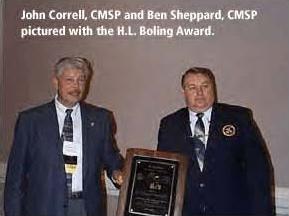
I wrote earlier this week about the shady behavior of John Correll, the Bush administration's nominee to head the Office of Surface Mining while he was Deputy Assistant Secretary at MSHA. One of his many problems at MSHA was his connection to not-for-bid contracts that went to longtime friends and associates Gerry Silver and Ben Sheppard. Sheppard obtained a series of contracts worth about $190,000.

And who is Ben W. Sheppard?
Ben W. Sheppard & Associates, LLC are a Christian organization that has unlocked the secrets to achieving continuous improvement. Their behavioral based unique processes have produced results that to date, are unequalled by their competition.
Now that's quite a combination: a faith based organization combined with behavior-based programs (as well as bad grammar).

But Correll apparently isn't the only faith-base safety practitioner at MSHA. Kathy Snyder at Mine Safety Watch noticed a rather strange phrase in an MSHA press release -- strange for a government document, at least in the old days when there was still a separation between church and state in this country.
“We continue to pray for the family and friends of the five miners who lost their lives this past weekend," said acting assistant secretary of MSHA David Dye in making the announcement.

Not "our hearts go out to," the families, not "our sympathies," not "we are profoundly sorry for their loss."

I'm going to step way out of line here, recognizing that the separation- of- church- and-state thing is a silly outworn notion that no public official takes seriously any more. But in my opinion, such a quote in this situation amounts to a tasteless advertisement for the piety of the speaker and -- amazingly -- a whole federal agency.

The place to tell someone you are praying for him or her is in a personal communication, not a press release.
Amen.

Snyder notes that shortly after she wrote her piece, the phrase was dropped from the press release on MSHA's website.

(Thanks to the kind reader who tipped me to the Sheppard information and photo.)

Tuesday, May 16, 2006

Metro Fatality: Did Worker Just Neglect His Training?

Washington Metro employee Jong Won Lee, 49, was killed Sunday after being hit by a Metro train while repairing track equipment. Today, the Washington Post greets us with this headline:
Worker Hit by Train Took Safety Course

The Metro employee who was struck and killed by a train Sunday at the Dupont Circle Station had received extra safety training put in place after a similar workplace fatality seven months ago, an agency spokeswoman said yesterday.
Well, shit, if he had "extra safety training," clearly he must have screwed up and disregarded his "extra safety training," right? Case closed.

Not so fast. First, it's far too early to tell. But from what we know about this accident, and a similar Metro fatality seven months ago, it isn't clear that even "extra, extra, extra training" would have helped.

What do we know so far?
Trains were running in both directions. The employees were able to stay clear of a northbound train. But Lee, who had worked for Metro since 1999, stepped back to avoid that train and was hit by a southbound train, No. 110, Metro officials said. He was struck, knocked onto the 750-volt third rail and electrocuted, according to Metro spokeswoman Lisa Farbstein. The third rail powers the trains and runs parallel to the rails that carry them.

The train that struck Lee was operating in automatic mode, traveling at 40 mph and braking as it entered the Dupont Circle Station, she said.
And what do we know about the previous fatality the resulted in the "extra safety training?" According to a Metro press release
"Various safety procedures were not followed during the track work project," said Fred Goodine, assistant general manager for system safety and risk protection. "For example, the track and structures and systems maintenance supervisor failed to contact the operations control center before approaching the track work area. He later left the work area, failing to ensure a safe work site for the crew at the time of the accident."

Also, train operators are supposed to sound a horn to warn track workers the train is approaching and stop if they don't receive acknowledgment that it was heard. The panel ruled that two train operators, including the one that hit Waldron, did not follow those procedures.

"Those operators will be disciplined for not following those procedures," said Steve Feil, chief operating officer of rail. "But the main fault still lies with the dismissed supervisor for not notifying his crew of the oncoming train or the operations control center of their location."

***

"This is a sad time for us. Had employees followed proper procedures, this unfortunate accident wouldn't have happened," Goodine said.
OK, let's first note the fact that the focus of that investigation was on the supervisors and the train operators, not what the worker who was killed did or what kind of training he had or didn't have.

But more important, although I haven't seen that report, but I'm always very suspicious of any accident investigation that concludes that "human error" was the main cause. As we've seen numerous times, most notably in last year's BP Texas City refinery explosion that killed 15 workers, it's too easy -- and generally wrong -- to simply blame workers for not following procedures and then fire the wrongdoers.

Usually, if you look a little deeper and ask "why" the workers weren't following procedures, you'll find the real root causes which, if corrected, could prevent similar accidents as well.

The fact is that human beings inevitably make errors. In fact, errors should be expected. But rather than focusing on the workers who make the errors, effective accident analysis – analysis that actually wants to get to the root causes and effective solutions -- looks for the conditions that made the errors possible.

Why weren't workers following procedures? Were they told to do things a different way by a supervisor who had a quota to fill? Were employees expected to take shortcuts to get the work done faster? Did they feel rushed by the constant drive to finish a job by the deadline? Were they not well trained for the job? Were they tired from too much overtime? Did the written procedures not make sense in the environment in which they were working? Did they not have the proper tools? These are the kinds of questions that need to be asked. Because if the answers to any of these questions lead to the real root cause of the accident, just firing someone isn't going to help anything. The same conditions are still there, and the same accident will happen again.

So here's a hint for Metro investigators. When you have two similar "human error" accidents, most knowledgeable investigators will tell you that it's a pretty good sign that you missed some of the deeper root causes in your first investigation.

Finally, maybe the answer to this problem is obvious. You can do extra, extra, extra super-duper training and fire everyone who even thinks about violating procedures. But ultimately, it may just come down to this: Maybe it's just too dangerous to have workers on the tracks when trains are traveling in both directions.


Related Stories