Wednesday, August 13, 2003

Minneapolis Cab Company Agrees to Put Cameras in Cabs

Speaking of acting like a union....here we have a positive result of a tragedy -- a cabdriver shot to death -- and some good old fashioned organizing. Somali cabdrivers in Minneapolis are planning a one-day walkout on August 18 to honor the two cabbies who were fatally shot in the past month and to draw attention to their security concerns.
Mohamed Saleh's picture was prominently displayed Monday on a national Web site devoted to the nation's steady list of slain cabdrivers, the same day the Minneapolis company he drove for decided to install security cameras in its taxis as a safety precaution.

***
Such safety measures have been credited with a dramatic decrease in cabdriver deaths in other metropolitan areas, including Baltimore, Boston and New York, where the city partly finances cameras or shields in virtually all the city's 50,000 taxicabs. As a result, the number of annual cabbie slayings in that city plummeted from 40 "to close to zero,'' said New York-based transportation consultant Bruce Shaller.
Scroll down for the background story.

For more information on cabdriver safety, check out this website, as well as this one.

Tuesday, August 12, 2003

More Holiday Shopping Tips

Check out www.seeyageorge.com for these T-Shirts:

Save the Environment: Plant a Bush Back in Texas

Like Father Like Son: One Term Only

One Nation...under surveillance.

Regime change begins at home.

Stop mad cowboy disease.

Somewhere in Texas...A village is missing its idiot.

The way you get a union is by acting like a union

Good story in In These Times about UNITE's Cintas organizing campaign. It's inspiring to see unions that really takes organizing seriously.
Since 1998 UNITE has quadrupled the number of unionized industrial laundry workers to 40,000. UNITE now represents about one-fourth of hourly employees in the industry. The union has boosted wages, won company-paid health insurance, expanded other benefits, and given workers a voice in the laundry industry through an aggressive organizing strategy. It has combined community pressure—mobilizing clergy, politicians, community groups, and customers—with vigorous employee organizing to demand “card check” recognition of the union. In other words, rather than go through the NLRB election procedures—which give employers greater opportunities to intimidate workers in anti-union campaigns and then to fight further over negotiating a contract if the union wins—UNITE typically fights to win promises of employer neutrality and, preferably, acknowledgement of the union on the basis of large majorities of employees signing union cards. Often workers strike, in conjunction with a comprehensive community support campaign, to win recognition. “The way you get a union is by acting like a union,” argues Liz Gres, who oversees the 30 organizers now focused on seven major Cintas markets.
The San Mateo Daily Journal has an article about a UNITE rally today at Starbucks, in order to pressure the company to fire Cintas as their apron, mat and linen service.
Cintas was cited by the Occupational Safety and Health Administration for serious violations last month, said UNITE spokesman Jason Oringer.

Two Cintas workers have also died because of “illegal and unsafe working conditions,” according to a statement by the group. They also charge that Cintas is under investigation for more than 100 violations of federal labor law including illegally firing and retaliating against pro-union employees.
There are other stories about the Cintas campaign here and here.

Monday, August 11, 2003

Minneapolis Taxi drivers call for one-day walkout over health and safety conditions

I think we could all learn a lesson in direct action for Minneapolis's Somali cabdrivers
August 11, 2003 -- Somali cabdrivers in Minneapolis said Sunday they will stage a one-day walkout to honor the two cabbies who were fatally shot in the past month and to draw attention to their security concerns.

More than 40 cabdrivers met at William Mitchell College of Law in St. Paul and agreed to park their cabs for 24 hours Aug. 18. They said they plan to ask non-Somali drivers to do the same. There are hundreds of cabdrivers in Minneapolis.

During the two-hour meeting, cabbies also said they intended to drive their cabs in a procession to Gov. Tim Pawlenty's office at the State Capitol in hopes of meeting with him.

Taxicab driving is one of the nation's most dangerous occupations, according to a report by the National Institute for Occupational Safety and Health. Drivers at Sunday's meeting say neither their employers nor the city of Minneapolis have done enough to make their jobs safer.

They are asking that bullet-proof partitions and security cameras be installed in their cabs. So far, cab companies have been unwilling to pay for such upgrades, and Minneapolis Mayor R.T. Rybak made it clear Friday that public money wouldn't be provided for private businesses.

Cabdriver Mustafa Hussen said that parking the cabs is worth losing one day's pay to show the solidarity that exists among the drivers.

"The strike is to remember the two brothers we lost in the community of taxi drivers," Hussen said. "The strike will be an expression of concerns that have not been addressed."
More here and here and here.


The Weekly Toll

State OSHA will investigate cannon death

August 8 -- The state office of the Occupational Safety and Health Division is investigating what caused a cannon to blow apart and kill a 16-year-old Aumsville boy at Camp Meriwether.

Christopher Kroker was employed as a counselor at the camp near Tillamook, so the death qualifies as a workplace accident.

Investigators will look into possible manufacturing defects, procedures, maintenance and training, said Steve Corson, spokesman for OR-OSHA.

OSHA Investigating Roofer's Lightning Death

August 5, 2003

COLUMBUS, Ohio -- Lightning from Monday's storms produced a deadly outcome for a local worker, NewsChannel 4's Marshall McPeek reported.

The worker, 17-year-old Herman Harnandez Vasquez, was killed when he was struck by lightning. The accident is under investigation.

Vasquez was working on a roof in Hilliard when Monday's thunderstorms rolled in. He took a direct hit from the lightning bolt. Despite rescue efforts, he was pronounced dead a short time later.

There are more questions than answers at this point. Not the least of which is whether any safety regulations were violated. Did he have safety training? Should he have even been working this job? It's going to take a while for investigators to come up with answers.

"This is simply an act of God," said Mike Feazel of Feazel Roofing.

(Isn't it always?)

More here: The death of an underage worker struck by lightning while roofing this week underscores how immigrant workers are injured or killed at disproportionate rates, advocates said.


OSHA is investigating fatal accident at plant

Tuesday, August 5, 2003

The federal Occupational Safety and Health Administration is investigating a forklift accident that killed a Sanford man while he was working in Berwick on Friday.

Thomas Brown, 48, was operating a stand-behind forklift at Prime Tanning Co. Inc. on School Street when he backed into a storage rack.

He got pinned between a shelving unit and the forklift as he backed it up about 3:20 p.m., Berwick police said.


Instructor suspended over death of trainee
A firefighter instructor who allegedly failed to recognize a Pennsylvania trainee's fatal heatstroke symptoms has been suspended without pay for 30 days, a newspaper reported Thursday.

County commissioners in Frederick County, Md., suspended Jeff Coombe late last week in connection with the July 2002 death of Andrew J. Waybright, The Frederick News-Post reported, citing anonymous sources.

Worker died from head trauma, autopsy finds

Aug. 9, 2003

Racine - A fall from a great height and severe head trauma will most likely be listed as the the cause of death of a Milwaukee man who was involved in a construction site accident in Racine last week, Racine County Medical Examiner Thomas Terry said Thursday.

Robinson fell from scaffolding and was impaled on a 5-inch bolt at a construction site near Batten Airport at Mount Pleasant St. and South St. He was 55.


Worker dies after fall at former power plant

Aug. 09, 2003 APPLETON — A 29-year-old man died after falling about 20 feet from the roof of an old power plant.

The man was a member of a five-person crew from A&A Environmental, of Poynette. The group was removing asbestos from the roof.

Gary Hart on Chemical Plant Security

Former Senator and Presidential candidate Gary Hart has followed my lead writing in the Washington Post about the Bush administration's rhetoric (and nothing else) on chemical plant security. He does a good job explaining the problems with the Inhofe bill:
Incredibly, the Inhofe bill provides for virtually no oversight or enforcement of safety requirements. Unlike Corzine's proposal, it would not allow the government to demand emergency action by companies that it has reason to believe are terrorist targets, nor would it insist on government review of facility security plans. (The latter failure is akin to the Internal Revenue Service's telling companies to fill out their tax forms but not to bother to file them.) The Inhofe bill prohibits the federal agency with the most expertise on chemicals, the EPA, from putting its skills to good use. And unlike the Corzine bill, the Inhofe bill would not require companies to replace dangerous chemicals -- which might pose tempting terrorist targets -- even when safer technologies are available and affordable. The chemical manufacturers say that they will consider making their processes safer. But we did not just ask airlines to simply consider improving security -- we made them do it.

If Inhofe's bill were to become law, only the chemical industry would breathe easier. But the Bush administration has an obligation to all Americans to do more than simply permit industry to write its own rules. We need legislation that keeps us safer by requiring chemical companies to reduce their risks and that ensures accountability through government oversight.

Liar, Liar, Pants on Fire...

You know, I'm starting to think they just can't help it. They have a pathological compulsion to lie. It's not that they think they're doing anything wrong really, it's just that the facts keep getting in the way of the "truth." Facts or the "truth?" The "truth" or the facts. "Truth," facts, "truth" facts. Life in Washington is just so hard. First there's this:


IG Investigates Whether EPA Misled Public on Water Quality
The Environmental Protection Agency's inspector general is investigating whether the agency is deliberately misleading the public by overstating the purity of the nation's drinking water, according to EPA officials and agency documents.
Seems the EPA was claiming that "94 percent of the population served by community water systems were served by systems that met all health-based standards," while the actual figure was "79 to 84 percent in 2002 -- putting an additional 30 million Americans at potential risk."

And then there was this....


White House Sway Is Seen in E.P.A. Response to 9/11

WASHINGTON, Aug. 8 -- An investigation by the Environmental Protection Agency's inspector general into official statements about air quality after the collapse of the World Trade Center has found that White House officials instructed the agency to be less alarming and more reassuring to the public in the first few days after the attack.
This is all about the EPA's almost immediate assurance to New Yorkers that the air was perfectly fine, even though they didn't have the information to support that. In fact, according to this report, EPA had originally intended to be much more cautious.

But the Inspector General got hold of EPA's original draft press release -- before the White House's Council on Environmental Quality got a look at it.
The report compares two news releases with their draft versions and concludes, "Every change that was suggested by the C.E.Q. contact was made."

The title for the original version of one news release was, "E.P.A. Initiating Emergency Response Activities, Testing Terrorized Sites For Environmental Hazards." In the final version, the second clause was changed to read, "Reassures Public About Environmental Hazards." In the same release, a section that said, "Even at low levels, E.P.A considers asbestos hazardous in this situation" was deleted and replaced with a section that read, in part, "Short-term, low-level exposure of the type that might have been produced by the collapse of the World Trade Center buildings is unlikely to cause significant health effects."
And then there was this unrelated article, except for the common theme of truth-challenged Administration officials...


Iraqi Trailers Said to Make Hydrogen, Not Biological Arms

WASHINGTON, Aug. 8 -- Engineering experts from the Defense Intelligence Agency have come to believe that the most likely use for two mysterious trailers found in Iraq was to produce hydrogen for weather balloons rather than to make biological weapons, government officials say.

The classified findings by a majority of the engineering experts differ from the view put forward in a white paper made public on May 28 by the C.I.A. and the Defense Intelligence Agency, which said that the trailers were for making biological weapons.

***

The engineering team that has come to believe the trailers were used to produce hydrogen includes experts whose task was to assess the trailers from a purely technical standpoint, as opposed to one based on other sources of intelligence. Skeptical experts had previously cited a lack of equipment in the trailers for steam sterilization, normally a prerequisite for any kind of biological production.

Bush administration officials have said the most compelling information that the trailers were used for making biological weapons has come from a human source, an Iraqi scientist who described the trailers and what he said was their weapon-making role to American experts months before.
So what do we believe? They eyes of our experts or an Iraqi scientist seeking to curry favor with the Americans?

For those of you who follow the wild goose chase for Weapons of Mass Destruction know that the fact that these trailers made weather balloons and not anthrax was available way back in May. For more information, you can read all about it at Daily Kos.

For my purposes, I thought the following paragraph was the most significant:
Senior administration officials have said repeatedly that the White House has not put pressure on the intelligence community in any way on the content of its white paper, or on the timing of its release.
No, of course not. Why would anyone ever suggest that the White House would put pressure on any agencies to hide truth or lie?

Saturday, August 09, 2003

Christmas is just Around The Corner

And it's not to early to start your shopping.

Friday, August 08, 2003

Sharing the Stealth: They Lie About Science Too

Congressman Henry Waxman has put out a report detaling the Bush Administration's manipulation and distortion of the scientific process in a few issues like Abstinence-Only Education, Agricultural Pollution, Arctic National Wildlife Refuge, Breast Cancer, Condoms, Drinking Water, Education Policy, Environmental Health Food Safety, Global Warming, HIV/AIDS, Lead Poisoning, Missile Defense, Oil and Gas, Prescription Drug Advertising, Reproductive Health, Stem Cells, Substance Abuse, Wetlands, Workplace Safety, and Yellowstone National Park.

Not much on workplace safety and health except for blackballing qualified nominees for scientific committees because of their support for the OSHA ergonomics standard.

Bush Administration Earns Failing Grade on Chemical Plant Security

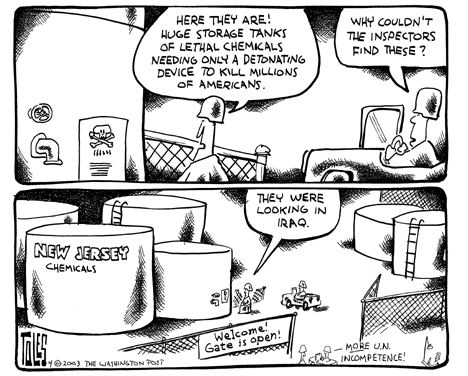
Terrorists didn't need Saddam Hussein's mythical chemical weapons of mass destruction to launch a catastrophic attack against the United States. It turns out they can literally find all the ammunition they need right here -- thanks to the inattention of the Bush administration.

This is a subject about which I've written extensively here and here. But the situation does not seem to be improving, according to an article in yesterday's Government Executive:
Despite the Bush administration's public promises and alarms, the White House has taken almost no action to improve security at any of the nation's 15,000 facilities -- including chemical manufacturing plants, petroleum tank farms, and pesticide companies -- that contain large quantities of potentially deadly chemicals. For that matter, the administration has done virtually nothing even to assess those facilities' vulnerability, even though the dangers are far from theoretical: An accidental leak at a Union Carbide pesticide plant in Bhopal, India, immediately killed between 3,800 and 8,000 people in 1984 and, according to some reports, has since claimed an additional 12,000 lives. Closer to home, an accidental chlorine gas leak at a Honeywell refrigeration plant in Baton Rouge, La., on July 20 sent four workers to the hospital and forced 600 residents to stay indoors.

Counterterrorism experts shudder to think about the number of deaths an intentional release of a toxic chemical could cause. And the Bush administration's inertia heightens their worries.

"These chemical plants have a vulnerability which has a catastrophic characteristic ... that could approximate the World Trade Center," Rand Beers, a White House counterterrorism adviser for 30 years, told National Journal. Dissatisfied with the Bush administration's approach to security, Beers resigned in March and now advises the presidential campaign of Sen. John Kerry, D-Mass.
How real is the danger?
Based on reports from the 15,000 facilities required to submit that worst-case-scenario information, the EPA warned that a terrorist attack on any one of the 123 chemical facilities located in densely populated areas could expose 1 million people to toxic chemicals. An attack on one of 700 other facilities could threaten at least 100,000 people. And an attack at one of 3,000 other chemical sites could affect 10,000 people.


It's not that the issue hasn't been on Bush's radar screen. It's just that he keeps changing the channel. Like the proverbial hot potato, the EPA earlier this year backed down before threats of chemical industry lawsuits and tossed responsibility for regulating chemical plant security over to the Department of Homeland Security.
Still struggling to get on its feet, Homeland Security has no authority to require the chemical industry to adopt stricter security measures. It also doesn't have the money or personnel to inspect industrial plants for potential security problems.
True to form, the Bush administration is relying on the voluntary efforts of the chemical industry to protect the country even though "two-thirds of the facilities that use or store high volumes of toxic chemicals...don't belong to those groups, according to EPA officials."

Meanwhile, on Capitol Hill, the chemical industry succeeded last year in killing Senator Jon Corzines chemical security bill after a unanimous vote from the Senate Committee considering the bill. Corzine's bill called for (gasp!) regulations that, among other things, would have required chemical facilities to move toward "inherently safer" production -- for example substituting safer chemicals for potentially hazardous ones and reducing the quantity of hazardous chemicals kept in the plant.

Corzine has resubmitted his bill this year, but instead of killing it outright again, the chemical industry has given luke-warm support to a much weaker bill introduced by Senator James Inhofe (D-OK)."Inhofe's bill would not require companies to submit vulnerability or security-improvement plans to Homeland Security. It also would not require companies to consider using alternatives to current chemicals and practices." Their theory is that we simply need to have more guns and higher fences, and keep the contents of chemical plants secret (as if!) -- which means keeping information away from those loose lips at EPA. (And, of course, this also means saying goodbye to citizens' post-Bhopal right to know what's brewing next door.)

Ironically, the Republicans' arguments end up supporting the philosophy behind Corzine's push for inherently safer processes:
Texas Republican Joe Barton, chairman of the House Energy and Commerce Subcommittee on Energy and Air Quality, said that although he's monitoring the situation, he sees no need for tough new chemical security requirements in the aftermath of 9/11.

"The problem you have in an open society is that it's physically impossible to make any large industrial site terrorist-proof," Barton said in an interview. "If there are enough terrorists who are dedicated enough and equipped well enough, they're going to overwhelm everything that you put up short of some sort of Fort Knox -- which doesn't make much sense, given the cost and the relatively remote possibility that any specific site is going to be targeted."


But to requote myself from a previous posting
how much sense does it make to only commit resources to guard a target (with questionable effectiveness) when in most cases it's entirely possible to shrink or even remove the target completely? As outlaw Willie Sutton explained, they robbed banks because that's where the money was. Chemical plants are potential targets for terrorists because that's where the greatest potential for terror is. Take the money out of the banks -- or the catastrophic potential out of chemical plants -- and no one cares.


So how has the industry been doing with its voluntary efforts?
A July 9 survey by the Conference Board, a New York City-based business research group, found that since 9/11, U.S. companies have increased their spending on security an average of only 4 percent. Other studies by the Brookings Institution, Rand, the Congressional Research Service, and the Progressive Policy Institute also raised serious questions about security problems at chemical plants and other high-risk facilities with large amounts of hazardous material.
Newspapers repeatedly report reporters successful attempts to walk unchallenged right into chemical plants and the Government Accounting Office also has serious doubts about the industry's ability to guarantee its own security.

But hey, ultimately we don't need no stinkin' terrorists to blow up our neighborhood chemical plant. We can do it ourselves. At this point, the prospect of terrorist attacks against U.S. chemical facilities is scary, but it's hypothetical. What is real are the hundreds of workers who have died and communities that have been threatened from explosions caused by the very real hazards of reactive chemicals -- which, if you scroll down a bit -- you will see that the Bush administration also refuses to regulate.

The bad news is that we're perfectly capable of causing mass destruction without Saddam Hussein's weapons and without terrorists. But the good news is that the solution to all of these threats is the same: Inherently safer production, better and safer management of chemical plants, and regulations to make sure it all happens.

California:Who Does Labor Love?

Apparently no one. Good article by Harold Meyerson in the LA Weekly on labor's luke-warm support for Gray Davis -- not because they like Gray, but to prevent what could be a precident-setting theft of a democratic election.
Union chiefs tell horror stories of Davis’ reluctance to agree to last year’s bill providing arbitration in farm-labor disputes; they note his aversion to populist causes and add that Davis is so shy about touting the good bills he has signed that their members don’t credit him with any significant achievements.
But the prospect of Dianne Feinstein is worse.
In just the past several weeks, Feinstein has sided in committee with Orrin Hatch, and against all her fellow Democrats, to limit the recompense workers can collect from employers for poisoning them with asbestos. She has come out in favor of private-school vouchers within the District of Columbia. And who can forget her vote for Bush’s 2001 tax cut, the only one of the 12 Democratic senators to side with Bush who came from a solidly Democratic state?
Of course all of this was written before Arnold, Bustamante and Garamendi got in, and before Feinstein got out. So who knows which way is up at this point. Maybe Davis should just resign. Democrat Bustamante becomes Governor, the recall is off and the R's are left sucking their thumbs.

Privitization: If it works for the Army, it'll work for the rest of the federal (and state and local) government(s) too

This nugget was mined from Suburban Guerrilla:

More on outsourcing - this time, in Iraq - with disastrous results.
U.S. troops in Iraq suffered through months of unnecessarily poor living conditions because some civilian contractors hired by the Army for logistics support failed to show up, Army officers said.

Months after American combat troops settled into occupation duty, they were camped out in primitive, dust-blown shelters without windows or air conditioning. The Army has invested heavily in modular barracks, showers, bathroom facilities and field kitchens, but troops in Iraq were using ramshackle plywood latrines and living without fresh food or regular access to showers and telephones.

Even mail delivery -- also managed by civilian contractors -- fell weeks behind.

Though conditions have improved, the problems raise new concerns about the Pentagon's growing global reliance on defense contractors for everything from laundry service to combat training and aircraft maintenance. Civilians help operate Navy Aegis cruisers and Global Hawk, the high-tech robot spy plane.

Thursday, August 07, 2003

Workplace Tragedies/Union Action Produce NJ Reactive Chemical Protections

The New Jersey rule to protect workers and communities against catastrophes caused by reactive chemicals that I wrote about a couple of days ago was a result of two workplace disasters and strategic organizing by unions and environmentalists.
Eight years after the notorious Napp Technologies explosion in Lodi and five years after another blast in Paterson, New Jersey is becoming the first state in the nation to regulate the potentially explosive chemicals blamed in both incidents.

Chemicals not regulated as hazardous materials were inadvertently mixed in a vat at Lodi plant, causing an explosion that killed five workers, injured 41, and forced 300 residents to be evacuated. Similarly, ingredients were incorrectly mixed at Morton International's dye manufacturing subsidiary, with the reaction injuring nine employees and rocking homes 15 blocks away.

Both catastrophes prompted calls from unions and environmentalists for regulation of such "reactive chemicals" - substances not considered hazardous on their own but which can become volatile if exposed to air or water, or mixed with the wrong ingredient.
As a result of these and other explosions caused by reactive chemicals, the U.S. Chemical Safety and Hazard Investigation Board has recommended that OSHA and EPA issue federal regulations. But the Bush administration has refused to act on the CSB's recommendations.
Without regulations like these, workers and people living in the surrounding communities are at risk from the kind of runaway reactions these kind of chemicals can have," Poje said.

Current regulation forces a company to give special training only to employees handling substances that are hazardous on their own, such as chlorine or ammonia.

So workers don't know the potential dangers of lesser-known chemicals such as ethyl nitrate and potassium hydrosulfite, "and they don't know to respond if there is an incident," Poje said. He noted that workers did not immediately evacuate after the accident at the Morton plant because the dangers were unknown to them.


Ergo Repeal Qualifies for Washington Ballot

This pretty much says it all
OLYMPIA, Wash. - An initiative to repeal the state's sweeping workplace-ergonomics rules qualified for the November ballot after a $350,000 campaign by homebuilders who called the regulations "an unnecessary job-killer."
The initiative would immediately repeal the ergonomics rules issued by the Department of Labor and Industries in 2000 in a bid to reduce worker injuries caused by repetitive motion, heavy lifting, and awkward working positions.
But the BIA didn’t just have money, they have the untruth (lies) on their side as well. See here and here and here.

(In case you want the true facts about the Washington State ergo standard, click here.)

The State AFL-CIO doesn't think much of the initiative either:
BIAW cash, lies land I-841 on ballot despite bogus signatures

Despite uncovering an extraordinarily high number of invalid and potentially fraudulent signatures, the Secretary of State's office announced Wednesday that the Building Industry Association of Washington's Initiative 841 to repeal our state workplace ergonomic safety rule narrowly qualified for November's ballot.

Time out for a little humor. Apparently the Associated Press headline writers don’t know their geography very well. Here’s the original headline about the Washington STATE ergonomics repeal:
Thursday, August 7, 2003 · Last updated 6:44 a.m. PT
Ergonomics repeal ready for D.C. ballot

THE ASSOCIATED PRESS

OLYMPIA, Wash. -- An initiative to repeal the state's sweeping workplace-ergonomics rules qualified for the November ballot after a $350,000 campaign by homebuilders who called the regulations "an unnecessary job-killer."
Seen one Washington, you’ve seen ‘em all.

Despair of the Jobless

Good Bob Herbert column in the New York Times today about the desperate unemployment situation in George Bush's America.

First, things are much worse than the official numbers show:
The official jobless rate, now 6.2 percent, does not come close to reflecting how grim the employment situation really is. The official rate refers only to those actively seeking work. It does not count the "discouraged" workers, who have looked for jobs within the last 12 months but have given up because of the lack of offers. Then there are the involuntary part-timers, who would like full-time jobs but cannot find them. And there are people who have had to settle for jobs that pay significantly less than jobs they once held.

When you combine the unemployed and the underemployed, you are talking about a percentage of the work force that is in double digits. That's an awful lot of lost purchasing power for a society that needs broad-based wage growth among its consumers to remain economically viable.
And the Bush Administration? Message: I don't give a shit.
The simple truth is that the interests of the Bush administration's primary constituency, corporate America, do not coincide with the fundamental interests of workaday Americans. On the business side of this divide, increased profits are realized by showing the door to as many workers as possible, and squeezing the remainder to the bursting point. Productivity (based primarily on improvements in technology) is way up. Hiring, of course, is down. Part-time and temporary workers are in; full-time workers with benefits are out.

And then there's the ominous trend of sending higher-skilled jobs overseas to low-wage places like India and China, an upscale reprise of the sweatshop phenomenon that erased so many U.S. manufacturing jobs over the past quarter century.

Working Americans need jobs just to survive. But the Bush administration equates the national interest with corporate interests, and in that equation workers can only lose.
Glad the recession is over. Someone better let these people know.

Terminate Arnold

Arnold just announced that he was going to run against Grey Davis in the California recall. He took the opportunity to bash the labor unions as special interests.

I have to take this opportunity to repeat one of my favorite lines from Bill Maher about Arnold's candidacy: "Finally, a candidate who can explain the Bush administration's positions on civil liberties in the original German."

Think I can get my money back from Terminator 3? (Hey, my kid made me see it.)

Washington State Ergonomics Referendum Resolution

Although the Building Industry Association of Washington's Initiative 841 to repeal the workplace ergonomic safety rule has yet to be officially certified for this fall's ballot by the Washington Secretary of State's office, the Washington State Labor Council, AFL-CIO is urging all labor organizations to adopt a resolution formally opposing the initiative.

Linked here is a draft resolution that can be used or adapted for this purpose. Even if you're not a resident of Washington State, I'm sure they'd appreciate the support. And don't forget that the bell tolls not just for them. If this turkey passes, it will make it all the harder to issue ergonomics protections on the federal level or in any other states.

Adopt the resolution and send it to them.

More information here and here.

Subway Hazards

Two good articles in Newsday about the hazards to workers and passengers in the New York subway tunnels.
The MTA is shortchanging straphangers' and workers' safety with an antiquated tunnel system and limited employee training for emergencies, critics charge.

"I think what has happened is that the health and safety of the workplace in the subway has been given less consideration than other aspects of the system," said Davitt McAteer, former chief of the U.S. Mine Safety and Health Administration. He recently surveyed the system's tunnels for the city's largest transit union and found the situation for riders is worse than for miners.

The safety expert, lawmakers and union leaders want better marked exits, brighter tunnels, improved evacuation procedures and more employee training on helping passengers escape underground dangers
Emergency response procedures in the event of another terrorist attack are one problem:
Subway workers have complained they have been given conflicting lessons about what to do in a terror attack. Some say supervisors have told them to run, while others report being told to stay and help passengers. New York City Transit says workers are told to assist passengers and notify emergency personnel.

Frank Goldsmith, director of occupational health for Local 100 of the Transport Workers Union, said of subway employees: "The problem that I feel, personally, is the lack of training and the lack of understanding. They simply are not being given proper training."....

The conductor of that F train said that in five years on the job, he had never been trained for a fire. He also said leaving the station in a dark tunnel was harrowing. "I couldn't see at all," said Florizel Gordon. "You're like a blind man, walking and feeling your way out."

The union said the smoke was worsened by fans operating in the wrong direction - a charge New York City Transit denies.

A tunnel in Queens where a worker was killed in 2001 still does not have enough light, union leaders say. Samuel McPhaul, 49, was killed when he tripped on the tracks and hit the third rail near the Grand Avenue station in Elmhurst. Union officials say better lighting would have made the tunnel safer.
And a rather chillilng article about what happened during a recent subway fire.
Subway conductor Florizel Gordon staggered through the smoky tunnel underneath York Street in Brooklyn, twisting his ankle and falling hard on the tracks. The feeble glare of his Transit-issue flashlight proved useless.

A passenger shouted to Gordon that another passenger was having a heart attack. Gordon picked himself up and walked over to an older man hobbling on a bad knee and experiencing chest pains.

"I told him to cover his face and put his hand over my shoulder, and I helped him out," Gordon, a conductor since 1998, said in the cadence and diction of his native Jamaica.

"Sir, you can't fall down on me," the 41-year-old conductor, himself barely able to stay up, told the stranger. "We have to get out of here."

This was the early-morning subway fire at the York Street station two Saturdays ago. As flames and sparks raged from underneath two subway cars, workers and passengers scrambled the more than 600 feet to the southern end of the platform on the F line before plunging into the dark, smoky tunnel. Now came a treacherous trek of several hundred feet over the tracks to the nearest emergency exit.

"There were no lights," Gordon said. "The tube was pitch black. ... The smoke was so thick. You're like a blind man walking and feeling your way through."
Subway worker safety is being investigated by President Clinton's former Director of the Mine Safety and Health Administration Davit McAteer. McAteer said he was shocked to see that the lighting in the subways was worse than lighting in coal mines.

Confined Space Fatalities

Earlier this week I wrote about a confined space incident that had a happy ending. Those workers were lucky. The ones I ran across today weren't:

Authorities in Hanover County are trying to determine what caused the death of a landfill worker. The accident happened Monday afternoon at a privately owned landfill.

Officials say two maintenance workers went into a manhole 18 feet deep to check on a sump pump. One of the men passed out and died before they could get him out. Investigators are not sure what caused the man to collapse. The man's name has not been released.

This is a confined space incident where the toxic gas was apparently introduced by the workers when they a gasoline-powered pump into a hole. This is an example of a poor or missing safety program and another where the rescuer almost ends up dead:

One city worker is dead and another was in serious condition this morning after an accident late Sunday afternoon that occurred while they were trying to repair a sewage pump station in Athens.

Mike Stanley, a 14-year city employee, was pronounced dead at O’Bleness Memorial Hospital, according to Athens Service-Safety Director Wayne Key.

Dave Carder was listed in serious condition this morning at Ohio State University Medical Center in Columbus, a hospital spokesman said.

The two men were overcome, possibly by carbon monoxide, after responding to a maintenance problem at the Oakmont sanitary lift station. Worker Scott Lambert also was at the scene.

Key said an underground portion of the lift station had flooded, and the workers attempted to use a vacuum truck to pump it out. When that failed, they gradually lowered a gasoline-powered pump into the 20-foot-deep hole, emptying it as the pump was lowered.

Stanley then descended into the lift station, but became ill. Lambert left the immediate area to call 911, and while he was away Carder apparently went down into the pump station to try to rescue Stanley, Key said.


And the U.S. is not the only country with confined space problems, as well as higher injury and fatality rates among foreign workers. This is from Greece:

Dimitris Kolovos, 45, and Vasili Passa, 42, died when they were overcome by methane fumes in a sewer
while carrying out a project for Acharnon Municipality at Menidi.

Dimitris Tsakalis, 32, first went into the sewer to measure its depth and was overcome by the fumes. His colleagues went in to save him and they too collapsed. They were pulled out a short while later by the fire department, but the two were dead and Tsakalis is being treated at Sismanogleio Hospital, where he is in critical condition. Labor Inspectorate officials said the three belonged to a small private team that was working on the area's sewerage system. They had not taken the necessary precautions, such as wearing gas masks, and no one was supervising them. If a supervisor was there, he had run away to evade arrest, officials said.

The accident underscored the dangers faced by foreign workers especially, as Passa and Tsakalis are Albanian citizens. Foreign workers are usually more likely to carry out dangerous work without objecting, are not union members, and often don't have the necessary training. Last year, 40 foreign workers died in work-related accidents, 38 died in 2001 and 20 in 2000.

Wednesday, August 06, 2003

Workers Comp Notes

Insurance Company Rate Hikes Force Comp Cuts

Leaders Call for Insurance Reform


Around the country, insurance company rate hikes have forced states to cut workers’ compensation benefits, according to AFL-CIO and Workplace Injury Litigation Group (WILG) leaders attending a national Workers’ Voice meeting in San Francisco July 19. For more information, check out the AFL-CIO's Workers' Comp Notes.