Confined Space
News and Commentary on Workplace Health & Safety, Labor and Politics

Tuesday, September 02, 2003


Out of Sight, But Never Out of Danger

Running AFSCME's health and safety program was never dull. You were always dealing with hazardous work that no one ever saw or thought about. The deadliest jobs among AFCME members were in highway work zones, most often for those who worked at night -- getting hit by oncoming traffic, or too often, getting hit by work equipment.

This article in the Tampa Tribune addresses many of those hazards:
Before midnight, under a span of Interstate 275, a bulldozer and 160-foot crane belched diesel fumes as work crews labored to widen the highway.

The black and blue smoke rose above the workers' heads, above temporary spotlights, then disappeared into the darkness.

Most of the renovations on the I-275 junction with Interstate 4 are performed during the day. But when they involve lifting heavy girders over crowded roads, those roads must be closed. And that means night work to men accustomed to working in daylight. They start about 7 p.m. and head for home just as the sun is rising.

For those men, the darker hours don't bring rest and relaxation; they bring sweat and sore muscles.

Every year, about 100 road crew workers die on the job in the United States, according to the American Road & Transportation Builders Association. Another 20,000 are injured. Working at night, in the shadows of floodlights, increases the safety risk.
But there's one major difference between these workers and the ones I used to work for. These aren't public employees, they're private contractors. More and more of the fatalities I see in roads and public works are private contractor employees, rather than public employees. Like refineries and other manufacturing jobs, employers seem to be contracting out the most dangerous work.

Ironically, in some states, contracting out public employee jobs can theoretically make them safer. In Florida, for example, public employees aren't covered by OSHA. It's perfectly legal for a public employee to dig a 15 foot trench without any shoring, whereas a private contractor could be cited by OSHA.

Of course, this is only theoretical, as most of the contractors aren't organized and probably have less health and safety consciousness than more unionized public employees and are less likely to file an OSHA complaint. And then there's this factor that I never knew about:
Andy Carroll, a civil engineer, has worked on the I-275 widening since it began in October. Although he generally works days, Carroll switches to nights when those projects require engineering.

Last week, he came out to observe the crews as they unloaded massive I-beam girders, as thick as 2 inches and as long as 100 feet, from the backs of tractor-trailers. The girders were laid flat on concrete posts along the downtown/Jefferson Street exit on southbound I-275. The girders were bolted together to form long spans. Those steel spans will be hoisted with a crane and set atop T-shaped, concrete pillars to form the structure of a bridge.

"We're not going to shut down the interstate for that,'' Carroll said. "We'll just shut down the on-ramp.''

Carroll said he hates the closures as much as motorists. They can cost him money.

His employer's contract with the state lets him close the roads as many as 60 times over the four-year life of the $73.5 million project. If the company, Granite Construction, closes the roads less than that, it receives $15,000 per unused closure. If the closures go over 60, the company owes the state $15,000 each time.
What kind of incentive system is this? The less safe the job, the more money the company makes. I wonder if the guys working out on the highways, inches away from speeding traffic in the middle of the night know about the terms of the contract.

Labels:


Violence Against Federal Lands Employees on the Rise

Public Employees for Environmental Responsibility (PEER) report that violence and threats of violence against Forest Service employees, BLM rangers, range specialists, and U.S. Fish and Wildlife Service employees were up in 2002 over the previous year.
"When park rangers are 10 times more likely to be assaulted than agents of the DEA [Drug Enforcement Administration] and 12 times more likely than FBI agents, a reasonable person would say the agency needs immediate change," said Randall Kendrick, director of the U.S. Park Rangers Lodge of the Fraternal Order of Police.
"These numbers may only be the tip of the iceberg, as many people in the field are discouraged from reporting threats and assaults," PEER's Eric Wingerter said.

Source: Grist

Labels: ,


Quote of the Week

"Changing the attitude at OSHA (the Occupational Safety & Health Administration) ...We made them advisory."

-- Congressman Cass Ballenger (R-NC), when asked about his proudest accomplishment as an elected official.


Monday, September 01, 2003


It's Labor Day, and many American workers seem pretty angry

This is the first line of an article in the Minneapolis Star Tribune. And, as my kids would say, "Well, duh!" Why are American workers angry? Let me count the ways:

Too Much Work

The Star-Tribune article deals with the Administration's overtime regs that will take away overtime from millions:
Faced with the possible loss of overtime pay, more than 76,000 workers have flooded the U.S. Department of Labor with reactions to proposed changes in the Fair Labor Standards Act.

In the small, spartan office the department has set aside for public review of the comments, paper copies of 24,000 comments -- mailed or faxed -- fill 66 large binders stored in cabinets along the wall. A computer database displays more than 52,000 e-mail comments, representing every state.
That's a hell of a lot of comments.

The Washington Post yesterday deals with the same issue. And here's a fact that most Americans don't realize:
In the United States, unlike many other industrialized countries, there are no federal laws limiting the number of hours that employees are compelled to work. But the Fair Labor Standards Act of 1938 set a workplace standard of 40 hours a week by requiring employers to pay non-management workers time-and-a-half for every extra hour worked in one week.
The problems is that in times when the economy is slow and unemployment is high, employers tend to take advantage:
Business groups and labor activists agree that many companies, pressured to hold down costs in a globally competitive environment, often ask employees to work longer than the standard American 40-hour workweek. And when the work is voluntary and fairly compensated, they say, that's a good thing -- for the employees who want the extra income and for the economy in general.

But labor experts also worry about the danger for exploitation in a slow economy, as companies continue to slash thousands of jobs every month and many workers feel they can't afford to say no to employers' requests.
The result?
Americans work more than many other people in developed economies, according to a recent report by the International Labor Organization, a United Nations agency that monitors workforce conditions. The ILO found that American workers put in an average of 1,825 hours per year, far more than workers in most European nations. French workers, by contrast, are employed an average of 1,545 hours per year, and German workers about 1,444 hours.

"In relative terms, Americans are workaholics among advanced industrialized countries," said the Chamber of Commerce's Workman.

According to Lawrence J. Johnson, chief of the ILO's employment-trends team, "there's been a decision in Europe to work less and less hours, a decision made culturally."

"The European Union and the United States have two different systems and react to economic conditions differently. . . . A lot of what Europeans have -- longer vacations, shorter hours -- are legislated, and in the United States, it is handled through collective bargaining," he said.

Or rather, such working conditions are determined through labor negotiations for the shrinking portion of the workforce represented by unions. Collective bargaining has become a less powerful tool for workers because of the diminished clout and reach of the labor movement, Johnson and others said. Today, only 13 percent of workforce is unionized, down from a third of all workers at labor's zenith in 1955.
Too Few Jobs

UNITE'S President Bruce Raynor talks about the loss of manufacturing jobs in the context of the bankruptcy of Pillowtex
Every manufacturing industry in the United States -- apparel, textiles, metals, paper, electronics -- has lost jobs in the past year. Over the past 36 months manufacturing employment has declined by 2.7 million. This is the longest decline since the Great Depression. The job crisis is not only in manufacturing. Since the economic recovery began, more than a million jobs have disappeared. Apparently the economy is doing well. Only workers are suffering.
The result: More fodder for Wal-Mart and McDonalds:
The workers are now desperate. They received no severance payments. Their health insurance is gone. Mortgages, car payments and taxes aren't being paid. Kannapolis, N.C., where Pillowtex is located, has always been a textile town. There are no other jobs available. And while the union is still trying to find a buyer for the company, the local government's response for economic development is to buy an ad in USA Today or the Wall Street Journal asking Bill Gates, Oprah Winfrey or Warren Buffett to consider moving some of their business operations to Kannapolis.
Even the NY Times seems to have noticed:
Even though the recession ended nearly two years ago, polls show that American workers are feeling stressed and shaky this Labor Day because the nation continues to register month after month of job losses and wages are rising more slowly than inflation.

One factor above all has fueled the insecurity: the nation has lost 2.7 million jobs over the last three years. The recovery has been so weak since the recession ended in November 2001 that the nation's payrolls are down one million jobs from when economic growth resumed.

Indeed, the current economic expansion is the worst on record in terms of job growth. The average length of unemployment, more than 19 weeks, spiked this summer to its highest level in two decades.
Too Few Grownups in Charge

Bob Herbert at the NY Times thinks the problem is that there is not enough adult supervision:

There was an interesting lead paragraph in an article on the front page of The Wall Street Journal last Thursday:

"The blackout of 2003 offers a simple but powerful lesson: Markets are a great way to organize economic activity, but they need adult supervision."

Gee. They've finally figured that out. The nuns I had in grammar school were onto this adult supervision notion decades ago. It seems to be just dawning on the power brokers of the 21st century. Maybe soon the voters will catch on. You need adults in charge.
And then in a take-off riff from John Lennon's "Imagine"
Imagine if we had done some things differently. If, for example, instead of squandering such staggering amounts of federal money on tax cuts and an ill-advised war, we had invested wisely in some of the nation's pressing needs. What if we had begun to refurbish our antiquated electrical grid, or developed creative new ways to replenish the stock of affordable housing, or really tackled the job of rebuilding and rejuvenating the public schools?

What if we had called in the best minds from coast to coast to begin a crash program, in good faith and with solid federal backing, to substantially reduce our dependence on foreign oil by changing our laws and habits, and developing safer, cleaner, less-expensive alternatives? This is exactly the kind of effort that the United States, with its can-do spirit and vast commercial, technological and intellectual resources, would be great at.

Imagine if we had begun a program to rebuild our aging infrastructure — the highways, bridges, tunnels and dams, the water and sewage facilities, the airports and transit systems. Imagine on this Labor Day 2003 the number of good jobs that could be generated with that kind of long-term effort.

All of these issues, if approached properly, are job creators, including the effort to reduce our energy dependence. The big hangup in the economic recovery we are supposed to be experiencing now is the continued joblessness and underemployment.

A fellow I ran into recently in San Jose, Calif., Andy Fortuna, said: "I've got a college degree and I'm washing cars. I'm working, but I'd like a good job. If the idea is for business to employ as few people as possible and keep their pay as low as possible — well, how's that good for me? Who speaks for me?"


More Labor Day News

Check out Nathan Newman for Labor Day news from around the web.


The Weekly Toll

This one is too sad

Dreams of success die with immigrant

Fulgencio Sosa Cortes’ dream died with him on June 12, one day before his one-year anniversary in America, when a felled tree fatally injured him while he was on a job site at a private home in Jackson. He leaves behind a beloved wife, two adoring children and an unfinished dream.


Weather/Construction Collapse Kills Worker

Jose Arellano, 29, of Irving died and four other unidentified men were injured when they became trapped for nearly an hour under a construction site at 3200 block of Guildford Lane near Hardin Boulevard.

Sudden straight-line winds rolled into the area, causing the second story of an adjacent construction site to blow on top of the two-story wooden frame the men were working on, said McKinney police Capt. Robert Dean.

Death of 18-Year Old in Fall

Palm Beach County sheriff's deputies and OSHA agents are investigating the death of an 18-year-old Broward County construction worker who fell down an elevator shaft at Delray Medical Center Tuesday morning. Salvador Cruz of Fort Lauderdale fell three stories down a hole in the roof of the building, investigators say.

Bridge worker drowns

A worker on the Fort Pitt Bridge construction project drowned in the Monongahela River Friday afternoon after falling out of a boat used to
transport workers from a pier work site.

The Allegheny County Coroner's Office identified the victim
as James Warren, 29, of Conneaut, Ohio, an employee of
Cleveland-based L.M. Lignos Enterprises.

Logger killed by falling treetop

Thursday, August 28, 2003

WALLINGFORD, Vt. - The Vermont State Police are investigating the death of a logger who has hit by a treetop that fell on top of him.

Raymond Petrossi, 53, of Wallingford was pronounced dead late Tuesday night at the remote scene in the woods off Hartsboro Road, police said.


Electric Worker Killed in Mishap
Another worker hurt in Auburndale power pole accident.


AUBURNDALE, FL -- An electrical worker was killed and a second employee injured when a power pole became electrified and shocked both men at their job site off of U.S. 92 in Auburndale on Wednesday afternoon, Tampa Electric workers said.

Antonio Severson, an employee with Mastec of Asheboro, N.C., died at Lakeland Regional Medical Center, said Milton Little, a lead supervisor for TECO.


Lewisville man killed in construction accident

A Lewisville, TX, man was crushed to death while he worked on the construction of a new Home Depot in Carrollton during the brief thunderstorm that passed through the area on Sunday night.

The worker who died was 25 years old. His name is being withheld pending the notification of his next of kin.

"We suspect his family lives in Mexico, and we're trying to find them," Sponhour said.

What is this? Yet another unkown worker killed by an unknown cause.

Police give construction site death case to OSHA

LAWRENCEVILLE — Police have turned over the investigation of a man who died Friday at a construction site to the Occupational Safety and Health Administration (OSHA).

The unnamed victim died while working at a construction
site near Jimmy Carter Boulevard and Peachtree Industrial Boulevard, where a shopping center is being built. He was dead when fire officials arrived, said Gwinnett Fire spokesman Chief Randy Robinson.

Gwinnett Police handled the incident but did not have any details about the death as of press time, said police spokesman Cpl. Dan Huggins.

Georgia trucker dies in forklift accident

COLUMBIA, S.C. -- A trucker from Ocilla, Ga., has died after he was struck by a forklift at a paper plant, authorities say.

Arnold Wayne Southard, 64, was hit by the forklift at Paper Stock Dealers around 3 p.m. Monday and died from multiple trauma less than six hours later, Richland County Coroner Gary Watts said.

Accident in N.Ky. kills Bell lineman

PETERSBURG - A Cincinnati Bell worker died Wednesday in western Boone County after becoming entangled in a spool of telephone wire.

Cletus Charles Woeste, 58, of Villa Hills was pronounced dead at the scene. The official cause of death was severe head injuries.

Woeste was hanging lines along a gravel road when his clothing or safety belt was caught in a winding spool of wire, said Boone County Coroner Doug Stith

Labels:


Sunday, August 31, 2003


Public Employers: Free From Ideological B.S?

I wrote the other day about a city in North Carolina that had received an OSHA citation and used it as inspiration to improve their health and safety program. Now we have another town in Kentucky that is forming an "OSHA Compliance Committee" to bring the city into compliance with the state's OSHA regulations. This action was also in response to an OSHA citation that resulted from an employee's complaints.
County to form OSHA compliance group

Scott County (KY) will form a committee to improve departments’ compliance with the state’s Occupational Safety and Health Administration regulations.

The implementation of the OSHA Compliance Committee was granted by the Scott County Fiscal Court at Thursday night’s meeting.

The decision comes on the heels of OSHA fining the Scott County Fire Department $21,350 in proposed penalties and citing it for 15 violations in a report issued July 16.

The fines and violations were in response to 21 complaints filed by an employee on April 29 with the state’s Occupational Safety and Health Administration. Complaints alleged the unnecessary use of force, violations of standard operating procedures and poor records keeping.
I'm not sure if this is a pattern, but it is interesting that public employers often seem to be far less hostile to OSHA than private sector employers, just as they seem to be generally much less hostile to unions and organizing than private sector employees. My hypothesis is that many private sector companies have been led astray (contaminated) by the government affairs people either in the Washington office (of large companies) or (for smaller companies) in the associations they belong to, like the National Association of Manufacturers or the National Federation of Independent Businesses.

In other words, in a better world, the behavior of small businesses might be similar to the constructive behavior of these municipalities if it wasn't for the fact that the small (and large) businesses were ideologically contaminated by the assocations, the Republican party and their Government Affairs types.

Why, you ask? Is it because the Republicans get more support if the business community thinks the sky is falling? Is it because business associations get more members if they scare the shit out of small businesses? Good questions! To be explored more later....

Labels:


Saturday, August 30, 2003


Workplace violence in the health sector

Global service sector union federation PSI and the ILO, International Council of Nurses (ICN) and the World Health Organisation (WHO) have, as part of a Joint Programme oan Workplace Violence in the Health Sector, published Framework guidelines for addressing workplace violence in the health sector. The organisations say workplace violence is a global problem affecting all sectors, but the health sector is at major risk. Violence in this sector may represent a quarter of all violence at work, and more than half of health workers may be affected. (From Hazards)


PSI World News. Full report: Framework Guidelines for addressing workplace violence in the health sector

Labels: ,


They Say It's My Birthday

They say I'm turning 50 today. (I know, I don't write like I'm a day over 30). One thing about having your own blog is that occasionally you can be self-indulgent and write about whatever you feel like.

I find this very hard to believe.... That it's my 50th birthday. Twenty years ago I was only 30, an age I still feel very close to. But 20 years from now, I'll be....Well, I don't really want to think about it. I mean, I'm still a very young, cool dude...despite what my teenage children think.

At this age, you finally have to admit that you're starting to approach the dawn of early middle age. And it's at this time in life that I really start to realize that:

-- I will probably never play center field for the Dodgers.

-- It's becoming increasingly unlikely that I will ever be President of the United States. Even my senatorial aspirations are looking a bit shakey.

-- I probably won't be the lead singer in any band playing RFK Stadium

-- My academy award chances may be slim -- even for one of those lifetime achievment awards.

So what do I have to show for myself? If "It's a Wonderful Life" were made about me, what would the world have looked like without me?

And what can I contribute for the rest of my productive years? How will my children see me?

Is it time to finally face my deepest fear. Actually my deepest fear is that by the time we get another Dem in the White House, I'll be 55 (or if we have another Reagan-Bush three term thing, I'd be.....Well, I don't really want to think about that either.

This is the time to put all of those day-to-day issues aside and try to find the answers to these and other difficult existential questions.

But this is also the time when a Sopranos rerun is on T.V. I can always contemplate again on my 55th birthday.

P.S. If your really want to get me a present....All I'm asking for is to GET GEORGE BUSH OUT OF THE WHITE HOUSE NEXT YEAR.


Friday, August 29, 2003


Yet Another Reason That Unions Are Security Risks

Bush Holds Federal Pay Raise to 2% in 2004

George the W has decided that federal employees (other than the military) should only receive 2% raises next year, as opposed to the 4.1% that the President has proposed for the military and that the House Appropriations Committee last month backed for all federal employees.

The reason?
In a letter to congressional leaders, Bush said the larger increase "would threaten our efforts against terrorism or force deep cuts in discretionary spending or federal employment to stay within budget."
Does this mean that those who advocate for a larger federal payraise are "threatening our efforts against terrorism?"

If so, John Sweeney better start packing his bags for Guantanemo:
AFL-CIO President John Sweeney said the president's action was "shameful, and makes clear that Bush is making federal employees pay for his own fiscal recklessness."
And, of course, there's the obvious point made by Tapped:
Tell us, Mr. President, do massive tax cuts for the wealthy, which balloon federal deficits and starve the government of needed funds, also threaten our efforts against terrorism? By your logic, yes.


That's the Proper Spirit!

If only all employers would take OSHA citations in such good spirit!
In response to both of the violations, [town manager Jim] Fatland said, “Learning from our mistakes will make us stronger tomorrow,” and he added, “the Town of Tryon is very appreciative to OSHA for working with us to improve the safety for our employees.”
I'm nominating them for Employer of the Week.


Thursday, August 28, 2003


Labor Day at the AFL-CIO

Check out the AFL-CIO's Labor Day Web page. And send some "e-cards" to friends and relatives.

Labels:


Who's To Blame?

The big news yesterday was the release of the Columbia space shuttle disaster report. Check it out here. It makes for fascinating reading, especially Chapter 8, which was written by Dianne Vaugh, who wrote the classic work on the original Challenger disaster. In Chapter 8, "History as Cause: Columbia and Challenger" she explores the systemic failures of the NASA safety system and how the problems uncovered after the Challenger disaster reappeared to cause the Columbia's problems.

The most interesting parts of the report focuses on the management system problems rather than individual failures. Vaughn cautions however that
the Board's focus on the context in which decision making occurred does not mean that individuals are not responsible and accountable. To the contrary, individuals always must assume responsibility for their actions. What it does mean is that NASA's problems cannot be solved simply by retirements, resignations, or transferring personnel.
The footnote accompanying this paragraph states
Changing personnel is a typical response after an organization has some kind of harmful outcome. It has great symbolic value. A change in personnel points to individuals as the cause and removing them gives the false impression that the problems have been solved, leaving unresolved organizational system problems.
Which makes the following headline from the New York Times "interesting":

Human Error Likely Cause of Blackout, Timeline Says

So, let me get this straight. Does this mean that a simple human booboo resulted in the gigantic blackout that swept parts of eight states and eastern Canada, cost billions of dollars and darkened the homes of millions of people? And does this imply that a slap on the hand (or maybe even jail time) will fix the electrical grid problem?

The only "substance" behind that headline is a quote from an unnamed investigator:
"Had all of the existing policies been followed, this would not have developed into a cascading event," the investigator said. "What we see are institutional breakdowns, not a breakdown of the system itself."
Those who do incident investigations realize, however, that the fact that procedures were not followed are rarely due to human failure. It is far more likely that the procedures were confusing or didn't anticipate the situation that the operators found themselves in.

Some people also blamed the Three Mile Island accident on the plant operators: If proper procedures had been followed, the near-disaster would have been a small unnotable incident. But the failure at TMI can more accurately be blamed on the fact that the information that the operators had available to them at the time was confusing, conflicting and inaccurate, and they had not been trained to address the specific situation they were facing. In other words, given the knowledge they had, the "standard operating procedures" were almost useless.

It may be theoretically possible to trace everything that happens in the world to humans (or nature). But in reality, barring sabotage or horseplay, there are few, if any, cases where the root cause of an incident -- workplace injury, space shuttle disaster, or huge blackout -- could be blamed on "human error."

Human error may be one of the "direct causes" of an incident. A direct cause is the action that directly results in the occurrence, while root causes are usually management system problems which, if corrected, would not only have prevented that specific problem, but other similar problems as well.

Rather than focusing on the operators who make the errors, modern accident analysis looks for the conditions -- or root causes -- that made the errors possible.

And now check this out:

AK Steel suspends 11 workers after fatal accident

MIDDLETOWN, Ohio - AK Steel Corp. has suspended 11 workers in connection with an overhead crane accident that killed a worker last month at the company's Middletown Works mill, a union official said.


Now I don't know any more about the details of this incident that what you can read from this article, but let me just suggest that you go check out that footnote above again.

Labels:


Union Health and Safety Programs: Organize and Die?

Last April, in one of my first postings, I opened a debate about whether the almost exclusive focus of several AFL-CIO unions on organizing was a threat to union health and safety programs.

The March 9 New York Times quote by John Wilhelm, president of the Hotel Employees and Restaurant Employees (a union that has chosen not to have a health and safety program), sent shivers up the spines of union health and safety activists:
"the A.F.L.-C.I.O. was spread too thin and should devote more of its money and energy to organizing. Mr. Wilhelm said he would even consider ideas like eliminating the federation's respected health and safety department to channel more money into organizing.

"My view is that if we don't devote the largest possible amount of money to organizing and to political action that relates to organizing, we will go out of business," he said. "And if we go out of business, we can't help anybody's health and safety."
This statement has caused quite a bit of concern among union health and safety staff, as well as rank and file activists about the role of health and safety programs in unions, especially in the context of the obvious need to increase resources dedicated to organizing. Is there, or should there be a conflict between health and safety programs and organizing? Is it a zero-sum game?

Harold Meyerson has written an excellent article in the American Prospect entitled "Organize or Die" about the struggle within the AFL-CIO over organizing strategies. He highlights the labor movement's left wing organizing "stars:" SEIU's Andy Stern, Hotel & Restaurant Workers' John Wilhelm, and UNITE's Bruce Raynor, and also discusses the efforts of Carpenter's President (and AFL-CIO dropout) Doug McCarron and Laborers' President Terry O'Sullivan. Stern, Raynor and Wilhelm rose through the union ranks on their organizing successes and continue to show how to build a union even in these tough political and economic times:
SEIU under Stern has grown by a stunning 535,000 new members so that it is now, at 1.5 million members, the largest union in the federation. The SEIU has had notable successes organizing home-care, nursing-home and hospital workers, and has continued to organize the janitors who clean America's office buildings.
Meyerson discusses the debates within the federation about how best to organize (focusing on sectors as HERE and SEIU are doing, using students and outsiders as SEIU tends to do, or rank and file union members as CWA favors), the idea of complimentary unions working together (e.g. janitors and hotel workers) instead of fighting over the same territory (e.g. public employees), the success or failure of John Sweeney, etc . While health and safety issues are not mentioned in the text of the article, the debate over the role of labor health and safety programs in an "organize or die" environment can be read between the lines:
Just as notable as the SEIU's success is the way it's been achieved. At Stern's prodding, the union now devotes about half its budget to organizing. The SEIU has hired hundreds of young people off college campuses or from community organizing groups to staff its campaigns. As existing staffers have been reassigned to organizing, locals have often had to train members to do the work of servicing their fellow members that the paid staff had previously performed.

***

Indeed, no two presidents have more radically restructured their unions than Stern and McCarron. Both have reduced the percentage of resources spent on servicing existing members to free more resources for organizing new ones. Both have reshaped locals -- over considerable opposition, in McCarron's case -- into larger units more capable of organizing. Both are apostles of organizing to drive up market shares, and disdainful of organizing that doesn't accomplish that end.
Labor health and safety activists remember well that when Andy Stern took over SEIU he decimated one of the labor movement’s largest and most active health and safety programs, leaving only one Washington representative to address the giant union’s abundance of health and safety issues.

As mentioned above, Wilhelm has been quoted as advocating elimination of the AFL-CIO's health and safety department. At a 2001 AFL-CIO Executive Council Meeting,
Wilhelm suggested reallocating federation resources to address the problem: 75 percent of the AFL-CIO's budget should be split equally between politics and organizing, with the remaining 25 percent allocated to other programs that contributed to those goals.

The suggestion went nowhere, but it was indicative of the strategic approach of Wilhelm's group. "Many of us feel that the AFL-CIO provides too many services that international unions should provide themselves and doesn't have enough focus to help unions with their strategic growth and politics," Stern says.
(Transferring services from the AFL-CIO to the individual unions is a rather ironic statement considering the cuts that Stern has made in SEIU's program and that Wilhelm has no health and safety program. Both unions rely on the AFL-CIO health and safety department for health and safety assistance.)

In addition to sowing fear into the hearts of those who have dedicated their careers to developing labor health and safety programs, this debate has forced to address one basic question: Why do unions need health and safety programs? Are they necessary for a vibrant labor movement or are they a remnant of the old “servicing model” of unions?

Aside from the obvious issue of saving lives and preventing injuries and illnesses, building the union and organizing new members is a pretty good reason to have a health and safety program. PACE activist Diane Stein discussed this issue on winning NYCOSH’s Silwood award,
People join unions because they need better work lives. Safety and health is a huge part of that struggle…. People join unions because they know that unions are the only institution who really put forward their agenda. We cannot abandon that agenda because we need resources for organizing. It simply doesn't make sense.
As one health and safety activist pointed out to me, fabled organizer Mother Jones’ famous line, “Mourn for the Dead, Fight like hell for the living” was all about workplace safety.

In other words, potential union members need a reason to join a union. Respect and better pay and benefits certainly lead the list of reasons in most cases, but saving lives and preventing injuries and illnesses are compelling reasons to to join a union in workplaces where health and safety problems exist.

Most health and safety staffers are anxious to get involved in organizing campaigns, but complain that it’s often difficult to convince the organizers that health and safety is a good organizing issue and to involve health and safety issues in the initial conceptualization of organizing campaigns.

On the other hand, some of the fault may lie within. When I first engaged in this debate last April, one long-time union health and safety activist responded that “Workers have always organized unions for better working conditions. This is not a diversion from organizing; it is its essence.” But she went on to criticize her (former) self and other health and safety “nuts” who had gotten so immersed in health and safety issues that they had “ gotten fat and lazy and forgot to organize.” These are problems
that we have failed to acknowledge and address. How are the structures we are building around health and safety building our unions? What role are the leaders who are first organized around health and safety issues taking in building bigger and stronger unions? What changes do we need to make to tie health and safety issues more closely to organizing a big, powerful and progressive Labor Movement?
Others are critical of many unions’ dependence on government grants which prohibit health and safety trainers from getting involved in organizing campaigns and tend to skew health and safety activities toward grant targets which may or may not be in tune with the union’s organizing targets. Although without the grant programs, many union health and safety programs would practically cease to exist.

Some unions have gotten the idea. AFSCME’s health and safety manual takes an organizing focus. Chapter 1, “ORGANIZING FOR A SAFE AND HEALTHY WORKPLACE” starts with the factors that make health and safety a good organizing issue:

· Health and safety affects all workers.
· Health and safety issues can be won.
· Health and safety concerns can move workers to take action.

Throughout the handbook, basic organizing principles are applied to health and safety problems.

UNITE’s organizing drive at Cintas is one of the few that integrates health and safety issues into the campaign. Unfortunately, campaigns like Cintas are more the exception than the rule, despite the efforts of union health and safety to integrate health and safety into organizing.

Aside from building the union and assisting in organizing campaigns, there are a few other reasons why unions need health and safety programs:

1. Health and safety programs save lives, prevent injuries and illnesses. If unions can’t save your life, what good are they? And when it comes to protecting workers’ safety and health, a knowledgeable, well-organized local union is better than all the regulations in the world. It’s hard to count workers who don’t die or who don’t get hurt or sick. But they exist.

While union activists may see unions as an inherently good things, most workers want some good, concrete reasons to organize and pay their dues to unions. For many union members, union resources that are used to train rank and file activists in how to investigate and organize around health and safety issues is a service well worth paying some dues money for. And some health and safety problems – fatality or health hazard investigations need the expertise provided by experts in a national union program. The “servicing model” of many unions may ultimately be a dead end, but that doesn’t mean that in some cases, workers don’t need services that only professional union staff can offer. (For information on how unions help to protect workers health and safety check out Hazards.)

2. Health and safety programs provide organizing and health and safety skills to rank and file activists. Local rank and file activists may run organizing campaigns and health and safety programs better than union staff, but many of the skills and much of the knowledge need by health and safety activists can be intimidating for newbies without training sponsored and conducted by union health and safety professionals.

3. Need for coordination between workplace conditions and local/national political battles. Forcing OSHA to issue health and safety standards or to enforce the law is no longer a simple administrative process. To be successful, unions need to organize massive grassroots political action campaigns. It takes coordination from the AFL-CIO and national unions, it involves organizing the victims of health and safety problems on the local and national level and it takes political action in Washington and in the states.

It took over a decade of nationwide organizing to get OSHA to issue its ergonomics standard in 2000, yet in a matter of hours, the labor movement was out-organized by the business community in Congress and the ergonomics standard was lost. To achieve future gains and to prevent future losses, health and safety issues have to be integrated with organizing and political action programs.

4. Union Health and safety programs stimulate and support research into illnesses and injuries caused by work. It is well known that workers are the proverbial canaries in the coal mines: Almost every major workplace health problem was initially discovered by workers and their unions, and then brought to the researchers and government regulators. The state of health and safety research in this country may not be as popular or well funded as we might wish, but imagine what it would be like without unions to detect the problems and provide the populations to study.

++++

These are not easy issues, but they need to be addressed by health and safety activists. Within a couple of years, the AFL-CIO may elect a new president. If it’s one of the organizing "stars," what will become of the AFL-CIO’s health and safety department, and departments in the individual unions? Can the case be made that health and safety programs are an integral part of organizing, rather than a costly distraction?

These are my thoughts. I encourage you to support or slam them. E-Mail me. Let me know if I can post your thoughts, and whether or not you want to remain anonymous if I decide to publish them.

Labels: ,


Wednesday, August 27, 2003


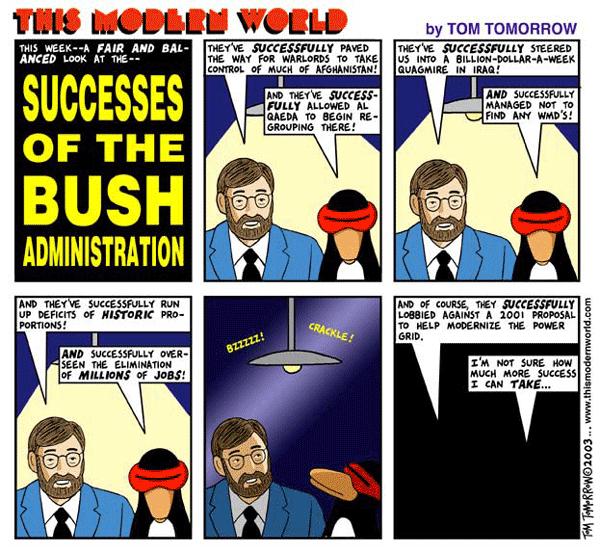
Successes of the Bush Administration

(Thanks to Mad Prophet for alerting me to this)


Attention Walmart Workers: Go to Hell

Good article in today's Washington Post by the American Prospect's Harold Meyerson contrasting Walmart encouraging the downward slide of wages in this country, as opposed to the effect of the early auto industry which pushed workers' wages up to the point where they could buy houses.
The nation's largest employer, with 3,200 outlets in the United States and sales revenue of $245 billion last year (which, if WalMart were a nation, would rank it between Belgium and Sweden as the world's 19th largest economy) doesn't pay its workers -- excuse me, "associates" -- enough to buy decent cars, let alone homes.
Actually, Meyerson doesn't go far enough. As other authors have pointed out, Walmart "associates" don't even make enough money to shop at Walmart.

Meyerson points out that Walmart's practices threaten not only the wages of Walmart workers and other service employees, but also the ability of workers to organize:
Wal-Mart's expansion into non-southern metropolitan areas, the company poses a huge threat to the million or so unionized clerks who work at the nation's major supermarket chains.
And finally, what does this say about democracy (economic and political) in America?
It may just be me, but I don't recall the moment when the American people proclaimed their preference for an economy driven by Wal-Mart to the one driven by General Motors. It is, after all, one thing to live in a nation where the largest employer wants workers to make enough to afford its cars; quite another to wake up in an America where the largest employer wants workers to make so little they'll be compelled to buy low-end goods in a discount chain. Indeed, polling has consistently showed that a clear majority of the American people have been dubious about the benefits of free trade -- but these are the only polls that the political elite, so poll-driven on other questions, has consistently ignored. By the same token, polling also shows that Americans believe workers should have the right to join unions free of intimidation, yet that has not been the case in the American workplace for at least the past three decades.
Update: Check out Carter Wright for more on Walmart's anti-union campaign.


Tuesday, August 26, 2003


Bill Moyers: Eve of Destruction?

Anyone who has seen Bill Moyers' show "Now with Bill Moyers" or read any of his articles knows that he is one of the only journalists in America who has the insight and courage to stand up to the Bush administration -- especially on environmental and workplace health and safety issues.

Check out this interview in Grist for more insight into (and inspiration from) Bill Moyers on environmental issues.

He first talks about the Bushies preference for "religious and political dogma" over facts:
Their god is the market -- every human problem, every human need, will be solved by the market. Their dogma is the literal reading of the creation story in Genesis where humans are to have "dominion over the fish of the sea, and over the fowl of the air, and over the cattle, and over all the Earth, and over every creeping thing ..." The administration has married that conservative dogma of the religious right to the corporate ethos of profits at any price. And the result is the politics of exploitation with a religious impulse.

Meanwhile, over a billion people have no safe drinking water. We're dumping 500 million tons of hazardous waste into the Earth every year. In the last hundred years alone we've lost over 2 billion hectares of forest, our fisheries are collapsing, our coral reefs are dying because of human activity. These are facts. So what are the administration and Congress doing? They're attacking the cornerstones of environmental law: the Clean Air Act, the Clean Water Act, NEPA [the National Environmental Policy Act]. They are allowing l7,000 power plants to create more pollution. They are opening public lands to exploitation. They're even trying to conceal threats to public health: Just look at the stories this past week about how the White House pressured the EPA not to tell the public about the toxic materials that were released by the September 11th attacks on the World Trade Center.
But, of course pure politics also factors in:
It's payback time for their rich donors. In the 2000 elections, the Republicans outspent the Democrats by $200 million. Bush and Cheney -- who, needless to say, are oilmen who made their fortunes in the energy business -- received over $44 million from the oil, gas, and energy industries. It spills over into Congress too: In the 2002 congressional elections, Republican candidates received almost $15 million from the energy industries, while the Democrats got around $3.7 million. In our democracy, voters can vote but donors decide.
The problem is that they're so good at it. Unlike the public bluster of Ronald Reagan's James Watt, these guys know that results are more important than rhetoric -- unless the rhetoric is used to lull the American people into believing that all is well:
They learned a big lesson from the Watt era. Not to inflame the situation. Use stealth. If you corrupt the language and talk a good line even as you are doing the very opposite, you won't awaken the public. Gale Norton will be purring like a kitten when she's cutting down the last redwood in the forest with a buzz saw.
But all is (hopefully) not lost. Moyers leaves us with a small bit of inspiration:
I once asked a friend on Wall Street about the market. "I'm optimistic," he said. "Then why do you look so worried?" I asked. And he answered: "Because I'm not sure my optimism is justified." I feel that way. But I don't know how to be in the world except to expect a confident future and then get up every morning and try in some way to bring it about.
Well, we may not all be Bill Moyers or have his acess to the media, but if we all "expect a confident future and then get up every morning and try in some way to bring it about," maybe we can start to turn this ship.

-- This is Pollyana Barab, signing off.


Monday, August 25, 2003


Sometimes it's nice to see that we can all get along and work together -- labor, enviros, native Americans -- and get some results.

Labor-Native American Coalition Confronts Taiwanese-Owned Company

Union members, Native Americans and local farmers have come together to confront Taiwanese-owned Continental Carbon Company with charges of environmental pollution, creating public health risks, and causing "economic havoc."

The problem is "carbon black dust that rains-down on their properties and in their homes. This pollution, they claim, has worsened since the company locked out members of Local 5857 of the PACE (Paper, Allied-Industrial, Chemical & Energy Workers) International Union."
The Ponca Tribe, which was first detected by the Lewis & Clark Expedition, originally settled in Northern Nebraska. According to Tribe Activist Casey Camp, in 1876, they were forced to walk to Oklahoma in the winter for resettlement -- a trek in which one of three died. Today, approximately 2,500 of the 24,000 residents of Ponca City are members of the Tribe. "Where once we died from relocation, today we are being killed with pollution," she said "Our people are dying from cancer and suffering from asthma and congestive heart failure, and why? The answer is because companies like Continental Carbon value their profits more than the lives of our elders and children. The earth, air and water are sacred and too important to be polluted for business profit."
The workers have been locked out by the company for over two years.
Speaking on behalf of the PACE Union was Todd Carlson, the Chairperson of the Locked-Out Workers Committee. Carlson and 85 other employees, all members of PACE, were locked-out of their jobs after they refused to accept severe cuts in pay and benefits that would have cost each employee about $35,000 per year. "Continental Carbon has been allowed to assault the economic health of our community and our environment," he stated, "The reinstatement of a PACE-represented workforce would be a huge step in the right direction to rectify both situations."


Labor-Environmental Coalition Forces Steelworkers to Clean Up Its Act

A coalition of environmental, labor and community groups has forced a Portland steel mill to spend $105,000 to settle a lawsuit alleging that the company repeatedly broke air-quality rules.
In an agreement filed last week in U.S. District Court, the Portland-based company said it would pay $55,000 to set up a system of air monitors around its North Portland steel mill and refinishing plant.

It also agreed to allow an independent monitor from PBS Environmental to make as many as 100 surprise inspections at its facilities during the next three years.
The settlement was a result of the work of a coalition of the U.S. Steelworkers, environmental and community groups:
The Environmental Justice Action Group, the United Steelworkers of America and the Alliance for Sustainable Jobs and the Environment sued the company in 2001, alleging that the mill violated its state-administered air permits and the federal Clean Air Act about 100 times since 1995.

***

"When the government doesn't do its job of holding corporate polluters to the legal limits, citizens have to step in and seek enforcement of the law," said Dave Foster, local director for the Steelworkers union. Oregon DEQ officials admitted in 2000 that they mistakenly ignored the violations.


Daddy, Tell Me About That Statue

Fallen Ironworkers Honored

Twin Cities union ironworkers, who normally erect buildings, will this week erect a memorial to their brethren killed on the job.

The almost 8-foot-high bronze statue will be dedicated Tuesday outside of the ironworkers' St. Paul union hall.

Ironworkers Local 512, which has 1,350 members, gathered the names of 25 Twin Cities ironworkers killed on the job since the 1930s, when the St. Paul and Minneapolis Ironworkers locals were merged.

The names of the deceased will be inscribed on the memorial, which was designed by Art Norby, the Afton artist who sculpted the Minnesota Korean War Veterans Memorial on the state capitol grounds.


Save These Dates: AFL-CIO Safety & Health Conference

December 7-10, 2003

AFL-CIO National Safety and Health Conference:
Safe Jobs and Strong Unions, Keep on Fighting


Detroit Marriott Renaissance Center
Detroit, Michigan

Join union safety and health representatives and activists like yourself from across the labor movement. Plenary sessions and workshops will give you practical information on current safety and health problems and how to tackle them. Exchange experiences and discuss strategies with other safety and health representatives and activists on how to improve safety and health in your workplace while increasing union strength.

Detailed information will be available soon here and on the AFL-CIO Safety and Health web site.

Labels:


Sunday, August 24, 2003


Hotel Workers Suffer From Workplace Hazards

A US study has shown strong connections between working conditions and the health of Las Vegas hotel room cleaners.
A study of 941 workers found that ergonomic problems, increasing workloads, and time pressure were significant causes of work-related pain and injury. Overall stress levels also contributed to pain and injury, as well as increased levels of smoking among workers.

Over 60% of workers reported severe back pain, and 45% had been injured at work in the last year. But nearly half of these injuries went unreported to workers' compensation bodies, with many workers using their own leave for time off work after injury. (Source: Worksafe)
The information in this article is important and ironic considering that on March 9, 2003, John Wilhelm, president of the Hotel Employees and Restaurant Employees, was quoted in the New York Times as saying that
"the A.F.L.-C.I.O. was spread too thin and should devote more of its money and energy to organizing. Mr. Wilhelm said he would even consider ideas like eliminating the federation's respected health and safety department to channel more money into organizing.

"My view is that if we don't devote the largest possible amount of money to organizing and to political action that relates to organizing, we will go out of business," he said. "And if we go out of business, we can't help anybody's health and safety."
Yeah, but on the other hand, if unions don't focus on workers' health and safety, they may have less reason to organize. And unless workers see political action as affecting their lives, why get involved? You can find more on this debate here.

The full Executive Summary of the report can be found here.


Workers Under Attack

Good article in the Denver Post about the Bush administration's attack on workers. The article highlights the war against worker health and safety, beginning with a discussion of Bush's refusal to issue a standard requiring employers to pay for their employees' workboots and other personal protective equipment.
President Bush and his administration are quietly implementing an aggressively pro-business labor strategy that focuses on voluntary compliance.

Since Bush's election in 2000, the Labor Department has yanked 41 worker-safety regulations in development off the books, including two addressing hazardous chemical dangers. The administration has frozen action on other rules, including one meant to prevent the spread of airborne diseases in the workplace. Bush has issued legally binding orders that weaken labor unions. The Labor Department now wants to rewrite rules governing who gets overtime pay.
Almost more depressing than the actual actions is the word "quietly" and the following sentence: "Most of the changes have escaped notice outside Washington." This is true even for those who are suffering the effects of these actions don't necessarily know that the Bush administration holds within its hands the ability to fix these problems and has deliberately chosen not to.

Aside: My wife was flying back from California yesterday and observed the new airport baggage procedures. Instead of just sliding (or lifting) the bags onto the conveyor where they are whisked away to be loaded on the plane, they're now taken to a station where they much be hefted onto a bomb exray machine. She observed an older gentleman (older than we are) lifting the heavy suitcases, twisting around and hefting them onto the x-ray machine where another worker reversed the procedure on the other side. She asked whether or not they had had any back injuries. He replied that "You wouldn't believe the number of people who are getting hurt." She told him the sad story of the demise of the OSHA ergonomics standard. It was new news to him. "Well we sure need OSHA in here."
Why this war, you may ask?
"Fundamental to Bush's political future is pleasing business," said Larry Sabato, political scientist at the University of Virginia's Center for Politics.

"The Bush people understand that the stronger labor unions are, the stronger the Democratic Party is," Sabato said.
Of course, even good reporters need a bit of education:
Bush's approach to labor became apparent in his first few months in office. Within two months, working with Congress, he repealed a Labor Department regulation requiring businesses to take specific steps to prevent repetitive stress injuries. A subsequent ergonomics standard released by the Bush administration relies on voluntary compliance by employers.
In fact, as you all know, the Bush administration has released no "standard." They have their "comprehensive approach" which consists of voluntary guidelines, compliance assistance and research on ergonomics issues that tells us nothing important that we don't already know -- In other words "Voodoo Ergonomics." And voluntary voodoo ergonomics doesn't seem to be helping the baggage handlers at the airport. Big surprise.

Read the article. It's good, but it's frustrating, because this is the kind of information that every American worker needs to know -- now and throughout the election process. They need to know why they're getting hurt and how the Republican politicians (and a few Democrats) are screwing them. They need to remember what happened to the ergonomics standard and they need to understand how voting -- in local and national elections -- affects everything in our lives, from health care, to public services, to coming home uninjured from work.

We've got work to do.

Labels:


Saturday, August 23, 2003


LABOUR WEBSITE OF THE WEEK

Not to blow my own horn or anything, but Labourstart has named Confined Space this week's Labor Website of the Week.
Subtitled 'News and Commentary on Workplace Health & Safety, Labor and Politics', this is one of the first of a new generation of trade union websites that are blogs (web logs). These sites tend to be somewhat more personal, more updated, and in some cases even more content-rich than conventional trade union sites. This site is a particularly good example of what a blog can do, and if you're interested in health and safety issues, it should be one of your favorites/bookmarks.
Couldn't have said it better myself.

Rather ironic, though, to come this week, when I've been in Knoxville and barely blogging.

Oh well, such is life in the Blogosphere.