Monday, April 19, 2004

California "Reforms" Workers Comp

I have written before about the California workers compensation mess
The central problem in California now is that the costs paid by employers are the highest in the country, while the benefits received by workers are about average - in part because many cases are disputed, which wastes resources.

Total costs for California employers increased to $29 billion in 2003 - eight times the gross domestic product of Haiti - from $11 billion in 1998. By one estimate, the average employer in California pays 5.2 percent of payroll for workers' compensation insurance, more than twice the average of other states. Rates are much higher in hazardous occupations: 43 percent for loggers, 33 percent for roofers, 22 percent for carpenters and 18 percent for truck drivers.
(Also here.)

Reforming the system was one of Governor Arnold's major campaign themes. He threatened to sponsor a referendum during the next election if the legislature didn't come up with a reform plan. With Schwarzenegger literally holding one million signatures, more than enough to put the referendum on the ballot, California Democrats decided that a legislative compromise might be the lesser of two evils and last week a workers compensation bill was passed and signed.

The dust hasn't cleared enough for me yet to make a final judgment, but it seems from this perspective that while the bill was a defeat for many labor positions, both sides made some compromises and the outcome probably wasn't as bad as a referendum might have been. There are articles here and here, and many more. I'd be interesting in hearing your opinions.

Labor lost on one of its major demands: capping skyrocketing insurance premiums, which would have forced insurance companies to pass along savings created by the reforms to employers through lowered premiums. There is ample evidence that rising insurance premiums were more a result in the insurance industry's bad investments than their rising expenses (see here and here), nevertheless the fear of scaring away business (and jobs) prevailed.

Permanent disability benefits will be reduced by 30% and there will be other reductions for employees able to return to light duty work. In addition, employers will have more control over the doctors that workers see and managed care will have a greater role in the system.
The proposal also would enable employers to set up a network of physicians to treat injured workers, while allowing their employees to pick doctors from within that pool. To choose a doctor outside the pool, employees could ultimately appeal to independent medical reviewers.

Attorneys who represent injured workers blasted that part of the plan.

"Free choice of doctors is very important to an injured worker," said David Schwartz, president-elect of the California Applicant Attorneys Association, a group of lawyers who represent injured workers.
On the brighter side,
the agreement would allow injured workers to seek immediate medical care paid for by the employer, repealing a provision that currently allows companies to delay paying for such care for up to 90 days. While at first glance that appears to be a hit on employers, the change is designed to get workers cared for quickly, reducing the conflict and resentment that grow when injured workers are denied the help they think they need.
Payments for permanent disabilities would be slightly reduced, while payments for the most severely injured would be nearly doubled.

Again, while on the whole, this was certainly no victory for labor, my feeling is that seeing how well business money manipulates the referendum process these days, workers may have come out better with this legislation than investing an enormous amount of resources into the ballot-box alternative. California labor also seemed to think it could have been worse:
Tom Rankin, president of the California Labor Federation, AFL-CIO, said the "deck was stacked against injured workers" under the new plan and called the compromise "far from perfect" because it didn't include rate regulation.

Still, Rankin said that injured workers fared better under Schwarzenegger than they would have under previous Republican governors.
I would, of course, welcome opposing (or supporting) opinions:

Should Employers Fire Injured Employees?

The answer to this question seems rather obvious. Even asking the question strikes me as offensive. Nevertheless, as we know, this seems to be a "dilemma" facing many employers. Workers Comp Insider tackles this question (Their answer is no, you shouldn't fire a worker on comp). Read the article. It has some interesting things to say, especially about employers who may use workers comp as an excuse to fire someone for performance problems that management was afraid to deal with:
We recommend that employers treat the employee in question the same way they would any other injured employee - providing excellent medical care, staying in communication through the recovery period, and helping the worker to recuperate and return to work as soon as feasible. When back on the job, the employer can address the performance issues.

All too often in these cases, the performance issues had not been adequately addressed in the past, and workers comp is seen as a way to sweep everything under the rug. Managers should deal with performance issues as they occur, and except in gross violations of company policy that dictate immediate dismissal, should use a progressive disciplinary process that allows the employee to understand and address problem areas. This is both the most fair and the most effective way to handle problems.
There's also an article on dealing with "bad blood between employers and employees over workers comp," primarily around the "fraud" issue:
In our experience, when employers address the human event of a work injury, and do so fairly, consistently, and with a focus on the employee's recovery and return to work, a better financial outcome ensues than when focusing on the money.

That's why we don't encourage employers to build their workers comp system around fraud. Indeed, there are some fraudulent employees -- it would be naive to think otherwise. (And let's not forget that there are fraudulent employers and providers, too). But building a management system around the bad egg results in a punitive system that punishes the majority for the sins of the few. People generally live up to expectations, so expectations are better set to high rather than low standards.

When we meet with an employer who identifies fraud as one of their primary workers comp issues, that is often a sign that we are dealing with an employer that has more problems than just a high workers comp bill. With some exceptions - as in states like California where the issues are systemic - a serious workers comp problem is often the he tip of an iceberg representing a host of festering employer-employee issues and problems; it is the symptom rather than the disease.

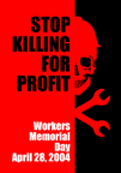
Don't Forget Workers Memorial Day, April 28

Workers Memorial Day is April 28.
 
It's not to late to organize or join activities in your area. For more information on event in the U.S., check the AFL-CIO website. For activities in other country, check out Hazards.

Sunday, April 18, 2004

The Weekly Toll

Note: In order to compile this list every two weeks, I have some fairly extensive searches set up on Google News Alerts. Yet sometimes it amazes me how many I miss and why they aren't picked up. For example, I just received the latest version of the Workers Memoral Day edition of PACEsetter, the monthly magazine of the Paper, Allied-Industrial, Chemical and Energy Workers International Union (PACE), which contained the biographies of five workers killed on the job over the past year. I had identified only one of the workers listed, Gary Hueneka. Is it because Google didn't pick them up or because they didn't even raise enough concern to appear in the local newspaper?

PACE Members Killed On The Job

Edward Sullivan, Pace Local 6-628, Tower Automotive, Elkton, MI, was killed September 2003 while working among some rolls of steel at the tower Automotive plant in Elkton, MI. Sullivan, 47, was crushed by some falling rods of steel.

Walter Kincey, PACE Local 3-1865, GP, Cedar Springs, GA, was killed when he fell into the beater pit at the Georgia Pacific Cedar Springs mill in August 2003.

Timothy Crank, member of Pace Local 5-857 at Conoco Phillips in Ponca City, OK, was severly burned when the gasoline processing unit exploded in July 2003. Crank, 39, was an operator at the facility's West Plant, which was undergoing some maintenance at the time of the incident. He was flown to a hosptial in Oklahoma City, where he died 10 days later.

Jordan Tripp Jr, member of PACE Local 5-1731, at International Paper Co. in Pine Bluff, AR, died July 5, 2003, when he became caught between the rollers of the extruder at the mill. He suffered severe head injuries which resulted in his death.

Police Officer Killed

Merced, CA -- Police spent Friday searching for the suspect who shot and killed a Merced police officer. The shooting happened Thursday night near Glen and 21st in southeast Merced.

Merced Police Commander Norm Andrade says officer Stephan Gray was shot while conducting a traffic stop on the 1900 block of Glen Ave. He was taken to Mercy Community Campus Hospital, where he died.


Worker dies in fall from bridge

He wasn't hooked to safety line, cop says

New Orleans -- In what turned out to be a tragically ironic comment, Lester Irula spent part of Thursday telling his boss how concerned he was about staying safe working high above the Mississippi River.

On Friday morning his worries turned into reality as Irula, part of the crew repainting the West Bank-bound span of the Crescent City Connection, fell 150 feet to his death from the bridge into the river.


Ninth worker dies in I-95 van crash

Fort Pierce, FL -- A grove worker who has been comatose since an April 1 rollover crash on Interstate 95 died early Friday, the ninth man to die from the crash.

His death comes a day after the Highway Patrol released an initial report citing careless driving as a contributing factor in the accident that killed eight other men and injured 10 more.

Crecenciano Escalanate, 35, had been on life support at Holmes Regional Medical Center in Melbourne since the accident.


Driver hits, kills Luzerne highway worker on I-84

Scranton, PA -- A Luzerne County man described by his boss as "a man who never had a bad word for anybody," was killed Thursday morning while working as a highway flag man on a Pike County highway.

Louis Kotch, 53, of 6 Columbus Circle in Mocanaqua, was part of a three-person survey crew for American Asphalt working on Interstate 84 when an elderly driver hit him with her vehicle just after 10 a.m.

Maybert Crane, 85, of 207 Pennsylvania Ave. in Matamoras, drove her car into the work zone and hit Mr. Kotch head-on, according to state police.


Falling limb strikes, kills Carroll County roads worker

Baltimore, MD -- A Carroll County roads operations employee was killed on the job yesterday when a falling tree limb struck him on the head, state police said.

Charles Edward Olinger Jr., 35, of Taneytown was hit on the head by a limb cut by another county worker while they were trimming trees in the area of Tyrone and Cross Section roads near Mayberry, said Cpl. Jeffrey Tanzola of the Westminster barracks.


Fatal forklift accident being investigated

ST. LUCIE COUNTY, FL -- The Occupational Safety & Health Administration is looking into a forklift accident that killed a man Tuesday afternoon.

The accident happened around 4:45 p.m. at Golden Harvest Fruit Company, in the 4700 block of North U.S. 1.

Victor Sirmons, 40, of Fort Pierce, was operating a forklift when investigators think he struck a pothole in the pavement near standing water, which caused the forklift to overturn onto him.


Construction worker falls from Skyway

Chicago Department of Transportation spokesman Brian Steele says construction on the Chicago Skyway has been halted while an investigation continues into an accident that killed a worker yesterday.

Police spokesman Sergeant Edward Alonzo says 42-year-old Raul Rebelles of Chicago was crossing an improvised wooden bridge covering a Skyway viaduct when he fell about 30 feet to the ground.

Steele says it appears that a portion of the walkway gave way at one of its supports.


USPS Worker Dies in Brylane Warehouse Accident

Indiana workplace safety officials and postal inspectors are investigating the death of a U.S. Postal Service clerk in a conveyor-related accident at Brylane's Indianapolis facility.

Bruce McFarland, a 37-year postal employee, was injured March 31 and died April 4. The facility warehouses inventory, and receives and fulfills purchasing orders from individual consumers. McFarland worked at Brylane's Detached Mail Unit, an area of the facility where postal employees perform mail verification, acceptance, dispatch and other postal functions.

He was "trapped between a door and a conveyor," said Pete Rimsans, a spokesman at the Indiana Occupational Safety and Health Division, which is investigating. "There was a crushing injury."


S.F. police officer killed by gunman

SAN FRANCISCO - A San Francisco police officer has been shot and killed on duty, the first such death since 1994. Authorities said the shooting took place late Saturday in the city's Bayview District after the two undercover officers approached a man who was acting suspiciously.

"They were going to talk to him and called out to him, and that's when he turned around and started shooting," Sgt. Neville Gittens said.

The man fired on officers with an automatic weapon, hitting both officers before fleeing, Gittens said. Officer Isaac Espinoza, 29, died after being shot twice. He was an eight-year veteran of the department. His partner, Officer Barry Parker, 38, was shot in the left leg.


Six Flags employee killed by coaster

SANTA CLARITA, Calif. -- An employee at Six Flags Magic Mountain who was struck and killed by a roller coaster Friday has been identified by authorities. Bantita Rackchamroon, 21, walked onto the Scream roller coaster's tracks in a restricted area shortly before the park opened, said park spokeswoman Sue Carpenter. She died at a local hospital.


Worker Falls To Death While Installing Chimney Caps: Family Wants To Know If Safety Procedures Were Followed

KANSAS CITY, Mo. -- A 33-year-old Cass County man died on Thursday when he fell from the roof of an apartment complex where he was installing chimney caps.

Royce Martinson had three young children to take care of. So, despite having been through one kidney transplant and needing another, he almost never called in sick to work, KMBC's Martin Augustine reported.


Fall from bridge kills painter

A painter working on the Benicia-Martinez Bridge lost his balance and plunged 120 feet to his death Wednesday afternoon, Caltrans officials said.

The worker, identified as 50-year-old William Calloway of Benicia, was getting ready to paint a portion of the existing span near the Martinez side at 3:05 p.m. when he tried to step from a scaffold to the edge of a concrete bridge column. He lost his balance and fell backward, said Caltrans spokesman Steve Cobb.


LOGGER CLINGS TO LIFE

David Wells, the 30-year-old logger injured on March 26 while working as a groundsman in the 400 block of Valley Road in Valley of Enchantment, clings to life at Loma Linda University Medical Center (LLUC).

A resident of Mentone, Wells was one of a handful of TFR Enterprises and Kansas City Tree Care workers utilizing a rope to guide the fall of a 120-foot pine tree when he reportedly moved in the wrong direction and was struck by the top portion of the bark beetle infested tree causing major injuries.


Man killed in North Las Vegas dump truck mishap

(North Las Vegas, NV) -- The man who died in a workplace accident earlier this week has been identified by authorities. North Las Vegas Police say 24-year-old Brian Sullivan was standing between a dump truck and a trailer Tuesday afternoon, when the truck driver tried to hook the two vehicles together. Sullivan was crushed between the trailer and the truck at "Rainbow Rock Company" on West Cheyenne Avenue.


Construction Worker Crushed By Steamroller In Seminole County

SEMINOLE COUNTY, Fla. -- A construction worker was critically injured Wednesday morning when a steamroller pinned him against some heavy equipment. The victim was working on a road project on Alafaya Woods Boulevard in Seminole County around 8am.

James Walker was standing between a roller and paver, preparing for his morning shift. For some yet unknown reason, the roller operator drove the heavy machinery right into him.

Walker's lower part of his body was crushed. He was air lifted to the emergency room at Orlando Regional Medical Center.... He's in stable condition. He suffered a broken lower left leg and a broken upper right leg. Doctors are checking to see if any of his internal organs were damaged.


Longtime Colbert County Sheriff's Department employee dies in wreck

TUSCUMBIA, AL – A longtime Colbert County Sheriff's Department employee died Tuesday afternoon when her vehicle was struck by an oncoming car at U.S. 72 and Woodmont Drive.

Patricia M. Lloyd, 49, 510 Monroe Ave., Muscle Shoals, was heading south on Woodmont at approximately 1 p.m., proceeding through the intersection, when a blue van driven by an unidentified woman hit her on the driver's side


MSHA identifies miner killed in accident

ERBACON, W.Va. -- Federal mining officials on Tuesday identified a miner killed at a Brooks Run Mining Co. LLC underground mine over the weekend.

William Brady, 47, a continuous mining machine operator at the Mercer Deep Mine near Erbacon, was crushed between the machine and part of the mine wall about 11:40 p.m. Saturday, according to a preliminary accident report from the U.S. Mine Safety and Health Administration. Brady died about 12:44 a.m. Sunday, the report said.

"We are conducting a full investigation there," said MSHA spokesman Rodney Brown.

Brady's death was the second fatality at the Webster County complex this year.

On March 2, 50-year-old Kerry Holliday of Smoot was trying to clear a feeder chute when a stockpile collapsed and killed him at the complex's preparation plant. Brooks Run failed to follow a routine procedure of cutting back coal walls to reduce the risk of a slide, Doug Conaway, director of the state Office of Miners' Health, Safety and Training, had said.


CLERK SHOT AT BROOKLYN 'DEATH' MART

Three thugs shot and critically wounded a clerk yesterday during a robbery at an all-night Brooklyn produce market where an employee was killed two years ago by a thief trying to steal a lime.

Cops said the bandits, all brandishing guns, walked into the David Fruits market on Church Avenue in East Flatbush at around 1:30 a.m., ordered an employee to open the cash register and grabbed an undetermined amount of money.

They forced four workers into a bathroom, holding a gun to one's head, then shot Tony Garcia, 22, in the jaw just below his right ear before fleeing.

A security camera filmed the heist and police were examining it.

Garcia, the father of two children who live with their mother in Mexico, was in a critical but stable condition at Kings County Hospital.

Worker Dies After Falling From Roof

STORM LAKE, Iowa -- A man who was working on a roof of a plant in Storm Lake died after he apparently slipped and fell.

Victor Duran, 32, of Storm Lake, fell from the roof at Rembrandt Enterprises March 30. He died Friday at a hospital in Sioux City.


Construction Worker Dies in 80' Fall

Salt Lake City, Utah -- A construction worker who was taking apart a crane tower fell 80 feet to his death.

Scott M. Fisher, 39, of Alpine, was working on the crane at an apartment construction site Saturday afternoon when the accident happened.


Gulfstream worker dies after getting pinned

GREENVILLE — A 40-year-old Greenville man died early Sunday after being injured in an accident about three hours earlier at Gulfstream Aerospace.

Clyde A. Kees, N1147 Westhaven Drive, was in a lift, working on an aircraft when he dropped an exacto knife he had in his hand. He bent down to pick it up and ended up getting pinned between the lift and aircraft, according to Outagamie County Coroner Ruth Wulgaert.


EMS worker dies on the job

A Rensselaer County EMS worker died while transporting a patient to the hospital.

Police said at around 7 p.m. Saturday, the Castleton volunteer ambulance service responded to a call on Birch Hill.

While transporting the patient to the hospital, the ambulance driver, Gerald "Jerry" Stalker, suffered a heart attack. The ambulance went off the road and into a ditch. A second ambulance then came to assist.


Saturday, April 17, 2004

Can this be true?

The Oklahoma Prosperity Project is implementing voter education programs designed to increase turnout for business-friendly candidates by providing "business leaders with tools to educate their employees on the candidates' positions on business issues and encourage their employees to get out to the polls on Election Day." The program is being sponsored by the Washington, D.C.-based BIPAC (Business Industry Political Action Committee).
"BIPAC noted before the 2000 election that there's been a real shift in where people are getting information about elections, and that some of the traditional sources aren't as effective as they used to be," said Kris Rush, executive director of the Oklahoma Prosperity Project. "Political parties and unions are certainly powerful, but where employees wish they could get information today, based on BIPAC research, is from their employers. They realize that in the economic times that we have been through that nobody understands the issues that affect their jobs better than their boss, better than their employer."
Yeah, right. And isn't that a beautiful dress you have on today Mrs. Cleaver.

"'Made in China'" products tainted with blood from cut-off fingers or hands."

Remember those commercials about how buying illegal drugs leads to terrorism? Well, more appropriate might be commercials showing how buying cheap Chinese goods leads to severed fingers and hands.
Wang Xuebing, a 19-year-old from Hubei province in central China, came to Shenzhen and got a job last July in a metalworking plant.

A month later, his foreman escorted a work crew to a different factory owned by a friend and "asked me and two co-workers to operate a metal mold machine," Wang said. The machine made casings for air conditioners, using tons of pressure to mold sheeting. Wang said the machine went on the fritz, but was rigged to work again.

"When I placed a metal sheet in the machine, it pressed down. My hand was severed. I lost consciousness," Wang recalled.

Zhu Qiang came to the Pearl River Delta region from inland Sichuan province in early 2002. On March 2 of that year, he got a job making industrial plastic and shopping bags. Two weeks later, while working a 16-hour shift, he lost his right hand.

"We were extremely tired. We were nodding our heads, almost asleep," Zhu said. "My hand got tangled with the plastic and got burned. I was rushed to the hospital. There was no way to save my hand."

For the loss of his right hand, 22-year-old Zhu was given about $4,800
This article describes in graphic detail how young Chinese workers migrate from rural areas to the city, then go to work in factories on machinery from which the guards have been removed in order to speed up production to meet the low cost demands from the United States.
In Shenzhen's hospital wards, maimed factory workers nurse mangled hands and forearm stumps. They tell of factory managers who've removed machine safety guards that slowed output, and of working on decrepit, unsafe machinery. Workers toiling 100 hours a week grow dazed from fatigue, then lose their fingers to machines.

Local officials routinely overlook appalling safety conditions, worried that factory owners will relocate. They send mutilated migrant workers back to distant rural villages, shunting the burden of workplace injuries onto poorer inland provinces….

Chinese Communist Party leaders are so eager to maintain high economic growth, and to create jobs for tens of millions of potentially restive Chinese, that they now preside over a savage form of capitalism. It's one in which maimed migrant workers can readily be discarded. Independent labor unions are banned. Workers are placed in front of machines for endless stretches.
So who's to blame? Sounds like Wal-Mart and its ilk to me.
Labor monitors say foreign companies that relentlessly demand lower prices, and U.S. consumers who gobble up low-cost goods, contribute to the problem.

Zhou Litai, a lawyer who represents hundreds of workers maimed or killed on the job, said foreign consumers should be aware that some "Made in China" products "are tainted with blood from cut-off fingers or hands."


Good old fashioned Bush-bashing

Let's go a bit off topic for a few minutes. Kevin Drum, in-house blogger at the Washington Monthly (and always an entertaining and educational read for all you political junkies out there) suggests that when life gets you down, there's nothing like a bit of good old sophomoric Bush-bashing to pick you up.

After a few days of reflection on Bush's recent press conference, I have to get a few things off of my chest. I actually watched the press conference the other night. Generally, I can't bear to watch him for more than five minutes at a time without feeling physically nauseous. I start chanting to myself, "How can this idiot be president? This must be a bad dream. A nightmare. Wake up, wake up, wake up...." (At which point my wife tells me to either shut up and listen or turn off the damn T.V.) But I figured maybe the press would have grown a backbone over the past few weeks, so there might be some fireworks worth watching.

The press didn't entirely disappoint (although if I was a White House press correspondent, I would have asked some harder questions and some actual FOLLOW-UPS when he didn't answer the original question. "Follow-ups," for those of you too young to remember when the press wasn't intimidated, are responses to non-answers or non-sensical answers.)

I will admit that I don't particularly like Bush (which probably comes as no surprise to anyone who knows me or who reads Confined Space) or think that he's ever been a particularly effective speaker. In other words, my expectations the other night were not very high. Nevertheless, I was shocked and appalled at his performance during the press conference. I thought it was absolutely frightening how he stumbled for words -- or more accurately, stumbled for thoughts -- when asked some basic questions that he must have rehearsed a million times with his staff, and how he kept falling back on the same "quiver of cliches and a few simple stock arguments,"as Josh Marshall described it, blathering on about freedom and those who hate freedom and how 9/11 made him sad, and on and on, anything not to actually respond to a question . (If you missed it, check here for a condensed version.) I was equally appalled at his blatant refusal to answer any question asked of him (and, again, disappointed that the press almost never followed up.)

Equally disappointing was the press coverage afterwards. Of course, all of the Republican hacks thought he was wonderful, but even the more "objective" and liberal pundits, as well as the newspaper reports the following day seemed to think in was somehow impolite or politically incorrect to admit that the guy is a total embarrassment. As one blogger put it (can't remember where it was), it was like the elephant sitting in the room that no one wanted to acknowledge.

I have discussed my impressions with a few friends who totally agree. But, then, I realized sometime early one evening in November 1980 that I didn't exactly have my finger on the pulse of the American voter. Maybe my friends and I are all just a small cadre of crazy, deluded Francophone, surrender-monkey, left-wing cult-members -- and we don't even know it.

So you can imagine my relief when Kevin Drum referred me to this article from the British Daily Mirror headlined, THE PRESIDENT'S BRAIN IS MISSING: Millions see Dubya fluff question on conflict (Check here for an image of the actual headline. Clip and save.) At least the British press are not afraid to note that the Emperor has no brain clothes.

Thanks Kevin, you were right. That did feel good.

Thursday, April 15, 2004

What OSHA Investigates

Not the two biggest killers of American Workers

Victor Sirmons, 40, of Fort Pierce, Florida was killed Tuesday when a forklift he was driving overturned on top of him. This was a tragic incident for Sirmons, his family and friends, but that's not what I'm writing about here. I'm writing about this paragraph in the article about Sirmon's death:
OSHA routinely investigates workplace accidents when someone is seriously injured or killed, except in the case of traffic accidents and workplace violence, said Luis Santiago, an OSHA area director.
These are the two leading causes of death in American workplaces. Fatal highway incidents were the most frequent type of fatal workplace event in 2002, accounting for about a quarter of all fatal work injuries. Workplace violence -- including assaults and suicides-- accounted for 15% of all work-related fatal occupational injuries in 2002. So why doesn't OSHA inspect? Partly because it seems as if nothing can be done by the empoyer to prevent these fatalities. But is that true?

Traffic accidents are generally thought to be caused by either unsafe driving on the part of the worker (his/her fault) or unsafe driving on the part of another driver (clearly not preventable). So what is to be done?

I wrote about this in an article, "Acts of God, Acts of Man," published in Working USA last year where I made the point that not everyone, especially the U.S. army, thinks that driving accidents are unpreventable. The Washington Post, reported last May that since the first Gulf War which say an alarming number of traffic accident fatalities, the military has made major -- and reportedly successful -- efforts to reduce injuries and fatalities resulting from driving accidents.
Compared with that from the first Gulf War, data from the latest fighting also reveal a dramatic reversal in the ratio of combat to noncombat casualties.

Twelve years ago, 50 percent more soldiers died in accidents (235) than in battle (147). In the recent war, there were only a third as many noncombat fatalities (36) as deaths in battle (101). The same pattern appears to hold for nonfatal injuries, with the data on evacuated Army troops showing that 107 had noncombat injuries, compared with 118 who had combat wounds.

The army attributed the steep drop in noncombat deaths and injuries, in part, to the Army's effort to improve driver safety and to ensure that soldiers were well-rested when operating vehicles. In the first Gulf War, motor vehicle accidents alone accounted for about half of all serious injuries. "Because this was such a motorized effort, we expected many more accidents than we actually saw. I think this is a definitive success story," [an Army spokesperson] said.
Add to this factors such as poor vehicle maintenance and pressure to get more work done in less time and pretty soon you have enough factors to at least merit an occasional inquiry into the causes of many work-related traffic accidents.

Until the early 1990's OSHA did not consider workplace violence to be a preventable hazard that should fall within OSHA's enforcement jurisdiction. In the early '90s, however, CalOSHA issued pioneering guidelines that addressed workplace violence like any other workplace hazard. First, there were factors that put certain employees at higher risk of assault, e.g. handling money, working in violence-prone neighborhoods at night, etc. Second, there are a number of preventable measures that could be taken to prevent violence: panic alarms and adequate staffing in mental health institutions, and video cameras and lock-drop safes in all-night convenience stores.

In the late 1990's, OSHA published two guidance documents on workplace violence, one aimed at violence against health care and social service workers, and the other addresses violence against late-night retail employees.

And if violence could be predicted and prevented, then employers could be cited for failure to take preventive measures. Following CalOSHA's example, OSHA handed out several significant General Duty Clause citations in the 1990's against health care establishments for not preventing assaults against workers. Since the late 1990's, however, OSHA has not cited any employers for workplace violence. During the latter days of the Clinton administration, OSHA's solicitors grew increasingly reluctant to pursue cases because they lost a case on appeal, and Bush's OSHA is not exactly known for sticking its neck out on any pioneering issues -- especially those many still do not consider to be preventable.

I will admit that traffic accidents and workplace violence may not appear to be as easily preventable as trench collapses or chemical exposures. They don't seem to be natural fits for OSHA. But twenty years ago, health care unions were laughed out of OSHA for daring to suggest that the agency may want to get involved in communicable diseases like hepatitis B and AIDS.

Traffic accidents and workplace violence are the two leading causes of workplace death in America. Many of these fatalities are predictable and preventable. Addressing them may require more reseach, creative thinking, and some political courage on OSHA's part. But I'm sure that the families and friends of the 2,989 workers who were killed in highway accidents or violent assaults in 2002 would appreciate it if the agency would pay a bit more attention to these hazards and not just dismiss them as problems that aren't worth investigating.

Bush EPA: Leave No Child Unpoisoned

Foxes Guarding the Chicken Coop -- Part XXXVII

15,000 children younger than 6 accidentally ingest rat poison (up from 11,000 ten years before), resulting in proposals for new child safety regulations. But wait, that was when the greens were in control of the country. Now the adults are in charge and -- surprise --
Over the past six years, the pesticide industry has fought off or stalled two regulatory initiatives designed to protect children and wildlife from becoming unintended victims of rat poisons, and public health and environmental groups charge that the industry had unusual access to block federal action.
Instead, using the old, tired, "safe when used as directed" logic, the EPA, at industry's urging, has decided to depend on stronger labeling and precautionary statements.

That should stop those dumb kids from eating rat poison.

Wednesday, April 14, 2004

Nursing Homes Shortchanged in OSHA Inspection Targeting Program

OSHA announced its 2004 site-specific targeting (SST) plan earlier this week. The SST will focus on approximately 4,000 high-hazard worksites.
This year's program is effective April 19 and will initially cover about 4,000 individual worksites on the primary list that reported 15 or more injuries or illnesses resulting in days away from work, restricted work activity, or job transfer for every 100 full-time workers (known as the DART rate). The primary list will also include sites based on a "Days Away from Work Injury and Illness" (DAFWII) rate of ten or higher (ten or more cases that involve days away from work per 100 full-time employees).
OSHA will once again add nursing homes to the SST. For the past two years, nursing homes were covered instead under a separate National Emphasis Program that OSHA abruptly cancelled last year.
The "National Emphasis Program for Nursing and Personal Care Facilities" was an attempt by OSHA to show that it was serious about ergonomics. Nursing home workers, as Henshaw said, had 2 1/2 times as many injuries and illnesses as private sector workers. And over half of those injuries are from overexertion and other ergonomic problems. (And just to put all of this in perspective, OSHA estimated during the Clinton administration ergonomic hearings that only around one-half of all ergonomic injuries were even reported.)

Nursing homes had been part of OSHA's regular "Site Specific Targeting" program. In fact, 2500 nursing and personal care facilities, out of a total of 13,000 in the private sector, were notified by OSHA last year that their injury and illness rates were higher than average and that they therefore had a higher than average chance of being inspected. Approximately 800 nursing homes would have been inspected under the targetting program, but Henshaw announced that under the NEP, 1000 would be inspected.
Although a central focus of the the NEP was ergonomics, OSHA only had a handful of citations and paltry fines to show for itself at the conclusion of the program.

But too many nursing home still have DART and DAFWII rates that qualify for targeted inspections in 2004, so instead of inspecting all of the nursing homes that have high enough injury and illness rates (as it does with all other industries), OSHA has decided that
Only the highest 50% rated establishments in these three SIC Codes with either a DART rate at or above 15.0 or a DAFWII case rate at or above 10.0 are included in the Primary List. No establishments in these three SIC Codes are added to the Secondary List.
The Secondary List includes businesses with slightly lower rates that are inspected when an area office finishes the primary list early.

OSHA's logic never fails to mystify me: Because there are so many hazardous nursing homes, we are only going to inspect half as many as other, less hazardous industries. And even if you finish your first list, instead of inspecting the other half of the nursing homes that were left off the list, you have to inspect other industries that have even fewer injuries.

Tuesday, April 13, 2004

What is OSHA doing About Immigrant Worker Safety?

Warning: Long article. Printer Friendly Version is here.

John Henshaw is pissed off. Why? A couple of weeks ago, AP reporter Justin Pritchard published an investigation into the workplace deaths of Mexican workers in the United States. Pritchard had written that "The jobs that lure Mexican workers to the United States are killing them in a worsening epidemic that is now claiming a victim a day, an Associated Press investigation has found."

In a letter responding to the AP investigation, OSHA Director Henshaw wrote that the AP investigation was "full of mischaracterizations" and wrong from the first sentence. Mexican worker deaths, while sharply rising for a decade, had fallen by 8.3 percent in 2002. Henshaw credited "OSHA's effort" for the drop.

In a follow-up article, Pritchard notes that while Mexican worker deaths did fall in 2002,
the good news did not extend to the overall Hispanic immigrant population the department is trying to reach. Workers in that group -- which includes Central and South Americans, as well as Mexicans -- continued to die in record numbers in 2002, federal data show....

The decline in Mexican-born worker deaths came during the safest year on record for the overall work force in the United States. From 2001 to 2002, total on-the-job deaths fell from 5,915 workers to 5,524 workers -- an unprecedented 6.6 percent drop.

Deaths among U.S.-born Hispanic workers declined at an even greater rate in 2002. However, deaths among all foreign-born Hispanics rose that year over 2001, from 572 to 577. It was also the first year Mexican-born worker fatalities fell since 1994-1995, when deaths dropped from 213 to 206.
What's the Real Story?

Reflecting rising media attention, I have written frequently about the plight of immigrant -- especially Hispanic -- workers in this country. Despite the fact that the numbers for specific nationalities may vary from year to year, the overall trend in immigrant health and safety is tragically disheartening. OSHA claims to be making a serious effort to address this problem, and takes full credit for whatever favorable trends the data picks up.

With all of the media attention to this problem, and OSHA fighting back, it may be a good time to take a minute to look at the problem and OSHA's response.

What Is the Problem?

First, there is no doubt, whatever the trends in specific nationalities, that, as the AP investigation states, there is a worsening epidemic of workplace death among immigrants in this country. (I have posted recent items based on media reports here, here, here, here, here and here. And The Weekly Toll is always filled with stories of immigrant worker deaths.)

Most of the causes are also well known.
  • Lack of Knowledge About Safety and Health Hazards: The jobs that many immigrants do are new and they are not familiar with the hazards of the jobs. Furthermore, they generally do not know about OSHA or their right to request and inspection and have their name kept secret
  • Language Barrier: This goes deeper than inability to speak or understand English. Many immigrant workers are illiterate in their native language. Spanish language fact sheets don't help in that situation.
  • Exploitation: Immigrant workers are frequently sent to do the most dangerous work.
  • Intimidation: This is closely related to exploitation. Immigrant workers are much less likely to call OSHA -- assuming they know about their rights -- than American citizens. If they are illegal, In addition, they often fear government officials, even those who are there to help them. This stems not only from the fears imported from their own country, but also fear of the "migra."
What Has OSHA Been Doing? Is It Effective?

How has OSHA been addressing these issues? OSHA Director John Henshaw takes credit for any improvement in the working conditions of Hispanic workers
We launched a three-prong attack combining vigorous enforcement of health and safety standards, outreach to the Latino community and effective education.

A Departmental Hispanic Workers Task Force was created to coordinate this effort, and it is working, as evidenced by the 2002 drop in workplace fatalities among Hispanic workers generally and Mexican-born workers specifically.
Truth? Stretching the truth? LiesDistortions? Let's explore.

First, Henshaw points out that OSHA and other DOL agencies have been forming alliances with Hispanic organizations, including Mexican consulates, across the nation. And this is true. Some regional offices have initiated and joined into broad-based innovative coalitions designed to reach out to Hispanic workers. I wrote last October about the Justice and Equality in the Workplace, a coalition organized in July 2001 to help inform Hispanic immigrants about their rights as workers and to uncover illegal employment practices and discrimination.

The coalition is made up of the U.S. Department of Labor's Office of Federal Contract Compliance and Wage and Hour Division, Equal Employment Opportunity Commission, the Mexican, Colombian, Guatemalan and El Salvadorian consulates, the City of Houston, the Harris County AFL-CIO, the Catholic Diocese of Galveston-Houston, the Mexican American Legal Defense and Educational Fund, the Hispanic Contractor's Association in Houston, the Associated General Contractors of America's Houston chapter, the Houston Chamber of Latino Business Owners as well as OSHA. On the whole, it seems to be doing good work and spawning similar programs elsewhere.

Second, Henshaw claims that "More information than ever before is now available in Spanish about job safety and health via the Web, in publications and through specialized training courses." Umm, I have some serious problems with this assertion. First, technically, it is true that "more" information is available than ever before in Spanish. But that's not saying much. Check out the OSHA's Spanish language publications. There are about a dozen publications, many of which were published in previous administrations, some as far back as the 1980. There is also a new set of ten fact sheets that seem to be targeted at employers, including one on health and safety precautions for your new business, as well as fact sheets on asbestos, workplace violence and other topics. The Personal Protective Equipment fact sheet has no mention of who is supposed to pay for the PPE, a contentious issue for the agency. A standard has been on hold since the Clinton administration that would have required employers to pay for most PPE.

And it's true that there is more Spanish language material on the web, although I have serious reservations about how accessible this information is to the average immigrant worker.

Even written materials have their problems
"We are talking about a community that prefers to stay in the shadows," said Jenny Sarabia, executive director of the Indiana Commission on Hispanic/Latino Affairs.

"Translating brochures and signs into Spanish is not enough," she added, because many of the new Hispanic arrivals in Indiana are unable to read English or Spanish.
I have no idea what Henshaw means by "specialized training courses" in Spanish. There is not one Spanish language training course listed on the OSHA Training Institute Course Schedule. The only Spanish language training that I know of is being conducted by grantees under the Susan Harwood Training Grant Program which the Bush administration has been attempting to eliminate since it came into office. The $11.2 million Harwood program was refocused on immigrant worker outreach in 2000 during the Clinton Administration. The grants were extended from 1-2 year programs to 5 year programs.

The current administration cancelled the second round of 5-year grants, attempted unsuccessfully (thanks to Congress) to cut the first 5-year round (which concludes this year) and has proposed to eliminate the $11 million Harwood grants and replace them with a $4 million program that would depend on electronic (internet and CD-Rom) training instead of actually having classes with an instructor. Referring to the proposed training cuts, Henshaw argued
“I would not use the word ‘cutting',” Henshaw said referring to the proposed $6 million decrease in the training grant program. “We do not feel the training program should be based on one-on-one training. We are developing materials and technology to get information out to more people.”
How all of this amounts to "effective education" I'm not sure.

There is another troubling aspect to OSHA training. Ultimately, it is not OSHA, but the employer who is responsible for training its workers. Tom O'Connor, director of the National Council on Occupational Safety and Health, wrote a letter to the editor of the Raleigh News and Observer, responding to a article about two Hispanic workers that were killed in separate construction accidents less than an hour apart in North Carolina notes that
Your report stated that some fatalities have involved Hispanic workers who "worked for companies that did not have the resources to provide training in Spanish." That is not good enough. It is a law, not an option. There are resources in the private sector, among nonprofit organizations and within OSHA to assist employers with this critical training. Those employers who fail to provide such training and whose workers die as a result should be prosecuted criminally.
Third Henshaw claims that "More Spanish-speaking inspectors and outreach staff are being hired." More than what? Pritchard's research does not validate Henshaw’s contention:
Safety experts inside and outside OSHA say the agency's outreach efforts are well intentioned, but beset by limited funding and a lack of Spanish-speaking staffers.
Even California is having problems hiring Spanish speaking OSHA employees.
The non-English speaking workforce of California is estimated to be more than 6 million workers, over one-third of the working population. Yet CalOSHA has only 29 inspectors (or 16% of the total) who are fluent in a language other than English. Twenty of these speak Spanish.

North Carolina is having similar problems.
The state office charged with enforcing safety in North Carolina workplaces is fighting an uphill battle trying to find and keep employees who speak Spanish -- a key asset in the effort to educate and train more workers.
The Labor Department's division of occupational safety and health has only seven bilingual training and compliance officers in a staff of 240. Many times, Spanish speakers are lured to private-industry jobs that pay better. To alleviate the problem, the agency recently sent two people to immersion courses in Costa Rica and Mexico.
And federal OSHA is in sadder shape:
Even some of OSHA's own Hispanic outreach officers say they need to do more. Marilyn Velez, OSHA's sole Spanish-speaking outreach worker in the eight-state Southeastern region, isn't sure what caused the drop from 28 to 8 Mexican-born worker deaths in Georgia in 2002. But she doesn't think workers were taking fewer risks, or that bosses were more insistent on safety.

"We knew that it was not just because it was outreach," said Velez.

More troubling, she said, is that Hispanic worker deaths appear to have risen in Georgia again in 2003.
Finally, in addition to outreach, Henshaw argues that "More inspections are being targeted to industries with high injury rates that employ large numbers of Hispanic workers, such as construction and landscaping." I don’t have the statistics with me at the moment, but I think OSHA is generally trying to target these areas. The question is how effective that targeting will be if immigrant workers are not aware of what OSHA is, how it works or if they can be protected against retaliation by employers.

A recent study of immigrant workers in California, Voices From the Margins: Immigrant Workers: Perceptions of Health and Safety in the Workplace, by the UCLA Labor Occupational Safety and Health Program (LOSH) found that Hispanic workers were not familiar with governmental agencies which could assist them. Less than 10 percent had ever heard of Cal-OSHA and no workers surveyed had contacted CalOSHA for assistance. Some of the workers did not contact governmental agencies because of their immigration status and also because of experiences in some of their home countries which led them to perceive government as “unfriendly” to workers.

Finally, even if immigrant workers are aware of what OSHA is and what rights they have, how secure are they that OSHA will not turn them into “la migra,” or that OSHA will be able to anything to help them if their employer retaliates against them for exercising their health and safety rights?

And then there is the effect of the Supreme Court’s 2002 Hoffman Plastics decision which held that undocumented immigrants were not entitled to back wages – even after being illegally fired for union activity – because their job was “obtained in the first instance by a criminal fraud." The Department of Labor has stated that it will still enforce the Fair Labor Standards Act, even for undocumented workers, because the FLSA addresses wages for time actually worked, whereas the Hoffman Plastics decision addresses time that would have been worked had the employee not been illegally fired. Secretary of Labor Elaine Chao has stated that
Regardless of a workers immigration status, the Labor Department remains committed to the enforcement of all protections offered by the Fair Labor Standards Act, the Mine and Safety and Health Act, and the Department’s other core labor statutes. Safety has no nationality—and every worker in this country deserves a safe workplace.
How states handle the Hoffman Plastics decision and how it affects workers’ OSHA rights is not clear, according to the National Employment Law Project.
The California Department of Industrial Relations recently posted a statement on its website clarifying that it will “Investigate retaliation complaints and file court actions to collect back pay owed to any worker who was the victim of retaliation for having complained about wages or workplace safety and health, without regard to the worker’s immigration status.”
This all sounds good on paper, but what about the real world? First, there is nothing on the OSHA webpage, and no announcement or interpretation that I am aware of that clarifies what effect the Hoffman decision has on OSHA’s willingness to investigate retaliation against undocumented immigrant workers. I have heard reports that some OSHA regions take these cases, while other do not. And how does the federal government force an employer to re-hire an undocumented worker? What if the employer’s next action is to call immigration? Is OSHA going to rule that calling immigration is an illegal form of retaliation and demand that Immigration allow the worker to be rehired? It doesn’t make much sense. Nor does President Bush’s immigration proposal make workers more secure about exercising their health and safety rights because the proposal requires workers to be "sponsored" by their employer. What's to keep an employer from suddenly deciding that he has a few less openings to sponsor if a worker complains about safety and health conditions?

Can OSHA Take Credit?

So is John Henshaw right? Is the 2002 improvement in Mexican worker deaths due to OSHA’s efforts?

Probably not. (But it was a great letter, John. Thanks for playing.) First, OSHA’s Hispanic worker initiative wasn’t announced until the end of February 2002. An 8% drop in fatalities as a result of a 10 month-old program would be impressive, indeed.

Pritchard reports that experts at the federal Centers for Disease Control (NIOSH) and the National Safety Council are skeptical whether any improvements can be credited to OSHA’s recent outreach initiative:
Workplace safety experts at the federal Centers for Disease Control and the National Safety Council, a nonprofit public service organization, said no research substantiates a link between OSHA's fledgling outreach and the drop in Mexican worker deaths.

"It's not something that you throw a small amount of money at and issue some pamphlets and you're going to see dramatic changes," said David Richardson, a University of North Carolina-Chapel Hill professor of epidemiology who tracks worker deaths in the South. "It's a slow battle."
So why the decline in Mexican worker deaths in 2002?
According to work safety specialists, statisticians and even some federal outreach workers, there's no evidence any one effort is responsible for the improvement in 2002. Possible factors include the economic recession that followed the September 2001 terror attacks and changes in immigration and border security. Mexican-born workers have stayed longer in the United States, gaining experience and perhaps decreasing their willingness to take risks.

"It's good that they're doing outreach," says Dr. Sherry Baron, a lead CDC researcher on immigrant workers. However, "a change in one year, it's hard to conclude anything. Part of it is, we need more time."
So what is to be done?

What can OSHA and others do to improve the plight of immigrant workers in this country.

The UCLA/LOSH study had four recommendations. The first recommendation was to
Establish a multi-year capacity building grants program for community-based organizations, clinics, and worker advocacy groups that work with, or provide services to, immigrants. This will allow them to provide training and educational materials for immigrant workers and also serve as an extension of governmental workplace health and safety agencies by reporting possible labor law violations and injury/illness cases.
The main reason is trust:
When asked where they went for assistance or advice on health and safety issues, most responded that they consulted with co-workers and immigrant worker advocacy groups or labor unions. They seldom turned to employers for such assistance. Workers in each of the industries turned to the worker centers or unions for information on how to work more safely, personal protective equipment, or legal assistance when injured. They trusted these organizations and felt comfortable going to them because their staff spoke the workers’ language and they felt secure that these organizations would not turn them into the Immigration and Naturalization Service (“la migra”) if they did not have legal immigration or working papers.
Funding these organizations that immigrant workers trust and who can effectively reach out is essentially what OSHA’s Susan Harwood Grant program was beginning to focus on. The clear lesson is that OSHA’s Susan Harwood training grant program should be significantly expanded in both funding and scope, not eliminated. And the program needs to provide much more funding to labor organizations, COSH groups and other community organizations. Unfortunately, OSHA’s grant program is increasingly ignoring these groups.

LOSH also recommended more research, public hearings, and the establishment of
a Clearinghouse/Resource Center for immigrant worker health and safety education and information.…that could provide education and information on workplace health and safety for these community based organizations, clinics and worker advocacy groups that work with immigrants.
While community based organizations clearly provide the most bang for the buck, federal and state OSHA’s need to hire more compliance officers and other staff who come from immigrant communities, or who at least speak their languages. Over the past several years, OSH has hired over 70 “Compliance Assistance Specialists” in each of its area offices. Unfortunately, most of these positions were filled with current OSHA employees rather than recruiting from immigrant communities. OSHA should also work with other federal and local agencies and community organizations to expand its Justice and Equality in the Workplace coalitions.

The toughest nut to crack is the problem of preventing or punishing retaliation against immigrant workers who attempt to use their OSHA rights. OSHA needs to find creative ways to work through labor unions, COSH groups, churches and other trusted organizations to send a strong message to employers that it is not acceptable to take advantage of immigrant workers or to retaliate against them when they complain about health and safety problems or when they report injuries or illnesses. Fines need to be raised for health and safety violations and criminal prosecutions more aggressively pursued.

The bottom line, of course, is the bottom line. If OSHA and Congress want to get serious about addressing the deadly health and safety problems faced by immigrant workers, it will take some innovative programs, and more money. Significantly more training grant money should be allocated and funding should be dedicated for federal and state OSHA programs to hire more employees from immigrant communities.

As the Indianapolis Star argued
State and federal agencies have tried to counter that assessment with Hispanic outreach services, literature and Web sites. Some employers have seized the moment on their own, providing Spanish training and otherwise making sure no worker is left at risk by language or culture differences. More assistance is needed, and budgets must be adjusted to make more of it face to face. To say the money isn't there is to ignore the wealth-producing sweat of this generation of America's builders.

OSHA Will Enforce Emergency Safety Measures -- Except in an Emergency

In its new National Emergency Management Plan (NEMP), the agency has clarified that in the future, OSHA will not enforce safety rules, but will instead "provide technical assistance during large-scale emergencies," according to an OSHA official. A major part of OSHA's assistance role during the emergency phase of nationally significant incidents "includes the assessment and the management of the risks faced by first responders and recovery workers," the official explained.
Joel Shufro, executive director of the New York Committee for Occupational Safety and Health (NYCOSH), was not pleased. NYCOSH has focused much of its efforts since 9/11 on exploring the health effects suffered by World Trade Center clean-up workers and has been a major critic OSHA's handling of safety and health at the former WTC site.
"Now, literally 6,000 heroic workers who responded in that emergency are seriously ill... OSHA's NEMP has some shocking flaws," commented Shufro. "OSHA's role will be limited to providing 'advice and consultation' with the result that standards that are specifically designed for emergencies, such as the Hazardous Waste Operations and Emergency Response standard will be treated as merely advisory."
According to Donald Elisberg, who helped prepare a report for the National Institute for Environmental Health Sciences on the lessons learned from the recovery operations at the WTC:
"The question is not whether someone will get cited," Elisburg contended, "but who in fact is responsible for the health and safety of first responders and skilled support personnel. Someone has to say: 'You are required to wear a respirator,' and assure it's done."

The Department of Homeland Security (DHS) appears to be following Elisburg's advice. In March, DHS released a memorandum spelling out NIMS, "a core set of principles" that will "enable effective, efficient, and collaborative incident management at all levels. The document provides for a safety officer (SO) who has the ultimate responsibility for the safety of workers and who reports directly to the incident commander. The SO has "emergency authority to stop or prevent unsafe acts during incident operations."

The Federal Emergency Management Administration (FEMA), a part of DHS, has been charged with carrying out the management of future emergency recovery operations. A FEMA official explained that NIMS requires compliance with all OSHA regulations. Aside from the SO's emergency power to stop unsafe acts, however, it not clear how safety and health standards will be enforced.


UPDATE: The quotation above may leave the impression that Don Elisberg is not in favor of OSHA enforcement of PPE standards during emergencies, which is not the case. The important point is that workers wear respirators when needed and that OSHA fulfill its role to enforce the wearing of respirators. Citations are one means -- and an important means -- to make sure that happens. Someone has to say: 'You are required to wear a respirator,' and assure it's done." OSHA can't be everywhere but they need to enforce the law so that H&S managers have some back up to correct problems and yes, have responders wear respirators. We need both effective (and fair) management and a clear enforceable OSHA policy on PPE.


Monday, April 12, 2004

Public Employee Safety and Health: Follow-Up

I received a rather (justifiably) angry letter from the Director of the Maine Department of Labor, Bureau of Labor Standards regarding my article about lack of OSHA coverage for public employees. I’m reprinting the letter here:
I think it only fair to start with a disclaimer. I'm the Director of the Maine Department of Labor, Bureau of Labor Standards and have over 30 years service with the Bureau. I take umbrage when you list Maine as a state "where it's legal to kill public employees." Maine has had a non-federally approved public sector occupational safety and health enforcement program since 1969. The rules we enforce are basically the OSHA regulations adopted by reference with some additions to address some areas of public sector employment that are unique, such as firefighting. While the direct enforcement staff may seem small - two compliance officers - that actually supplies better coverage than federal OSHA in Maine. There are about 4,200 public sector establishments, so we have one inspector per 2,100 establishments. There are around 43,200 private sector establishments and 13 federal OSHA inspectors, so their ratio is one per 3,300 establishments. And we do issue fines. While the fines may not be as eye-catching as some OSHA fines, there are probably as frequent and it doesn't take as much to get the attention of public officials as it might a large private employer.

While it is true that the Legislature and Governor could eliminate the program tomorrow, the same is true of federally-approved state programs. It would just take longer - like the day after tomorrow. While it hasn't always shown up as additional funding, the program does have political support. As an example from this Legislative session, a bill to upgrade the firefighter safety standards was reported out of Committee unanimous ought-to-pass and easily received the necessary two-thirds in both the House and the Senate. We're not going away any time soon.

In addition, Maine does have an occupational manslaughter law which has been used, although not against a public sector employer to date.

The bottom line is that public employees in Maine do have a right to a safe and healthy workplace and some viable protection for that right.

William A Peabody, Director
Maine Department of Labor
Bureau of Labor Standards
Before I respond, I need to explain better how all of this works.

When federal OSHA was created, public employees were not covered. The federal government covered all private sector employees, but states were given the option of developing a “state plan” and taking over health and safety enforcement, as long as their programs were “at least as effective as” the federal program. Their programs would receive up to 50% of their funding from the federal government. In addition, these state plans were required to cover their public employees. Twenty-one states have full state plans that cover private and public sector employees.

States were later given the opportunity to cover their public employees only, under a federal approved (and co-funded) program, leaving their private sector coverage to federal OSHA. Three states have taken this option: Connecticut, New York and New Jersey. The other 26 states, plus the District of Columbia either have no program at all, programs on paper, but without funding or staff, programs that cover some public employees (e.g. state employees), but not others (e.g. city and county employees), and a few states, like Maine, that have relatively well funded and staffed programs.

Now, a couple of responses to Mr. Peabody’s letter.

First, in my experience, Maine had one of the better non-federally approved public employee health and safety programs. That said, as they say in Congress, I'd like to "revise and extend" my previous remarks. I owe Mr. Peabody and his co-workers an apology. I did not mean to imply that the state of Maine, or the few other states that have reasonably well-funded public employee programs (as opposed to Texas or Florida), consider it legal to kill public employees. In retrospect, it would have been more accurate for me to list "States Where The Federal Government Considers It Legal To Kill Public Employees."

And it's also true, as Mr. Peabody says, that even federally approved state-plan states can give their state plans back to the federal government, along with public employee coverage. In fact, however, no federally approved state has ever done this. California gave up its state plan in the 1980’s (it was later restored due to a referendum), but kept the public employee portion. Other states occasionally threaten to give up their state plan (none have actually done so since California’s experience), but all have pledged to hold on to the public employee portion.

Florida, on the other hand, which did not have a federally approved program, actually did get rid of its public employee program.

In addition to having an easier time getting rid of public employee coverage, non-federally approved programs do not have to be “at least as effective as” the federal plan. This means that there are no funding or staffing requirements, making them much more vulnerable to budget cutbacks than the federally approved plans.

Finally, non-federally approved plans don’t have to cover all public employees, nor do they have to enforce federal OSHA standards. They can pretty much cover whomever they want under whatever standards they want with as few inspectors as they think they can afford.

Ultimately, however, whatever the quality of these programs, we’re still left with the same outrageous treatment of public employees as second-class citizens, not deserving of the same rights that private sector employees enjoy. In fact, even in many federally approved public employee programs, public employers are not fined or penalized for violations of the law. The feds have determined that even without penalties, these programs are "at least as effective" as the private sector coverage. Go figure.

While some states, like Maine, may do better than others, the bottom line is that the law of the land considers it completely optional to protect the health and safety of public employees and guarantee that they have safe workplaces.

As we move into the 21st century, there is absolutely no reasonable justification for this state of affairs. None.

After re-reading Janet Chapa Morris's letter, twenty-two years after I first went to work for AFSCME, I’m angrier than the day I started.


Hispanic Worker Deaths Up North in Indiana

There have been recent articles about the deaths of immigrant workers in North Carolina, South Carolina and Florida. Now we move north to Indiana:
Guillermo Sanchez came to Indiana in pursuit of a better life -- the jobs and opportunities that attracted millions of other immigrants before him.
But for the 23-year-old native of Mexico -- and a growing number of other Hispanic workers in Indiana -- the American dream turned into a deadly nightmare.

Sanchez died Monday of head injuries sustained March 26 when a bundle of steel knocked him to the ground at Westfield Steel in Hamilton County.

Since 1998, at least 30 other Hispanics -- most of them natives of Mexico -- have died on the job in Indiana, according to the U.S. Department of Labor's Bureau of Labor Statistics and data gathered by The Indianapolis Star. While Hispanics accounted for 3.5 percent of the state's population in 2002, the most recent year for which worker fatality statistics are available, they made up 7 percent of workplace deaths.

DOE To Hanford Clean-up Workers: “Don’t Worry, Be Happy.”

Workers cleaning up toxic and radioactive wastes at the Hanford nuclear reservation are nervous about speed-ups and allegations of covering up work-related illnesses, and are concerned that the vapors they inhale may be making them sick.
A 1997 draft report by the Pacific Northwest National Laboratory concluded that the risk of contracting cancer from exposure to the vapors could be as high as 1.6 in 10.

In the industrial world, normal risk is for one worker in 10,000 to contract cancer from exposures in the workplace, according to Tim Jarvis, a former researcher at the laboratory and peer reviewer of the report. Jarvis now is a private consultant often contracted by the Government Accountability Project.

"The report shows that exposure to tank vapors is extremely hazardous and will most likely lead to fatal cancers in the workers if exposure is continued," Jarvis said.
But, don’t worry, say the Department of Energy and the contractor in charge of the clean-up:
CH2M Hill, the Colorado-based contractor hired to handle cleanup, and the Energy Department, which manages the cleanup, say most of the chemicals are diluted and pose no danger to workers. Only three - ammonia, nitrous oxide and butanol - have been found in the tanks' air cavities at levels exceeding occupation exposure limits, CH2M Hill said.

"No one has received a toxic dose of these chemicals," said Rob Barr, director of environment safety and quality for the Energy Department's Office of River Protection.

"We are concerned and they should be concerned," Barr said. But, he added, "We have a very high assurance that there are no long-term effects of the chemicals that are out there, because they are at such a low level."

CH2M Hill says the rising number of exposures are, in part, a result of educating workers about vapors and encouraging them to report unusual smells.
Yeah, that’s the problem with educating workers: it just results in exposure to toxic chemicals. Better to keep them in the dark.

Makes sense to me…

Legacy

Piles of mine lead-containing mine waste, kids with high blood-lead levels and poor reading scores.
PICHER, Okla. — The wind blows hard here these days, carving the 100-foot minimountains of mine waste into buttes and whipping dust into the yards and homes nearby. In 2000, the last time a comprehensive study was done, 12 percent of the small children tested had levels of lead in their blood above the hazard threshold — about two and a half times the national average.

That was good news. In 1997, lead levels had been twice as high among children under 6 here and in the nearby communities Cardin and Hockerville, all of them near the center of the Tar Creek Superfund site. One child in four was then at risk for problems related to lead exposure, like lowered I.Q.'s and behavioral disorders.

These communities, where lead and zinc were mined for 60 years, are at a crossroads. In the last six years, the Environmental Protection Agency has spent $120 million to clean up the yards of families living in the middle of one of the oldest sites on the Superfund list of the country's most contaminated toxic waste sites. If the cleanup is responsible for lower lead levels among children, then further cleanup may make them safer. But if the wind off the hillsides recontaminates the land and the air, the scattershot damage that lead may inflict on young nervous systems will remain a danger.

Unlike Love Canal, the Superfund site in upstate New York that was declared clean in March, the massive Tar Creek mining site, whose lead ore became bullets fired in two world wars, offers a cautionary tale. Like a patient riddled with overlapping infections, Tar Creek has exhibited almost every symptom of a modern wasteland. Acidic, rust-red waterways threaten to pollute subterranean aquifers and pose a risk to wells and downstream lakes. Houses have been swallowed by subsidence above abandoned mine shafts; sports fields in Picher sit atop a massive underground cavern.
And as night follows day, the responsible industries deny that there's any danger.
Robert Joyce, a lawyer for the two companies, said, "We believe very strongly, based on the evidence we have, that dust is not the source of lead contamination in Picher."

Don Robbins, the director of environmental services at Asarco, which also operated in the area, said, "There's no doubt that there's some concentration of lead in the tailings, but we believe that the concentration of lead in the tailings and the chemical form of that lead would not provide a significant risk to the children in the community."

Those companies and three others are defendants in a class-action suit brought by 11 Picher residents, seeking damages for health consequences and asking a federal judge to order a relocation program.


Florida Blood Money: $75,000 per death if you're Mexican, $150,000 if you're Canadian

'The most patently unconstitutional thing I've seen in my life.'

Families of the 8 Mexican workers who were killed in a van rollover on April 1 will receive $75,000 in workers compensation payments. Not bad? Not bad if you don't realize that the families would have gotten $150,000 if they were immigrants from Canada, instead of Mexico.

Yes, 145 years after the Emancipation Proclamation, and 15 years after the Florida Supreme Court declared it unconstitutional, Florida law still provides twice as much for a dead Canadian worker as a dead Mexican worker.

The way it works is that if the dead Mexican worker's family happens to know about the law and the Supreme Court decision, and can hire a lawyer to challenge it, they may get the full $150,000. But for those who don't know, the law remains on the books, and the insurance companies pay less for Mexicans than for Canadians.
"The reason why is racial," said West Palm Beach lawyer Jose G. Rodriguez, who represents the Mexican consulate and has fought the workers comp law. "Canadians are like Americans; they have the same last names, they speak the same language and they have the same color skin."
The infuriating thing is that this isn't just an oversight, or a law that the overworked Florida legislature hasn't had time to change:
Last year, Florida lawmakers had a special session to revamp Florida's workers comp laws. Although they put caps on attorneys' fees in workers comp cases, they didn't touch the Canadian benefit exemption. Instead, they upped the death benefit for U.S. and Canadian families to $150,000. Families from other countries would be eligible for half: $75,000.

"The problem is the Emancipation Proclamation happened about 145 years too early for some folks in this country," Rodriguez said. "You won't get the Florida Legislature to change it."
Ah, it's good to be living in a color-blind society.

Inside Out

You know how I'm always criticizing OSHA for promoting compliance assistance as the potion that will magically bring about safer workplaces in a far more effective and superior way than that old-fashioned, heavy handed, confrontational enforcement, citations and fines?

So I'm at a party tonight, talking with an attorney from one of the Building Trades unions. He's telling me about how he's seen a recent upswing in DOL audits of union finances -- looking for double-dippers and their ilk. The other thing he's noticed is that, while Clinton's Department of Labor spent a lot of time teaching local unions how to handle their finances responsibly, the current administration seem to focus exclusively on enforcement.

I guess what's good for the goose isn't necessarily good for the gander.

Update: Check out Nathan Newman who has a similar observation about Bush's IRS moving the focus of its tax audits from the wealthy to the working poor.

Sunday, April 11, 2004

Kerry: Environmental Extremist?

Republican National Committee Hack Chairman, Marc Racicot, told reporters
that a Kerry proposal to raise fuel-efficiency standards on cars and light trucks enough to produce a fleet average of 36 miles per gallon by 2015 would cost 450,000 jobs nationwide and 105,000 in Michigan alone.

Kerry policies on hunting and recreational use of federal lands also put him out of step with Michigan voters, the campaign chairman said.

"He's incredibly environmentally green," Racicot said. "Environmental extremism is not something that the people of Michigan are going to support."
A Kerry spokesman noted that "Since George Bush has been president, Michigan has lost nearly 300,000 jobs."

"He will proceed in such a way as to bring the economic recovery to a screeching halt," Racicot told campaign workers at the headquarters in Southfield, a suburb of Detroit.


Although, if I recall correctly, our last "environmental extremist" president actually created jobs.

Caltrans Commemorates Early Workers Memorial Day

"Working on the California highway system should not be a life or death situation."

The California Department of Transportation, Caltrans, has a 60-foot-wide diamond made up of 160 cones representing each worker killed on the state's roads and highways in the past 80 years. After going three years without a single fatality, two cones have been added since the end of February.
Mike Feliciano, a 55-year-old Salinas man, was struck and killed by a motorist as he drove home Feb. 25.

Then Wednesday, as Caltrans was preparing for its annual memorial service in front of the state Capitol, William Calloway fell to his death. The 50-year-old Benicia man was a structural steel painter for Caltrans.