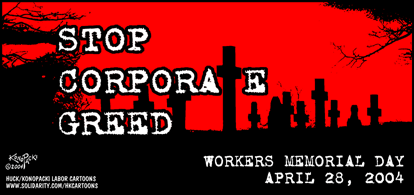
I have three pictures side by side in my house: John L. Lewis, Franklin Delano Roosevelt and Jesus. I draw Social Security on account of FDR. I draw a pension on account of John L. Lewis, and I'm going to Heaven because of Jesus.
-- Jack McReynolds, 70, retired miner, West Frankfort, KY
"That 81 people in Massachusetts lost their lives in the workplace is an absolute disgrace," said MassCOSH Executive Director Marcy Goldstein-Gelb. "This report demonstrates that the cost of cutting corners on safety is paid in human lives."
Mass AFL-CIO President Robert J. Haynes echoed that sentiment, and pointed to a far-reaching piece of legislation that U.S. Senator Edward M. Kennedy has drafted that will help curtail workplace deaths in the future.
"It’s terribly tragic that this many people died on the job in 2003, but it’s morally offensive that so many of these deaths were preventable," said Haynes. "Thankfully, our senior senator is working on this problem, and has a solution that will save lives."
Senator Edward M. Kennedy is sponsoring the Protecting America’s Workers Act, that would expand safety protections to millions of workers, improve enforcement procedures, increase penalties for willful and serious violations, and strengthen protections for workers who report employer safety violations.
This story was picked up by Workers Comp Insider which, while understanding the effect of national policies on workplace safety, argues that, ultimately "management philosophy, the commitment to the work and the workforce, determines whether there will be serious injuries or even death." They go on to ask employers who are reading their site whether the following factors may be leading to increases in workplace fatalities:
reduced employment (while the amount of work remains the same)
reduced spending on training (as a result of difficult economic times),
cuts in federal and state enforcement efforts (reducing the chance that they'll be inspected)
and fear of job loss among workers (leading to reluctance to complain about working conditions)
And the answer to these questions, according to Workes Comp Insider?
There are no simple answers to these questions. But good management understands the importance of keeping workers safe, healthy, and productive. It never makes good business sense -- or ethical sense, for that matter -- to scrimp on safety just because no one may be watching. Any company's most valuable asset is a skilled workforce. The realities of a tough economy may require reductions in the workforce. But prudent employers will remain sensitive to the strains and stresses of these reductions and take steps to support remaining workers, helping them to perform their jobs safely. From the perspective of good business practices, nothing else makes sense.
OSHA Fines Atlantic City Garage Collapse Contractors
OSHA has cited four contractors in the Atlantic City Tropicana parking garage collapse that killed four construction workers last October. (here and here)
Fabi construction received the largest fine, $98,500. Fabi received one "willful" violation, punishable by a $70,000 fine.
Workers on the project reported cracks radiating at 45-degree angles from columns weeks before the collapse, but no one acted on the warnings, Gary Roskoski, OSHA area director said.
"Connecting horizontal steel to the vertical (components) is a basic construction engineering design, very basic. It's Engineering 101,'' he said.
Robert J. Mongeluzzi, a lawyer representing the families of two victims, said: "This was a death trap and an accident waiting to happen.''
To the victims' families, the safety citations issued against contractors Thursday for the Tropicana Casino and Resort parking garage collapse don't add up to much.
About $30,000 per life, to be exact.
"Thirty thousand dollars a man ain't (expletive)," said an angry Ed Wittland, 34, whose father died in the collapse. "Thirty grand? Come on. It's ridiculous."
Fabi called the citations an "unproven allegation which in no way represents a determination of the actual cause" of the collapse.
In a statement, Fabi officials said: "At all times during the construction Fabi addressed all safety requirements, including constructing the garage in accordance with the approved plans and procedures."
Keating officials, too, said the findings did not point to a "clear-cut" cause. "We feel there is still much information to be gathered and analyzed," they said in a statement. "It is our intention to appeal this specific citation as we continue that important process."
Officials at Site Blauvelt said they, too, would appeal. "We think the citation is unfounded and filed erroneously," said Dan Sell, vice president of human resources for the company.
Officials at Mitchell Bar Placement could not be reached for comment.
I haven't seen any indication about whether or not OSHA is seeking a criminal prosecution. OSHA's press release is here.
John Kerry is clearly a regular reader of Confined Space. Today the Democratic Presidential candidate criticized President Bush for neglecting chemical plant security at home while Americans continue to die in a wild goose chase for weapons of mass destruction in Iraq. (He didn't actually use those words, but he hasn't yet hired me as his speech writer.)
Confined Space has addressed this issue several times (here and here) noting the potential for a chemical plant explosion to wipe out far more lies than 9/11 along with the number of occasions over the past couple of years that reporters have been able to slip unimpeded into chemical plants past their "security."
Kerry endorsed the idea present in legislation introduced by Senator Jon Corzine that would require chemical plants to do security assessments, increase physical security and require the use of less dangerous chemicals and technologies whenever that is practicable. The Bush Administration and the American Chemical Council want to make such assessments voluntary and do not want any requirement to use less dangerous chemicals.
Kerry blamed the administration's inaction on his political ties to the chemical industry.
Kerry said Bush has accommodated the chemical industry, which favors voluntary efforts to improve security, because of campaign contributions from executives.
The Kerry campaign cited pledges to Bush during 2000 and 2004 of at least $1.5 million from 15 fund-raisers it said were tied to the chemical industry. The campaign also cited nearly $6.5 million in soft-money contributions -- corporate, union or unlimited donations -- from the industry to Republicans during the 2000 and 2002 campaigns.
"This administration unfortunately has been unwilling to take these steps because they have sided with the chemical industry that pushes back,'' Kerry said. "We don't care who they're writing campaign checks to. It's time for them to make America stronger.''
Kerry's website goes into more detail on connections between the Bush administration an the chemical indusry.
And in one of the many statements from the Bush Administration that fails the Confined Space laugh test, a spokesman claimed tht he was shocked, SHOCKED, that John Kerry was playing politics with homeland security:
"John Kerry has played politics with homeland security throughout this campaign, and today he is doing it again," Bush spokesman Steve Schmidt said. "John Kerry voted against the Department of Homeland Security six times and wants to weaken the Patriot Act. His speech today is not a credible alternative but a retread of policies that the president has already advocated."
This is from the same administration, you may recall, that used 9/11 footage of dead firefighters in its first campaign commercials and will hold its convention in NY right before 9/11.
The Occupational Safety and Health Administration has announced that it will offer testing for beryllium disease to inspectors who may be been exposed to the toxic dust in the course of inspections.
Finkel filed a whistle-blower complaint, alleging he was transferred because he was advocating a safety plan that OSHA higher-ups did not want. The agency denied the claim, and the case was settled.
"It's a shame that somebody had to jeopardize his job in order to push forward a needed safety measure," Ruch said.
Finkel, now a senior adviser at OSHA, said: "I just hope no one turns out to have blood abnormalities or disease who could have learned of this three years ago when the issue was first raised." He emphasized that he was speaking for himself and not the agency.
Finkel argued that OSHA had started to put together a beryllium testing program in 1999, but that current Assistant Secretary John Henshaw pulled the plug in 2002. Finkel alleged that the cost of the program would be so small, that the only thing that the agency must be afraid of tort liability.
Beryllium is used in a variety of industries to help make products ranging from missile components to laptop computers to golf clubs. OSHA estimates that 1,000 inspectors, or three-fourths of its force, have conducted inspections in industries handling the metal.
Agency records show that many of those inspections have taken place in facilities that have had high levels of beryllium dust, up to 30 times the safety standard.
Dr. Lee Newman, a leading beryllium researcher, predicted OSHA likely will find that 2 percent to 6 percent of its exposed inspectors will have beryllium disease or blood abnormalities linked to the illness, the same rate found in similar testing programs.
"I am delighted that OSHA made the right decision to offer testing," Newman said. "It's important that they do this."
Senators Push Legislation to Toughen OSHA Penalties
In honor of Workers Memorial Day (see below) and the thousands of workers who die every year in the workplace, Senators Edward M. Kennedy (D-MA) and Jon Corzine (D-NJ) have renewed the campaign for stronger sanctions against employers who willfully kill workers. Legislation introduced by Corzine would increase the maximum prison sentence to 10 years from six months for willful safety violations that result in deaths.
The proposal to toughen penalties comes in response to the New York Times stories showing the poor record of OSHA and the Justice Department in going after high fines and jail time for employers guilty of willfully killing their employees.
Commerce Secretary Donald Evans called the Corzine-Kennedy proposal "just another policy to destroy jobs.'' House Majority Leader Tom DeLay, R-Texas, said the proposal would be "the worst thing that you could do -- telling a small business person that they could go to prison over an OSHA violation.''
The worst thing you could do? Funny, I think willfully putting someone in an environment where they're going to die is worse.
Update: rawblogXport points out a rather serious "typo" in the AP article cited above:
sometimes a typo is more than a misplaced decimal, especially on such a timely topic - compare the following article, run by dozens of newspapers today, with the article below it posted 02/25/2004:
Families Lobby for Workplace Safety By Jeffrey McMurray, AP In an investigative series on workplace deaths, The New York Times last year found 1,242 cases between 1982 and 2002 in which OSHA concluded workers had died because of 'willful' safety violations by employers. OSHA sought prosecution on only 93 percent of those cases. There were only 11 convictions.
Justice Dept. Drops Most Criminal OSHA Referralsoccupationalhazards.com Critics in Congress and elsewhere have been hammering OSHA ever since a recent New York Times article revealed that over the past 20 years, the agency failed to seek criminal prosecution against 93 percent of the companies whose willful violations of safety rules caused workers to die.
Here's To OSHA: Protecting Employers From The Hazards Of Standards and Enforcement
I have been "celebrating" Workers Memorial Day since the very first event in 1989, the first year of the Bush I administration. Usually they're sad occasions. Workers dying from perfectly preventable causes, children left to grow up without parents, parents having to bury their children. Sad stuff.
This year, however, it looks like there's actually something to celebrate. After just over thirty years of OSHA's existence, humankind has apparently advanced to the point where we don't need workplace health and safety regulations any more. We have apparently been cured of the desire to save a few bucks by cutting corners, speeding up the job and skipping those pesky trench boxes and guard rails. We've advanced to the point where we only need voluntary programs, educational materials, and compliance assistance. All those mandatory standards, inspections, citations, fines and penalties are so 20th century. We've evolved. We've arrived.
But this is just the beginning. I hear that next year we're getting rid of speed limits, drivers licenses and traffic cops. Everyone will be issued fact sheets about how safe driving saves lives and money. Fire and building codes? Who needs 'em? Safe buildings save money. Just give landlords and builders the facts. They're mature adults. They don't want to kill anyone. Environmental regulations? Just tell coal plants and oil refineries how to run their businesses more cleanly. And if information and compliance assistance doesn't work, we can always form some more Alliances.
Yes, we're on the dawn of a brave new world.
The original purpose of Workers Memorial Day was to bring national recognition to the price -- in preventable illness, injury and death-- that too many workers still pay just for going to work every day. The idea has clearly caught on. Although Workers Memorial Day was created by the labor movement, even OSHA has honored the day for the past decade. Of course, I remember the time when OSHA would actually do substantive things on Workers Memorial Day. In 1998, for example, OSHA issued its Workplace Violence Guidelines for Retail Workers. Even this Republican Administration has traditionally attempted to include some substance in its Worker Memorial Day Press Releases over the past twoyears. But not anymore. Read OSHA Director John Henshaw's Press Release. Better yet, don't waste your time. I'll give you the shorter version:
Mourn their loss, cherish their memories. Pay tribute, reduce hazards, play nicely with stakeholders, and work harder.
Amen
So how do we honor workers in 2004? Let me count the ways.
Meanwhile, the state of Washington has honored disabled workers by deciding that they don’t need no stinkin’ ergonomics standard, and Colin Powell’s State Department has decided that toxic chemical have more rights that terrorism suspects and should continue to be considered innocent until the proven, smoking gun deaths of workers proves them to be guilty.
I could (and often do) go on and on. But for more of the Complete Bush Record on safety and health check out the AFL-CIO's Bushwatch.
There is no doubt that at this time in American history, the greatest tribute we can pay to those who have lost their lives and those who have been injured or made ill in the workplace is to elect John Kerry for President. With an administration that values tax cuts for the rich and a costly crusade in Iraq over any kind of human needs at home, we'll be lucky if OSHA's budget only takes small hits over the next few years. And unless it's stopped, OSHA's preference for "voluntary" activities over enforcement and standards will soon begin to take a bigger chunk out of enforcement and standards.
OSHA still has some excellent staff in Washington D.C. and in the field who are dedicated to aggressively protecting workers regardless of the anti-worker ideology coming from the White House. But how long will they stick around facing another four years of forming alliances and being nice when some employers would clearly respond better to a kick in the butt than a pat on the ass?
So lets rededicate ourselves to the fight. Read back over The Weekly Tolls for the past year and think about the lives lost -- almost ten times as many as we've lost in Iraq so far, almost twice as many as we lost on 9/11.
And while we're remembering the dead and their loved ones, let's also take a moment to think of ways to provide support for those who are continuing to fight for the living: the families of the men and women who have died in the workplace and have vowed to fight so that their loved ones will not have died in vain; the union and COSH group activists focusing on the fight for safe workplaces when there are so many other problems and priorities to deal with; OSHA, MSHA and NIOSH career staff who have dedicated their lives to assuring that American workers have safe workplaces despite the political winds that try to blow them off course. And finally, let's also not forget those health and safety directors and staff at companies around the country who are trying to convince their bosses and the bean counters to invest in safety even though there may not be any OSHA requirement and the chance of being inspected is smaller and smaller all the time.
And finally, let's all work for better times by next Workers Memorial Day.
The Government Accounting Office issued an evaluation of OSHA’s voluntary programs a while back and I’m just getting around to reading it. The report was requested by Congressman Charlie "OSHA Killed the Tooth Fairy" Norwood (R-GA). The programs evaluated include State consultation programs, funded by OSHA, Voluntary Protection Program (VPP), Strategic Partnership Program, and the new Alliance Program. Some, such as VPP, exempt companies from regularly scheduled inspections; membership in others can result in lower fines, while others, such as the Alliances, focus on education and public relations.
According to OSHA's interpetation of the report, the GAO found that these things were the best thing since Post-It notes. After reading the report myself, however, I have come to the conclusion that either no one at OSHA actually read the report, or (more likely) they're hoping that no one else reads the report.
In summary, the GAO report reminds me of the old Pac-Man game: voluntary programs have no proven value, but they're gobbling up the resources that OSHA needs to fulfil its Congressional mandate to “assure safe working conditions for working men and women.”
On its website, OSHA boasts that the “GAO Report Highlights Effectiveness of OSHA's Voluntary and Cooperative Programs”
The General Accounting Office's report recognizes that these compliance assistance programs are highly effective in extending OSHA's reach. They complement and augment OSHA's aggressive efforts to enforce occupational safety and health standards to achieve greater reductions in workplace injuries, illnesses and fatalities.
The OSHA announcement states that
A year-long study by the Government Accounting Office on OSHA's voluntary compliance programs wrapped up last month saying the strategies "have improved employers' safety and health practices" and noted that many participants interviewed said the programs resulted in not only helping to reduce injury and illness rates but also have fostered "better working relationships with OSHA."
Those of us who still think that Congress was serious when it created OSHA as an agency that is supposed to enforce the American worker’s right to a safe workplace might take a different view.
OSHA’s voluntary programs go all the way back to the Reagan era with the founding of the Voluntary Protection Program (VPP) in 1982. Alliances, primarily with industry associations, are the newest program, developed in the Bush administration as a substitute for issuing standards and are the only OSHA voluntary program that doesn't include labor unions. 41 percent of OSHA’s national alliances, for example, were ergonomic-related. OSHA recently established an alliance with a number of chemical industry associations as a substitute for revising its Process Safety Management regulation as recommended by the U.S. Chemical Safety Board.
What is missing from OSHA’s rather sanguine view of the report is that the optimistic conclusions are based almost solely on interviews with participants (all nine of them), who (surprise) prefer voluntary activities over actual enforcement of the law. Otherwise, there’s no real evidence that these programs are effective in improving health and safety conditions.
The report concludes that
OSHA’s voluntary compliance programs have reduced injuries and illnesses and yielded other benefits, according to participants, OSHA officials, and occupational safety and health specialists, but the lack of comprehensive data makes it difficult to fully assess the effectiveness of these programs. Participants we interviewed in the three states and nine worksites we visited told us they have considerably reduced their rates of injury and illness. They also attributed better working relationships with OSHA, improved productivity, and decreased worker compensation costs to their involvement in the voluntary compliance programs. However, much of the information on program success was anecdotal, and OSHA’s own evaluation of program activities and impact has been limited to date. OSHA currently does not collect complete, comparable data that would enable a full evaluation of the effectiveness of its voluntary compliance programs. (My emphasis)
I don’t know about you (or Congress), but I don't need to spend dwindling taxpayer dollars to condcut a GAO study that concludes that companies would rather have voluntary programs than enforcement and fines…or that they would say that the voluntary programs are more effective. Do bears defecate in the woods?
This might be rather amusing in an irritating sort of way, until you get to the resource section. The GAO is rather concerned about the large and growing level of resources that OSHA is dedicating to a group of programs with no proven effectiveness:
The resources OSHA devotes to its voluntary compliance strategies consume a significant and growing portion of the agency’s limited resources. In fiscal year 2003, OSHA executed its numerous programs under a $450 million budget. The agency spent $126 million on its voluntary compliance programs and compliance assistance activities— approximately 28 percent of its total budget—and about $254 million, about 56 percent of its budget, on enforcement activities. The percentage of resources dedicated to voluntary compliance programs and compliance assistance activities has increased by approximately 8 percent since 1996, when these programs represented about 20 percent of the agency’s budget. During this same period, the proportion of resources OSHA dedicated to its enforcement activities fell by 6 percent, from about 63 percent to about 56 percent of the agency’s total budget, although the total funds devoted to enforcement have remained fairly constant because of increases in OSHA’s total budget over this period. In addition, enforcement efforts, as measured by the number of inspections, have remained constant or increased slightly each year, according to agency officials. While it cannot be determined that resources were directly redistributed from enforcement to compliance assistance activities, funding for OSHA’s other programs remained relatively stable, with only small increases or decreases in funding since 1996(My emphasis)
(And for those of you who are math-challenged, that means that the share of OSHA’s budget devoted to compliance assistance has gone up by 40%, while the share devoted to enforcement has gone down by 11%.)
By the way, OSHA’s Susan Harwood training grant program is also part of the total voluntary compliance program budget. Look at the trends over the past five years: In FY 2000, the Harwood program was funded at $8 million and went up to $11 million the following year, where it remains today despite the Bush administration’s annual attempts to replace the training grant program with a $4 million internet "training" program. The rest of compliance assistance was at $89 million in FY 2000 and has swollen to $124 million for next year.
From FY 2004 to FY 2005, the Bush Administration wants to cut the worker training program by over $6 million whlie it wants to raise the voluntary compliance programs by $5 million. Hmmm….
The report notes that these voluntary compliance programs don’t come cheap. They require agency oversight to ensure that participants comply with requirements or agreements, which results in “growing administrative responsibility” that requires "concerted agency resources."
Frighteningly, OSHA plans to increase in the number of worksites in the VPP program from 1,000 to 8,000. The report points out, however, that to certify a worksite as a VPP worksite requires a comprehensive on-site review that usually lasts 1 week and involves approximately three to five OSHA personnel. The report notes that
Several regional officials—whose offices are responsible for conducting on-site reviews—said that increasing the number of VPP worksites would strain their resources because of the number of staff required to conduct reviews of new worksites and recertifications of existing worksites.
The GAO report concludes with a recommendation that before expanding these programsOSHA might want to actually collect data to evaluate these programs and then develop a “strategic framework” to figure out how to pay for all of these competing priorities.
The agency must balance its plans to expand its voluntary compliance programs with its enforcement responsibilities. Given OSHA’s current resources, it is unclear how it can undertake much expansion without a careful assessment of the impact on its resources and other programs. Unless it has such an assessment, OSHA runs the risk of compromising the quality of its voluntary compliance programs.
Compromising its voluntary compliance programs? Sounds to me like they’re compromising the rest of OSHA.
AFL-CIO Releases 13th Annual Death on the Job Report
The AFL-CIO has released its 13 Annual Death on the Job report. The report is a national and state-by-state profile of worker safety and health in the United States. It's considered the policy "bible" for workplace health and safety activists. A combination of too few OSHA inspectors and low penalties makes the threat of an OSHA inspection hollow for too many employers. Millions of workers are still left with no OSHA coverage.
Here are some of the "highlights."
15 workers were fatally injured and more than 12,800 workers were injured or made ill each day during 2002. These statistics do not include deaths from occupational diseases, which claim the lives of an estimated 50,000 to 60,000 workers each year.
a 62 percent increase in the number of trench fatalities, from 33 in 2002 to 53 in 2003.
Fatal injuries among Hispanic or Latino workers decreased about 6 percent, although the 840 fatalities recorded for Hispanic workers is the second-highest annual total for the population. States that saw an increase in the number of Hispanic worker fatalities in 2002 include Alabama, Arkansas, Florida, Idaho, Indiana, Maine, Maryland, Nebraska, New Jersey, North Carolina, Pennsylvania, Tennessee, Virginia, Washington and Wyoming.
The number of fatal work injuries among foreign-born Hispanic workers increased in 2002 to 577 from 527 in 2001.
Musculoskeletal Disorders continue to account for more than one-third of all injuries and illnesses involving days away from work and remain the biggest category of injury and illness. The occupations that reported the highest number of MSDs involving days away from work in 2002 were nursing aides and orderlies (44,421); truck drivers (36,814); and laborers, nonconstruction (24,862). Based on studies and experience, OSHA has estimated that MSDs are understated by at least a factor of two.
Government counts of occupational injury and illness are underestimated by as much as 69 percent. Companies have an incentive to underreport because OSHA’s enforcement targeting system is based on injury rates. Employers themselves are increasingly discouraging workers from reporting by using prizes and other incentives for groups who report the fewest injuries, and by implementing systems to discipline employees who report injuries.
as documented in a December 2003 New York Times series, prosecutions of recklessly negligent employers are extremely rare. Of the 170,000 workplace deaths since 1982, only 16 convictions involving jail time have resulted—although 1,242 cases involving work deaths were determined by OSHA to involve “willful” violations by employers (violations in which the employer knew that workers’ lives were being put at risk).
Penalties for significant violations of the law remain low. In fiscal year (FY) 2003, serious violations of the OSH Act carried an average penalty of only $871 ($856 for federal OSHA, $885 for state OSHA plans).
2,240 federal and state OSHA inspectors responsible for enforcing the law at 8.1 million workplaces. At its current staffing and inspection levels, it would take federal OSHA 106 years to inspect each workplace under its jurisdiction just once.
Between FY 1999 and FY 2003 the number of employees who work in workplaces inspected by federal OSHA inspections decreased by nearly 12 percent. The average number of hours spent per inspection also decreased between FY 1999 and FY 2003, from 22 to 18.8 hours per safety inspection and from 40 to 34.7 hours per health inspection. The number of citations for willful violations decreased from 607 in FY 1999 to 391 in FY 2003. The average penalty per violation and per willful violations both increased in FY 2003 from the FY 2002 level, while the average penalty per serious violation decreased to its lowest level since 1999.
After three and a half years under the Bush administration, rulemaking at OSHA and MSHA has virtually ground to a halt. In December 2003, the administration published its latest semiannual regulatory agenda, which sets forth its regulatory priorities and plans for the coming year. Having already withdrawn 22 pending OSHA regulatory actions from its regulatory agenda, in its May 2003 regulatory agenda the Bush administration withdrew the glycol ethers standard and the tuberculosis standard, leaving few major initiatives on the regulatory schedule.
OSHA still has taken no action on the Employer Payment for Personal Protective Equipment standard, which has been through the rulemaking process and is ready for final action.
The one major regulation on which OSHA is working, hexavalent chromium, is the result of a lawsuit brought against the agency by Public Citizen and PACE International Union.
The only major regulations still on the regulatory agenda are for silica, beryllium and hearing conservation for construction workers. But there is no commitment from OSHA to propose these rules. This will be the only administration in history not to issue a major safety and health regulation during its four years in office.
17 MSHA standards to improve safety and health for miners have been withdrawn, including the Air Quality, Chemical Substances and Respiratory standard.
Adjusting for inflation, the FY 2005 proposed OSHA budget represents a $6.5 million cut over FY 2004 appropriations.
The FY 2005 OSHA budget proposes increasing programs for voluntary compliance and employer assistance while cutting training and outreach programs for workers and freezing standard-setting and enforcement programs. At OSHA, the president proposes to cut worker safety training programs by 65 percent and to shift these funds to employer assistance programs.
The administration’s budget proposes a cut in coal enforcement at MSHA from $116.4 million in FY 2004 to $114.9 million in the FY 2005 request.
For FY 2005, the Bush administration has proposed a $278.9 million budget for NIOSH—$237 million for program activity and $41.9 million to fund the National Occupational Research Agenda (NORA). This is the same level of funding appropriated by Congress for FY 2004 and represents a $4.4 million cut in real dollars. In the previous three years, the administration proposed major cuts in the NIOSH budget, all of which were rejected by Congress.
So what's on the agenda for the future?
Address the high death and injury rate of Hispanic and foreign-born workers
Ergonomics: As long as Bush is in office, there won't be a federal standard, but efforts are under way in states such as Michigan.
Develop government program to regulate the hundreds of thousands of chemicals that are not regulated by OSHA.
Stop the U.S. government and chemical industry from undermining the European REACH effort to test and control exposures to thousands of chemicals currently in commerce
Address the effects of as downsizing, increased hours of work, increased pace of work and changes in technology, work processes and management techniques on workers' health.
Fight behavior-based safety programs, incentive programs and injury discipline programs that discourage workers from reporting injuries and illnesses.
This is the last Weekly Toll before 2004 Workers Memorial Day. In addition to the names that I pick up in Google searches, I've also added a number of names from union lists of members killed on the job. Last week, I listed a number of PACE members killed on the job. This week, I've listed a number of members of AFSCME, UAW and the Steelworkers. As I mentioned last week, it amazes me how many of these I've missed through the Google news searches. Is it because Google didn't pick them up or because they didn't even raise enough concern to appear in the local newspaper?
The North Carolina Occupational Safety and Health Division said faulty equipment is partly to blame for the accident. The alarm on the truck that signals when the truck is in reverse did not appear to be working when the worker was hit, according to officials. Officials did not release the victim's name but they did say the workers are from Curtin Drainage and Trucking in Charlotte, N.C.
OSHA looks at trench collapse
Gainesvile, FL --The federal Occupational Safety and Health Administration is investigating the circumstances surrounding the death of a Commerce man who was buried alive over the weekend while working in a trench in northeastern Forsyth County.
An employee of Pro-Septic and Plumbing, identified by local authorities as 18-year-old Joseph "Jody" Domingue, died Saturday afternoon when the trench he was working in collapsed and spilled five feet of dirt on him.
Worker killed in building collapse, 2 injured
MATTOON, IL -- A building collapse here Friday resulted in two demolition workers coming out alive, while the third man was found dead by rescue workers less than an hour after he was buried by debris.
Denny Thornton of Johnstown said he and two co-workers, Wayne "Red" Boruff, 46, of rural Toledo, and Matt Swearingen, 27, of Toledo, were working on a joist when the roof and a portion of the second floor caved in on top of them shortly before noon Friday at the old Montgomery Building, 1706 Broadway Ave. The rescue workers had brought Swearingen out on a stretcher, but Boruff was later found dead in the building.
4 die in Downstate plant explosion
8 more workers sent to hospitals ILLIOPOLIS, Ill. -- Firefighters from about 25 departments worked all day Saturday trying to extinguish a blaze at the Formosa Plastics Corp. plant sparked by a chemical explosion that killed four workers. The cause of the Friday night blast is still unknown. Eight workers were taken to nearby hospitals in Springfield and Decatur, where their conditions ranged from fair to critical. One of the injured was airlifted to Memorial Medical Center in Springfield, hospital spokesman Ed McDowall said. Six other employees either declined care or were treated and released.
Based on preliminary reports, Joseph Machalek, 50, of Decatur; Larry Graves, 47, of Decatur; Glenn Lyman, 49, of Cornland; and Linda Hancock, 56, of Decatur died of smoke inhalation, said Sangamon County Coroner Susan Boone. Autopsies on the four victims will be conducted Monday, she said.
Worker dies in Walter coal mine
Walter Industries of Tampa reported a fatal accident Friday at one of its coal mines in Brookwood, Ala. Gary Wayne Keeton, 57, was found dead Friday morning, his body apparently carried to the surface by a conveyor system used to transport coal in the company's No. 7 mine.
His was the first fatality at Walters' Alabama mines since 13 workers died in explosions in the No. 5 mine in 2001. In that accident, a federal investigation blamed Walter for failing to prevent a buildup in combustible coal dust and other safety problems, but the company disputed the findings. The death, which is being investigated, was the third at Mine No. 7 since it opened in 1977.
Authorities received a call Thursday night reporting that Paul John Perschbach of Orlando, Fla., was repairing the Crazy Submarine ride at the Gibraltar Trade Center when another worker started up the ride, Officer Daniel Shook said. The other worker apparently didn’t realize Perschbach was working on the ride.
Shook said Perschbach was caught in the ride’s machinery. He was transported to a local hospital, where he was pronounced dead. “From all appearances, this appears to be an accident and a miscommunication between two workers,” said Detective Sgt. Mary Sclabassi.
Hours after the cave-in, an investigator from the Occupational Safety and Health Administration was at 2779 N. Charlotte St., where three workers had been laying sewer pipe late.
Two other OSHA investigators arrived yesterday from the agency's Allentown office. They're looking for clues as to why the 70-foot-long, 12-foot-deep trench failed.
The falling earth buried Brian K. Bealer, 43, of Boyertown, according to New Hanover police. An autopsy was to be performed this morning.
It happened Friday morning at the Fansteel Washington Manufacturing plant. The Washington County Sheriff's Office said that the worker's name has not been released.
Family, friends mourn worker
Harrisburg, PA -- Kyle McNaughton 21, loved to weld, mow grass and help others remove snow. He recently purchased a Cub Cadet lawnmower, and his parents, John and Peggy McNaughton, gave him a snowblower as a gift.
"He loved to mow. He loved to work. He would mow for anybody," John McNaughton said yesterday after he, Peggy and Kyle's brother, Brady, 19, made funeral arrangements.
Kyle was killed on the job when a half-ton piece of steel fell on him at Taryn Co. in Spring Twp. Officials at the scene Thursday said McNaughton was operating a machine similar to a forklift with a boom to lift a 6-by-12-foot sheet of steel.
Perry County Coroner Michael Shalonis said the steel was not attached properly to the boom. When McNaughton got off the machine to adjust it, the steel fell on him.
Upper Dublin police officer killed on duty
Sgt. James Miller, a 28-year veteran of the Upper Dublin Police Department, died early Tuesday morning when his police vehicle was involved in a crash on the 1700 block of Dreshertown Road. He was 55 years old.
Upper Dublin Police Sgt. Lee Benson said Miller was working the night shift, 6 p.m. to 6 a.m., when his vehicle was involved in the crash around 4:30 a.m. According to Benson, the vehicle rolled over during the accident, ejecting Miller. He was pronounced dead at the scene.
Ironworker Killed in Fall
Pawtucket, RI -- George Patrick Hopkins Jr, 31, of Armistice Boulevard, a welder and ironworker, died Thursday at Morton Hospital, Taunton, Mass., after an accident in which he fell through the roof of a warehouse at the site of the future Jordan's Furniture, at the Liberty and Union Industrial Park, in Taunton.
He was the fiancé of Kelly L. Allard of Pawtucket. Born in Providence, a son of George Patrick Hopkins of New Bedford, Mass., and Teresa A. (Melucci) Valentine of Seekonk, he was a lifelong resident of Pawtucket.
Mr. Hopkins had been working for Accord Steel & PreCast Erectors Inc. for several years. He was a member of the ironworkers' union, Local 37, in East Providence.
Construction worker dies from electrocution
PORT ST. LUCIE, FL — A 22-year-old construction worker was killed Monday when a cable from a crane apparently touched powerlines, officials said.
Lorenzo Rosas, of the 500 block of Southwest Faith Street, was pronounced dead at 5:26 p.m. at St. Lucie Medical Center — about 90 minutes after the incident at a construction site near the intersection of San Miguel Street and Santiago Avenue, said Officer Kacey Donnell, police spokesman.
OSHA Investigating Burn Death
Rogers Iron Employee Survived Nearly Three Weeks After Accident
ROGERS, AK -- Occupational Safety and Health Administration officials are investigating an accident that led to the death of a Rogers Iron and Metal Corp. employee.
Rodrigo Diaz, 63, of Rogers died Sunday at the burn unit in a Springfield, Mo., hospital. He lived for 20 days after he accidentally set himself on fire outside the business at 721 N. Arkansas while using a cutting torch.
Johnnie Johnson, safety director for Yaffe Companies in Muskogee, Okla., said the investigation will show Diaz's death was the result of a "tragic, freak accident" and that Rogers Iron and Metal was not at fault. Yaffe is Rogers Iron and Metal's parent company.
COSBY (WATE), TN -- A seasonal worker on a trail clearing crew at Great Smoky Mountains National Park collapsed and died on the job Thursday morning.
Ricky Campbell, 50, of Newport, collapsed at around 8:15 a.m. about one mile up from the Snake Den Ridge Trail in the Cosby area of the park, the park service announced. He had been hiking with two other employees to begin some tree clearing work.
Thomas J. Steiner, 35, died at a hospital of a gunshot wound to the head, said CHP spokesman Tom Marshall.
Construction accident kills one
Lake Elsinore, CA -- A foreman died Tuesday after being pinned against a wall by a large backhoe at a Lake Elsinore construction site, according to authorities.
Antononio Gutierrez Jr., 42, of Rancho Cucamonga was overseeing concrete work in the 19700 block of Grand Avenue, according to a Riverside County coroner's news release.
The accident happened Tuesday morning near Highway 70 and Raines Mill Road in the Princeton area.
Authorities say 39-year-old Nathan Barry Shapiro ran into a truck that was stopped at a red light.
Teen worker found dead in Albertville poultry plant
ALBERTVILLE, Ala. (AP) -- A teenage worker was found dead at an Albertville poultry plant, according to plant officials, and investigators were checking out the circumstances and questions about his age. Police Chief Benny Womack said Wednesday that Augustin Juan, 17, of Albertville was found at the Waynes Farm LLC plant shortly before 5:20 p.m. Tuesday. He said a cause of death would not be determined until the forensics department performed an autopsy.
June 4, 2003 Thomas Hanlon, 56, Local 164 machine operator, Eaton Corp. Truck Clutch Division, Auburn, Ind. Brother Hanlon was standing by a clutch-testing machine, beyond the protective light curtain. When he leaned into the machine, the carrier plate lowered and crushed him.
August 2, 2003 Raul R. Martinez, 54, Local 600 caster mechanical team pipefitter, Rouge Steel, Dearborn, Mich. was removing a cracked roller on a continuous support roller assembly located on a rebuild stand. The roller separated and fell, striking him and causing fatal injuries.
November 3, 2003 Ed Steinke, 55, Local 182 electrician, Ford Motor Co., Livonia, Mich, was on a JLG aerial lift removing old conduit from the overhead steel structure. Brother Steinke was caught between the upper guardrail of the basket and a six-inch pipe.
November 7, 2003 Concepcion Rodriguez, 55, Local 477, an arc wash welder, at Chicago Castings, in Cicero, Ill. died from electrocution while attempting to turn on a welding machine. Operators had previously experienced shocks from the equipment.
November 22, 2003 Jeff West, 44, Local 600 general welder, Ford Motor Co., Dearborn, Mich was killed when he fell approximately 20 feet to a basement area during the installation of a stamping machine.
AFSCME
John Webb and Allen Cappel were killed when their Ohio Department of Transportation car was hit by a dump truck on September 4, 2003.
San Wileym, a prison boot factory supervisor’s throat was slashed by an inmate in Texas on January 29, 2003.
Carlos Lozada of Connecticut, was riding in the back of a refuse truck when an errant driver crossed into the wrong lane and smashed into the truck on September 15, 2003.
Adolfo Mendez suffered a fatal heart attack while performing his duties for a city in Connecticut on May 15, 2003.
Brian Bergeon was killed while trying to remove a tire from the rim. It exploded and he was struck by the tire rim on February 23, 2004
United Steelworkers of America
On April 8, Bernard Rogers, 48, a straightener operator for Progressive Processing, Inc. in Elyria, Ohio, was killed instantly when he got caught in the straightener and was thrown to the ground head first. Brother Rogers was a member of Local Union 2354-08 in District 1.
On April 9, Joseph Galan,19, a utility man for Co-Steel Company in Perth Amboy, New Jersey, was killed when a dump truck hit the forklift he was in and knocked it over, causing severe head and chest injuries. Brother Galan was a member of Local Union 9473 in District 4.
On May 2, Roland Beauregard, 43, an employee of Noranda Inc.; Falconbridge Societe Miniere Raglan DU; Raglan Mine in Katinniq-Raglan, Quebec, was found unconscious sitting on a pipe at work. He died a few hours later from heart problems. Brother Roland was a member of Local 9449 in District 5.
On June 27, Kriss Gibbs, 37, an outside contractor working at USS Granite City Works in Granite City, Illinois, was killed when he was caught between two pond lining boxes. Bargaining unit employees of USS are represented by Local Union 1899 in District 1.
On October 30, Dave MacLeod, 46, a supervisor at Dynatec Ltd. in Sudbury, Ontario, fell to his death during the process of sinking a new ventilation shaft at Garson Mine, one of our mines in the Sudbury area. This is part of the Garson Mine deep project for Inco. Bargaining unit employees of Inco Limited are represented by Local Union 6500 in District 6.
On October 30, Jean-Noel Belanger, 48, an employee of Geant Dormant (Cambior Inc.) in Amos, Quebec, was killed when he could not escape a rock fall. Brother Belanger was a member of Local Union 4796-13 in District 5.
On January 4, Andy Jarouz, 55, an employee at Stelco Inc., Hilton Works in Hamilton, Ontario, was killed while working at the ladle repair station and fell 5 metres off a scaffold and was crushed by a steel plate. Brother Jarouz was a member of Local Union 1005 in District 6.
On January 6, Author Quitana, 58, conttrel operator for Groupo Mexico SA DE CV; Asarco Inc.; Hayden Smelter in Hayden, Arizona, died from electrocution. He was a member of Local Union 886 in District 12.
On January 13, Mickey Hargrave, 41, a heavy/highway construction worker for No. 1 Contracting Company; AJ Roman, owner, in Reading, Pennsylvania, was killed when he fell from a concrete bridge abutment (20 feet high). Brother Hardgrave was a member of Local 15253 in District 10.
On March 8, Robert Brogan, 31, an employee of Leggett & Platt Inc. in Mason, Ohio, was crushed to death when a bedspring compactor failed. Brother Brogan was a member of Local Union 156U-05 in District 1.
On April 13, Ed Theriot, 50, an employee of Bayou Steel Corp. in La Place, Louisiana, was fatally injured when caught between a billet cooling bed and a billet transfer car. He died later that day in the hospital. Brother Theriot was a member of Local Union 9121 in District 9.
On April 26, Robert Brzezinski, 43, an employee of Algoma Steel, Inc. in Sault St. Marie, Ontario, was killed when he fell from a charging platform into a pit at the #2 steel-making shop. Brother Brzezinski was a member of Local Union 2724 in District 6.
According to an article in the NY Times, after years of decline, the number of violent assaults in health care and social services is again on the rise. The cause, underbudgeting, overcrowding and understaffing.
Following the murder of California doctor Erlinda Ursua by a mental patient last year, I wrote about the root causes of her death:
When voters, whipped into an anti-tax frenzy by right-wing radio talk/T.V. show wingnuts, as well as politicians seeking to ride the their wave, refuse to see the need to raise taxes to pay for needed government services, you end up with more needy people getting fewer services in understaffed facilities. While the underfunding has ramifications throughout society -- especially for the patients and their families -- it is the workers at the facilities who are literally putting their bodies, and in some cases, their lives on the front lines of these ideological battles.
Security guards and County Sheriffs are fine, but what's really needed is more staff -- adequately paid staff to provide proper therapeutic help, and adequately paid staff to provide support.
Apparently the problem is not exclusive to California
Incidents of workplace violence, from verbal abuse to assault, appear to be climbing in health care and social services, at a time when workplace homicides in those industries have been declining for about a decade, labor experts say.
"Clearly, workplace violence in these areas is beginning to come back up," said Lynn Jenkins, a branch chief in the division of safety research at the National Institute for Occupational Health and Safety, a federal agency that researches ways to prevent work-related injury and illness.
Ms. Jenkins said that the reporting of nonfatal workplace crimes was fragmented, and workers in fields like social services or mental health care might accept acts of violence as part of their jobs. But anecdotal evidence gathered by the institute points to an increase, she said.
"Basically, you have fewer workers delivering fewer services to more people," Ms. Jenkins said. "It's a formula for disaster."
According to the most recent numbers from the Bureau of Labor Statistics, cases of workplace violence in health care and social services in New York State dipped from 1998 to 1999, but increased from 2000 to 2001, when the economic downturn hit.
In health care, the bureau said, cases of workplace violence rose to 16.5 per 10,000 full-time workers in 2001 from 13.7 per 10,000 in 2000.
Cases of violence in social services increased to 35.4 per 10,000 employees in 2001 from 25.6 per 10,000 in 2000.
Although federal OSHA has issued guidelines to assist health care and social service workers to prevent workplace violence, OSHA does not currently cite employers for failure to prevent an environment that may lead to assaults.
New York unions representing public employees are urging the state to take action
Last year, a group of unions proposed standards for diminishing workplace violence for public employees to the New York State Department of Labor's Hazard Abatement Board, which makes recommendations on health and safety standards.
The proposed standards include definitions of violence and steps employers should take to create a safe workplace, ranging from drafting antiviolence policies to employee training. The board held public information sessions on the proposed standards and is reviewing the information it gathered, according to a spokeswoman for the Labor Department, Christine Burling.
Labor advocates say it is important for workers to recognize that workplace violence can take many forms.
More information on workplace violence in health care and social services here, here and here.
ILLIOPOLIS, Ill. -- Firefighters from about 25 departments worked all day Saturday trying to extinguish a blaze at the Formosa Plastics Corp. plant sparked by a chemical explosion that killed four workers. The cause of the Friday night blast is still unknown, officials said.
"They're just going to try and maintain it tonight and go back tomorrow and see what they can do," said Sgt. Joe Rath of the Sangamon County Sheriff's Department. "There's a lot of ... plastic in there."
Eighteen afternoon-shift employees were at the facility about 10:45 p.m. Friday when the explosion, which was heard about 20 miles away, erupted into an orange mushroom cloud above the plant and disrupted power throughout this village of about 1,000 people. The initial blast was followed by several smaller ones, officials said.
Eight workers were taken to nearby hospitals in Springfield and Decatur, where their conditions ranged from fair to critical. One of the injured was airlifted to Memorial Medical Center in Springfield, hospital spokesman Ed McDowall said. Six other employees either declined care or were treated and released.
Based on preliminary reports, Joseph Machalek, 50, of Decatur; Larry Graves, 47, of Decatur; Glenn Lyman, 49, of Cornland; and Linda Hancock, 56, of Decatur died of smoke inhalation, said Sangamon County Coroner Susan Boone. Autopsies on the four victims will be conducted Monday, she said.
Sometimes we focus exclusively on workplace fatalities and forget about those who suffer serious injuries that may affect them for the rest of their lives:
There was a point, as he lay in the rubble, his body numb, his screams for help muffled by a mouthful of blood and concrete, that Hassan Ali accepted that this was the way he was going to die.
After falling five stories, his leg was shattered, his jaw crushed so badly that a doctor would later compare it to running a hand over a crumpled bag of potato chips. A slab of concrete hung precariously over him, threatening to finish the job.
In the end, four construction workers died in the collapse of the Tropicana Casino & Resort parking garage Oct. 30. Ali, a 43-year-old concrete worker, survived.
But six months later, living is still a struggle for a man who once prided himself on his physical strength and who now doesn't know whether he will be able to walk unaided again. He thanks God that he is alive, but sometimes the depression is overwhelming. The physical pain is almost constant, the anger still strong.
Officials from one of the companies involved, the Philadelphia-based Keating Building Corp., said in a statement:
"We have committed every possible resource to ensure that we deliver the safest, highest-quality work possible every day at dozens of sites... . We remain committed to exceeding the industry's highest standards on a daily basis."
A New York Times story that I wrote about yesterday blamed the collapse on “faulty installation of concrete floors after changes were made to the design to speed the job and save money.”
OSHA’s report is due out soon.
Victims and their families hope that when the silence is finally broken, someone will be held accountable for their suffering.
"It won't make me better, but it will make me feel better if they step up to the plate and say, 'We were wrong and we accept responsibility for that,' " Ali said.
In Ali's case, it would mean accepting responsibility for an accident that resulted in his having nine surgeries. A dozen metal pins still pierce through the skin of his lower right leg, keeping the bones inside in line.
His jaw is no longer wired shut, but he still can't eat solid food and carries a napkin to wipe away the drool that dribbles stubbornly out of the corners of his mouth.
Life for the once-energetic father of two sons, 12 and 21, now revolves around medications, trips to the doctor, making small steps in a long and arduous healing process. His family's life revolves around helping him.
"Whoever was responsible for building that building, I blame them," Ali said from his townhouse, where his sister and fiancee work in shifts tending to him. "Something went wrong somewhere and they let it happen."
Another Day, Another Dollar, Another 4 Dead Workers
Atlantic City Garage Collapse Blamed on Changes to "Speed the Job and Save Money"
The New York Times reports that the garage collapse that killed four construction workers and injured 20 others last October
was caused by the faulty installation of concrete floors after changes were made to the design to speed the job and save money, according to engineers for the contractors and others who have studied the design plans and the debris.
It is apparently still unclear whether it was the revised design or the way that design was executed that was to blame. One thing that is clear, however, is that the laborers and carpenters on the sight knew that something was wrong.
"Everywhere along the line, the checks and balances failed," said an engineer for one of the contractors, who asked that he not be named because of the ongoing investigation.
The laborers and carpenters at the site, in interviews, said they did raise objections about a condition they thought was hazardous: the insufficient shoring that was being used to hold up the not-yet-dry concrete floors. Workers said they noticed that some of the shores - essentially temporary steel or wooden pogo sticks that go from the ceiling to the floor - were under such stress that they were bending or bowing. Laborers also reported troublesome-looking cracks in the concrete. But George Tolson, one of the Fabi laborers who noticed this condition, said he was told to keep working.
"All they wanted," said David R. Hand, 33, a laborer for Fabi who was pouring the concrete "is to go faster, faster, faster. Time is money. That was it."
The Atlantic County prosecutor has confirmed that criminal inquiry was underway.
"Someone should be held criminally responsible," said Robert A. Tartaglio Sr., who worked on the Tropicana expansion last year with his son, Robert Jr. - one of the four men killed in the collapse. "Someone is responsible up the line for making these decisions. And as far as I am concerned, they committed a crime."
Repeat Violator And this wasn't the first time that the companies involved in the collapse had had serious safety problems.
In June 1995, a 23-year-old Fabi worker who was removing concrete slabs atop Tropicana's adjacent 10-story parking garage fell 100 feet to his death, down an elevator shaft, after the floor he was standing on collapsed. Fabi was fined $31,500 by the federal government and Keating was fined $6,400, after authorities concluded that the workers had not been properly trained or supervised.
Then, in October 2002, after work on the new expansion got under way, three workers were injured when the concrete floor they were standing on gave way and they fell to the ground. In this case, according to one contractor, there was no shoring at all underneath the area where the men were working. Keating was in this case fined $1,125 and Fabi $8,375, although the penalties are being appealed.
Jim Moran, director of the Philadelphia Area Project on Occupational Safety and Health, a union-backed group representing about 100,000 workers, said all workplace deaths were horrendous. "But it is even more egregious,'' he said, "when it is a repeat offender. If you are going to keep fining people for killing other people, on its face, that is ridiculous."
What's The Only Thing Worse Than Being Mistaken For A Ku Klux Klan Murderer?
Republicans are in a panic in the state of Colorado since Senator Ben Nighthorse Campbell decided to retire instead of running for another term. Democrats are running popular Colorado Secretary of State Ken Salazar for the seat. Some think the Republicans are giving up and to avoid wasting money have convinced beer giant Pete Coors to run. Coors, in addition to being independently wealthy, comes from a long line of arch-conservative, anti-labor, union-busting, environment-shredding uncompassionate and unapologetic right-wing conservatives.
My Colorado correspondant reports that Coors is doing his best to live up to his family's reputation:
Thursday's New York Times misidentified GOP Senate candidate Pete Coors as a Ku Klux Klan member who murdered a black sharecropper.
The Coors campaign found the error "so outrageous it's kind of funny," said spokeswoman Cinamon Watson.
"It could have been worse," she joked. "Pete could have been identified as John Kerry."
Or Adolf Hitler, Joseph Stalin, Genghis Khan or Saddam Hussein.
Hold on for the ride, people. Still six months to go....
When we write about the hazards facing immigrant workers in this country, we usually write about fatalities. Deaths are easier to count, -- or, said another way, they're harder to hide -- than illnesses. Even for non-immigrant workers, work-related illnesses generally go unrecognized, undiagnosed and unreported.
A survey of janitors and cleaning staff working for a Brighton firm found widespread injuries and health problems that workers trace to unsafe working conditions and poor training, according to the nonprofit Massachusetts Coalition for Occupational Safety and Health.
Workers reported skin burns from toxic polishes they applied wearing porous latex gloves supplied by their employer, Commercial Cleaning Services. They also were required to do metal polishing in unventilated elevators with the doors closed, and to handle sharp objects, dead animals, blood, and other potential biohazards without safety gloves, according to the report.
Commercial Cleaning Inc. of Brighton employs the janitors who clean the Ritz/Millenium and several other sites.
The workers reported using such chemicals as a metal polish containing the central nervous system toxin 2-butoxyethanol and the asthma-causing agent ethanolamine; chlorine bleach (sodium hypochlorite); and a brass polish containing ammonia.
More than three quarters of workers surveyed had received no training on safe use of chemicals. Some containers storing the chemicals had no labeling or were improperly labeled and workers were not provided with proper personal protective equipment, such as impermeable gloves and safety goggles.Training, labeling and availability of Material Safety Data Sheets are all requirements of OSHA's Hazard Communication Standard.
“Virtually every one of the janitors we spoke to suffered from health problems such as respiratory problems, dizziness, rashes, and headaches, that they believe are connected to their jobs” said MassCOSH Occupational Health Specialist Isabel Lopez. “We’ve confirmed that there are serious hazards. Now, it’s time for Commercial Cleaning to act responsibly.”
Commercial Cleaning Inc. of Brighton employs the janitors who clean the Ritz/Millenium and several other sites. MassCOSH surveyed 47 of the 140 janitors who work for Commercial Cleaning after receiving complaints by several janitors that their workplace health concerns were being ignored by the cleaning company’s management. The report’s findings show 83% of workers surveyed reported exposure to hazardous chemicals such as a metal polish that contains both an asthma-causing agent, ethanolamine, and the central nervous system toxin 2-butyoxethanol.
Commerical Cleaning management is reportedly reading the report before responding.
In a 50 to 47 vote, the Senate failed to pass the Asbestos compensation bill today. 60 votes were needed to break a filibuster. All Democrats voted against the bill except (guess who?) Zell Miller (D-GA). According to the AFL-CIO the $124 billion bill was severely underfunded.
The action on a procedural vote disappointed Republican sponsors who want to rein in hundreds of thousands of asbestos lawsuits they say are crippling businesses.
It also marked another failure in a broad Republican effort to make changes in tort law. Other bills recently barred by the Senate included caps on malpractice damages and curbs to class action lawsuits.
Senate Republican Leader Bill Frist said after the vote his party would not give up, and some Democrats showed interest in compromise. Talks were expected to resume in the coming days.
But Utah Republican Sen. Orrin Hatch, who sponsored the bill with Frist, said time was short in a busy election year.
"If we don't get that (consensus) done in another week, it seems to me that this bill is going to be dead," Hatch said. There is no comparable legislation in the House, which has been letting the Senate take the lead on the issue.
By the way, in case you think this victory was due to the hard work of Senators and their staff, you're wrong. Most of the endless work that went in to marshalling the evidence to convince enough Democrats to oppose this legislation was compiled by the AFL-CIO -- particularly due to the tireless efforts of AFL-CIO Occupational Safety and Health Director Peg Seminario. If you're feeling grateful, send here an e-mail expressing your appreciation. Even hero's need some love.
The U.S. Senate will vote today on the Frist/Hatch asbestos company bailout bill. If it passes, huge companies like Halliburton will save millions of dollars that should be going to the millions of asbestos victims who inhaled the toxic material for decades after the industry knew it was killing them.
You can contact your Senator on the right side of this page or via e-mail here and clicking on your senators’ e-mail addresses. Or you can telephone the Senate switchboard by dialing 202-224-3121 and asking for your senators’ offices.
The New York Times has also come out strongly against the bill
With its glaring shortcomings, the bill is widely expected to fail, yet Senator Frist presses ahead. Business interests are exercising their election-year muscle for a vote, while the G.O.P. further pursues its campaign to rein in pro-Democratic trial lawyers by crimping citizens' right to sue.
A fair trust-fund approach is the best solution to the asbestos problem, as it would expedite payments to victims and unclog the court system. But the victims' compensation limits in the Senate bill are too small to justify closing out the right to sue. And the proposed fund of up to $124 billion from insurance and defendant companies already seems inadequate. The flawed bill, backed by the White House, would mean windfalls for companies like Halliburton, as it would cap their liability at a lower dollar amount than they would probably pay to settle these cases. Senator Frist should end the great rush and allow time for honest compromise.
The asbestos bill is just the first volley in the battle by Bush and the Republican party to accomplish one of their top priorities: “tort reform.” For the non-lawyers out there, “torts” are basically the ability of citizens or workers to sue a company that produces a product that harms them. Most recently, for example, a jury awarded $20 million to a worker exposed to lung-destroying popcorn butter flavoring. Given the growing impotence of the regulatory process in this country, the ability of workers and consumers to sue producers is one of the only tools the common folk still have to protect themselves. And for this reason, business interests have succeeded in getting the Republican party to promote tort reform to the top of their political agenda.
I wrote earlier this week about the asbestos compensation bill (Fairness in Asbestos Injury Resolution Act, known as the FAIR (sic) Act) coming before the Senate this week. Paul Brodeur, who has written several noteworthy books about this nation’s asbestos scandal that has doomed millions to early death and disability, has written an article in the Nation with the purpose of “Educating Senator Frist,” notes first that Frist is historically challenged which may account for his rather questionable view of the asbestos producers as victims.
In a speech before the Senate in November, Frist described the Johns-Manville Corporation and W.R. Grace & Company as "reputable companies" that had been driven into bankruptcy because of asbestos litigation. What he apparently did not know was that Johns-Manville had not only been aware since the early 1930s that incurable asbestos lung disease was disabling and killing its own workers but also had instituted a corporate policy not to inform sick workers about X-ray findings showing that they had developed asbestos disease.
In an infamous memorandum, the medical director of Johns-Manville described his company's policy toward unimpaired workers with X-ray evidence of lung damage as follows: "The fibrosis of this disease is irreversible and permanent so that eventually compensation will be paid to each of these men. But as long as the man is not disabled it is felt that he should not be told of his condition so that he can live and work in peace and the Company can benefit by his many years of experience." Is it any wonder that when presented with such evidence from internal company documents, jurors in what Senator Frist calls "the flawed tort system" began meting out punitive damages against Johns-Manville for outrageous and reckless misconduct?
Brodeur also goes after Frist, a surgeon, for suggesting that smokers who worked with asbestos are somehow not deserving of compensation. He urges Frist to check out studies that show prove the synergy between smoking and asbestos exposure (“Synergy” is where the effects of two or more substances multiply the effects far more than just adding the individual effects together). Brodeur cites studies that show that
nonsmoking asbestos workers develop lung cancer five times more often than nonsmoking workers not exposed to asbestos, that cigarette-smoking workers not exposed to asbestos develop lung cancer ten times as often as nonsmoking workers not exposed to asbestos, and that workers who both smoke and are exposed to asbestos develop lung cancer fifty to sixty times as readily as workers who neither smoke nor are exposed to asbestos.
Brodeur concludes with about the tort system that I have made many times before, in reference to trial lawyers:
After all, it is this system that exposed the misdeeds of the asbestos manufacturers to begin with, and provided the only true measure of justice and compensation for tens of thousands of sick asbestos workers and the families of dead asbestos workers, who had been betrayed for decades by their "reputable" employers.
Indeed, it was not OSHA or EPA asbestos standards that essentially eliminated asbestos manufacturing (but not use) from this country, and it isn’t OSHA or EPA regs that will hopefully make a company think twice about covering up damning information and studies about the toxicity of their products. It is the fact that they can be successfully sued for millions of dollars. It may not be a neat or tidy system, but with the success that Republicans and their business supporters have had gumming up the regulatory and enforcement systems, the tort system may soon be all that workers, consumers or communities have to defend their health and their lives.
Update: The NY Times reports here and here that after the expected defeat of the first vote tomorrow, Frist has agreed to re-open negotiations for a bipartisan bill.
Interesting blog posting from Respectful of Otters about a woman with AIDS who works for Wal-Mart. What's the problem? No insurance, so your tax dollars take care of the problem.
She works 40 hours a week at Wal-Mart. Like many of their employees, she can't afford their health insurance plan. Even if she could, they wouldn't cover her HIV care because it's a pre-existing condition. It isn't even about paying for the drugs, which are expensive - she qualifies for the state AIDS Drug Assistance Program, which picks up all of her prescriptions for her. Wal-Mart won't pay for office visits to an HIV specialist, and they won't pay for the blood tests she needs to monitor her condition.
So you, the federal taxpayer, will be paying for her medical care. Today you also gave her $40 worth of food vouchers, because after she pays her rent (which eats more than half her wages, and she lives in a slum) there's not a lot left over to buy food. I'm sure you're glad to do it, right? You don't want her to die.
And looking at the bigger picture, we see the "Wal-Martization" of society, with Wal-Mart not only abusing its own employees, but also forcing other entire industries to adopt Wal-Mart's policies in order to survive.
The 70,000 grocery workers on strike in Southern California are the front line in a battle to prevent middle-class service jobs from turning into poverty-level ones. The supermarkets say they are forced to lower their labor costs to compete with Wal-Mart, a nonunion, low-wage employer aggressively moving into the grocery business. Everyone should be concerned about this fight. It is, at bottom, about the ability of retail workers to earn wages that keep their families out of poverty.
The only answer is to organize Wal-Mart.
Update: And check out the comments attached to the posting for an interesting debate, some of it sparked by my SHOCKING suggestion that organizing Wal-Mart workers might be the solution to this woman's problem, as well as (directly and indirectly) millions of other American workers.
This case raises a number of interesting issue not anticipated when the bloodborne pathogens standard was being developed. Now there's a push for additional regulations
The new push for government regulation of the San Fernando Valley-based adult film industry comes as dozens of production companies shut down after two adult film stars tested positive last week for the virus that causes AIDS.
"I think we need to look at what we can do to have some basic level of safety," Supervisor Yvonne Brathwaite Burke said.
The two recent cases are the first in the industry since one was detected in 1999, following seven cases in 1998, said Sharon Mitchell, founder of The Adult Industry Medical Health Care Foundation in Sherman Oaks. The foundation tests about 1,200 workers a month.
Mitchell said that 30 to 50 percent of workers already use condoms but, if the government made it mandatory for the rest, it could backfire, creating a more dangerous public health problem.
"The reality of this population all using condoms is a wonderful dream," Mitchell said. "These people are going to work, they get paid more money for not using condoms and they will go and shoot underground. If they are running and scattered, they won't come in to get tested."
CalOSHA is being asked to investigate the outbreak and recommend measures the government can take to ensure the industry practices safe sex.
"When You Can't Breathe, That Just Ruins Your Whole World"
NPR story about the second of 30 lawsuits against International Flavors and Fragrances for destroying the lungs of popcorn plant workers who inhaled diacetyl, the butter flavoring used on the popcorn.
Last month a jury awarded Eric Peoples $20 million for damage suffered from inhaling the chemical at the plant. Now it's Linda Redman's turn. Like Eric Peoples, Redman also needs a lung transplant.
Additional stories on popcorn lung are listed on the right-hand column of this page.
Science blogger Chris Mooney has an article in Legal Affairs about how the right wing is using "sound science" arguments to torpedo the Endangered Species Act and how real scientists are pissed off about it.
The issues behind the attacks on the Endangered Species Act are similar to the issues behind the attacks on other environmental laws and the OSH Act. As much as we all wish it weren't true, when dealing with the environment and public health decisions often need to be made in the face of scientific uncertainty. In those cases, government agencies need to exercise their best professional judgement in applying the laws. That's what Congress intended. But, as Mooney states, " 'sound science' bills wouldn't fix this problem—they'd gum up the decision-making process, creating paralysis instead of better analysis."
There is pretty much universal agreement that something needs to be done about the asbestos compensation mess. Under the current system, the courts are clogged and the system has trouble apportioning compensation between those who are currently ill versus those who may, at some future date become ill. Most also agree that some kind of compensation fund is the best way to go. (I have written previously about the bill here, here, here and here.)
The problem, of course, is the size of the fund. Intense negotiations between industry representatives, labor, trial lawyers and victims groups have been taking place for almost a year. Senator Orin Hatch (R-UT) introduced a similar bill last year that was passed by committee, but neither labor, the trial lawyers, nor the insurance industry were happy with it. While the AFL-CIO is in favor of passing a decent bill, Hatch’s original version was much too small to adequately compensate asbestos victims. Even the insurance industry wasn’t too happy with Hatch’s original version, feeling that it was too big. Only the companies being sued, like Halliburton, Dick Cheney’s old employer, were happy, because they wouldn't have to pay as much to asbestos victims.
So a “compromise” agreement was reached -– between the insurers and manufacturers -- but no labor. What did they agree to? A trust fund that was $40 billion smaller than the already-too-small version agreed to originally by the Senate Judiciary Committee. As one labor observer noted, that move didn’t even pass the laugh test.
The bill currently being debated is similar to the “compromise” version unacceptable to labor and most Senate Democrats. But don't worry, Halliburton is happy.
Frist and Hatch have been meeting secretly with - guess who? - asbestos companies like Halliburton and the insurance company honchos to put obscenely small limits on the fund. Their bill would funnel $113 billion into the trust over the next 27 years, amended down from an original $150 billion proposal. That figure sounds like a lot, but actually breaks down into miniscule benefits for the thousands of asbestos victims throughout the country. And that's not mentioning the thousands of American workers who will undoubtedly come down with diseases like asbestosis and mesothelioma (an incurable form of lung cancer) in the years to come.
There are 200,000 claims pending against Halliburton, for example, for a total of $4.3 billion. Under the Frist-Hatch bill, the corporation would be required to pay just $546 million over the next 27 years.
Even Hatch now agrees that the bill is not expected to pass. Most Democrats are opposed, and even some conservative Republicans and business associations are opposed to an expensive bailout.
In a letter to Hatch last week, Dirk Van Dongen, president of the National Association of Wholesaler-Distributors, said, “Many wholesaler-distributors and others face larger out-of-pocket asbestos-related costs under [Hatch’s proposal] than they do under the tort system now in place.”
Nevertheless, Hatch and Senate Majority Leader Bill Frist are bringing it up for a vote anyway, hoping to make it an election year issue.
Hatch blames the trial lawyers for the bill's expected defeat.
Hatch said Democrats are afraid that presidential candidate Sen. John Kerry (D-Mass.) will miss out on $50 million in campaign funds from the trial lawyers, adding it would be “pretty pathetic that they would let these hundreds of thousands of people go down the drain without just compensation, which we have in this bill, because of politics.”
Hatch said on the Senate floor that trial lawyers stand to gain at least $60 billion from asbestos litigation if the current system is not reformed.
Yes, “greedy” trial lawyers are easy targets, but lets look at the world. What or who is out there really making corporations pay – pay so that it really hurts them – for injuring, killing and making workers sick? Not OSHA with its anemic fines and almost complete inability to issue new regulations. Workers alone certainly don’t have the money to hire attorneys and pay their fees and they can’t sue their employers. It’s really only the system where attorneys get a percentage of the money they win for their clients that has made companies think twice about producing dangerous products. And it’s often the money that these firms make off these lawsuits that allow them get involved in less profitable activities to benefit workers.
Once again, despite the fact that all players see the need for an asbestos compensation fund, the greed of the insurers and the companies with asbestos liability seems to have scuttled the whole process.
I’m sure you Senators would be happy to hear your opinion. If you don’t already know how to get in touch with them, check out the “Contact Congress” box on the right side of this page.
I have written before about the California workers compensation mess
The central problem in California now is that the costs paid by employers are the highest in the country, while the benefits received by workers are about average - in part because many cases are disputed, which wastes resources.
Total costs for California employers increased to $29 billion in 2003 - eight times the gross domestic product of Haiti - from $11 billion in 1998. By one estimate, the average employer in California pays 5.2 percent of payroll for workers' compensation insurance, more than twice the average of other states. Rates are much higher in hazardous occupations: 43 percent for loggers, 33 percent for roofers, 22 percent for carpenters and 18 percent for truck drivers.
Reforming the system was one of Governor Arnold's major campaign themes. He threatened to sponsor a referendum during the next election if the legislature didn't come up with a reform plan. With Schwarzenegger literally holding one million signatures, more than enough to put the referendum on the ballot, California Democrats decided that a legislative compromise might be the lesser of two evils and last week a workers compensation bill was passed and signed.
The dust hasn't cleared enough for me yet to make a final judgment, but it seems from this perspective that while the bill was a defeat for many labor positions, both sides made some compromises and the outcome probably wasn't as bad as a referendum might have been. There are articles here and here, and many more. I'd be interesting in hearing your opinions.
Labor lost on one of its major demands: capping skyrocketing insurance premiums, which would have forced insurance companies to pass along savings created by the reforms to employers through lowered premiums. There is ample evidence that rising insurance premiums were more a result in the insurance industry's bad investments than their rising expenses (see here and here), nevertheless the fear of scaring away business (and jobs) prevailed.
Permanent disability benefits will be reduced by 30% and there will be other reductions for employees able to return to light duty work. In addition, employers will have more control over the doctors that workers see and managed care will have a greater role in the system.
The proposal also would enable employers to set up a network of physicians to treat injured workers, while allowing their employees to pick doctors from within that pool. To choose a doctor outside the pool, employees could ultimately appeal to independent medical reviewers.
Attorneys who represent injured workers blasted that part of the plan.
"Free choice of doctors is very important to an injured worker," said David Schwartz, president-elect of the California Applicant Attorneys Association, a group of lawyers who represent injured workers.
the agreement would allow injured workers to seek immediate medical care paid for by the employer, repealing a provision that currently allows companies to delay paying for such care for up to 90 days. While at first glance that appears to be a hit on employers, the change is designed to get workers cared for quickly, reducing the conflict and resentment that grow when injured workers are denied the help they think they need.
Payments for permanent disabilities would be slightly reduced, while payments for the most severely injured would be nearly doubled.
Again, while on the whole, this was certainly no victory for labor, my feeling is that seeing how well business money manipulates the referendum process these days, workers may have come out better with this legislation than investing an enormous amount of resources into the ballot-box alternative. California labor also seemed to think it could have been worse:
Tom Rankin, president of the California Labor Federation, AFL-CIO, said the "deck was stacked against injured workers" under the new plan and called the compromise "far from perfect" because it didn't include rate regulation.
Still, Rankin said that injured workers fared better under Schwarzenegger than they would have under previous Republican governors.
I would, of course, welcome opposing (or supporting) opinions:
The answer to this question seems rather obvious. Even asking the question strikes me as offensive. Nevertheless, as we know, this seems to be a "dilemma" facing many employers. Workers Comp Insider tackles this question (Their answer is no, you shouldn't fire a worker on comp). Read the article. It has some interesting things to say, especially about employers who may use workers comp as an excuse to fire someone for performance problems that management was afraid to deal with:
We recommend that employers treat the employee in question the same way they would any other injured employee - providing excellent medical care, staying in communication through the recovery period, and helping the worker to recuperate and return to work as soon as feasible. When back on the job, the employer can address the performance issues.
All too often in these cases, the performance issues had not been adequately addressed in the past, and workers comp is seen as a way to sweep everything under the rug. Managers should deal with performance issues as they occur, and except in gross violations of company policy that dictate immediate dismissal, should use a progressive disciplinary process that allows the employee to understand and address problem areas. This is both the most fair and the most effective way to handle problems.
There's also an article on dealing with "bad blood between employers and employees over workers comp," primarily around the "fraud" issue:
In our experience, when employers address the human event of a work injury, and do so fairly, consistently, and with a focus on the employee's recovery and return to work, a better financial outcome ensues than when focusing on the money.
That's why we don't encourage employers to build their workers comp system around fraud. Indeed, there are some fraudulentemployees -- it would be naive to think otherwise. (And let's not forget that there are fraudulent employers and providers, too). But building a management system around the bad egg results in a punitive system that punishes the majority for the sins of the few. People generally live up to expectations, so expectations are better set to high rather than low standards.
When we meet with an employer who identifies fraud as one of their primary workers comp issues, that is often a sign that we are dealing with an employer that has more problems than just a high workers comp bill. With some exceptions - as in states like California where the issues are systemic - a serious workers comp problem is often the he tip of an iceberg representing a host of festering employer-employee issues and problems; it is the symptom rather than the disease.
 
It's not to late to organize or join activities in your area. For more information on event in the U.S., check the AFL-CIO website. For activities in other country, check out Hazards.
Note: In order to compile this list every two weeks, I have some fairly extensive searches set up on Google News Alerts. Yet sometimes it amazes me how many I miss and why they aren't picked up. For example, I just received the latest version of the Workers Memoral Day edition of PACEsetter, the monthly magazine of the Paper, Allied-Industrial, Chemical and Energy Workers International Union (PACE), which contained the biographies of five workers killed on the job over the past year. I had identified only one of the workers listed, Gary Hueneka. Is it because Google didn't pick them up or because they didn't even raise enough concern to appear in the local newspaper?
PACE Members Killed On The Job
Edward Sullivan, Pace Local 6-628, Tower Automotive, Elkton, MI, was killed September 2003 while working among some rolls of steel at the tower Automotive plant in Elkton, MI. Sullivan, 47, was crushed by some falling rods of steel.
Walter Kincey, PACE Local 3-1865, GP, Cedar Springs, GA, was killed when he fell into the beater pit at the Georgia Pacific Cedar Springs mill in August 2003.
Timothy Crank, member of Pace Local 5-857 at Conoco Phillips in Ponca City, OK, was severly burned when the gasoline processing unit exploded in July 2003. Crank, 39, was an operator at the facility's West Plant, which was undergoing some maintenance at the time of the incident. He was flown to a hosptial in Oklahoma City, where he died 10 days later.
Jordan Tripp Jr, member of PACE Local 5-1731, at International Paper Co. in Pine Bluff, AR, died July 5, 2003, when he became caught between the rollers of the extruder at the mill. He suffered severe head injuries which resulted in his death.
Police Officer Killed
Merced, CA -- Police spent Friday searching for the suspect who shot and killed a Merced police officer. The shooting happened Thursday night near Glen and 21st in southeast Merced.
Merced Police Commander Norm Andrade says officer Stephan Gray was shot while conducting a traffic stop on the 1900 block of Glen Ave. He was taken to Mercy Community Campus Hospital, where he died.
Worker dies in fall from bridge
He wasn't hooked to safety line, cop says
New Orleans -- In what turned out to be a tragically ironic comment, Lester Irula spent part of Thursday telling his boss how concerned he was about staying safe working high above the Mississippi River.
On Friday morning his worries turned into reality as Irula, part of the crew repainting the West Bank-bound span of the Crescent City Connection, fell 150 feet to his death from the bridge into the river.
His death comes a day after the Highway Patrol released an initial report citing careless driving as a contributing factor in the accident that killed eight other men and injured 10 more.
Crecenciano Escalanate, 35, had been on life support at Holmes Regional Medical Center in Melbourne since the accident.
Louis Kotch, 53, of 6 Columbus Circle in Mocanaqua, was part of a three-person survey crew for American Asphalt working on Interstate 84 when an elderly driver hit him with her vehicle just after 10 a.m.
Maybert Crane, 85, of 207 Pennsylvania Ave. in Matamoras, drove her car into the work zone and hit Mr. Kotch head-on, according to state police.
Falling limb strikes, kills Carroll County roads worker
Baltimore, MD -- A Carroll County roads operations employee was killed on the job yesterday when a falling tree limb struck him on the head, state police said.
Charles Edward Olinger Jr., 35, of Taneytown was hit on the head by a limb cut by another county worker while they were trimming trees in the area of Tyrone and Cross Section roads near Mayberry, said Cpl. Jeffrey Tanzola of the Westminster barracks.
Fatal forklift accident being investigated
ST. LUCIE COUNTY, FL -- The Occupational Safety & Health Administration is looking into a forklift accident that killed a man Tuesday afternoon.
The accident happened around 4:45 p.m. at Golden Harvest Fruit Company, in the 4700 block of North U.S. 1.
Victor Sirmons, 40, of Fort Pierce, was operating a forklift when investigators think he struck a pothole in the pavement near standing water, which caused the forklift to overturn onto him.
Construction worker falls from Skyway
Chicago Department of Transportation spokesman Brian Steele says construction on the Chicago Skyway has been halted while an investigation continues into an accident that killed a worker yesterday.
Police spokesman Sergeant Edward Alonzo says 42-year-old Raul Rebelles of Chicago was crossing an improvised wooden bridge covering a Skyway viaduct when he fell about 30 feet to the ground.
Steele says it appears that a portion of the walkway gave way at one of its supports.
USPS Worker Dies in Brylane Warehouse Accident
Indiana workplace safety officials and postal inspectors are investigating the death of a U.S. Postal Service clerk in a conveyor-related accident at Brylane's Indianapolis facility.
Bruce McFarland, a 37-year postal employee, was injured March 31 and died April 4. The facility warehouses inventory, and receives and fulfills purchasing orders from individual consumers. McFarland worked at Brylane's Detached Mail Unit, an area of the facility where postal employees perform mail verification, acceptance, dispatch and other postal functions.
He was "trapped between a door and a conveyor," said Pete Rimsans, a spokesman at the Indiana Occupational Safety and Health Division, which is investigating. "There was a crushing injury."
S.F. police officer killed by gunman
SAN FRANCISCO - A San Francisco police officer has been shot and killed on duty, the first such death since 1994. Authorities said the shooting took place late Saturday in the city's Bayview District after the two undercover officers approached a man who was acting suspiciously.
"They were going to talk to him and called out to him, and that's when he turned around and started shooting," Sgt. Neville Gittens said.
The man fired on officers with an automatic weapon, hitting both officers before fleeing, Gittens said. Officer Isaac Espinoza, 29, died after being shot twice. He was an eight-year veteran of the department. His partner, Officer Barry Parker, 38, was shot in the left leg.
Six Flags employee killed by coaster
SANTA CLARITA, Calif. -- An employee at Six Flags Magic Mountain who was struck and killed by a roller coaster Friday has been identified by authorities. Bantita Rackchamroon, 21, walked onto the Scream roller coaster's tracks in a restricted area shortly before the park opened, said park spokeswoman Sue Carpenter. She died at a local hospital.
Worker Falls To Death While Installing Chimney Caps: Family Wants To Know If Safety Procedures Were Followed
KANSAS CITY, Mo. -- A 33-year-old Cass County man died on Thursday when he fell from the roof of an apartment complex where he was installing chimney caps.
Royce Martinson had three young children to take care of. So, despite having been through one kidney transplant and needing another, he almost never called in sick to work, KMBC's Martin Augustine reported.
The worker, identified as 50-year-old William Calloway of Benicia, was getting ready to paint a portion of the existing span near the Martinez side at 3:05 p.m. when he tried to step from a scaffold to the edge of a concrete bridge column. He lost his balance and fell backward, said Caltrans spokesman Steve Cobb.
LOGGER CLINGS TO LIFE
David Wells, the 30-year-old logger injured on March 26 while working as a groundsman in the 400 block of Valley Road in Valley of Enchantment, clings to life at Loma Linda University Medical Center (LLUC).
(North Las Vegas, NV) -- The man who died in a workplace accident earlier this week has been identified by authorities. North Las Vegas Police say 24-year-old Brian Sullivan was standing between a dump truck and a trailer Tuesday afternoon, when the truck driver tried to hook the two vehicles together. Sullivan was crushed between the trailer and the truck at "Rainbow Rock Company" on West Cheyenne Avenue.
Construction Worker Crushed By Steamroller In Seminole County
SEMINOLE COUNTY, Fla. -- A construction worker was critically injured Wednesday morning when a steamroller pinned him against some heavy equipment. The victim was working on a road project on Alafaya Woods Boulevard in Seminole County around 8am.
James Walker was standing between a roller and paver, preparing for his morning shift. For some yet unknown reason, the roller operator drove the heavy machinery right into him.
Walker's lower part of his body was crushed. He was air lifted to the emergency room at Orlando Regional Medical Center.... He's in stable condition. He suffered a broken lower left leg and a broken upper right leg. Doctors are checking to see if any of his internal organs were damaged.
Longtime Colbert County Sheriff's Department employee dies in wreck
TUSCUMBIA, AL – A longtime Colbert County Sheriff's Department employee died Tuesday afternoon when her vehicle was struck by an oncoming car at U.S. 72 and Woodmont Drive.
Patricia M. Lloyd, 49, 510 Monroe Ave., Muscle Shoals, was heading south on Woodmont at approximately 1 p.m., proceeding through the intersection, when a blue van driven by an unidentified woman hit her on the driver's side
MSHA identifies miner killed in accident
ERBACON, W.Va. -- Federal mining officials on Tuesday identified a miner killed at a Brooks Run Mining Co. LLC underground mine over the weekend.
William Brady, 47, a continuous mining machine operator at the Mercer Deep Mine near Erbacon, was crushed between the machine and part of the mine wall about 11:40 p.m. Saturday, according to a preliminary accident report from the U.S. Mine Safety and Health Administration. Brady died about 12:44 a.m. Sunday, the report said.
"We are conducting a full investigation there," said MSHA spokesman Rodney Brown.
Brady's death was the second fatality at the Webster County complex this year.
On March 2, 50-year-old Kerry Holliday of Smoot was trying to clear a feeder chute when a stockpile collapsed and killed him at the complex's preparation plant. Brooks Run failed to follow a routine procedure of cutting back coal walls to reduce the risk of a slide, Doug Conaway, director of the state Office of Miners' Health, Safety and Training, had said.
CLERK SHOT AT BROOKLYN 'DEATH' MART
Three thugs shot and critically wounded a clerk yesterday during a robbery at an all-night Brooklyn produce market where an employee was killed two years ago by a thief trying to steal a lime.
Cops said the bandits, all brandishing guns, walked into the David Fruits market on Church Avenue in East Flatbush at around 1:30 a.m., ordered an employee to open the cash register and grabbed an undetermined amount of money.
They forced four workers into a bathroom, holding a gun to one's head, then shot Tony Garcia, 22, in the jaw just below his right ear before fleeing.
A security camera filmed the heist and police were examining it.
Garcia, the father of two children who live with their mother in Mexico, was in a critical but stable condition at Kings County Hospital.
Clyde A. Kees, N1147 Westhaven Drive, was in a lift, working on an aircraft when he dropped an exacto knife he had in his hand. He bent down to pick it up and ended up getting pinned between the lift and aircraft, according to Outagamie County Coroner Ruth Wulgaert.
Police said at around 7 p.m. Saturday, the Castleton volunteer ambulance service responded to a call on Birch Hill.
While transporting the patient to the hospital, the ambulance driver, Gerald "Jerry" Stalker, suffered a heart attack. The ambulance went off the road and into a ditch. A second ambulance then came to assist.
The Oklahoma Prosperity Project is implementing voter education programs designed to increase turnout for business-friendly candidates by providing "business leaders with tools to educate their employees on the candidates' positions on business issues and encourage their employees to get out to the polls on Election Day." The program is being sponsored by the Washington, D.C.-based BIPAC (Business Industry Political Action Committee).
"BIPAC noted before the 2000 election that there's been a real shift in where people are getting information about elections, and that some of the traditional sources aren't as effective as they used to be," said Kris Rush, executive director of the Oklahoma Prosperity Project. "Political parties and unions are certainly powerful, but where employees wish they could get information today, based on BIPAC research, is from their employers. They realize that in the economic times that we have been through that nobody understands the issues that affect their jobs better than their boss, better than their employer."
Yeah, right. And isn't that a beautiful dress you have on today Mrs. Cleaver.
"'Made in China'" products tainted with blood from cut-off fingers or hands."
Remember those commercials about how buying illegal drugs leads to terrorism? Well, more appropriate might be commercials showing how buying cheap Chinese goods leads to severed fingers and hands.
Wang Xuebing, a 19-year-old from Hubei province in central China, came to Shenzhen and got a job last July in a metalworking plant.
A month later, his foreman escorted a work crew to a different factory owned by a friend and "asked me and two co-workers to operate a metal mold machine," Wang said. The machine made casings for air conditioners, using tons of pressure to mold sheeting. Wang said the machine went on the fritz, but was rigged to work again.
"When I placed a metal sheet in the machine, it pressed down. My hand was severed. I lost consciousness," Wang recalled.
Zhu Qiang came to the Pearl River Delta region from inland Sichuan province in early 2002. On March 2 of that year, he got a job making industrial plastic and shopping bags. Two weeks later, while working a 16-hour shift, he lost his right hand.
"We were extremely tired. We were nodding our heads, almost asleep," Zhu said. "My hand got tangled with the plastic and got burned. I was rushed to the hospital. There was no way to save my hand."
For the loss of his right hand, 22-year-old Zhu was given about $4,800
This article describes in graphic detail how young Chinese workers migrate from rural areas to the city, then go to work in factories on machinery from which the guards have been removed in order to speed up production to meet the low cost demands from the United States.
In Shenzhen's hospital wards, maimed factory workers nurse mangled hands and forearm stumps. They tell of factory managers who've removed machine safety guards that slowed output, and of working on decrepit, unsafe machinery. Workers toiling 100 hours a week grow dazed from fatigue, then lose their fingers to machines.
Local officials routinely overlook appalling safety conditions, worried that factory owners will relocate. They send mutilated migrant workers back to distant rural villages, shunting the burden of workplace injuries onto poorer inland provinces….
Chinese Communist Party leaders are so eager to maintain high economic growth, and to create jobs for tens of millions of potentially restive Chinese, that they now preside over a savage form of capitalism. It's one in which maimed migrant workers can readily be discarded. Independent labor unions are banned. Workers are placed in front of machines for endless stretches.
So who's to blame? Sounds like Wal-Mart and its ilk to me.
Labor monitors say foreign companies that relentlessly demand lower prices, and U.S. consumers who gobble up low-cost goods, contribute to the problem.
Zhou Litai, a lawyer who represents hundreds of workers maimed or killed on the job, said foreign consumers should be aware that some "Made in China" products "are tainted with blood from cut-off fingers or hands."
Let's go a bit off topic for a few minutes. Kevin Drum, in-house blogger at the Washington Monthly (and always an entertaining and educational read for all you political junkies out there) suggests that when life gets you down, there's nothing like a bit of good old sophomoric Bush-bashing to pick you up.
After a few days of reflection on Bush's recent press conference, I have to get a few things off of my chest. I actually watched the press conference the other night. Generally, I can't bear to watch him for more than five minutes at a time without feeling physically nauseous. I start chanting to myself, "How can this idiot be president? This must be a bad dream. A nightmare. Wake up, wake up, wake up...." (At which point my wife tells me to either shut up and listen or turn off the damn T.V.) But I figured maybe the press would have grown a backbone over the past few weeks, so there might be some fireworks worth watching.
The press didn't entirely disappoint (although if I was a White House press correspondent, I would have asked some harder questions and some actual FOLLOW-UPS when he didn't answer the original question. "Follow-ups," for those of you too young to remember when the press wasn't intimidated, are responses to non-answers or non-sensical answers.)
I will admit that I don't particularly like Bush (which probably comes as no surprise to anyone who knows me or who reads Confined Space) or think that he's ever been a particularly effective speaker. In other words, my expectations the other night were not very high. Nevertheless, I was shocked and appalled at his performance during the press conference. I thought it was absolutely frightening how he stumbled for words -- or more accurately, stumbled for thoughts -- when asked some basic questions that he must have rehearsed a million times with his staff, and how he kept falling back on the same "quiver of cliches and a few simple stock arguments,"as Josh Marshall described it, blathering on about freedom and those who hate freedom and how 9/11 made him sad, and on and on, anything not to actually respond to a question . (If you missed it, check here for a condensed version.) I was equally appalled at his blatant refusal to answer any question asked of him (and, again, disappointed that the press almost never followed up.)
Equally disappointing was the press coverage afterwards. Of course, all of the Republican hacks thought he was wonderful, but even the more "objective" and liberal pundits, as well as the newspaper reports the following day seemed to think in was somehow impolite or politically incorrect to admit that the guy is a total embarrassment. As one blogger put it (can't remember where it was), it was like the elephant sitting in the room that no one wanted to acknowledge.
I have discussed my impressions with a few friends who totally agree. But, then, I realized sometime early one evening in November 1980 that I didn't exactly have my finger on the pulse of the American voter. Maybe my friends and I are all just a small cadre of crazy, deluded Francophone, surrender-monkey, left-wing cult-members -- and we don't even know it.
So you can imagine my relief when Kevin Drum referred me to this article from the British Daily Mirror headlined, THE PRESIDENT'S BRAIN IS MISSING: Millions see Dubya fluff question on conflict (Check here for an image of the actual headline. Clip and save.) At least the British press are not afraid to note that the Emperor has no brain clothes.
Victor Sirmons, 40, of Fort Pierce, Florida was killed Tuesday when a forklift he was driving overturned on top of him. This was a tragic incident for Sirmons, his family and friends, but that's not what I'm writing about here. I'm writing about this paragraph in the article about Sirmon's death:
OSHA routinely investigates workplace accidents when someone is seriously injured or killed, except in the case of traffic accidents and workplace violence, said Luis Santiago, an OSHA area director.
These are the two leading causes of death in American workplaces. Fatal highway incidents were the most frequent type of fatal workplace event in 2002, accounting for about a quarter of all fatal work injuries. Workplace violence -- including assaults and suicides-- accounted for 15% of all work-related fatal occupational injuries in 2002. So why doesn't OSHA inspect? Partly because it seems as if nothing can be done by the empoyer to prevent these fatalities. But is that true?
Traffic accidents are generally thought to be caused by either unsafe driving on the part of the worker (his/her fault) or unsafe driving on the part of another driver (clearly not preventable). So what is to be done?
I wrote about this in an article, "Acts of God, Acts of Man," published in Working USA last year where I made the point that not everyone, especially the U.S. army, thinks that driving accidents are unpreventable. The Washington Post, reported last May that since the first Gulf War which say an alarming number of traffic accident fatalities, the military has made major -- and reportedly successful -- efforts to reduce injuries and fatalities resulting from driving accidents.
Compared with that from the first Gulf War, data from the latest fighting also reveal a dramatic reversal in the ratio of combat to noncombat casualties.
Twelve years ago, 50 percent more soldiers died in accidents (235) than in battle (147). In the recent war, there were only a third as many noncombat fatalities (36) as deaths in battle (101). The same pattern appears to hold for nonfatal injuries, with the data on evacuated Army troops showing that 107 had noncombat injuries, compared with 118 who had combat wounds.
The army attributed the steep drop in noncombat deaths and injuries, in part, to the Army's effort to improve driver safety and to ensure that soldiers were well-rested when operating vehicles. In the first Gulf War, motor vehicle accidents alone accounted for about half of all serious injuries. "Because this was such a motorized effort, we expected many more accidents than we actually saw. I think this is a definitive success story," [an Army spokesperson] said.
Add to this factors such as poor vehicle maintenance and pressure to get more work done in less time and pretty soon you have enough factors to at least merit an occasional inquiry into the causes of many work-related traffic accidents.
Until the early 1990's OSHA did not consider workplace violence to be a preventable hazard that should fall within OSHA's enforcement jurisdiction. In the early '90s, however, CalOSHA issued pioneering guidelines that addressed workplace violence like any other workplace hazard. First, there were factors that put certain employees at higher risk of assault, e.g. handling money, working in violence-prone neighborhoods at night, etc. Second, there are a number of preventable measures that could be taken to prevent violence: panic alarms and adequate staffing in mental health institutions, and video cameras and lock-drop safes in all-night convenience stores.
And if violence could be predicted and prevented, then employers could be cited for failure to take preventive measures. Following CalOSHA's example, OSHA handed out several significant General Duty Clause citations in the 1990's against health care establishments for not preventing assaults against workers. Since the late 1990's, however, OSHA has not cited any employers for workplace violence. During the latter days of the Clinton administration, OSHA's solicitors grew increasingly reluctant to pursue cases because they lost a case on appeal, and Bush's OSHA is not exactly known for sticking its neck out on any pioneering issues -- especially those many still do not consider to be preventable.
I will admit that traffic accidents and workplace violence may not appear to be as easily preventable as trench collapses or chemical exposures. They don't seem to be natural fits for OSHA. But twenty years ago, health care unions were laughed out of OSHA for daring to suggest that the agency may want to get involved in communicable diseases like hepatitis B and AIDS.
Traffic accidents and workplace violence are the two leading causes of workplace death in America. Many of these fatalities are predictable and preventable. Addressing them may require more reseach, creative thinking, and some political courage on OSHA's part. But I'm sure that the families and friends of the 2,989 workers who were killed in highway accidents or violent assaults in 2002 would appreciate it if the agency would pay a bit more attention to these hazards and not just dismiss them as problems that aren't worth investigating.
15,000 children younger than 6 accidentally ingest rat poison (up from 11,000 ten years before), resulting in proposals for new child safety regulations. But wait, that was when the greens were in control of the country. Now the adults are in charge and -- surprise --
Over the past six years, the pesticide industry has fought off or stalled two regulatory initiatives designed to protect children and wildlife from becoming unintended victims of rat poisons, and public health and environmental groups charge that the industry had unusual access to block federal action.
Instead, using the old, tired, "safe when used as directed" logic, the EPA, at industry's urging, has decided to depend on stronger labeling and precautionary statements.
That should stop those dumb kids from eating rat poison.
This year's program is effective April 19 and will initially cover about 4,000 individual worksites on the primary list that reported 15 or more injuries or illnesses resulting in days away from work, restricted work activity, or job transfer for every 100 full-time workers (known as the DART rate). The primary list will also include sites based on a "Days Away from Work Injury and Illness" (DAFWII) rate of ten or higher (ten or more cases that involve days away from work per 100 full-time employees).
OSHA will once again add nursing homes to the SST. For the past two years, nursing homes were covered instead under a separate National Emphasis Program that OSHA abruptly cancelled last year.
The "National Emphasis Program for Nursing and Personal Care Facilities" was an attempt by OSHA to show that it was serious about ergonomics. Nursing home workers, as Henshaw said, had 2 1/2 times as many injuries and illnesses as private sector workers. And over half of those injuries are from overexertion and other ergonomic problems. (And just to put all of this in perspective, OSHA estimated during the Clinton administration ergonomic hearings that only around one-half of all ergonomic injuries were even reported.)
Nursing homes had been part of OSHA's regular "Site Specific Targeting" program. In fact, 2500 nursing and personal care facilities, out of a total of 13,000 in the private sector, were notified by OSHA last year that their injury and illness rates were higher than average and that they therefore had a higher than average chance of being inspected. Approximately 800 nursing homes would have been inspected under the targetting program, but Henshaw announced that under the NEP, 1000 would be inspected.
Although a central focus of the the NEP was ergonomics, OSHA only had a handful of citations and paltry fines to show for itself at the conclusion of the program.
But too many nursing home still have DART and DAFWII rates that qualify for targeted inspections in 2004, so instead of inspecting all of the nursing homes that have high enough injury and illness rates (as it does with all other industries), OSHA has decided that
Only the highest 50% rated establishments in these three SIC Codes with either a DART rate at or above 15.0 or a DAFWII case rate at or above 10.0 are included in the Primary List. No establishments in these three SIC Codes are added to the Secondary List.
The Secondary List includes businesses with slightly lower rates that are inspected when an area office finishes the primary list early.
OSHA's logic never fails to mystify me: Because there are so many hazardous nursing homes, we are only going to inspect half as many as other, less hazardous industries. And even if you finish your first list, instead of inspecting the other half of the nursing homes that were left off the list, you have to inspect other industries that have even fewer injuries.
Warning: Long article. Printer Friendly Version is here.
John Henshaw is pissed off. Why? A couple of weeks ago, AP reporter Justin Pritchard published an investigation into the workplace deaths of Mexican workers in the United States. Pritchard had written that "The jobs that lure Mexican workers to the United States are killing them in a worsening epidemic that is now claiming a victim a day, an Associated Press investigation has found."
In a letter responding to the AP investigation, OSHA Director Henshaw wrote that the AP investigation was "full of mischaracterizations" and wrong from the first sentence. Mexican worker deaths, while sharply rising for a decade, had fallen by 8.3 percent in 2002. Henshaw credited "OSHA's effort" for the drop.
In a follow-up article, Pritchard notes that while Mexican worker deaths did fall in 2002,
the good news did not extend to the overall Hispanic immigrant population the department is trying to reach. Workers in that group -- which includes Central and South Americans, as well as Mexicans -- continued to die in record numbers in 2002, federal data show....
The decline in Mexican-born worker deaths came during the safest year on record for the overall work force in the United States. From 2001 to 2002, total on-the-job deaths fell from 5,915 workers to 5,524 workers -- an unprecedented 6.6 percent drop.
Deaths among U.S.-born Hispanic workers declined at an even greater rate in 2002. However, deaths among all foreign-born Hispanics rose that year over 2001, from 572 to 577. It was also the first year Mexican-born worker fatalities fell since 1994-1995, when deaths dropped from 213 to 206.
What's the Real Story?
Reflecting rising media attention, I have written frequently about the plight of immigrant -- especially Hispanic -- workers in this country. Despite the fact that the numbers for specific nationalities may vary from year to year, the overall trend in immigrant health and safety is tragically disheartening. OSHA claims to be making a serious effort to address this problem, and takes full credit for whatever favorable trends the data picks up.
With all of the media attention to this problem, and OSHA fighting back, it may be a good time to take a minute to look at the problem and OSHA's response.
What Is the Problem?
First, there is no doubt, whatever the trends in specific nationalities, that, as the AP investigation states, there is a worsening epidemic of workplace death among immigrants in this country. (I have posted recent items based on media reports here, here, here, here, here and here. And The Weekly Toll is always filled with stories of immigrant worker deaths.)
Most of the causes are also well known.
Lack of Knowledge About Safety and Health Hazards: The jobs that many immigrants do are new and they are not familiar with the hazards of the jobs. Furthermore, they generally do not know about OSHA or their right to request and inspection and have their name kept secret
Language Barrier: This goes deeper than inability to speak or understand English. Many immigrant workers are illiterate in their native language. Spanish language fact sheets don't help in that situation.
Exploitation: Immigrant workers are frequently sent to do the most dangerous work.
Intimidation: This is closely related to exploitation. Immigrant workers are much less likely to call OSHA -- assuming they know about their rights -- than American citizens. If they are illegal, In addition, they often fear government officials, even those who are there to help them. This stems not only from the fears imported from their own country, but also fear of the "migra."
What Has OSHA Been Doing? Is It Effective?
How has OSHA been addressing these issues? OSHA Director John Henshaw takes credit for any improvement in the working conditions of Hispanic workers
We launched a three-prong attack combining vigorous enforcement of health and safety standards, outreach to the Latino community and effective education.
A Departmental Hispanic Workers Task Force was created to coordinate this effort, and it is working, as evidenced by the 2002 drop in workplace fatalities among Hispanic workers generally and Mexican-born workers specifically.
Truth? Stretching the truth? LiesDistortions? Let's explore.
First, Henshaw points out that OSHA and other DOL agencies have been forming alliances with Hispanic organizations, including Mexican consulates, across the nation. And this is true. Some regional offices have initiated and joined into broad-based innovative coalitions designed to reach out to Hispanic workers. I wrote last October about the Justice and Equality in the Workplace, a coalition organized in July 2001 to help inform Hispanic immigrants about their rights as workers and to uncover illegal employment practices and discrimination.
The coalition is made up of the U.S. Department of Labor's Office of Federal Contract Compliance and Wage and Hour Division, Equal Employment Opportunity Commission, the Mexican, Colombian, Guatemalan and El Salvadorian consulates, the City of Houston, the Harris County AFL-CIO, the Catholic Diocese of Galveston-Houston, the Mexican American Legal Defense and Educational Fund, the Hispanic Contractor's Association in Houston, the Associated General Contractors of America's Houston chapter, the Houston Chamber of Latino Business Owners as well as OSHA. On the whole, it seems to be doing good work and spawning similar programs elsewhere.
Second, Henshaw claims that "More information than ever before is now available in Spanish about job safety and health via the Web, in publications and through specialized training courses." Umm, I have some serious problems with this assertion. First, technically, it is true that "more" information is available than ever before in Spanish. But that's not saying much. Check out the OSHA's Spanish language publications. There are about a dozen publications, many of which were published in previous administrations, some as far back as the 1980. There is also a new set of ten fact sheets that seem to be targeted at employers, including one on health and safety precautions for your new business, as well as fact sheets on asbestos, workplace violence and other topics. The Personal Protective Equipment fact sheet has no mention of who is supposed to pay for the PPE, a contentious issue for the agency. A standard has been on hold since the Clinton administration that would have required employers to pay for most PPE.
And it's true that there is more Spanish language material on the web, although I have serious reservations about how accessible this information is to the average immigrant worker.
"We are talking about a community that prefers to stay in the shadows," said Jenny Sarabia, executive director of the Indiana Commission on Hispanic/Latino Affairs.
"Translating brochures and signs into Spanish is not enough," she added, because many of the new Hispanic arrivals in Indiana are unable to read English or Spanish.
I have no idea what Henshaw means by "specialized training courses" in Spanish. There is not one Spanish language training course listed on the OSHA Training Institute Course Schedule. The only Spanish language training that I know of is being conducted by grantees under the Susan Harwood Training Grant Program which the Bush administration has been attempting to eliminate since it came into office. The $11.2 million Harwood program was refocused on immigrant worker outreach in 2000 during the Clinton Administration. The grants were extended from 1-2 year programs to 5 year programs.
The current administration cancelled the second round of 5-year grants, attempted unsuccessfully (thanks to Congress) to cut the first 5-year round (which concludes this year) and has proposed to eliminate the $11 million Harwood grants and replace them with a $4 million program that would depend on electronic (internet and CD-Rom) training instead of actually having classes with an instructor. Referring to the proposed training cuts, Henshaw argued
“I would not use the word ‘cutting',” Henshaw said referring to the proposed $6 million decrease in the training grant program. “We do not feel the training program should be based on one-on-one training. We are developing materials and technology to get information out to more people.”
How all of this amounts to "effective education" I'm not sure.
There is another troubling aspect to OSHA training. Ultimately, it is not OSHA, but the employer who is responsible for training its workers. Tom O'Connor, director of the National Council on Occupational Safety and Health, wrote a letter to the editor of the Raleigh News and Observer, responding to a article about two Hispanic workers that were killed in separate construction accidents less than an hour apart in North Carolina notes that
Your report stated that some fatalities have involved Hispanic workers who "worked for companies that did not have the resources to provide training in Spanish." That is not good enough. It is a law, not an option. There are resources in the private sector, among nonprofit organizations and within OSHA to assist employers with this critical training. Those employers who fail to provide such training and whose workers die as a result should be prosecuted criminally.
Third Henshaw claims that "More Spanish-speaking inspectors and outreach staff are being hired." More than what? Pritchard's research does not validate Henshaw’s contention:
Safety experts inside and outside OSHA say the agency's outreach efforts are well intentioned, but beset by limited funding and a lack of Spanish-speaking staffers.
Even California is having problems hiring Spanish speaking OSHA employees.
The non-English speaking workforce of California is estimated to be more than 6 million workers, over one-third of the working population. Yet CalOSHA has only 29 inspectors (or 16% of the total) who are fluent in a language other than English. Twenty of these speak Spanish.
The state office charged with enforcing safety in North Carolina workplaces is fighting an uphill battle trying to find and keep employees who speak Spanish -- a key asset in the effort to educate and train more workers. The Labor Department's division of occupational safety and health has only seven bilingual training and compliance officers in a staff of 240. Many times, Spanish speakers are lured to private-industry jobs that pay better. To alleviate the problem, the agency recently sent two people to immersion courses in Costa Rica and Mexico.
And federal OSHA is in sadder shape:
Even some of OSHA's own Hispanic outreach officers say they need to do more. Marilyn Velez, OSHA's sole Spanish-speaking outreach worker in the eight-state Southeastern region, isn't sure what caused the drop from 28 to 8 Mexican-born worker deaths in Georgia in 2002. But she doesn't think workers were taking fewer risks, or that bosses were more insistent on safety.
"We knew that it was not just because it was outreach," said Velez.
More troubling, she said, is that Hispanic worker deaths appear to have risen in Georgia again in 2003.
Finally, in addition to outreach, Henshaw argues that "More inspections are being targeted to industries with high injury rates that employ large numbers of Hispanic workers, such as construction and landscaping." I don’t have the statistics with me at the moment, but I think OSHA is generally trying to target these areas. The question is how effective that targeting will be if immigrant workers are not aware of what OSHA is, how it works or if they can be protected against retaliation by employers.
A recent study of immigrant workers in California, Voices From the Margins: Immigrant Workers: Perceptions of Health and Safety in the Workplace, by the UCLA Labor Occupational Safety and Health Program (LOSH) found that Hispanic workers were not familiar with governmental agencies which could assist them. Less than 10 percent had ever heard of Cal-OSHA and no workers surveyed had contacted CalOSHA for assistance. Some of the workers did not contact governmental agencies because of their immigration status and also because of experiences in some of their home countries which led them to perceive government as “unfriendly” to workers.
Finally, even if immigrant workers are aware of what OSHA is and what rights they have, how secure are they that OSHA will not turn them into “la migra,” or that OSHA will be able to anything to help them if their employer retaliates against them for exercising their health and safety rights?
And then there is the effect of the Supreme Court’s 2002 Hoffman Plastics decision which held that undocumented immigrants were not entitled to back wages – even after being illegally fired for union activity – because their job was “obtained in the first instance by a criminal fraud." The Department of Labor has stated that it will still enforce the Fair Labor Standards Act, even for undocumented workers, because the FLSA addresses wages for time actually worked, whereas the Hoffman Plastics decision addresses time that would have been worked had the employee not been illegally fired. Secretary of Labor Elaine Chao has stated that
Regardless of a workers immigration status, the Labor Department remains committed to the enforcement of all protections offered by the Fair Labor Standards Act, the Mine and Safety and Health Act, and the Department’s other core labor statutes. Safety has no nationality—and every worker in this country deserves a safe workplace.
How states handle the Hoffman Plastics decision and how it affects workers’ OSHA rights is not clear, according to the National Employment Law Project.
The California Department of Industrial Relations recently posted a statement on its website clarifying that it will “Investigate retaliation complaints and file court actions to collect back pay owed to any worker who was the victim of retaliation for having complained about wages or workplace safety and health, without regard to the worker’s immigration status.”
This all sounds good on paper, but what about the real world? First, there is nothing on the OSHA webpage, and no announcement or interpretation that I am aware of that clarifies what effect the Hoffman decision has on OSHA’s willingness to investigate retaliation against undocumented immigrant workers. I have heard reports that some OSHA regions take these cases, while other do not. And how does the federal government force an employer to re-hire an undocumented worker? What if the employer’s next action is to call immigration? Is OSHA going to rule that calling immigration is an illegal form of retaliation and demand that Immigration allow the worker to be rehired? It doesn’t make much sense. Nor does President Bush’s immigration proposal make workers more secure about exercising their health and safety rights because the proposal requires workers to be "sponsored" by their employer. What's to keep an employer from suddenly deciding that he has a few less openings to sponsor if a worker complains about safety and health conditions?
Can OSHA Take Credit?
So is John Henshaw right? Is the 2002 improvement in Mexican worker deaths due to OSHA’s efforts?
Probably not. (But it was a great letter, John. Thanks for playing.) First, OSHA’s Hispanic worker initiative wasn’t announced until the end of February 2002. An 8% drop in fatalities as a result of a 10 month-old program would be impressive, indeed.
Pritchard reports that experts at the federal Centers for Disease Control (NIOSH) and the National Safety Council are skeptical whether any improvements can be credited to OSHA’s recent outreach initiative:
Workplace safety experts at the federal Centers for Disease Control and the National Safety Council, a nonprofit public service organization, said no research substantiates a link between OSHA's fledgling outreach and the drop in Mexican worker deaths.
"It's not something that you throw a small amount of money at and issue some pamphlets and you're going to see dramatic changes," said David Richardson, a University of North Carolina-Chapel Hill professor of epidemiology who tracks worker deaths in the South. "It's a slow battle."
So why the decline in Mexican worker deaths in 2002?
According to work safety specialists, statisticians and even some federal outreach workers, there's no evidence any one effort is responsible for the improvement in 2002. Possible factors include the economic recession that followed the September 2001 terror attacks and changes in immigration and border security. Mexican-born workers have stayed longer in the United States, gaining experience and perhaps decreasing their willingness to take risks.
"It's good that they're doing outreach," says Dr. Sherry Baron, a lead CDC researcher on immigrant workers. However, "a change in one year, it's hard to conclude anything. Part of it is, we need more time."
So what is to be done?
What can OSHA and others do to improve the plight of immigrant workers in this country.
The UCLA/LOSH study had four recommendations. The first recommendation was to
Establish a multi-year capacity building grants program for community-based organizations, clinics, and worker advocacy groups that work with, or provide services to, immigrants. This will allow them to provide training and educational materials for immigrant workers and also serve as an extension of governmental workplace health and safety agencies by reporting possible labor law violations and injury/illness cases.
The main reason is trust:
When asked where they went for assistance or advice on health and safety issues, most responded that they consulted with co-workers and immigrant worker advocacy groups or labor unions. They seldom turned to employers for such assistance. Workers in each of the industries turned to the worker centers or unions for information on how to work more safely, personal protective equipment, or legal assistance when injured. They trusted these organizations and felt comfortable going to them because their staff spoke the workers’ language and they felt secure that these organizations would not turn them into the Immigration and Naturalization Service (“la migra”) if they did not have legal immigration or working papers.
Funding these organizations that immigrant workers trust and who can effectively reach out is essentially what OSHA’s Susan Harwood Grant program was beginning to focus on. The clear lesson is that OSHA’s Susan Harwood training grant program should be significantly expanded in both funding and scope, not eliminated. And the program needs to provide much more funding to labor organizations, COSH groups and other community organizations. Unfortunately, OSHA’s grant program is increasingly ignoring these groups.
LOSH also recommended more research, public hearings, and the establishment of
a Clearinghouse/Resource Center for immigrant worker health and safety education and information.…that could provide education and information on workplace health and safety for these community based organizations, clinics and worker advocacy groups that work with immigrants.
While community based organizations clearly provide the most bang for the buck, federal and state OSHA’s need to hire more compliance officers and other staff who come from immigrant communities, or who at least speak their languages. Over the past several years, OSH has hired over 70 “Compliance Assistance Specialists” in each of its area offices. Unfortunately, most of these positions were filled with current OSHA employees rather than recruiting from immigrant communities. OSHA should also work with other federal and local agencies and community organizations to expand its Justice and Equality in the Workplace coalitions.
The toughest nut to crack is the problem of preventing or punishing retaliation against immigrant workers who attempt to use their OSHA rights. OSHA needs to find creative ways to work through labor unions, COSH groups, churches and other trusted organizations to send a strong message to employers that it is not acceptable to take advantage of immigrant workers or to retaliate against them when they complain about health and safety problems or when they report injuries or illnesses. Fines need to be raised for health and safety violations and criminal prosecutions more aggressively pursued.
The bottom line, of course, is the bottom line. If OSHA and Congress want to get serious about addressing the deadly health and safety problems faced by immigrant workers, it will take some innovative programs, and more money. Significantly more training grant money should be allocated and funding should be dedicated for federal and state OSHA programs to hire more employees from immigrant communities.
State and federal agencies have tried to counter that assessment with Hispanic outreach services, literature and Web sites. Some employers have seized the moment on their own, providing Spanish training and otherwise making sure no worker is left at risk by language or culture differences. More assistance is needed, and budgets must be adjusted to make more of it face to face. To say the money isn't there is to ignore the wealth-producing sweat of this generation of America's builders.
OSHA Will Enforce Emergency Safety Measures -- Except in an Emergency
In its new National Emergency Management Plan (NEMP), the agency has clarified that in the future, OSHA will not enforce safety rules, but will instead "provide technical assistance during large-scale emergencies," according to an OSHA official. A major part of OSHA's assistance role during the emergency phase of nationally significant incidents "includes the assessment and the management of the risks faced by first responders and recovery workers," the official explained.
Joel Shufro, executive director of the New York Committee for Occupational Safety and Health (NYCOSH), was not pleased. NYCOSH has focused much of its efforts since 9/11 on exploring the health effects suffered by World Trade Center clean-up workers and has been a major critic OSHA's handling of safety and health at the former WTC site.
"Now, literally 6,000 heroic workers who responded in that emergency are seriously ill... OSHA's NEMP has some shocking flaws," commented Shufro. "OSHA's role will be limited to providing 'advice and consultation' with the result that standards that are specifically designed for emergencies, such as the Hazardous Waste Operations and Emergency Response standard will be treated as merely advisory."
According to Donald Elisberg, who helped prepare a report for the National Institute for Environmental Health Sciences on the lessons learned from the recovery operations at the WTC:
"The question is not whether someone will get cited," Elisburg contended, "but who in fact is responsible for the health and safety of first responders and skilled support personnel. Someone has to say: 'You are required to wear a respirator,' and assure it's done."
The Department of Homeland Security (DHS) appears to be following Elisburg's advice. In March, DHS released a memorandum spelling out NIMS, "a core set of principles" that will "enable effective, efficient, and collaborative incident management at all levels. The document provides for a safety officer (SO) who has the ultimate responsibility for the safety of workers and who reports directly to the incident commander. The SO has "emergency authority to stop or prevent unsafe acts during incident operations."
The Federal Emergency Management Administration (FEMA), a part of DHS, has been charged with carrying out the management of future emergency recovery operations. A FEMA official explained that NIMS requires compliance with all OSHA regulations. Aside from the SO's emergency power to stop unsafe acts, however, it not clear how safety and health standards will be enforced.
UPDATE: The quotation above may leave the impression that Don Elisberg is not in favor of OSHA enforcement of PPE standards during emergencies, which is not the case. The important point is that workers wear respirators when needed and that OSHA fulfill its role to enforce the wearing of respirators. Citations are one means -- and an important means -- to make sure that happens. Someone has to say: 'You are required to wear a respirator,' and assure it's done." OSHA can't be everywhere but they need to enforce the law so that H&S managers have some back up to correct problems and yes, have responders wear respirators. We need both effective (and fair) management and a clear enforceable OSHA policy on PPE.
I received a rather (justifiably) angry letter from the Director of the Maine Department of Labor, Bureau of Labor Standards regarding my article about lack of OSHA coverage for public employees. I’m reprinting the letter here:
I think it only fair to start with a disclaimer. I'm the Director of the Maine Department of Labor, Bureau of Labor Standards and have over 30 years service with the Bureau. I take umbrage when you list Maine as a state "where it's legal to kill public employees." Maine has had a non-federally approved public sector occupational safety and health enforcement program since 1969. The rules we enforce are basically the OSHA regulations adopted by reference with some additions to address some areas of public sector employment that are unique, such as firefighting. While the direct enforcement staff may seem small - two compliance officers - that actually supplies better coverage than federal OSHA in Maine. There are about 4,200 public sector establishments, so we have one inspector per 2,100 establishments. There are around 43,200 private sector establishments and 13 federal OSHA inspectors, so their ratio is one per 3,300 establishments. And we do issue fines. While the fines may not be as eye-catching as some OSHA fines, there are probably as frequent and it doesn't take as much to get the attention of public officials as it might a large private employer.
While it is true that the Legislature and Governor could eliminate the program tomorrow, the same is true of federally-approved state programs. It would just take longer - like the day after tomorrow. While it hasn't always shown up as additional funding, the program does have political support. As an example from this Legislative session, a bill to upgrade the firefighter safety standards was reported out of Committee unanimous ought-to-pass and easily received the necessary two-thirds in both the House and the Senate. We're not going away any time soon.
In addition, Maine does have an occupational manslaughter law which has been used, although not against a public sector employer to date.
The bottom line is that public employees in Maine do have a right to a safe and healthy workplace and some viable protection for that right.
William A Peabody, Director
Maine Department of Labor
Bureau of Labor Standards
Before I respond, I need to explain better how all of this works.
When federal OSHA was created, public employees were not covered. The federal government covered all private sector employees, but states were given the option of developing a “state plan” and taking over health and safety enforcement, as long as their programs were “at least as effective as” the federal program. Their programs would receive up to 50% of their funding from the federal government. In addition, these state plans were required to cover their public employees. Twenty-one states have full state plans that cover private and public sector employees.
States were later given the opportunity to cover their public employees only, under a federal approved (and co-funded) program, leaving their private sector coverage to federal OSHA. Three states have taken this option: Connecticut, New York and New Jersey. The other 26 states, plus the District of Columbia either have no program at all, programs on paper, but without funding or staff, programs that cover some public employees (e.g. state employees), but not others (e.g. city and county employees), and a few states, like Maine, that have relatively well funded and staffed programs.
Now, a couple of responses to Mr. Peabody’s letter.
First, in my experience, Maine had one of the better non-federally approved public employee health and safety programs. That said, as they say in Congress, I'd like to "revise and extend" my previous remarks. I owe Mr. Peabody and his co-workers an apology. I did not mean to imply that the state of Maine, or the few other states that have reasonably well-funded public employee programs (as opposed to Texas or Florida), consider it legal to kill public employees. In retrospect, it would have been more accurate for me to list "States Where The Federal Government Considers It Legal To Kill Public Employees."
And it's also true, as Mr. Peabody says, that even federally approved state-plan states can give their state plans back to the federal government, along with public employee coverage. In fact, however, no federally approved state has ever done this. California gave up its state plan in the 1980’s (it was later restored due to a referendum), but kept the public employee portion. Other states occasionally threaten to give up their state plan (none have actually done so since California’s experience), but all have pledged to hold on to the public employee portion.
Florida, on the other hand, which did not have a federally approved program, actually did get rid of its public employee program.
In addition to having an easier time getting rid of public employee coverage, non-federally approved programs do not have to be “at least as effective as” the federal plan. This means that there are no funding or staffing requirements, making them much more vulnerable to budget cutbacks than the federally approved plans.
Finally, non-federally approved plans don’t have to cover all public employees, nor do they have to enforce federal OSHA standards. They can pretty much cover whomever they want under whatever standards they want with as few inspectors as they think they can afford.
Ultimately, however, whatever the quality of these programs, we’re still left with the same outrageous treatment of public employees as second-class citizens, not deserving of the same rights that private sector employees enjoy. In fact, even in many federally approved public employee programs, public employers are not fined or penalized for violations of the law. The feds have determined that even without penalties, these programs are "at least as effective" as the private sector coverage. Go figure.
While some states, like Maine, may do better than others, the bottom line is that the law of the land considers it completely optional to protect the health and safety of public employees and guarantee that they have safe workplaces.
As we move into the 21st century, there is absolutely no reasonable justification for this state of affairs. None.
After re-reading Janet Chapa Morris's letter, twenty-two years after I first went to work for AFSCME, I’m angrier than the day I started.
Guillermo Sanchez came to Indiana in pursuit of a better life -- the jobs and opportunities that attracted millions of other immigrants before him.
But for the 23-year-old native of Mexico -- and a growing number of other Hispanic workers in Indiana -- the American dream turned into a deadly nightmare.
Sanchez died Monday of head injuries sustained March 26 when a bundle of steel knocked him to the ground at Westfield Steel in Hamilton County.
Since 1998, at least 30 other Hispanics -- most of them natives of Mexico -- have died on the job in Indiana, according to the U.S. Department of Labor's Bureau of Labor Statistics and data gathered by The Indianapolis Star. While Hispanics accounted for 3.5 percent of the state's population in 2002, the most recent year for which worker fatality statistics are available, they made up 7 percent of workplace deaths.
A 1997 draft report by the Pacific Northwest National Laboratory concluded that the risk of contracting cancer from exposure to the vapors could be as high as 1.6 in 10.
In the industrial world, normal risk is for one worker in 10,000 to contract cancer from exposures in the workplace, according to Tim Jarvis, a former researcher at the laboratory and peer reviewer of the report. Jarvis now is a private consultant often contracted by the Government Accountability Project.
"The report shows that exposure to tank vapors is extremely hazardous and will most likely lead to fatal cancers in the workers if exposure is continued," Jarvis said.
But, don’t worry, say the Department of Energy and the contractor in charge of the clean-up:
CH2M Hill, the Colorado-based contractor hired to handle cleanup, and the Energy Department, which manages the cleanup, say most of the chemicals are diluted and pose no danger to workers. Only three - ammonia, nitrous oxide and butanol - have been found in the tanks' air cavities at levels exceeding occupation exposure limits, CH2M Hill said.
"No one has received a toxic dose of these chemicals," said Rob Barr, director of environment safety and quality for the Energy Department's Office of River Protection.
"We are concerned and they should be concerned," Barr said. But, he added, "We have a very high assurance that there are no long-term effects of the chemicals that are out there, because they are at such a low level."
CH2M Hill says the rising number of exposures are, in part, a result of educating workers about vapors and encouraging them to report unusual smells.
Yeah, that’s the problem with educating workers: it just results in exposure to toxic chemicals. Better to keep them in the dark.
PICHER, Okla. — The wind blows hard here these days, carving the 100-foot minimountains of mine waste into buttes and whipping dust into the yards and homes nearby. In 2000, the last time a comprehensive study was done, 12 percent of the small children tested had levels of lead in their blood above the hazard threshold — about two and a half times the national average.
That was good news. In 1997, lead levels had been twice as high among children under 6 here and in the nearby communities Cardin and Hockerville, all of them near the center of the Tar Creek Superfund site. One child in four was then at risk for problems related to lead exposure, like lowered I.Q.'s and behavioral disorders.
These communities, where lead and zinc were mined for 60 years, are at a crossroads. In the last six years, the Environmental Protection Agency has spent $120 million to clean up the yards of families living in the middle of one of the oldest sites on the Superfund list of the country's most contaminated toxic waste sites. If the cleanup is responsible for lower lead levels among children, then further cleanup may make them safer. But if the wind off the hillsides recontaminates the land and the air, the scattershot damage that lead may inflict on young nervous systems will remain a danger.
Unlike Love Canal, the Superfund site in upstate New York that was declared clean in March, the massive Tar Creek mining site, whose lead ore became bullets fired in two world wars, offers a cautionary tale. Like a patient riddled with overlapping infections, Tar Creek has exhibited almost every symptom of a modern wasteland. Acidic, rust-red waterways threaten to pollute subterranean aquifers and pose a risk to wells and downstream lakes. Houses have been swallowed by subsidence above abandoned mine shafts; sports fields in Picher sit atop a massive underground cavern.
And as night follows day, the responsible industries deny that there's any danger.
Robert Joyce, a lawyer for the two companies, said, "We believe very strongly, based on the evidence we have, that dust is not the source of lead contamination in Picher."
Don Robbins, the director of environmental services at Asarco, which also operated in the area, said, "There's no doubt that there's some concentration of lead in the tailings, but we believe that the concentration of lead in the tailings and the chemical form of that lead would not provide a significant risk to the children in the community."
Those companies and three others are defendants in a class-action suit brought by 11 Picher residents, seeking damages for health consequences and asking a federal judge to order a relocation program.
Florida Blood Money: $75,000 per death if you're Mexican, $150,000 if you're Canadian
'The most patently unconstitutional thing I've seen in my life.'
Families of the 8 Mexican workers who were killed in a van rollover on April 1 will receive $75,000 in workers compensation payments. Not bad? Not bad if you don't realize that the families would have gotten $150,000 if they were immigrants from Canada, instead of Mexico.
The way it works is that if the dead Mexican worker's family happens to know about the law and the Supreme Court decision, and can hire a lawyer to challenge it, they may get the full $150,000. But for those who don't know, the law remains on the books, and the insurance companies pay less for Mexicans than for Canadians.
"The reason why is racial," said West Palm Beach lawyer Jose G. Rodriguez, who represents the Mexican consulate and has fought the workers comp law. "Canadians are like Americans; they have the same last names, they speak the same language and they have the same color skin."
The infuriating thing is that this isn't just an oversight, or a law that the overworked Florida legislature hasn't had time to change:
Last year, Florida lawmakers had a special session to revamp Florida's workers comp laws. Although they put caps on attorneys' fees in workers comp cases, they didn't touch the Canadian benefit exemption. Instead, they upped the death benefit for U.S. and Canadian families to $150,000. Families from other countries would be eligible for half: $75,000.
"The problem is the Emancipation Proclamation happened about 145 years too early for some folks in this country," Rodriguez said. "You won't get the Florida Legislature to change it."
Ah, it's good to be living in a color-blind society.
You know how I'm always criticizing OSHA for promoting compliance assistance as the potion that will magically bring about safer workplaces in a far more effective and superior way than that old-fashioned, heavy handed, confrontational enforcement, citations and fines?
So I'm at a party tonight, talking with an attorney from one of the Building Trades unions. He's telling me about how he's seen a recent upswing in DOL audits of union finances -- looking for double-dippers and their ilk. The other thing he's noticed is that, while Clinton's Department of Labor spent a lot of time teaching local unions how to handle their finances responsibly, the current administration seem to focus exclusively on enforcement.
I guess what's good for the goose isn't necessarily good for the gander.
Update: Check out Nathan Newman who has a similar observation about Bush's IRS moving the focus of its tax audits from the wealthy to the working poor.
Republican National Committee Hack Chairman, Marc Racicot, told reporters
that a Kerry proposal to raise fuel-efficiency standards on cars and light trucks enough to produce a fleet average of 36 miles per gallon by 2015 would cost 450,000 jobs nationwide and 105,000 in Michigan alone.
Kerry policies on hunting and recreational use of federal lands also put him out of step with Michigan voters, the campaign chairman said.
"He's incredibly environmentally green," Racicot said. "Environmental extremism is not something that the people of Michigan are going to support."
A Kerry spokesman noted that "Since George Bush has been president, Michigan has lost nearly 300,000 jobs."
"He will proceed in such a way as to bring the economic recovery to a screeching halt," Racicot told campaign workers at the headquarters in Southfield, a suburb of Detroit.
Although, if I recall correctly, our last "environmental extremist" president actually created jobs.
"Working on the California highway system should not be a life or death situation."
The California Department of Transportation, Caltrans, has a 60-foot-wide diamond made up of 160 cones representing each worker killed on the state's roads and highways in the past 80 years. After going three years without a single fatality, two cones have been added since the end of February.
Mike Feliciano, a 55-year-old Salinas man, was struck and killed by a motorist as he drove home Feb. 25.
Then Wednesday, as Caltrans was preparing for its annual memorial service in front of the state Capitol, William Calloway fell to his death. The 50-year-old Benicia man was a structural steel painter for Caltrans.
If Safety Was Voluntary, Only Volunteers Would Be Safe
Study Finds That Voluntary Safety Measures Don't Work
Talk to most industry executives and Bush political appointees these days and you'll find that they only have nice things to say about the virtues of Bush's OSHA and EPA, where alliances, compliance assistance and voluntary industry guidelines have ushered in a new era of peace, cooperation and good times. They'll dimly recall the bad old days of the distant past when those old fashioned, top down, command-and-control, inflexible, confrontational, one-size-fits-all regulations reigned and OSHA and EPA didn't see eye-to-eye on workplace and environmental "progress."
Well, it turns out that things may not be as rosy as the current in-crowd believes. U.S. PIRG released a report today that shows that voluntary measures may not be all that it was billed as.
Chemical facilities owned by companies enrolled in an industry-sponsored voluntary safety program have had more than 1,800 accidents per year since 1990, according to a new report released today by the U.S. Public Interest Research Group.
The U.S. PIRG report, "Irresponsible Care: How the Chemical Industry Fails to Protect the Public From Chemical Accidents," analyzes the history of accidents at the facilities that implement Responsible Care, a voluntary security code subscribed to by companies that are members of the American Chemistry Council, the largest industry lobbying organization and loudest opponent of mandatory safety standards. The report criticizes Bush Administration plans to address safety and security at chemical facilities by industry self-regulation.
US PIRG, and its NJPIRG, its New Jersey affiliate conducted the study. They found that
Facilities in New Jersey that are owned by ACC member companies have had 521 accidents since 1990, ranking the state 13th in the country.
BP, Dow, and DuPont nationally ranked first through third, respectively, for the most accidents at their facilities since 1990. Facilities owned by these companies across the nation had nearly one third of the accidents at all ACC member companies since 1990.
Between 1990 and 2003, there has been no downward trend in the number of accidents at facilities that have adopted Responsible Care.
"The safety record of ACC member companies since Responsible Care? began shows that voluntary measures just don't work," said Rick Engler, Director of the New Jersey Work Environment Council, an alliance of 70 labor and environmental organizations.
A major problem with the "Responsible Care?" brand to self-regulation is that it ignores the practice of "inherently safe production" which substitutes safer chemicals and processes wherever possible, thereby eliminating the possibility of serious consequences from an accident. The cocept of inherently safe production has become more urgent since 9/11 because of the terrorist threat to the nation's chemical facilities. The chemical industry and Bush administration are relying on voluntary Responsible Care guidelines to safeguard this country's chemical facilities. The report criticizes the federal government for relying on the chemical industy's responsible care security guidelines which focus on perimeter security, rather than substituting safer technologies. Newspaper articles and a recent 60 Minutes program have documented numerous security breaches.
The debate over chemical plant security has been raging almost since the day after 9/11. Senator Jon Corzine has introduced legislation for the past two years that would require industry to explore new safer technologies - less volatile chemicals, for example - and require their use where "practical." The Bush administration's favored bill would essentially relay on voluntary industry guidelines.
The PIRG report also focuses on efforts in New Jersey to rely on a voluntary system for securing chemical plants, which largely uses the industry-created Responsible Care security code in place of publicly developed standards for assuring security at chemical facilities. According to the report,
The "Memorandum of Agreement Concerning Domestic Security Preparedness" between New Jersey's Domestic Security Preparedness Task Force, the state Department of Environmental Protection (DEP), the American Chemistry Council, and the Chemistry Council of New Jersey was developed without public input and did not include any public interest, environmental, or labor participants. Both the DEP and the Attorney General have not made drafts of the agreement public, citing "homeland security concerns," despite the fact that the Agreement does not contain any information about particular facilities.
NJPIRG and WEC again urged the Governor to use his existing authority and to support new legislation to mandate that chemical facilities substitute safer chemicals and processes where feasible. The groups also expressed support for state and federal legislation proposed by State Senator Sweeney, US Senator Corzine (NJ) and Congressman Pallone (NJ) that would require facilities to adopt chemical security improvements.
Check out the new Association of Flight Attendants (CWA) health and safety website. In addition to information for flight attendants, it has useful information for frequent travellers as well, including information on pesticide spraying in overseas flights and Deep-Vein Thrombosis (Death by Economy Class) where sitting too long in one position encourages the development of blood clots that travel to the lungs.
And the best thing about the new web page? Its Important Links page lists Confined Space.
America's Most Mistreated Workers: Public Employees
Imagine opening your newspaper to the following headline
Government Takes Workplace Safety Rights Away From 8 Million Workers
We'd see angry denunciations in Congress and shocked editorials in newspapers across the nation. John Sweeney would hold a press conference condemning those who would sentence public employees to injury and death. Union members would take to the streets, fax machines and post offices.
But you won't see that headline. You won't see it because those rights weren't taken away; they were just never bestowed upon the public employees of this nation when the OSHAct was passed in 1970. Although states were given the right to cover their public employees in federally approved programs, with matching funding coming from the federal government, only 24 states have done so.
Public employees work in some of this nation's most dangerous workplaces: highways, prisons, hospitals, law enforcement, fire fighting, mental health institutions and wastewater treatment plants. 6,455 public employees died in the workplace from 1992 to 2001, according to the Bureau of Labor Statistics. They die in perfectly legal 15 foot-deep, unprotected trenches, in unmonitored confined spaces, on unsafe machinery and no one investigates their deaths, no one is fined and no one seems to care -- except for their families. Last week, the ex-wife of one Texas public employee killed on the job wrote me:
My name is Janet Chapa Morris. My ex-husband was killed on the job for Harris County Precinct One (Houston Texas) on 12/3/03.
I contacted OSHA shortly after Michael's death. The County makes a practice of "rigging" up the tractors (I believe the one that killed Michael was one of these) instead of maintaining them properly. I was told that because the County was a government entity, they were not required to report injuries or even deaths to OSHA.
Who do they report to? How can I make it known that the County regularly "works around" problem tractors? They force the men to work in very unsafe conditions, then when someone is hurt or killed, they all clam up in fear of loosing their own jobs.
I am not looking for money. Please do not think that my questions are designed to "assist" in some wrongful death case.
I have a 13 year old daughter who lost her father. She was his whole life, he prepared very well for her just in case something such as this happened. She is now financially set for life. It does not even come close to replacing her father and one of my best friends.
My wish, and the wish of my daughter is that NO OTHER family EVER has to share our horrible experience. We went to the site of the accident. We saw his blood and bits of his clothing scattered over a 30 foot area. I have his last words on my voice mail at work.....they were....."...my gears...." and that was it. I have his autopsy report in my desk, the damage done to him was horrific. He was dragged and crushed to death. The trauma he suffered was so great that I can't even begin to list the injuries.
Please write me back if you know a way for me to bring this to the attention of the proper authorities and/or the public.
Janet L. Chapa Morris
P. S. The County was kind enough to plant a tree in his honor at Barbara Jordan Park on 3/24/03. There is a lovely plaque on the tree. I'm sure my daughter will take great comfort from it. When she needs her father, she can go talk to an oak tree. Lousy trade-off.
I wrote her back and not knowing which, if any, agency in Texas cares about dead public employees, gave her the e-mail addresses of a number of reporters:
Janet: I'm so sorry for your loss. The death of any worker angers me, but I get especially angry and sickened when public employees die. As you may know, public employees are only covered by OSHA in about half the states. This is one of the least known, and most outrageous workplace facts about this country. The U.S. is the only "advanced" country where it is essentially perfect legal to kill public employees. And they aren't just conservative southern states like Texas. Pennsylvania and Massachusetts also don't cover their public employees.
I don't think most people even realize what kind of work many public employees do or that they aren't covered by OSHA in many states. My feeling that we need to create a big stink in the press. Then challenge state legislators who don't think public employees need protection to try doing their jobs: go down in an unprotected trench, go work in an understaffed mental health institution, go do your ex-husband's job on the equipment he had to work on.
Yesterday I got this response:
Jordan:
Please feel free to post my message on your website. I believe that the more people know about the horrible working conditions that the public employees have to endure, the louder the outcry will be to make changes.
Thank you so much for the articles and the email address for the reporter. I would like to contact her as I know of at least two others who have died while working for either the Harris County Precinct Roads and Bridges and/or the Harris County Flood Control District.
Michael and his co-workers were on the front line whenever there was a disaster here. When tropical storm Allison hit, Mike, like the other men he worked with, left their homes and went out in dump trucks rescuing people, the elderly, the young, the helpless, from their flooded homes. Incidentally, Mike's home was ruined in the flood while he worked to help others.
I don't believe that many people know just how much the public servants actually do to help those who cannot help themselves.
I, like you, would like to make the public aware of the danger that these men and women put themselves in to make our lives better.
Janet Chapa-Morris
In my 16 years at AFSCME, I don't think a day went by that I didn't talk to a reporter, state or federal legislator, AFSCME members or leaders or anyone else who would listen about the injustice being done to this nation's public employees. When I started at AFSCME, New York was about to become the 23rd state to cover public employees. When I left 16 years later, not one additional state had adopted a federally approved program. (Since then, the state of New Jersey has adopted a federally approved public employee OSHA program.)
In the early 1990's, the labor movement and Democrats attempted to revise the OSHAct. One of the revisions was to provide coverage for all public employees. The League of Cities, Conference of Mayors and Association of State Legislators opposed coverage: It would cost too much, it was an "unfunded mandate," and "we don't need it because we take good care of our public servants employees."
That legislation never went anywhere -- even when the Democrats controlled all three branches of government (only 12 years ago). Since then, there has been no serious activity in Congress or in any of the states, aside from New Jersey.
Some of these states have non-federally-approved OSHA programs. The problem is that, unlike the federally approved programs, these don't have to be adequately funded or maintain standards and enforcement "at least as effective as" the federal program. In addition, they can follow the path of Florida Governor Jeb Bush who abolished Florida's public employee OSHA program in June 2000. (Apparently he's a Republican that hates government so much that he thinks public employees deserve to die.)
What are the states where it's legal to kill public employees? Alabama, Arkansas, Colorado, Delaware, Florida, Georgia, Idaho, Illinois, Kansas, Louisiana, Maine, Massachusetts, Mississippi, Missouri, Montana, Nebraska, New Hampshire, North Dakota, Ohio, Oklahoma, Pennsylvania, Rhode Island, South Dakota, Texas, Washington D.C., West Virginia, Wisconsin
Last December, I wrote a letter to Florida Senator Bob Graham after one of his famous "workdays" when he does the job of an "average" worker. This time, he spent the day in a public workplace. I suggested that on his next workday, he mount a campaign for public employee OSHA coverage and kick it off by
going down in a 12 foot deep trench that is not shored or sloped. Climb down into a manhole or other confined space that has not been monitored for hazardous chemicals or oxygen deficiency. Go work on a locked, understaffed, overcrowded mental health ward or maybe in a high security prison. Go drive around in some old city vehicles with defective brakes. Maybe you could bring a few Florida state legislators and Governor Bush with you.
Assuming you live through the experience and that you think that this nation's public employees don't deserve to work and die under such conditions, please consider spending whatever time you have left in the public eye fighting for OSHA protections for public employees. They do the jobs that this country demand to make life safe and enjoyable. Safe workplaces are the least they deserve.
So what is to be done to save more children from losing their fathers and mothers, to keep them from being treated as second class citizens of this country? I have two ideas.
First, every time you read about a public employee death in a state without coverage, talk to the reporter and write a letter to the editor. In the recent past, good reporters like David Barstow at the New York Times, or Justin Pritchard at AP or Andrew Schneider and Sara Shipley at the St. Louis Post Dispatch seem to be the only forces in this society that can effect change in this society.
The "easy" solution is to elect more labor-friendly Democrats, with emphasis on the "labor-friendly." We're in an election year now and I don't think any election, national or local, will turn on the issue of public employee OSHA coverage. Nevertheless, as you in the states that have no coverage talk to the candidates, ask them if they're even aware that public employees don't have a right to a safe workplace. And ask them to support legislation providing coverage. It may be a while before we retake the federal and more state governments, but it's never too late to start laying the groundwork.
It's the least we can do for Michael Chapa's daughter.
Never let it be said that I never say nice things about OSHA – when it’s deserving. OSHA Region I in Massachusetts levied a $ 371,000 fine on Modern Continental construction company.
OSHA's inspection found employees at the two Chelmsford worksites exposed to cave-in hazards while working in unprotected excavations that also lacked safe means of escape. At both sites, the supervisors with the knowledge to spot the cave-in hazards and the authority to correct them failed to do so. In addition, workers at one site were exposed to falls of up to 28 feet from an unguarded walkway while workers at the other site faced crushing hazards from a crane that had been set on unstable ground and had not been inspected for defects.
Workers at the Bedford and Billerica sites who were required to work over or near the Concord and Shawsheen rivers faced serious injury if they fell in the water since the required life-saving skiffs, life vests and ring buoys were not available. At the Bedford jobsite, an unsafe raft used to transport workers across the Shawsheen River and an un-inspected and improperly positioned scaffold posed additional hazards.
Modern Continental was cited for four alleged willful, five alleged repeat and seven alleged serious violations of the Occupational Safety and Health Act. The willful citations account for $235,000 in proposed fines, $120,000 in penalties stemmed from the repeat citations and $16,000 in fines from the serious citations. A detailed breakdown is contained in the attached fact sheet.
 
This citation must be particularly painful to Modern Continental - or at least its P.R. people – because these fines are not exactly consistent with their web page, which boasts
Modern Continental has become a leader in safety management within the construction industry. Through innovative management and a team approach, Modern has developed a diversified loss control program which encompasses Corporate and Owner and Contractors Insurance Programs. Modern prides itself on providing safe work sites to all of its employees, with corporate safety directors and 20 site-specific health and safety representatives. We consider environmental, health and safety the most significant performance factors to the success of the project. Modern is committed to the philosophy of zero accidents and injuries. We believe all accidents and injuries are preventable
Ted Fitzgerald, an OSHA spokesman said that in some cases, Modern knowingly failed to protect its workers. In other cases, the contractor allowed lax safety conditions to continue, even after inspectors for the government agency had informed the company of similar violations at other work sites on the highway job.
Modern also brags about all the Safety Awards it has won from the Associated General Contractors of America, the World Safety Organization, the Massachusetts Safety Council, and Paul Revere Transportation.
The World Safety Organization award was for the “Most Improved Contractor.” Think they also have one for the “Most Penalized Contractor?” Kind of makes you wonder about how much all those awards are worth.
Oh, and this is touching. The webpage also boasts that the company is
based on the personal and business principles of the founding partners -- love, discipline, justice and respect -- Modern Continental has built a reputation unmatched in the industry.
Kind of tough love, if you ask me. But they’re right about one thing. Their reputation is unmatched in the industry: This is the largest total fine the agency has proposed in New England in the past 3 1/2 years and one of the largest in the country. According to the Bedford Minuteman, “Matt Watkins, spokesman for Modern, said the company is currently discussing its options.” Well, Matt, you could start by changing your web page.
Modern has incurred more than 100 violations in the state since 2000, according to OSHA's Web site. Among them was a penalty for $49,000 as the result an accident that occurred on Saturday, July 22, 2000, when a shoring system angle iron cross brace slipped from a bundle being lifted out of a construction pit by a crane and impaled a worker through his skull.
I don't, because I'm too busy blogging. But if you're looking for some good workplace health and safety literature, check out the Confined Space Reading List, courtesy of Powells.
And as a special bonus (for me, not you), I get a commission when you order a book from my list (or any book from Powells).
So go ahead, buy for yourselves (Summer's approaching) or friends. I figure if all of you buy just one book every time you click on this site, I can quit my day job and just blog all the time.
Think about it.
P.S. Feel free to suggest additional books to put on the list:
Hispanic Business Inc., a research firm and magazine publisher, estimates Spanish-speaking workers nationwide comprise nearly 16 percent of the construction industry work force, about 9 percent of manufacturing workers and 7.1 percent of agricultural workers.
"Our entire economy would be in a bind if we didn't have these guys coming from Mexico to do these skilled-labor jobs," said John Cone, executive director of the Homebuilders Association of South Carolina. "It's absolutely pulling the economy of this state along."
But unfortunately, as elsewhere in the country, their lives are dispensable
While the jobs they take tend to pay a decent wage, better certainly than fast-food restaurant work, many Hispanics also find themselves doing work that involves big risks.
Hispanic worker fatalities nationwide shot up 58 percent, from 533 to 840, between 1992 and 2002. One out of every 19,880 Hispanic workers died on the job in 2002, compared to one in 25,340 white workers and one in 28,643 black workers, according to government statistics.
While Hispanics officially made up only 2.7 percent of South Carolina's 1.97 million-member work force in 2002, 6.5 percent of the 107 workplace fatalities that year-- seven deaths -- involved Hispanics. That's down from 9.8 percent in 2001 and 10 percent in 2000. But the numbers underscore that Hispanics are dying in disproportionate numbers.
In one of the more notorious incidents, the government fined Burriss Electric Co. of Lexington $42,075 in the deaths last year of two teenage Mexican brothers, Rigouerto and Moses Xaca Sandoval. The boys, ages 15 and 16, were digging a trench that collapsed at a school construction site.
There are the usual problems: language, intimidation -- and a bit of "blame the worker:
"They're wanting to please their employers and going too far sometimes," said Danny Dilworth, risk control manager for the South Carolina Homebuilders Self Insurers Fund. "They're not going to look at their boss and say, 'I'm not going up there.' ... Even if the employer says to use the harness, that's not the way these guys have done it before."
Oh yeah, ever heard of training?
The real extent of the problem may never be known:
Worker compensation claims are a major source of abuse, said Hector Esquivel, a Hilton Head lawyer.
"Someone will get hurt on the job and the employer, knowing the worker is illegal, will threaten to call immigration (if the injury is reported)," said Esquivel
And I'm sure industry's reports to OSHA are no more accurate than those to Workers Com.
Meanwhile, the Palm Beach Post reacts to the killing of 8 migrant workers Thursday on Interstate 95 near Fort Pierce in a rollover accident. In some ways, those who lived through the crash may be better off than others migrant worker who are injured in Florida workplaces
Dozens of farmworkers have lost their lives the same way on Florida's roads. Hundreds of family members have been left without insurance or assistance to bury their dead. Migrants, often without legal status or advocates, are easy to ignore. Yet if the tragic aspect of this crash is similar, it may differ from the prototype in important ways.
Because Circle H leased the van, survivors and relatives may have recourse to seek compensation. Typically, growers deflect accountability by relying on subcontractors -- middlemen who transport workers to the fields. Hospital bills go unpaid because subcontractors carry no insurance and have shallow pockets. This time, the company may have to be accountable.
And it seems that this tragedy may be bringing Governor Bush's chickens home to roost.
The record of the grower also distinguishes this tragedy. Last month, Gov. Bush named Circle H President George Pantuso to the Florida Citrus Commission. The governor did so despite a recent U.S. Department of Labor case against Mr. Pantuso's grove based on 29 violations -- including failure to provide safe vehicles. The Florida Department of Business and Professional Regulation has cited Circle H for inadequate sanitation facilities and failure to validate driver licenses. What about Mr. Pantuso's record of not complying with rules and safety regulations suggests that he deserves a seat on a prestigious state commission?
After ignoring farmworkers' issues during his first five years in office, Gov. Bush last month proposed a modest reform bill that would toughen the licensing of subcontractors and require disclosure of pesticide use. But if the governor really wanted to get serious about ending abuse, he would hold growers responsible for safety and fair treatment rather than perpetuate a corrupt system that uses middlemen as fall guys. California set the right model for reform in 1999, when it placed tough regulations on growers in response to a van accident that killed 13. Regular inspections of vehicles and seat-belt requirements are sure to save lives.
But ultimately, Florida politicians -- and Florida voters -- have to decide which side they're on: saving a few pennies or saving lives:
As long as the goal is to produce produce at the cheapest cost, a price will be paid in human misery. Until the industry embraces reform or the Legislature and the governor demand it, until consumers accept citrus and tomatoes at $2.09 a pound instead of $1.99, last week's tragic scene is certain to repeat itself. Farmworkers will die in horrific crashes as long as Floridians' conscience will bear it.
Foxes Guarding the Environmental Chicken Coop -- Part LXVII
Krugman on Mercury: Bush's Latest Environmental Disaster
I've written a couple of times on one of the many Bush environmental scandals: recucing controls on mercury pollution, the administration letting industry write the new regs. The Bush administration (or should I say Bush's money friends) proposed an "cap and trade" program for mercury, a program that is incredibly inappropriate, as I explained last November:
So, imagine that the building next door to you is being torn down and you learn that it's spewing cancer-causing asbestos dust into the air around your home. You quickly call the Environmental Protection Agency expecting to see the building owners hauled off to jail. But the nice people at EPA say "Sorry, the owner of the building next door has bought some asbestos credits from the building owner across town who is doing an especially good job cleaning up his asbestos. Deal with it."
That's essentially what Bush's EPA is proposing in its new proposal to regulate mercury pollution from coal-fired power plants. A similar system is used for air pollutants like sulfur dioxide, that are not considered to be "hazardous air pollutants" under the Clean Air Act. Since mercury is a human neurotoxin, the Clinton Administrtion had decided that pollution credits would not be appropriate.
As usual, Paul Krugman reduces the technical complexity to their corrupt political essence. If it wasn't life-threatening, it would be getting boring after all of these years.
So how did the original plan get replaced with a plan so obviously wrong on the science?
The answer is that the foxes have been put in charge of the henhouse. The head of the E.P.A.'s Office of Air and Radiation, like most key environmental appointees in the Bush administration, previously made his living representing polluting industries (which, in case you haven't guessed, are huge Republican donors). On mercury, the administration didn't just take industry views into account, it literally let the polluters write the regulations: much of the language of the administration's proposal came directly from lobbyists' memos.
E.P.A. experts normally study regulations before they are issued, but they were bypassed. According to The Los Angeles Times: "E.P.A. staffers say they were told not to undertake the normal scientific and economic studies called for under a standing executive order. . . . E.P.A. veterans say they cannot recall another instance where the agency's technical experts were cut out of developing a major regulatory proposal."
Mercury is just a particularly vivid example of what's going on in environmental protection, and public policy in general. As a devastating article in Sunday's New York Times Magazine documented, the administration's rollback of the Clean Air Act has gone beyond the polluters' wildest dreams.
And the corruption of the policy process — in which political appointees come in with a predetermined agenda, and technical experts who might present information their superiors don't want to hear are muzzled — has infected every area I know anything about, from tax cuts to matters of war and peace.
Yes, we know they're bad guys. When will the rest of America (or at least that half that still seems to support him) wake up and smell the mercury?
Kucinich Report Shows Weak Enforcement of Auto Repair Asbestos Regs
Congressman Dennis Kucinich's office released a report last week that analyzed violations of asbestos regulations promulgated by the Occupational Safety and Health Administration (OSHA) in auto repair facilities from 1973-2003. The study found that
Despite long-standing scientific agreement on the serious and potentially fatal hazards of working with asbestos, this study shows that OSHA's enforcement of asbestos regulations in this field has been rare, and rarer still since 2000. The findings show that auto repair workers are unaware of the presence of asbestos in the materials they use, employers do not monitor for the presence of asbestos, yet workers are exposed to high levels of asbestos. Most OSHA violations are the result of complaints, not from routine programs or surprise inspections by OSHA or any other testing agency.
The study reported that the U.S. consumed 288 tons of asbestos containing friction products in 2002.
This study follows a November 2003 petition by the lawfirm Morgan, Lewis and Bockius to EPA requesting that the agency "stop distributing warning booklets, posters and videotapes that give mechanics guidance on the need to protect themselves from asbestos," calling the material "alarmist and inflammatory."
What to do if you're a Repblican in an election year and newspapers are spewing an unending barrage of stories about how your president is dismantling popular environmental protections?
George W. Bush's campaign workers have hit on an age-old political tactic to deal with the tricky subject of global warming - deny, and deny aggressively.
The Observer has obtained a remarkable email sent to the press secretaries of all Republican congressmen advising them what to say when questioned on the environment in the run-up to November's election. The advice: tell them everything's rosy.
It tells them how global warming has not been proved, air quality is 'getting better', the world's forests are 'spreading, not deadening', oil reserves are 'increasing, not decreasing', and the 'world's water is cleaner and reaching more people'.
The global warming stuff is just the usual Bushian head-in-the-sand stuff, of course, but the part of his environmental message that I really love is the piece about how air is getting better, water is getting cleaner, etc. etc.
This is basically true, of course, but it's largely thanks to environmental regulations passed over the past 40 years. Bush likes to act as if it just sort of magically happened and we should thank the Lord for our good luck. Oh, and let's gut all those pesky regulations while we're at it since the free market is evidently so good at getting industrial polluters to mend their ways.
"This report has the ingredients of a film script a la Erin Brockovich," said Anthony Gooch, spokesman for the Commission in Washington, referring to the story of a legal assistant's battle with industrial polluters.
"It raises very serious issues about the degree of balance on the part of the US in putting together its policy stances on EU legislation."
A report issued last week by Congressman Henry Waxman contained documents showing that the high level Bush Administration officials, including Secretary of State Colin Powell, are actively lobbying against the plan, following a script pushed by the U.S. chemical industry.
"Important and legitimate public interest concerns about the impact of chemicals on the environment, public health and whether the industry conforms to acceptable levels of sustainable development are key elements in bringing forward our proposals," Mr Gooch said. "But they just don't seem to have been part of the US policy formulation mix on this one."
According to Inside EPA, Waxman and Senator James Jeffords (I-VT) Democrats are considering requesting "a General Accounting Office (GAO) investigation into the administration’s activities and the degree to which they were formulated in secret with industry, or lawmakers could seek measures in the upcoming appropriations bills that would forbid federal agencies from lobbying on REACH."
Jeffords questioned Stephen Johnson at his confirmation hearing to become Deputy
Administrator of EPA last week about why EPA, which is supposed to be protecting the environment, is spending money on trips to Europe to oppose REACH. Waxman has requested relevant documents from a number of government agencies and sent a letter to President Bush asking the president to issue a statement saying that the United States will not work to “undermine environmental standards in other nations."
Barstow/Bergman Win Pulitzer for Workplace Safety Series
David Barstow and Lowell Bergman won the Pulitzer Prize for the New York Times series about worker safety at a company where lax enforcement allegedly contributed to thousands of injuries and some deaths.
The New York Times won for an unusual collaboration across media with the PBS program "Frontline'' and the Canadian Broadcasting Corp. The piece examined workplace hazards at the foundries of cast-iron pipe manufacturer McWane, Inc.
"This represents an extraordinary pioneering example of a hybrid form of journalism,'' Times Executive Editor Bill Keller said. "It's another demonstration that whatever may be said about the Times being stodgily traditional, the fact is, we can do whatever we put our minds to."
Last December, Barstow also completed a series of articles on the federal government's failure to pursue criminal convictions when employers willfully kill workers. Both series can be found here.
the reasons for a toxic coal slurry spill in Appalachia that ranks among the worst environmental disasters in U.S. history.
Jack Spadaro tells Correspondent Bob Simon that political appointees in the Department of Labor whitewashed a report that said an energy company that had contributed to the Republican Party was responsible for the 300-million gallon spill.
For more background, I've written about this here and here.
EPA Set to Deregulate 3.8 billion chemically soaked shop towels
And speaking of regulatory changes that neglect worker and environmental safety.... The laundry giant Cintas is attempting to use its contributions to the Bush administration to save millions of dollars by deregulating the disposal of chemically laden shop rags. The EPA published a draft rule to exempt industrial laundry companies from federal hazardous and solid waste requirements for "shop towels" contaminated with toxic chemicals.
Last November the U.S. Environmental Protection Agency announced plans to revise its rules regarding "industrial wipes" that sop up the harsh chemical solvents used to clean off automotive and printing equipment. Rags that are bought, used and then thrown out, are classified as "solid" or "hazardous" waste, therefore subject to thorough regulation. Leased and laundered rags, however, are not classified as hazardous waste unless they’re literally dripping with solvent. Regulation of such rags is left to states. Companies that manufacture, distribute and sell rags decry the double standard, pointing to a 1997 EPA report which stated that commercial laundering of rags produces 30 percent more solid waste (in this case, "sludge") than outright disposal.
The EPA rule would permanently exempt the chemical solvent rags from federal hazardous and solid waste regulations. According to EPA's own research, as many as 164,000 businesses in the U.S. use about 3.8 billion shop towels soaked in toxic solvents each year.
At a recent hearing on the EPA proposal, Cintas driver Mark Fragola told of the health effects he is suffering from exposure to the rags:
At the age of 31, Mark Fragola has already undergone two major surgeries and spent weeks recuperating from painful procedures on his sinus cavities. He no longer has a sense of smell and may suffer from respiratory ailments for the rest of his life. He has lost his sense of security in his own health, and he lives with the uncertainty of whether his acute conditions will return. He has incurred thousands of dollars in medical expenses and still carries debt from these services. Mark and his physician believe that his poor health is the result of exposure to toxins and hazardous substances during his employment with Cintas Corp. as a sales representative and driver in Branford, Connecticut.
The labor union UNITE has been locked in a fierce organizing battle with Cintas, the nation's largest industrial laundry. The company supplies uniforms to over 500,000 businesses, and it employs 27,000 workers. Cintas is the 13th-largest donor to Republican congressional candidates, chipping in $109,000 last year, according to CRP.
Congresswoman Rosa DeLauro (D-CT) also testified at the hearing, review Cintas's sorry environmental record:
In 2000, the Connecticut Department of Environmental Protection sued the Cintas' plant in Branford Connecticut, which is located in my district, for 250 violations of the Clean Water Act, which occurred between September 1994 and April 2000. These charges included excessive emissions of cancer-causing solvents like methylene chloride and tetrachloroethylene, other solvents such as methyl ethyl ketone, and metals such as lead and cadmium.
—"I believe EPA has an obligation to protect workers... workers who are trying to do their jobs."
Right now, Cintas awaits a pending trial to address these charges in our state's Superior Court. But we only need look to the company's environmental record elsewhere in the country to understand how seriously Cintas takes these alleged violations. In Michigan, for instance, Traverse City forced Cintas to stop handling shop towels in September, 2002, after 10 violations of the emission limits for organic solvents. Rather than come into compliance with city law, Cintas opted to move its operations to Grand Rapids, which has no limits required for wastewater contaminants or monitoring for toxic solvents.
For more information on the campaign click here. In addition, the EPA is accepting comments on its proposed rule changes until April 9. Write to the EPA and demand that it place the lives of workers and the integrity of the environment first. Click here to see a sample letter and for information on how to send a message to the EPA.
Resignations at DOE Follow Revelation of Failed Nuclear Worker Program
Two top Department of Energy officials resigned Friday following revelations that the DOE's program to compensate sick nuclear weapons plant workers has cost $74 million of taxpayers' funds - and only one worker has been paid.
DOE Undersecretary Robert Card had told Senators last week that with $76 million more this year and next, the agency should be able to pay a couple of hundred workers. Senate Republicans were particularly upset:
The DOE program for sick atomic-bomb plant workers is "a catastrophic failure," said Sen. Lisa Murkowski, R-Alaska.
"Sick workers are getting shortchanged, taxpayers are getting gouged and Congress is getting taken for a ride," said Sen. Chuck Grassley, R-Iowa. "The Energy Department's problems are not going to be solved by throwing more money into a black hole."
The DOE program addressed workers who had become ill due to chemical exposures that are not automatically paid like the part of the program administered by the Deparatment of Labor for nuclear bomb workers who were diagnosed with several specific diseases. In the DOE program, a panel of doctors has to consider the exposure evidence and then make a recommendation on compensation. That recommendation goes back to the worker's state which then has to decide whether or not the worker will be compensated. So far, only one worker has been paid.
Part of the problem is that more workers than expected applied for the program. In addition, DOE took two years to issue the rules under which the cases would be judged. Ultimately, though, the system, as written is doomed to failure because payment remains largely dependent on the state workers comp systems whose failings led to the development of the program in the first place.
Adding insult to injury Card and Assistant Secretary Beverly Cook, who also resigned on Friday, were the authors of the proposed and withdrawn rule that the Energy Department that would have let contractors at nuclear facilities pick which safety rules they should follow.
Uses obscure reglatory changes rather than going to Congress
This is not a particularly new story, but its told in great detail today in the New York Times Magazine.
It's so messy trying to change the laws that require the Enviromental Protection Agency to actually protect the environment. You want to do what your friends pay you to do, but all the public debates, the votes, partisanship, newspaper articles, all that yechy Washington stuff. Much easier just to weaken application of the laws through obscure regulatory changes and bureaucratic directives. Too bad this article comes out just as a Washington Post poll finds that fewer and fewer people think President Bush is governing as a compassionate conservative.
"Astonishingly Grotesque:" Popcorn Lung Shows Failure of Regulatory System
OSHA to Workers: We don't need no stinkin' regulations.
More on the tragic 'popcorn lung' story. I've written quite a bit about this lung-destroying butter flavoring, the effects of which have so far resulted in a $20 million verdict for a victim in the first case to come to trial. Among the major lessons of this tragedy is that neither the current system of government regulation, nor voluntary industry actions are effectively protecting workers.
And the damage may go way beyond popcorn makers.
Investigators at the National Institute for Occupational Safety and Health say that workers who make a wide variety of products, from candy to snack cakes to potato chips, could be at risk of developing a severe lung disease associated with breathing butter flavoring vapors.
"We know that butter flavorings are very widely used," said Dr. Gregory Wagner, director of the agency's Division of Respiratory Disease Studies. "What we don't know is how much injury has occurred."
The buttery popcorn flavoring, including its chief component, diacetyl, eats away at the coating of the lung's airways and is one of the worst lung toxins ever seen by this country's leading experts.
One scientist, research physiologist Jeffrey Fedan, used the words "astonishingly grotesque" to describe the toxic effect of diacetyl, a key ingredient in the flavoring.
Vincent Castranova, chief of NIOSH's pathology and physiology research branch, said that the effect of breathing butter flavoring vapors could be likened to inhaling acid.
"The airway response is the worst we've ever seen," Castranova said. And that's comparing it to a catalogue of notorious respiratory toxins such as asbestos and coal dust.
"When we say this is bad compared to what we've done before, we have a database of 20 years of exposure to different things that we compare it to," Castranova said. "In layman's terms, it ate away the coating of the airway."
So how did government and industry respond to this when it was first discovered and what are they doing about it now? An excellent article by Sara Shipley in yesterday's St. Louis Post Dispatch takes a close look at government and industry actions (or lack thereof). The hero in this case seems to be NIOSH which aggressively investigated the workers involved and studied the effects of the chemical. But NIOSH is only a research institution, unable to enforce standard or even to investigate a workplace without the employer's consent or a request by three workers, which can present a major problems
Some companies, such as family-owned B.K. Heuermann Inc. in Nebraska, welcomed NIOSH. But others were less cooperative.
ConAgra Foods Inc., for example, let NIOSH conduct air sampling at its popcorn plant in Hamburg, Iowa, in 2001, but the company would not allow workers to be interviewed or tested, NIOSH medical officer Dr. Richard Kanwal said.
Later, ConAgra officials refused to let NIOSH visit its plant in Marion, Ohio, even after the agency learned in 2002 that a former worker had been diagnosed with bronchiolitis obliterans. Only after three employees signed a confidential request did investigators get to the scene.
OSHA, unlike NIOSH, was specifically created to protect workers by setting and enforcing "permissible exposure limits." So is the agency jumping into action? Not exactly.
Despite the severity and speed with which the butter flavoring chemicals appear to act, no regulations have been developed to prevent workers from breathing the mixture.
The Occupational Health and Safety Administration, the federal agency that enforces workplace safety standards, has focused instead on developing voluntary guidelines.
OSHA developed a brochure in October 2002 for the Popcorn Board, a Chicago-based industry group, to distribute to its members across the country, agency officials said.
The 10-page document recommends that microwave popcorn factories require workers to wear air-purifying respirators and goggles while working with flavoring chemicals. Other recommendations include instituting annual breathing tests for employees, installing adequate room ventilation and conducting air monitoring inside the plant.
A high-level OSHA official said the agency doesn't need specific regulations on butter flavoring to protect worker safety. A general provision in the law requires employers to provide a safe workplace. Any facility that fails to carry out OSHA's recommended controls and has a worker with flavoring-related lung disease could be subject to a citation, he said.
However, OSHA has not cited any of the companies where workers fell ill.
So the agency doesn't need no stinkin' regulations to protect workers safety? They are going to rely on the general duty clause? Which has not been used to protect a single worker from this toxin. In other words, blah, blah, blah.
We all know that OSHA has essentially gone out of the regulation business, that they have decided instead to rely on Alliances with industry associations. So what about the industry associations? Have they spread the good word, whipping their members into swift and effective action. Have they leapt in to fill the vast void left by OSHA's voluntary impotence? Again, not exactly.
In a statement issued last month, a spokesman for the flavoring manufacturers association said that the trade group held workshops on respiratory safety in 1997 and 2002 to educate its members.
"We take each report of a potential problem with the safety of flavors in manufacturing settings very seriously," executive director Glenn Roberts said. "Fortunately, such incidents are very rare in our industry. Our goal is to understand what happened, and work with the best medical and workplace safety experts to recommend to our members and customers any additional workplace safety measures that may be needed."
All of this exciting activity by OSHA and the flavoring association just makes me burst into song: one of my favorite pieces from My Fair Lady:
Sing me no song! Read me no rhyme! Don't waste my time, Show me!
Please don't implore Beg on the seats Don't make all the speech Show me!
(More here on the activities of the Flavoring and Extract Manufacturing Association.)
So what is to be done? This case illustrates the human cost of a broken regulatory system. OSHA regulates very few chemicals and most OSHA limits were adopted by ACGIH limits set in the 1940's and 1950's based on the scientific evidence than available. The layers and layers or regulatory analysis added onto the process by the Reagan administration and the Gingrich Congress have turned a standard-making process that took from six months to a couple of years, to a labyrinth now measured in decades. (An excellent review of the broken regulatory system can be found in this 2001 testimony by AFL-CIO Health and Safety Director Peg Seminario.)
Assistant Secretary for OSHA John Henshaw stated that
"As soon as the (popcorn) issue arose, we began working with NIOSH and the popcorn manufacturers and their employees to do everything we can to ensure that the highest health and safety practices were implemented."
Everything? Is that true?
First, OSHA uses the regulatory burden as an excuse not to even being the process of regulating. Fact sheets and Alliances can happen much more quickly, OSHA argues. This makes perfect sense if one ignores the obvious fact that OSHA can -- and traditionally has -- done both simultaneously.
But OSHA has another overlooked, seriously underused and almost forgotten tool in its arsenal: The Emergency Temporary Standard (ETS). If the Assistant Secretary determines that "employees are exposed to grave danger from exposure to substances or agents determined to be toxic or physically harmful or from new hazards," OSHA can issue an Emergency Temporary Standard, which also serves as a proposed standard until the final standard is issued which must be done within six months. OSHA has rarely used this provision of the act, even in the rare case that the agency has issued an ETS, the courts have often overturned it. No successful ETS has been issued in over 25 years.
Would the courts uphold an ETS on diacetyl or the combination that makes up the buttery flavoring? Who knows? But here we have a chemical that is "very widely used," whose effects can be "likened to inhaling acid," a chemical that results in "astonishingly grotesque" effects on the lungs, "the worst" that this nation's leading experts have ever seen.
I'm no lawyer, but if I was King of OSHA, I'd say an ETS might be worth a try to avoid any more cases like former ConAgra employee Keith Campbell:
A coughing fit jerks Keith Campbell's body tight, as if he's being strangled by invisible demons. When the spasm passes, he leans his head back into his worn orange recliner and closes his eyes to let the dizziness pass.
Until two years ago, Campbell, 45, prided himself on being able to work 12-hour factory shifts and still take on odd jobs. These days, a trip to Wal-Mart leaves him exhausted. He doesn't have the strength to hold his baby grandson for long.
"They said it was safe. I thought it was safe," Campbell said wearily, occasionally hacking into a handkerchief. "It's a food plant; what could be dangerous?"
Doctors say that Campbell's lungs are crippled from breathing butter flavoring vapors at a microwave popcorn factory in nearby Marion. He worked for two years as a flavoring mixer at the ConAgra Foods plant, measuring and dumping butter-flavored powders and pastes into heated vats of soybean oil.
Company officials assured employees that the plant was safe in 2001, after outbreaks of lung disease had been reported among workers at a microwave popcorn plant in Jasper, Mo., Campbell said. ConAgra still says the plant was safe then, and continues to be so.
Firm's Owner Sentenced for Killing Worker and Burning Another
The owner of a Washington State company was sentenced by a California court to a year in jail, for killing one workers and seriously burning another in a 2001 explosion in Chico, CA.
Howard Jacobsen, the company's owner, was personally supervising the removal of petroleum residue from one of several 50-foot high gasoline storage tanks at the Jesse Lange Distributor site on the Midway south of Chico Feb. 13, 2001, when a fiery explosion that rocked the city. Investigators concluded the explosion occurred when static electricity ignited residual fumes.
Jack Nickerson Jr., 36, of Empire, Stanislaus County, was inside the tank when it exploded and was killed outright.
Randall Barclay, who at the time was working for a local subcontractor, Chico Drain and Oil, suffered second and third degree burns over more than 60 percent of his body.
Jacobsen must also perform 200 hours of community service and reimburse the burned worker $1.3 million in medical costs. As part of an earlier plea bargain, Jacobsen's company, Northern Lights Mechanical Inc., of Everett, Wash., agreed to pay $250,000 in criminal penalties after admitting to numerous worker's safety violations in connection with the fatal Chico tank explosion.
Barclay said he had no training in dealing with "flammable removal," received no special instructions on how to do the job safely and that "the only safety equipment I had on was a hard hat."
"I'm not out for vengeance, but I do want justice," the injured worker said, asking the judge to sentence the firm's owner to prison.
Echoing those comments, state prosecutor Gale Filter charged the cleanup company willfully violated numerous worker's safety regulations, including failing to clear and continuously monitor for flammable fumes inside the tank and not properly grounding cleanup equipment.
In seeking a mid-term term of two years, eight months in prison for the cleanup company's owner, Filter declared: "Every corner that could be neglected in terms of safety was cut ... this was a blueprint for a deathtrap."
The company has already been slapped with 28 citations and fined almost $245,000 by California's Occupational Safety and Health Administration (Cal-OSHA).
EDWARDSVILLE, Kan. - An emergency medical technician and a paramedic were shot and killed early Saturday in an apparent ambush, authorities said. Police were searching later in the day for the paramedic's ex-husband and were investigating the possibility he committed suicide.
The victims were identified as emergency medical technician Tye Brown, a 33-year-old father of two, and paramedic Katherine Malone, 30. They were found dead at an Edwardsville fire station shortly after midnight, said Eric Dooley, a spokesman for Metropolitan Ambulance Service Trust, an ambulance service for the two-state Kansas City area. More here.
Seven dead in I-95 crash
Seven migrant workers were killed and 12 more were injured late Thursday afternoon when the Econoline van they were riding in struck the median on southbound Interstate 95 and rolled over four times, just short of the Okeechobee exit that was supposed to take them back to Fort Pierce, officials said.
All 19 were ejected from the van during the crash. All of the men in the van were believed to be Mexican immigrants. The accident was yet another in a long line of fatal wrecks involving immigrant workers. In 1990, 10 workers from the same family were killed when a van ran off a remote country road and plunged into a canal near Clewiston.
The crash came less than four months after a Palm Beach Post series, "Modern-Day Slavery," documented how Florida's migrant labor system abuses poor farm workers from Mexico. The series noted how large numbers of farm workers are packed tightly into vans or trucks and how some are killed or maimed in accidents.
Dominino Pizza worker is shot by robber after closing time
Chris Jacoby, 18, was taken to Memorial Regional Hospital in Hollywood, where his condition was listed as serious, police said.
A Pembroke Pines Police Department spokesman said Jacoby was alone in the shop, at 1401 N. Palm Av., when he was held up at gunpoint at 12:43 a.m. Thursday.
Man killed in industrial accident at Warren factory
Woman killed by hydraulic lift
Macomb, MI -- State labor officials have not determined whether they will conduct a formal investigation into the death of a truck driver inside a Warren manufacturing facility.
Preliminary findings of a police review of the incident show no foul play was involved in the death of Willie King, 67, of Benton Harbor, Warren police said Wednesday.
King had exited the flatbed truck inside Warren Screw Products, on Schoenherr near Nine Mile Road, and was unloading the cargo when a bundle of metal bars ? weighing approximately 4,000 pounds ? shifted and crushed him against a cement wall shortly after 3:30 p.m. Tuesday, police said.
The industrial accident is the second in Macomb County in the past week. Last Saturday, Rena Kim Griffin, 37, died at FPM Heat Treating in Fraser.
Fraser Public Safety officials said Griffin was working with a hydraulic lift that moves large pieces of metal into a furnace and then returns to the floor. Police investigators believe Griffin was stuck underneath the lift when in come down, injuring her neck.
Nobody at the facility had seen her for 20 minutes and nobody witnessed the incident, police said. Griffin died at the scene. The incident remains under investigation by the General Industry Safety & Health Division.
The incident happened just after 4 o'clock Tuesday near the Brownfield Highway and Indiana. Rusty Sanders was operating a piece of heavy machinery, called a Pipe Crane, when it toppled over. Sanders was left trapped between the crane and a trench.
Memphis police officer dies in squad car wreck
Investigators are piecing together information from a wreck that killed a Memphis police officer. The deadly accident happened just before two Tuesday morning. Officer Marlon Titus' squad car crashed into the Dixie Queen at Grand and Park.
Traffic accident on I-75 kills construction worker
An accident just north of Lake City on Interstate 75 leaves one woman dead and another with minor injuries.
A construction worker is dead after an accident on I-75 just north of Lake City last night. 38-year-old Joyce Crews was putting up construction speed limit signs on the interstate when she tried to make a u-turn across all three lanes and her pick-up truck was struck by a tractor trailer.
Man Buried at Construction Site
Wednesday morning a worker was buried in soil at a Better Jacksonville Plan road construction site.
According to police, four men were working in a 15-foot deep hole at the corner of 110th and Wesconnett Boulevard when the walls suddenly collapsed.
Three of the men were able to get out of the hole uninjured, but the fourth man suffered a broken leg when a 100-pound tree stump fell on him. 52-year-old Comer Lindley was taken to the hospital with life-threatening injuries.
Forklift Accident Kills Worker
A 19-year-old forklift driver is dead after the five-ton machine tipped over and crushed him overnight. North Las Vegas police and OSHA are investigating how the accident happened at a lumber yard near I-215 and Range Road. Authorities say speed might've been a factor. It looks like the driver was turning the forklift with the lift raised -- but not carrying anything -- when it tipped.
Contractor dies after falling through skylight at Plantation High School
Ceranord Siffort, a 43-year-old worker for Padula and Wadsworth Construction Co., died after falling through a rooftop skylight at the high school about 11 a.m., according to the Plantation Fire-Rescue Department. Siffort fell 20 feet into a bathroom under construction.
Officials still seeking cause of accidental death at nursery
Albany, OR -- Officials still don't know exactly what happened to cause the death of a Harts Nursery employee in an equipment accident on Thursday.
Scott D. Wriggelsworth, 24, of Albany, was killed while operating a skid loader at the nursery operation outside Jefferson.
Doug Hart, co-owner of Harts Nursery, said Wriggelsworth was a good employee, though he had only worked there for about a week. He died of head injuries, and investigators think he may have leaned forward out of the cab and become caught between the frame of the loader and the lifting mechanism on the front.
HPD officer killed in suspected drunk driving accident
Houston -- Forty-three-year-old Officer Frank Cantu Jr. was working in the Montrose area when his patrol car was broadsided at the intersection of Dunlavy and West Gray.
Police say the driver of the other car has been charged with intoxication manslaughter.
Mechanic Dies In Accident At Urbana High School
URBANA, Md. -- Frederick County school officials said a mechanic at Urbana High School fell to his death as he was climbing a light pole at the football stadium.
It happened about 10 a.m. Thursday when the worker was climbing the 65-foot pole to adjust the lights.
A school spokeswoman said Larry Rough, 45, fell more than 50 feet. Officials said he had been wearing a safety harness and three other workers were with him when the accident happened.
Warrant officer killed in line of duty
Pretrial Warrant Supervisor Joseph LeClaire, 53, of Greenacres Road, was shot to death while serving as arrest warrant in East Germantown.
The accused gunman, Darien Houser, 41, was wanted for failing to appear in court. He allegedly shot LeClaire in the head and stomach after entering his apartment on the 4900 block of Stenton Avenue. Officers Vincent A DiSandro, 37, and Carlo Delborrello, 29, were wounded in the encounter.
Power worker electrocuted in Carbon County
SARATOGA, Wyo. (AP) -- A worker died when he was electrocuted while helping move a power line in Carbon County.
David Bennett, 40, of Saratoga, died last Friday, according to the Carbon County Sheriff's Office. He was a 14-year employee of Carbon Power and Light.
Wallace J. Bigler Jr. died shortly after 7 a.m. when he was moving a piece of assembly equipment with two other employees at the facility off Walnut Bottom Road east of Shippensburg, according to a release from Cumberland County Coroner Michael Norris.
The machine fell on Bigler as it was being placed in a new location, a state police news release says.
Meat plant worker dies after arm gets caught
MERCED, CA -- A Richwood Meat employee died Tuesday after being pulled into the machine he was operating, company officials said. Chris Banghart, 24, who had worked at Richwood for about four years, was taken by air ambulance to Doctors Medical Center in Modesto. He died en route to the hospital.
Dean P. Robertson, 40, of County Route 25A in Richfield Springs was pronounced dead at the scene by Herkimer County Coroner Christopher Moser, police said.
Robertson, an employee of Hanson Aggregates, was standing in a rock quarry on Kingdom Road when the accident occurred about 10 a.m. With him at the time was co-worker Theodore R. Dziadik, 41, of Hopkins Road, Richfield Springs.
The two men were standing near a crane while the crane operator was extending the crane boom and lowering the cable lines, state police said. Suddenly, the ball weight at the end of a crane cable broke free and fell, striking Robertson and killing him upon impact.
Forklift accident kills worker in Kenner
New Orleans -- A Pellerin Milnor Corp. employee was killed Tuesday when a forklift he was operating fell on its side and pinned him to the ground, in the second fatal accident at the Kenner plant in less than a year.
James Harrington, 58, of Metairie, was pronounced dead at Charity Hospital, company spokesman Gary Gauthier said.
Store Employee Dies When Van Crashes Into Mall
COLUMBUS, Ohio -- A paraplegic driver lost control of his hand-operated van at a Columbus mall, killing a store employee walking outside. Shelton Coleman, 24, a male J.C. Penney employee, died at the scene after being hit by the van and thown into the side of the mall. The employee, who was outside the building on a break at the time of the incident, became pinned underneath the vehicle after it smashed into the building.
Two construction workers killed in separate incidents
Two workers died in separate construction site incidents in Wake County Monday, the state Department of Labor reported.
Juan Zepeda, 28, was killed in the morning when a concrete column collapsed at North Carolina State University's Carter-Finley Stadium. Zepeda was one of three workers who fell about 30 feet when the column toppled, according to N.C. State Campus Police. The other two were injured.
The second fatality happened shortly before 1 p.m. off N.C. 55 near Holly Springs while workers were lifting an object at a water line trench.
"Apparently something failed and it fell on the employee," Santos said.
That victim's identity was not immediately available. More here.
Grove Worker Run Over, Dies
A 54-year-old grove worker was killed early Monday when he was struck and run over by a piece of equipment, Polk County sheriff's officials said.
J. Angel Franco-Cortez was killed near Lake Wales about 7:25 a.m. when he walked into the path of the equipment, known as a grove goat.
The right-wing Mackinac Center in Michigan had high hopes for Democratic governor Jennifer Granholm at the beginning of ther administration, awarding her the grade ob B- for her spending cuts and an order to the Department of Environmental Quality to speed up air quality permits for industry.
But recent actions are threatening the Governor's grade point average. Her sins. The usual Democratic vices: threatened tax increases, "protectionism," restrictions on new plants and farms that use too much groundwater, and.....you guessed it: Ergonomics:
Last November, Washington State voters resoundingly overturned workplace ergonomics regulations that state bureaucrats had imposed on businesses. This came after a 2001 vote in Congress to throw out a similar set of job-killing rules the Clinton administration initiated during its final days. You would think they would learn, but no, a "work group" convened by Gov. Granholm’s Michigan Occupational Safety and Health Administration is busily crafting ergonomics rules for Michigan’s current job providers. I say "current" job providers, because when prospective Michigan employers take stock of the costs, they may give Michigan a pass.
US Government Lobbies Against Euro Chemical Safeguards at Request of Chem Industry
So what else is new?
I've written a number of times about the European Union's proposed REACH (Registration, Evaluation and Authorization of Chemicals) program that would require chemical manufacturers and importers to gather and report the quantity, uses and potential health effects of approximately 30,000 chemicals. About 1,400 of these chemicals are known or suspected to be carcinogens, reproductive toxicants, persist in the environment or to accumulate in body tissues. The initiative would subject these 1,400 chemicals to an authorization review similar to that used in the regulation of pharmaceuticals. These chemicals could be strictly controlled, depending on whether they are an environmental, consumer or workplace hazard, or even banned.
Needless to say, the American chemical industry has not been too happy about this proposal and is doing its best to squelch it, some even calling it a national security threat. Today, Congressman Henry Waxman (D-CA) released a report that
shows that the Administration, at the request of the U.S. chemical industry, mounted a campaign to block the efforts of the European Union to require chemical companies to adequately assess the risks of chemicals that are sold in the marketplace.
The report examines how the Bush Administration responded to a landmark effort by the European Union to reduce the risks of chemical exposure.
The report is based on a series of documents obtained by the Environmental Health Fund.
"This report reveals that the Bush administration worked hand-in-glove with the chemical industry to oppose the European chemical initiative.
"There is no evidence that the administration ever attempted to determine what was best for the nation as a whole," Waxman said. "The administration ignored requests to analyze what the benefits of the European proposal might have been and dismissed the concerns of environmental and public health groups. ... The only views that mattered were those of the chemical industry."
None of this is particularly surprising. I've written before about U.S. government attempts to influence the European Union's decision and the strange reasoning they use to justify their actions.
Perhaps Rep. Waxman should be more concerned with the potential impact of Europe?s proposed scheme on his constituents and American workers rather than conspiracy theories hatched by anti-industry activists. The innuendo in today's report obscures the U.S. government?s legitimate and wholly appropriate role in raising questions about the global impact of REACH.
Conspiracy theories? Are they perhaps referring to a chapter of the report that compares a list of "themes" developed by US industry associations with a memo sent by Secretary of State Colin Powell to diplomatic posts in European Union nations. For example,
Industry theme: "REACH will work to stifle innovation and the introduction of new safer chemicals."
Secretary Powell's cable: "These compliance costs may negatively impact innovation and EU development of new, more effective, and safer chemicals and downstream products."
Industry theme: "Suppliers might not share information about chemicals and might pull a particular chemical off the market because they don't want to go through the burden of testing and registration."
Secretary Powell's cable: "Manufacturers of chemicals for many applications may halt production where demand does not justify registration and testing costs."
Waxman concluded that
Taken together, the documents described in this report provide a case study of how a well-connected special interest can reverse U.S. policy and enlist the support of numerous federal officials, including a cabinet secretary, to intervene in the environmental policies of other countries. Under President Clinton, the United States adopted a policy of recognizing the authority of other nations to act to protect their public health and environment. At the urging of the chemical industry, however, the Bush Administration reversed this policy and actively opposed European Union efforts to improve the regulatory system for chemicals.
Greg Lebedev, president of the American Chemistry Council, argues that the industry's actions are perfectly justifiable: "The questions the U.S. government is raising about the global impact of REACH are perfectly sensible. American companies have a stake in Europe as investors, manufacturers and suppliers."
Right. So that means we (as in the American chemical industry) get to determine whether Europeans get poisoned and polluted because we have a stake "as investors, manufacturers and suppliers?" Do other country that invest, manufacture and supply the American homeland have a right to determine what chemicals we're exposed to?
I wasn't in the mood to do an April Fools Day story this year, so I'm linking one here that I did a couple of years ago -- when I had a sense of humor, before turning into an embittered humorless old blogger.
DISCLAIMER: The views expressed in this Blog are my own and do not, in any way, shape or form, reflect or represent the views or policies of my employer. Links to or from other websites of individuals or organizations do not constitute an endorsement of these views.