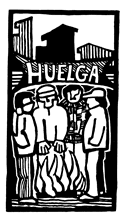
I have three pictures side by side in my house: John L. Lewis, Franklin Delano Roosevelt and Jesus. I draw Social Security on account of FDR. I draw a pension on account of John L. Lewis, and I'm going to Heaven because of Jesus.
-- Jack McReynolds, 70, retired miner, West Frankfort, KY
Preventing Hispanic Worker Deaths: An Uphill Battle in NC
Better start climbing
You wonder why there are so many immigrant deaths in American workplaces?
"I had one boss who told me to go to the top of a roof," Tomas Ramirez recalled. "I said, 'Give me a rope," and he said 'I had another guy do it without a rope; are you a chicken?' Well, I'm not a chicken, so I climbed up there without the rope."
In North Carolina, while workplace deaths and injuries are falling in general, Hispanic deaths and injuries are on the rise
In 2002, the last year for which complete statistics are available, there were 169 workplace fatalities in North Carolina. That was 17 percent fewer than the year before, and the lowest number since record-keeping began in 1992. It was a remarkable improvement, with one exception: 25 Hispanics died on the job that year, up from 20 the year before.
Since October, at least six more Hispanics have died on the job in North Carolina, Labor Department data shows. Two of them lost their lives this past Monday in separate construction accidents in Wake County, the latest reminder of the risks such jobs bring.
Workers of Hispanic origin are also over-represented in nonfatal work injuries. In 2002, Hispanics made up 5.3 percent of the state's work force, but 7.4 percent of nondeadly accidents that involved days away from work, according to data released last week by the Bureau of Labor Statistics.
State officials say they're trying to address the problem. Some aren't so convinced
Tom O'Connor, a Chapel Hill-based coordinator for COSH, a national network of worker advocacy groups, is more blunt.
"Whatever they're doing doesn't seem to be working," he said.
O'Connor is helping lead a campaign to impose tougher federal penalties on employers that don't follow safety and health regulations. He points to California, which three years ago raised the maximum civil fines for serious workplace safety violations to $25,000, compared with North Carolina's $7,000.
Cherie Berry, chairwoman of the N.C. Labor Commission, doesn't think that tougher penalties would fix the problem.
A lot of small businesses, she said, can't afford to pay fines higher than what her agency levies today, so why force them out of business? But Berry also called on more employers to step up to the plate.
"We're out there trying to point out the benefits of training workers in safety," she said. "But it's also incumbent on the industry to self-police."
OK, now let me get this straight. We don't want to fine businesses because they can't afford to pay the fines, but you're somehow going to convince them to shell out money to enjoy the "benefits" of making their workplaces safe? Seems to me that there's no greater benefit for a business than to avoid a fine that might put them out of business. (While I always hate to sound partisan -- I'm a uniter, not a divider -- it should be noted that the Ms. Berry's position is elected and she, unlike the rest of the North Carolina cabinet, is a Republican -- in case you couldn't tell from her "philosophy.")
And what is "self-policing" in this context? Are businesses going to fine each other? You get kicked out of the country club if you kill more than one worker per year? Maybe drivers should start self policing other drivers too. I've always wanted to make a citizens' arrest when someone runs a light and almost hits me.
Which is not to say that solving the problem is an easy task
In the 1990s, North Carolina had the fastest-growing Hispanic population of any state, Census data shows. The numbers have continued to soar through the recent economic downturn: Between 2000 and 2002, the state's Hispanic population grew an additional 16 percent to nearly half a million residents.
During the same three-year period, North Carolina's Hispanic work force grew 42.3 percent to 215,000.
In 2002, nearly 30 percent of Hispanic workers in North Carolina earned their living in construction, the industry that claimed more lives than any other that year: 44. One in five worked in manufacturing and one in 10 in agriculture, the industries that rank second and third in terms of fatalities.
The North Carolina Department of Labor doesn't have enough Spanish speakers and often can't keep those it has because they are lured away by better wages in private industry.
So what's the answer if you want to address the problem? Spend the money that's needed, increase the disincentives to killing workers, or rely on self-policing?
Senate Majority Leader Bill Frist says he wants to bring the industry-favored asbestos bill up for a vote in the middle of April. Although negotiations continue, the current bill doesn't look good. Here are a couple of T.V. ads opposing the bill, here and here.
I wrote the other day about ACOEM's (American College of Occupational and Environmental Medicine) curious choice of obesity for their 2004 Labor Day focus.
Brown University's David Egilman had some more observations:
I think Jordan has his dates messed up. Surely based on the date of release this must have been an April Fools joke. Or maybe it is serious and just the program is a joke.
As with tobacco this question presents an epistemological choice. (Of course ACOEM did and does not and will not deal with these. This is an easy answer organization.) Do we solely blame the victim or are there structural issues that "cause or contribute" to obesity?
How about the the obvious corporate efforts to influence children to eat unhealthy foods? Watch any commercials during Sat AM cartoons lately?
What are the corporate medical directors of McDonald's and that great health foundation Kellogg doing about that? Will the ACOEM spur them to action? This is so important (threatening) that ACOEM will avoid all discussion.
How about more subtle issues like stress at work or the distribution of power at work that may contribute to maladaptive behaviors? Will ACOEM call for a 35 hour work week and mandatory unionization? No. These are off the table certainly; they will not be discussed.
Or how about a society whose only raison d'etre is consumption? Should a society be organized around other (even additional) constructs like quality of life (6 weeks vacation), universal health insurance and guaranteed quality primary and secondary education?
David Egilman MD, MPH
Clinical Associate Professor
Brown University
Taking a few moments to write as the father of a college-bound daughter (and two more every two years).
Generally, I don't like New York Times political columnist David Brooks. That's because he really should have been a high school college counselor instead of a political columnist. His column today makes more sense than anything I've read on the subject. If you are in my situation read this. If you expect to be in the next few years, print this out and save it.
Forgotten among the thousands who died on 9/11 are the hundreds or more who helped rescue the victims and clean up the mess -- and are now still suffering the consequences, apparently without any notice, care or assistance from a government that told them the air was safe.
Hundreds of Ground Zero workers have lingering illnesses, but the government isn't paying for their care, said a leading doctor and two federal lawmakers.
Of 700 workers in a treatment program at Mount Sinai Medical Center, three-quarters still suffer from upper-respiratory problems brought on by work at the World Trade Center site, said Dr. Robin Herbert, co-director of the hospital's Center for Occupational and Environmental Medicine. More than 40% suffer post-traumatic stress, said Herbert.
"The rates of symptoms we're seeing do not seem to be decreasing much," Herbert said. "The health problems we're seeing are serious and persistent." Herbert said the center is still analyzing data from its health screening of 9,229 workers, but an initial sampling of 250 showed half still have health issues.
Representatives Reps. Carolyn Maloney (D-Manhattan) and Christopher Shays (R-Conn.) have introduced legislation that would require the federal government to pay for their treatment.
"The lack of federal coordination, delays in funding, and total absence of aid for treatment shows a shameful neglect of 9/11 health issues in Washington," Maloney said. "We hope to change that with this legislation."
Herbert said that without government aid, many of the workers have no way of paying for their treatment.
"Many of our patients have become disabled," Herbert said. "They have no income, no health insurance and, in the absence of a philanthropically funded program, no way to get any care."
Vhristie Whitman was Administrator of the Environmental Protection Agency on 9/11 and Newsday columnist Dennis Duggan thinks she might learn a lesson from Richard Clarke's apology:
Christie Whitman wasn't at City Hall yesterday. She was out among the horse set in Somerset County, behind the neatly trimmed hedges of her wealthy estate.
The people visiting City Hall yesterday were the walking wounded, the ones who believed her when she declared that the air at Ground Zero was safe to breathe just days after the Twin Towers were toppled.
Most of the people who believed her in September 2001 were numbed by attack. They wanted life to be as normal as possible.
So the apartment dwellers went in and cleaned up their homes, the kids went back to school, the Wall Streeters returned to work and the rescuers came down by the thousands to search for the living and the dead.
Whitman wasn't one of those at Ground Zero. At the time, she was in Washington, issuing her statement. "Our tests show that it is safe for New Yorkers to go back to work in New York's financial district," she said.
Workers comp in California and elsewhere is such a mess it makes you think that the solution might just lie in making sure workers don't get hurt in the first place....
The San Francisco Chronicle has a good article outlining the basic facts of the California Workers comp crisis which we've written about here before. Basically, in California, direct cash payments to workers are at or below the national average, but California employers pay the nation's highest rates for coverage due to the high number of claims that are filed and higher medical costs in California.
Governor Schwarzenegger (Jeez that's still hard to write -- but so is President Bush) has proposed a reform package that basically screws workers and is threatening to promote and even more drastic referendum if the legislature doesn't act to cut the current program in half.
Fraud is a Fraud
In addition to the main article, there are several interesting sidebars. One is about an insurance fraud investigator, Steven Begley, who spends some time tracking down cheating workers,
But left out of the public debate this year seems to be the cheating ways of their bosses.
Their scams, he said, include "not reporting all the claims they should be claiming, or running a shell corporation: changing the officers of the company on papers to lie and say you've never had experience running a business before. Or misclassifying your employees."
Is fraud a major problem? According to Begley it's a popular fiction:
While the level of fraud can't be judged by the number of cases investigated, that number is far smaller than some imply. In 1999, the most recent year for which statistics are available, 1.6 million workers' compensation claims were filed. Investigators are probing only 989 of those cases.
So, what's at stake?
Not much. Despite reformer rhetoric that plays on the notion of rampant fraud, the Schwarzenegger-backed ballot initiative doesn't call for an increase in the number of state investigators to tame it. Talk swirling around the expected compromise reform bill hasn't centered on fraud containment, either.
Confined Space is one year old today. Taking a moment to pat myself on the back: Almost 900 pages, well over a quarter million words...and I'm still married and employed (for now).
And think of what's happened since Confined Space hit the web. One year ago today, George Bush was president, OSHA was sinking into irrelevancy and still hadn't issued its Tuberculosis or Payment for Personal Protective Equipment standards, most public employees weren't covered by OSHA, immigrant workers were dying and being injured in record numbers, American soldiers were dying in Iraq and weapons of mass destruction had yet to be found.
Whereas, today, one year later.....
Nevermind.
Looking back, it's also time to consider whether I've reached my goals. My original idea for this Blog was to show, with concrete examples, that politics and voting matter:
Voting matters -- in national and local elections. It matters in big ways and small way, but it also matters in how safe their workplaces are going to be. It matters whether their children are going to grow up with unhealthy injured parents, or no parents at all. People need to understand that everything is connected. Tax cuts, growing deficits, appropriations, executive orders, regulatory "reform" -- it all affects our safety every day.
And finally, of course, I had
a grandiose notion that this Weblog might make a difference. Might make a few more people aware that something evil this way comes. It's here. And we need to recognize it, talk about it and do something about it.
So, have I made a few more people aware? I suppose so. I've gotten somewhere over 40,000 hits in the past year (and close to 70,000 page views), numbers that grow almost every month. I'm averaging around 200 a day, 1500 a week. Almost half of the hits are from searches, some looking for information on confined space safety or other health and safety issues, others looking for:
As if the work isn't hard enough, it's so hot in the laundry that nurses are joining laundry room workers at Acme Central Hospital to stage an action...
(You get the idea)
If I've managed to make a few people think for the first time about the proper role for government in protecting worker safety, about how the media not only under-reports workplace injuries, illnesses and fatalities, but rarely looks deeply into the root causes then it's a success. And perhaps some of the issue raised in this blog will grow up to become issues in this the upcoming elections.
On a personal level, I've found writing this blog to be enormously enjoyable. It gives me a reason to read everything I can find on workplace safety and health, to learn more about the issues and to think about what all of this means in the larger context of life in America's workplaces -- and in the American political landscape.
But most fulfilling, and unexpected, have been the e-mails I've received from families of workers killed on the job after they've found their husband's or father's or brother-in-law's names on Confined Space. At first I found it curious that people would be trolling the web months after the death, looking for....what? A sign that someone out there still remembers and cares, or maybe some actions that OSHA may have taken (but forgotten to inform the family about)? I don't know, but it's clear that they found on Confined Space some measure of satisfaction that there are others out there who are angry about what happened to their loved ones, and others who understand that their deaths were not "freak accidents," but tragedies that could have been prevented had the law been followed. And finally, that there are people out there fighting to see that tragedies like theirs don't happen again.
----
Fulfilling and fun, but also enormously time-consuming. Luckily I don't need much sleep and my teenage children would prefer that I be seen and heard as rarely as possible. My wife, Jessie, has been enormously supportive considering that she's rather computer phobic and this occasionally cuts into completion of my Honeydew list. And I've been reading the same damn book for three months (of course, it is 1000 pages long.) Hard to read books, blog and have a day job at the same time.
The challenge now is how to build readerhip. I had fantasies that every organized -- and lots of unorganized workers would be avid readers. I'm still around twenty to thirty million hits short. Confined Space has been linked on a number of local and international union websites, although it's becoming increasingly clear to me that most workers don't come home and surf the web every night (or at least they don't surf their union's webpages much). In fact most of my readership comes during weekdays, presumably at work. (On break time, I'm of course.) I occasionally collect e-mail addresses from union webpages and send e-mails. Generally I get more thank you's than curses. Basically I need to depend on all of you to spread the word.
So what does the future hold for Confined Space? My original intention was to keep it going at least until the election. After that, who knows? (in more ways than one). It's a lot of work (enjoyable as it is), so I've also been considering other options -- inviting a few more writers aboard and making this a "group blog," or possibly joining forces with one or more other similarly minded bloggers. (Volunteers know where to find me.)
Finally, thanks to all of you for reading, sending supportive notes and occasionally even commenting on individual posts. I think the main contribution this blog has made is creating a community of like-minded workers, activists and health and safety professionals. God knows, we need that community in times like these.
So here's hoping that by next March 29, our long national nightmare will have ended and we'll be moving forward again.
More Hanford Problems: DOE, Contractors Can't Get Injury/Illness Story Straight
Federal OSHA never fails to answer criticism againt the agency by boasting that injury and illness numbers have been falling steadily for several years. This may be good news, but is it accurate news. With the reports we hear of workers being encouraged not to report injuries, or being carted into work with broken limbs so that they aren't recorded as a "day away from work," can we believe the numbers.
Now we find that even the federal government is lying about workers injured on the job. The Washington Post reports today that:
The Department of Energy has failed to keep accurate count of worker injuries at nuclear waste cleanup sites across the United States, and its records often downplay the dangers of cleanup work, according to a draft audit by the department's inspector general
Not only that, but
The inspector general's investigation also found instances in which major cleanup contractors were not required by the department to report any information on how many workers were hurt or sickened while working around nuclear waste. It found that the department also fails to record a significant number of workplace injuries that contractors themselves have documented.
The most serious example was at the Idaho National Engineering and Environmental Laboratory, where the main contractor, Bechtel, reported 463 days lost to injury. The Department of Energy's database listed 166 days.
The Department of Energy and its contractors at the Hanford Nuclear Reservation in Washington State came under attack earlier this month for covering up work-related injuries and illnesses arising from exposure to toxic vapors.
Secretary of Energy Spencer Abraham has said he will not tolerate any contractor behavior that endangers workers. But critics of the Energy Department say that the Bush administration, as part of its push for an "accelerated cleanup" of nuclear waste sites, has created financial incentives for contractors to cut corners on safety and underreport workplace injuries.
In many cases, those incentives involve extra cash for companies that work fast. CH2M Hill, for instance, can earn a bonus of as much as $2 million for each waste tank it empties by 2006.
The system also penalizes contractors -- by taking away as much as 10 percent of contract fees that in many cases run into the billions of dollars -- if they report too many workplace injuries.
MUST READ: Put 'em to work, poison 'em, then move to China and fire their asses
This is an amazing and extremely disturbing article from the East Bay Express about AXT Inc., a Fremont, CA, semiconductor company which exposed its employees to airborne arsenic at levels four times the legal limit in 2000 and was issued "Willful" citations and penalties of $313,000 by Cal/OSHA, the California workplace health and safety agency.
Company employees were almost entirely recent Chinese immigrants who spoke no English. As a result of the Cal/OSHA inspections and fines, American Xtal Technology (AXT) moved its production operations to Beijing, China, where it now has a 1,000-worker factory doing the work that health and safety regulators in California would not allow.
Despite the reloccation of the major production operations, the company has been cited and fined three times since the 2000 inspection, including another set of "Willful" citations issued in June 2003, which are currently under appeal.
Every day, Chan poured industrial alcohol into dozens of boxes. She worked without goggles -- her supervisors did not provide any -- and her eyes were assaulted by the alcohol fumes and gallium arsenide dust. By the end of each shift, she and her co-workers would stagger to their cars, their eyes red, bleary, and inflamed, their vision so clouded they could barely see. At night, when Chan went to sleep, she says the pain felt as if someone were rubbing gravel and sand into the underside of her eyelids, or piercing her irises with little needles.
In October 2001, a woman on the cleaning crew asked Chan to look at her neck. "She asked if there are lumps in glands in her throat, and she went to the doctor the next day," Chan recalls. Her friend was eventually diagnosed with nasopharyngeal carcinoma, a cancer of the upper respiratory tract. She never returned to work and eventually was laid off. Today, she can no longer talk above a guttural wheeze.
The following April, another woman on Chan's crew was diagnosed with rectal cancer, which has left her unable to control her bowels. In the space of six months, half the members of her team discovered they were staring death in the face. Chan confronted her manager and asked if something was wrong with the air, but he told her not to worry. "They said, 'We have people working here for ten years, and they're okay,'" Chan says. "I was very worried, but I still had to work, so there was nothing I could do about it."
As it turned out, Chan wouldn't have to worry much longer. In September 2002, AXT outsourced her job to a new factory in China, firing her and more than one hundred other workers. When she came to pick up her two weeks of severance pay, she says, a manager told her that unless she signed a statement promising never to sue AXT, she wouldn't get her money. Chan signed the statement.
It's a common story in Silicon Valley as we've seen from recent lawsuits against IBM.
Workplace toxins and outsourcing jobs are hardly new to Silicon Valley. Personal computers and the Internet continue to transform our lives in many ways, but the building blocks of the high-tech revolution have left a toxic legacy in Bay Area soil and drinking water. Santa Clara County, for instance, now has 23 Superfund waste clean-up sites -- the most of any county in America: Nineteen of them are directly related to the high-tech industry and involve poisons such as freon, benzene, and trichloroethylene. The 1980s saw a disturbing rise in the incidence of birth defects and miscarriages in certain Silicon Valley neighborhoods, and the cost of cleaning contaminated sites and settling the subsequent lawsuits has run into hundreds of millions of dollars.
Moving production to China where AXT doesn't have to worry about worker health reveals the dark underside of globalization:
"The reason everyone talks about outsourcing is cheap labor," says Jim Puckett, founder of the Basel Action Network, a nongovernmental organization that tracks the spread of toxic chemicals across the globe. "But there are certain things that go hand in hand with cheap labor that no one wants to talk about. They include the lack of government occupational safety regulation, lack of tort law to redress a grievance, lack of labor unions. All of these things are part and parcel of outsourcing. You're not just taking advantage of cheap labor, you're taking advantage of marginalized and vulnerable populations, and the fact that you can poison people without ever having to face the music."
Much of the attention paid to the exploitation of immigrant workers focuses on the construction industry, but it's the same story here.
Young Shin, the executive director of Asian Immigrant Women Advocates, says employers hire workers such as Zhao precisely because they speak little or no English and know nothing of their legal rights. "It's not an accident that certain industries employ Asian females with no or limited English," Shin says. "It's institutional; it's a design to hire certain targeted populations. You're talking about immigrants who do not have networks to assert their rights, so it's an easy target for them. Second, this being the US, a monolingual society, when you don't speak English it's hard to get information about your rights. So you're targeting a population that's easy to exploit."
Read the entire article. It gets worse when workers experience increased exposures after the company had been inspected and cited by CalOSHA and then appealed the citation which meant the CalOSHA inspectors could no longer enter the plant until the appeal is resolved. And this article, along with many others appearing lately on the plight of immigrant workers in this country also raises important questions about whether federal OSHA or state OSHA's have the resources, ideas or will to tackle these problems. More on that later this week.
Two other things: The CalOSHA inspector who broke this story, Garrett Brown, is well known to many Confined Space readers. Garrett is also the coordinator of the Maquiladora Health & Safety Support Network, a volunteer network of over 400 occupational health and safety professionals who provide information, technical assistance and on-site instruction regarding workplace hazards in the 3,000 "maquiladora" (foreign-owned assembly) plants along the U.S.-Mexico border.
I also want thank the author of this article, Chris Thompson, for believing that Americans should care about how American companies treat immigrant workers in this country and in the countries that they flee to. Chris joins David Barstow, Justin Pritchard and Andrew Schneider in the Confined Space Journalism Hall of Fame. If you appreciated this story, send him an e-mail. Reporters need love too.
Occupational Physicians Group Makes Obesity the Focus of Annual 2004 Labor Day Checklist.
Every year the American College of Occupational and Environmental Medicine (ACOEM) identifies a topic for its "Labor Day Checklist" which is designed to provide "quick tips on a timely topic to improve the health and safety of workers, the workplace, and the environment." In past years, ACOEM has chosen hearing loss, occupational asthma, eye safety, communicable diseases, back injuries and ergonomics. Not a bad list.
So what to choose this year? It's probably not an easy decision. Look around. We have an epidemic of immigrant worker death, injury and illness. Asbestos-related illness remains a serious nationwide problem, and millions of workers face harmful exposure to toxic chemicals about which we know very little. Year after year, OSHA "enforces" the same forty year old chemical standards for a tiny fraction of the chemicals used in this country. Meanwhile, OSHA, the only government agency charged with enforcing safe workplace conditions is rapidly turning into a poorly funded business consulting association while thousands of workers die every year from perfectly preventable "accidents."
So what should ACOEM choose for its 2004 Labor Day list? So much to choose from. So few opportunities to make a splash. Definitely not an easy decision.
Or maybe it can be an easy decision. Why not just peruse the news and see what's popular these days? How about OBESITY? Yeah, that's the ticket. Everyone's jumping aboard the obesity train. The Bush Administration has declared war on obesity. Obesity among children is at epidemic proportions. Walks to raise money to fight obesity have joined walks to fund AIDS and Breast Cancer research.
Of course, people can take this all too far. Happily, we have the U.S. Congress (joined by a number of state legislatures) who have manned the trenches in defense of the embattled double bacon cheeseburger by passing legislation to ban lawsuits against the fat food pushers. (Thank heavens for the U.S. House of Representatives, which in the span of a couple of weeks has saved the Republic from both hamburger haters and breast exhibitionists.)
Happily, there are a few thinkers going against the flow. Responding to a 102-1 vote by the Florida legislature to ban lawsuits against restaurants and fast food vendors, the Palm Beach Post had the nerve to note that the Emperor is slightly underdressed:
Courageous lawmakers might have considered actually doing something about public health. At the least, public-service messages could instruct families on healthy eating habits. If the state gave public schools an adequate budget, they could afford physical education programs and wouldn't have to sell sodas and junk food in vending machines in an attempt to make ends meet. The governor's task force on obesity recently criticized the machines but offered no ideas as to how schools might afford to get rid of them. Without help from the state, they can't. If the legislators really wanted to take on a public-health problem, they might try doing something about the one in six Floridians who have no health insurance. How about some protection for those families?
But I digress. Back to trashing ACOEM.
What are they thinking? Enquiring minds want to know. A study in the January issue of ACOEM's Journal of Occupational and Environmental Medicinefound that
Workers' physical activity and physical fitness had a significant impact on their work performance. More physically active workers reported higher work quality and better overall job performance. As physical fitness increased, so did the quantity of work performed. In addition, more fit workers needed to expend less extra effort to do their work.
Obesity had a significant but negative impact on work. Twenty-two percent of workers in the study were classified as obese, and 4.5 percent as severely obese. Obese employees reported more difficulty getting along with coworkers, while severely obese workers missed significantly more days of work.
Again, I'm not saying that fighting obesity is a bad thing, nor is it necessarily inconsistent with the rest of ACOEM's mission, to promote the "health and productivity of workers, their families, and communities."
But come on people, everyone and their uncle is promoting the war against obesity these days, whereas almost no one (with the exception of labor unions and a handful of health and safety activists and enterprising reporters) is making any serious attempt to focus the public's attention on the continuing carnage in America's workplaces.
Instead of spending their time and resources telling people they eat too much, occupational physicians, organized by ACOEM, could use this opportunity to call attention to sick, injured and dead workers that almost no one else in this country seems to know or care about. For ACOEM to just melt into the throngs and choose obesity as the main focus of this Labor Day is, as one occupational physician told me, "an embarrassment to occupational medicine."
Connection Between Environment and Public Health? Industry Shocked and Panicked!
This is a really bizarre article. I mean, where have these people been for the past 30 years?
Chemical Policy Alert (no link) reports that
Bart Mongoven, who monitors non-governmental lobbying efforts for Stratfor, a private intelligence (sic) firm that consults with industry and government agencies, said in a March 23 speech to petroleum industry officials here that environmentalists are involved in a number of "coordinated" campaigns that are "gaining momentum," trying to attract patient advocacy groups to environmental proposals that promise to improve public health, as opposed to those that only protect the environment.
Now, I know industry people have always tried to label environmentalists as a bunch of tree huggers who didn't really care about anything except birds and snail-darters, but I never thought they actually believed it themselves.
"In five years, the environmental community would like to see all debates [be about] the environment and health," he said in a speech at the National Petrochemical and Refiners Association (NPRA) annual meeting. "Right now, the environmental community doesn't have the credibility with the public like it does in the Netherlands and Germany," he said, adding that emphasizing health "works here."
Mongoven said that environmentalists have traditionally focused health arguments on the impacts of toxic exposure to pesticides. But the advocacy groups have now broadened the debate to the health impacts of industrial emissions and effluent as well, he said.
Yeah, about 25 years ago. What planet have these people been living on?
He said that one way for industry to fight these new lobbying efforts is to paint the efforts as being "anti-chemical," rather than in favor of a public health goal.
Oh yeah. That'll work. Good idea, Bart! And here's another new idea. Maybe you can label them as anti-job too.
(Hmm. I'm clearly in the wrong business. Maybe I can start a consulting group and make speeches to industry organizations warning them that unions are starting to argue that workplace safety activities are starting to focus on worker health and safety, as opposed to, ah, union organizing, and, and this is really bad, because people actually care about their friends and neighbors and family members dying and getting maimed and sick at work! Yeah, that's the ticket. I could be rich.)
What really worries these guys is a group called Collaborative on Health and the Environment which has had some success building an alliance with patients rights and disease groups such as Alliance for Prostate Cancer Prevention, the American Cancer Society, the ALS Association and a number of other similar local and national organizations that are increasingly making the connection between environmental problems and chronic health issues. The Collaborative is headed by Stanford Professor Dr. Phil Lee, a former U.S. Assistant Secretary of Health and Human Services in the Clinton Administration.
And indeed they sound kind of wierd and scary:
The group, which was established in 2002, cites a range of pollutants that may be responsible for increased rates of chronic disease, including synthetic chemicals, heavy metals and related elements such as lead, mercury and arsenic. "Since World War II, more than 85,000 synthetic chemicals have been registered for use in the United States and another 2,000 are added each year, and few are adequately tested for their potential impacts on health," the group says.
Exposure to these substances may be responsible for increases in a host of diseases, including asthma, autism, birth defects, cancers, developmental disabilities, diabetes, endometriosis, infertility and Parkinson's disease, the group says on its website. As part of its efforts, the group strongly emphasizes the use of biomonitoring -- testing for the presence of toxins in the human body -- as one of a number of strategies to monitor human exposure to toxins.
And NPRA members are running scared
Some industry officials say Mongoven's speech raises concerns about the possible success of future environmental lobbying campaigns. "Quite honestly, your presentation scared the heck out of me," Charles Drevna, NPRA's director of technical advocacy, said after the speech.
And if they think they're worried now, wait until they see this:
Birth Weights Up After EPA Pesticide Ban, Study Finds
By Marc Kaufman
Washington Post Staff Writer
Thursday, March 25, 2004; Page A10
Researchers at Columbia University found that infant birth weights and birth lengths in upper Manhattan improved immediately after the pesticides chlorpyrifos and diazinon, used in a number of household products, were banned for indoor use by the Environmental Protection Agency beginning in 2000.
Yesterday I wrote about the chemical hazards faced by Korean nail salon workers. Today the hazards faced by another largely ignored group of workers -- Chinese food delivery persons.
Nearly six weeks have passed since Huang Chen, 18 years old, the youngest of three children and the only son of Ming Garden's owners, delivered a chicken dinner to a seventh-floor apartment in one of those brown buildings. Delivering takeout is how Mr. Chen died.
The authorities say that two 16-year-old boys decided to set up the deliveryman, that they stabbed him and beat him with a baseball bat for fear that he could identify them, that they wheeled his body out in a shopping cart before shoving it into his car, that they dumped his body in a pond about three miles away and that from this endeavor they realized about $50.
The boys were charged with murder, and the news media briefly revisited one of this city's continuing narratives, the victimizing of Asian food deliverymen. John C. Liu, a city councilman from Queens, who is Asian-American, called for a one-day moratorium on such deliveries, and suggested that while picking up their food, customers get to know the people on the counter's other side.
People needed to be reminded "that there are human lives and human faces behind the preparation and delivery of their food," Mr. Liu said this week. The reminder was necessary, he added, because he detects a racist component to the beating and killing of deliverymen - men like Mr. Chen.
"It's as though we're not American," Mr. Liu said, his voice rising in anger. "We're not human, even. We're not real people."
OSHA handed down a whopping $468,600 against Midwest Racking Manufacturing Inc. for a series of safety and health violations. OSHA accused the company
of violations ranging from electrical hazards to allowing smoking within 20 feet of a spray painting operation.
The firm, which makes metal storage racks, also is accused of not having protective covers on machines and not providing gear for workers' eyes and feet, as well as respirators.
So why the big fine?
OSHA has cited the company seven times since 1995 for total of $192,945 in fines for similar problems, federal officials said. It was unclear Wednesday how those fines had been dealt with.
Federal officials said the company has failed to correct some hazards in spite of offers of free assistance from OSHA.
The company is owned by Michael Sabados Jr., who is the president of the company, federal officials said. His father, Michael Sr., is operations director.
Federal officials said they were unable to determine whether any workers had been injured at the Madison plant, which was opened in 1994. They said the firm didn't keep records of injuries.
This story has one other ironic -- and tragic -- twist
Michael's brother, Richard, died in October when a forklift he was operating in Mishawaka, Ind., tipped over on him. He was installing shelving for Midwest Racking at a pet supply store.
I wrote a couple of weeks ago about Michael Gerstenslager, the Ohio highway maintenance worker who displayed a sign with the word "traitor" on a snowplow while helping provide security for President Bush's motorcade. Gerstenlager, a steward with the Ohio Civil Service Employees, AFSCME Local 11, was charged by the Ohio Department of Transportation (ODOT) with two work-rule violations and one Ohio Revised Code violation: posting an obscene gesture, the misuse of public equipment and insubordination. He accepted a two-week suspension without pay.
And then there was this other issue:
Peter Wray, a spokesman for the union that represents Gerstenslager - the Ohio Civil Service Employees Association - said he can't explain Gerstenslager's actions but complained that ODOT should never have provided security, at least not without reimbursement from Bush.
"With all the state cutbacks, we can't afford to be providing this type of support," Wray said.
Bush visited Cleveland to promote his economic policies, though his speech featured much of the same material he covers in his campaign speeches.
ODOT spokeswoman Lora Hummer said the state was not reimbursed for its employees' time. She said that the cost was "minimal" and that it is a "patriotic duty" to help. She described the state's involvement in Bush's visit as a "successful mission."
Gag me with a spoon.
Well, someone certainly did their patriotic duty. Maybe Gerstenslager should consider his two week suspension a campaign contribution.
OCSEA has been inundated with letters of support. If you haven't yet, you can send e-mails supporting Gerstenslager to Bruce Wyngaard at OCSEA.
'Reckless Endangerment' Ain't What It Used To Be...
Dude, that's harsh!
UPDATE: I didn't have the following article quite right yesterday. Reading the NY District Attorney's Press Release today, I discovered the following:
As a result of today's plea to Reckless Endangerment, Kaltech will be required to provide and pay for a comprehensive twenty-four hour course of chemical safety training resulting in an OSHA certification for all employees of sign manufacturers in the New York City area using chemical processes in their work who attend. All Kaltech employees - and those of other sign and chemical companies owned by Kaltech's principals - will be required to attend the training courses....At least 26 companies in New York City, Long Island and New Jersey will be invited to attend the training sessions. The training sessions, which will be advertised, are free and open to any employees of metropolitan area sign companies who use chemical processes in their work.
This is kind of an interesting concept -- paying to train worker from all similar companies in your area. Might be something to emulate.
-------------
For blowing up a building and injuring dozens of workers and bystanders in April 2002, Kaltech Industries has been sentenced to.....comply with the law.
NEW YORK (AP) A sign-making business pleaded guilty to reckless endangerment Wednesday and will pay to train its employees to use hazardous chemicals following an April 2002 building explosion that injured dozens of people.
Kaltech Industries, which stored hazardous chemicals in the basement of its building, entered the plea in Manhattan's state Supreme Court, prosecutors said.
Kaltech employees and workers at companies affiliated with Kaltech will be required to take the course, which would certify employees to use chemical processes in their work.
The April 25, 2002, blast collapsed the building's facade onto West 19th Street and frayed the city's nerves just months after the Sept. 11 terrorist attack.
Thirty-one people were hospitalized after the blast, which investigators say was caused by workers mixing incompatible waste products.
Doesn't OSHA's Hazard Communication Standard already require companies to train their employees?
The U.S. Chemical Safety and Hazard Investigation Board found last September one of the root causes of the explosion was the failure of Kaltech to train its employees in hazardous chemical and hazardous waste safety, as well as the failure of the NY City fire code to require training of employees who work with hazardous materials.
The Board recommended that Kaltech train its workers, that the NY Fire Code be revised to include worker training and that the fire department train its inspectors in safe management of hazardous materials.
On March 25, 1911, 146 young immigrant garment workers died in a tragic fire at the Triangle Shirtwaist Factory in New York City. This tragedy galvanized a city to fight for labor reforms and for fire safety in the workplace.
Great website on the Triangle Fire here. And order Triangle: The Fire That Changed America, by Dave Von Drehle from the Confined Space Reading list. Another article here.
Throughout this country immigrant workers are doing hazardous work whose dangers go almost unnoticed. They don't generally belong to unions, and they will almost never see an OSHA inspector.
Luckilly for workers in some parts of the country, there are COSH groups and other health and safety activists who attempt to educate and help these workers.
This article deals with efforts by NYCOSH to address the hazards faced by Korean nail salon workers in New York who are exposed to a number of solvents that cause cancer, asthma, burns, serious allergic reactions, liver and kidney damage.
It began with a runny nose and red, irritated eyes, but then came the coughing. Before long, Soonok Kim was having trouble breathing.
A doctor diagnosed her with severe asthma, which she believes was likely the product of more than a decade spent working at nail salons with little ventilation and lots of chemicals.
"My chest felt a lot of pain. My body felt weak," said Kim, 37, of Flushing, who worked as a nail technician for 11 years after immigrating to New York City from Seoul in the Republic of Korea in 1989.
"I felt like I'd be dead sooner or later," Kim said.
NYCOSH and the Young Korean American Service & Education Center will survey 100 of these workers to find out what they are exposed to and to try to prevent others from suffering health problems.
Evidence of illness has been mostly anecdotal, with workers relating symptoms such as asthma, skin rashes, burns and severe allergic reactions. Though the city's more modern salons have ventilation equipment and provide employees with face masks and gloves, Na said most salons remain packed into tiny, poorly ventilated spaces, providing little relief for workers.
Salon employees often work 10 hours a day with their heads bent inches away from a client's hands and feet, Kim described. Breaks come only when business is slow. Lunch is eaten next to trays of toxic nail polish removers and other chemicals.
"It's a workforce that no one pays attention to in an industry that's not really regulated," said Beverly Tillery of the Manhattan-based New York Committee for Occupational Safety and Health, a nonprofit coalition of unions, workers, physicians, and health and safety activists.
Michigan Republicans Vow to Cut Off Funding for Ergo Standard
Vowing to stomp out any hint of an ergonomic standard like it was a toxic weed, the Republicans in the Michigan state legislature are preparing to pass legislation cutting off funding for MIOSHA's work on an ergonomics standard. As I wrote previously,
In 2002, Michigan OSHA formed a steering committee to develop a framework for addressing an ergonomics rule and appointed members to the Ergonomics Standard Advisory Committee from management, labor and the public. Around half of the states run their own OSHA program and are able to issue their own workplace safety standard. Currently, California is the only state with an ergonomics standard. Washington state's was repealed last year.
After three meetings, Charles Owens, state director of the National Federation of Independent Business resigned from the Ergonomics Standard Advisory Committee because, he said, he realized that the mission of the committee was to develop a standard. Owens said that he had been under the impression that the purpose of the committee was to determine if a standard was needed. National NFIB was one of the most active business associations behind the repeal of the federal ergonomics standard in 2001.
According to Inside OSHA,
Within a week, House Appropriations Committee Chairman Marc Shulman (R-Oakland) will move to insert
language into the state’s fiscal year 2005 budget that will express the intent of the Legislature that no funds allocated to MIOSHA be used to promote development of an ergonomics standard. Shulman told Inside OSHA, “We [Republican lawmakers] have been informed that it [regulating ergonomics] just doesn’t seem like it is an economically feasible issue.”
Even though MIOSHA hasn't even yet issued a rough draft of a regulation, Shulman claims that early action is needed to protect workers' jobs: "When everyone is talking about jobs, jobs, jobs, we have to keep jobs in Michigan."
Now, this job blackmail attack is older than Adam Smith, and in times of high unemployment, it's particularly effective, as we have seen in Washington State. Of course, students of recent history may remember that Republican attacks on the federal ergonomics standard reached their zenith during the boom times of the Clinton administration. High unemployment, low unemployment. I guess no season is good for an ergonomics standard.
Even without Republican obstructionism, the standard faces a number of hurdles
The advisory committee is composed of an equal number of business and labor representatives, plus a public representative. Assuming it can reach agreement on a new rule, it would undergo a number of public hearings and would have to be approved by the two state standards commissions. In order to merit approval, the commissions must certify there is a "clear and convincing need" for the rule.
Finally, the Governor's Office of Regulatory Reform must sign off on the rule.
But hey. No point in putting everyone through all that pain. Might as well put it out of its misery now.
Have you ever noticed how Republicans champion states rights until some states impose stricter controls over business than the federal government? (or until they want to select a President -- but that's another story.)?
The latest is an effort by Congressman Michael Oxley to take away states' ability to regulate the insurance industry. including workers compensation insurance. Oxley's bill
would force the states to adopt uniform standards and permit the market to determine insurance prices rather than have them determined by regulators as is generally the case now.
That is music to the ears of many of the biggest insurers. Once content with sluggish state regulation as long as it remained relatively lax, they have been campaigning for a single federal regulator to replace those in each of the states as competition with banks and mutual fund companies has intensified. The insurers say they want efficiency: one-stop shopping and quicker approval of new insurance and investment products. Their critics say that they want less regulation and that customers would suffer.
One force driving the initiative is a desire to end what Mr. Oxley called "the travesty of price controls" in the insurance industry by allowing the market to set prices. He said his changes would increase profits for an industry that has been lagging behind banking and other financial service businesses and would give customers more choices.
Oxley's proposal is strongly opposed by the AFL-CIO and the Consumer Federation of America. According to the AFL-CIO's Rob McGarrah,
While many states have fairly weak insurance regulation, it's better than the total deregulation Oxley has proposed for the American Insurance Association.
Effective insurance rate regulation in Massachusetts and Virginia protected workers from benefit cuts this past year, but skyrocketing workers' compensation rates in Florida and California forced legislators to cut benefits, with Schwarzenegger demanding another $11 billion in benefit cuts by Friday or he'll again put his "jobs" initiative on the November ballot. (Since California deregulated workers' comp insurance in 1993 26 companies have gone bankrupt and rates soared 300% in the last 2 years) In New York, insurers are leading the opposition to our drive to increase the near-poverty $400 week benefit rate.
J. Robert Hunter, a former insurance regulator in Texas and now the director of insurance for the Consumer Federation of America says that
Americans are going to get ripped off. Insurance is not like other products. The policies are complex legal documents. Most people can't look at an insurance policy and tell whether they have a good one. It's hard to compare prices because coverage can vary greatly. You need someone looking out for the customer. The insurance companies aren't going to do that.
If you'd like to sign on to a letter opposing this legislation, contact Rob McGarrah at the AFL-CIO.
No, this is not a story about Taliban attacks on business women. This is a story about OSHA possibly going after companies -- especially small construction companies -- who hide behind complex corporate structures to avoid repeat violations from OSHA.
The Washington Post's Cindy Skrzycki writes that the Occupational Safety Review Commission is considering two cases of business owners who have owned a series of companies that have killed workers, but are fighting repeat OSHA violations because their original companies have gone out of business.
The cases in question stem from OSHA inspections that alleged the companies were violating rules that protect workers from falls and other hazards.
The safety agency cited Sharon and Walter Construction Corp., a general contracting company in New Hampshire, for repeat violations since the owner ran an earlier company that had the same employees and work, and had been cited in 1995. The company owes $10,750 in penalties.
Charles A. Russell, an attorney for Sharon and Walter, said his client should not be considered a repeat violator since the first venture, a sole proprietorship, went bankrupt. He also said the company should not be held liable for an employee who fell off a roof because he was an independent contractor.
The other case involves two New Jersey companies that are involved in pouring concrete for major commercial projects. OSHA alleged that through complicated family ownership provisions, Altor Inc. and Avcon Inc. were in effect owned by father and son, Vasilios and Nicholas Saites, and they should be personally liable for $292,300 in penalties for various safety violations.
Paul A. Sanders, a New Jersey attorney representing Altor and Avcon, said: "The individuals don't intend to pay the fees. They don't think they are responsible."
The AFL-CIO doesn't agree.
"It's about naming and holding the responsible parties responsible," said Lynn Rhinehart, associate counsel for the AFL-CIO. "These are a series [of cases involving] construction companies and they have been repeatedly cited for OSHA violations. There is evidence they manipulated the corporate form to evade OSHA penalties."
Interesting cases, but I'm not optimistic. The Post notes that these cases were selected a for review a while back by Democrat Thomasina V. Rogers. Currently the Board has two Republican members, in addition to Rogers.
Dennis Mulvihill in a letter to the Cleveland Plain Dealer (published by master-blogger Atrios) wonders
why the Republicans believe that hearing a four-letter word on the radio is more damaging than death or catastrophic injury. Consider that the Bush administration wants to increase FCC
fines for indecency up to $500,000 per violation per station, yet at the same time, it wants to restrict noneconomic damages in tort cases to $250,000 or $350,000.
So if a DJ says a four-letter word on the radio, the harm is so appalling that a fine of $500,000 per word, per station is justified. But if someone is paralyzed, killed or otherwise catastrophically injured, the most the family could get for the (noneconomic) loss would be up to $350,000.
Good point.
The same analogy could be made for OSHA citations. It's a lot cheaper to willfully kill one of your employees than to call them a "fu*kwad" on the radio.
OSHA's inaction is even getting to be too much for normally sober occupational health and safety journals. Jerry Laws, editor of Occupational Safety and Health magazine notes that
On Feb. 2, the U.S. Chemical Safety and Hazard Investigation Board formally notified OSHA that it won't quietly accept the cooperative, anti-regulation approach OSHA favors. (I'll get angry letters from some readers over this statement, so watch our magazine's Letters page in upcoming issues. Here's my response: What other description fits an agency that scraps its own proposed regulations on tuberculosis, employer-paid PPE, and a musculoskeletal disorders column on the recordkeeping form, to name a few examples, and instead stays busy signing "alliance" agreements and lowering the bar so it can pad the ranks of its Voluntary Protection Program?)
You may remember that in January, the CSB found that OSHA's non-response to their recommendation that the agency revise its Process Safety Management standard to include reactive chemicals to be "unacceptable.
Noting that OSHA had also been dinged by the New York Times at the end of last year, Laws was unimpressed with OSHA director John Henshaws response to the CSB determination:
Henshaw had a quick answer ready when The Times focused on his agency's weak enforcement in fatality cases. He quickly answered [CSB Chairman Carolyn] Merritt, as well: "Our comprehensive approach to address hazards is a sound one. . . . We welcome the opportunity to continue to work with the Board and would consider further information they provide us." He could answer even faster by simply telling the truth: We aren't in the business of writing new rules.
And sometimes I think Confined Space is the only publication out there that sees OSHA for what it's really become. Welcome to the crowd, Jerry.