One of the major problems with ensuring the ssafety of workers in the country is the lack of staffing and resources that federal OSHA or OSHA state aplans have to enforce the law. The AFL-CIO calculates that at its current staffing and inspection levels, it would take federal OSHA 117 years to inspect each workplace under its jurisdiction just once.
But Montgomery County, Maryland seems to be strongly considering launching a new initiative that could effectively leverage Maryland OSHA's limited resources. On Thursday, December 14, the Montgomery County Commission on Health issued a long-awaited report calling for county action to combat occupational hazards in the region's workplaces.
The seven point plan includes proposals which range from making the issuance of building permits contingent on contractors providing safety training, to publicizing businesses with exemplary safety records. However, the key recommendation in the plan is a proposal to train health inspectors, building inspectors and others to identify workplace hazards and file charges with MOSH, Maryland's state OSHA program. The proposal would also funnel money to immigrant rights groups and other community groups to do the same.
The principal author of the plan is Commission member Jim Grossfeld, a member of the Washington-Baltimore Newspaper Guild / CWA. Despite the fact that Montgomery County is one of America's most liberal counties -- and among its wealthiest -- he anticipates a tough battle to win approval of the plan by the County Council and County Executive.
Grossfeld points out that some have claimed that county action is unnecessary since Maryland's new, Democratic governor, Martin O'Malley, will revitalize MOSH. But he and others argue that, even with added support from Annapolis, MOSH "cannot be effective absent involvement by local government and community groups." He notes the recent study by the International Labor Organization (ILO) which found that, in order to make jobs safer, developed countries like the U.S. ought to have one health and safety inspector per 10,000 workers. "That means Maryland ought to have roughly 300 inspectors, but MOSH has fewer than a quarter as many today."
Supporters of the plan, led by organized labor and Casa of Maryland, say their approach could be used to extend MOSH's reach in other Maryland counties, too. However, they also warn that county officials shouldn't assume that the approach they're recommending is cost-free. "Any time you give a county employee additional responsibilities you need to be prepared to hire additional workers to help carry them out."
In addition to Grossfeld, the proposals have been backed by two other labor members of the Commission on Health: Silvia Casaro, who is the client services coordinator for the Metro Washington Council; and Lee Goldberg, policy director of SEIU's Long Term Care Division.
You can also see and hear Jim elaborating on the program here on The Coffee House, a cable TV magazine of public affairs and the arts.
Those seeking additional information on the effort in Montgomery County are invited to contact its supporters at: saferjobs@att.net.
Showing posts with label Immigrant Workers. Show all posts
Showing posts with label Immigrant Workers. Show all posts
Saturday, January 13, 2007
Thursday, September 21, 2006
"Repugnant" Companies That Deny Workers Comp for Undocumented Workers
Yet another in a growing number of disgusting news stories about how insurance companies are trying to get out of paying workers comp for injured undocumented workers. It's not enough that they do the most dangerous work in the country, for low pay and suffer a higher and climbing rate of injuries and fatalities than non-immigrant workers. Let's screw them when they get hurt as well.
This article by Liz Chandler in the Raleigh News and Observer tells the story of Francisco Ruiz who, after losing his job in Mexico, crossed over the border to the United States and got a job with the Belk Masonry Co. which offered him $300 a week to work as a laborer for a masonry crew. On Oct. 7, 1997, a crane hoisting Ruiz along with a load of bricks collapsed, throwing him to the ground where the bricks rained down on him.
Just another day's work for Companion.
Related Articles
This article by Liz Chandler in the Raleigh News and Observer tells the story of Francisco Ruiz who, after losing his job in Mexico, crossed over the border to the United States and got a job with the Belk Masonry Co. which offered him $300 a week to work as a laborer for a masonry crew. On Oct. 7, 1997, a crane hoisting Ruiz along with a load of bricks collapsed, throwing him to the ground where the bricks rained down on him.
He broke a rib and injured a kidney, and his right lung collapsed. He also hit his head on the floor, severely injuring his brain's frontal lobe, which controls language, memory and motor function.Ruiz took the company to court and won.
Ruiz was in a coma, able to breathe only with a ventilator.
His younger brother, Jose, left his wife, two young children and his job in Mexico and rushed to Charlotte.
Ruiz's wife followed, with a temporary pass to enter the country, leaving her three children behind. When she arrived at Carolinas Medical Center, she found the Virgin of Guadalupe medal in her husband's hand.
Nurses were hoping for a miracle, but at Belk Masonry, a counterattack had begun.
The Companion Property & Casualty Insurance Co. paid his initial medical bills, but adjusters wanted to know all about Francisco Ruiz. When they discovered his illegal work status, they rejected his claim.
The law in North Carolina, as in most states, says that illegal immigrants who are hurt on the job are entitled to compensation. Companies, the law says, must pay injury benefits to "every person engaged in employment ... whether lawfully or unlawfully employed."
But officials at Companion Property & Casualty questioned the law's intent. Why should they pay an alien who lied about his immigration status to get his job? How could an illegal worker technically be considered an employee?
It would be "repugnant," the court said, for a company that benefited from a worker's labor not to pay him for an injury. Whether the worker was illegal didn't matter.The company appealed and after winning several appeals over five years, the case finally reached the North Carolina Supreme Court which refused to hear Companion's final appeal. Another year to settle and Ruize was finally awarded $438,000.
Just another day's work for Companion.
The company was disappointed but not surprised.Deep pocket? How about the the legal obligation of companies and workers comp insurers to pay the costs of workers' deaths, injuries, medical treatment, lost wages and disabilities. -- whether or not they're "legal."
"We're always viewed as the deep pocket," said Companion President Charles Potok. "If you're talking about paying somebody or cutting someone off cold, we typically lose."
Related Articles
- "Violation of the American Spirit" -- Immigrants Denied Workers Comp, September 17, 2006
- Throwaway Workers, Part 2: Labor Day For The Most Vulnerable, September 4, 2006
- Throwaway Workers: The Immigrant Experience, September 4, 2006


Monday, September 04, 2006
Throwaway Workers, Part 2: Labor Day For The Most Vulnerable
 The Chicago Tribune's second installment of "Throwaway Workers" appears today. It deals with immigrant workers who have been seriously injured on the job, and the lack of medical or financial support they receive -- because the companies haven't provided insurance, because they just go out of business, or because they just refuse.
It's depressing reading, even for someone like me who's up to his elbows in these stories every day. Reading their series is like re-reading The Jungle or some other century old story of how badly workers were treated before we realized that it was inhumane to treat humans like that, and passed laws to criminalize such treatment. The problem, of course, is that these stories are taken from toay's workplaces, and for that we should all be ashamed.
But before going into the gory details, I want to take a moment to sing the praises of the authors, Steve Franklin and Darnell Little. Most reporters don't even take the time to notice the conditions under which workers work, particularly those who are at the bottom of the heap. Even where journalists report on working conditions, injuries and deaths, they rarely go beyond "the employer said this..." and "OSHA said that..."
Compare that with the work they've done on this series:
Work on these articles began in December when photographer Abel Uribe began interviewing injured workers and their families. Besides available government records and interviews, the stories are based on Tribune reporter Darnell Little's analyses of 35 years of U.S. Occupational Safety and Health Administration records, 14 years of Bureau of Labor Statistics worker fatality data and 12 years of national fatality records. Little and reporter Stephen Franklin interviewed workers and numerous government, public health and union officials, as well as worker safety advocates.As I said yesterday, while most of the Labor Day news articles deal with unions, statistics and politics, Franklin and Little are talking about real workers -- what Labor Day is really about. And the picture isn't pretty:
Raul Rosas lies in pain in a dark, foul-smelling hovel that resembles a shallow cave more than a basement.And the current media and election year political frenzy around "illegal immigrants" is making the problem worse.
Paralyzed in a workplace accident five years ago, he survives by selling fruits and vegetables from a wheelchair on a Chicago street corner. But now he is sick with a stomach infection and can't buy medication because he has no way to get to a drugstore.
Since losing the ability to walk, Rosas' life has shrunk to the barest existence. He is a veritable ghost, and a depleted one because he is an illegal immigrant and therefore ineligible for all government assistance beyond emergency room care.
"It is very hard," he said dejectedly, turning his crumpled body away.
When an undocumented worker has an accident or gets sick, it puts pressure on the families, who must do without a paycheck, and it puts pressure on the public health system, because the workers are less likely to have insurance.
This is an issue at the heart of the debate over immigration reform: whether the economic contributions of illegal workers outweigh the costs, and whether they should remain in the U.S. at all.
What's been overlooked are the risks the workers take, the price they pay and the impact.
Because they tend to exist in the shadows, beyond the workplace protections that others take for granted, the undocumented are more likely to face hardships after their accidents. Some return home. Others remain in the United States, partly because they still can earn more income here.
Rosas, an immigrant from Mexico, was hired to remove a tree from a back yard. The tree fell and seriously injured him.
"The guy he was working for didn't even want to call the ambulance," said Ramon Canellada, a disability coordinator at Schwab Rehabilitation Hospital on Chicago's South Side, where Rosas was briefly treated.
Since then, Rosas has not received any government-supported therapy, or any medicine or a wheelchair. He bought those himself. One of his few protectors is Canellada, who has tried to keep an eye on him, even scrounging for parts for Rosas' electric wheelchair.
Fiercely independent, Rosas, 48, lives on whatever he earns from fruit-and- vegetable sales during warm-weather days. He pays $300 a month for his tiny corner of the basement, which he shares with two other Latino workers.
Before the recent uproar over illegal immigrants, Rene Lune, a worker with Access Living, a Chicago agency that helps the disabled, would refer injured Latino workers such as Rosas to public health agencies, which might overlook their immigration status and provide help.OSHA, to its credit, recognizes that there health and safety conditions for immigrant workers is a problem. But, although the agency is attempting to hire more Spanish speaking inspectors and building coalitions with community groups in some cities, their efforts had little effect for a variety of reasons -- the inadequate resources the administration has dedicated to the effort, inadequate OSHA fines, along with the eternal tension between jobs and safety:
"Now with all of the strict background checks, [agencies] won't do it," Lune said.
The worker's compensation system is supposed to help injured workers such as Rosas with recovery--and that includes illegal immigrants. Nearly every employer in Illinois is required to provide such coverage.
But because of the risky or marginal jobs held by illegal workers and the types of employers they work for, the system hasn't exactly benefited Latino workers.
Many are injured while working for small businesses that have neither health insurance nor worker's compensation coverage, said attorney Jose Rivero. Some larger companies, he added, don't think they have to provide benefits for their "clandestine" workforce.
For years the state did little to make sure employers complied with the state's worker's compensation law. From 1983 to 1996, the Illinois Workers Compensation Commission kept shut its compliance unit for budgetary reasons, according to state officials. It now has four workers, none of whom speaks Spanish.
Asked how many employers comply with the law, state officials, replying by e-mail, said they didn't know but were looking for ways to find that out.
To begin, the agency's ranks are limited, they say. Then there is the wave of fear that swept Latino communities last year after Homeland Security officials, posing as OSHA representatives, called a "mandatory" safety workshop in North Carolina and arrested the workers who showed up. OSHA officials say that was a wrong thing to do and won't happen again.Finally, take a look at the comments back on the main page of the series (right hand side, in red). There are a troubling number that are of the opinion that because they're "illegal," they deserve what they get.
There also is the broad reluctance of workers and others to identify dangerous workplaces.
"It is better. People know who we are," said Michael Connors, OSHA's regional head in Chicago. "But it is not like we are getting any calls or complaints from the community."
Nor, Connors said, do physicians alert his agency.
Jose Oliva of the Chicago-based Interfaith Committee on Worker Issues, an advocacy group, said it has a unique arrangement with OSHA that allows it to relay workers' anonymous complaints. It was the first of its kind in the nation, and OSHA officials hailed it as a way to reach workers.
But sometimes Oliva is reluctant to name companies.
"It is hard for us," he said. "You know you are putting people back into danger. [But] if the company went out of business, you would have 300 people out of jobs."
Not long ago he decided not to file a complaint with OSHA against a Bellwood company after it agreed to hire back about 25 Latinos who had been let go because they took time off to march in an immigration rally. Some workers had complained that the firm did not provide safety equipment and that fans failed to ventilate toxic fumes, Oliva said.
A month after the company rehired the workers, an explosion there killed a truck driver making a delivery and injured three factory workers and two firefighters. OSHA officials said they are investigating the incident at Universal Farm Clamp Co.
It's time to crack down on employers who hire illegal immigrants. As for the immigrants, they have a choice: take your chances working a dangerous job or leave the country.I've written about this before (here). We can deal with this issue on a practical basis: Not enforcing the law for immigrants just makes it more attractive for employers to hire them and makes work even more dangerous for everyone else (complain about you're working conditions and we'll just fire you and hire someone who won't complain.)
Submitted by: danielle
We can also look at the situation from a moral basis -- how we like to think of ourselves as a nation. My opinion is that the compassion of a nation should be measured by how they treat those who are most vulnerable. By that test, we're failing.
Throwaway Workers: The Immigrant Experience
The raging debate over this country's immigration policy tends to focus on how high we build the walls, and whether or when those who have been working here for years will be given the opportunity to become citizens. Lost in the debate is the issue of the work that the immigrants are doing, and how many get injured or killed.
Instead of talking about the fate of unions and trends in wages, Chicago Tribune writers Steve Franklin and Darnell Little are marking Labor Day 2006 by writing about actual workers -- telling the stories of "throwaway workers," Latinos who labor and die in the country's most dangerous jobs.
Instead of talking about the fate of unions and trends in wages, Chicago Tribune writers Steve Franklin and Darnell Little are marking Labor Day 2006 by writing about actual workers -- telling the stories of "throwaway workers," Latinos who labor and die in the country's most dangerous jobs.
Before the accident, he had warned the owner of the small Diversey Avenue dry cleaner that the pressing machine was old and dangerous. But his boss told him to forget about it and Mario, fearful of losing his job, didn't say another word.They note the disproportionately high injury and death rate of immigrant workers:
Then one day last winter the massive, steaming press collapsed on Mario's left arm, melting the skin, mangling his fist and costing him a $5.70-an-hour job. There was no health insurance, no worker's compensation benefit and no severance pay offered, Mario said.
"If you don't have papers, you work eight or 10 hours a day, six days a week, and you don't complain," said the muscular, middle-age illegal immigrant from Mexico.
Much of the furor over immigration reform has been about whether undocumented workers like Mario should be allowed to stay in the U.S. or made to leave. But beyond that debate lies an undeniable fact: They face disproportionate dangers on the job.
While non-Latino workplace fatalities dropped 16 percent between 1992 and 2005, Latino workers' deaths jumped 72 percent during the same time. Last year the fatality rate for Latinos was 4.9 per 100,000 workers, a rate unmatched by any other group. They accounted for more than 16 percent of all deaths though they make up only 13 percent of the workforce....and why it's happening:
Of all the workplace deaths investigated by the U.S. Occupational Safety and Health Administration in the Chicago area in the last three years, half involved immigrants. Federal officials say nearly all of them were Latino.
They are vulnerable because many are immigrants who are illiterate in English, have little understanding of American culture and are grateful for any job, no matter how dangerous. And because many are undocumented immigrants, afraid of being deported, they often don't ask questions and don't challenge the boss.And the exploitation doesn't stop after they're injured:
"They shouldn't be dying and they don't even have the same rights to complain. Being illegal, they fear retaliation. This is assuming that they know that what they are doing is dangerous," said Jordan Barab, a workplace safety advocate in Washington, D.C., and a former union health and safety expert.
Lawyer John Budin, who regularly is consulted by injured workers, said it's common for bosses to refuse to pay medical bills or to warn undocumented employees against filing a worker's compensation complaint.Language difficulties aren't just inconvenient; they can be deadly:
"I had a guy come in this week whose boss said, `I'll call immigration and get you deported back to Mexico if you file,' " he recalled in an interview last month. The worker, he added, is worried and thinking it over.
The failure to communicate may have been fatal for a 16-year-old Latino youth who fell from a construction project and hit his head in May 2004 in South Carolina. The construction boss told the crew chief to take him right away to a hospital. The boss later told federal officials that the crew leader usually understood English. But the leader took the youth to his home and gave him aspirin instead. The teen died that night.The authors also examine the strange fact that while fatalities are going up for immigrant workers, injuries seem to be going down.
"We have investigated a number of cases where the victim was Spanish-speaking and the training was only in English, and there was little or minimal attempts to translate it into Spanish," said Dawn Castillo, an official with the National Institute of Occupational Safety and Health, the research arm for the nation's worker safety and health effort.
But James Platner, head of research for the Washington-area Center to Protect Workers' Rights, a construction union-backed organization, seriously doubts that.The immigration debate will go on through this election season and beyond. But whatever side you take, remember that they came to this country to work; they didn't come to die.
The reality, he and others suggest, is that there is a vast undercount of the injuries because Latino illegal immigrants stray far from public facilities and do not report their wounds. If they do get care, they are often reluctant to explain where their injuries took place.
"It is hard to get the real story because they are afraid," explained Dr. Eileen Couture, head of clinical care at Cook County's Oak Forest Hospital.
"You say this [accident] has to be reported and they say, `You don't understand, I need my job. You don't understand, I have to feed my family.' You don't want them walking out, so it is a give and take."
Monday, July 17, 2006
Meatpacker's Treatment of Workers and Animals: Not Kosher
Something's not Kosher in Iowa.
Kosher beef is not only tastes better, according to many meat eaters, but it is good for the soul as well, because Jewish law requires that animals be killed quickly and humanely, and the processes must be approved by supervising rabbis.
Unfortunately, at least in one Kosher meat processor, AgriProcessors Inc in Iowa, not only are the cows allegedly not killed humanely, but the human workers aren't treated humanely either, according to a long article in last May's Forward:
Kosher beef is not only tastes better, according to many meat eaters, but it is good for the soul as well, because Jewish law requires that animals be killed quickly and humanely, and the processes must be approved by supervising rabbis.
Unfortunately, at least in one Kosher meat processor, AgriProcessors Inc in Iowa, not only are the cows allegedly not killed humanely, but the human workers aren't treated humanely either, according to a long article in last May's Forward:
One of those workers — a woman who agreed to be identified by the pseudonym Juana — came to this rural corner of Iowa a year ago from Guatemala. Since then, she has worked 10-to-12-hour night shifts, six nights a week. Her cutting hand is swollen and deformed, but she has no health insurance to have it checked. She works for wages, starting at $6.25 an hour and stopping at $7, that several industry experts described as the lowest of any slaughterhouse in the nation.Now, the Washington Post reports that two Conservative Jewish organizations have created a task force to investigate the problems at the plant:
Juana and other employees at AgriProcessors — they total about 800 — told the Forward that they receive virtually no safety training. This is an anomaly in an industry in which the tools are designed to cut and grind through flesh and bones. In just one month last summer, two young men required amputations; workers say there have been others since. The chickens and cattle fly by at a steady clip on metal hooks, and employees said they are berated for not working fast enough. In addition, employees told of being asked to bribe supervisors for better shifts and of being shortchanged on paychecks regularly.
"Being here, you see a lot of injustice," said Juana, who did not want her real name used because of her precarious immigration status. "But it's a small town. It's the only factory here. We have no choice."
A month after the [Forward] piece ran May 26, the Rabbinical Assembly and the United Synagogue of Conservative Judaism launched a fact-finding study to find out what wrongs, if any, are being committed at the plant in Postville, Iowa.Workers report being treated like animals:
On Manuel's first day, he said, he found himself slicing up chicken carcasses without even receiving the hour-long orientation that other workers had described.And People for the Ethical Treatment of Animals allege that the animals aren't treated very well either:
"There's no training," he said. "You learn by getting chewed out."
Now, Manuel arrives each day at 4:45 a.m. Although the Supreme Court decided last year that meatpacking plants must pay their workers for donning and doffing — dressing and undressing before and after work — Manuel and the union organizers who lived in Postville said that the workers are not allowed to punch in until they take their positions on the line. Rubashkin responded by saying that the company did change the rules when the Supreme Court ruling came down.
Manuel works 10-hour days in the chicken department. Lunch breaks are 30 minutes, but after taking on and off the bloody smocks and masks at the beginning and end, there is closer to 15 minutes' time left for eating. Dozens of workers on a shift share the cafeteria, and the workers say there are only three microwaves, which short-circuit when used simultaneously.
"I've said, 'Why do you treat us like this?'" Manuel said. "We're human beings, not animals."
People for the Ethical Treatment of Animals has also campaigned against the slaughterhouse in recent years, alleging that workers, including rabbis, ripped the tracheas and esophagi out of the throats of fully conscious cows, which were left trying to stand three minutes after their throats were slit.OSHA also isn't pleased with the company's treatment of workers:
PETA cites a 2004 videotape it says was obtained by an undercover cameraman for the group. In the video, cows that have had their throats slit are shown writhing on the ground of the plant in pools of their own blood. AgriProcessors denied charges of inhumane slaughter then, telling PETA that its practices complied with kosher law.
Temple Grandin, a designer of livestock handling facilities and the author of several books on animal handling, welfare and facility design, saw the PETA tape but has not been allowed to visit the facilities.
"During my career I have visited over 30 kosher beef plants in the U.S., Canada and other countries . . .," she writes on her Web site. "Kosher slaughter without stunning can be done with an acceptable level of welfare when it is done correctly. When shehita [Jewish ritual slaughter] is performed correctly with the long knife, the cattle appear not to feel it. This tape shows atrocious procedures that are NOT performed in any other kosher operation."
When it comes to outside regulatory agencies, the Occupational Safety and Health Administration have tagged AgriProcessors this year with six violations. That amounts to more than half the violations in all Iowa meatpacking plants during that time, according to OSHA statistics.And the Agriculture Department isn't very happy about the plant's treatment of animals:
In March, the U.S. Department of Agriculture released a report finding that AgriProcessors had indeed violated provisions of the Humane Slaughter Act. The USDA did not, however, pursue criminal charges.
Thursday, March 23, 2006
More On The Death Of Francisco Alejandro Garcia
We have a little more about the poorly-reported death of Francisco Alejandro Garcia. You may recall that I was rather upset at the lack of information in the article about his death.
First, Mary Vivenzi whose boyfriend Kevin Noah was killed, falling from Golden Gate Bridge in 2002 while working on an earthquake retrofit project, sent a letter to the WBDJ who ran the original story.
And speaking of journalism, Cathleen in the comments brought our attention to the local newspaper, the Martinsville Bulletin, which has done some decent coverage of the story (but is apparently too small to show up in Google.)
It seems that Garcia was working for a contract company, National Service Co. of Mt. Pleasant, Iowa, that cleans industrial equipment. Garcia was on a platform above a processing machine, hosing off the moving blades with a water hose when he fell in. No one observed him fall, but he apparently either slipped or the hose got tangled in the blades. (Guardrails? Lockout?)
The result was not pretty:
Garcia's brother-in-law said that "neither he nor anyone in the household has been contacted by Knauss or National Service since the accident, and he has not known how to reach appropriate authorities to make inquiries."
First, Mary Vivenzi whose boyfriend Kevin Noah was killed, falling from Golden Gate Bridge in 2002 while working on an earthquake retrofit project, sent a letter to the WBDJ who ran the original story.
I would like to inquire on what do you base the importance of your journalistic efforts when deciding what or what not to give a story.And the station's response?
Because it is personally offensive that when reporting such a tragic event as a workers death you would not allow your journalism to extend itself further than a whole paragraph I fail to understand why this article seemingly failed in comparison next to that of your article Radford student gets big chance on Price Is Right which somehow managed to merit the importance of a full page story. It makes me angry and it makes me sick and once again gives merit to my belief that there are those who come to work for the love of what they do and others who only show up for the check.
Its a sad thing when the public is forced to rely on passionless journalism as a source of information. And sadder still to imagine how hard your lack of compassion affects those who need you most.
Our information was based on a brief news release from the Henry County Sheriff's Department sent to us Saturday evening. That was all the information available to us all weekend. We passed along all we had regarding the circumstances both on the air and on the Internet.What elements you failed to present? How about what happened? What safety standards might have been violated? What other workers had to say about working at the plant? The company's safety record? You know, "journalism." And it's not always necessary to invade the privacy of grieving families to get some useful information -- especially, as we shall see, there most of the grieving family wasn't even there.
Perhaps you are upset we did do more on this story Monday, although by then, the events were three days old. And we have learned over and over that grieving family members resent media inquiries as they prepare to bury a loved one.
But that does not mean we are done with the story.... we will request a copy of the state or federal safety inspection report.
Nonetheless, we regret that you find our response to be inadequate, and we do not pretend to be perfect in our decision-making process. Please let us know what elements to this story we failed to present that you believe are important and deserve our further attention.
And speaking of journalism, Cathleen in the comments brought our attention to the local newspaper, the Martinsville Bulletin, which has done some decent coverage of the story (but is apparently too small to show up in Google.)
It seems that Garcia was working for a contract company, National Service Co. of Mt. Pleasant, Iowa, that cleans industrial equipment. Garcia was on a platform above a processing machine, hosing off the moving blades with a water hose when he fell in. No one observed him fall, but he apparently either slipped or the hose got tangled in the blades. (Guardrails? Lockout?)
The result was not pretty:
The State Medical Examiner's Office in Roanoke completed an autopsy of Garcia on Monday. Dr. William Massello, assistant state medical examiner, said Garcia's cause of death will be listed as multiple injuries from body fragmentation. He said it would be accurate to say Garcia's body was pulled into pieces when he was caught in the machine.Sadly, Garcia's wife and child were on their way from Mexico to visit him when he was killed:
A week and a half ago, Alejandra Jimenez Arias was a happy young wife and mother with a promising life ahead of her. She had left Mexico with her 2-year-old daughter, Zuemy, on a week-long, 3,000-mile journey, expecting a joyous reunion with the husband and father they had not seen for 10 months.The community is taking up a collection from Hispanic stores and Mexican restaurants throughout Virginia and South Carolina where many of their townspeople and distant relatives live. They're trying to raise the $6,800 it will take to send his body back to Mexico for burial.
She arrived in Martinsville on Monday as a widow.
When Arias reached the Mexican/American border late Friday night and called her husband to tell him that they were nearly here, her brother-in-law answered. Julio Cesar Alejandro Garcia broke the news to her that 19-year-old Francisco Alejandro Garcia had died that evening when he fell into a processing machine at the Knauss Snack Food plant.
Garcia's brother-in-law said that "neither he nor anyone in the household has been contacted by Knauss or National Service since the accident, and he has not known how to reach appropriate authorities to make inquiries."
Monday, February 27, 2006
Immigration To Impersonate OSHA Only If National Security Threatened
OK, so if Osama Bin Laden or some of his buddies sneak onto a military base as undocumented construction workers, and the Bureau of Immigration and Customs Enforcement (ICE) thinks they might be likely to take a break from plotting the downfall of Western Civilization to attend OSHA training, they might then -- and only then -- again use the tactic of imitating OSHA personnel to nab the terrorists.
Or at least that's what ICE officials are telling Occupational Hazards.
ICE officials admit that the North Carolina raid last Summer, where they invited undocumented workers to a phony OSHA training, was a mistake because they didn't coordinate with OSHA or get the agency's permission.
Impersonating OSHA officials, on the other hand, may nab illegal immigrants, but if word gets out that OSHA officials may actually be the migra in disguise, immigrants will be discouraged from looking for legitimate safety training or filing complaints with the agency -- which may lead to their injury or death -- a bad thing.
In any case, all the attention being paid to this issue seems to be paying off. At least now they're promising to ask OSHA's permission.
Related Articles
Or at least that's what ICE officials are telling Occupational Hazards.
ICE officials admit that the North Carolina raid last Summer, where they invited undocumented workers to a phony OSHA training, was a mistake because they didn't coordinate with OSHA or get the agency's permission.
What recent media reports have focused on is ICE's position that it will not completely rule out such ruses in the future.After all, Boyd argued,
"As a general rule we don't anticipate using such a ruse again with any regularity," [ICE spokesperson Dean]Boyd said. "However – and this is unfortunate – were there some sort of national security threat or extreme situation – I can't hypothesize what may occur in the future – it might be something we would contemplate."
As a hypothetical example of such "a grave criminal matter or national security matter," Boyd said ICE might consider using the OSHA ruse "were there a terrorist working in a facility and the only way to lure that person to a location where he or she could be safely arrested were such a ruse."
"But, obviously, we would not go forward without the prior coordination and approval of OSHA and the Department of Labor," Boyd said.
Ruses in general are a "tried and true law enforcement technique."Uh, yeah, Dean, nice try. But there's a slight difference. Impersonating a pedophile nabs pedophiles. And if pedophiles suspect that the "teenagers" they're making contact with aren't real teenagers -- maybe they'll stop soliciting on the web, also arguably not a bad thing.
"Any given day there are police departments and law enforcement agencies throughout the country posing as teenagers on the Internet to locate and arrest pedophiles," Boyd said. "That's a ruse."
Impersonating OSHA officials, on the other hand, may nab illegal immigrants, but if word gets out that OSHA officials may actually be the migra in disguise, immigrants will be discouraged from looking for legitimate safety training or filing complaints with the agency -- which may lead to their injury or death -- a bad thing.
In any case, all the attention being paid to this issue seems to be paying off. At least now they're promising to ask OSHA's permission.
Related Articles
- NY Times Again Picks Up OSHA Impersonation Story, February 11, 2006
- Illegal' Workers: "They Get What They Deserve?", February 8, 2006
- mmigration Officials Refuse To Stop Impersonating OSHA, February 7, 2006
- APHA Letter To Homeland Security Protesting Fake OSHA Sting, August 23, 2005
- Immigration Scam Causing Concern in Texas, August 6, 2005
- OSHA or Immigration? How To Tell The Difference, July 17, 2005
- NY Times Covers OSHA Impersonation Story, Saturday, July 16, 2005
- Betrayal in North Carolina: Unions Condemn OSHA Impersonators, July 14, 2005
- Stupid and Deadly: Undocumented Workers Lured into Arrest With Promise of Safety Training, July 11, 2005
Saturday, February 11, 2006
NY Times Again Picks Up OSHA Impersonation Story
Well, there's one thing you can say about the New York Times: their journalists -- particularly labor reporter Steven Greenhouse -- read the right blogs.
The Times again picked up on Tuesday's Confined Space story (which was picked up from a story in Inside OSHA), about the Immigration and Customs Enforcement bureau's insistence on continuing to impersonate OSHA officials in order to nab undocumented immigrant workers. ICE officials invited workers to a mandatory OSHA training last July at Seymour Johnson Air Force Base in North Carolina, where they arrested 48 workers. ICE is a bureau within the Department of Homeland Security (DHS).
The raid came under fierce criticism from labor unions and immigrant rights officials who argued that immigrant workers, who have a much higher injury and death rate than US-born workers, would be afraid to report dangerous safety conditions to OSHA, or even seek information, if they feared being deported. North Carolina and Federal OSHA officials also opposed the tactic
AFL-CIO officials disagree with ICE's tactics:
Related Stories
The Times again picked up on Tuesday's Confined Space story (which was picked up from a story in Inside OSHA), about the Immigration and Customs Enforcement bureau's insistence on continuing to impersonate OSHA officials in order to nab undocumented immigrant workers. ICE officials invited workers to a mandatory OSHA training last July at Seymour Johnson Air Force Base in North Carolina, where they arrested 48 workers. ICE is a bureau within the Department of Homeland Security (DHS).
The raid came under fierce criticism from labor unions and immigrant rights officials who argued that immigrant workers, who have a much higher injury and death rate than US-born workers, would be afraid to report dangerous safety conditions to OSHA, or even seek information, if they feared being deported. North Carolina and Federal OSHA officials also opposed the tactic
OSHA officials repeated yesterday the stance they took after the July raid, saying the agency worked to build trust with Hispanic workers. They also said they did not condone using the agency's name in this type of ruse.But despite a statement last October by DHS Secretary Michael Chertoff that impersonations using health and safety were not appropriate, ICE officials are defending use of the ruse.
[ICE spokesman Dean] Boyd said the employment of illegal immigrants at sensitive facilities like military bases posed a serious threat to domestic security. He said that, given their illegal status, they might be vulnerable to exploitation by criminals or terrorists.He promised to "coordinate" with OSHA if they use the tactic again (whatever good that will do...)
"That's why we're aggressively targeting these types of workers at sensitive facilities," Mr. Boyd said. "We've got an obligation under the law to do what we need to do to remove those people immediately from a position where they could do potential harm."
AFL-CIO officials disagree with ICE's tactics:
Ana Avendano, a lawyer with the A.F.L.-C.I.O., also criticized immigration officials for not providing the assurances that safety advocates were seeking."We told them that the population of workers that we're dealing with is suffering the highest mortality rate and highest injury rate on the job," Ms. Avendano said. "If immigration officials are going to use OSHA as a ruse, all they will do is reduce the trust of workers to go to OSHA with concerns about safety problems."
On a personal note, I find it amazing how many hostile notes I've gotten from people asking me why I allegedly support illegal activity on the part of undocumented immigrants, but oppose illegal activity by employers who violate health and safety laws? And how can I criticize any tactic that nabs lawbreakers?
The simple answer is that illegal immigration may be, well, illegal, but the penalty is not death or serious injury. And, as one of my [more supportive] commenters points out, one crime is more akin to trespassing, while the other is more like negligent homicide.
Related Stories
- 'Illegal' Workers: "They Get What They Deserve?", February 8, 2006
- mmigration Officials Refuse To Stop Impersonating OSHA, February 7, 2006
- APHA Letter To Homeland Security Protesting Fake OSHA Sting, August 23, 2005
- Immigration Scam Causing Concern in Texas, August 6, 2005
- OSHA or Immigration? How To Tell The Difference, July 17, 2005
- NY Times Covers OSHA Impersonation Story, Saturday, July 16, 2005
- Betrayal in North Carolina: Unions Condemn OSHA Impersonators, July 14, 2005
- Stupid and Deadly: Undocumented Workers Lured into Arrest With Promise of Safety Training, July 11, 2005
Wednesday, February 08, 2006
'Illegal' Workers: "They Get What They Deserve?"
I get comments -- both positive and negative. The posts I write about the workplace abuse of immigrant workers, such as yesterday's article about the continuing scandal of immigration officials impersonating OSHA inspectors, probably generate the most negative comments.
Most of these (on Confined Space or other blogs that linked to these stories) can be summed up as follows:
You know where the comments are. Have at it.
Most of these (on Confined Space or other blogs that linked to these stories) can be summed up as follows:
What don't you understand about the word "illegal?" We should be using any means to deport them. If we keep them out, or send them home, we're actually protecting them. And why should we be spending our tax dollars to protect criminals? This kind of whining just shows why you liberals who support illegal immigration are soft on national security.Being who I am, I can't generally help responding, so to ease the strain on my overused carpal tunnel, I'm going to respond here -- and then just link back here every time I get the usual attacks.
- First, it's not a matter of supporting illegal immigration, it's a matter of recognizing that it's here, it's growing and the reason, as Harold Meyerson explained in today's Washington Post, is not that we've let our guard down at the border; the cause is globalization and the economic devastation that NAFTA has caused in Mexico.
The North American Free Trade Agreement was sold, of course, as a boon to the citizens of the United States, Canada and Mexico -- guaranteed both to raise incomes and lower prices, however improbably, throughout the continent. Bipartisan elites promised that it would stanch the flow of illegal immigrants, too. "There will be less illegal immigration because more Mexicans will be able to support their children by staying home," said President Bill Clinton as he was building support for the measure in the spring of 1993.
But NAFTA, which took effect in 1994, could not have been more precisely crafted to increase immigration -- chiefly because of its devastating effect on Mexican agriculture. As liberal economist Jeff Faux points out in "The Global Class War," his just-published indictment of the actual workings of the new economy, Mexico had been home to a poor agrarian sector for generations, which the government helped sustain through price supports on corn and beans. NAFTA, though, put those farmers in direct competition with incomparably more efficient U.S. agribusinesses. It proved to be no contest: From 1993 through 2002, at least 2 million Mexican farmers were driven off their land.
The experience of Mexican industrial workers under NAFTA hasn't been a whole lot better. With the passage of NAFTA, the maquiladoras on the border boomed. But the raison d'etre for these factories was to produce exports at the lowest wages possible, and with the Mexican government determined to keep its workers from unionizing, the NAFTA boom for Mexican workers never materialized. In the pre-NAFTA days of 1975, Faux documents, Mexican wages came to 23 percent of U.S. wages; in 1993-94, just before NAFTA, they amounted to 15 percent; and by 2002 they had sunk to a mere 12 percent.
The official Mexican poverty rate rose from 45.6 percent in 1994 to 50.3 percent in 2000. And that was before competition from China began to shutter the maquiladoras and reduce Mexican wages even more. - Undocumented workers may be in this country illegally, but the penalty shouldn't be death (or even serious injury.)
- If you want to encourage employers to hire undocumented immigrants, the best way to do it is to make sure that the workers are too afraid to complain about their health and safety conditions. Employers will prefer to hire undocumented immigrants to work in unsafe conditions because it will give them an automatic advantage over those who hire "legal" workers who might actually call OSHA.
- Discourging immigrants from calling OSHA also makes work more dangerous for "legal" workers. If employers are free to hire and abuse undocumented immigrants without fear that they'll complain about their safety conditions, US-born workers will feel they need to accept the same unsafe conditions or risk being replaced.
- One might argue that you are "protecting" undocumented immigrants by deporting them, but what you're actually doing by impersonating OSHA officials is making work more dangerous for the population of immigrant workers who are still here because they won't dare risk complaining about health and safety conditions for fear of being deported.
You know where the comments are. Have at it.
Tuesday, February 07, 2006
Immigration Officials Refuse To Stop Impersonating OSHA
They're back.
In an amazing display of arrogance and insensitivity, Homeland Security's Bureau of Immigration and Customs Enforcement (ICE) has stated that it would continue to impersonate OSHA officials in order to nab undocumented workers, according to Inside OSHA (paid subscription). ICE had previously indicated that it would cease and desist.
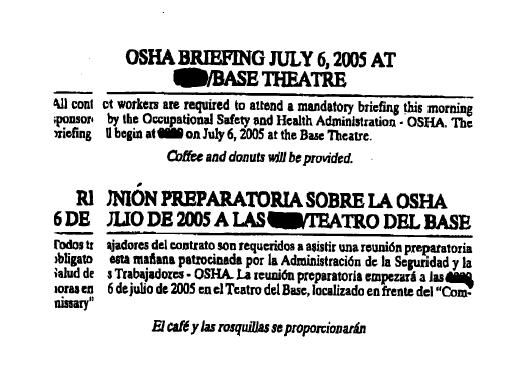
Last summer, ICE agents, impersonating OSHA staff, sent out a flyer announcing a mandatory safety training to lure undocumented immigrant workers into arrest at the Seymour Johnson Air Force Base in Goldsboro, North Carolina. When the workers showed up, ICE authorities took into custody dozens of undocumented workers from Mexico, Honduras, El Salvador and Ukraine.weapons chickens of mass destruction? (And speaking of chickens, the federal government would be better putting its money and energy into mother nature's own chicken-borne weapon of mass distruction -- the avian flu.)
The raid was widely condemned by labor, workplace safety, immigrant rights and public health groups across the country, as well as federal OSHA and North Carolina OSHA.
 Undocumented workers are killed and injured far more often than non-immigrant workers. They're frequently too afraid they'll lose their jobs to complain about unsafe conditions -- assuming they know where to complain -- and they're often afraid that OSHA inspectors will turn them in to immigration authorities.
OSHA and immigrant worker support groups have gone to great lengths to assure immigrant workers that they have nothing to fear from calling OSHA, although the impersonation tactics seriously undermine those efforts, putting immigrant workers at greater risk of getting hurt or dying in the workplace.
Inside OSHA reports that ICE said it would contact the affected agencies before impersonating OSHA officials again, but refused to say what they'd do if OSHA objected.
Ironically, President Bush's FY 2007 budget calls for an increase of $2.6 million in OSHA's Complaince Assistance budget to expand Hispanic worker outreach. Well, unless OSHA can convince the geniuses at Homeland Security/ICE that they're intimidating Hispanic workers out of any contact with OSHA or health & safety activities, you might as well pour the money down the drain.
Related Stories
In an amazing display of arrogance and insensitivity, Homeland Security's Bureau of Immigration and Customs Enforcement (ICE) has stated that it would continue to impersonate OSHA officials in order to nab undocumented workers, according to Inside OSHA (paid subscription). ICE had previously indicated that it would cease and desist.
Immigration and Customs Enforcement (ICE) officials told immigration and labor groups during a closed-door meeting Jan. 30 that the department will continue to have its agents pose as officials from other agencies, including OSHA, to nab illegal immigrants at work sites, despite earlier signals the policy would be dropped. The meeting was set up to discuss last year's controversial sting operation where ICE officials posed as OSHA employees, which had prompted an outcry from labor groups and concerns from OSHA.OSHA was not present at the meeting.
Last summer, ICE agents, impersonating OSHA staff, sent out a flyer announcing a mandatory safety training to lure undocumented immigrant workers into arrest at the Seymour Johnson Air Force Base in Goldsboro, North Carolina. When the workers showed up, ICE authorities took into custody dozens of undocumented workers from Mexico, Honduras, El Salvador and Ukraine.
ICE officials told attendees of the meeting that the department's first priority is national security and public safety and they would not change their controversial sting policy, according to sources involved in the discussions. In a letter sent to [the National Immigrant Law Center] NILC last year, ICE officials said they would no longer continue the practice, however, they now say they view everything from a threat-based level and would continue to increase their work site enforcement of food production companies and industries related to national security, the sources say.Since when are food production companies "related to national security?" Does the agency fear that an undocumented immigrant may succeed in unleashing the feared
The raid was widely condemned by labor, workplace safety, immigrant rights and public health groups across the country, as well as federal OSHA and North Carolina OSHA.
 Undocumented workers are killed and injured far more often than non-immigrant workers. They're frequently too afraid they'll lose their jobs to complain about unsafe conditions -- assuming they know where to complain -- and they're often afraid that OSHA inspectors will turn them in to immigration authorities.
OSHA and immigrant worker support groups have gone to great lengths to assure immigrant workers that they have nothing to fear from calling OSHA, although the impersonation tactics seriously undermine those efforts, putting immigrant workers at greater risk of getting hurt or dying in the workplace.
Inside OSHA reports that ICE said it would contact the affected agencies before impersonating OSHA officials again, but refused to say what they'd do if OSHA objected.
Ironically, President Bush's FY 2007 budget calls for an increase of $2.6 million in OSHA's Complaince Assistance budget to expand Hispanic worker outreach. Well, unless OSHA can convince the geniuses at Homeland Security/ICE that they're intimidating Hispanic workers out of any contact with OSHA or health & safety activities, you might as well pour the money down the drain.
Related Stories
- APHA Letter To Homeland Security Protesting Fake OSHA Sting, August 23, 2005
- Immigration Scam Causing Concern in Texas, August 6, 2005
- OSHA or Immigration? How To Tell The Difference, July 17, 2005
- NY Times Covers OSHA Impersonation Story, Saturday, July 16, 2005
- Betrayal in North Carolina: Unions Condemn OSHA Impersonators, July 14, 2005
- Stupid and Deadly: Undocumented Workers Lured into Arrest With Promise of Safety Training, July 11, 2005
Tuesday, December 06, 2005
The Pineros: Newspaper Series Forces Change in Treatment of Immigrant Workers
These are hard times for workplace safety. The business-controlled Republican party controls the Presidency and both houses of Congress, allowing for almost no oversight to address how workers are treated, especially immigrant workers. Given those facts, as I've often argued, the most effective force for progressive change these days is the media.
Last month, the Sacramento Bee ran a three part series on the plight of the Pineros -- the immigrant workers who work in the pines -- and the horrible safety conditions they face every day on the job. They're in this country on legal visas and federal officials oversee the contractors that employe the workers -- often witnessing the hazardous conditions and abuse without taking any action.
As a result of the series, the head of the US Forest Service proposed sweeping changes last week to better protect migrant Latino forest workers from injury and abuse on the job, including demanding that agency personnel shut down unsafe job sites on the spot.
Last month, the Sacramento Bee ran a three part series on the plight of the Pineros -- the immigrant workers who work in the pines -- and the horrible safety conditions they face every day on the job. They're in this country on legal visas and federal officials oversee the contractors that employe the workers -- often witnessing the hazardous conditions and abuse without taking any action.
As a result of the series, the head of the US Forest Service proposed sweeping changes last week to better protect migrant Latino forest workers from injury and abuse on the job, including demanding that agency personnel shut down unsafe job sites on the spot.
"My biggest frustration out of this is I want the Forest Service to have a culture of safety," U.S. Forest Service Chief Dale Bosworth said Wednesday in his first public comments since the series was published Nov. 13-15. "And that means safety for everybody."Of course, we've been here before.
Bosworth expressed concern that migrant workers were being hurt and exposed to abuse on jobs overseen by the Forest Service but that little was being done to correct the problems.
The Bee found that Forest Service job inspectors, formally called contracting officer representatives, often jotted notes about injuries, hazardous conditions and poor treatment in their work diaries but did not act on them. By contrast, errors in tree planting and thinning were quickly attended to.
***
Within days of the stories' publication, Bosworth sent a memo to regional foresters outlining his plans for corrective action.
"I do not expect everyone to become an expert in immigration law, on OSHA regulations or on the wage-and-benefits laws administered by the Department of Labor," he wrote. But when his employees "become aware of possible violations in any of these areas, I expect them to promptly report the situation to the appropriate oversight agency."
Bosworth also called for immediate action to prevent injuries and accidents. When migrant workers are discovered toiling without safety gear - a common occurrence on Forest Service jobs - "don't let them work," he wrote. "When these situations occur, (employees) must take action, just as we would with our own employees."
Twelve years ago, a House committee report chastised the agency for tolerating abusive conditions among contractors employing Latinos on federal jobs.Forest Chief Dale Bosworth's memo can be found here.
A hearing was held. Reforms were promised. The problems endured. Georgia reforestation contractor David Ellis chalked it up to simple economics.
"The U.S. Forest Service is all about saving money and passes the buck to the Nation at large for their policy of hear no evil see no evil," Ellis wrote in an e-mail. "I have seen and heard with my own ears and eyes how the Forest Service (personnel) boast about saving money on contractors who housed Mexicans in tents on the job site, no water, no toilet, no shower, just the low bidder!"
Thursday, May 05, 2005
Just Another Trench Death: Well Covered For A Change
A few days ago I wrote about a new federal program that was using violations of environmental and other laws to generate huge fines and jail terms against employers whose willful violation of OSHA regulations ended in the death of a worker. Laws other than the Occupational Safety and Health Act had to be used because the OSHAct itself doesn't allow for large enough penalties to deter serious and willful violations of OSHA standards.
But the question I asked at the end of that review was
Lorenzo Pavia was buried alive in aWest Brighton trench collapse 16 months ago. His oldest son is now head of the family:
Finally, I want to extend some much deserved praise to the journalist who wrote this article, Heidi Shrager of the Staten Island Advance. You all know that one of my pet peeves is preventable trench collapses -- and the other is journalists who write short formulaic articles about workplace deaths that leave the impression that these "accidents" are somehow surprising, unexpected and just plain bad luck.
Those few journalists who take the time to talk to people and do the research necessary to show that most of these tragedies are preventable, and that the safeguards this society has established are not working effectively -- deserve our praise, our support and our thanks. I believe it was David Barstow's two series in the New York Times that forced the federal government to finally start looking for more creative ways to issue meaningful penalties against some employers. And if we have any hope of making more significant changes in this country,it will be journalists like Heidi Shrager writing similar stories in small papers around the country about the thousands of preventable deaths that happen every year.
Good journalism and organizing.
But with the demise of the AFL-CIO's health and safety department and total corporate/Republican control in Washington, the media may be our best hope for now.
.
But the question I asked at the end of that review was
Where does this leave the guys crushed in collapsing trenches or who fall two stories from an unsafe scaffold -- and no environmental law as violated? OSHA handed down 446 willful citations in Fiscal Year 2004 (compared with 607 in FY 1999). It is unclear how many of those involved the death or serious injury of a worker, but the handful of cases that OSHA is able to prosecute with the assistance of the EPA or Postal Service will mostly likely not apply to more than a small handful of these.This is one of those stories, covered in an excellent article in the Staten Island Advance:
Lorenzo Pavia was buried alive in a
Jesus was saddled with one intractable burden: facing the reality that the gruesome death of his father -- a 39-year-old Mexican worker who was buried under thousands of pounds of earth when a deep trench caved in because it was unshored -- will not automatically lead to jail time or a multi-million dollar settlement.The City of New York, as well as OSHA are increasing the amount of outreach and training they are doing to try to prevent trench collapses. But there are problems:
"My father never wanted to go in," said Jesus of the trenches that were a common part of his father's job for Formica Construction. Polite and soft-spoken, Jesus' eyes narrowed and his jaw clenched as he recalled the evenings his father would return from work complaining. "If they don't do the job, they don't get out of work. So what's my father gonna do?"
For Jesus, justice will likely amount to little more than $550 paid to his mother, Paula Pavia, every 15 days in workers' compensation. The yearly sum of $13,383 will come until she remarries or passes away.
An investigation by the federal Occupational Safety and Health Administration revealed that Ken Formica, the site supervisor and Pavia's employer, made a conscious decision to violate the safety standard that all trenches deeper than five feet must be shored or sloped.
"It was my mistake," Formica told OSHA in his deposition, two months after the accident.
Yet the company was fined just $14,000, about $3,000 less than what the city fines firms for posting signs without a permit.
Experts say the agency lacks the manpower to widely enforce its rules. This is a problem since small construction firms trying to cut costs will often choose time over safety, they add.Pavia's is not, of course, an isolated case:
For instance, the simplest, quickest type of shoring is a box that can be dropped into an open pit known as a trenchbox, said Jordan Barab, an ex-official with the federal Occupational Safety and Health Administration who writes extensively about the issue on his worker safety Web log.
But when there are multiple utility lines, as there were in the trench that killed Pavia, shoring becomes a much more painstaking, time-consuming process, said Barab. Workers need to install separate braces as they dig further down.
"There are a lot of little construction companies around, everyone's trying to underbid everyone else, time is money," he said. "Everyone thinks maybe my luck will hold out this time."
Ken Formica may have been relying on luck on a cold December afternoon in 2003, when he and his men set about hooking up a sewer main for new townhouses at the corner of Taylor Street and DeGroot Place. Lorenzo Pavia and a second man, John Paci, then 66, descended a 15-foot trench that was muddy at the bottom from heavy rain and snow that fell just two days before.
In his OSHA deposition, Formica said he often chose Pavia for trench work because he was "my most skilled." When asked what his policy was for excavation safety, he told the investigator, "Make it safe. Make a safe hole."
But when pressed for details, he revealed that his company had no written safety and health program, and that he lacked basic knowledge required to ensure a safe trench, such as soil types.
At about 3 p.m., the workers were done, and Formica, watching his men from the driver's seat of an excavator, told them to come out of the hole.
"They were walking towards the ladder, and that's when it collapsed," he told OSHA.
Horrified at seeing Pavia swallowed entirely by earth, Formica grabbed the wheel of the excavator. But instead of scooping out Pavia, the backhoe decapitated him. The autopsy showed that by that time, Pavia had already been asphyxiated.
The percentage of construction fatalities in which the victim was Hispanic more than doubled between 1993 and 2003, to 23 percent from 11 percent, according to the U.S. Dept. of Labor's Bureau of Labor Statistics.
"There's all these safety rules and regulations, and they're never followed," said Jeffrey Manheimer, a Manhattan-based personal injury lawyer who specializes in workplace injury cases among day laborers.
Citing the statistic that most fatalities happen on non-union job sites, he added that the workers "certainly don't have the clout to complain about any conditions."
Staten Island hosts its share of Mexican workplace tragedies. In September, 2003, Port Richmond resident Pedro Munoz de Leon was crushed and killed by the boom of a crane that snapped off, as he was working on dry dock in West Brighton. Not long before that, Librado Velasquez, a 44-year-old worker from Port Richmond, had his right arm and leg crushed in a forklift accident while working in New Jersey.
Lorenzo Pavia died in a notorious type of construction accident, a trench cave-in. In 2003, 15 of the country's 48 trench cave-in fatalities, or 31 percent, were Hispanic, according to BLS data. OSHA's analysis of internal investigations puts the percentage even higher, at 44.
Experts say trench cave-ins happen in part because people underestimate the soil's speed and power."It's like a car falling on you," said Scott Schneider, director of occupational safety and health for the Labors' Health and Safety Fund of North America. "It can collapse in about half a second. You don't have time to get out."
Finally, I want to extend some much deserved praise to the journalist who wrote this article, Heidi Shrager of the Staten Island Advance. You all know that one of my pet peeves is preventable trench collapses -- and the other is journalists who write short formulaic articles about workplace deaths that leave the impression that these "accidents" are somehow surprising, unexpected and just plain bad luck.
Those few journalists who take the time to talk to people and do the research necessary to show that most of these tragedies are preventable, and that the safeguards this society has established are not working effectively -- deserve our praise, our support and our thanks. I believe it was David Barstow's two series in the New York Times that forced the federal government to finally start looking for more creative ways to issue meaningful penalties against some employers. And if we have any hope of making more significant changes in this country,it will be journalists like Heidi Shrager writing similar stories in small papers around the country about the thousands of preventable deaths that happen every year.
Good journalism and organizing.
But with the demise of the AFL-CIO's health and safety department and total corporate/Republican control in Washington, the media may be our best hope for now.
.
Wednesday, February 23, 2005
Worker Advocates Win Journalism's Polk Awards
Two safety advocates whose articles have been covered in Confined Space have won Polk Awards awards for extraordinary journalism. The 2004 Awards will be presented at a luncheon on April 21, 2005.
Walt Bogdanich of the New York Times won the national reporting category, his fourth Polk award, for his series on how railroad companies were able to sidestep regulations.
Justin Pritchard, the AP's news editor for Southern California, won the labor reporting prize for his investigation into the high rate of work-related deaths among Mexican workers in America.
These are the kind of articles (along with David Barstow's articles on Death in the Workplace and Andrew Schneider's asbestos coverage) that you should be showing to your local reporters when they don't quite know how to handle a workplace accident. These journalists know how to investigate the root causes of these incidents and show how politics affects peoples' chances of staying alive and healthy. But they can also show other journalists the fame and awards that can be won by following up on these stories that are otherwise relegated to a few paragraphs in the back pages.
All of Bogdanich's original articles can be found here.
Confined Space articles that cover Bogdanich's investigations are here:
Blood On (and near) The Tracks
Head of Federal Railroad Administration Resigns Under Pressure
Behavioral Safety Comes To The Railroads
Look Both Ways -- And Then Pray
As If That Wasn't Bad Enough...More on Rail Safety
Links to Pritchard's orginal articles can be found at the Polk Awards webpage (scroll down). Confined Space stories based on Pritchard's articles can be found here:
What is OSHA Doing About Immigrant Worker Safety?
Mexican Workers in the U.S.: Impaled, Shredded in Machinery, Buried Alive
.
Walt Bogdanich of the New York Times won the national reporting category, his fourth Polk award, for his series on how railroad companies were able to sidestep regulations.
Justin Pritchard, the AP's news editor for Southern California, won the labor reporting prize for his investigation into the high rate of work-related deaths among Mexican workers in America.
These are the kind of articles (along with David Barstow's articles on Death in the Workplace and Andrew Schneider's asbestos coverage) that you should be showing to your local reporters when they don't quite know how to handle a workplace accident. These journalists know how to investigate the root causes of these incidents and show how politics affects peoples' chances of staying alive and healthy. But they can also show other journalists the fame and awards that can be won by following up on these stories that are otherwise relegated to a few paragraphs in the back pages.
All of Bogdanich's original articles can be found here.
Confined Space articles that cover Bogdanich's investigations are here:
Blood On (and near) The Tracks
Head of Federal Railroad Administration Resigns Under Pressure
Behavioral Safety Comes To The Railroads
Look Both Ways -- And Then Pray
As If That Wasn't Bad Enough...More on Rail Safety
Links to Pritchard's orginal articles can be found at the Polk Awards webpage (scroll down). Confined Space stories based on Pritchard's articles can be found here:
What is OSHA Doing About Immigrant Worker Safety?
Mexican Workers in the U.S.: Impaled, Shredded in Machinery, Buried Alive
.
Saturday, November 20, 2004
Immigrant Dies On The Job: What America Thinks
A taste of America in the Greeley (CO) Tribune.
Comments
Re: Man killed at plant
by Anonymous on Thursday, October 28 @ 07:46:16 PDT
Was he here legally?? or are the tax payers going to have to eat the cost of his funeral because he was here illegally??
Re: Man killed at plant
by Anonymous on Thursday, October 28 @ 09:09:07 PDT
can you really be that much of an a$$ that a life is lost tragically and all you can think of is if taxpayers are going to have to pay the funeral. I feel so sorry for you if thats how sad and full of anger your life really is. This person had a family that is going to feel so much sadness and all you can think of is the money. I pray maybe one day you'll have a little more compassion for all of God's people.
As for the family of the victim
Dios te bendiga
Re: Man killed at plant
by Anonymous on Thursday, October 28 @ 09:50:21 PDT
NO, but we'll probably have to pay shipping and handling to get him back to the old country
Re: Man killed at plant
by Anonymous on Thursday, October 28 @ 10:20:14 PDT
More than likely you will be more of a burden on taxpayers than he would have ever been. Have a little sense of compassion/decorum.
Re: Man killed at plant
by Anonymous on Thursday, October 28 @ 10:37:38 PDT
Once again, a heartless, unnecessary comment when a human being has died. I see your point of view but don't you think that you should express your opinion on a different situation instead of after a death. He isn't legal or illegal now, he is dead. Have respect!!!
Re: Man killed at plant
by Anonymous on Friday, October 29 @ 08:26:22 PDT
Unfortunately for we Americans, we would have never known he was in this country if he hadn't died. These people need to be ferreted out before their names make the paper.
Re: Man killed at plant
by Anonymous on Thursday, October 28 @ 10:44:02 PDT
If here Illegaly, Western sugar can pay for the funeral. The death is tragic however. He probably was not instructed well enough because of the language barrier. Being a non-english speaker may have cost him his life. The feds need to do a better job of making sure these people are not put into dangerous postions with lack of communication skills. Oh yeah, lets get the borders sealed up better so these families don't have to endure the tragic losses caused by the ungrateful American business owners...
Re: Man killed at plant
by Anonymous on Thursday, October 28 @ 10:58:50 PDT
wow! way to be ignorant. a man just died.
Re: Man killed at plant
by Anonymous on Thursday, October 28 @ 15:32:50 PDT
If so many born and raised coloradans would get off there lasy buts and quit collecting welfare and do the jobs that are out there. Greely would not have to hire workers from Mexico to come and do the job. But Greeley knows, these workers are the ones that keep the town going, and do the job, knowing they are making crap money. But they don't complain.They do there job every day. where as thes rest sit on there behinds collecting welfare. so please have some respect for the man who gave his life to make sure his family many miles away would be taken care of. god bless him and his family
Man killed at plant
Greeley, CO -- A Western Sugar employee died Wednesday afternoon when he apparently got caught in a conveyor belt that was unloading sugar beets from a truck.The loading station is located behind the Western Sugar Co. plant, north of the intersection of Ash Avenue and 16th Street in east Greeley. In addition to the Weld County Coroner's Office, also responding to the scene Wednesday afternoon were Union Colony Fire/Rescue Authority firefighters and Greeley police.The name of the victim may not be released for days, according to the coroner's office, because his family must be located in Mexico.
Coroner's investigator Marcia Vincent said the man was working at the conveyor and a piece of his clothing may have been caught in the machinery. He was pulled into the machine and died immediately.
Comments
Re: Man killed at plant
by Anonymous on Thursday, October 28 @ 07:46:16 PDT
Was he here legally?? or are the tax payers going to have to eat the cost of his funeral because he was here illegally??
Re: Man killed at plant
by Anonymous on Thursday, October 28 @ 09:09:07 PDT
can you really be that much of an a$$ that a life is lost tragically and all you can think of is if taxpayers are going to have to pay the funeral. I feel so sorry for you if thats how sad and full of anger your life really is. This person had a family that is going to feel so much sadness and all you can think of is the money. I pray maybe one day you'll have a little more compassion for all of God's people.
As for the family of the victim
Dios te bendiga
Re: Man killed at plant
by Anonymous on Thursday, October 28 @ 09:50:21 PDT
NO, but we'll probably have to pay shipping and handling to get him back to the old country
Re: Man killed at plant
by Anonymous on Thursday, October 28 @ 10:20:14 PDT
More than likely you will be more of a burden on taxpayers than he would have ever been. Have a little sense of compassion/decorum.
Re: Man killed at plant
by Anonymous on Thursday, October 28 @ 10:37:38 PDT
Once again, a heartless, unnecessary comment when a human being has died. I see your point of view but don't you think that you should express your opinion on a different situation instead of after a death. He isn't legal or illegal now, he is dead. Have respect!!!
Re: Man killed at plant
by Anonymous on Friday, October 29 @ 08:26:22 PDT
Unfortunately for we Americans, we would have never known he was in this country if he hadn't died. These people need to be ferreted out before their names make the paper.
Re: Man killed at plant
by Anonymous on Thursday, October 28 @ 10:44:02 PDT
If here Illegaly, Western sugar can pay for the funeral. The death is tragic however. He probably was not instructed well enough because of the language barrier. Being a non-english speaker may have cost him his life. The feds need to do a better job of making sure these people are not put into dangerous postions with lack of communication skills. Oh yeah, lets get the borders sealed up better so these families don't have to endure the tragic losses caused by the ungrateful American business owners...
Re: Man killed at plant
by Anonymous on Thursday, October 28 @ 10:58:50 PDT
wow! way to be ignorant. a man just died.
Re: Man killed at plant
by Anonymous on Thursday, October 28 @ 15:32:50 PDT
If so many born and raised coloradans would get off there lasy buts and quit collecting welfare and do the jobs that are out there. Greely would not have to hire workers from Mexico to come and do the job. But Greeley knows, these workers are the ones that keep the town going, and do the job, knowing they are making crap money. But they don't complain.They do there job every day. where as thes rest sit on there behinds collecting welfare. so please have some respect for the man who gave his life to make sure his family many miles away would be taken care of. god bless him and his family
Monday, October 04, 2004
Rights? What Rights? Hispanic Workers Continue to Die On The Job
The number of workplace fatalities among Hispanic workers dropped slightly last year, according to the Bureau of Labor Statistics, but their rate of fatalities among remains 25 percent higher than the rate recorded for all workers, and foreign-born Hispanic workers are more likely to die than Hispanics born in this country.
Two students at the Graduate School of Journalism at UC Berkeley have written an interesting article about the lives and deaths of Hispanic workers and why the problem remains. They write of the death of 27-year old Ignacio Calixtro, who had gone to the U.S. from Mexico to raise money to support his ailing mother. He was killed when an attachment on a forklift came loose and a wall fell he had been helpign to raise fell and crushed him.
They also write of the delemmas faced by those who work construction jobs every day in this country without even knowing their rights, much less being able to stand up for them:
Two students at the Graduate School of Journalism at UC Berkeley have written an interesting article about the lives and deaths of Hispanic workers and why the problem remains. They write of the death of 27-year old Ignacio Calixtro, who had gone to the U.S. from Mexico to raise money to support his ailing mother. He was killed when an attachment on a forklift came loose and a wall fell he had been helpign to raise fell and crushed him.
They also write of the delemmas faced by those who work construction jobs every day in this country without even knowing their rights, much less being able to stand up for them:
In Contra Costa County ... where new housing developments stretch as far as the eye can see, immigrant day laborers can be found most mornings on Concord's Monument Boulevard, amid the tidy strip malls, hoping general contractors will hire them to work as roofers, to dig or to do odd jobs on construction sites.In other words, what we have is a group of workers who don't know their rights, who are willing to work long hours with low pay, under dangerous conditions and who are afraid to complain because they need the money. It's an old and all-too-common story, but one we shouldn't be living with in 2004 in the United States of America.
One of those laborers, Francisco Cid, from Mendoza, Mexico, has been working on construction projects in the United States for eight months, sending whatever money he can spare home to support his wife and four kids. He usually makes $10 per hour, often working
10 to 14 hour days without overtime pay. He said the most dangerous jobs are the ones where he works up high, such as roofing and painting, and he rarely wears a harness.
"I'm scared sometimes, but I have to do it because I need the money," said Cid. "If you say 'I'm scared,' then (the bosses) say 'I'll find another.'
"If you die, the company doesn't have to pay anything," Cid said. Workers' rights advocates said that is a common misconception among Latino workers. California worker's compensation laws apply to any individual hurt or killed on the job, documented or not.
Day laborers like Albarado and Cid are often undocumented, as was Calixtro, but Flores says immigrant workers who are citizens or have the right to work in this country are as likely to be abused.
"Employers aren't honest. They don't tell workers their rights," said Flores.
Flores often works from the offices of the Instituto Laboral de la Raza in San Francisco's Mission District. The organization's bilingual staff helps immigrant workers file worker's compensation claims for injuries and back wages. Sarah Shaker, the organization's executive director, estimates "virtually none" of the 140 new workers that seek help each month are aware of their rights.
Thursday, August 05, 2004
Hispanic Summit: Political Advantage Without Political Leadership
I've spent quite a bit of time trashing the Bush Administration's recent Hispanic Summit (here, here and here), so now I'm happy give some bandwidth to Maria Echaveste, President Clinton's former Deputy Chief of Staff and currently senior fellow at the American Progress Action Fund and a member of the Coalition for Comprehensive Immigration Reform.
Echaveste argues that "the summit was one more example of how the Bush administration never misses an opportunity to seek political advantage without actually exhibiting leadership."
We've already discussed here the "photo-op" nature of the event while Hispanic workers continue to die in high numbers:
Echaveste argues that "the summit was one more example of how the Bush administration never misses an opportunity to seek political advantage without actually exhibiting leadership."
We've already discussed here the "photo-op" nature of the event while Hispanic workers continue to die in high numbers:
What else can one conclude when the big news of the summit was a grant in the sum of $2.75 million to Esperanza USA, a faith-based Hispanic nonprofit organization, to work in nine U.S. cities with at-risk Hispanic youth? While a worthwhile goal, it is hard not to see the political opportunism at play here when two of the cities are Miami and Orlando in hotly contested Florida. Even the declaration signed with Mexico's secretary for foreign affairs, also announced at the summit, was all talk and no action. That declaration simply affirmed both countries' commitment to improving workplace protections for Mexican workers in the United States, without any new resources or enhanced enforcement efforts.Echaveste points out however, that if the Bush administration was really interested in helping Hispanic workers, there was something concrete they could have done:
Chao might have used this summit to announce administration support for the AgJobs bill sponsored by Sens. Larry Craig, an Idaho Republican, and Edward Kennedy, a Massachusetts Democrat. Enactment of this bill would do more to save lives and prevent injuries than Chao's thinly veiled political pandering of last week. Why? Simply because one of the three most dangerous industries in the country is agriculture, and Latinos comprise more than 90 percent of farmworkers. Yet because 80 percent of that workforce is undocumented, many workers are afraid to speak up when facing work-safety issues for fear of deportation.The bill has the support of organized labor and the agriculture industry. So why are Bush and Senate Majority Leader Bill Frist (R-TN) holding it up?
The AgJobs bill would grant temporary legal status to approximately 500,000 farmworkers and an opportunity to obtain permanent legal status if those workers continue to work in agriculture for a specified period of time. And because agriculture is so dependent on a foreign workforce, the bill would also update the existing foreign temporary worker program to enable employers to recruit the workers they need in a legal manner, and no longer be complicit in the underground labor market that is the underpinning of agriculture.
The vocal but small anti-immigrant wing of the Republican Party appears to be more important to Bush than finding solutions to intractable problems.
Tuesday, April 13, 2004
What is OSHA doing About Immigrant Worker Safety?
Warning: Long article. Printer Friendly Version is here.John Henshaw is pissed off. Why? A couple of weeks ago, AP reporter Justin Pritchard published an investigation into the workplace deaths of Mexican workers in the United States. Pritchard had written that "The jobs that lure Mexican workers to the United States are killing them in a worsening epidemic that is now claiming a victim a day, an Associated Press investigation has found."
In a letter responding to the AP investigation, OSHA Director Henshaw wrote that the AP investigation was "full of mischaracterizations" and wrong from the first sentence. Mexican worker deaths, while sharply rising for a decade, had fallen by 8.3 percent in 2002. Henshaw credited "OSHA's effort" for the drop.
In a follow-up article, Pritchard notes that while Mexican worker deaths did fall in 2002,
the good news did not extend to the overall Hispanic immigrant population the department is trying to reach. Workers in that group -- which includes Central and South Americans, as well as Mexicans -- continued to die in record numbers in 2002, federal data show....What's the Real Story?
The decline in Mexican-born worker deaths came during the safest year on record for the overall work force in the United States. From 2001 to 2002, total on-the-job deaths fell from 5,915 workers to 5,524 workers -- an unprecedented 6.6 percent drop.
Deaths among U.S.-born Hispanic workers declined at an even greater rate in 2002. However, deaths among all foreign-born Hispanics rose that year over 2001, from 572 to 577. It was also the first year Mexican-born worker fatalities fell since 1994-1995, when deaths dropped from 213 to 206.
Reflecting rising media attention, I have written frequently about the plight of immigrant -- especially Hispanic -- workers in this country. Despite the fact that the numbers for specific nationalities may vary from year to year, the overall trend in immigrant health and safety is tragically disheartening. OSHA claims to be making a serious effort to address this problem, and takes full credit for whatever favorable trends the data picks up.
With all of the media attention to this problem, and OSHA fighting back, it may be a good time to take a minute to look at the problem and OSHA's response.
What Is the Problem?
First, there is no doubt, whatever the trends in specific nationalities, that, as the AP investigation states, there is a worsening epidemic of workplace death among immigrants in this country. (I have posted recent items based on media reports here, here, here, here, here and here. And The Weekly Toll is always filled with stories of immigrant worker deaths.)
Most of the causes are also well known.
- Lack of Knowledge About Safety and Health Hazards: The jobs that many immigrants do are new and they are not familiar with the hazards of the jobs. Furthermore, they generally do not know about OSHA or their right to request and inspection and have their name kept secret
- Language Barrier: This goes deeper than inability to speak or understand English. Many immigrant workers are illiterate in their native language. Spanish language fact sheets don't help in that situation.
- Exploitation: Immigrant workers are frequently sent to do the most dangerous work.
- Intimidation: This is closely related to exploitation. Immigrant workers are much less likely to call OSHA -- assuming they know about their rights -- than American citizens. If they are illegal, In addition, they often fear government officials, even those who are there to help them. This stems not only from the fears imported from their own country, but also fear of the "migra."
How has OSHA been addressing these issues? OSHA Director John Henshaw takes credit for any improvement in the working conditions of Hispanic workers
We launched a three-prong attack combining vigorous enforcement of health and safety standards, outreach to the Latino community and effective education.Truth? Stretching the truth?
A Departmental Hispanic Workers Task Force was created to coordinate this effort, and it is working, as evidenced by the 2002 drop in workplace fatalities among Hispanic workers generally and Mexican-born workers specifically.
First, Henshaw points out that OSHA and other DOL agencies have been forming alliances with Hispanic organizations, including Mexican consulates, across the nation. And this is true. Some regional offices have initiated and joined into broad-based innovative coalitions designed to reach out to Hispanic workers. I wrote last October about the Justice and Equality in the Workplace, a coalition organized in July 2001 to help inform Hispanic immigrants about their rights as workers and to uncover illegal employment practices and discrimination.
The coalition is made up of the U.S. Department of Labor's Office of Federal Contract Compliance and Wage and Hour Division, Equal Employment Opportunity Commission, the Mexican, Colombian, Guatemalan and El Salvadorian consulates, the City of Houston, the Harris County AFL-CIO, the Catholic Diocese of Galveston-Houston, the Mexican American Legal Defense and Educational Fund, the Hispanic Contractor's Association in Houston, the Associated General Contractors of America's Houston chapter, the Houston Chamber of Latino Business Owners as well as OSHA. On the whole, it seems to be doing good work and spawning similar programs elsewhere.
Second, Henshaw claims that "More information than ever before is now available in Spanish about job safety and health via the Web, in publications and through specialized training courses." Umm, I have some serious problems with this assertion. First, technically, it is true that "more" information is available than ever before in Spanish. But that's not saying much. Check out the OSHA's Spanish language publications. There are about a dozen publications, many of which were published in previous administrations, some as far back as the 1980. There is also a new set of ten fact sheets that seem to be targeted at employers, including one on health and safety precautions for your new business, as well as fact sheets on asbestos, workplace violence and other topics. The Personal Protective Equipment fact sheet has no mention of who is supposed to pay for the PPE, a contentious issue for the agency. A standard has been on hold since the Clinton administration that would have required employers to pay for most PPE.
And it's true that there is more Spanish language material on the web, although I have serious reservations about how accessible this information is to the average immigrant worker.
Even written materials have their problems
"We are talking about a community that prefers to stay in the shadows," said Jenny Sarabia, executive director of the Indiana Commission on Hispanic/Latino Affairs.I have no idea what Henshaw means by "specialized training courses" in Spanish. There is not one Spanish language training course listed on the OSHA Training Institute Course Schedule. The only Spanish language training that I know of is being conducted by grantees under the Susan Harwood Training Grant Program which the Bush administration has been attempting to eliminate since it came into office. The $11.2 million Harwood program was refocused on immigrant worker outreach in 2000 during the Clinton Administration. The grants were extended from 1-2 year programs to 5 year programs.
"Translating brochures and signs into Spanish is not enough," she added, because many of the new Hispanic arrivals in Indiana are unable to read English or Spanish.
The current administration cancelled the second round of 5-year grants, attempted unsuccessfully (thanks to Congress) to cut the first 5-year round (which concludes this year) and has proposed to eliminate the $11 million Harwood grants and replace them with a $4 million program that would depend on electronic (internet and CD-Rom) training instead of actually having classes with an instructor. Referring to the proposed training cuts, Henshaw argued
“I would not use the word ‘cutting',” Henshaw said referring to the proposed $6 million decrease in the training grant program. “We do not feel the training program should be based on one-on-one training. We are developing materials and technology to get information out to more people.”How all of this amounts to "effective education" I'm not sure.
There is another troubling aspect to OSHA training. Ultimately, it is not OSHA, but the employer who is responsible for training its workers. Tom O'Connor, director of the National Council on Occupational Safety and Health, wrote a letter to the editor of the Raleigh News and Observer, responding to a article about two Hispanic workers that were killed in separate construction accidents less than an hour apart in North Carolina notes that
Your report stated that some fatalities have involved Hispanic workers who "worked for companies that did not have the resources to provide training in Spanish." That is not good enough. It is a law, not an option. There are resources in the private sector, among nonprofit organizations and within OSHA to assist employers with this critical training. Those employers who fail to provide such training and whose workers die as a result should be prosecuted criminally.Third Henshaw claims that "More Spanish-speaking inspectors and outreach staff are being hired." More than what? Pritchard's research does not validate Henshaw’s contention:
Safety experts inside and outside OSHA say the agency's outreach efforts are well intentioned, but beset by limited funding and a lack of Spanish-speaking staffers.Even California is having problems hiring Spanish speaking OSHA employees.
The non-English speaking workforce of California is estimated to be more than 6 million workers, over one-third of the working population. Yet CalOSHA has only 29 inspectors (or 16% of the total) who are fluent in a language other than English. Twenty of these speak Spanish.
North Carolina is having similar problems.
The state office charged with enforcing safety in North Carolina workplaces is fighting an uphill battle trying to find and keep employees who speak Spanish -- a key asset in the effort to educate and train more workers.And federal OSHA is in sadder shape:
The Labor Department's division of occupational safety and health has only seven bilingual training and compliance officers in a staff of 240. Many times, Spanish speakers are lured to private-industry jobs that pay better. To alleviate the problem, the agency recently sent two people to immersion courses in Costa Rica and Mexico.
Even some of OSHA's own Hispanic outreach officers say they need to do more. Marilyn Velez, OSHA's sole Spanish-speaking outreach worker in the eight-state Southeastern region, isn't sure what caused the drop from 28 to 8 Mexican-born worker deaths in Georgia in 2002. But she doesn't think workers were taking fewer risks, or that bosses were more insistent on safety.Finally, in addition to outreach, Henshaw argues that "More inspections are being targeted to industries with high injury rates that employ large numbers of Hispanic workers, such as construction and landscaping." I don’t have the statistics with me at the moment, but I think OSHA is generally trying to target these areas. The question is how effective that targeting will be if immigrant workers are not aware of what OSHA is, how it works or if they can be protected against retaliation by employers.
"We knew that it was not just because it was outreach," said Velez.
More troubling, she said, is that Hispanic worker deaths appear to have risen in Georgia again in 2003.
A recent study of immigrant workers in California, Voices From the Margins: Immigrant Workers: Perceptions of Health and Safety in the Workplace, by the UCLA Labor Occupational Safety and Health Program (LOSH) found that Hispanic workers were not familiar with governmental agencies which could assist them. Less than 10 percent had ever heard of Cal-OSHA and no workers surveyed had contacted CalOSHA for assistance. Some of the workers did not contact governmental agencies because of their immigration status and also because of experiences in some of their home countries which led them to perceive government as “unfriendly” to workers.
Finally, even if immigrant workers are aware of what OSHA is and what rights they have, how secure are they that OSHA will not turn them into “la migra,” or that OSHA will be able to anything to help them if their employer retaliates against them for exercising their health and safety rights?
And then there is the effect of the Supreme Court’s 2002 Hoffman Plastics decision which held that undocumented immigrants were not entitled to back wages – even after being illegally fired for union activity – because their job was “obtained in the first instance by a criminal fraud." The Department of Labor has stated that it will still enforce the Fair Labor Standards Act, even for undocumented workers, because the FLSA addresses wages for time actually worked, whereas the Hoffman Plastics decision addresses time that would have been worked had the employee not been illegally fired. Secretary of Labor Elaine Chao has stated that
Regardless of a workers immigration status, the Labor Department remains committed to the enforcement of all protections offered by the Fair Labor Standards Act, the Mine and Safety and Health Act, and the Department’s other core labor statutes. Safety has no nationality—and every worker in this country deserves a safe workplace.How states handle the Hoffman Plastics decision and how it affects workers’ OSHA rights is not clear, according to the National Employment Law Project.
The California Department of Industrial Relations recently posted a statement on its website clarifying that it will “Investigate retaliation complaints and file court actions to collect back pay owed to any worker who was the victim of retaliation for having complained about wages or workplace safety and health, without regard to the worker’s immigration status.”This all sounds good on paper, but what about the real world? First, there is nothing on the OSHA webpage, and no announcement or interpretation that I am aware of that clarifies what effect the Hoffman decision has on OSHA’s willingness to investigate retaliation against undocumented immigrant workers. I have heard reports that some OSHA regions take these cases, while other do not. And how does the federal government force an employer to re-hire an undocumented worker? What if the employer’s next action is to call immigration? Is OSHA going to rule that calling immigration is an illegal form of retaliation and demand that Immigration allow the worker to be rehired? It doesn’t make much sense. Nor does President Bush’s immigration proposal make workers more secure about exercising their health and safety rights because the proposal requires workers to be "sponsored" by their employer. What's to keep an employer from suddenly deciding that he has a few less openings to sponsor if a worker complains about safety and health conditions?
Can OSHA Take Credit?
So is John Henshaw right? Is the 2002 improvement in Mexican worker deaths due to OSHA’s efforts?
Probably not. (But it was a great letter, John. Thanks for playing.) First, OSHA’s Hispanic worker initiative wasn’t announced until the end of February 2002. An 8% drop in fatalities as a result of a 10 month-old program would be impressive, indeed.
Pritchard reports that experts at the federal Centers for Disease Control (NIOSH) and the National Safety Council are skeptical whether any improvements can be credited to OSHA’s recent outreach initiative:
Workplace safety experts at the federal Centers for Disease Control and the National Safety Council, a nonprofit public service organization, said no research substantiates a link between OSHA's fledgling outreach and the drop in Mexican worker deaths.So why the decline in Mexican worker deaths in 2002?
"It's not something that you throw a small amount of money at and issue some pamphlets and you're going to see dramatic changes," said David Richardson, a University of North Carolina-Chapel Hill professor of epidemiology who tracks worker deaths in the South. "It's a slow battle."
According to work safety specialists, statisticians and even some federal outreach workers, there's no evidence any one effort is responsible for the improvement in 2002. Possible factors include the economic recession that followed the September 2001 terror attacks and changes in immigration and border security. Mexican-born workers have stayed longer in the United States, gaining experience and perhaps decreasing their willingness to take risks.So what is to be done?
"It's good that they're doing outreach," says Dr. Sherry Baron, a lead CDC researcher on immigrant workers. However, "a change in one year, it's hard to conclude anything. Part of it is, we need more time."
What can OSHA and others do to improve the plight of immigrant workers in this country.
The UCLA/LOSH study had four recommendations. The first recommendation was to
Establish a multi-year capacity building grants program for community-based organizations, clinics, and worker advocacy groups that work with, or provide services to, immigrants. This will allow them to provide training and educational materials for immigrant workers and also serve as an extension of governmental workplace health and safety agencies by reporting possible labor law violations and injury/illness cases.The main reason is trust:
When asked where they went for assistance or advice on health and safety issues, most responded that they consulted with co-workers and immigrant worker advocacy groups or labor unions. They seldom turned to employers for such assistance. Workers in each of the industries turned to the worker centers or unions for information on how to work more safely, personal protective equipment, or legal assistance when injured. They trusted these organizations and felt comfortable going to them because their staff spoke the workers’ language and they felt secure that these organizations would not turn them into the Immigration and Naturalization Service (“la migra”) if they did not have legal immigration or working papers.Funding these organizations that immigrant workers trust and who can effectively reach out is essentially what OSHA’s Susan Harwood Grant program was beginning to focus on. The clear lesson is that OSHA’s Susan Harwood training grant program should be significantly expanded in both funding and scope, not eliminated. And the program needs to provide much more funding to labor organizations, COSH groups and other community organizations. Unfortunately, OSHA’s grant program is increasingly ignoring these groups.
LOSH also recommended more research, public hearings, and the establishment of
a Clearinghouse/Resource Center for immigrant worker health and safety education and information.…that could provide education and information on workplace health and safety for these community based organizations, clinics and worker advocacy groups that work with immigrants.While community based organizations clearly provide the most bang for the buck, federal and state OSHA’s need to hire more compliance officers and other staff who come from immigrant communities, or who at least speak their languages. Over the past several years, OSH has hired over 70 “Compliance Assistance Specialists” in each of its area offices. Unfortunately, most of these positions were filled with current OSHA employees rather than recruiting from immigrant communities. OSHA should also work with other federal and local agencies and community organizations to expand its Justice and Equality in the Workplace coalitions.
The toughest nut to crack is the problem of preventing or punishing retaliation against immigrant workers who attempt to use their OSHA rights. OSHA needs to find creative ways to work through labor unions, COSH groups, churches and other trusted organizations to send a strong message to employers that it is not acceptable to take advantage of immigrant workers or to retaliate against them when they complain about health and safety problems or when they report injuries or illnesses. Fines need to be raised for health and safety violations and criminal prosecutions more aggressively pursued.
The bottom line, of course, is the bottom line. If OSHA and Congress want to get serious about addressing the deadly health and safety problems faced by immigrant workers, it will take some innovative programs, and more money. Significantly more training grant money should be allocated and funding should be dedicated for federal and state OSHA programs to hire more employees from immigrant communities.
As the Indianapolis Star argued
State and federal agencies have tried to counter that assessment with Hispanic outreach services, literature and Web sites. Some employers have seized the moment on their own, providing Spanish training and otherwise making sure no worker is left at risk by language or culture differences. More assistance is needed, and budgets must be adjusted to make more of it face to face. To say the money isn't there is to ignore the wealth-producing sweat of this generation of America's builders.
Subscribe to:
Comments (Atom)