Confined Space
News and Commentary on Workplace Health & Safety, Labor and Politics

Monday, March 28, 2005


NIOSH by the Numbers

Over the years NIOSH (the National Institute for Occupational Safety and Health) has always had to fight for its existance. At one point it was in danger of being eliminated completely. Last year the planned reorganization of CDC would have further buried NIOSH within a "coordinating center." This plan was stopped by an outcry from both Labor and Industry and the help of key Senators like Senator Specter. Over the past 5 years, financially it has seemingly been in good shape. The line item for Occupational Safety and Health (i.e., NIOSH) in the CDC budget grew from $247.2 Million dollars in FY 2001 to $286.0 Million in FY 2005. Yet a closer look shows that NIOSH is being subverted, as is perhaps the will of Congress. While NIOSH's budget has grown, CDC has been diverting more and more money from the NIOSH budget for "Business Support Services." CDC has taken over grants management, computer services, budget execution, as well as communications for NIOSH. This diversion grew from $10.7 Million dollars in FY 2001 to $44.7 Million dollars in FY 2005. So, in effect, NIOSH's budget only gained about $3.3 Million over those 5 years, well below inflation and salary increases. One could argue, as I am sure CDC will, that these are not diversions., that CDC is consolidating business services and will provide them to NIOSH more efficiently and cost-effectively. Were that was true. In fact, NIOSH was previously spending $5 Million a year on Computer services, which covered all desktop computers, lab equipment and field equipment. They are now paying CDC $10 Million a year for computer services and only the desktops are covered. Moreover, all requests for computer services have to be funneled through CDC in Atlanta. Such a deal.

Now comes the President's budget for FY 2006. Bush has proposed an actual decrease in funding- to $285.9 Million. Even worse, he has proposed that the number of full time positions at NIOSH be cut from 1435 in FY 2005 (down from 1480 in FY 2001) to 1246! While many of these positions are unfilled right now, this cut would force NIOSH to go to CDC and beg for positions every time they needed to fill one. So for those of you who became complacent when NIOSH was saved from the reorganization by Congress or thought you could relax because NIOSH's budget was rising, forget it. Get the gloves on and come out fighting. NIOSH is, yet again, in danger.

BTW, last week the NIOSH Board of Scientific Counselors, which advises NIOSH on all matters, voted unanimously to express their concerns about these cuts and request an investigation of the contracting-out of services to CDC.


Sunday, March 27, 2005


Weekly Toll

Tow truck driver killed in Clinton County crash

LOGANTON, Pa. - A Clinton County tow truck operator was struck and killed on westbound Interstate 80 as he tried to assist a motorist, state police said. Donald Eugene Snook, 47, an employee of Bressler's Garage, was killed instantly in the 6:45 a.m. Friday accident, according to John Hanna, the county's chief deputy coroner.


Two U.S. contractors killed in Iraq

BAGHDAD -- Two U.S. contractors have died in an ambush south of the Iraqi capital. A third was injured. The contractors worked for Blackwater Security Consulting. The company’s Web site says it helps provide diplomatic security for State Department officials in Iraq. Yesterday’s attack involved a homemade bomb that exploded next to the workers’ vehicle. Last year, four Blackwater employees were killed in Fallujah and two of the corpses were hung from a bridge. The Brookings Institution says at least 232 American civilian security and reconstruction contractors were killed in Iraq up to the end of 2004.


Worker killed in construction accident

Westchester,NY- A 36-year-old construction worker was killed at a New Rochelle work site yesterday when an 800-pound metal plate from a retaining wall came loose and struck him in the head. The Westchester Medical Examiner's Office identified the victim as Prenga Sander of 106 Sterling Ave. in Yonkers, though police said he lived in Bridgeport, Conn.


Grocer Is Killed in Jersey City During an Attempted Robbery

JERSEY CITY- Fausto V. Garcia was known in his neighborhood as the kind of businessman who would sell financially struggling customers items on credit and who could be seen smiling as he swept the sidewalk in front of his bodega. Before dawn on Monday morning, just after Mr. Garcia opened the store, the Union Superette Grocery, on Communipaw Avenue, three armed and masked men confronted him in what law enforcement authorities called an attempted robbery. When it was over, Mr. Garcia, 54, had been shot and killed, along with one of the masked gunmen. One of Mr. Garcia's employees was injured in the confrontation, the Hudson County prosecutor, Edward J. De Fazio, said.


Construction worker killed at Torrance condominium site

Torrance, CA- Tractor crushes man against a wall while he unloads tools and equipment at site of new development on Torrance Boulevard near Madrona Avenue. A construction worker died today at a Torrance work site when his tractor ran into him and pinned him against a wall. The unidentified man died at Little Company of Mary Hospital shortly after the 7:30 a.m. accident a condominium construction site in the 3500 block of Torrance Boulevard, Torrance fire Battalion Chief Bill Samp said.


Two Transportation Department workers killed in head-on crash

Boise, ID-Idaho State Police says two Idaho Transportation Department workers died after being hit head-on by cement truck on U.S. 95 about 20 miles south of Grangeville near Slate Creek just after 9 a.m. today. Police say James Onthank, 43, of Grangeville and his co-worker, Toby Joe Stevens, 43, of Grangeville were northbound in an ITD dump truck on U.S. 95 when a southbound Grangeville Transit Mix cement truck driven by Walter H. Merrill, 49, of Cottonwood blew a tire and crossed into the path of the dump truck, hitting it head-on. The tumbler of the cement truck broke loose in the crash and crushed the cab of the ITD vehicle, killing Stevens and Onthank. Merrill was transported in serious condition to Syringa General Hospital in Grangeville.


Plainfield school worker dies from serious burns

NJ- An electrician severely burned in a fire at Plainfield High School last week has died. Ollie Johnson, 69, died at 1:20 a.m. Saturday, officials said yesterday. He had worked for the district for 18 years. "We're deeply saddened," district Superintendent Paula Howard said yesterday. Johnson had a "spiritual and graceful way of being" that added to the district, she said. "It's a sad day in Plainfield," said Jiles Ship, the city's safety director. Johnson was working in an electrical room at the high school March 5 when some equipment became energized and caused an explosion just after 9 a.m. Johnson spent a week in a drug-induced coma at St. Barnabas Medical Center in Livingston with third-degree burns over 80 percent of his body. He was removed from a respirator several days ago.


Woman dies in accident at Arvin Sango

Madison, IN- An Arvin Sango employee died Monday night when she was crushed by one of the company’s presses. Thelma Sue Bailey, 57, of 507 S.R. 156, Florence, was pronounced dead at 10:47 p.m. at Arvin Sango after she was caught in a press, Jefferson County Coroner Alice Jackson said. “I’m not sure how it happened,” Jackson said.


Area farmer killed in tractor roll-over

Centerville, IA- The Appanoose County Sheriff' Office responded to a report of a man trapped under a farm tractor at approximately 10:07 p.m. Sunday in the 30500 block of 230th Avenue. Paul A. Baugher, 84, of rural Cincinnati, was found under a farm tractor in a farm field and was pronounced dead at the scene by the Appanoose County Medical Examiner. Preliminary details of the incident revealed that Baugher had left his residence between 5 and 6 p.m. to feed cattle and work in nearby farm fields. When Baugher did not return to the residence, family members began checking the farm fields for Baugher. Baugher was found trapped under the farm tractor by a
family member.


Riviera Beach worker killed during robbery

CA- A moving company employee was killed in front of his girlfriend during an attempted robbery this morning near Riviera Beach, authorities said. George Smith, 53, and his girlfriend were opening up the front office at All My Sons Moving and Storage, 7656 Byron Drive, about 6:30 a.m. when two masked men with guns stormed in. The robbers demanded money and ransacked the front office. During the confrontation, Smith was attacked and killed. The attackers fled from the scene and were still at large this morning. The Palm Beach County Sheriff's Office did not immediately say what the cause of death was, but it did not appear that Smith had been shot.


Police need help finding driver who hit and killed Chronicle employee

Houston, TX- Surveillance video has been released in hopes of catching up with a hit and run driver who killed a Chronicle employee over the weekend. Alysia Benson was hit by a white Chevy or GMC truck while taking a walk in northwest Harris County Saturday night. Investigators say the man captured in surveillance video is a person of interest in the case with whom they want to speak. The video was taken from a nearby Burger King restaurant. Witnesses say the man walked in and talked about an accident that night. Benson was a staff employee at the Houston Chronicle.


Man killed in trench collapse

MELVIN, IL -- A rural Melvin man died Tuesday morning when a trench in which he was working collapsed on him. William W. Glenn, 66, of 1170 North 1400 East Road, was pronounced dead at Gibson Area Hospital in Gibson City shortly after the 11:25 a.m. accident.


Crash cause not yet known

Riverside, CA- Did the firetruck driver turn into a tour bus, and was he wearing a seatbelt? The driver of an Upland fire engine that collided with a tour bus on Interstate 10 Tuesday morning apparently was ejected from the engine's cab, and "the obvious conclusion" would be that he wasn't wearing a seat belt, an investigator said Tuesday. The bus company's attorney accused the driver, fire Engineer Tom Barilla, of cutting in front of the bus, though the California Highway Patrol has not determined the cause of the wreck that killed one person and injured dozens more.


Man who caught fire at Wegmans loading dock dies

Rochester, NY- The man burned in a truck fire at a Wegmans store Wednesday morning has died. The Monroe County Sheriff’s department says 76-year-old Carl Minnick of Greece died Wednesday night at Strong Memorial Hospital. Wednesday morning minnick was sitting in the passenger seat of a Toyota truck at the East Henrietta Road Wegmans loading dock when somehow the truck caught fire. A Wegmans employee and customer used blankets to extinguish the fire. They were both treated for burns at Strong Hospital. The cause of the fire is still under investigation.


Flags at half-staff in honor of fallen officer

SEATTLE - Seattle Mayor Greg Nickels has directed that all U.S. flags be flown at half-mast throughout the city Thursday in honor of a Seattle Harbor Patrol officer who died Wednesday after falling into the Lake Washington Ship Canal. The officer, 39-year-old Jackson V. Lone, was under water near 3rd Avenue Northwest and Northwest 36th Street for from five to 10 minutes. Lone and his partner in a Harbor Patrol boat were securing a tug boat that drifted loose in Wednesday's winds, according to Police spokesman Scott Moss.


2nd AJC worker dies from car crash

GA- A longtime Atlanta Journal-Constitution employee died Wednesday from injuries sustained in a February car crash that also claimed the life of an Atlanta man. Charlcy Marsh, 46, a 25-year company veteran, worked in the mailroom at the newspaper's Gwinnett County Printing Plant. She handled preprinted items that are inserted into the papers. She died Wednesday at Gwinnett Medical Center.


Officer slain in shootout, Suspect in carjacking also killed in exchange of gunfire

Jackson, MS- A nine-year Jackson police officer was killed Thursday following a gun battle on a city street with a carjacking suspect who also died. Thomas Catchings, a 41-year-old motorcycle patrol officer, died while in surgery at the University of Mississippi Medical Center.He'd lost a large amount of blood from a gunshot wound to the abdomen, Dr. Robert Schwieg said.


Man on tractor killed by branch, It broke through windshield and crushed worker in Marlborough.

PA- A Bedminster Township man was killed earlier this week in Marlborough Township when he was crushed by a branch while using a tractor to clear bushes and trees. Thomas Hardy, 41,, was killed Monday afternoon while working near a wooded area along Price Road.


Construction man crushed in Hillsdale

HILLSDALE - A construction worker was crushed Thursday morning when his boss inadvertently ran him over with a 14-ton excavator, authorities said. Jose Peralta, 32, of Garnerville, N.Y., was standing in front of the large machine when he threw a cellular telephone to operator Michael Dutra, owner of Dutra Excavation of Montvale, said Detective Sgt. Michael Niego.


Local Auto Dealer Dead From Gunshot Wounds

Detroit, MI- A man who worked hard to build his business and support his growing family died this weekend after a fight for his life. Auto dealer Waad Murad was shot in the head Thursday night. Police in Detroit were still searching for the escaped gunmen thought to have shot Murad.


SAN FRANCISCO Mediator killed in Bayview, Victim had worked to end gun violence

San Francisco, CA- A graduate of a San Francisco city-sponsored conflict resolution program was shot and killed in the Bayview district, hours after mediating a clash between a relative and the suspected gunman, police said Thursday. Armond Hervey, 25, was shot outside a market at Third Street and Hollister Avenue at 8:44 p.m. Wednesday. On Thursday, after receiving a tip, police detained an unidentified parolee as part of the investigation.


Boeing employee shot to death in carjacking near Sea-Tac Airport

SEATAC, Wash. -- A longtime Boeing worker was shot to death Friday morning in a carjacking at an intersection near Seattle-Tacoma International Airport, investigators said. Witnesses said they saw the victim's body pushed from the black Ford Mustang he had been driving, then the carjacker sped off in the car. Authorities identified the man killed as 62-year-old Ron Whitehead of SeaTac.


Arrest made in fatal stabbing of sub shop owner, Suspect is a former employee of Owings Mills eatery

Baltimore, MD- Baltimore County police said they have a suspect in custody in this morning's fatal stabbing of a sub shop owner at a shopping center in Owings Mills. Police said that just before 10 a.m., a former employee of the Greek Village Pizza and Subs on Reisterstown Road entered the shop. Authorities said the man began talking with the shop owner, Amir Shahmaee, 58, of Towson. Then, the former employee allegedly began stabbing Shahmaee. It was unclear what prompted the stabbing.


Shocked neighbors hold vigil for store owner and employee, Candles light the scene as scores of Highland friends and family members gather at the store at Palm Avenue and Ninth Street

HIGHLAND, CA- They came 200-plus strong to lay flowers and light candles Thursday night in front of the large metal doors of Cee Vee's Liquor and Couch Potato Video. "I can't move," said David Olton, 47, of Highland. "I've been here since 5 p.m. I've been trying to leave but I couldn't move." Olton stood in front of the flowers and candles left in support of the recovery of owner Steven Hall, 53, and in memory of store employee Brian David Gregorio, 25, both of Highland. On Wednesday night, the men were shot in a robbery by two men. Hall later died in Loma Linda University Medical Center.


2 workers die as crane collapses

IRVING, TX - Two construction workers were killed Saturday morning when the arm of a crane buckled and collapsed, sending three steel beams crashing to the ground. The beams fell a few feet from Mandalay Canal, leaving little room for escape. A third person was injured in the 300 block of East Las Colinas Boulevard, the Irving Fire Department said. That's person's name was not released. Juan Roldan, 26, of Mesquite and his cousin Angel Roldan, 33, of Dallas were killed in the accident. Victor Osmani, who owns an Italian restaurant across from the construction site, saw the boom of the crane fall as he arrived at the restaurant about 9:30 a.m.


Work site cave-in kills two brothers

SC- Two brothers died Tuesday in a torrent of dirt that poured into a trench where they were working at the Blythewood High School construction site. Rigobeto Xaca Sandoval, 22, and Moises Xaca Sandoval, 22, both of 1515 Busbee Road, Gaston, probably died instantly, their skulls crushed by the soil that buried them, Richland County Coroner Gary Watts said.


Suffolk police officer dies during foot pursuit

SUFFOLK, VA — A Suffolk police officer collapsed and later died Friday while chasing after a suspect who is accused of breaking curfew. According to police, 33-year-old Officer William Henley approached a group of suspects near Webb Street Friday night. Brian Ralph ran, and Henley followed. Mid-chase, he collapsed and died from a previously undiagnosed medical condition.


Police Officer Shot, Killed During Routine Traffic Stop

Louisville, KY - A Louisville police officer was fatally shot Wednesday after responding to complaints about an unruly driver. A teenage suspect in the shooting then killed himself, police said. Officer Peter Grignon, 27, died of two bullet wounds to the head and neck about 2½ hours after the 7 a.m. shooting. The two-year veteran of the force was the first Louisville or Jefferson County police officer to die in the line of duty since 1988. He had celebrated his first wedding anniversary just days earlier.


Trench Collapse Kills Man

Buffalo,NY- Hamburg Police and OSHA officials are investigating an accident that trapped and killed a worker repairing a sewer line. Police say Charles M. Lee, Jr., 34, of Lackawanna had died before rescue crews even arrived. It took firefighters over five hours to remove Lee's body from the trench.


N.J. Motel Owner Killed

Philadelphia, PA - A Burlington County motel owner was shot to death Tuesday and the gunman remained at large Tuesday night. A landscaper found Ranjit "Randy" Patel, 57, of Voorhees, on the floor near the registration desk of the Rodeway Inn Motor Lodge about 2:30 p.m. Bleeding from a head wound, Patel was pronounced dead when EMTs arrived.


Worker crushed by stacks of granite while on the job

SOUTHAVEN, Miss. A Tennessee man was crushed to death yesterday in Mississippi by slabs of granite weighing several hundred tons. DeSoto County Coroner Jeff Pounders says 22-year-old Darrell Swank, of Collierville, Tennessee, was an employee of Global Granite in Southaven. Pounders says Swank died when two stacks of granite fell on him as he tried to move them with an overhead lift. Swank was alone in the back of the warehouse when the accident occurred. A fellow employee had left just before the accident after injuring his finger.


Victims of the explosion and fire at the BP Amoco Texas City oil refinery, which killed 15 people and injured over 100:

• Kimberly Smith, 43, Dayton, JE Merit • Larry Linsenbardt, 58, Mount Belvieu, employer unknown • Ryan Rodriguez, 28, Baytown, JE Merit • Morris King, 52, Baytown, JE Merit • Larry Thomas, 63, Huffman, JE Merit • Daniel Hogan, 58, Glenmora, La., Fluor-Daniel • Eugene White, 53, no hometown, JE Merit • Rafael Herrera, 27, Baytown, Fluor-Daniel • Glenn Bolton, 50, College Station, JE Merit • Jimmy Hunnings, 58, Baytown, Fluor-Daniel • Susan Taylor, 33, Baytown, JE Merit • Linda Rowe, 47, Hornbeck, La., JE Merit • James Rowe, 48, Hornbeck, La., JE Merit • Lorena Cruz, 32, La Porte, JE Merit • Arthur Ramos, 59, Houston, JE Merit. All those killed have been identified.


Victims of the explosion and fire at the Texas City oil refinery, which killed 15 people and injured over 100:

Dead
Kimberly Smith, 43, Dayton, JE Merit • Larry Linsenbardt, 58, Mount Belvieu, employer unknown • Ryan Rodriguez, 28, Baytown, JE Merit • Morris King, 52, Baytown, JE Merit • Larry Thomas, 63, Huffman, JE Merit • Daniel Hogan, 58, Glenmora, La., Fluor-Daniel • Eugene White, 53, no hometown, JE Merit • Rafael Herrera, 27, Baytown, Fluor-Daniel • Glenn Bolton, 50, College Station, JE Merit • Jimmy Hunnings, 58, Baytown, Fluor-Daniel • Susan Taylor, 33, Baytown, JE Merit • Linda Rowe, 47, Hornbeck, La., JE Merit • James Rowe, 48, Hornbeck, La., JE Merit • Lorena Cruz, 32, La Porte, JE Merit • Arthur Ramos, 59, Houston, JE MeritAll those killed have been identified.

Injured
• University of Texas Medical Branch at Galveston, 23 treated, including most of the gravely injured arriving by Life Flight helicopter and ambulance. Seven in critical condition. Six in good condition. The rest have been released.• Mainland Medical Center in Texas City, 60 treated, mostly plant workers. 53 treated and released, six admitted, one critically injured patient flown by Life Flight helicopter to Memorial Hermann Hospital.• Clear Lake Regional Medical Center in Webster, 23 treated, a mix of plant workers and nearby residents arriving by ambulance, car and even bus. Only two were admitted to the hospital, both in stable condition.• Memorial Hermann Hospital in Houston. Received one critically injured plant worker with back and neck injuries from Mainland Medical Center.


Motorman faulted in death of signal engineer

BOSTON- The operator of a subway train was likely at fault in the death of a veteran signal engineer who was killed when he was struck by a train while working on a frozen signal, a transit official said. Obioma Hillary Nna was killed on Jan. 27 near Wellington Station in Medford.


Man killed in petroleum tanker explosion

HARLINGEN, Texas - Local authorities and the Bureau of Alcohol, Tobacco and Firearms were investigating the cause of a petroleum explosion that killed a worker early Friday. David Cavazos, 47, was cleaning a petroleum tanker when the explosion occurred at Wright Petroleum Co. Inc. "There are a lot of fumes in those tankers and something triggered them off," said Cameron County Sheriff Omar Lucio. "Unfortunately, he was right there.


N.J. trucker killed in Brunswick crash

NJ- A New Jersey truck driver was killed Monday when he lost control of a tractor-trailer on state Route 46 in Brunswick County and crashed. State police said Dean R. Motter, 47, of Blackwood, N.J., wrecked about 12:30 p.m. a half-mile south of state Route 652.


Suspect in slaying of Vietnamese store owner arrested

Baton Rouge, Louisiana- US Police in the Louisiana city of Baton Rouge on Feb. 23 arrested a man accused of fatally shooting a store owner of Vietnamese origin last week. Roy Ray Banks, 25, was booked into the Parish Prison Monday night on counts of first-degree murder and armed robbery. Banks is accused of shooting Sammy Nguyen, 40, in the head outside his store around 8:45 p.m. Friday Feb. 18.


Trooper's death fortified tough meth law effort Oklahoma officer slain by addict on day after Christmas in 2003

West Virginia- On the day after Christmas in 2003, Oklahoma Highway Patrol Trooper Nik Green left his home in the little community of Devol just north of the Red River. A neighbor had alerted him about a suspicious car on a quiet country road about a mile away. It didn't take long for Green to find the car, along with an addict in the process of setting up equipment in the trunk to make methamphetamine. A struggle ensued, with the addict gaining control of Green's service pistol. A video camera in Green's cruiser captured only the horrifying audio, on which the trooper can be heard pleading in vain for his life.


Sinkhole Death: Firefighters Recover Body of City Worker

SUN VALLEY, CA — Flags at city facilities were ordered flown at half staff today after firefighters recovered the body of a city worker who died when he fell into a sinkhole in Sun Valley. Rory Shaw, a civil engineer with the Department of Public Works' Bureau of Engineering, had been a city employee for 15 years. "My heart and prayers go out to Rory's family, friends and co-workers and I extend my deepest sympathies," said Los Angeles Mayor Jim Hahn. "I have ordered all flags at city facilities to be flown at half staff in his honor.


MAN SHOT DEAD AFTER DISPUTE WITH CLIENT AT REPAIR SHOP

Palm Beach, FL- A mechanic was shot and killed in front of an auto repair store Wednesday afternoon after getting into an argument with a customer, police said. The customer fired twice at the mechanic at Phoenix Auto Repair, located at 2617 South St., striking him once in the back as he tried to run, according to police and witnesses. Investigators identified the victim as 39-year-old Hector Inostroza of West Palm Beach. He was rushed into emergency surgery at St. Mary's Medical Center soon after the attack and died on the operating table, according to police.


Train collision kills truck driver

KELLOGG, MINN.- A 57-year-old man died Monday when a train struck the semitrailer truck he was driving in southeastern Minnesota. Harry Grant Roberts Jr., of Lake City, was declared dead at the scene of the crash, which happened about 12:30 p.m. in Kellogg.


DEER BLAMED IN FATAL ACCIDENT ON NEW ROAD IN AMHERST; BAIT-AND-SHOOT ISSUE THRUST INTO SPOTLIGHT

Buffalo, New York- Deer in the road caused a fatal crash Friday night in Amherst, a suburb that has tried for years to pare its large deer herd for just this reason. Jeremy Glosser, 24, of Lockport, a taxi driver for Custom Cab, was killed in the deer-car crash in North Amherst, police said. A passenger in the taxi, Donna Young, 41, also of Lockport, was taken to Erie County Medical Center with head injuries. She was listed in fair condition Saturday, a hospital official said.


Crop-duster pilot dies in crash Ceres man cited engine trouble before he died

CA- A crop-duster pilot was killed Friday when his aircraft crashed in a muddy field shortly after taking off from the Firebaugh Airport, authorities reported. The Fresno County Coroner's Office identified the victim as Daniel Shanahan, 40, of Ceres in Stanislaus County. Jim Williams, a safety inspector with the Federal Aviation Administration in Fresno, declined to comment about what might have caused the crash. His office will file a report with the National Transportation Safety Board. It could take one to six months for the investigation to be completed.


Slain Store Owner Planned A Safer Business, Wife Says

Lakeland, FL -- Raised a Southern Baptist, Donna Abu-Khdair found Islam, and then, six years ago, found her husband, Fadi Abu-Khdair, a Palestinian from Jerusalem, whose idea of the American dream was to own a convenience store. The young couple lived out that dream, operating a BP gas station on Memorial Boulevard for the past three years, working seven-day weeks selling everything from fried chicken to budget cigars. It was not meant to be, said Donna Abu-Khdair, 27, whose husband was shot and killed last Wednesday night as he tended his store, alone.


Building ruled out in illness; UCR: One participant in a seminar has died, and several others have reported symptoms.

CA- Riverside County's disease-control chief has found no evidence to suggest that a UC Riverside building is unsafe after the death of a Huntington Beach police officer and the illnesses of other participants in a seminar earlier this month. "There's nothing suggesting the building in and of itself is the cause of any illness," said Barbara Cole on Friday. Mark Hanson, a Huntington Beach police officer, died Sunday night at La Palma Intercommunity Hospital in Orange County of acute bronchitis, the Orange County coroner's office ruled earlier this week.


Town wants trains to slow down following deadly wrecks

ROSELAND, La.- Following two deadly wrecks in four days near here, the town council is calling on the state to get trains to slow down as they pass through Tangipahoa Parish in southeastern Louisiana. On Thursday, Amtrak's City of New Orleans passenger train smashed into a truck at a railroad crossing in Independence killing two workmen. Four days before, the same train killed a man and three girls in a pickup truck in Roseland, about 10 miles from the scene of Thursday's fatal wreck. Both crossings had only crossbuck signs and no warning lights. The town council met Thursday and drafted a resolution calling on the Louisiana Department of Transportation and Development to slow down trains. The council also wants to install crossing guards. Killed Thursday were two men who were in an electrical contractor's bucket truck, Tangipahoa Parish sheriff's spokesman Chuck Reed said. The men were identified as Tyler Davis Jr., 23, of Ponchatoula, and Dan Warren, 35, of Amite. Davis, the driver, is the son of a Hammond developer who lost another son to a scuba diving accident several years ago, Reed said.


Cause of fatal plane crash may never be known

Sheboygan, WI- A preliminary report on the plane crash Feb. 4 that killed three Plymouth Foam Inc. executives and a pilot indicates the aircraft slammed into the ground nearly nose-first after rapid-ly dropping from the sky from 7,000 feet, according to the National Transportation Safety Board. But because so little wreckage was recoverable, the crash's cause may never be known, one local aviation operator said. Killed in the crash were Scott E. Roberts, 41, and Vance Roberts, 49, brothers and co-owners of Plymouth Foam; Michael A. Borzcik, 50, a vice president of the firm; and pilot Paul A. Riddle, 71.


Henry officer on way to call killed in crash; 3 teens charged in burglary that brought police

GA- Charges will not be filed against the truck driver involved in a crash that killed a Henry County police officer en route to a burglary call early Wednesday morning. Officials said the driver "did everything possible" to avoid hitting the police officer. But three men were charged in connection with the burglary the officer was headed for. The three allegedly tripped an alarm at Premier Wireless at 110 Eagle's Landing Parkway about 5 a.m. Wednesday, sending police to the scene. One of the responding officers was slightly injured when he was hit by the fleeing suspects' car, said Henry County police Lt. Jason Bolton. Officers fired shots at the suspects but no one was hit, Bolton said. The three men were caught after a short car chase. Officer Charles "Chuck" Haist, 32, was answering a call for backup at the scene when he crashed into a Dodge pickup truck heading eastbound on Ga. 20/81 near the entrance ramp to I-75 in Henry County. Witnesses told police Haist was driving with lights and sirens at the time.


2 indicted in killing of restaurant executive

DALLAS _ Two men were indicted on capital murder charges Wednesday by a Dallas County grand jury in connection with the kidnapping and slaying of a Dallas restaurant owner. Jose Felix and Edgar Acevedo are accused of kidnapping Oscar Sanchez from his Oak Cliff neighborhood in January and killing him. Felix is being held in the Dallas County jail. Acevedo is believed to be in Mexico. The restaurant executive's body was found Jan. 27 under construction debris in a remote wooded area in southeast Dallas. The Sanchez family operates El Ranchito and La Calle Doce restaurants in the Oak Cliff and Lakewood areas of Dallas. The indictment accuses the men of shooting and killing Sanchez during the kidnapping.


Officials check for UCR link in death; TIMETABLE: The Huntington Beach police officer was on the campus last week.

Riverside, CA- Health officials in Riverside and Orange counties are investigating whether the death of a Huntington Beach police officer was linked to time he spent at a training seminar at UC Riverside last week. Mark Hanson, 46, died Sunday night at La Palma Intercommunity Hospital in Orange County of acute bronchitis, said Joseph Luckey, supervising deputy coroner for the Orange County Sheriff's Department coroner's office.


Ohio trucker killed in crash on mountain pass

Bellaire, Ohio- A tractor-trailer jackknifed coming down the west side of icy Homestake Pass on Interstate 90 and smashed into a parked semitrailer, killing its driver as he was making a roadside adjustment of his trailer's brakes, the Montana Highway Patrol said Monday. The victim was Michael Martin, 48, of Bellaire, Ohio. He died Sunday night when he was pinned between his truck and the guardrail.


Brenda D. Cowan Act passes in the Senate

Lexington, KY — Senate Bill 217, also known as the Brenda D. Cowan Act, was passed unanimously by the Kentucky Senate Thursday by a vote of 38 - 0. The bill would amend KRS 508.025, relating to assault in the third degree, to provide that a person is guilty of assault in the third degree when he causes or attempts to cause physical injury to emergency medical services personnel, organized fire department members, and rescue squad personnel. The bill would also name the Act the "Brenda D. Cowan Act" in honor of Lexington Fire and Emergency Services' Lt. Brenda Cowan, who was gunned down on Feb. 13 while responding to a victim of domestic violence.

N.C. man found shot to death at truck stopWilmington

N.C.- A North Carolina truck driver was found shot to death Tuesday morning at a Greensville County truck stop. WWBT-TV reports that Frank Dolce Jr., 42, of Wilmington, N.C., was found early Tuesday morning shot to death in his cab. Dolce worked for Ace Transportation based in Lafayette, La. Greensville Police said Dolce had made a delivery in Baltimore and was heading back home when he pulled into Love's Truck Stop around 9 p.m. Monday. The death is under investigation by the Greensville Sheriff's Department.


Murder charge filed in store clerk killing

DURHAM, NC -- Police on Thursday charged a Durham man with murder in the death of a convenience store clerk who was fatally beaten in February. Keith Wade Kidwell, 20, was charged with murder in the Feb. 10 death of Crayton Nelms, a 45-year-old cashier at the Kangaroo gas station and convenience store at 4604 N. Roxboro Road. An autopsy revealed that Nelms died from blunt force trauma, Durham police Investigator Vincent Bynum said.


State charges pair in jewel killings

BRIDGEPORT A Superior Court judge Tuesday signed arrest warrants for Christopher DiMeo and his girlfriend, Nicole Pearce, for last week's murders of Fairfield jewelry store owners Tim and Kim Donnelly. The warrants charging DiMeo with capital felony, two counts each of murder and felony murder and one count of first-degree robbery and Pearce with two counts of felony murder and one count of conspiracy to commit first-degree robbery were to be served on the defendants today in their Nassau County, N.Y., jail cells.


HOUSEKEEPER'S SLAYING `PURE TORTURE,' COPS SAY, HER BOSS IS ACCUSED OF POURING BLEACH DOWN HER THROAT AND STRANGLING HER.

Orlando, FL -- Housekeeper Wanda Wright died a horrible death. She was beaten, had bleach poured down her throat and her mouth duct-taped before she was strangled with a belt. The 39-year-old Titusville woman was killed, police said Friday, because Margaret Allen, whose house she cleaned, was convinced that Wright had stolen a purse containing $2,000. As Allen, her 18-year-old son, Quintin, and her boyfriend, James Terry Martin of Titusville, went to court Friday to face charges in the case, investigators collected evidence from Wright's shallow grave west of Mims. "I cannot imagine what she went through, having to ingest cleaning fluids and having a belt tied around her throat," said Cmdr. John Lau of the Titusville Police Department. "This is just pure torture." According to police, Wright was cleaning the house Tuesday when Allen, who has a long criminal history, accused her of stealing the purse.Truck driver killed in crash with trainSELZ, N.D.- A Schwan's delivery truck driver was killed when his truck collided with a train at a crossing on a Pierce County gravel road, the Highway Patrol says. James Roma, 38, of Harvey, failed to yield to the Burlington Northern Santa Fe train around 11 a.m. Wednesday and was killed on impact, authorities said. It happened about 1 mile east of Selz, at a crossing marked with crossbucks.


Daughter files lawsuit in man's forklift death

Pittsburgh, PA- The daughter of a North Fayette man who died in an industrial accident in a Hays shipping warehouse has filed a wrongful death lawsuit against the warehouse operator and the man who ran over her father with a forklift. The lawsuit filed last week in Allegheny County court seeks unspecified damages from Tech Industries -- which operates the Galvtech warehouse -- and forklift driver Brad Winters, of Elizabeth Township, for the March 2003 death of Joseph Beck, 59.


Victim likely watched, ambushed ; Gunman netted $ 2,000 in October robbery and killing of kind-hearted business owner

Houston, TX- A northside Houston business owner known for helping the downtrodden apparently was stalked by robbers in the days before he was shot to death, investigators said. Police think Larry Fiedler, 62, was the victim of a "jugging"-style robbery that netted the gunman $ 2,000 Oct. 18 outside Fiedler's scrap-metal business at 1515 N. Main. Fielder died Dec. 12. Crime Stoppers offered a reward of up to $ 5,000 for tips leading to an arrest and charges.


Mickel admits he killed cop

Marysville, CA- Andrew H. Mickel admitted Friday that he killed Red Bluff police Officer David Mobilio but will not reveal his defense until later in his trial. "I want to tell you that I did ambush and kill David Mobilio," Mickel, who is representing himself, told a Colusa County jury of seven women and five men during his opening statement. Mickel said prosecutors will present evidence - all true - that he bought the gun used to kill Mobilio on Nov. 19, 2002, and left a homemade flag at the murder scene with the words, "This was a political action."


No rules broken in Lone's death, Policy allowed him to remove float coat, police chief says

Seattle- Officer Jackson Lone removed a flotation device while on shore securing a tugboat, slipped, hit his head and drowned in the waters of the Lake Washington Ship Canal, a Seattle police investigation has determined. The death of the 39-year-old Harbor Patrol officer was an accident, and Lone did not break any department policies by not wearing his "float coat" on shore, Chief Gil Kerlikowske said yesterday during a news conference.


Easton SWAT officer dies after Downtown shooting, Fallen city officer was eight-year veteran

EASTON, PA -- An eight-year city police veteran was fatally wounded Friday afternoon inside police headquarters as officers completed SWAT training exercises, sources said. Patrolman Jesse Sollman was shot about 3:30 p.m. inside the police building on South Third Street, officials said.


Company cited in deadline accident

MONTICELLO, I- , Iowa An eastern Iowa company has been cited for a safety violation in connection with an accident in January that killed a worker. Police say the January 21st accident at the Commander Buildings Incorporated site in Monticello killed 53-year-old Dennis Dirks, of Manchester, when a large steel truss struck him and a co-worker. Dirks was pronounced dead at a hospital. His co-worker suffered head and leg injuries and was treated and released.


Six Killed in Pennsylvania Plane Crash

BELLEFONTE, Pa. Mar 26, 2005 — Six People Killed in Single-Engine Plane Crash Outside Bellefonte, Pa., Near Construction Site. Six people were killed when a single-engine plane crashed Saturday near a construction site where a new county prison is being built, authorities said. The turboprop plane went down around 2 p.m. in Benner Township just outside Bellefonte, the Centre County seat, near the site of the future Centre County Correctional Facility, officials said. Witnesses said the plane sputtered and hit the ground nose-first, said Tim Boyde, county director of administrative services, who was at the crash scene. Attorney Carl Freedman said pilot Jeffrey Jacober, 51, of Providence, R.I., and Gregg Weingeroff, 49, were killed along with the four other passengers. He said both men were his clients and his personal friends.


Roper man ran over, killed in Martin County

NC- A Roper man was killed early Friday morning after a tractor-trailer ran him over at the Weyerhaeuser lumber mill. Shortly before 9 a.m. Tyrese Lamont Allen, 29, of 76 Spruill's Loop Road died at the scene when he was knocked to the ground by the vehicle and trapped between the truck and the trailer.


Employee burned in company explosion dies of burns

Oklahoma City,OK- A man has died after suffering burns in a series of explosions at an Edmond construction company. Officials say Daniel Littrell was flown by helicopter to Integris Baptist Medical Center after the Thursday afternoon explosion at Duit Construction Company. The 42-year-old employee died later of complications from the burns.


Family mourns man shot to death Friday

VA- A Virginia Beach family is dealing with the Good Friday murder of a husband and father. Thomas Laurendeau, 58, was killed yesterday when a man entered the Wachovia Bank in the College Square Park shopping center and shot Laurendeau multiple times. Laurendeau was an employee at the bank. "He stayed late at the bank a lot because he was the only guy there, and he worried about those girls being there alone," said Martha Laurendeau, his widow.


Police: Anonymous caller may have clues in security guard's murder

AKRON, OH -- A 9-1-1 caller could help solve a homicide case in Akron. The problem is the woman reported the murder anonymously, and police were unable to trace her cell phone call. Police say it all started with the suspect breaking the glass doors of Burt Greenwald Chevrolet. When the alarm went off, Buckeye Security sent long-time employee Michael Laughlin. Minutes later an anonymous woman called police. “Hurry up it’s a white blazer,” said the 9-1-1 caller. “He just shot a man. He beat him, and he shot him. Hurry up get down there!”


Man, woman found dead in office building in downtown Greenville

Birmingham,AL- An employee of an architectural firm killed a female co-worker and then himself at the office where they worked, Greenville police say. Danny O'Neal Moon, 54, of Greenville died of a self-inflicted gunshot wound around 5 p.m. Friday, Greenville County Deputy Coroner Linda Holbrook said. Moon and Linda Ann Cuturilo, 49, of Greenville were found in a downtown office building that housed architectural firm Aracadis, Holbrook said. Greenville police spokesman Lt. Mike Gambrell said Moon entered the office of Cuturilo, an administrative assistant, and shot her in the head with a small caliber handgun.


Gas-hauling tractor-trailer explodes, killing driver

Newark,NJ- The driver of a tractor-trailer loaded with gasoline was killed yesterday when the vehicle overturned and exploded while leaving the New Jersey Turnpike at Interchange 11, police said. Jasvir Singh, 25, of Middlesex, died in the accident, which shut down the exit for the southbound truck lanes for several hours, authorities said.


Company fined in mill worker's death had previous violations

CONCRETE, Wash. -- A sawmill fined for safety violations after a mill worker was dragged into a debarking machine and killed had been cited for safety problems in the past. The state Department of Labor and Industries investigated operations at NW Forest Fibre Products three years ago, then cited the company for failing to develop a "log-out, tag-out" plan requiring employees to lock down a machine's power supply before performing maintenance on it. L&I spokesman Robert Nelson said the company had not put such a plan in place by Sept. 15, when a rag that 28-year-old Keith Cain was using to wipe water off a debarker drum got caught between two spinning tires and dragged him into the machine, which strips bark from tree limbs.


Truck driver killed in I-95 crash

NORWALK -- Slippery road conditions apparently led to an accident that killed a Islip, N.Y., truck driver on Interstate 95 near the Norwalk-Westport border early yesterday, state police said. Donald Bulk, 52, was driving a Sysco Food tractor-trailer in the right southbound lane when a van driven by a Port Chester, N.Y., woman lost control and spun across the highway at 1:02 a.m., police said.


Granite slabs crush stone worker to death

SCHILLER PARK, IL -- A Chicago man was killed when 6,000 pounds of granite fell on him Thursday while he was on the job at a stone fabrication and installation company in Schiller Park, police said. Ivan Caudillo, 21, of the 2500 block of South Albany Avenue, was pronounced dead at Euro Marble and Granite.


construction worker found dead identified

Seattle- The construction worker whose body was found outside a former restaurant on Dexter Avenue North earlier this week has been identified as Ramiro Longoria, 44, according to the King County Medical Examiner's office. Ramiro Longoria died from skull and rib fractures, injuries to his head and torso and lung lacerations, according to a medical examiner investigator. It's not known if Longoria fell or jumped from the building, but police say there was no evidence of a crime. Longoria's body was found by a passerby early Wednesday on the pavement below the upper balcony of the now-closed Adriatica Restaurant at 1107 Dexter Ave. N. The tri-level building is being remodeled and police said Longoria had been working on the project and sleeping at the site.


Worker Dies After Fall From Bridge

Nashville, TN- A construction worker was killed Friday morning in Columbia when he fell off a bridge while preparing to sandblast it, authorities said. Investigators believe he was painting underneath the bridge over the Duck River on Highway 31 when he fell about 50 feet onto a rocky area. He died instantly. Investigators are now trying to figure out what kind of safety harness or equipment he was using.


Police Release Name of Worker Killed at RC Willey

SALT LAKE CITY, UT -- We now know the name of the R.C. Willey employee crushed to death yesterday. Police say 24-year-old Travis Nielsen was killed at a R.C. Willey Warehouse in Salt Lake City. They say six tabletops -- weighing a total of 18-hundred pounds -- fell on him. Authorities say they aren't sure how much time exactly passed before workers found the man. They pushed the tabletops off Nielsen and called 911. Nielsen was pronounced dead at the scene. Salt Lake City police spokesman Dwayne Baird said there was no evidence of foul play.


Utah man dies in construction accident at Tamarack

Tamarack Resort officials have confirmed a fatal accident at a construction site at the new resort. Resort officials say the accident was not related to the skiing hill. A construction worker was killed on a job site around 4:30 p.m. Tuesday after a beam struck him in the head. He was wearing a hard hat. The deceased man has been identified as 32-year-old John Robert Steele of Utah. He worked for Jacobsen construction, which was building the members lodge at Tamarack.


N.J. Motel Owner Killed

NJ- A Burlington County motel owner was shot to death Tuesday and the gunman remained at large Tuesday night. A landscaper found Ranjit "Randy" Patel, 57, of Voorhees, on the floor near the registration desk of the Rodeway Inn Motor Lodge about 2:30 p.m. Bleeding from a head wound, Patel was pronounced dead when EMTs arrived.


Mechanic Crushed By School Bus

Seattle,WA- MONROE - A mechanic was run over and killed by a school bus near Monroe Tuesday morning. The Snohomish County sheriff's office says the mechanic was alone with the bus after it broke down in the 12600 block of 251st Avenue Southeast. The driver of the bus carrying junior and senior high school students had called for a replacement bus and the mechanic. Deputy Rich Niebusch says the students were transferred to the new bus and taken to school. About 7:40 a nearby resident reported seeing the bus roll down a hill to an empty field. The man's body was discovered in the path of the bus. He was a six-year employee of the district. Deputies and the Washington State troopers are investigating.


UPS worker found dead, Fremont resident discovered in truck; autopsy planned today

FREMONT — When Richard Brennan did not return from his delivery route Monday evening, his United Parcel Service co-workers began to worry he might be in trouble. Two hours later, their worst fears were realized. Brennan, a 48-year-old Fremont resident, was found dead in his UPS truck some three hours after he made his last delivery, said police Sgt. Mark Riggs.


TOSHA Investigates Fatal Fall

TN-Tennessee authorities are investigating an accident that killed a construction worker last Friday. It happened at the future site of Woodland Park Baptist Church off of Standifer Gap Road in Chattanooga. Police say 46-year-old James Stephens of Chickamauga, Georgia was 80-feet off the ground when he apparently slipped and fell to his death. He worked for Chattanooga Crane & Rigging. Tennessee Occupational Safety and Health officials are conducting a formal investigation. They say it will be at least two weeks before they release their preliminary findings.

Labels: , ,


Saturday, March 26, 2005


Transparency? Or PR Savvy?

It has been three days since the devastating explosion on Wednesday, March 23 at the BP refinery that killed 15 workers and seriously injured dozens of others. For those who want the latest on the situation in Texas City, a crew of Houston Chronicle journalists are doing a tremendous job keeping information flowing to the public. In today’s edition, one article “Victims remembered by families, friends” provides a snapshot into the lives of eight of the deceased. One worker, Lori Cruz, was in her final week of employment at the plant. Also among the dead were a husband and wife team, Linda and James Rowe, who traveled from Louisiana to work temporarily at the BP plant.

But woe to those who choose only to rely on the words of journalists. Where might one go for information about the Texas City explosion and investigation? Well, what about official government sources? Checking out OSHA’s website, you will be disappointed. There is no mention of the explosion. Instead, workers and an interested public will learn that OSHA and the American Apparel & Footwear Association (AAFA) renewed their alliance. (You’ve read previously here about these alliances.) Another prominent announcement on OSHA’s website describes the President’s FY’2006 budget request. Despite the pronouncement that the budget will make “a positive impact on workplace safety and health,” it includes the elimination of the $10.2 million Susan Harwood training grants program.

Noticeably absent from OSHA’s site is any mention of the agency’s role in investigating the explosion at the BP refinery. We know that OSHA experts are on the scene, but I guess this Department of Labor prefers to focus on hand-shakes and other niceties of workers’ safety and health, and not the nightmarish explosions, unnecessary deaths, and the other awful realities faced by workers at many workplaces. The other federal agency on the scene is the US Chemical Safety and Hazard Investigation Board (CSB). In contrast to OSHA, the CSB’s homepage prominently displays a news release noting that the agency has seven investigators on the scene, and provides the names (yes, the names of actual, real people) and phone numbers of CSB staff to contact for further information.

OK, so much for the feds. Go to the BP site and information about the explosion is front-and-center on their homepage. Granted, this is a multi-billion dollar firm that spends gazillions on public relations, but at least they are acknowledging that the explosion occurred, that 15 people perished, that many others were injured, and that a community is stricken by grief and pollution. In addition to the information on their homepage, BP has created a separate information page which includes a very personal message from the plant director, the names of the deceased and an update on recovery efforts and the beginning phase of the investigation. The BP site also mentions that the Paper, Allied Chemical Employees International Union (PACE) has begun an independent investigation of the explosion. (This blogger couldn’t find any information on the PACE website about the BP explosion.)

What about the Jacobs Engineering Group, Inc., employer of 11 of the 15 victims of the refinery disaster? Go to their website, and it looks like business as usual. After clicking through the site, including the world map showing Jacobs Engineering has offices in 66 cities worldwide, I continued to search for some sign that someone in the firm’s corporate offices realized there had been a terrible explosion. Finally, I found it, a brief news release, tucked under Investor Relations.

Have I been co-opted by BP’s sophisticated public relations apparatus? Am I giving this global conglomerate undeserving credit for being transparent? Given what we are learning about the actual safety record at the BP Texas City plant, perhaps I should be wary of BP’s apparent openness. Perhaps, but the optimist in me says, maybe this time, the corporation will learn a lesson from this tragedy. That Lord John Brown, head of BP, is sincere and will insist that workers’ safety forever trump shareholder profits.

Labels: ,


With A Little Help From My Friends

I'm out of here. Leavin' on a jet plane. On vacation!

To a far-away land where I'll have no (or very limited) access to a computer. Back the week of April 4th.

But instead of leaving you all in a lurch, I've asked a few of my good friends to join Tammy and fill in for me while I'm gone. They are among the best and the brightest in occupational safety and health, so I'm sure you'll be well taken care of. I'll let them introduce themselves as they write, although some may wish to remain anonymous. Be kind to them. I'm hoping a few will get the fever and continue after I return.

The always-wonderful Celeste Monforton will help to coordinate this gaggle, so if you have any good ideas or spy any major problems (broken links, world-altering typos, etc.) feel free to e-mail her.

Talk to you when I get back....

-- Jordan

.


Friday, March 25, 2005


Anniversary of a Tragedy

Today marks the 94th Anniversary of the Triangle Shirtwaist fire that killed 146 employees.
One girl climbed onto the window sash. Those behind her tried to hold her back. Then she dropped into space. I didn't notice whether those above watched her drop because I had turned away. Then came that first thud. I looked up, another girl was climbing onto the window sill; others were crowding behind her. She dropped. I watched her fall, and again the dreadful sound. Two windows away two girls were climbing onto the sill; they were fighting each other and crowding for air. Behind them I saw many screaming heads. They fell almost together, but I heard two distinct thuds. Then the flames burst out through the windows on the floor below them, and curled up into their faces.

The firemen began to raise a ladder. Others took out a life net and, while they were rushing to the sidewalk with it, two more girls shot down. The firemen held it under them; the bodies broke it; the grotesque simile of a dog jumping through a hoop struck me. Before they could move the net another girl's body flashed through it. The thuds were just as loud, it seemed, as if there had been no net there. It seemed to me that the thuds were so loud that they might have been heard all over the city.
Eyewitness Account by UP Reporter William G. Shepherd

For an excellent account of the tragedy, read David Van Drehle's Triangle: The Fire That Changed America.

***

Meanwhile, back to the present:

Three immigrant janitors will file a lawsuit today against two supermarkets in the Bronx, accusing them of endangering their lives by locking them in at night, with the fire exits blocked or padlocked.

The janitors, who worked the late night shift scrubbing and waxing floors, accuse two C-Town supermarkets of false imprisonment and negligence.

The janitors' lawyers said they were filing the lawsuit partly out of frustration that government regulators had not done more to crack down on stores in New York that lock in their late-night janitors.

"We're bringing this lawsuit because it's outrageous that this practice is going on," said Amy Carroll, a lawyer with MFY Legal Services, a nonprofit law office serving low-income New Yorkers. "We should have learned our lesson with the Triangle Shirtwaist factory fire that locking in workers is unconscionable. This lawsuit seeks to hold these stores accountable and to change a practice endemic in the industry."

.


Thursday, March 24, 2005


BP In California: "callous and intentional noncompliance purely for economic reasons"

This doesn't seem to be BP's month.

BP West Coast Products has agreed to fines, health programs and improvements totaling a record $81 million for thousands of pollution violations over the past decade at its Carson, California oil refinery. It's the largest air-pollution penalty in American history for a single facility.

BP agreed to pay
  • $25 million in cash penalties to the South Coast Air Quality Management District (AQMD).
  • $6 million in past AQMD emissions' fees.
  • $20 million to improve its Carson refinery.
  • $30 million over 10 years into community programs that address asthma diagnoses.
"The lawsuit and settlement send a strong message that AQMD has a zero-tolerance policy," Atwood said. "This should be an extremely strong deterrent. This type of corporate behavior will not be tolerated."

AQMD had two pending lawsuits worth $616 million asserting that BP failed to inspect and repair parts, pipe joints and connections in the refinery, which converts crude oil into gasoline, diesel and jet fuel. It is one of seven refineries in Southern California, and one of the largest in the state.
BP claims that they were in compliance with air emission standards, but just misinterpreted the inspection rules. Not quite, According to AQMD chief counsel Peter Mieras, and we don't even know the true extent of BP's violations:
The exact amount of pollution emitted from the refinery has yet to be calculated because the air district relies on companies to report their own emissions' inventory. Since BP failed to identify and inspect as many as half the components in its facility during the last decade, emissions might be as much as double previous totals.

"In this case, it's much more than an interpretation of the rules," he said. "They engaged in callous and intentional noncompliance purely for economic reasons."
And for the umpteenth time this week, I return to the theme of my article earlier this week, Of Fish and Men: Corporate Penalties And The Law, where I describe in tragic detail the relative insignificance of penalties for killing workers compared with environmental penalties.

I would be willing to put money on the prediction that BP's penalty for killing 15 workers at its Texas City facility yesterday will be dwarfed by this penalty. Any takers?

.

Labels:


Ten OSHA Staff Test Positive For Beryllium Sensitization

Ten OSHA employees out of 271 tested have confirmed postive results for beryllium sensitization according to an internal memo sent to OSHA staff by Acting Assistant Secretary of Labor for OSHA Jonathan Snare. In January, Chicago Tribune reporter Sam Roe revealed that three OSHA employees had tested postive. Beryllium is an extremely toxic metal that carries a high risk of causing chronic beryllium disease, a fast-progressing and potentially fatal lung disease.

Snare opens the memo stating that "OSHA is committed to protecting the health and safety of its employees." You would hardly suspect from these statements that OSHA in April of 2002, former OSHA Assistant Secretary John Henshaw had pulled the plug on a 2000 plan to test OSHA inspectors for exposure to beryllium. OSHA Regional Administrator Adam Finkel disclosed OSHA's reversal to the press and in return for his service, was removed from his position as Regional Administrator. Finkel then filed a whistleblower complaint against OSHA. After several articles in the national press, Henshaw announced last April -- four and a half years after the original screening was to go into effect -- that OSHA would offer testing for beryllium disease to inspectors who may be been exposed to the toxic dust in the course of inspections.

Although his fears have been vidicated, Finkel is still concerned. It's not clear whether those that tested positive had high exposures or low exposures to beryllium. If those tested happen to have had low exposures, it would mean that those with higher exposures are at even more risk.

Furthermore, Finkel notes that Snare's memo said nothing about screening retirees, staff that left OSHA or state plan inspectors.

But fear not. Snare concludes the memo stating that "We value the health of all OSHA employees." We're sure he means former employees, retired employees and state plan employees as well. I mean, have they ever given us a reason to doubt their sincerity?

UPDATE: OSHA Press Release here.

.


BP, site of fatal explosion, is Nation's Leader in Accidents

BP Amoco, owner of the Texas City refinery that exploded on Wednesday, killing 15 contract workers, ranked first in the Nation for workplace accidents since 1990, according to an April 2004 report by U. S. Public Interest Group (PIRG). US PIRG reports that BP’s U.S. facilities have had more than 3565 accidents since 1990, ranking first in the nation. The report, Irresponsible Care: How the Chemical Industry Fails to Protect the Public From Chemical Accidents, analyzed the history of accidents at the facilities that implement Responsible Care®, a voluntary code subscribed to by member companies of the American Chemistry Council, formerly the Chemical Manufacturers Association (CMA). Between 1990 and 2003, there has been no downward trend in the number of accidents at facilities that have implemented Responsible Care®.


.

Labels:


Wednesday, March 23, 2005


At Least 14 Dead, Hundreds Injured In Huge Refinery Explosion

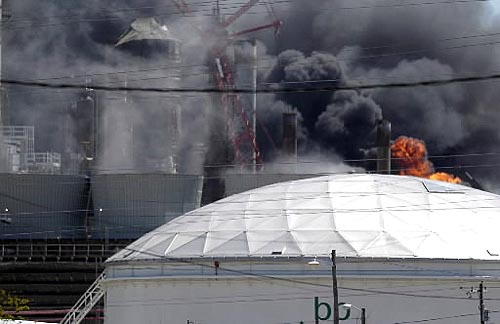
In one of the biggest workplace disasters in decades, a massive explosion at a BP Amoco refinery in Texas City, Texas, has killed at least 14 15 workers and injured more than 100. Several are in critical condition. The explosion may resurrect questions about the widespread use of contract labor in U.S. refineries and chemical plants.


The explosion apparently began in the isomer unit, which produces components used to raise the octane content of gasoline. The facility,which first began operations in 1934, is huge, employing over 1800 workers. Plant workers are represented by the Paper, Allied-Industrial, Chemical and Energy Workers International Union (PACE)but plant management reports that all 14 who died were contractors working for J.E. Merritt in Pasadena, Calif., part of Jacobs Engineers.

The rising use of contractors in oil refineries as a way to cut costs has been highly controversial. OSHA commissioned an investigation into the massive October 1989 explosion at a Texas Phillips 66 refinery that killed 23 workers. That explosion also involved contractors, and the resulting "John Gray" report found that they had not received adequate training and were not adequately familiar with how the plant operated. At the time of yesterday's explosion, the plant was undergoing a "turnaround" process, or annual major maintenance, and it was gradually being brought back on line. 2200 out of the 3300 workers at the facility yesterday were contract employees.

According to the Associated Press,
The blast left a gaping hole in the earth, mangled nearby offices, and was so powerful that witnesses said it rattled homes as far as five miles away. Cars and trucks in an employee parking lot were coated with soot and debris.

"It was real scary. Have you ever heard the thunder real loud? It was like 10 times that," said plant worker Charles Gregory, who was with several co-workers inside a trailer tank when the floor started rumbling.
Production at the plant is so large that the explosion caused fuel prices to rise.

BP's Texas City complex includes 30 refinery units spread over 1,200 acres.

With 460,000 barrels of crude oil processed every day, the plant provides 3 percent of the U.S. gasoline supply. The refinery also ranks as the eighth largest polluter in the state of Texas. It released 5.1 million pounds of pollutants in 2002, according to the latest data, including some chemicals that are known carcinogens and cause other serious health effects.

A population of 31, 413 people resides within a three-mile radius of the refinery.

The Texas City plant has a long history of safety problems. A Sept. 2, 2004, accident killed two Texas City workers when pressurized, superheated water was released from a 12-inch check valve. The incident resulted in a $109,500 OSHA fine, including seven serious violations and a willful citation for failing to relieve trapped pressure within a pipe.

The refinery was fined $63,000 for a March 30, 2004 explosion and fire in which no one was injured. There was also a fire in 2000 in which no one was injured and and explosion in 1995 that sent over 100 to the hospital. Finally, in 1993, the company paid $20 million in damages to the family of a worker who died after an April 1992 explosion at the Texas City plant.

Texas City was also the site of one of the biggest industrial disasters in American history when 576 people were killed when a fire aboard a ship at the Texas City docks triggered a massive ammonium nitrate explosion. That blast broke windows in Houston, forty miles away.

The US Chemical Safety and Hazard Investigation Board is on its way to Texas to investigate the blast.

Recent Workplace Disasters

Although the final death toll is not in yet, this appears to be the worst workplace disasters in recent history


  • April 23, 1987: 28 construction workers died in the collapse of the L'Ambiance Plaza apartment building
  • October 23, 1989: A fire and explosion in Pasadena, Texas, Phillips 66 refinery killed 23 workers
  • July 5, 1990: Explosion at Arco Chemical Co. chemical plant in Channelview kills 17 people.
  • September 3, 1991: 25 workers died another 49 were injured fighting to escape through locked fire doors of the Imperial chicken processing plant in Hamlet, NC
  • Sept. 23, 2001: 13 workers were killed in an explosion at the Jim Walter No. 5 underground mine in Brookwood, Alabama.
More on Texas industrial disasters here.


Living with refineries
: here and here.

UPDATE

BP Refinery Blast Sends Gasoline Futures to a Record

March 24 (Bloomberg) -- An explosion at a BP Plc refinery in Texas sent gasoline to a record $1.608 a gallon in New York and heightened concern supplies may be disrupted before the U.S. summer driving season.

BP, the world's second-largest publicly traded oil company, said yesterday the explosion in Texas City, Texas, killed at least 14 people and injured 70 at its biggest refinery. A gasoline component-making unit is shut, Hugh Depland, a BP spokesman said yesterday by telephone from Houston.

The fire was at least the fourth incident in a year at the plant, which processes 460,000 barrels a day of crude oil and supplies about 30 percent of BP's fuel in North America. Gasoline has gained 47 percent this year, increasing inflationary pressure in the world's largest economy and leaving consumers with less to spend.

The Texas City plant is "a monster of a refinery," said Ed Silliere, vice president of risk management at Energy Merchant LLC in New York. Now is "the wrong time for us to be seeing the loss of this unit as we get set to go into the gasoline season."

More BP stories here.
Labels: ,


McWane Admits to "Environmental Crimes": $4.5 million Fine

Our old friend McWane Corporation has pleaded guilty to "environmental crimes," fined $4.5 million, placed on probation for five years and required to spend an estimated $12 million on plant upgrades.

McWane was the focus of a 2003 NY Times/Frontline series about the high number of workplace injuries and fatalities at that company's facilities.

The plea is a significant development for McWane, which is facing a sweeping federal criminal investigation of its plants in several states. Based in Birmingham, Ala., McWane already faces federal indictments in Alabama and New Jersey, accused of conspiring to violate environmental and workplace safety laws.

"This is the third criminal prosecution of McWane in the last 16 months, and the first time that McWane has pleaded guilty and accepted responsibility for criminal conduct," said David M. Uhlmann, chief of the environmental crimes section of the Justice Department.

At a court hearing in Tyler, the company admitted two felony offenses. It said it knowingly violated the Clear Air Act by making major modifications at Tyler Pipe without installing the necessary air pollution controls. The company also acknowledged that it knowingly made false statements to environmental regulators.
The company is also facing indictments in New Jersey and Alabama, but is fighting those. The Alabama case should be interesting as a former McWane manager admitted that the company had flooded a creek with millions of gallons of water poisoned by heavy metals over a period of years.

The NY Times/Frontline series revealed the company as a corporate criminal for it high number of injuries and fatalities, and OSHA's failure to bring criminal charges:

From 1995 to 2002, at least 4,600 injuries were recorded in McWane foundries. In that same period, the company was cited for more than 400 safety violations and 450 environmental violations.
In 2002, the company paid a $250,000 fine for a willful violation of workplace safety standards that resulted in the death of a worker.

$4.5 million penalty, plus $12 million in upgrades versus $250,000 for a workplace death. Once again we see the difference in penalties assessed for environmental crimes versus crimes that kill workers.


Related Stories

Labels:


Tuesday, March 22, 2005


Sudden Death In The Steel Industry

Almost a soon as they got home, Randa heard the van roar into the driveway. Then the strong, hurried footsteps, followed by loud knocking. There were six of them standing there when she opened the door.

"Yes?"

"Mrs. Tolman?"

"Yes."

"We're from U.S. Steel."

"Yes..."

"There's been an accident. You have to come with us."

It had been a massive 1,600-pound wheel from one of the overhead cranes which did it, they said. Herbie had been working on it and the wheel just fell, suddenly, and crushed him. They told her that Herbie had died around 11 AM, and that he was gone the moment it hit him.
This is a scenario repeated too many times recently among families of U.S. steelworkers.

Journalist Dan Frosch has written a moving and informative article about the rising number of deaths in the steel industry. I've written a number of times recently (see below)about the rising death toll in the steel industry and the reasons for it, which Frosch details. After years of downsizing and automating had cut the death rate in the steel industry, the recent changes in the industry have once again made jobs more hazardous:
In recent years, a worldwide steel boom began to change the industry's fate and American steel plants have fired up production once again. According to the American Iron and Steel Institute, U.S. steel plants shipped off nearly six percent more product in 2004 than in 2003, and approximately 12 percent more than in 2002.

But while business is good, steel companies have suddenly found themselves without the "old timers," as they're called, whose mastery of their own specialized crafts has been particularly missed now that there's more work to be done. Ostensibly, a far younger, less experienced generation of workers like Herbie Tolman, have been thrust into technically demanding and often dangerous jobs without many of the veterans there to show them the safest way to work.

Unsure of how long the boom will last, steel companies have been reluctant to rehire, despite the fact that during the downturn, crew sizes were scaled down and safety and preventative maintenance staff reduced, says Mike Wright, director of health, safety and environment for USWA.

To meet the increased demand in production, many companies did the next best thing: they signed labor agreements with the USWA which allowed workers to be shifted from the job they'd initially trained for, to different departments within the plant. Indeed, more work, less knowledge and a reduced emphasis on safety have all contributed to the problem, it seems.

"The workers have been under extraordinary pressure," Wright says.
And the companies are just making the situation worse:
But there's an underbelly to this safety-consciousness, says the union. U.S. Steel, says the USWA, has also been doing something very dangerous ­ disciplining employees for reporting injuries and accidents, and in the process forcing workers to think twice about coming forward when something in the plant has gone wrong.

"If there's an injury now, discipline often follows," says Wright. "And as a result, people just aren't reporting what's happening, so you lose basic information on how to make a plant safer."

Local union representatives at other U.S. Steel plants echo Wright's concern. Some workers at Granite City Works in Granite City, Illinois, say that since U.S. Steel took over the plant in 2003, their jobs have become considerably more dangerous, in part because, they say, the company discourages workers from reporting injuries or unsafe conditions.

"At this plant, if you're worried about the safety of the job you're doing, then you are considered insubordinate," says Gary Gaines, financial secretary for Granite City Works USWA Local 1899. "This company refuses to acknowledge that there are hazards in the steel industry."

Last December, one worker at the plant, Karl Richards, was killed from carbon monoxide poisoning while adjusting a valve on a blast furnace, and in February, another worker, David Prengel, was crushed against a loading dock by a cargo train.
Herbie Tolman's wife, meanwhile, is facing life with $588 a week in workers compensation money she gets from the state. What hurts her most, she says, is that no one from U.S. Steel has ever called to apologize.

"Not one person has called from Pittsburgh, not one person! Couldn't they have done that?" she wonders. "Herbie was so proud of that job. He loved it so much. I still can't believe he's never coming back."


Related Stories:


The Labor Movement: What Harold Meyerson Says...

I have voiced my skepticism about certain unions' (SEIU, Teamsters, etc.) proposals to slash the AFL-CIO's budget in order to rebate the funds to unions to be used for organizing.

Washington Post and American Prospect columnist Harold Meyerson agrees with me:
"For all that, the Teamster dues-rebate proposal around which the dissident unions rallied seemed more symbolic than real, and an inadequate expression of the deeper discontent fueling the revolt. Leaders on both sides of the question acknowledged that the rebates would augment their own unions' organizing programs by no more than 10 percent. Ultimately, however, the real impact wouldn't be the added funds to the member unions; it would be the radical diminution in the size of the AFL-CIO's budget and staff. And it's that diminution that seems closer to the heart of the dissidents' revolt. "We have to blow up the AFL-CIO bureaucracy," John Wilhelm, who heads the hotel side of UNITE HERE, told a labor forum in Los Angeles in February. "The staff should be cut by at least 50 percent." For Wilhelm and his allies, John Sweeney's AFL-CIO has become the symbol of a slow-footed and unsustainable status quo. "
I can't speak for the rest of the AFL-CIO infrastructure, but the loss of the federation's health and safety department isn't worth whatever might be gained by "blowing up" the AFL-CIO.

Meanwhile, in a completely different perspective on the struggles within the labor movement, former UAW Executive Board member and New Directions founder Jerry Tucker accuses both "sides" of focusing too much on form and process, doing nothing than rearranging deckchairs on the Titanic, when a much more fundamental change in the labor movement is needed.
There is some evidence that the current debate inside the AFL-CIO has already foundered, despite its narrowly drawn focus. The internet ping-pong match of competing proposals is already giving way to news account postings of 'winners and losers' based on meetings and preliminary votes that have been taken internally. One possible result may be a split in the national center, with one or more unions withdrawing from the Federation.

U. S. labor needs a counter-offensive. And, the centerpiece of labor's counter-offensive, with or without all current labor leaders, should be derived from a new vision of America based on justice and the creation of a new social intersection for all of those abused by the nexus of corporation and state and today's neoliberalism.

A true crisis-resolution strategy must re-introduce a culture, and shared vision, of struggle and of common defense, through worker to worker, union to union, and social movement to social movement solidarity. Under one broad social banner, we need to declare war on poverty, racism, sexism, imperialism, and the denial of the fundamental right to affordable health care for all, full employment, shorter work-time, and many other of the true values due all participants in a just society.

Labels:


Bush & The Schiavo Case: Headlines We Won't See

In cases like this one, where there are serious questions and substantial doubts, our society, our laws, and our courts should have a presumption in favor of life.

-- George W. Bush


WASHINGTON, Monday, March 21 - The House early Monday gave final Congressional approval to legislation that would allow a federal court to intervene in the case of Terri Schiavo, and the measure was signed quickly at the White House by President Bush, who flew back to Washington from his Texas ranch on Sunday.


Headlines We Won't Be Seeing:

Bush Rushes Back To Washington To Sign Bill Imposing Strict Limits on Mercury Pollution

Bush Rushes Back To Washington To Sign Bill Imposing Strict Limits on Hexavalent Chromium Exposure

Bush Rushes Back To Washington To Sign Bill Calling for Beryllium Screening of OSHA Inspectors

Bush Rushes Back To Washington To Sign Bill Calling For Criminal Prosecutions of Employers Cited For Willful Violations in Death of Workers


I guess you only get "a presumption in favor of life" if you're brain-dead or haven't been born yet.

UPDATE: Incidentally, if you're interested in a full discussion of the Schiavo case, check out Obsian Wings, as well as Respectful of Otters (here and below.


EPA & Mercury: Fooling All The People All The Time?

Oops.

When the Environmental Protection Agency unveiled a rule last week to limit mercury emissions from U.S. power plants, officials emphasized that the controls could not be more aggressive because the cost to industry already far exceeded the public health payoff.

What they did not reveal is that a Harvard University study paid for by the EPA, co-authored by an EPA scientist and peer-reviewed by two other EPA scientists had reached the opposite conclusion.

That analysis estimated health benefits 100 times as great as the EPA did, but top agency officials ordered the finding stripped from public documents, said a staff member who helped develop the rule. Acknowledging the Harvard study would have forced the agency to consider more stringent controls, said environmentalists and the study's author.
Hey, I'm sure it was an accident. Anyone can make a mistake, or lie or cheat or falsify.

Related Articles


Monday, March 21, 2005


Immigrant Workers: Chew 'em Up, Spit 'em Out & Kill 'em, But Don't Pay Their Comp!

On January 28, 2003, two brothers from Veracruz, Mexico, Moises and Rigoberto Xaca, age 15 and 17 were crushed to death in an 8 foot deep trench in Blythewood, South Carolina. The brothers had travelled from Veracruz, where their family picked coffee beans and lived in a one-room house with no running water. They saw the larger houses with running water that their neigbors with family members in the United States were able to build. In the ten months before they died, the boys sent home $4,372, nearly three years of pay for picking coffee beans in Veracruz.

The Columbia South Carolina State is running a series looking back at the boys' death and the aftermath:

In a few months, the doors of Richland 2’s new $50 million Blythewood High School will open to thousands of teenagers in the county’s fast-growing Northeast. The students will study within sturdy red bricks.

In January 2003, however, the property was little more than a patch of sandy soil.

Burriss Electrical Co. was one of six contractors at the site. The company, founded in 1991 by Tommy Burriss, had won a $3 million contract to install electricity for the school. Burriss needed workers to dig trenches for electrical and telecommunications lines.

On Monday, Jan. 27, Moises, Rigoberto, their cousin and the hometown friend showed up at the construction site. Burriss Electrical hired them and 18 others.

Burriss officials said everyone in the group held what appeared to be valid Social Security cards and “green cards,” giving them permission to work in the United States. The brothers’ cards listed their ages at 22 instead of 16 and 15.

The hometown friend said a Burriss supervisor gave them employment papers to fill out and told them to return to work the next day.

That night, the brothers took their applications to a friend who speaks English. While filling out the papers, the group talked about butchering a hog to barbecue for Rigoberto’s 16th birthday on Feb. 6.

For their first day working on the job, the boys arrived around 7 a.m. wearing jeans, T-shirts and camouflage jackets.

They worked inside an 8-foot- deep trench with their friends. An excavator dug into the earth. The hometown friend, Moises, Rigoberto and the others followed in its path to lay the electrical conduit.

Eighty minutes into the workday, the friend realized the trench’s sandy walls were crumbling. He turned and yelled for Moises and Rigoberto to run.

The friend escaped.

But his words came too late for the brothers.

Sand and chunks of compacted dirt buried them.

Fellow workers scrambled to dig out the boys, but the teens most likely were killed immediately. They were not wearing helmets, and the soil’s weight crushed their skulls, Richland County Coroner Gary Watts said.
In March 2003, OSHA fined Burriss Electrical $42,075 for six safety violations at the site, including $29,000 for a willful violation because Burriss had been cited for the same trenching violation in 2000.

But Burriss is figting the citation, "out of principle," according to Burriss lawyer Chuck Thompson.

“It was a tragic accident,” Thompson said. “It was nothing anybody did willfully.”

According to OSHA, a willful citation does not mean that someone intended to kill a worker, but that there was "intentional disregard or plain indifference to the requirements of the Occupational Safety and Health Act."

And to add insult to injury, the State of South Carolina is fighting paying the full workers compensation amount:

By state law, the beneficiaries of a worker killed on the job are entitled to money. The amount is based on a formula, also set by state law, which essentially gives heirs up to 500 weeks of the deceased’s wages. There is a cap on the amount that can be awarded.

However, a section of the S.C. workers’ compensation code says payments to foreign workers’ dependents can be limited to half of what the family of a Canadian or a U.S. worker would receive.
(There is a similar law in Florida)

The workers comp situation for undocumented immigrants gets even worse -- the subject of a second article in the State. It seems that South Carolina employers are only too happy to accidentally overlook the fact that many of the workers they hire are undocumented -- until they get hurt. Then they're suddent shocked, SHOCKED, that illegal workers are within their midst, and how dare they try to cheat honest American taxpayers by claiming workers compensation.

Cinthia Duenaz used a fake Social Security card and work permit to get a job slicing skins and bones from chicken breasts at a Gold Kist plant in Sumter.

Her first name on her job application — Cinthia — was spelled differently from the “Cynthia” on her work permit.

Gold Kist either did not notice or did not care that Cinthia was an illegal immigrant.

The company, however, did care about Duenaz’s legal status when she fell off a stool at work and needed medical treatment. Gold Kist tried, unsuccessfully, to refuse paying for her treatment.

Duenaz isn’t alone.

Antonio, a 19-year-old illegal worker who lost his leg in an accident two years ago, also ran into the same problem when it came time to pay his hospital bills.

Attorneys who represent illegal aliens in workers’ compensation cases say insurance companies often try to deny payments.

Duenaz hired an attorney to file a workers’ compensation claim on her behalf. Gold Kist denied the claim, saying Duenaz was not covered because she was an illegal worker.

Although the courts have upheld the immigrant workers' right to collect compensation,

In January, two state representatives filed bills that would eliminate workers’ compensation claims for illegal aliens who obtain jobs through fraud, such as presenting fake ID cards and Social Security numbers.

***

For now, the bills have stalled. However, Rep. Bill Leach, R-Greenville, and Rep. Bill Sandifer, R-Oconee, the bills’ sponsors, have said they will continue to push for the change.

When Sandifer first spoke about the bills during a House subcommittee meeting, he explained his reasoning.

"I don’t know how you could go home and tell your constituents how you allowed illegal aliens who cheated to claim workers’ comp,” Sandifer said. “I know I couldn’t."

Later, Sandifer said paying workers’ compensation benefits to illegal immigrants only encourages them to come to South Carolina for work. Jobs belong in the hands of U.S. citizens and those who have gone through proper legal channels, he said.

It’s an opinion supported by many voters in a state with the nation’s fourth-highest unemployment figures.
This is in a state where Hispanic workers make up 3 percent of the population, but account for about 20 percent of workplace deaths and injuries.

Eduardo and Maria Xaca, the parents of Moises and Rigoberto still have not received any workers compensation payments. Even if they do receive the full amount, I somehow doubt that they'll think they've beaten the system.

“All they did was go to lose their lives,” Eduardo, 42, said before giving into his tears. “My little ones. My little children.”

The parents break down into hard sobs when they talk about “little Moises” and “little Rigoberto.”

“They always thought of their mother and father, brothers and sisters,” Maria said. “My little children were very responsible. They were always loving. They were always hard working.”

The family added more rooms to their house, but improvements stopped when the boys died. There is no extra money to finish, Eduardo said.

Meanwhile, young men in their town continue to pour into the United States, sending home money so the Xacas’ neighbors can have bigger, more comfortable homes and can buy cars.

Eduardo and Maria know Moises and Rigoberto’s story won’t stop the migration. The draw of money is too powerful.

So, they advise the young men to rely on faith. That means praying in church and crossing the border with Virgin Mary statues and rosaries in their pockets.

“I tell them to pray to God that nothing happens to them,” Maria said. “What happened to us I do not wish on anyone because losing a child is like losing half of your life.”

POSTSCRIPT

2 workers killed in crane
collapse

Saturday, March 19, 2005

IRVING, TX – Two construction workers building a parking garage in Las Colinas died Saturday morning when a crane boom collapsed, dropping debris that crushed them.

One witness said the crane appeared out of balance before the accident.

The boom, which reached high above the four-story garage, buckled about 9:20 a.m. as it hoisted 30-foot steel beams for the structure's skeleton.

Angel Roldan, 33, of Dallas and Juan Roldan, 26, of Mesquite died in the accident. The men, who were cousins, were taking a break at ground level when three beams crashed to the ground in the 300 block of East Las Colinas Boulevard, police said.


Related Stories

Labels:


Saturday, March 19, 2005


Of Fish and Men: Corporate Penalties And The Law

One of the favorite anecdotes told by critics of OSHA's ineffectiveness is that the penalty for causing the death of a worker by willfully violating safety laws is half the maximum for harassing a wild burro on federal lands.

Over the last few days, we've learned some other things. The penalty for killing fish and crabs is far higher than the penalty for killing a worker. And the penalty for running a yellow light is far higher (proportionately) than the penalty for systematically hiring and abusing undocumented immigrant workers.

Lets discuss our system of laws and the penalties for breaking those laws. I'm no lawyer, but I think I understand the way it's supposed to work: people and corporations are supposed to obey the law or else be punished in a way that will serve not only as a disincentive to repeat their crime, but also to deter others from following down the same wayward path.

For example, while visiting my sister at a family reunion in Eugene, Oregon last summer, I was so busy enjoying the sites of that lovely town, that I neglected to stop when the traffic light turned yellow. As the rear end of my car was still in the intersection when the lite turned red, I was awarded a citation from one of Eugene's friendly motorcycle cops, along with a $230 fine -- an amount more than sufficient to deter me and every member of my family from even thinking about violating a traffic law.

Somehow, it doesn't work that way if you're a large corporation -- or even a small company -- especially if your only crime is killing a worker.

Today our favorite company, Wal-Mart, made the front page of the NY Times:
Wal-Mart Stores Inc., the nation's largest retailer, agreed to pay $11 million to settle a federal investigation that found hundreds of illegal immigrants were hired to clean its stores, government and company officials said yesterday.

U.S. officials described the settlement's dollar figure as the largest of its kind. But Wal-Mart admitted no wrongdoing in the case, saying it was unaware contractors were employing illegal immigrants.
In fact, Wal-Mart claims it wasn't even a fine, but rather "a voluntary payment that would be used to help ensure compliance with immigration laws."

Eleven million dollars sounds like a lot of money, But Nathan Newman puts it in perspective:
Prosecutors announced they were dropping all criminal charges against Wal-Mart for its use of contractors employing undocumented workers in exchange for paying an $11 million fine, a hefty sounding amount but a pittance for a company with $288.2 billion in sales last year. Let's put it this way-- this is an equivalent financial hit to an average person making $50,000 per year being hit with a $1.90 fine for illegal activity.

The double standard for corporate crime is astounding-- we destroy the lives of young people for minor drug crimes, but corporate executives can break the law and steal pay from their workers, and all they get it a financial slap on the wrist.
Yesterday, the US Justice Department and the Environmental Protection Agency announced a $10 million fine against Motiva Enterprises. Motiva is an oil refining and retail business owned by Shell Oil Company and Saudi Refining, Inc.
On July 17, 2001, Tank 393, a 415,000 gallon capacity tank at Motiva’s Delaware City Refinery, exploded while containing spent sulfuric acid, which is a mixture of sulfuric acid, water, and hydrocarbons. The explosion killed one worker, Jeffrey Davis, and injured numerous others. Spent sulfuric acid from the tank farm spilled into the Delaware River, resulting in thousands of dead fish and crabs.

***

Following the explosion, EPA criminal investigators gathered evidence which indicated that Tank 393 had a long history of problems. Among other things, Tank 393 had numerous localized corrosion and leaks during the previous eight years, including six leaks from June 1998 to May 2001. Company inspectors repeatedly recommended that Tank 393 should be taken out of service as soon as possible for an internal inspection, but no internal inspection was conducted after 1994. Motiva also switched Tank 393 from storing fresh sulfuric acid to spent sulfuric acid without conducting a full engineering review (known as a management of change review) that would have required technical experts to analyze the changes to account for the flammable hydrocarbons in spent sulfuric acid.

Shortly before the explosion, according to the statement of facts, Motiva had several warnings from its own employees about Tank 393’s problems. Nevertheless, workers were sent to acid tank farm to repair the catwalk connecting the tanks on July 17, 2001, and a hot works permit was issued for the job. During the afternoon of that day, flammable vapors from Tank 393 reached a heat source, and the resulting explosion caused the Tank 393 to separate from its foundation pad. Mr. Davis’s body was never recovered. Additionally, approximately 99,000 gallons of sulfuric acid drained into the Delaware River for days after the explosion.
A couple of observations:

Although this is the largest fine in Delaware environmental history, those closest to the accident weren't happy:
"I was disappointed that the federal government chose not to charge any individual for criminal actions," Sen. David B. McBride, D-Hawks Nest said. "While this is a very steep penalty, I'm concerned that it will just be viewed by some as a cost of doing business."

Mary Davis, the widow of Jeff, would not comment publicly on Thursday's action, according to Matthew A. Casey, one of the attorneys who represented the family in a separate lawsuit. The company settled that case for $36.4 million.

Davis called for harsh penalties against the company in an earlier state criminal prosecution. In 2003 she wrote: "We were not even left with his body to bury. Motiva destroyed our hopes, our dreams and our future."
Jeffrey Davis's body was completely dissolved by the acid he fell into. Only the steel shanks of his boots were found.

OK, $10 million. A good chunk of change, but not a lot for a company of that size. Let's look at it now in a slightly different perspective. If Motiva hadn't sent a bunch of fish and crabs to meet their maker, we wouldn't be talking about a violation of environmental laws; we'd be talking only of violations of the Occupational Safety and Health Act, which resulted in a paltry $175,000 penalty in 2002. That fine, originally a "willful" violation (meaning the company was aware of the hazard) was reduced to an "unclassifed" violation, which, in the words of Robert Gombar, the attorney representing Motiva, avoids "unnecessary complication presented by harmful labels." OSHA also refused to seek criminal prosecution, which didn't sit well with the family or the state of Delaware, as recounted in a December 2003 NY Times article by investigative reporter David Barstow:
In Delaware, the state's congressman and senators wrote to [Assistant Secretary of Labor John] Henshaw this year and demanded that he account for "OSHA's inexplicable decision" to reduce the violations in Delaware City. OSHA's handling of the case, they wrote, had compounded "the emotional trauma for the family."

In response, OSHA's deputy administrator, R. Davis Layne, wrote that OSHA had simply "exercised its prosecutorial discretion" to settle a contested case. Families, he explained, are not consulted "regarding confidential litigation matters."

But if OSHA saw no potential for a criminal case, Delaware's attorney general, M. Jane Brady, did. In an interview, she recalled the stunned reaction of one Motiva lawyer when she announced her intention to seek charges: "You got to be kidding me."

This summer, Motiva pleaded no contest to criminally negligent homicide and assault, only the second such prosecution in state history. The company was ordered to pay $46,000 in fines, then the maximum under state law, and $250,000 more to a victims fund. Soon after, Delaware changed its law to allow far higher fines.
In fact, however, even the $175,000 OSHA fine against Motiva was far higher than normal OSHA penalties for killing workers.

I wrote a tongue-in-cheek article last month about the low $5,800 penalty handed down to K&M Construction for killing a worker, John Duesler, last July in an unprotected 9 foot deep trench.

But even that fine sounds huge compared with this:
A Napa construction company has been fined $300 in connection with the industrial death of one of its workers.

The accident, which happened on Sept. 3, 2004, took the life of Rebecca Kogan, 39, of Menlo Park. Kogan had been employed with Tri-County Construction as a grade checker for just a couple of weeks at the time she was killed.

Kogan was run over by one of the monstrous wheels of a Caterpillar motor grader, according to authorities. She was pronounced dead at the site on Tower Road, in south Napa County.

After investigating the accident, the California Division of Occupational Safety and Health ruled there was lack of communication between Kogan and the grader driver and lack of management knowledge at the site.
So lets put a slightly different perspective on Nathan Newman's analogy. If the Labor Department wanted to have the same impact on Wal-Mart that Eugene's finest had on me, the fine would have been somewhere in the neighborhood of $650 million rather than $11 million.

So what's the message here? If you're a large corporation, make sure you target your political contributions well and hire expensive lawyers.

If you're a worker who's going to die on the job, make sure you take a bunch of fish with you.

.

Labels:


Friday, March 18, 2005


Bird Flu and the Future Of The Labor Movement

Revere at Effect Measure manages to weave together the impending Bird Flu crisis, workplace safety & health, organizing and the future of the labor movement, all in one short post:
The bird flu situation should remind us that there is an important occupational health and safety issue here for poultry workers. A major population of the poultry workers is in the south. Health and safety, especially if it potentially involves the families and children of workers, is a potent organizing issue, more so than wages. The ergonomic and injury issues of great concern to poultry workers can be strengthened by adding an infectious disease that can be brought home to the list of issues. Organized labor should be alerted to this problem and begin to organize poultry workers around it.


Pity The Baggage Screeners

I need to stop writing and start reading more blogs. Workers Comp Insider has a couple posts about the back and other ergonomic injuries facing airport baggage screeners. Sure glad we don't have that stinkin' ergonomics standard:
USA Today recently ran a feature on airport baggage screeners and the extraordinarily high rate of injuries that they suffer in the course of their work. Approximately one out of every four workers reports an injury and one out of 8 workers has an injury that requires lost time. Yikes - this makes bag screening one of the nation's most hazardous jobs.

Injured workers at the Transportation Security Administration (TSA), more than two-thirds of whom are screeners, missed nearly a quarter-million days of work last year. The lost job time has contributed to a staffing shortage that has strained checkpoint security and lengthened lines at airports.

TSA employees injured on the job missed work in 2004 at five times the rate of the rest of the federal workforce. They were injured four times as often as construction-industry workers and seven times as often as miners.
Not that anyone cares about their injuries, but hey, it's slowing down the lines!

Then they go on to diagnose some of management system failures causing the problem, along with some solutions:

The massive hiring of 45,000 security people in the Transportation Security Administration is a classic case study in "not-exactly the best" management practices. Indeed, LynchRyan cautions employers that the "good times" of expansion come with a very high risk for injuries and losses, simply due to the fact that you have to hire so many strangers. Safe hiring, under the best of circumstances, is a huge management challenge. When you combine a new occupation with difficult working conditions and ambiguous job descriptions, you have a recipe for serious trouble.

Workers Comp Insider is sponsored by LynchRyan, "a management consulting firm specializing in workers' compensation cost controls" so hopefully managers -- who probably don't read Confined Space religiously -- are learning something.

.

Labels:


Danger Lurks....In MY Own Back Yard

This isn't good:
Potential danger is lurking on the railroad tracks that sit on Takoma Park's western edge and cut through downtown Silver Spring, a panel of experts said last week as they called for support of the District of Columbia's law regulating the transport of ultra-hazardous materials.

At the top of the list of dangers is chlorine, which is shipped from Augusta, Ga., to northern New Jersey on 90-ton tanker cars. Fred Millar, a member of the District of Columbia Local Emergency Planning Committee who has a background in issues related to hazmat transport, said a terrorist attack on one of those tanker cars could kill as many as 100,000 people within 30 minutes of an explosion.
Hmm.

Takoma Park. That's where I've lived -- a short 10 minute walk from those tracks --- for the past 22 years, during which time I've witnessed three major derailments -- happily, none involving toxic chemicals.

Kind of makes you think....

.


Thursday, March 17, 2005


Anyone Know A Good Trench Rescue Class?

According to this article, "A Poplar Bluff man is counting his blessings today after a close call mishap Tuesday at a work site on PP Highway."

Looking at the photo, it seems more like three Poplar Bluff men should be counting their blessings. Generally, one wants to shore up the walls of a trench before climbing down to rescue someone.


This guy, unfortunately, wasn't so lucky:


Man killed in trench collapse


MELVIN, IL -- A rural Melvin man died Tuesday morning when a trench in which he was working collapsed on him.

William W. Glenn, 66, of 1170 North 1400 East Road, was pronounced dead at Gibson Area Hospital in Gibson City shortly after the 11:25 a.m. accident.

Ford County Coroner Doug Wallace said Glenn was digging a trench to work on a septic line at the Saul Fores residence, 312 E. Third St. in Melvin, when the 6-foot trench walls collapsed.

Labels:


Confined Space Mailing List: Sign Up Today

If you're one of the unlucky few who don't already get a weekly mailing from me, maybe you'd like to join the crowd.

Check out the upper left hand column of Confined Space where it says "Join the Confined Space Mailing List."

Put in your name and e-mail address and you'll receive a weekly notification of Confined Space postings over the past week. It's free. It's easy. And it's only one e-mail a week.

Note: There's a "double opt-in" procedure, which means once you sign up, you'll get an e-mail asking you to click on a hyperlink to confirm your subscription. If you don't click within seven days, your subscription will not come into effect.


Wednesday, March 16, 2005


What Happened To My Dad?

The Contra Costa Times ran a fascinating, yet heartbreaking series last week describing a virtual perfect storm of industrial disaster that swallowed the lives of five men and left fourteen children without fathers -- a pipeline company that had recently purchased too many aging pipelines to keep track of, a low-bid contractor with a terrible safety record and a municipal utility, unaware and unconcerned about the contractor's safety record driving the contractor to hurry and get the job done.

The result:
The blast threw Victor Rodriguez so high into the air that when he hit the pavement every bone in his skull shattered. His left leg, sternum and ribs broke.

The battered body of the father of two young girls lay burning in the street near downtown Walnut Creek that November afternoon.

Roger Paasch heard the shouts, saw the fireball roaring toward him and scrambled out of a 14-foot-deep trench.

Jeremy Knox followed right behind.

When they reached ground level, Knox felt his face swelling. He looked down. Skin hung off his hands.

Paasch chased down two workers who ran by engulfed in flames and got them to the ground. The flames died out on one. Paasch ripped the burning shirt off the other.

Somebody yelled to Paasch, "You're bad, you're bad! Sit down, sit down!"

But Paasch, a welder, was too badly burned to sit. He walked instead. Minutes later, medics loaded him into one of four medical helicopters, where he slipped into unconsciousness.

Four months later, his nightmares endure.

"I remember everybody else was all messed up," Paasch said. "Everybody in the whole thing was messed up."

As the victims and their families cope with the disaster's aftermath, investigators consider whether to blame one or both of the companies involved.

On Nov. 9, the men were building a water main for the East Bay Municipal Utility District, unaware they were in extreme danger.

The trench they were digging and working in had crossed a point where construction drawings clearly showed a high-pressure gasoline line jutting toward their path. The plans warned specifically that the 100-foot section they had crossed into was a place where extra precautions were required.

The warnings went unheeded.
Killed in the explosion were Tae Chin Im, 47, Javier Ramos, 36, Israel Hernandez, 36, Miguel Reyes, 43, and Victor Rodriguez, 26.

The story began when the East Bay Utility District needed to lay down a water main and hired and fired one company for not working fast enough, then hired Mountain Cascade, Inc., a Northern California construction firm with a terrible safety record.
In the six years before a fatal Walnut Creek explosion in November, two of the company's workers and a motorist died on the company's job sites.

At least six other workers suffered serious injuries, including a 19-year-old college student whose leg was ripped off at the hip last summer and three sewer workers who nearly died from exposure to poisonous gas.

Investigators cited haste in two of the deaths and a failure to properly train a worker in the other. The company routinely resisted investigations by the California Division of Occupational Safety and Health, according to records, and claimed in a 2001 letter to the agency that its problems had to do with image, not safety.
In addition to their poor safety record, Mountain Cascade routinely resisted investigators and intimidated employees who witnessed accidents out of talking to CalOSHA inspectors.

The owner of the pipeline that exploded was Kinder Morgan, the nation's largest owner of liquified fuel pipelines. The rapidly expanding company has faced questions over the past two years about its ability to safely maintain its expanding pipeline network. The Houston-based company has drawn a number of fines over the past 21 months for numerous pipeline ruptures and spill, including a record-setting $325,000 federal Transportation Department penalty for not monitoring cracks and corrosion throughout its network.
Kinder Morgan's troubles, including the Nov. 9 disaster in Walnut Creek, show it probably fails to commit enough resources to maintenance and safety, said Carl Weimer, executive director of Pipeline Safety Trust, a watchdog group in Washington state, where a 1999 pipeline explosion killed three people.

"It seems to relate to how fast they've grown," Weimer said of the company's huge expansion over the past eight years. "Is it freak events or is it a management thing? Kinder Morgan has had a rapid growth period that could have contributed to some of those problems."

A Kinder Morgan spokesman denied there was a pattern of mismanagement but acknowledged the company has experienced an unusual series of accidents.
Kinder Morgan was supposed to place markers delineating the location of the pipeline. It's not clear that they ever did that. Mountain Cascade, meanwhile, was supposed to avoid the fuel line, even if it meant excavating by hand. But they were in a hurry and never shut down the backhoe.

The East Bay area is particularly vulnerable to this type of problem.
Millions of gallons of toxic, highly dangerous fuel course each day through hundreds of miles of hidden petroleum arteries buried under the East Bay, part of a vast nationwide circulatory system that delivers two-thirds of the nation's petroleum. Contra Costa has more petroleum pipelines per square mile than any other California county.

The nationwide network is aging, at times neglected, and historically poorly regulated. When pipes leak, the threat is normally limited to the environment or gasoline prices.
And until recently, the federal government, which has authority over interstate pipeline safety, has been asleep at the switch.
After decades of poor monitoring, the federal Office of Pipeline Safety, a small unit within the Transportation Department, began to comprehensively investigate the condition of the nation's pipelines.

In the first 25,000 miles of petroleum pipelines examined as of last year, inspectors found 20,000 "integrity threats," 1,200 of which required immediate repair. Regulators said those early results showed such an inventory was overdue.

Industry officials say statistics show moving petroleum through pipes is safer than by trucks or trains.

They also say the number of pipeline incidents is dropping.

That's true, but accidents with death, injuries or more that $50,000 in damage are on the rise as more fuel flows through pipelines and population growth puts more people near them, according to the U.S. Government Accountability Office.
And California's fire marshal's office, which oversees pipeline safety, has no enforcement authority even when it identifies violations of the law or unsafe conditions.

And underneath it all is that state government that spends billions of dollars on construction projects without evaluating the safety records of the firms they hire.

In this case, although Mountain Cascade submitted the lowest bid by $500,000, the other bidder, Ranger Pipelines Inc. of San Francisco, had a far better safety record. EBMUD was not aware of either firms' safety record, however.
The law does not require it, and most public agencies do not request or review bidders' safety histories before awarding multimillion-dollar contracts.

"They (public agencies) think it's too expensive," said Frances C. Schreiberg, a former staff attorney for the investigations division of the state Division of Occupational Safety and Health.

Without such a law, contractors who cut corners gain an advantage in a state that requires public contracts go to the lowest "responsible bidder," she said.

"It creates an unlevel playing field for those who do safety," said Schreiberg, who has lobbied to require safety reviews as part of public contracting law.
Public agencies assume that companies with a valid contractors license must have a safe record or CalOSHA would have taken away their license. But CalOSHA doesn't have the authority to do that. All they can do is turn a company's citation history over to the Contractor's State License Board, but the board can't say when or if it ever acts on CalOSHA referrals.

What we have here is failures in multiple systems: the inability to sanction companies with unsafe workplace safety records, the inability to factor safety records into contracting systems, the inability to address serious problems of our crumbling infrastructure and the inability of government assume its most basic responsibility -- assuring the safety of its citizens.

It's the workers -- and their children -- who suffer from these failures.


Many of those injured in the blast still suffer from their burns.
For the families of the dead, it's even worse.

When Victor Rodriguez died, he left two daughters, Ariana, 3, and Alegandra, 18 months. He was already looking forward to their quinceanera parties, when the girls turned 15. He planned to buy them beautiful dresses and dance all night.

"His daughters were his treasures," said Juana Liliana Arias, 26, their mother.

The girls are too young to understand why their father is gone. But since his death, Ariana sometimes sees her mother crying by herself.

The 3-year-old tells her, "Don't cry, Mommy, I'm with you."
.

Labels:


Globalization Health and Safety Conference Announcement

I don't do a whole lot of conference promotion on this site (unless I'm speaking there), but this one looks too good to pass up. If you're in the neighborhood, or can get there, try to attend

Workplace Health and Safety in the Global Economy
April 29-30, 2005
University of Oregon, Eugene

Globalization means working conditions in developing and industrial countries are more and more interconnected, and OHS practitioners, labor activists, and researchers need to talk about it.

The University of Oregon Labor Education and Research Center is hosting a conference on OHS and labor issues in the globalized economy to promote this discussion and share technical, political, and organizing skills and resources across borders and continents. Health and safety professionals, labor and NGO activists, corporate officials, and researchers from Latin America, Asia, South Africa, US, Canada, and Europe will gather at the two-day working conference to address "needs, barriers, and signs of progress" in the area of working conditions and labor rights and to highlight projects around the world that provide examples of effective action and continuing needs. The conference will provide ample networking opportunities for practitioners, activists, and researchers. The conference will commemorate Worker Memorial Day during lunch on April 29.


Sessions include:
  • OHS Prevention Programs in the Informal Sector
  • Global Corporate Programs: Best Practices and Barriers
  • Regulation and Enforcement in the Global Semiconductor Industry
  • Immigration, Migration, and OHS
  • Gender Issues In OHS In Developing Countries
  • Trade agreements, public health, and occupational health


Speakers include:
  • Ellen Rosskam, ILO
  • Harley Shaiken, UC-Berkeley
  • Monina Wong, Hong Kong Christian Industrial Committee
  • Cathy Walker, Canadian Auto Workers Union
  • Andrew Watterson, Univ. of Stirling
  • Julia Quinonez, Comite Fronterizo de Obreras (Mexico)
  • Deanna Robinson, Gap, Inc.
  • Homero Fuentes, Coverco (Guatemala)
  • Kalpona Akter, Bangladesh Center for Workers Solidarity
  • Garrett Brown, Maquiladora Health and Safety Support Network
  • Maggie Robbins, Hesperian Foundation

Cosponsors:
ILO Programme on Socio-Economic Security
Wayne Morse Center for Law and Politics
Maquiladora Health and Safety Support Network
National Council for Occupational Safety and Health

Registration: $165 regular, $85 student

More information here.


Elaine Chao Goes To The Senate

Nathan Newman blogs about Labor Secretary Elaine Chao's appropriations hearing yesterday to discuss the FY 2006 budget. Hot topics were DOL's sweetheart deal with Wal-Mart and major cuts in DOL's International Labor Affairs Bureau.

Bottom line:
Put these facts together and you have an administration that doesn't care about child labor abroad-- thereby helping to feed cheap manufactured goods to companies like Wal-Mart -- or child labor at home, to help Wal-Mart and other low-wage shops staff their stores.

Labels:


Tuesday, March 15, 2005


Right to Know: RIP? Happy Sunshine Week

Happy Sunshine Week!

Huh?

Yes, this is the first national Sunshine Week, an event sponsored by more than 50 news outlets, journalism groups, universities and the American Library Association to focus on the issues that surround the freedom of the press and government openness.

And it has never been needed more than it is now. There is a great debate raging in this country, mostly behind the scenes, that will impact the safety of this nation's first responders, as well as citizens living in the vicinity of industrial facilities that use significant amounts of chemicals. The debate is over the right of workers and citizens to know what chemicals they may be exposed to. It's a battle that was largely fought and won years ago, but is being refought again under the specter of terrorist threats.

Last week I wrote an article entitled "First Kill The Responders" about a Homeland Security Department proposal to remove the hazard identification placards from railroad chemical tank cars in order to protect the country from train-targeting terrorists. First responders who have a need to know what they're confronting are not amused.

Meanwhile, an rail accident last week in Salt Lake City shows that while the battle over the right-to-know, it's apparent that we've still got a long way to go before right to know, actually becomes the ability to know:

A railroad tank car that leaked toxic fumes, forcing thousands of people from their homes, was not designed to hold the mixture of highly corrosive acids with which it had been filled, the car's owner said Monday.

Some 6,000 people were allowed to return home and highways were reopened Monday after crews pumped the hazardous brew of waste out of the tank car.

Tests showed the tank car had been filled with a mixture of acetic, hydrofluoric, phosphoric and sulfuric acids, which easily corroded the car's lining, said Louie Cononelos, a spokesman for Kennecott Utah Copper of Magna, Utah.

Cononelos said the car was supposed to be used only for hauling sulfuric acid.

The copper mining company owned the car, but Philip Services, a hazardous waste handler, had leased it, and was using it to haul waste belonging to its customers. Philip Services spokesman Paul Schultz said the load complied with federal Transportation Department guidelines on the shipment of hazardous materials.

South Salt Lake Fire Chief Steve Foote said the incident could lead to a criminal investigation.

Officials said 6,000 gallons of liquid was pumped out of the car and it was believed about 6,500 gallons more had leaked and soaked into the ground. Contaminated soil will have to be neutralized with lime and removed, they said.

And the plot thickens. On one hand, this tanker had one of the placards that the Department of Homeland Security is proposing should be removed. On the other hand, it was wrong. Even thought the tanker was carrying a variety of highly dangerous acids, the placard showed only sulfuric acid. And although the shipping manifests were recovered, they were so confusing that it took two days to figure out what was in the tanker.


The spill at the Union Pacific rail yard in South Salt Lake sent an orange cloud of potentially lethal gases over a several-block area. Several roads and highways, including a stretch of Interstate 15, were shut down for almost a day.

Watching a crew member poke a pen through the tanker's solid steel wall, South Salt Lake Fire Chief Steve Foote had no clue exactly what he was dealing with.

"It wasn't until two days after the incident that we had the state lab bring the results," Foote said Wednesday. "There was a lot of misinformation."

At issue is the tanker's Uniform Hazardous Waste Manifest, a federal government form as bureaucratic as it sounds - full of confusing numbers and dry legalese.

It's supposed to provide a complete paper trail of a hazardous shipment, and it should be a source for police, firefighters and any others who need accurate and accessible information to safely respond to toxic spills.

But critics say police and firefighters, who respond to a wide range of emergencies, can't be expected to make sense of the arcane jargon on the form.

"It's a whole plethora of numbers, codes and abbreviations, and that makes it difficult to follow through on what these things mean," Foote said. The manifest for last weekend's tank car was so puzzling that he assigned an entire team to make sense of it.
The Association of American Railroads, which likes to boast of the safety of chemical transport by rail, thinks this is all much ado about almost nothing:
Rail is the safest method of shipping hazardous materials. Railroads have an outstanding track record in safely delivering hazardous materials – 99.9998 percent of hazardous materials carloads arrive at their destination without a release caused by a train accident. Hazmat accident rates have declined 87 percent sine 1980 and 34 percent since 1990.
That railcar in Salt Lake City (as well as January's South Carolina chlorine train accident that killed nine), must have been among the .0002 percent. And this statistic kind of misses the point. We're concerned here about low probability, high impact accidents. 99.9998 percent sounds good, unless that .0002 percent is really bad stuff that get's released in a highly populated area.

All of these accidents, as well as the continuing debate over chemical plant safety, heighten the stakes of the Right-to-Know debate. Is there too much easy information available for our security? Is there too little? Is what's available too hard to understand or is it too easy to understand?

Last month we even saw chemical manufacturers and the government of the chemical-laden state of New Jersey actually keeping the unions that represent the workers in the chemical plants in the dark while developing chemical plant security plan.

Meanwhile, the American Railroad Association, along with the Departments of Homeland Security and Justice, are arguing that Washington D.C.'s recently passed ban on hazardous rail transport through the city will actually “increase exposure to possible terrorist action.” Their reasoning?
The Department of Justice and Department of Homeland Security said the DC law would “result in a dramatic increase in the total miles over which such materials travel and the total time the materials are in transit,” and "increase their exposure to possible terrorist action."
Well, yeah, but if re-routing the material through less densely populated areas -- even if it covers more distance -- means that a terrorist attack would kill far fewer people, wouldn't that actually reduce the threat of terrorism? Or am I missing something?

The issue seems to transcend normal political divisions. In solidly Republican Utah, for example, people are particularly concerned about their right to know:
In Utah, the public's right to know what is being shipped is an issue not only in the wake of the March 6 spill, but in the debate over plans to ship high-level nuclear waste to the Skull Valley Goshute reservation 50 miles west of Salt Lake City.

Chip Ward, co-founder of the Healthy Environment Alliance of Utah, said the potential transport of nuclear waste through the state underscores the importance of accessible information.

The risks, he said, "approach a whole different scale when you talk about transporting nuclear waste."
But there are signs that common sense seems to be breaking out -- at least among the front-line responders:
[South Salt Lake Fire Chief Steve]Foote said the likelihood of an accident is greater than a terrorist attack. Removing the placards is exchanging one risk for another, he said.

"We're starting to have more and more of these [accidents], but as far as I know, none of them has actually been sabotaged," he said.


Since 1973, 47 people have died in the United States as the result of tank cars either failing or derailing, Federal Railroad Administration statistics show. The most recent accident, on Jan. 6, killed nine people in Graniteville, S.C., when a derailed tank car spewed chlorine.

Between 1990 and 2004, there were 504 documented releases from 881 tank cars hauling hazardous materials,prompting the evacuation of a total of 144,497 people.

Warren Flatau, spokesman for the Federal Railroad Administration, did not believe any of the accidents were the result of sabotage.
And if we really need something to fear, let's not forget the recent National Transportation Safety Board (NTSB) report that warned that as many as half of the 60,000 tank cars in service in the United States do not meet current industry standards, making them more susceptible to rupture.

The media is slowly catching on to the threat. Orlando Sentinel columnist Myriam Marquez recently published widely syndicated op-ed strongly defending the public's right to know"
The public’s “right to know” stands as the centerpiece of any democracy. Without informed citizens, there can be no real government accountability. Access to what government is doing is everybody’s business.

Since the terrorist attacks of Sept. 11, 2001, our rights have been dismissed as a threat to national security, and many Americans accept the blackout as necessary to secure liberty. That’s the tough sell democracy faces under today’s climate of fear from terrorism

***

Congress was duped when it gave companies the right to hide from the public information about the chemicals they store or information about other "critical infrastructure." That’s part of the law creating the Homeland Security Department.

If people living in the vicinity of, say, a chemical plant don’t know what’s being stored, how much of it, and what type of safety plans the company has in place, are those folks any safer than if they had that information and knew what they might face from an accident or even an attack on the plant?

It used to be that the Environmental Protection Agency’s Web site contained environmental reports filed by chemical plants so that the public could know what types of potentially poisonous materials were near their homes, businesses or schools. The EPA yanked those from its site post 9/11.

Accidents are more likely than terrorist attacks on such plants. Now people are more vulnerable, not less, because they haven’t a clue what risks they face. Until it’s too late.
The situation is getting so ridiculous that even conservatives are getting upset:
Last year a trade publication called Mine Safety and Health News asked the U.S. Labor Department for biographical information about a new deputy secretary it wanted to profile. The department refused.

The information, it said, would invade his privacy.

Privacy and national security are big reasons for the clampdown on public information from Washington. From Vice President Dick Cheney's energy task force to information about the safety of dams in the Carolinas, many federal records have become off-limits. But critics say secrecy has become part of the culture.

"In the last 30 years, we've never had an environment that's been as hostile to openness as we have now," says Pete Weitzel, coordinator of the Coalition of Journalists for Open Government.

***

In Congress, many Republicans and Democrats are trying to open the doors of government wider.

"Conservatives are realizing that transparency is big government's biggest enemy," Mark Tapscott, director of the conservative Heritage Foundation Media and Public Policy Center, told a Newhouse News reporter last month. "Some conservatives have had a tendency to mistake an emphasis on the importance of transparency with long-haired college professors."
Let's all have a happy Sunshine Week. It may be your last.

Labels:


EPA Sells Mercury Pollution

The Bush Administration's "cap and trade" mercury pollution plan will be issued today. I've written about the health problems inherent this unprecidented method of regulating a toxic chemical, as well as the GAO report showing that the administration has cooked the books on the economic analysis.

For those of you looking for a good analysis of the book-cooking by the EPA, check out science blogger Chris Mooney's article in the American Prospect.

Mooney describes the two alternative approaches -- using the"best available technology" to reduce mercury pollution, the approach traditionally used to control toxic substances, and the "more lax, market based 'cap and trade'" model.

Mooney describes how this administration, which talks big about "cost-benefit" analysis and sound science, has somehow forgotten to factor the benefits into its analysis:
maybe most stunningly, the GAO added that the EPA had failed to "quantify the human health benefits of decreased exposure to mercury, such as reduced incidence of developmental delays, learning disabilities, and neurological disorders." In short, perhaps the most obvious source of benefit from regulatory action -- and an area where the tougher technology-based approach clearly bests cap and trade -- got short shrift. And despite this, the technology-based approach still had a net economic benefit of $ 13 billion annually!

But wait, there's more. In a February report, the EPA inspector general highlighted some of the same problems as the GAO, but also noted that the EPA had failed to select the best technology-based approach to begin with. In effect, the EPA cherry-picked a technology-based standard that
would result in mercury reductions comparable to the administration's Clear Skies plan, rather than a standard that would actually achieve the maximum possible pollution reductions (as the Clean Air Act requires). To do so, the agency had to attempt multiple model runs just to find a technology-based scenario that was bad enough that it would match the cap-and-trade approach. In short, once again the EPA rigged its analyses to make the Bush administration's politically favored approach seem like it could match the competition.
And not only did the EPA falsify the economic analysis, but the regulatory watchdog of this administration, the White House Office of Management and Budget, somehow overlooked the fact that the benefits of the technology approach were missing:
Moreover, the White House branch typically charged with scrutinizing agency proposals to make sure they're based on rigorous economic analyses -- John Graham's office within the OMB --- was curiously "asleep at the cost-benefit switch," as legal scholars Lisa Heinzerling and Rena Steinzor of the Center for Progressive Regulation explain in a lengthy article on the corruption of economic analysis in the mercury-regulatory process.

Remember the big picture here: Conservatives are the ones who have long yelped about the need to impose an economic check on federal-agency regulations. But along came a proposed agency action with massive benefits, and the hardheaded economists at the OMB simply shrugged while a politicized EPA rigged its analyses. Whatever regulatory option the administration ultimately chooses for mercury next week, we now know that it will have emerged from a truly dubious process.
It's so disappointing how they live up to our lowest expectations.

Related Articles:


Monday, March 14, 2005


And we're trusting this company with our lives?

"TIMCO Aviation Services Inc. is one of the largest independent Commercial Jet Maintenance, Repair, Modification, Overhaul and Aircraft Storage service providers in the United States" So says the Timco website. Sounds good to me. Until today:
GREENSBORO -- Air safety advocates are troubled by TIMCO's use of illegal immigrants to work on airplanes at Piedmont Triad International Airport not only for fear of terrorism, but also out of concern for mechanical errors that could put the flying public at risk.

The company's use of undocumented immigrants could lead to a maintenance flaw with serious in-flight consequences, said Gail Dunham, president of the National Air Disaster Alliance/Foundation.

"TIMCO hired them because they are cheap," said Dunham, a Summerfield resident whose Washington-based group claims to be the nation's "largest grass-roots air safety organization."

"When people's lives are on the line, they should be hiring the very best people, not the cheapest," she said.


Sunday, March 13, 2005


Bankruptcy in the Nation's Capital: Still Outraged After All These Years

Washington Post colunist and frequent television pundit David Broder has been around Washington D.C. a long time and seen a lot shenanigans. Sometimes I find him a bit too complacent about the goings-on here, but it's nice to see that with all his years in Washington, he's still sometimes still able to muster a health portion of outrage at the abuse and hubris of those who hold the levers of power.

The latest case that's gotten Broder's pants in a twist is the corrupt bankruptcy bill, passed last week in the Senate (with an obscene amount of Democratic support) and soon to be passed by the House and signed by the President:
When it comes to blatant hypocrisy, nothing beats the Senate record on the just-passed bankruptcy bill.

This "reform," which parades as an effort to stop folks from spending lavishly and then stiffing creditors by filing for bankruptcy protection, is a perfect illustration of how the political money system tilts the law against average Americans.

***

The recent decade's rise in the number of bankruptcy cases has been dramatic, and it is not difficult to find cases of abuse. But most bankruptcy petitions are filed by people with real financial problems, often the result of family illness, divorce or loss of jobs. This bill will make it harder for everyone -- chiselers and innocent victims alike -- to get a clean start without the overhang of mounting interest payments on unpaid credit cards and other debt.

For two weeks the Senate sponsors shot down virtually every attempt to separate the sheep from the goats and carve out protections for the average family trapped by circumstances. The dry language of the Congressional Record recites a series of one-sided votes rejecting amendments "to protect service members and veterans . . . to exempt debtors whose financial problems were caused by serious medical problems . . . to preserve existing bankruptcy protections for individuals experiencing economic distress as caregivers to ill or disabled family members . . . to exempt debtors if their problems were caused by identity theft." Nothing would be allowed to stand in the way of the creditors' pursuit of those folks.
Broder is particularly outraged that not only were all of the "liberal" amendments rejected (for example that would have exempted families who had to declare bankuptcy due to medical costs), but two Republican-sponsored amendments were also rejected by the leadership. One was introduced by Republican Charles Grassly (IA) that would have kept corporations from shielding their assets in huge "asset protection trusts used by wealthy individuals to shelter their portfolios from creditors." The other was from Texas Senator John Cornyn that would have prevented corrupt companies like Enron from filing bankruptcy claims in states that go softer on corporations, rather than states where most of their business and employees reside. (This is particularly galling after the recent passage of "tort reform" that put similar restrictions on citizens filing class action suits.)

It's interesting to read an earler column by Broder (sign-in and password: "bugmenot"), written almost exactly four years ago about the same topic, as well as the first outrage of this administration -- repeal of the ergonomics standard:
Bankruptcy and ergonomics were not topics George W. Bush talked about when he was running for president, so it is not surprising that few if any voters gave much thought to those matters when deciding how to mark their ballots last November.

But elections have consequences, even for issues that go undiscussed in the campaign. And it turns out that millions of Americans will find their lives changed because Bush's views on bankruptcy and ergonomics are radically different from those of his predecessor, Bill Clinton, and his opponent, Al Gore.

In his final month in the White House, Clinton vetoed a bill that would have made it harder for many Americans to clear up their debts by filing for bankruptcy. And just four days before his tenure came to a close, he allowed sweeping Labor Department regulations to go into effect, requiring employers to deal more promptly and fully with workplace conditions that contribute to strained backs, stiff wrists, cramped hands and all the other symptoms of repetitive motion distress. Gore supported both policies and would have continued them, had he succeeded Clinton.

But last week, the Republican Congress, acting with the approval and encouragement of the Bush White House, moved to reverse directions in both areas. Invoking a procedure never used before, the House and the Senate sent Bush a resolution that simply wipes out the ergonomics regulations that went into effect Jan. 16. And the Senate moved toward final approval of the same bankruptcy bill that Clinton had vetoed but Bush is eager to sign.
So how did they get away with these travesties?
The simple fact that for eight straight years it has gained a place on a crowded congressional calendar is testimony to the impact of the millions of dollars that banks and credit card companies have spent on lobbyists and campaign contributions.

What happened -- and didn't happen -- during two weeks of Senate debate demonstrates just how the powerful exert their influence. It's all too typical of what takes place now in Washington with most issues.

Few policy battles, Social Security being a current example, draw enough public and press interest for the legislators to feel real scrutiny. Most are in a netherworld where media coverage is cursory and interest groups' pressure determines the outcome. That's how bankruptcy reform made it through the Senate and why it will soon pass the House and be signed into law by President Bush.

Which is why on the eighth day God created bloggers.

UPDATE: And speaking of bloggers, Revere at Effect Measure writes about why the bankruptcy bill, in addition to being a moral outrage, is a public health issue (because for average people the main cause of bankruptcy is overwhelming medical bills) and points us to Paul Krugman's recent NY Times op-ed, Josh Marshall's new Bankruptcy Page and a new blog, Politology, dedicated to rallying the blogosphere (along with the rest of America) against the bankruptcy bill.

Related Stories

Labels:


Weekly Toll

Locust Grove resident is electrocuted

Tulsa, OK -- An employee of a Tulsa Port of Catoosa company was electrocuted Friday afternoon.

Jonathan Lee Graves, 30, of Locust Grove was doing repair work on the electrical panel of a crane when he was electrocuted at the Catoosa Fertilizer Terminal.

Larry Elkin, chief investigator for the Rogers County Sheriff's Office, said Graves was transported to a Tulsa hospital and pronounced dead.

The Tulsa Port of Catoosa Web site states that the Catoosa Fertilizer Terminal is owned by ConAgra Inc. and provides storage and distribution of fertilizer and other dry bulk products.

Birmingham teen charged in Radio Shack slaying

BIRMINGHAM, Ala. -- A teenager fired from a job at a Radio Shack store has been charged with capital murder in the robbery and death of a worker at the store who was shot execution-style.

Police said Brandon Washington, 17, was charged in the killing of Justin Campbell, 20, at a Radio Shack store in Roebuck on Jan. 16 where he was working alone.


Fisherman dies after fire on boat

HYANNIS, Mass. -- A fisherman has died as a result of a fire on a boat east of Nantucket, the Coast Guard said.

A Coast Guard helicopter rescued four New Bedford fishermen from a life raft Tuesday night after the Enterprise, a 72-foot fishing boat, caught fire two miles off Nantucket, Coast Guard spokeswoman Kelly Newlin said.

One of the four, William Langisera, 45, later died at Cape Cod Hospital.

Trench Collapse Victim Leaves Large Family
Wife, Nine Children Remember Him As Cowboy At Heart

DuPONT, Ind. -- The worker killed in a Tri-state trench collapse Friday left nine children, one step daughter, five grandchildren and a grieving wife. The family of 48-year-old John Mefford describes him as a fun loving family man who was a cowboy at heart. Mefford lived here in DuPont, about 60 miles west of Cincinnati. His family was making funeral arrangements over the weekend. Mefford died working on a Lawrenceburg city sewer project behind the Dearborn County Hospital. He was in a 15-foot trench when the walls caved in. Co-workers dug frantically but couldn't save him It took the Hamilton County Urban Search and Rescue Team more than 12 hours to recover the body.


Fairfield jewelers killed in robbery

Fairfield, CT -- In a horrific crime that shocked this quiet community, the husband-and-wife owners of a downtown jewelry store were slain in a burst of gunfire during an apparent robbery Wednesday. The bandit escaped.

The double homicide occurred just before 6 p.m. at Donnelly Jewelry, 1438 Post Road.

Kimberly Ann Donnelly, 52, died at Bridgeport Hospital. Her husband, Timothy F. Donnelly, also 52, was pronounced dead at the store. They lived on Eaton Street in Bridgeport.

State and local police were investigating whether the Fairfield slayings were linked to earlier jewelry store robberies in Westchester, Rockland, and Nassau counties in New York. Police from those jurisdictions were headed to Fairfield late Wednesday.


Union City man found dead in ditch

UNION CITY, CA — The Alameda County Coroners Office is expected to perform an autopsy today on the body of a 36-year-old Union City man discovered over the weekend in a shallow ditch off Interstate 880 near the Hayward border. Pedestrians found the body of Robert Gonzales face down in about 2 feet of water just before 5 p.m. Saturday near the corner of Whipple Road and Dyer Street, Sgt. Mark Quindoy said Sunday. On most weekend afternoons, Gonzales, who was employed by a nearby furniture store, could be seen at the busy intersection listening to his Walkman and holding a giant arrow sign with the words Furniture Liquidation Mattress, co-workers said.


Cabby Killed in Stop at Convenience Store

Washington, DC -- Two Men Attack Eritrean Immigrant in Northeast Washington, Police Say The taxicab that Esayas Alazar rented was supposed to have been disabled, but on Friday night he drove it to his death. The 50-year-old Eritrean native was shot as he left a convenience store in the 4900 block of South Dakota Avenue NE about 9:30 p.m., D.C. police said.


Hills mourns public service worker who died on the job

Rochester, MI- An equipment operator for the city of Rochester Hills died March 1 while plowing a city street. William (Bill) Thurston, 60, collapsed while operating a road grader on Perrydale. Several residents told police he made one pass on the road, then pulled the grader over to the side around 1:30-1:40 p.m. They believed he was taking his lunch break. But when the grader hadn't moved by around 2:15 p.m., a resident went to check on the driver and found him slumped over the wheel. He was pronounced dead at 3:04 p.m. Heart disease is suspected as the cause of death. Thurston, of Utica, was a crew leader and heavy equipment operator and had been employed by the city's Department of Public Service for 27 years. He enjoyed golfing, hunting, and making stained glass.


Shooting in Shively leaves man dead; suspect sought

Shively, KY- Shively's first homicide in three years occurred early yesterday outside a nightclub on Dixie Highway, and police are looking for a suspect. Michael L. Teasley, 32, a security employee of Club 502, was shot multiple times and died at 4:14 a.m. at University Hospital, Jefferson County Deputy Coroner Jim Wesley said. Teasley, who lived in the 1600 block of Moore Court, near Shively, was found in the parking lot of the club, 2509 Dixie Highway, at 3:43 a.m. by Shively police called to the scene. Police Chief Ralph Miller said the victim had evicted the assailant from the club earlier in the evening. The man returned near closing time and shot Teasley, who was escorting patrons to their cars, Miller said.


Hardeeville officer dies in cruiser crash early Sun. morning

Hardeeville, SC - A Hardeeville Police officer was killed after his cruiser flipped over and hit a tree on Interstate 95. Jasper County Coroner Martin Sauls says 34-year-old Corporal Mark Jones of Hardeeville died instantly in the wreck shortly after 4:00 Sunday morning.


Man killed in Morristown factory accident

MORRISTOWN, KS -- A Jefferson City man was killed early Wednesday morning in an accident at a Morristown factory. Employees of Mountain Valley Recycling, 5501 Jeffery Lane in Morristown, say they discovered Juan Carlos Martinez was missing when the machinery he was operating stopped working. He was found dead inside the machinery at about 4:40 a.m.


Trucks collide, killing 1 driver, injuring another

Denver, CO -- A dump truck driver died and another was hurt when their vehicles collided at Stapleton on Monday.

Their names were not released.

At 8:30 a.m., one dump truck struck another, said Tom Gleason of Forest City Stapleton Inc. The trucks were hauling dirt on a construction road in preparation for building a new park in Stapleton.

One of the drivers, a 57-year-old man, died at the scene, and the other suffered serious injuries, Denver police Detective Teresa Garcia said. He was taken to Denver Health Medical Center.

The Denver Police Department and the Occupational Safety and Health Administration are investigating the incident.


Dump Truck Driver Killed In Freight Train Crash

BUNNELL, Fla. -- A man was killed in a crash between a freight train and a dump truck in Flagler County. An engineer from the mile-long train suffered minor injuries Monday as a load of dirt from the truck scattered across the train in the rural town of Bunnell. The southbound train struck the truck behind the cab and dragged it about 300 feet down the tracks. The truck spun around as the train tore it apart. The truck's fill dirt, engine and driver were ejected, and the train continued for another 200 yards before it finally stopped.


Man killed in Port of Iberia accident

Port of Iberia, LA- Employee trapped when toolbox fell from forklift. A workplace accident early today killed an employee at Dynamic Industries at the Port of Iberia, Iberia sheriff’s deputies said. The early investigation indicates that the 48-year-old employee was killed just before 1 a.m. when a heavy toolbox fell from a forklift as the box was being unloaded from a truck. The toolbox pinned the man between the fork lifted and the trucks bed.


Pilot killed in W. Milford taught flying for 5 decades

West Milford, NJ--As a kid in upstate New York, Harold E. Botsford Jr.'s favorite haunt was the local airport. When he wasn't begging for rides with his pilot brother, he would wash down planes and study their controls. By 1941, the 16-year-old Botsford had his license to fly.On Sunday, the Cessna crashed within 100 feet of the auto body shop where De Groat works. "We can hear them whenever they come over," he said. "But I didn't hear any engine on this plane." Warden said it sounded like a stall. "Since that runway is built on a hilltop, it looks like they never really gained any altitude - they just went down after leaving the runway," he said.


Woman slain at South Side landscaping company, Another woman in custody

Tucson, AZ- Colleague's wife faces murder count A woman walked into an office Monday morning with a shotgun and pulled the trigger, according to witnesses and investigators. She didn't say a word until her husband, the victim's co-worker, ran inside and grabbed her. "What'd you do that for?" he asked, throwing the shotgun outside. A moment later, 38-year-old Dawn Wear gave herself up to Pima County sheriff's deputies, and paramedics tried in vain to revive 36-year-old Annette Lucas. She died at the scene.


City Employee Charged With Murder In Slayings

LOS ANGELES, CA -- A Los Angeles city employee accused of using an assault rifle to kill a supervisor and co-worker at a maintenance yard last week was charged Tuesday with capital murder. Thomas Sampson, 25, is to be arraigned Tuesday afternoon at the downtown Los Angeles courthouse on two counts of murder and one count of possession of an assault weapon -- an SKS rifle with a detached magazine. The murder charges include the special circumstance allegations of lying in wait and multiple murders. Prosecutors have not yet decided if they will seek the death penalty. Sampson is accused of fatally shooting his 54-year-old supervisor, Rene Flores, and 49-year-old co-worker Ricardo Garris, last Thursday afternoon at the city street maintenance yard at 2474 E. Olympic Blvd., where all three worked.


Worker Slain in Aspen Hill Holdup

Washington DC- Syed Rizvi did what he was told. When a man demanded money in the snack shop of the Mobil gas station in Aspen Hill yesterday afternoon, the 55-year-old clerk handed over the cash. The gesture was not enough. With no apparent provocation, the man then shot Rizvi in the head as several employees and customers stood in the shop. Rizvi died about 90 minutes later at a Baltimore hospital.


Man dies in trench collapse

SUN CITY HILTON HEAD, SC- A construction worker died Tuesday after a trench collapsed in Sun City. Delfino Martinez, 39, of Rincon, Ga., was working for a subcontractor, Construction Projects Group of Dallas, when the accident happened shortly after 3 p.m., said Beaufort County death investigator Bob Bromage. Martinez, a native of Mexico, was installing irrigation when the trench collapsed on him. He was pulled out and rushed to Coastal Carolina Medical Center in Hardeeville where he was declared dead a short time later.

Martinez was working for Dallas-based Construction Projects Group, Bromage said. An autopsy is scheduled for today at Hilton Head Regional Medical Center.


Worker Found Dead in Tube

Philadelphia, PA— New Castle County paramedics say a 46-year-old man died this morning after he was swept away on a conveyer belt and lodged in a three-foot-diameter tube at a plant in New Castle. Authorities say it happened around 5 a-m at the Clean Earth plant on Pyles Lane. The company says Rick Miller may have suffered a heart attack. Paramedics say Miller was missing for about 45 minutes when co-workers found him in the tube. They say he may have suffocated. New Castle County Police are investigating the accident. An autopsy is being conducted to determine the exact cause of death.


Family seeking answers in son's death

Sterling,CO- Two Sterling parents plan to bury their son here, after he fell 180 feet to his death Friday from a cellular phone tower outside Yuma. The man's father said Tuesday he wants to know why the accident happened. Rich Ballasch also said he wants cell phone users to recognize the perils of high-tower work, like his 35-year-old son Stephan Ballasch faced. His parents plan a memorial here for the Wray father of three daughters, who also is survived by his wife, Lori. "It's a very dangerous job," Ballasch's father said. "I know he was using his safety equipment, his safety harness," he added, saying he recently talked with his son's co-workers at Viaero Wireless.


Pottstown man dies in fall at construction site

Pottstown,PA-- A Pottstown man fell to his death Saturday while working at the construction site of the Shannondell complex, police said. The accident occurred just after 8 a.m. Saturday at the Audubon site, according to Lower Providence Township Police Chief Francis L. Carroll. Jimmer B. Burbank, 21, who had been working as a roofer, was in the bucket of a lift unit when the mechanism tipped, police reports state. The victim fell approximately 50 feet to the ground and suffered multiple injuries to his body, Carroll said.


Worker killed in partial collapse of trench

CLAYTON TWP., MI- A worker laying sewer lines for a new subdivision was killed Wednesday when a frozen chunk of earth broke loose from a trench wall and hit him. Robert Orr, 52, of Flint was working in a 12-foot-deep trench when the chunk rolled down the wall and pushed him against the cement pipeline, township Police Chief Chuck Melki said.


Vallery Arrested

LAFAYETTE, La. - A man accused of killing his ex-girlfriend in the hotel where she worked was arrested Thursday in Theriot. Acting on a tip, police called the Terrebonne Parish Sheriff's Office to tell them Vallery was at the home of a friend in the community of Theriot, along Bayou Dularge. Vallery was arrested without incident, Police said. Jennifer Herring, 30, of Scott, died at a hospital early Wednesday afternoon after a man walked into the lobby of the Microtel Inn and Suites in Lafayette and shot her repeatedly.


Trucker crushed to death by pallet

Queens, NY- A Canadian trucker loading a big rig in Queens was killed yesterday when a pallet of glass fell and crushed him, police said. The 54-year-old driver and another worker were standing near the truck about 12:20 p.m. in College Point when the casing around the large pallet gave way, police said. "It could have been any one of us," said a trucker at Empire Architectural Metal & Glass Corp. who asked not to be identified. Empire makes storefront and interior glass displays.


Barbershop employee shot, killed after argument

Houston, TX -- Homicide detectives are investigation the overnight shooting that apparently involved an employee of a barbershop on Avenue F in Houston's east side. Detectives say that according to witnesses, there was an argument in front of the barbershop at around 8 p.m. Wednesday night. They say the employee then ran down Avenue F and was struck at least seven times by a high-caliber weapon. He was pronounced dead at the scene.


Boy, 14, Charged With Killing School Bus Driver

CUMBERLAND CITY, Tenn. -- A 14-year-old boy was charged with fatally shooting a school bus driver as she drove her morning route Wednesday. A relative of the driver said she had reported the boy a day earlier for using smokeless tobacco on the bus.


Northrop Grumman worker shot at coast shipyard dies.

PASCAGOULA, LA — A Northrop Grumman Ship Systems employee shot last week at the company's Gulf Coast shipyard died Thursday, officials said. Donald Ray Eddins, 53, was pronounced dead at 3:20 p.m. at Singing River Hospital in Pascagoula, hospital officials told The Associated Press. "He was a valued co-worker and a friend to many in Northrop Grumman, and in his community," the company said in a statement. "We, as a company, join all who knew him in mourning his death, and extend our heartfelt condolences to his family, friends and co-workers as, together, we work through these tragic times." Eddins, of Theodore, Ala., died 10 days after he and a co-worker were allegedly shot by another employee on Feb. 21. None of the 24 students on the bus, ranging from kindergarten to the 12th grade, was hurt, even though the bus crashed into a utility pole after driver Joyce Gregory was shot.


Forklift accident kills landscaper in Bluffton, Second workplace fatality this week

BLUFFTON, SC -- A 21-year-old landscaper died Thursday morning when he was run over by a forklift in Berkeley Hall, the Beaufort County Coroner's Office said. The 8:30 a.m. accident on Hopsewee Drive was the second workplace fatality in Bluffton this week involving a Mexican-born laborer. It was the third such incident in southern Beaufort County in the past six months and comes at a time when the state labor board is pushing safety measures on the job. Coroner Curt Copeland identified the man killed Thursday as Silvero Pacheo Esteban of Beaufort.


West Sac man crushed on job beneath iron

Woodland,CA- A man was crushed under a 3,000-pound piece of iron in West Sacramento last week. James Gomez, 45, of Los Angeles, died at 6:22 p.m. on Feb. 28 of multiple blunt force injuries due to compression beneath the weight, Yolo County Deputy Coroner Robert LaBrash said Wednesday.


Funeral set for man killed in well accident

MARSHALL, TX – Services for Michael Wayne Knighton, 19, who died in a drilling accident Wednesday, are at 10 a.m. Saturday at Pirtle Cemetery under the direction of Rader Funeral Home. The Overton resident was killed and three people were injured in the accident at a well site in Woodlawn, north of Marshall. State and federal agencies on Wednesday completed an investigation into the incident, but a spokesman for Mercer Well Services said the company is not ready to release their findings.


Atlantic City officer dies after being struck by bus

ATLANTIC CITY, N.J. -- A 28-year-old patrolman who hails from a family of policemen and firefighters died Friday of injuries suffered when he was struck by a tour bus while directing traffic. Officer Thomas McMeekin Jr., 28, a five-year veteran of the Atlantic City Police Department, was diverting traffic from an accident scene a block from the casino strip about 5 p.m. Thursday when he was struck by an empty bus.


Kissimmee manager killed during robbery on tourist strip

Orlando, FL- Relatives and friends of a manager gunned down at her job at a Checkers restaurant were mourning Thursday as investigators tried to find the man who killed her. The shooting happened Wednesday at Old Town, a shopping, dining and entertainment complex on the U.S. Highway 192 tourist strip, about 11:50 p.m., said Capt. July Rivers, an Osceola County sheriff's spokesman. Manager Betty Jane Wise, 56, was shot about an hour before closing.


DHL driver killed in crash

Westchester, NY — A delivery truck driver died yesterday after he collided with another truck, then struck a concrete pillar beneath the New York State Thruway overpass along Route 59. The 2:50 p.m. accident ripped open the front end of the 15-foot DHL Worldwide Express vehicle and crumpled the cab, Orangetown police said. The driver was found unconscious on the glass-covered ground near the yellow truck. A doctor driving by stopped and tried to resuscitate him, Sgt. Sean Russo said. The man was taken to Nyack Hospital by the Nyack Community Ambulance Corps. Rockland Paramedic Services responded as well.


Pepsi driver killed in accident

VIRGINIA BEACH, Va. -- A 50-year-old driver for the Pepsi-Cola Bottling Co. of Salisbury apparently drove his truck off the Chesapeake Bay Bridge-Tunnel as he was heading north toward Maryland, and home. Howard Hannah, a Salisbury resident, was the driver, a Pepsi official said. Bridge authorities said Hannah's tractor-trailer was traveling in the northbound lanes at around 3:40 a.m. Friday when it overran 240 feet of guardrail on the right-hand side, left the road and plunged into the water. Paige Addison of the bridge's public relations office said a motorist had reported seeing a "fireball" on the bridge at that time in a call to a toll plaza. The Virginian-Pilot reported that Coast Guard search teams recovered the body from the water at about 12:40 p.m. Friday, floating near Fishermans Island at the north end of the bridge.


Prosecutor's staffer slain on Westside

Indianapolis, IN-Police today were investigating the killing of a paralegal in Marion County prosecutor's office during a robbery at his Westside apartment. Joseph L. Johnson, 40, was shot twice in the chest on the 3200 block of Tara Court East at 9:15 p.m. Friday, Indianapolis Police Sgt. Gary King said. After he was shot, Johnson called 911 to report it, King said. When police arrived, Johnson was on the floor. He was taken to Wishard Memorial Hospital, where he was pronounced dead.


Woman Dead After Cingular Call Center Shooting

Lubbock, TX- A 20-year-old Lubbock woman is dead and her boyfriend is charged with murder. 22-year-old Raymon Montelongo Jr. was arrested just minutes after turning himself into police and is being held at the Lubbock County Jail.. Montelongo allegedly shot Erica Perez in the Cingular call center parking lot where she worked around 1:05pm Friday afternoon. About 1:38pm, Montelongo came to LPD with information regarding the shooting. His black Monte Carlo match the vehicle description of the car on scene. Police processed the car and found a semi-automatic pistol. Perez died two hours later at University Medical Center.


Hermosa shooting kills 1 brother, injures another

Hermosa Beach, CA -- Two brothers are gunned down at their construction job behind the Rocky Cola Cafe. The gunman apparently approached the pair as they arrived for work and then escaped. Two brothers were shot and one was killed in a shooting Saturday morning behind a popular Hermosa Beach restaurant filled with customers, authorities said. The men -- both construction workers -- were shot just after 9 a.m. behind Rocky Cola Cafe, where 10th Street dead ends just west of Pacific Coast Highway. The assailant apparently approached the workers as they arrived for work at a residential construction site near the restaurant, said Hermosa Beach police Sgt. Paul Wolcott.


Clerk shot to death during robbery

Middletown, NY- An employee at a grocery store in the City of Newburgh was killed yesterday during an apparent robbery attempt, police said last night. Jose Morales, 68, of Newburgh, was shot to death just before 4 p.m. while working as a clerk at the Latin Grocery at 193 Broadway, police said. No description of the killer was available at press time.


Lawrence police officer dies in crash

Lawrence, IN- A Lawrence police officer was killed shortly before midnight Saturday when his patrol car was struck by a minivan pursued by police. The officer, whose name was not immediately released, was moving slowly along Franklin Road, near 46th Street, awaiting the approaching minivan, said Lawrence police Capt. Don Deputy.


Oklahoma City Police Identify Slain Convenience Store Owner

OKLAHOMA CITY, OK-Oklahoma City police are identifying the man fatally shot inside a southwest metro convenience store Friday night as 37 year old Thanh Nguyen. Nguyen -- the store owner -- was shot at the Union Market at 1700 South McKinley about 11 pm Friday during a robbery. Police say two men described as white or Hispanic and in their 30s entered the store and tied up Nguyen and another employee in the robbery attempt. One employee managed to escape and run for help. As the employee fled the store, shots rang out that left Nguyen dead.


Employee dies at Waubonsee

Chicago, IL- A maintenance worker at Waubonsee Community College in Sugar Grove died there Saturday evening, police say. Robert J. Odenbach, 39, of Plano was pronounced dead after police and paramedics were called to the college's maintenance building on the south end of campus just before 7 p.m., according to the Kane County Sheriff's Office. "There's no evidence whatsoever of foul play or trauma," Kane County Coroner Chuck West said Sunday. "We're looking for natural causes." An autopsy is set for today. Waubonsee officials were unavailable for comment Sunday. The college's Web site listed Odenbach as employed as a mechanic at the school. Kane County sheriff's police, the Sugar Grove Fire Department and Waubonsee police responded to the scene.


Daughter of Alabama man slain at shipyard recalls his love

PASCAGOULA, Miss. - Bonnie Schneider's last words to her father were "I love you." Schneider, of Pascagoula, always ended conversations with Donald Ray "Bubba" Eddins of Theodore, Ala., that way. "I'd call my dad at work at least once a week to tell him I loved him and that I was thinking about him," she told The Mississippi Press newspaper on Sunday. "I know that's the last words we spoke to each other." Eddins, 53, died Thursday afternoon at Singing River Hospital, 10 days after he and another Northrop Grumman quality assurance supervisor, Ben Gaffney, were shot by a co-worker during a meeting at the Ingalls shipyard in Pascagoula.


Gas station clerk killed in apparent holdup attempt

St. Lewis, MO- A clerk at a gas station at North Broadway and Riverview Drive was shot to death in an apparent holdup attempt shortly after 11 p.m. Monday, St. Louis police said. Anne Youngermann, 61, was fatally shot in the head as she stood behind the counter of the Speedie Gas gas station and convenience store at 8880 North Broadway, in the Baden neighborhood. Another employee who was in back room when he heard a single gunshot, came out to see the gunman run out of the store and south on Broadway.


Worker Dies After Being Burned Over 70 Percent Of Body, Man Burned After Explosion At U.S. Casting Company

CANTON, Ohio -- The federal Occupational Safety and Health Administration is investigating an accident at a casting company plant in Canton two weeks ago after an injured worker died on Sunday. William Dorn, 47, of Barberton died of burns he received over 70 percent of his body when a metal-melting furnace exploded at the U.S. Casting Company. Firefighters said the explosion early on the morning of Feb. 22 occurred in the furnace control box when a cooling coil leaked, causing a reaction.


Fort Pierce Hispanics easy crime targets

Palm Beach, FL-...a month ago, Adan Beltran, a 23-year-old who worked at Azteca, was killed during a robbery attempt behind the store, one of the most recent victims of a crime pattern in Fort Pierce that has also surfaced in predominantly Hispanic neighborhoods throughout South Florida. "We always knew people were getting robbed because we heard it from out customers," said Erica Serrano, whose family owns Azteca and a neighboring bakery. "But it's changed a lot. Now it's kids doing (the robberies)." Five teens tried to rob Beltran at gunpoint while he was cutting boxes behind Azteca the afternoon of Feb. 9. Beltran, who was born with one arm, had worked at Azteca for more than five years and often gave most of his money to his mother, his family said. One of the teens shot at Beltran several times, wounding him in the chest and stomach and later telling police he and his friends wanted to rob some "amigos," investigators said.


Truck Driver Killed Tuesday

Sallisaw, OK,- A Joplin, Mo., truck driver died Tuesday after his truck ran off an Interstate 40 westbound lane and traveled over 600 feet into a heavily wooded area on the north side of the interstate. The accident occurred at the 316 mile marker on the interstate, directly north of the eastbound rest area between Sallisaw and Muldrow. Oklahoma Highway Patrol (OHP) Trooper Dewayne Walters said Tuesday evening that Troy Daniel Walker, 58, was unconscious when found by rescue workers, and died later at St. Francis Hospital in Tulsa.


Truck crash kills area man

CHAMPAIGN. IN – A Danville truck driver was killed as a result of his flatbed truck crashing into a Champaign apartment building Tuesday evening. John Henderson Jr., 58, was pronounced dead at Carle Foundation Hospital, Urbana, at 5:52 p.m. Tuesday, according to the Champaign County coroner's office. The circumstances surrounding his death are still under investigation and an autopsy was to be conducted today. At 5:15 p.m., the truck driven east by Mr. Henderson crashed into a four-story, wood-frame apartment building at 407 E. University Ave., C, according to Dena Schumacher, spokeswoman for the Champaign Fire Department. The crash caused a fireball explosion, she said.


Lariat death being investigated

Clovis, NM- The work-related death of a grain inspector Friday in Lariat is being investigated by the Occupational Safety and Health Administration, a company official said. Johnny Torres, 38, of Farwell was killed when he slipped and fell under a train, according to Bill Prince, owner of Farwell Grain and Inspection. Torres worked for the company about 15 years, Prince said. He was also a manager for the company.


Three killed in I-80 pileup

McCook, Nebraska- Firefighters examine the burned out remains of the cab of one of five trucks involved in a fatal accident on Interstate 80 near North Platte on Thursday. Smoke and blowing dust, below, obscure the scene of carnage. The accident closed the highway for several hours. The Nebraska state patrol identified the dead as John Latham, 70, of Springfield, the driver of one of the trucks, Jeanne Kerechanin, 54, and Pamela Hartman, 46, both of Manitou Springs, Colo., who were traveling in a car.


Taxi driver killed, passenger injured in crash off I-95

Baltimore, MD- A taxi driver was killed last night when his vehicle left northbound Interstate 95 near Halethorpe and crashed into several trees, then burst into flames, state police said. A passenger suffered serious injuries and was taken by ambulance to Maryland Shock Trauma Center.


County judge, court reporter and deputy killed in Atlanta

ATLANTA -- Atlanta and Georgia state police Friday were conducting a massive manhunt for the suspect in a shocking shooting spree that left a Fulton County judge, deputy and court reporter dead and another deputy wounded. Police were seeking Brian Nichols, 33, this afternoon. Several Atlanta, Forsyth and DeKalb schools were secured or locked down during the manhunt. Deputies at the Fulton County Courthouse told reporters that Fulton Superior Court Judge Rowland Barnes was killed, along with a court reporter, identified as Julie Ann Brandau, 43, of Snellville.


City employee killed in crash

Wichita, KS -- A Wichita city employee died after being hit by a dump truck Friday afternoon. The accident happened between 21st Street and K-96 on West Street. A dump truck carrying a load of sand crossed the centerline hitting the city truck head on. The city employee was pronounced dead at the scene. The dump truck driver was taken to the hospital in critical condition. Investigators say the driver of the dump truck may have suffered a heart attack before the accident. Witnesses say they saw him slumped over the steering wheel and went off the highway before he hit the city employee. Names of the both drivers have not been released.


Contractor's death third construction death at medical center

MUSKOGEE, Okla. (AP) -- A construction worker putting up scaffolding died after falling 50 feet in the atrium of the Veterans Affairs Medical Center. Roy Castorena's death Thursday was the third fatal accident at a construction site around the hospital's north tower in nine years, reports show. Investigators say they aren't sure if Castorena's harness failed to secure him or whether his support collapsed beneath him to cause his fall.


Washington and Lee employee died from fall, authorities say

Roanoke, VA- Michael Gorman, director of the Lenfest Center for the Performing Arts, was preparing for a symphony concert when he fell. A Washington and Lee University employee died from a fall, apparently while working on stage lights in a campus performance hall, authorities said Friday.


Forest Service helicopter crashes, killing 3

SHELBYVILLE, TX — Three people were killed Thursday when a helicopter under contract to the U.S. Forest Service crashed during prescribed burning operations in the Sabine National Forest, officials said. The victims were identified as pilot Jose Victor Gonzales, John Greeno and Charles Edgar, said Heather Crustner, a dispatcher with the Texas Department of Public Safety in Lufkin.


Suspects Arrested In Exotic Dancer's Death

Rockville, MD - Two men were arrested Friday night in the disappearance and death of an exotic dancer, Montgomery County (website - news) police said. Antoine Levelle Gatewood, 33, of Largo, is charged with first-degree murder in the death of Emily Cagal, 24. The second suspect was expected to be charged as an accessory, but his name was withheld pending charges, police spokeswoman Lucille Bauer said. Cagal, who danced at parties as part of her job with the for the "Touch Too Much" entertainment service, was reported missing March 5 after she failed to show up to meet relatives in Florida.


Tow truck driver killed in Clinton County crash

LOGANTON, Pa. - A Clinton County tow truck operator was struck and killed on westbound Interstate 80 as he tried to assist a motorist, state police said. Donald Eugene Snook, 47, an employee of Bressler's Garage, was killed instantly in the 6:45 a.m. Friday accident, according to John Hanna, the county's chief deputy coroner.

Two U.S. contractors killed in Iraq

BAGHDAD -- Two U.S. contractors have died in an ambush south of the Iraqi capital. A third was injured. The contractors worked for Blackwater Security Consulting. The company’s Web site says it helps provide diplomatic security for State Department officials in Iraq. Yesterday’s attack involved a homemade bomb that exploded next to the workers’ vehicle. Last year, four Blackwater employees were killed in Fallujah and two of the corpses were hung from a bridge. The Brookings Institution says at least 232 American civilian security and reconstruction contractors were killed in Iraq up to the end of 2004.


Officer killed by van recalled as quiet, dedicated

Work and travel along Pendleton Pike paused Friday in honor of a fallen police officer whose life had followed the same highway.

The funeral procession for Lawrence Police Department Officer Craig Herbert wound its way from Lawrence to Pendleton after services at Calvary Temple Church on the Far Eastside.

Herbert, 34, died in Lawrence when a stolen van being chased by another officer slammed into his car March 5.

.

Labels: ,


Saturday, March 12, 2005


It's Alright, He Got Fried, And He Died, Cocaine

Sometimes you think you've seen it all, and then...

Big Dog Drilling company was fined $100,500 by OSHA for the September 1, 2004 electrocution death of Cody Hall of Midland Texas. Hall died when he touched an energized mobile trailer that had come into contact with a damaged electrical line that should have been buried.

But no, says Big Dog. Hall was actually killed by cocaine that was found in his blood during the autopsy, according to Fred Rabe, Big Dog safety manager.

On the issue of Hall’s death, Rabe said he believes he was not electrocuted and that the results of an autopsy prove it.

Rabe, who has a copy of the autopsy, said Hall “induced” his own death through illegal drug use in the hours leading up to the accident.

Although the autopsy report found "circumstances and scene of the accident were consistent with a low-voltage electrocution with rescuers receiving a shock upon retrieving the body," Rabe claims that
“We’ve got other things, but I can’t discuss it.” Rabe attributed Hall’s death to Hall himself.

"At some point in time, employees have to take responsibility for their own well-being," Rabe said.

“When you do drugs and do not use the equipment for you to use for your safety and you get bit — we can’t have a babysitter watching every minute and every move that an employee does.”
It's not clear how the cocaine actually killed Hall. Perhaps it made him especially vulnerable to electricity? Or made him forget to check to make sure the trailer wasn't electrofied?

OSHA says that Big Dog was in violation of the law.
OSHA Lubbock Area Director Richard Tapio said the electrical cable leading to the trailer should have been buried 18 inches to 24 inches deep.

Tapio cited the National Electric Code as the standard on which OSHA regulations are based.
Otherwise Big Dog is an upstanding corporate citizen. Except for the Jan. 8 workplace death of Odessan Brian Harrison, a Big Dog rig hand, currently under investigation by OSHA, who died after falling 90 feet from a Big Dog rig in rural Upton County. And then there's the November 2004 explosion at a Big Dog drilling site in Pecos County, currently being investigated by OSHA. Oh, and let's not overlook the June 2001 $1,925 penalty against Big Dog for an improperly maintained hoist that exposed employees to "overhead falling material hazards."

And then there's the fact that Harrison's brother-in-law quit after one day of work for Big Dog because the job was too dangerous:
The week before Harrison’s death, his brother-in-law, Fidel Flores, went to work for Big Dog but quit at the end of his first day.

He had a job with another company, but Flores, 22, needed the extra income. Big Dog hired him to operate the drilling tongs.

Flores said he worked one eight-hour shift and then quit, disillusioned about the strenuous nature of the job, the irregular hours and long commute to the drilling site.

"I was like, maybe I’m going to like it. It was too dangerous for me,"1 Flores said.
Flores said he received no training before he was allowed on the rig and had no prior experience operating tongs.

"I went on there just straight-on to perform,” he said. “They told me this is what you do, and I was learning hands-on."
Sounds to me like the Big Dog needs to be fixed.

.


Thursday, March 10, 2005


Massive Layoffs Planned at the AFL-CIO

The Washington Times reports that the AFL-CIO is planning to lay off 80 to 100 staffers in response to last weeks decision to restructure the federation, devoting more money to political action. The AFL-CIO currently employs 421 persons.
Robert Welsh, chief of staff for AFL-CIO President John J. Sweeney didn't say when the cuts will come or identify which workers are likely to lose their jobs.

"The first step is to develop a new blueprint for what staffing and capacity should look like, given the vision that Sweeney laid out and the executive council signed off on," said Denise Mitchell, special assistant to Mr. Sweeney.
Last week the AFL-CIO Executive Council voted to increase spending on political and legislative activity from $32 million to $45 million annually. The Council rejected a proposal by the Teamsters, SEIU and other unions that would have rebated $35 million -- or 50% of the AFL-CIO's income -- from the Federation's budget to unions to use for organizing.

No word yet on what this means for the AFL-CIO health and safety department but thing aren't looking too good. The whole debate seems to have come down to a chicken and egg fight over whether we need to go after political change first in order to be able to organize, or organize first in order to build a big enough membership to effect political change.

In my humble opinion there is no doubt that organizing has to come first. To get the major changes in labor law that the labor movement needs to make mass organizing possible, you would not only need a (liberal) Democratic president, but large Democratic majorities in both houses of Congress. (Maybe in my childrens' lifetime...) On the other hand, organizing Wal-Mart, the world's largest retailer, isn't going to be quick and easy either.

But I don't agree that slashing the AFL-CIO's budget is the way to get there. The relatively small amount of money that would go back into the unions' budgets isn't going to be near sufficient to suddenly transform the shrinking unions into mean organizing machines. Labor's organizing problems are much too big to be fixed by a few more dollars. And the loss of the AFL-CIO's health and safety department (along with other services that the nation's central labor body plays is a high price to pay for a negligible payoff.

....in my humble opinion.
.

Labels:


New OSHA Director: Scary Thoughts

Inside OSHA (paid subscription) is reporting that Acting Assistant Secretary of Labor (and former ephedra lobbyist) Jonathan Snare is being considered for the permanent position. Snare, a Texas Republian operative who has been with the Department of Labor's Solicitor's office for the past couple of years.
It is widely believed that Snare is vying to make his current position permanent, numerous industry
sources say.

"He definitely wants the job and he has done well as acting head," an industry source says. Industry officials were originally disgruntled by Snare’s appointment
because of his previous position in the Labor Department Solicitors Office.
"Snare seems to be shrugging off the stigma of the solicitor’s office. He’s been very open to industry concerns," one industry official says.
Hey, if he's OK for industry, what else is there to be said?

Other candidates for the slot seem to be Stuart Burkhammer is currently director of construction services within OSHA’s contruction office. Burkhammer was principal vice president and manager for corporate environment, safety and health services at the construction company Bechtel for 10 years. Another candidate receiving mention is Sherwood Kelly, the senior vice president of safety in the construction risk management group at Willis Corp., a risk management and insurance intermediary company.

But NIOSH Director John Howard and industry lawyer Horace (Topper) Thompson are still considered the leading candidates for the job, according to Inside OSHA.

.


Organizing Around Safety In Tar Heel

My friend Rory from across the sea notes that I neglected to read an important sidebar to Sunday's story about the Tar Heel, North Carolina hog processing workers.
The United Food and Commercial Workers has been trying to organize workers at the plant for more than a decade. A collective bargaining contract would, among other things, strengthen worker safety programs at the plant, the union contends.

The union lost elections at the plant in 1994 and in 1997.

In December, the National Labor Relations Board ordered a new union election at the plant after it determined that the company had used unfair labor practices, including threats against employees, to try to quash the union campaign.
As the article implies, health and safety has been a major theme of the organizing campaign which has been so dirty that the NLRB has ordered new elections. You can read more about the Smithfield campaign here.


Wednesday, March 09, 2005


OMB Deregulation: Bush Starts To Pay Back Friends

It's not quite two months since the second coming inauguration and the White House Office of Management and Budget has already laid out a plan to roll back regulations for its business buddies who put them in office.
The Bush administration said on Wednesday that it was considering overhauling 76 regulations on subjects from pollution control to worker leave, in an effort to ease the burden on U.S. manufacturing firms.

Federal agencies such as the Environmental Protection Agency and the Department of Labor were instructed to review or update the regulations that cover subjects like toxic emissions by companies and the hours worked by truck drivers.

The White House Office of Management and Budget says its aim is to boost efficiency, while critics said the effort was a giveaway to special interests.
The move was predicted today's Wall St. Journal (paid registration) in an amazingly candid article about the Bush administration's dishonorable intentions:
The Bush administration is expected to launch a push for business-friendly regulation, possibly including streamlined and more flexible pollution standards, chemical-handling rules, and workers' medical-leave protections.

***

OMB is leading the effort, which may be launched as early as this week, through its Office of Information and Regulatory Affairs. The project is being coordinated by former Harvard professor John Graham, who has turned OMB's regulatory arm into a voice for the administration's pro-business views on regulation, after years of relative inaction under the Clinton administration.

The campaign appears in part to be a recycling of a broader effort from Mr. Bush's first term to overhaul outmoded regulations governmentwide. That initiative achieved less than the administration hoped, because some agencies dragged their feet on the White House's suggested changes, according to regulatory experts.

***

The initiative comes as business interests are making headway in Washington on several fronts, including tightening class-action rules and consumer-bankruptcy laws.

The White House is expected to put forward a new priority list of regulations for agencies to rewrite or push through. Some changes would be relative tweaks, while others would be substantial. Changes would be made administratively with little or no input from Congress.

OIRA gave what some experts regard as a preview of the regulatory-review effort in December, when it published several lists of rules for which either the administration or business and other private-sector groups had sought overhaul. Much of the new initiative is expected to focus on industry-nominated changes

OMB says the changes "bring lower costs, greater efficiency and more flexibility to businesses."

But Robert Schull, analyst at OMB Watch, a public interest group, called the proposal a "wish list from industry" that will weaken environmental protections and consumer and workplace safety.
"They have gone through and checked off the issues they'll get behind," Schull said. "They are doing whatever they can to help corporate interests."


OSHA To Beef Up Criminal Prosecutions

We'll see....

William Sellers IV, a prosecutor at the Department of Justice who has led the U.S. criminal enforcement effort of OSHA rules for many years, and Solicitor of Labor Howard Radzely have promised to take measures to beef up criminal prosecutions of workplace safety violators.

Sellers, in a presentation to American Bar Association's Occupational Safety and Health Law Committee midwinter meeting promised to focus on a number of new areas, according to an article in Occupational Hazards:
  • OSHA is expanding cooperation with EPA criminal enforcement. OSHA inspectors are being trained to recognize violations of EPA rules for referral to that agency. As we've seen in the recent W.R. Grace asbestos indictments, EPA fines can be hundreds of times higher, and jail sentences easier than under the Occupational Safety and Health Act.

  • OSHA is now discussing with the Department of Justice all cases involving willful violations of OSHA rules that lead to a fatality, to determine how and whether to pursue criminal prosecution.

  • In order to facilitate criminal prosecution by the Justice Department, OSHA inspectors have received new training on how to conduct inspections that could lead to a criminal case.

  • The Sarbanes-Oxley act, passed in the wake of the Enron scandal, has also strengthened federal penalties for lying or misleading government officials with respect to safety investigations. Violation of the Sarbanes-Oxley act can bring up to 20 years in prison, while the OSH Act treats a violation as a misdemeanor.
This toughening of OSHA policy comes in the wake of a hard-hitting 2003 series by NY Times reporter David Barstow which showed that the agency failed to seek criminal prosecution against 93 percent of the companies whose willful violations of safety rules caused workers to die.

.

Labels:


Safety Pays? Maybe. But Workplace Fatalities in The Steel Industry Don't Pay Much

"I thought OSHA was some kind of powerful organization that had a lot of impact and influence to bring about serious ramifications. I expected the company would get more than a slap on the hand. ... I thought the job of OSHA was to put the fear of God into companies -- like they were the hand of God. But they're not."
That's probably what a lot of people in this country think. It's certainly what the National Association of Manufacturers, National Federation of Independent Businesses, Chamber of Commerce and others want people to think.

But Shirley Parker now knows better. Parker's husband Tony was killed June 4 at Ispat Inland Inc. steel mill when fell 20 to 25 feet into an area beneath his work station where he was struck by a hot metal transfer car. OSHA fined the company $8,625 for five serious violations in connection with Parker's death. But the agency had already "cited the company for at least 86 violations since 2000, with 55 of the serious violations occurring during a wall-to-wall inspection in 2002." And Parker's not the only widow who is upset:
Elizabeth Richards, whose husband Karl, died Dec. 21 of carbon monoxide poisoning at U.S. Steel Corp.'s Gary Works, agrees that any fine assessed by OSHA won't bring her husband back, but believes large fines would get the company's attention.

The agency's investigation into Richards' death is ongoing.

"If I had my way they'd be fined $10 million, $20 million," Elizabeth Richards said.

"Then they'd care. If OSHA fines them $10,000, it's like a slap in the face to my husband. Ten-thousand dollars to U.S. Steel is nothing. It's not even pin money. If OSHA fined the company enough, they'd pay attention; otherwise, it doesn't matter to them. Keeping the mill operating is more important than getting a small fine."

Two people were gassed at the same blast furnace six months before Karl Richards, and four workers two weeks later, she said.

"OSHA isn't doing its job and the mills don't care," Richards said.
In fact, 12 deaths over the past five years have cost the northern Indiana steel mills only $45,500 in Indiana Occupation Safety and Health Administration fines.

Two years ago, New York Times reporter David Barstow wrote a series of articles about OSHA's failure to go after criminal indictments for repeat and willful violations of safety standards. In one series Barstow focused on the McWane Corporation and in the other on a series of construction and other incidents, primarily at small companies. The problem of low OSHA fines is clearly a nationwide issue.

Indiana OSHA's Tim Crouse, director of Industrial Hygiene and Complianceseems to be learning the language of the new century well.
although the agency's fines are relatively small compared to the revenues of the steel companies, operating safely and reducing injuries and illnesses simply makes good business sense.

"All sources of increasing revenues are treated with respect, especially those from implementing an effective safety program," Crouse said in a written response to questions from The Times.

"Healthy productive workers are paramount to business success."

Nothing except "the commitment of the employer and employees to work safely" can assure workplace safety, he said.
Yeah, right. Personally, I think the the $280 million fine and major jail terms being contemplated for W.R. Grace officials will drive a bit more "good business sense" into those who are careless with workers lives.

.


Agreement For Immokalee Farmworkers

I wrote last week about the plight of Florida's Immokalee Farmworkers who formed the Coalition of Immokalee Workers and organized a boycott of Taco Bell to put pressure on the fast-foot company Yum Brands Inc. to improve working conditions.

Today, the Washington Post reports that an agreement has been reached and the Coalition has called off the boycott.

In what both sides called an unprecedented agreement, the fast-food company said it will increase the amount it pays for tomatoes by a penny per pound, with the increase to go directly to workers' wages. Taco Bell said it will help the farmworkers' efforts to improve working and living conditions.

The Coalition of Immokalee Workers, an advocacy group made up largely of indigent immigrants who work tomato fields in southwest Florida, and representatives of Taco Bell and its corporate parent, Yum Brands Inc., announced the agreement at a news conference at Yum headquarters in Louisville. The farmworkers had traveled there for a protest on Saturday.

Although they praised the outcome, both sides stressed that the fast-food industry as a whole needs to do more. "Now we must convince other companies that they have the power to change the way they do business and the way workers are treated," said Lucas Benitez, a founding member of the workers coalition

There is more information on the agreement at the Coalition's website.


Tuesday, March 08, 2005


Well, This is a Surprise!

EPA Distorted Mercury Analysis, GAO Says

You may recall a story in December 2003 about EPA's brilliant new plan to implement a "cap and trade" program for the toxic chemical mercury. This is how I described it at the time:
So, imagine that the building next door to you is being torn down and you learn that it's spewing cancer-causing asbestos dust into the air around your home. You quickly call the Environmental Protection Agency expecting to see the building owners hauled off to jail. But the nice people at EPA say "Sorry, the owner of the building next door has bought some asbestos credits from the building owner across town who is doing an especially good job cleaning up his asbestos. Deal with it."

That's essentially what Bush's EPA is proposing in its new proposal to regulate mercury pollution from coal-fired power plants. A similar system is used for air pollutants like ozone, that are not considered to be "hazardous air pollutants" under the Clean Air Act. Since mercury is a human neurotoxin, the Clinton Administrtion had decided that pollution credits would not be appropriate.
Then the Post reported that some of the text of the proposed mercury rule had been lifted verbatum from the comments of a law firm representing the utility industry that was backing the new rule.

Finally, in today's Washington Post, we hear that:
The Environmental Protection Agency distorted the analysis of its controversial proposal to regulate mercury pollution from power plants, making it appear that the Bush administration's market-based approach was superior to a competing scheme supported by environmentalists, the nonpartisan Government Accountability Office said yesterday.

Rebuking the agency for a lack of "transparency," the report said the EPA had failed to fully document the toxic impact of mercury on brain development, learning, and neurological functioning. The GAO urged that these problems be rectified before the EPA takes final action on the rule.

Sen. Patrick J. Leahy asked the GAO to review the mercury plan.

The analysis follows a critical report by the EPA's inspector general that suggested that agency scientists had been pressured to back the approach preferred by industry.
Regulations being written by and for the regulated industry has become so common in this administration that I don't know why the papers even report on it any more.

But one more thing. If the papers are going to report on it, put paragraphs like this somewhere up front, not at the very end of the article:

Mercury is a toxic metal linked to a broad range of health problems, especially in children and pregnant women. Mercury contamination of fish has led health authorities to warn women of childbearing age to reduce consumption of certain types of fish, and to stop eating fish such as shark and swordfish.

.


Busy, Busy, Busy -- Around The Web

Busy, busy busy.

Dayjob: One of those one-day wonders yesterday: 4 metros, 4 airplanes and a rental car, all for a 20 minute meeting. Worth it, but....

Father Knows Best: Then tonight, my newly driving daughter #2 calls to inform me that she has a flat tire. It's freezing cold, I'm in a very light jacket on the way to pick up the #1 daughter at the train station, back home to get glove, boots, another jacket, then to the rescue. I'm cold, dirty, aching -- but I'm a hero. As the kids get older, the Dad gets to be a hero less and less often. So I guess I should savor it.

Meanwhile, daughter #1 has returned from college with a computer housing a record-setting, world-class collection of spyware. I've spent an inordinate amount of time trying to get rid of it so that I can be a hero for daughter #1 as well.

Anyway, back to the "real world." When thing get busy, bloggers -- crib off each other:

Workers Comp Insider has a good review of an article by Liz Mineo in the Metro West Daily News highlights the unacceptably high rate of fatalities among Hispanic workers.

Revere up at Effect Measure covers the current turmoil at the Centers for Disease Control, reported in the Washington Post, under the questionable leadership of Julie Gerberding. Some Confined Space readers have pointed out that the Post article didn't even mention the turmoil caused by the reorganization of NIOSH.

Revere also reports on a group of scientists who sent a letter to NIH Director Elias Zerhouni with data demonstrating that
the baneful effect the biodefense agenda was having on support for important research into organisms of genuine public health concern, while simultaneously diverting vast sums into research of little public health significance, all on the grounds it involved potential biowarfare agents.
Mick Arran discusses the bankrupt Bankruptcy Bill and it's frontal assault on the middle class. And Suzie Madrik at Suburban Guerrilla notes that there are far too many Dems jumping on board.

Nathan Newman at LaborBlog trashes Pennsylvania Republican Rick Santorum's (R-Neanderthal)
that would ostensibly raise the minimum wage by $1.10 per hour, but in reality would cut wages for millions of American workers and expand unregulated sweatshops across the country.

***

The upshot: while 1.2 million workers could qualify for a minimum wage increase, another 6.8 million workers, who work in companies with revenues between $500,000 and $1,000,000 per year, would lose their current minimum wage protection.
Oh, and by the way, it would also get rid of overtime and state minimum wage laws.

He has a number of posts on this "Sweatshop Expansion Bill" here, here and here.

Finally, I've found a couple of interesting new blogs. Citizen Chris is written by Chris Snyder, who has been working on tugs in the San Francisco Bay area while getting a degree in political science. He's amazed at how few rights people have outside of collective bargaining sphere and wants to help educate people. Welcome.

And another welcome to Kittlybenders, written by a public health professional whose "major interests include public health, the environment, and the intersection between the two, with a particular emphasis on the impacts of ethical (or, more commonly, unethical) behavior." Check it out just to find out what "Kittlybenders" means.


Sunday, March 06, 2005


Who Knows What Evil Lurks On The Floor Of Smithfield Packing Co? Not OSHA.

This is certainly reassuring:
TAR HEEL -- Every day, 30,500 hogs enter a sprawling complex of metal buildings in Bladen County, emerging hours later in the form of 6 million pounds of shrink-wrapped pork chops and other meat products.
The job of killing, cutting and packaging is performed by 6,000 people at the Smithfield Packing Co. plant, the world's largest pork slaughterhouse.

The plant in Tar Heel, about 100 miles south of Raleigh, has been been described by some as a harsh and dangerous workplace where people toil until their bodies give out and they either quit or get fired. The latest such salvo came in January, when an international human rights organization accused the company of widespread employee abuse.

Smithfield fired back the same day, saying the report was full of inaccuracies and false information. Injuries at Smithfield factories have been declining in recent years as the company has focused on safety, a company spokesman said.

But what really goes on inside the walls of the massive plant 100 miles south of Raleigh remains unknown, even to the state agency charged with protecting North Carolina workers.

No one at the N.C. Department of Labor can say today whether employees at Smithfield or anywhere else are safe on the job. No one knows which work sites have the most injuries.


By law, three or more employees must be hurt in an accident, or a worker must die, before their boss is required to pick up the phone and call the state. That means tens of thousands of injuries every year may never be accounted for.

Companies are required by law to provide a safe work environment for their employees, and most do. But few will ever see a state inspector on their property to confirm it.

Although the Labor Department now focuses almost all its planned inspections on industries with high injury rates including meat-packing plants its staff of 110 inspectors reaches fewer than 6,000 of North Carolina's 230,000 workplaces every year.

When the state initiated such an inspection at the Tar Heel plant last week, it was only the second planned inspection there since Smithfield began its operation in Bladen County 13 years ago. It could be up to six months before the results of the inspection will be made public.

Actually, someone knows how many injuries occur at Smithfield, but they aren't telling:

The only North Carolina office that knows firsthand about injuries on the job is the N.C. Industrial Commission, which handles workers' compensation claims. The commission doesn't communicate with the Labor Department, however.

Its 28-year-old computer system is incapable of sorting and analyzing claims by employer, according to its chairman, Buck Lattimore.

This has created a worker protection system that relies almost entirely on employees to report problems, leaving most companies to regulate themselves.
But they really really care about their employees. Except for the ones that they work half to death, then when their backs give out, refuse to acknowledge that the injury may have been work-related and deny workers comp. Does this sound like it might produce a work-related back injury?

The large sides of pork barreled down the belt, 3 seconds apart. [Ray] Hall's job was to wrestle them into position, sink two hooks into them and slide the 50-pound pieces of meat to an adjacent table. There he clipped them in place so other workers could quickly cut out the loins.

In an eight-hour shift, he'd hook more than 9,000 sides. An automatic counter made sure he and his co-workers kept up the pace.

"Those lines flew," he said.

Eventually, the furious pace took its toll. On April 12, Hall said, a year after he started work at Smithfield, he felt something pull in his back. His supervisor sent him to the company health clinic across the street from the plant. A nurse told him he had just pulled a muscle and sent him back to work, Hall said.

***

Hall insists he signed a form saying he had suffered a work-related injury. The company's medical files show no record of that clinic visit. Hall says the document "disappeared."

By the next day, his pain had become so severe that the company nurse asked him to see an outside doctor. An MRI showed two herniated discs in his spine.

Smithfield said then, and still maintains, that the injury was not work-related, Hall's medical documents show.
During the OSHA ergonomics debates of the late 1990's, the companies insisted that these injuries were caused by workers playing softball, bowling or tennis on the weekends and then blaming the resulting injuries on work. Yeah, that's the ticket. Has nothing to do with the guy pushing 450,000 pounds of pork every day.

Hall says he didn't know in April to insist on workers' compensation, the insurance system that guarantees North Carolinians who suffer injuries on the job 66 percent of their weekly pay, up to $674, until they recover.

He tried once to return to work and was taken out in a wheelchair when the pain in his back became unbearable. In August, after the doctor said he remained unfit to work, Smithfield fired him.

Probably served him right, lazy tennis-playing, slacker. Workers comp fraud if I ever saw it.

The hazards at these plants was the subject of a widely reported (and widely ignored in North Carolina) investigation conducted by Human Rights Watch in January, which also reported that the companies' claims that falling injury rates show safer conditions are probably not accurate:
Animal-slaughtering and processing plants record some of the highest injury rates in North Carolina: 9.2 cases for each 100 workers in 2003, the last year for which statistics are available. The federal Bureau of Labor Statistics compiles the data from interviews with about 8,000 North Carolina employers that are granted anonymity in return for sharing such information.

[Human Rights Watch Report author Lance] Compa questions the accuracy of the numbers. "There is enormous pressure not to report injuries," he said. "Especially with injuries that are not visible to the naked eye, the company can always say that you didn't get hurt at work, you got hurt at home moving furniture or working on the car."

The problem has been exacerbated, Compa thinks, with the influx of immigrants to the meat-packing industry.

Forty-two percent of employees in the nation's meat-packing plants are Hispanic, the GAO says. Smithfield declined to discuss the demographic makeup of the work force in the Tar Heel plant.

"They're often afraid to get their name in the system because they're not citizens," Compa said.


From 1998 to 2001, nonfatal injuries in North Carolina meat-packing plants dropped from an annual rate of 18.3 per 100 workers to 9.2, according to the Bureau of Labor Statistics.

That dramatic decline, mirrored nationwide, is a direct result of better safety and health programs, industry officials say.

But Compa and the GAO suggest that underreporting skews government surveys conducted to track occupational injury and illness rates. Among the GAO's recommendations to the U.S. Department of Labor: Set up inspection programs that specifically target workplaces that report a large reduction in injuries.
Read the entire article. If you're in a state with meatpacking plants, send it to your Senators and Congressman.

Related Stories

Labels: ,


Saturday, March 05, 2005


Corporate America Not Family Friendly?

I find politics in this country is a funny thing, especially lately (that's "funny" as in "weird," not "funny" as in "ha ha") I have often argued in this blog that although the last election was said to have been fought and won by those "values" people (vs. us sectarian liberals with no values), actually the election was won by corporate interests who used religion and values and gay marriage and fear of terrorists as a front to win an election which was really about winning total control over our economy, over our workplaces over our communities and over our environment. Tens of millions of Americans were manipulated by gay marriage, abortion, fear of terrorists taking over every small town in America -- all for the benefit of Bush's Rangers and Pioneers

At some point, however, you'd expect the values people to wake up and realize that corporate interests are antithetical to their family and religious values, and in fact, most of the Republicans running on the values ticket (including President Bush) probably couldn't care less about abortions or gay marriage or familes except to the extent it will get them elected.

So it's interesting to read this New York Times article today about good, moral family-centered people in the workforce who are getting sick and tired of not having any vacation or sick leave and getting fired for having to leave work to take care of their sick children, and indications that there may be some cracks forming between corporate interests and people focused on family values.

"These are issues that cross party lines," said John de Graaf, national coordinator of Take Back Your Time, a left-leaning coalition of public health specialists, family and women's groups, environmentalists, union members and church groups. "There's a lot of potential Republican interest. This is completely about family values. People need time to have strong marriages, strong families and strong communities. When people don't have enough time, families can break down."

Liberals and conservatives are finding that they share common ground when it comes to changing attitudes on issues like having parents spend more time with their children. But for liberals, earning conservatives' support for legislation mandating vacations or paid sick days is not easy, making the battle in Congress and in many states an uphill struggle. Conservatives' corporate allies generally oppose such proposals. "Our members are decidedly against mandates from the federal government," said Patrick Lyden, a lobbyist with the National Federation of Independent Business.

***

W. Bradford Wilcox, a sociologist at the University of Virginia who has written extensively about evangelicals, said bridging the divide over how to give Americans more time will not be easy.

"Many hard-working, rank-and-file evangelicals would support legislation guaranteeing paid sick days or paid vacations," Professor Wilcox said. "But evangelical leaders will not go along with these ideas because their close allies in the business community are so firmly against it." (emphasis added)

And who knows, this if they play it right, this could help the Democrats win a few more votes.
United States Census data point to increased stress on women. The average middle-class married woman works 500 hours, or 12.5 weeks, more per year than in 1979.

"The No. 1 concern that women have today - even more than security - is a lack of time," said Frank Luntz, a Republican pollster.
The Bush Administration's solution is the long-stalled comp time bill that, instead of requiring overtime pay for work over 40 hours a week, would let employers give workers the choice between overtime pay and comp time. Labor has opposed the bill, feeling it would make it easier for employers to avoid paying overtime while increasing their control over the time workers could take comp time.

Others have a "simpler" solution:
Catherine H. Myers, executive director of the Family and Home Network, based in Virginia, said a preferable solution, instead of enacting mandates, would be for parents to quit or to reduce their paid employment to spend more time caring for their children. "When we consider what our children really need, how can we afford not to give them our time?" Ms. Myers said.
Yeah, that's the ticket. Quit. How can we afford not to?


For more information on this subject, check out the Hazards Get-a-life! webpages which provide "news and advice about those work-life balance headaches, like overwork, fatigue, long hours and inhumane work patterns."

.


First Kill The Responders

You come over the rise, looking down on the disaster spreading out below you -- a multi-car collision involving a chemical tanker car on a derailed train, crumpled cars, bleeding, crying passengers and a tanker on its side leaking...something. You pull out the binoculars, train them on the railcar looking for the placard and find...nothing. No placard, no indication of what's spewing out of the tanker.

What do you do? Drive on down to help people, putting your own life, and the life of the rescue crew in danger? Evacuate the community? Or wait until someone can contact the company to find out what might be in the train?

This is a delemma that first responders once faced decades ago before train cars were required to have placards identifying any hazardous contents. Now, however, the Homeland Security and Transportation Departments have been considering whether to remove the placards:
For decades, emergency-response teams approaching train wrecks have peered at the signs through binoculars to see what dangerous chemicals might be leaking. But federal officials will soon decide on a proposal to remove the placards from all tank cars. Their fear is that terrorists could use them to lock in on targets for highly toxic attacks.

The idea has sparked an outcry from firefighters and rail workers, who say removing the signs could endanger their lives. They say federal officials seem more focused on guarding against a terrorist attack than on the daily threat of accidents.


"There's this feeling that you have to secure everything possible in every way possible for every possible kind of terrorist attack," Garry L. Briese, executive director of the International Association of Fire Chiefs, said.

The dispute illustrates a growing push to mask sensitive data about the nation's industrial base from the prying eyes of potential terrorists. In the tug of war over tank cars and other industrial information, critics question whether the move toward secrecy is overwhelming safety concerns and even chilling debates over how to eliminate the vulnerabilities.

People who live near chemical and nuclear plants, dams and oil and gas pipelines complain that it has become harder to find out about disaster plans and environmental hazards, and some have sued for more information. Engineering reports have been stripped from government Web sites, and several agencies are creating new controls on sensitive information that go far beyond the wide-ranging classification system built in the cold war.
First responders are particularly concerned since the recent railway catastrophe in South Carolina where leaking chlorine killed nine and injured hundreds last month.
Firefighters, railroad workers and large chemical companies are adamant about keeping the placards. Statistics show that chemicals leak from dozens of rail cars a year and that deaths occur periodically.

The chlorine placard is black and white. It has a skull and crossbones and the number 1017, the chlorine code. Without placards, "we'd be completely in the dark" at many crashes, said Joe Ashbaker, a supervisor in the San Bernardino County Fire Department in California.
The drive for secrecy is even shutting workers out of the chemical security planning process as we saw last month when unions and environmentalists protested a New Jersey chemical plant security plan that was developed without the input of the unions that represent the workers that work inside the plants.

Some doubt whether all the secrecy is really helping anyone and what other alternatives might exist:
"You can hide the information, but if the vulnerability still exists, the bad guys will find it," said Gary D. Bass, executive director of OMB Watch, a group in Washington that supports more openness. "So let's reduce the vulnerability instead."

Mr. Bass said similar debates had prompted some complexes like a sprawling sewage plant in Washington to switch to less-toxic chemicals.
The Association of American Railroads is looking for alternatives to placards, but the computerized, eletronic satellite based systems have been proven expensive, cumbersome and less effective. The railway industry, under attack by communities like Washington DC that are seeking to restrict hazardous materials through the city, may be more interested in keeping communities in the dark than in keeping terrorists guessing:
On Tuesday, the District of Columbia Council extended a ban on shipping hazardous cargo through Washington.

Even as it opposed the ban, the CSX railroad company quietly re-routed some cargo away from Capitol Hill last spring. But citing security, railroad and security officials refused for months to tell the Council about the rerouting. It turns out that the railroad simply shifted the cargoes to tracks in other neighborhoods. Federal and railroad officials said the other tracks seemed less likely to be targets.

Related Articles
"We can't protect ourselves if we are not part of the plan" February 20, 2005
As If That Wasn't Bad Enough...More on Rail Safety, January 9, 2005
"The uninterrupted flow of hazardous materials is necessary for the health and safety of the U.S", January 8, 2005
Just Be Careful Not To Breathe, January 6, 2005
Weapons of Mass Destruction Found -- In Our Backyards, November 17, 2003
The War for Chemical Plant Safety, May 4, 2003

.

Labels:


Friday, March 04, 2005


Join The Debate

I started a discussion about the fate of the AFL-CIO Health and Safety Department on SEIU's blogsite. Click here, scroll down and join in.

.

Labels:


Bush Cares About Black Folk, He Really Cares!

This is a bit off topic, but well worth reading. I admit to not having read any columns by Washington Post Columnist Eugene Robinson, but this is one of the best I've read about George Bush's new-found concern over the how unfair the current social security system is for African Americans:
I have to assume that President Bush's sudden concern for my life expectancy, and that of my homies, is just breathtaking political cynicism, nothing more. He isn't sincere. If he were, it would mean a road-to-Damascus transformation as profound as his earlier conversion from jejune, fun-loving frat boy to sober, responsible man of God.

Here's what he said in January, pitching his dodgy private Social Security accounts at a forum: "African American males die sooner than other males do, which means the system is inherently unfair to a certain group of people. And that needs to be fixed."

Like I said, it takes your breath away. An administration that claims to be colorblind, that has been consistently hostile to affirmative action, that deals with black America mainly by inviting some preachers to the White House every now and then to toss them a few faith-based dollars -- an administration that denies race any importance -- has suddenly identified a blatant racial injustice and is determined to right it?

What this would mean, if Bush were serious, is that he now accepts race as an objective, quantifiable factor in American life. Not only that: It would also mean that to measure the impact of race he is using not "opportunity" -- the Republican mantra -- but "outcome," which is doctrinal heresy. The grave, after all, qualifies as the ultimate outcome.

If the president were serious, he'd have to spend the rest of his term reversing his policies. Take the death penalty. Bush was the Grand Executioner of Texas as governor, but since blacks are disproportionately represented on death row and the killers of white victims are more likely to be executed than those who killed blacks, the system must be "inherently unfair." Obviously it "needs to be fixed," doesn't it?
More good stuff to follow. Read it.


W.R. Grace: Did These Guys Ever Tell The Truth?

Turns out W.R. Grace may be liable for prosecution again due as the fallout from the company's asbestos coverup continues to spread. I've written a few times about W.R. Graces's contamination of Libby, Montana with asbestos-laden vermiculite. Of course, the problem didn't stay there. The vermiculite was transported for processing to around 30 facilities across the country, in towns like Hamilton, NJ:
HAMILTON - The soil around the former W.R. Grace & Co. factory here that produced attic insulation for decades was contaminated with such high levels of asbestos that federal environmental regulators recently declared it an "imminent and substantial threat" to current workers at the site and the surrounding community.

Dirt sampled at the site by the U.S. Environmental Protection Agency between 2000 and 2001 showed concentrations of asbestos as high as 40 percent in some surface soils on the property, according to an internal EPA report.

Three years after the agency's initial sampling, contractors overseen by the EPA began digging up dirt at the Zonolite site on Industrial Drive. Over the course of five months, they removed more than 9,000 tons of contaminated soil from the property and trucked it to an out-of-state landfill.

The EPA investigation stood in stark contrast to the environmental report filed by W.R. Grace when it closed the site in the mid-1990s.

A consultant hired by the company to assess contamination at the site reported only trace amounts of asbestos on the property, so little of the hazardous material that they asserted it was unnecessary to take soil samples on much of the site.


The state Department of Environmental Protection accepted the company's report and declared the site clean. Five years later, the Accurate Document Destruction Inc. shredding company moved its operations onto the property.

"W.R. Grace said there was no asbestos above 1 percent on the site and that wasn't true," said Richard Cahill, a spokesman for the EPA's Region II office. "We found it was inaccurate by doing sampling on the site."

Related Articles

Asbestos: Cruel, Deadly and Uncompensated, February 19, 2005
Libby Montana and Tort Deform: What's Wrong With This Picture?: February 15, 2005
They Were Killing Us, They Were Killing Our Wives and Children: February 12, 2005
W.R. Grace Goes To Jail: "Why not all the others?": February 10, 2005

Labels:


Thursday, March 03, 2005


John Henshaw Lands Safely

Those of you unable to sleep at night worrying about what John Henshaw was going to do after resigning as Assistant Secretary of Labor for OSHA can finally rest easy. Henshaw has found gainful employment as Executive Advisor for C2 Facility Solutions(R), "the critical asset management software firm" in Louisville, KY.

After reading their press release, I can honestly tell you that I don't have a clue what this company does or what he will be doing there. But the clouds began to clear when I went to their website and saw that one of the major tabs was .... Alliances.

John Henshaw is home.

.
Related Stories
OSHA Alliances: Meaningless Media or Bureaucratic Incest?, March 8, 2004


Health & Safety and Organizing (continued)

My friend Rory (of Hazards fame) from across the water reminds me of a 2001 poll conducted by Peter D. Hart Research Group for the AFL-CIO showing that one of the leading reasons that people have a positive attitude toward unions is ...health and safety issues.


And he nicely provides a list of examples of well-known union campaigning victories - both media and organizing - and the role that health and safety played.


Much more to be said on this subject -- by me, Rory and YOU -- but there's a day job to attend. More later.

.

Labels:


Wednesday, March 02, 2005


The New AFL-CIO: Wither Safety & Health?

While the legions of John Sweeney and Andy Stern assemble to do battle in the far-away magical kingdom of Las Vegas, it might be a good time for those of us left at home to discuss what really matters: what do the coming changes in the AFL-CIO mean for workplace health and safety?

For those of you who have been napping through the past year, there is a debate raging in the halls of the AFL-CIO about what can be done to reverse labor's declining membership. SEIU President Andy Stern is leading the charge with several "suggestions" and is threatening to take his ball and go home if there is no agreement. On the other hand, other unions, such as the Machinists, are threatening to take their ball and go home if Stern's proposals are accepted.

In all seriousness, the problems are extremely critical, even life threatening. Unions today account for 7.9 percent of the nation's private workforce and 12.5 percent of all workers. In the 1950s, one-third of all workers belonged to a union. One thing that everyone agrees on is that it's the right time to have this debate.

To make a long story short (if you want the long version, David Moberg, writing for The Nation, will accommodate you here), Stern and his allies (including the Teamsters and UNITE-HERE) have several proposals, most of which I'm not going to discuss here. (All of the unions' proposals can be found here.) The three proposals that have garnered the most attention are:

  1. Cut up to 50% of affiliates' AFL-CIO dues if they promise to dedicate 10% of their budget to organizing. A smaller AFL-CIO would then reduce its staff and responsibilities, and focus more on politics and legislative issues.

  2. Force (or strongly encourage) the 58 existing unions (some of which are very small and unable to organize effectively) to merge into 20 large unions. Currently forty AFL-CIO unions have fewer than 100,000 members.

  3. Restructure the jurisdiction of those larger unions so that they cover entire industry sectors. In other words, instead of having a dozen large, medium and small unions that represent health care workers, you'll have only one big union with enhanced power and leverage.
It's unclear what will happen with most of these proposals either during the current AFL-CIO Executive Board meeting or running up to the AFL-CIO Convention in July. But there does seem to be an agreement emerging on one proposal: rebating the dues that affiliates pay to the federation in return for devoting more resources to organizing. According to news reports, AFL-CIO President John Sweeney has given his support to cutting a portion of unions' contributions to the federation and refocusing the Federation's remaining resources toward legislation and politics. Cynical observers might not be too surprised that the one proposal almost everyone could agree to involves cutting dues (who wouldn't want to vote themselves a dues decrease?)

And skeptics might wonder if this plan will really contribute significantly to solving the AFL-CIO's problems. Is lack of money the main reasons that unions have failed to organize successfully or is it just that many unions don't know how (or don't really want) to organize? Or might it have something to do with the political atmosphere, unsupportive laws and a changing national and global economic structure?

Unions currently contribute only 1% of their percapita income to the AFL-CIO. Will rebating 1/3 or 1/2 of that amount make the difference between a faltering and thriving labor movement? And can these decisions be made successfully without first having a debate on what the Federation's role should be?

Which brings us to the main points: If the Federation's budget is to be cut significantly, and more focus is to be put on politics and legislative activities, what becomes of the Health and Safety Department? And what exactly is the role of workplace health and safety in the labor movement?

The Role of Health And Safety in Labor

The role of health and safety in the labor movement and in organizing was one of the first topics I addressed in this blog and through the miracle of the internet, you an go back and read those articles.

That first discussion was initiated by a statement made by then Hotel Employees and Restaurant Employees President John Wilhelm's in March 2003:

"the A.F.L.-C.I.O. was spread too thin and should devote more of its money and energy to organizing.

Mr. Wilhelm said he would even consider ideas like eliminating the federation's respected health and safety department to channel more money into organizing. "My view is that if we don't devote the largest possible amount of money to organizing and to political action that relates to organizing, we will go out of business," he said. "And if we go out of business, we can't help anybody's health and safety."

In April 2003, I reprinted a speech by Diane Stein, Executive Board Member of PACE Local 1-149, in which she defended the mission of workplace safety in the labor movement:

I know that there is debate in the labor movement right now about whether we can afford to continue working on safety and health when we need so many resources devoted to organizing. While none of us would argue against organizing, I would argue that we can't afford to do away with what some may consider to be "special projects" and that includes safety and health.

People join unions because they need better work lives. Safety and health is a huge part of that struggle.

***

Without unions actively working on these issues, we would be failing the people we represent.

People join unions because they know that unions are the only institution who really put forward their agenda. We cannot abandon that agenda because we need resources for organizing. It simply doesn't make sense.
And in August 2003 I wrote a longer piece entitled "Union Health and Safety Programs: Organize and Die?" in which I examined in great depth whether organizing and union health and safety programs are conflicting or complimentary and whether there was a role for a workplace health and safety programs in a union -- or a labor movement -- that decides to redirect a substantial percentage of its resources to organizing.

In brief, the conclusion of that article was that health & safety programs are important to workers and unions because they save lives, contribute to organizing campaigns and they're important to legislative and regulatory fights that affect workers' lives. Finally, almost every major workplace health problem was initially discovered by workers and their unions, and then brought to the researchers and government regulators. (For information on how unions help to protect workers health and safety check out Hazards.)

Since those articles were written, UNITE has merged with HERE and Wilhelm is now the co-president of the merged union. Ironically, UNITE-HERE is probably the union that most effectively uses health and safety issues in its organizing campaigns. Meanwhile, Wilhelm is often named as a possible challenger to AFL-CIO President John Sweeney who has said he would run for re-election next July.

Questions

So we're left with a many questions, a few of which I've asked below:


  1. Why is it important for the AFL-CIO to have a health and safety department?

  2. What effect would the demise of the AFL-CIO's health and safety program have on the programs of individual unions?

  3. What effect would the demise of the AFL-CIO's health and safety program have on workers -- those in unions and those outside of unions.

  4. Assuming it is important to preserve the AFL-CIO's Health and Safety Department, how can rank-and-file activists, union staff, academics and other health and safety activists organize to convince the powers-that-be to preserve the department?
I don't have the answers to these questions, but I volunteer to begin the discussion.

The AFL-CIO Health and Safety Department: RIP?

So what’s going to happen if there are significant cutbacks in the AFL-CIO budget, and the remaining budget is increasingly dedicated to legislation and politics? The rumor is that the Health and Safety Department would be abolished and the staff (those who aren’t laid off) would be merged into the legislative department.

Why do we care?

What does the AFL-CIO health and safety department do? The staff consists of only four professionals, led by veteran Peg Seminario, one of the most respected health and safety -- and labor -- leaders in the country. One staff position is fully dedicated to workers comp issues (and is the only labor person in the country who addresses workers compensation issues from a national perspective.) The department plays a crucial strategic coordinating role with the various union, particularly focused on legislation, standards, and enforcement activities. Depending on the political environment, their activities may be more defensive than offensive.

Forcing OSHA to issue health and safety standards or to enforce the law is no longer a simple administrative process. To be successful, unions need to organize massive grassroots political action campaigns. It takes coordination from the AFL-CIO and national unions, it involves organizing the victims of health and safety problems on the local and national level and it takes political action in Washington and in the states.

This role was most apparent during the 10-year long ergonomic fight that finally resulted in a standard (before it was revoked). This was a battle fought by many unions on multiple fronts: political, scientific, workplace, regulatory, legal and congressional, all coordinated by the AFL-CIO health and safety staff. The AFL-CIO is practically the only player holding down the fort against asbestos compensation legislation that threatens to undermine the rights and compensation for thousands of victims of the asbestos industry. In my 23 years in the labor movement and government, working in the workplace safety and health area, I’ve never ceased to be amazed at how the energy and organization of that department has challenged – and generally beaten – the combined forces of corporate America in legislative, legal and regulatory battles.

And lets not forget symbolism. There is probably no issue more central to the founding of the labor movement in this country than the issue of safety on the job. Look back at any of the early stories of the founding of the American labor movement and you'll find workplace safety and health concerns. The history of the Mineworkers, the Steelworkers, the Oil Chemical and Atomic Workers and many other early unions is also the story of workplace safety. The 1968 Memphis sanitation workers strike was sparked by two workplace fatalities. So what message are we sending to American workers (and the enemies of American workers) if we devalue the importance of the issue upon which the labor movement was founded. It's hard to "Mourn for the Dead, Fight like hell for the living" from the perspective of the legislative department.

Finally, and perhaps most important, how can working people and individual unions working alone and individually be any match for the well funded combined power of the Chamber of Commerce, NAM, NFIB and individual industry associations who have the ability to hire high-priced attorneys, scientists – and legislators.

Workers RIP?

And what do these changes mean for workers, not just those relative few who still belong to unions, but to the many who do not.

Most workers, of course, won't be directly affected by the disappearance of the AFL-CIO's health and safety department, but where will they be without a central force in Washington defending their right to a safe workplace against the powerful corporate-Republican juggernaut doing everything it can to to destroy the labor movement and to destroy the workplace protections that American workers have only enjoyed for the past 35 years.

Those who still belong to unions may continue to have health and safety departments to rely on to educate their activists and defend their rights in the workplace and in Washington D.C., but those without union representation will be left with nothing.

And will individual unions continue to support health and safety programs? Labor health and safety activists remember well that when Andy Stern took over SEIU he decimated one of the labor movement’s largest and most active health and safety programs, leaving only one Washington representative to address the giant union’s abundance of health and safety issues.

And the state of most individual union health and safety departments is not good. Many of the smaller unions don't have any health and safety staff and depend on the Federation for information, resources and technical assistance. Even in the larger unions, most staff is funded by government grants. This means that in an era where the labor movement is attempting to shift more and more of its resources to organizing and politics, most health and safety staff is forbidden to participate in organizing or politics. In addition, the grants tend to skew health and safety activities toward grant targets which may or may not be in tune with the union’s organizing targets, although without the grant programs, many union health and safety programs would practically cease to exist.

And, of course, dependence on government grants in this period of overwhelming hostility toward labor and toward workplace safety issues is not a secure place to be. Bush has tried unsuccessfully every year to reduce OSHA’s $10 million grant program by 60%, and this year he's trying to eliminate the entire program. Its fate rests, as it has in previous years, on Republican Senator Arlen Specter, whose health is not good.

Most health and safety staffers are anxious to get involved in organizing campaigns, but complain that it’s often difficult to convince the organizers that health and safety is a good organizing issue and to involve health and safety issues in the initial conceptualization of organizing campaigns. Some have just about given up.

I certainly don't have the answers to all of these questions. These are not easy issues, but they need to be addressed by health and safety activists. Change is needed and it's coming. But will these changes be good for workers' safety and health?


These are my thoughts. I encourage you to support or blast them. Use the comment box below (which will limit those of you who tend to be wordy), or E-Mail me and I'll print or summarize your thoughts. Let me know if I can post your thoughts, and whether or not you want to remain anonymous if I decide to publish them.

P.S. You can also leave your vision of the union movement on the AFL-CIO website here and on SEIU's blog here.

Related Stories

The Great Debate I: Union Health and Safety Programs vs. Organizing, April 7, 2003
Union Health and Safety Programs: Organize and Die, August 29, 2003

Labels:


Bad People Spill Formaldehyde

OLYMPIA -- Providence St. Peter Hospital has been fined $45,000 by the state Department of Labor and Industries for numerous workplace safety violations related to the cleanup of a chemical spill.
What's wrong with this situation? Let me count the problems:
  1. The fine was reduced by from $107,000 to $49,000. Why? Because the hospital agreed to comply with the law.
    The fine, which initially was tagged at $107,000, was reduced as part of a settlement in which the hospital agreed to provide better training for employees and improve its policy regarding the handling of potentially hazardous materials spills.
  2. Why is exposure to formaldehyde bad?
    Formaldehyde, which is used to preserve tissue and organ samples, can cause breathing difficulties and burning sensations in the eyes, nose, throat and lungs. Lengthy exposure to formaldehyde can cause serious injury to respiratory passages, according to the Occupational Safety and Health Administration.
    The article neglects to mention that formaldehyde also causes cancer. I wonder if the exposed workers know that.

  3. The violations mostly dealt with the lack of adequate equipment, such as respirators, or training for employees wiping up the liquid.

    "We have a policy that, since the spill, we have gone over with a fine-tooth comb and improved considerably," said Deborah Shawver, the hospital's director of public relations. "The problem back last July is that people did not follow the policy."
    So "people did not follow the policy?" Bad people. Lazy people. Hopefully they punished the bad, lazy, incompetant people. The problem here of course is that it takes more than a policy (on paper, stuck in a file drawer, ready to show any OSHA or JCAHO inspectors who come through). Management has to encourage people to follow the policies, workers have to be educated about the hazard and trained to handle it. Appropriate respirators have to be supplied, workers have receive medical examinations in order to wear them and they have to be fit tested annually.

  4. Hmm, seems the bad, lazy incompetent people were managers?
    Hospital housekeepers called their manager, who advised them that they would be able to handle it themselves, said Justin Brooks, a housekeeper with the hospital's Environmental Services department.

    But the housekeepers lacked proper protective equipment or tools and, under hospital regulations at the time, the hospital should have called the fire department or an outside firm, Brooks said.
  5. The employees worked with their union, Service Employees International Union 1199 NW, which represents about 520 workers at the hospital, to file a complaint with the state, said Carter Wright, the union's communications director.
    Think they would have filed a complaint (or even known they had a right to file a complaint) if they hadn't had a union?

    Hope they handle chemotherapy drug spills better than they handle formaldehyde.


Tuesday, March 01, 2005


Bankrupt Administration

From E.J. Dionne in today's Washington Post about the bankruptcy bill currently being considered in Congress:
You could make a case for this bankruptcy bill if it were narrowly focused on those who truly abuse the system. Instead, the bill sweeps away protections for worthy and unworthy creditors alike. This will make it much tougher for those who fall on hard times to escape burdens they confront through little fault of their own.

Listen to Elizabeth Warren, a Harvard law professor and one of the most learned and powerful critics of the bill. Testifying before the Senate Judiciary Committee in early February, Warren argued that the proposal "assumes that everyone is in bankruptcy for the same reason -- too much unnecessary spending."

What does that mean in practice? "A family driven to bankruptcy by the increased costs of caring for an elderly parent with Alzheimer's disease is treated the same as someone who maxed out his credit cards at a casino," Warren said. "A person who had a heart attack is treated the same as someone who had a spending spree at the shopping mall. A mother who works two jobs and who cannot manage the prescription drugs needed for a child with diabetes is treated the same as someone who charged a bunch of credit cards with only a vague intent to repay."
And then there's the family driven to bankruptcy by a disabling workplce injury.

And the following statement could apply to any number of Republican efforts to weaken safeguards for workers or anyone else in this society that needs protection.

There is a great misunderstanding that the key fight in our politics is between friends and foes of capitalism. In fact, the battle is among supporters of capitalism who disagree over what rules should govern the market. Should the rules favor the wealthy and the connected, or should they give some protection to those who fall into distress and would like nothing more than a chance to rejoin the ownership society? If Democrats sell out on the bankruptcy bill, they will, alas, show which side they're on


Immokalee Farmworkers: Still A Harvest of Shame After All These Years

What primitive society is this? I say invade their country, kill their leaders and convert them to....Oops, it's Florida, USA:
IMMOKALEE, Fla. -- The best part of the farm workers' day may be 4 a.m., still pitch black out, when they gather in a concrete building on the corner of Third and Main for hot coffee and bread.

Minutes later, hundreds of them, almost all men, head to a parking lot behind the building to wait for farm crew chiefs who will pick the workers who will pick the tomatoes for the day.

If they're lucky, the workers get to spend 12 hours on their hands and knees, filling buckets of tomatoes for 40 to 50 cents a bucket. To make at least $50, they scurry to fill 125 32-pound buckets -- two tons of tomatoes. But if it rains, as it did Friday, work stops. The workers are returned to the parking lot in rickety school buses 12 hours after they left, having earned just a few dollars, maybe none at all.

In short, things have not changed much in the 45 years since Edward R. Murrow's television documentary "Harvest of Shame" highlighted the plight of Immokalee's migrant workers. Today the Immokalee area, about 40 miles inland from the Gulf of Mexico in southwest Florida, produces the largest supply of fresh tomatoes for the nation's supermarkets, as well as for some of the biggest fast-food chains in the world. But the farm workers are still dirt poor. They still work long days with no overtime, no benefits and no job security, seven days a week. They still live squished into hovels or packed 12 to a trailer, in trailers fit to be scrap.

But the Immokalee farm workers, or tomato pickers, as they call themselves, are making the improvement of their condition a national cause.
Yum! Brands Inc., is the world's largest restaurant company with five restaurant chains. Yum! Brands Inc., the world's largest restaurant company with five restaurant chains, purchases a substantial amount of Immokalee tomatoes and owns Taco Bell (along with KFC, Pizza Hut, A&W and Long John Silver's), which uses a lot of tomatoes, which is why the Coalition of Immokalee Workers is organizing a boycott of Taco Bell.


Google Groups Subscribe to Confined Space
Email:
Browse Archives at groups.google.com


Google
Search WWW Search Confined Space


DISCLAIMER: The views expressed in this Blog are my own and do not, in any way, shape or form, reflect or represent the views or policies of my employer. Links to or from other websites of individuals or organizations do not constitute an endorsement of these views.
Looking for Confined Space Safety Information?
Click Here

Google
Search Web Search Confined Space

Greatest Hits


BP Texas City Explosion Stories

2006 Mine Disaster Stories

Popcorn Lung Stories

Speech on Receiving the APHA Lorin Kerr Award
by Jordan Barab, November 9, 2004


Acts of God, Acts of Man," by Jordan Barab, Working USA

Lies, Partisanship Caused Ergo Standard to Crumble, by Jordan Barab, Safety + Health, February 2002

A Week of Death, by Jordan Barab, Hazards, February 5, 2003

Archives


March 2003
April 2003
May 2003
June 2003
July 2003
August 2003
September 2003
October 2003
November 2003
December 2003
January 2004
February 2004
March 2004
April 2004
May 2004
June 2004
July 2004
August 2004
September 2004
October 2004
November 2004
December 2004
January 2005
February 2005
March 2005
April 2005
May 2005
June 2005
July 2005
August 2005
September 2005
October 2005
November 2005
December 2005
January 2006
February 2006
March 2006
April 2006
May 2006
June 2006
July 2006
August 2006
September 2006
October 2006
November 2006
December 2006
January 2007

Recent Posts


FINALIST

Koufax Award

For Best Single Issue Blog of 2003 and 2004