Thursday, August 14, 2003

Beyond Arnold: Californians Also To Vote On “Colorblind” Racial and Ethnic Policy

The recall of Governor Grey Davis is not the only initiative in the upcoming California election. Voters will also be asked to vote on the "Racial Privacy Initiative"
The measure would prevent state entities from sorting people by race. Approval would mean that no government agency in California would be allowed to ask for details of race, ethnicity, color, or national origin on job applications. And the state could not use such data to classify people involved in public education, public contracting, or public employment.
It is being pushed by Ward Connerly, the same University of California regent who introduced Proposition 209, which barred racial and gender preferences for all state institutions. It is opposed by state and national civil rights organization, as well as the American Public Health Association which states that
Racial and ethnic health disparities persist in a number of key health conditions, in access to health care and in the quality of health care delivery. If we are to address these disparities, we need the vital information currently collected by our public health agencies and other public institutions to better understand why these disparities occur and ways we can eliminate them.

***
People die prematurely because of inequalities in health care and health status. Knowledge of these differences provides important insight into ways to connect the problems, save lives and improve health.
As Jessie Jackson put it, “It's just really stupid. No one who can see would fight for the right to be blind.”

Hanford HazWaste Workers Worry About Their Health -- For Good Reason

The Seattle Post Intelligencer has a powerful, but frightening article about hazardous working conditions among the workers cleaning up the Hanford Nuclear Reservation where 177 tanks hold 53 million gallons of A-bomb chemical and radioactive waste.

Many workers have complained about chemical exposures. But as in many workplaces in this country,
Many workers are afraid to come forward and complain, Hanford watchdogs and whistle-blowers say. Electricians such as Young can earn up to $90,000 a year, and work at the nation's largest nuclear cleanup site is steady.

But for some, the fear of being sickened by the gases has finally trumped the fear of losing their jobs. They're afraid the exposures are responsible for a suite of health problems, ranging from black tongue to numb gums. And there's the specter of hidden diseases that strike years later.
One of the more amazing sections describes workers having to fight to be able to wear respirators:
Earlier this year, one worker was sent to the hospital with a swollen, sore throat after breathing strong vapors. In May, another worker asked for leaking seals to be replaced at two tanks where employees have sought medical attention because of the gases. Officials said they're working on the problem.

CH2M Hill officials defend their policy not to provide masks to everyone whenever they want them, saying they can do more harm than good.

The masks can be hot, making workers in the Eastern Washington desert vulnerable to overheating. They can obstruct vision, inhibit communication, and make workers more prone to trips or falls.

To receive an air-purifying mask, workers must have a medical checkup, be properly fitted and get approval from an industrial hygienist.

"They may or may not be issued a respirator depending on the situation," said Rob Barr, manager of environment, safety and quality with DOE's Office of River Protection, which oversees the tanks.
Reading the article, I'd be nervous too, espcially with the assurances that "'The only health effects we see ... are immediate effects,' said Buffi LaDue, an epidemiologist with the foundation. 'It clears up within 45 minutes to an hour or so.'"

Now where have we heard that before?

Nevertheless, workers are encouraged not to worry:
The U.S. Department of Energy, which is responsible for overseeing the Hanford cleanup, and the contractor responsible for the project, CH2M Hill Hanford Group, insist that tank-farm workers are safe.

They say there is no evidence of long-term health effects from the gases, there is adequate monitoring of the vapors, and protective masks are available when warranted. A committee was created last year to answer questions about the vapors.
This is the Bush Department of Energy speaking. Are these people you would tend to trust about long term health effects, especially cancers, which can take 20 to 30 years to show up?

In the "lessons (not) learned" department, the article notes that
This spring, Hanford workers dating to the 1940s finally began receiving checks from the federal government to compensate them for radiation-related cancers and other debilitating ailments. So far, $5.3 million has been paid to 40 current and former workers, while more than 450 have had their claims denied.

Afraid of becoming the next generation of casualties, Young and others want easier access to masks that filter air, or to have masks with air pumped into them or supplied in a tank.
Read the article. Then scroll down to the article on the European "precautionary principle" and ask yourself where you'd rather be working if you're interested in getting to know your grandchildren.

Nursing Home Fined For Unsafe Needles

"Safety is a Priority"

To OSHA's credit (and it's hard to find much to give them these days), they have issued an appropriate $102,000 "willful" violation to Beaver Valley Nursing & Rehabilitation Home in Beaver Falls, PA where
Managers required workers to use banned needles, exposing them to increased health risks from blood-borne diseases
According to OSHA,
A willful violation exists under the Act where the evidence shows either an intentional
violation of the Act or plain indifference to its requirements.

The employer committed an intentional and knowing violation if:

An employer representative was aware of the requirements of the Act, or the existence of an applicable standard or regulation, and was also aware of a condition or practice in violation of those requirements, and did not abate the hazard.
In this case
Even after acknowledging in internal safety meetings that the needles broke OSHA regulations, managers continued to require workers to use the banned needles, the agency said.

That represented "willful violation" of regulations requiring safer, protective needles, and resulted in a $70,000 fine, said OSHA spokeswoman Leny Uddyback-Forston.

"There were times employees would bring this up (that) they should be using safe devices and these safe devices were not used," said Edward Selker, assistant director of OSHA's Pittsburgh area office.
Unsafe needles weren't the only problem:
OSHA also cited the home for rejecting a union representative's request to view safety records.

"They told us they could not provide us with the information and that we were not entitled to that information," said Kevin White, organizer for Service Employees International Union District 1199P, which represents about 100 workers.

Health care facilities have been required since 1999 to use syringes with guards and sheaths, safeguards designed to prevent workers from "needle sticks" that could transmit such blood-borne diseases as Hepatitis B, Hepatitis C and HIV.

Other violations included improper training, inadequate medical counsel to workers after needle sticks and failure to replace overfilled needle disposal bins.
In its defense, facility administrator John Papasodero said in a faxed statement that safety is "a priority" at the Beaver Valley nursing home.

And I'm sure there are signs on the wall that prove it.

Wednesday, August 13, 2003

MSHA Issues Quecreek Mine Accident Report

The Mine Safety and Health Administration has issued a final report on the Quecreek Mine accident that trapped nine miners in the mine for 77 hours.
A federal report more than a year in the making concluded inaccurate, abandoned maps caused last summer's Quecreek Mine accident.

But the Mine Safety and Health Administration report issued Tuesday also cited the coal mine's owner, PBS Coals Inc., mine operator Black Wolf Coal and Musser Engineering for negligence. MSHA also castigated state permitting procedures for weaknesses that contributed to the accident that nearly killed 18 Somerset County coal miners.
Fines have not been determined yet, although
Unlike the state, which recently issued a report with no findings against the mine owners, their consultants or the mine operator, MSHA issued negligence violations against PBS, Black Wolf and Musser for failing to provide accurate, certified abandoned mine maps.
The report, which has not yet been seen by the United Mine Workers, is not without controversy:
MSHA also dismissed a Pennsylvania Deep Mine Safety engineer's contentions that PBS representatives showed him a more accurate map of the abandoned mine, but refused to file a copy of it with the state and consistently ignored his warnings that they had not provided a final certified abandoned mine map. Although the Pennsylvania Inspector General's Office issued a report stating that engineer Tom McKnight's statements appeared credible, Lauriski said his team could find nothing to support them.

Safety experts from the United Mine Workers said they had yet to see the MSHA report but were concerned that the Inspector General's report was getting short shrift. Lauriski, who noted his team was not given the Inspector General's report until the final days of its probe, insisted MSHA did everything it could to investigate it.
More here on the report and here is a previous report about the mine.

Preventing illness and environmental catastrophes instead of paying afterward, if ever.

First they play footsie with Saddam, then those Eurosocialist-surrender monkeys attack capitalism-as-we-know-it.

Here is yet another excellent article by Sam Lowenberg in the American Prospect about the European precautionary principle, "a doctrine enshrined in the 1992 Maastricht Treaty among European Union members, governments should protect their populations against risk, even before all the data are compiled," and how they're whipping American companies into shape. I've written about this before, but in a nutshell, those pinko Europeans are
Crafting legislation that by 2005 will require the industry to conduct extensive safety tests on 30,000 common chemicals. At least 1,500 are expected to be banned or severely restricted in their use as a result. The industry estimates that the testing alone will cost it more than $7.5 billion
The most interesting parts of the article are the descriptions of U.S. companies' futile attempts to use the same tactics that succeed here to kill the European regulations. Their problem begins with the whole precautionary principle:
The doctrine is a prescription for government intervention before harm occurs. By contrast, Washington generally doesn't pass broad regulatory overhauls unless there's concrete evidence of harm. U.S. laws that put new burdens on industry -- such as the Superfund or the recent accounting reform -- tend to be attempts to clean up disasters.
The Euros claim that prevention actually saves money:
Proponents claim that the chemical-testing legislation will save companies money in the long run. Dr. Michael Warhurst, who works on the issue for the World Wildlife Fund, argues that the tests will keep especially dangerous chemicals off the market and thus preempt many large lawsuits. He points out that product liability lawsuits cost U.S. industry about $180 billion a year, or 1.9 percent of the gross domestic product
Of course, American companies have another way to avoid spending money on product liability lawsuits: It's called "Tort Reform".

Another quaint cultural difference: The Europeans don't shy away from the fact that the regulations will be costly -- 14 billion and 26 billion euros by the year 2020.
But, by the Europeans' count, this is a small price to pay for the benefits gained. The European Commission estimates that the strengthened regulation of chemicals will result in a drop of 2,200 to 4,300 cancer cases per year, with a savings over 30 years of 18 billion to 54 billion euros in occupational health costs alone.
In America, on the other hand, we avoid such costly regulations by something called "cost-benefit analysis" where we only count the costs and not the benefits.
Clearly they have all of their priorities mixed up:
Last year, the U.S. ambassador to the European Union, Rockwell Schnabel, complained in a Wall Street Journal Europe op-ed that European regulators did not take enough business input into their decisions and that they were concentrating too much on environment and health at the expense of growth and trade.
Let me repeat that for those of you who spaced out for a minute: European regulators did not take enough business input into their decisions and that they were concentrating too much on environment and health at the expense of growth and trade.

OK. So what cultural psychopathology underlies this clearly deviant behavior?
The current conflict between corporate America and the European Union cannot be fully understood unless one considers that the bribery and corruption that have long plagued European politics are dwarfed by what is legal and accepted in Washington. In the United States, lobbyists can kill legislation at almost any point in its progress. They can keep it from ever being heard in committee and they can cut its funding after it's been passed. Whether the issue is tobacco, health insurance or nuclear power, corporate lobbying tactics in Washington are standard: Give tens of thousands of dollars to candidates, hire former officials who used to regulate the industry, and utilize mass mailings and front groups to produce an appearance of grass-roots support, known in the business as "Astroturf."
Read the article. It's important information that only rarely makes it into the mainstream press. And it gives us over here something to shoot for -- changing the mindset of the American public and the politicians that supposedly represent them, but who actually live in terror of being accused of "concentrating too much on environment and health at the expense of growth and trade."

P.S. You know what pisses me off? (Yeah, I know, everything.) In this country, the slightest whiff of regulation elicits immediate cries of "bankruptcy," "bad business climate," "suffering small businesses," etc. But you know what? When Europe finally issues all of these regs, the U.S. companies will happily participate and whine all the way to the bank.

Why? Because as Lowenberg points out, "they want to do business in Europe's 340-million-person market -- or in its half-billion-person market next year, when the European Union is slated to add 10 new member countries. "

On the other hand, these activities give me a bit of hope that conditions in the U.S. don't really have to be this crazy for all eternity. Even if it's a somewhat difficult these days to change things on this side of the Atlantic, it's at least good to know that an alternative reality exists on this earth and not just in our imaginations. (Oh give me a break, you idealistic twirp!) Blech! I gotta go....

Minneapolis Cab Company Agrees to Put Cameras in Cabs

Speaking of acting like a union....here we have a positive result of a tragedy -- a cabdriver shot to death -- and some good old fashioned organizing. Somali cabdrivers in Minneapolis are planning a one-day walkout on August 18 to honor the two cabbies who were fatally shot in the past month and to draw attention to their security concerns.
Mohamed Saleh's picture was prominently displayed Monday on a national Web site devoted to the nation's steady list of slain cabdrivers, the same day the Minneapolis company he drove for decided to install security cameras in its taxis as a safety precaution.

***
Such safety measures have been credited with a dramatic decrease in cabdriver deaths in other metropolitan areas, including Baltimore, Boston and New York, where the city partly finances cameras or shields in virtually all the city's 50,000 taxicabs. As a result, the number of annual cabbie slayings in that city plummeted from 40 "to close to zero,'' said New York-based transportation consultant Bruce Shaller.
Scroll down for the background story.

For more information on cabdriver safety, check out this website, as well as this one.

Tuesday, August 12, 2003

More Holiday Shopping Tips

Check out www.seeyageorge.com for these T-Shirts:

Save the Environment: Plant a Bush Back in Texas

Like Father Like Son: One Term Only

One Nation...under surveillance.

Regime change begins at home.

Stop mad cowboy disease.

Somewhere in Texas...A village is missing its idiot.

The way you get a union is by acting like a union

Good story in In These Times about UNITE's Cintas organizing campaign. It's inspiring to see unions that really takes organizing seriously.
Since 1998 UNITE has quadrupled the number of unionized industrial laundry workers to 40,000. UNITE now represents about one-fourth of hourly employees in the industry. The union has boosted wages, won company-paid health insurance, expanded other benefits, and given workers a voice in the laundry industry through an aggressive organizing strategy. It has combined community pressure—mobilizing clergy, politicians, community groups, and customers—with vigorous employee organizing to demand “card check” recognition of the union. In other words, rather than go through the NLRB election procedures—which give employers greater opportunities to intimidate workers in anti-union campaigns and then to fight further over negotiating a contract if the union wins—UNITE typically fights to win promises of employer neutrality and, preferably, acknowledgement of the union on the basis of large majorities of employees signing union cards. Often workers strike, in conjunction with a comprehensive community support campaign, to win recognition. “The way you get a union is by acting like a union,” argues Liz Gres, who oversees the 30 organizers now focused on seven major Cintas markets.
The San Mateo Daily Journal has an article about a UNITE rally today at Starbucks, in order to pressure the company to fire Cintas as their apron, mat and linen service.
Cintas was cited by the Occupational Safety and Health Administration for serious violations last month, said UNITE spokesman Jason Oringer.

Two Cintas workers have also died because of “illegal and unsafe working conditions,” according to a statement by the group. They also charge that Cintas is under investigation for more than 100 violations of federal labor law including illegally firing and retaliating against pro-union employees.
There are other stories about the Cintas campaign here and here.

Monday, August 11, 2003

Minneapolis Taxi drivers call for one-day walkout over health and safety conditions

I think we could all learn a lesson in direct action for Minneapolis's Somali cabdrivers
August 11, 2003 -- Somali cabdrivers in Minneapolis said Sunday they will stage a one-day walkout to honor the two cabbies who were fatally shot in the past month and to draw attention to their security concerns.

More than 40 cabdrivers met at William Mitchell College of Law in St. Paul and agreed to park their cabs for 24 hours Aug. 18. They said they plan to ask non-Somali drivers to do the same. There are hundreds of cabdrivers in Minneapolis.

During the two-hour meeting, cabbies also said they intended to drive their cabs in a procession to Gov. Tim Pawlenty's office at the State Capitol in hopes of meeting with him.

Taxicab driving is one of the nation's most dangerous occupations, according to a report by the National Institute for Occupational Safety and Health. Drivers at Sunday's meeting say neither their employers nor the city of Minneapolis have done enough to make their jobs safer.

They are asking that bullet-proof partitions and security cameras be installed in their cabs. So far, cab companies have been unwilling to pay for such upgrades, and Minneapolis Mayor R.T. Rybak made it clear Friday that public money wouldn't be provided for private businesses.

Cabdriver Mustafa Hussen said that parking the cabs is worth losing one day's pay to show the solidarity that exists among the drivers.

"The strike is to remember the two brothers we lost in the community of taxi drivers," Hussen said. "The strike will be an expression of concerns that have not been addressed."
More here and here and here.


The Weekly Toll

State OSHA will investigate cannon death

August 8 -- The state office of the Occupational Safety and Health Division is investigating what caused a cannon to blow apart and kill a 16-year-old Aumsville boy at Camp Meriwether.

Christopher Kroker was employed as a counselor at the camp near Tillamook, so the death qualifies as a workplace accident.

Investigators will look into possible manufacturing defects, procedures, maintenance and training, said Steve Corson, spokesman for OR-OSHA.

OSHA Investigating Roofer's Lightning Death

August 5, 2003

COLUMBUS, Ohio -- Lightning from Monday's storms produced a deadly outcome for a local worker, NewsChannel 4's Marshall McPeek reported.

The worker, 17-year-old Herman Harnandez Vasquez, was killed when he was struck by lightning. The accident is under investigation.

Vasquez was working on a roof in Hilliard when Monday's thunderstorms rolled in. He took a direct hit from the lightning bolt. Despite rescue efforts, he was pronounced dead a short time later.

There are more questions than answers at this point. Not the least of which is whether any safety regulations were violated. Did he have safety training? Should he have even been working this job? It's going to take a while for investigators to come up with answers.

"This is simply an act of God," said Mike Feazel of Feazel Roofing.

(Isn't it always?)

More here: The death of an underage worker struck by lightning while roofing this week underscores how immigrant workers are injured or killed at disproportionate rates, advocates said.


OSHA is investigating fatal accident at plant

Tuesday, August 5, 2003

The federal Occupational Safety and Health Administration is investigating a forklift accident that killed a Sanford man while he was working in Berwick on Friday.

Thomas Brown, 48, was operating a stand-behind forklift at Prime Tanning Co. Inc. on School Street when he backed into a storage rack.

He got pinned between a shelving unit and the forklift as he backed it up about 3:20 p.m., Berwick police said.


Instructor suspended over death of trainee
A firefighter instructor who allegedly failed to recognize a Pennsylvania trainee's fatal heatstroke symptoms has been suspended without pay for 30 days, a newspaper reported Thursday.

County commissioners in Frederick County, Md., suspended Jeff Coombe late last week in connection with the July 2002 death of Andrew J. Waybright, The Frederick News-Post reported, citing anonymous sources.

Worker died from head trauma, autopsy finds

Aug. 9, 2003

Racine - A fall from a great height and severe head trauma will most likely be listed as the the cause of death of a Milwaukee man who was involved in a construction site accident in Racine last week, Racine County Medical Examiner Thomas Terry said Thursday.

Robinson fell from scaffolding and was impaled on a 5-inch bolt at a construction site near Batten Airport at Mount Pleasant St. and South St. He was 55.


Worker dies after fall at former power plant

Aug. 09, 2003 APPLETON — A 29-year-old man died after falling about 20 feet from the roof of an old power plant.

The man was a member of a five-person crew from A&A Environmental, of Poynette. The group was removing asbestos from the roof.

Gary Hart on Chemical Plant Security

Former Senator and Presidential candidate Gary Hart has followed my lead writing in the Washington Post about the Bush administration's rhetoric (and nothing else) on chemical plant security. He does a good job explaining the problems with the Inhofe bill:
Incredibly, the Inhofe bill provides for virtually no oversight or enforcement of safety requirements. Unlike Corzine's proposal, it would not allow the government to demand emergency action by companies that it has reason to believe are terrorist targets, nor would it insist on government review of facility security plans. (The latter failure is akin to the Internal Revenue Service's telling companies to fill out their tax forms but not to bother to file them.) The Inhofe bill prohibits the federal agency with the most expertise on chemicals, the EPA, from putting its skills to good use. And unlike the Corzine bill, the Inhofe bill would not require companies to replace dangerous chemicals -- which might pose tempting terrorist targets -- even when safer technologies are available and affordable. The chemical manufacturers say that they will consider making their processes safer. But we did not just ask airlines to simply consider improving security -- we made them do it.

If Inhofe's bill were to become law, only the chemical industry would breathe easier. But the Bush administration has an obligation to all Americans to do more than simply permit industry to write its own rules. We need legislation that keeps us safer by requiring chemical companies to reduce their risks and that ensures accountability through government oversight.

Liar, Liar, Pants on Fire...

You know, I'm starting to think they just can't help it. They have a pathological compulsion to lie. It's not that they think they're doing anything wrong really, it's just that the facts keep getting in the way of the "truth." Facts or the "truth?" The "truth" or the facts. "Truth," facts, "truth" facts. Life in Washington is just so hard. First there's this:


IG Investigates Whether EPA Misled Public on Water Quality
The Environmental Protection Agency's inspector general is investigating whether the agency is deliberately misleading the public by overstating the purity of the nation's drinking water, according to EPA officials and agency documents.
Seems the EPA was claiming that "94 percent of the population served by community water systems were served by systems that met all health-based standards," while the actual figure was "79 to 84 percent in 2002 -- putting an additional 30 million Americans at potential risk."

And then there was this....


White House Sway Is Seen in E.P.A. Response to 9/11

WASHINGTON, Aug. 8 -- An investigation by the Environmental Protection Agency's inspector general into official statements about air quality after the collapse of the World Trade Center has found that White House officials instructed the agency to be less alarming and more reassuring to the public in the first few days after the attack.
This is all about the EPA's almost immediate assurance to New Yorkers that the air was perfectly fine, even though they didn't have the information to support that. In fact, according to this report, EPA had originally intended to be much more cautious.

But the Inspector General got hold of EPA's original draft press release -- before the White House's Council on Environmental Quality got a look at it.
The report compares two news releases with their draft versions and concludes, "Every change that was suggested by the C.E.Q. contact was made."

The title for the original version of one news release was, "E.P.A. Initiating Emergency Response Activities, Testing Terrorized Sites For Environmental Hazards." In the final version, the second clause was changed to read, "Reassures Public About Environmental Hazards." In the same release, a section that said, "Even at low levels, E.P.A considers asbestos hazardous in this situation" was deleted and replaced with a section that read, in part, "Short-term, low-level exposure of the type that might have been produced by the collapse of the World Trade Center buildings is unlikely to cause significant health effects."
And then there was this unrelated article, except for the common theme of truth-challenged Administration officials...


Iraqi Trailers Said to Make Hydrogen, Not Biological Arms

WASHINGTON, Aug. 8 -- Engineering experts from the Defense Intelligence Agency have come to believe that the most likely use for two mysterious trailers found in Iraq was to produce hydrogen for weather balloons rather than to make biological weapons, government officials say.

The classified findings by a majority of the engineering experts differ from the view put forward in a white paper made public on May 28 by the C.I.A. and the Defense Intelligence Agency, which said that the trailers were for making biological weapons.

***

The engineering team that has come to believe the trailers were used to produce hydrogen includes experts whose task was to assess the trailers from a purely technical standpoint, as opposed to one based on other sources of intelligence. Skeptical experts had previously cited a lack of equipment in the trailers for steam sterilization, normally a prerequisite for any kind of biological production.

Bush administration officials have said the most compelling information that the trailers were used for making biological weapons has come from a human source, an Iraqi scientist who described the trailers and what he said was their weapon-making role to American experts months before.
So what do we believe? They eyes of our experts or an Iraqi scientist seeking to curry favor with the Americans?

For those of you who follow the wild goose chase for Weapons of Mass Destruction know that the fact that these trailers made weather balloons and not anthrax was available way back in May. For more information, you can read all about it at Daily Kos.

For my purposes, I thought the following paragraph was the most significant:
Senior administration officials have said repeatedly that the White House has not put pressure on the intelligence community in any way on the content of its white paper, or on the timing of its release.
No, of course not. Why would anyone ever suggest that the White House would put pressure on any agencies to hide truth or lie?

Saturday, August 09, 2003

Christmas is just Around The Corner

And it's not to early to start your shopping.

Friday, August 08, 2003

Sharing the Stealth: They Lie About Science Too

Congressman Henry Waxman has put out a report detaling the Bush Administration's manipulation and distortion of the scientific process in a few issues like Abstinence-Only Education, Agricultural Pollution, Arctic National Wildlife Refuge, Breast Cancer, Condoms, Drinking Water, Education Policy, Environmental Health Food Safety, Global Warming, HIV/AIDS, Lead Poisoning, Missile Defense, Oil and Gas, Prescription Drug Advertising, Reproductive Health, Stem Cells, Substance Abuse, Wetlands, Workplace Safety, and Yellowstone National Park.

Not much on workplace safety and health except for blackballing qualified nominees for scientific committees because of their support for the OSHA ergonomics standard.

Bush Administration Earns Failing Grade on Chemical Plant Security

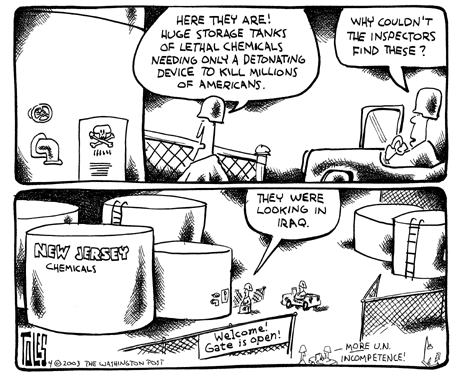
Terrorists didn't need Saddam Hussein's mythical chemical weapons of mass destruction to launch a catastrophic attack against the United States. It turns out they can literally find all the ammunition they need right here -- thanks to the inattention of the Bush administration.

This is a subject about which I've written extensively here and here. But the situation does not seem to be improving, according to an article in yesterday's Government Executive:
Despite the Bush administration's public promises and alarms, the White House has taken almost no action to improve security at any of the nation's 15,000 facilities -- including chemical manufacturing plants, petroleum tank farms, and pesticide companies -- that contain large quantities of potentially deadly chemicals. For that matter, the administration has done virtually nothing even to assess those facilities' vulnerability, even though the dangers are far from theoretical: An accidental leak at a Union Carbide pesticide plant in Bhopal, India, immediately killed between 3,800 and 8,000 people in 1984 and, according to some reports, has since claimed an additional 12,000 lives. Closer to home, an accidental chlorine gas leak at a Honeywell refrigeration plant in Baton Rouge, La., on July 20 sent four workers to the hospital and forced 600 residents to stay indoors.

Counterterrorism experts shudder to think about the number of deaths an intentional release of a toxic chemical could cause. And the Bush administration's inertia heightens their worries.

"These chemical plants have a vulnerability which has a catastrophic characteristic ... that could approximate the World Trade Center," Rand Beers, a White House counterterrorism adviser for 30 years, told National Journal. Dissatisfied with the Bush administration's approach to security, Beers resigned in March and now advises the presidential campaign of Sen. John Kerry, D-Mass.
How real is the danger?
Based on reports from the 15,000 facilities required to submit that worst-case-scenario information, the EPA warned that a terrorist attack on any one of the 123 chemical facilities located in densely populated areas could expose 1 million people to toxic chemicals. An attack on one of 700 other facilities could threaten at least 100,000 people. And an attack at one of 3,000 other chemical sites could affect 10,000 people.


It's not that the issue hasn't been on Bush's radar screen. It's just that he keeps changing the channel. Like the proverbial hot potato, the EPA earlier this year backed down before threats of chemical industry lawsuits and tossed responsibility for regulating chemical plant security over to the Department of Homeland Security.
Still struggling to get on its feet, Homeland Security has no authority to require the chemical industry to adopt stricter security measures. It also doesn't have the money or personnel to inspect industrial plants for potential security problems.
True to form, the Bush administration is relying on the voluntary efforts of the chemical industry to protect the country even though "two-thirds of the facilities that use or store high volumes of toxic chemicals...don't belong to those groups, according to EPA officials."

Meanwhile, on Capitol Hill, the chemical industry succeeded last year in killing Senator Jon Corzines chemical security bill after a unanimous vote from the Senate Committee considering the bill. Corzine's bill called for (gasp!) regulations that, among other things, would have required chemical facilities to move toward "inherently safer" production -- for example substituting safer chemicals for potentially hazardous ones and reducing the quantity of hazardous chemicals kept in the plant.

Corzine has resubmitted his bill this year, but instead of killing it outright again, the chemical industry has given luke-warm support to a much weaker bill introduced by Senator James Inhofe (D-OK)."Inhofe's bill would not require companies to submit vulnerability or security-improvement plans to Homeland Security. It also would not require companies to consider using alternatives to current chemicals and practices." Their theory is that we simply need to have more guns and higher fences, and keep the contents of chemical plants secret (as if!) -- which means keeping information away from those loose lips at EPA. (And, of course, this also means saying goodbye to citizens' post-Bhopal right to know what's brewing next door.)

Ironically, the Republicans' arguments end up supporting the philosophy behind Corzine's push for inherently safer processes:
Texas Republican Joe Barton, chairman of the House Energy and Commerce Subcommittee on Energy and Air Quality, said that although he's monitoring the situation, he sees no need for tough new chemical security requirements in the aftermath of 9/11.

"The problem you have in an open society is that it's physically impossible to make any large industrial site terrorist-proof," Barton said in an interview. "If there are enough terrorists who are dedicated enough and equipped well enough, they're going to overwhelm everything that you put up short of some sort of Fort Knox -- which doesn't make much sense, given the cost and the relatively remote possibility that any specific site is going to be targeted."


But to requote myself from a previous posting
how much sense does it make to only commit resources to guard a target (with questionable effectiveness) when in most cases it's entirely possible to shrink or even remove the target completely? As outlaw Willie Sutton explained, they robbed banks because that's where the money was. Chemical plants are potential targets for terrorists because that's where the greatest potential for terror is. Take the money out of the banks -- or the catastrophic potential out of chemical plants -- and no one cares.


So how has the industry been doing with its voluntary efforts?
A July 9 survey by the Conference Board, a New York City-based business research group, found that since 9/11, U.S. companies have increased their spending on security an average of only 4 percent. Other studies by the Brookings Institution, Rand, the Congressional Research Service, and the Progressive Policy Institute also raised serious questions about security problems at chemical plants and other high-risk facilities with large amounts of hazardous material.
Newspapers repeatedly report reporters successful attempts to walk unchallenged right into chemical plants and the Government Accounting Office also has serious doubts about the industry's ability to guarantee its own security.

But hey, ultimately we don't need no stinkin' terrorists to blow up our neighborhood chemical plant. We can do it ourselves. At this point, the prospect of terrorist attacks against U.S. chemical facilities is scary, but it's hypothetical. What is real are the hundreds of workers who have died and communities that have been threatened from explosions caused by the very real hazards of reactive chemicals -- which, if you scroll down a bit -- you will see that the Bush administration also refuses to regulate.

The bad news is that we're perfectly capable of causing mass destruction without Saddam Hussein's weapons and without terrorists. But the good news is that the solution to all of these threats is the same: Inherently safer production, better and safer management of chemical plants, and regulations to make sure it all happens.

California:Who Does Labor Love?

Apparently no one. Good article by Harold Meyerson in the LA Weekly on labor's luke-warm support for Gray Davis -- not because they like Gray, but to prevent what could be a precident-setting theft of a democratic election.
Union chiefs tell horror stories of Davis’ reluctance to agree to last year’s bill providing arbitration in farm-labor disputes; they note his aversion to populist causes and add that Davis is so shy about touting the good bills he has signed that their members don’t credit him with any significant achievements.
But the prospect of Dianne Feinstein is worse.
In just the past several weeks, Feinstein has sided in committee with Orrin Hatch, and against all her fellow Democrats, to limit the recompense workers can collect from employers for poisoning them with asbestos. She has come out in favor of private-school vouchers within the District of Columbia. And who can forget her vote for Bush’s 2001 tax cut, the only one of the 12 Democratic senators to side with Bush who came from a solidly Democratic state?
Of course all of this was written before Arnold, Bustamante and Garamendi got in, and before Feinstein got out. So who knows which way is up at this point. Maybe Davis should just resign. Democrat Bustamante becomes Governor, the recall is off and the R's are left sucking their thumbs.

Privitization: If it works for the Army, it'll work for the rest of the federal (and state and local) government(s) too

This nugget was mined from Suburban Guerrilla:

More on outsourcing - this time, in Iraq - with disastrous results.
U.S. troops in Iraq suffered through months of unnecessarily poor living conditions because some civilian contractors hired by the Army for logistics support failed to show up, Army officers said.

Months after American combat troops settled into occupation duty, they were camped out in primitive, dust-blown shelters without windows or air conditioning. The Army has invested heavily in modular barracks, showers, bathroom facilities and field kitchens, but troops in Iraq were using ramshackle plywood latrines and living without fresh food or regular access to showers and telephones.

Even mail delivery -- also managed by civilian contractors -- fell weeks behind.

Though conditions have improved, the problems raise new concerns about the Pentagon's growing global reliance on defense contractors for everything from laundry service to combat training and aircraft maintenance. Civilians help operate Navy Aegis cruisers and Global Hawk, the high-tech robot spy plane.

Thursday, August 07, 2003

Workplace Tragedies/Union Action Produce NJ Reactive Chemical Protections

The New Jersey rule to protect workers and communities against catastrophes caused by reactive chemicals that I wrote about a couple of days ago was a result of two workplace disasters and strategic organizing by unions and environmentalists.
Eight years after the notorious Napp Technologies explosion in Lodi and five years after another blast in Paterson, New Jersey is becoming the first state in the nation to regulate the potentially explosive chemicals blamed in both incidents.

Chemicals not regulated as hazardous materials were inadvertently mixed in a vat at Lodi plant, causing an explosion that killed five workers, injured 41, and forced 300 residents to be evacuated. Similarly, ingredients were incorrectly mixed at Morton International's dye manufacturing subsidiary, with the reaction injuring nine employees and rocking homes 15 blocks away.

Both catastrophes prompted calls from unions and environmentalists for regulation of such "reactive chemicals" - substances not considered hazardous on their own but which can become volatile if exposed to air or water, or mixed with the wrong ingredient.
As a result of these and other explosions caused by reactive chemicals, the U.S. Chemical Safety and Hazard Investigation Board has recommended that OSHA and EPA issue federal regulations. But the Bush administration has refused to act on the CSB's recommendations.
Without regulations like these, workers and people living in the surrounding communities are at risk from the kind of runaway reactions these kind of chemicals can have," Poje said.

Current regulation forces a company to give special training only to employees handling substances that are hazardous on their own, such as chlorine or ammonia.

So workers don't know the potential dangers of lesser-known chemicals such as ethyl nitrate and potassium hydrosulfite, "and they don't know to respond if there is an incident," Poje said. He noted that workers did not immediately evacuate after the accident at the Morton plant because the dangers were unknown to them.


Ergo Repeal Qualifies for Washington Ballot

This pretty much says it all
OLYMPIA, Wash. - An initiative to repeal the state's sweeping workplace-ergonomics rules qualified for the November ballot after a $350,000 campaign by homebuilders who called the regulations "an unnecessary job-killer."
The initiative would immediately repeal the ergonomics rules issued by the Department of Labor and Industries in 2000 in a bid to reduce worker injuries caused by repetitive motion, heavy lifting, and awkward working positions.
But the BIA didn’t just have money, they have the untruth (lies) on their side as well. See here and here and here.

(In case you want the true facts about the Washington State ergo standard, click here.)

The State AFL-CIO doesn't think much of the initiative either:
BIAW cash, lies land I-841 on ballot despite bogus signatures

Despite uncovering an extraordinarily high number of invalid and potentially fraudulent signatures, the Secretary of State's office announced Wednesday that the Building Industry Association of Washington's Initiative 841 to repeal our state workplace ergonomic safety rule narrowly qualified for November's ballot.

Time out for a little humor. Apparently the Associated Press headline writers don’t know their geography very well. Here’s the original headline about the Washington STATE ergonomics repeal:
Thursday, August 7, 2003 · Last updated 6:44 a.m. PT
Ergonomics repeal ready for D.C. ballot

THE ASSOCIATED PRESS

OLYMPIA, Wash. -- An initiative to repeal the state's sweeping workplace-ergonomics rules qualified for the November ballot after a $350,000 campaign by homebuilders who called the regulations "an unnecessary job-killer."
Seen one Washington, you’ve seen ‘em all.

Despair of the Jobless

Good Bob Herbert column in the New York Times today about the desperate unemployment situation in George Bush's America.

First, things are much worse than the official numbers show:
The official jobless rate, now 6.2 percent, does not come close to reflecting how grim the employment situation really is. The official rate refers only to those actively seeking work. It does not count the "discouraged" workers, who have looked for jobs within the last 12 months but have given up because of the lack of offers. Then there are the involuntary part-timers, who would like full-time jobs but cannot find them. And there are people who have had to settle for jobs that pay significantly less than jobs they once held.

When you combine the unemployed and the underemployed, you are talking about a percentage of the work force that is in double digits. That's an awful lot of lost purchasing power for a society that needs broad-based wage growth among its consumers to remain economically viable.
And the Bush Administration? Message: I don't give a shit.
The simple truth is that the interests of the Bush administration's primary constituency, corporate America, do not coincide with the fundamental interests of workaday Americans. On the business side of this divide, increased profits are realized by showing the door to as many workers as possible, and squeezing the remainder to the bursting point. Productivity (based primarily on improvements in technology) is way up. Hiring, of course, is down. Part-time and temporary workers are in; full-time workers with benefits are out.

And then there's the ominous trend of sending higher-skilled jobs overseas to low-wage places like India and China, an upscale reprise of the sweatshop phenomenon that erased so many U.S. manufacturing jobs over the past quarter century.

Working Americans need jobs just to survive. But the Bush administration equates the national interest with corporate interests, and in that equation workers can only lose.
Glad the recession is over. Someone better let these people know.

Terminate Arnold

Arnold just announced that he was going to run against Grey Davis in the California recall. He took the opportunity to bash the labor unions as special interests.

I have to take this opportunity to repeat one of my favorite lines from Bill Maher about Arnold's candidacy: "Finally, a candidate who can explain the Bush administration's positions on civil liberties in the original German."

Think I can get my money back from Terminator 3? (Hey, my kid made me see it.)

Washington State Ergonomics Referendum Resolution

Although the Building Industry Association of Washington's Initiative 841 to repeal the workplace ergonomic safety rule has yet to be officially certified for this fall's ballot by the Washington Secretary of State's office, the Washington State Labor Council, AFL-CIO is urging all labor organizations to adopt a resolution formally opposing the initiative.

Linked here is a draft resolution that can be used or adapted for this purpose. Even if you're not a resident of Washington State, I'm sure they'd appreciate the support. And don't forget that the bell tolls not just for them. If this turkey passes, it will make it all the harder to issue ergonomics protections on the federal level or in any other states.

Adopt the resolution and send it to them.

More information here and here.

Subway Hazards

Two good articles in Newsday about the hazards to workers and passengers in the New York subway tunnels.
The MTA is shortchanging straphangers' and workers' safety with an antiquated tunnel system and limited employee training for emergencies, critics charge.

"I think what has happened is that the health and safety of the workplace in the subway has been given less consideration than other aspects of the system," said Davitt McAteer, former chief of the U.S. Mine Safety and Health Administration. He recently surveyed the system's tunnels for the city's largest transit union and found the situation for riders is worse than for miners.

The safety expert, lawmakers and union leaders want better marked exits, brighter tunnels, improved evacuation procedures and more employee training on helping passengers escape underground dangers
Emergency response procedures in the event of another terrorist attack are one problem:
Subway workers have complained they have been given conflicting lessons about what to do in a terror attack. Some say supervisors have told them to run, while others report being told to stay and help passengers. New York City Transit says workers are told to assist passengers and notify emergency personnel.

Frank Goldsmith, director of occupational health for Local 100 of the Transport Workers Union, said of subway employees: "The problem that I feel, personally, is the lack of training and the lack of understanding. They simply are not being given proper training."....

The conductor of that F train said that in five years on the job, he had never been trained for a fire. He also said leaving the station in a dark tunnel was harrowing. "I couldn't see at all," said Florizel Gordon. "You're like a blind man, walking and feeling your way out."

The union said the smoke was worsened by fans operating in the wrong direction - a charge New York City Transit denies.

A tunnel in Queens where a worker was killed in 2001 still does not have enough light, union leaders say. Samuel McPhaul, 49, was killed when he tripped on the tracks and hit the third rail near the Grand Avenue station in Elmhurst. Union officials say better lighting would have made the tunnel safer.
And a rather chillilng article about what happened during a recent subway fire.
Subway conductor Florizel Gordon staggered through the smoky tunnel underneath York Street in Brooklyn, twisting his ankle and falling hard on the tracks. The feeble glare of his Transit-issue flashlight proved useless.

A passenger shouted to Gordon that another passenger was having a heart attack. Gordon picked himself up and walked over to an older man hobbling on a bad knee and experiencing chest pains.

"I told him to cover his face and put his hand over my shoulder, and I helped him out," Gordon, a conductor since 1998, said in the cadence and diction of his native Jamaica.

"Sir, you can't fall down on me," the 41-year-old conductor, himself barely able to stay up, told the stranger. "We have to get out of here."

This was the early-morning subway fire at the York Street station two Saturdays ago. As flames and sparks raged from underneath two subway cars, workers and passengers scrambled the more than 600 feet to the southern end of the platform on the F line before plunging into the dark, smoky tunnel. Now came a treacherous trek of several hundred feet over the tracks to the nearest emergency exit.

"There were no lights," Gordon said. "The tube was pitch black. ... The smoke was so thick. You're like a blind man walking and feeling your way through."
Subway worker safety is being investigated by President Clinton's former Director of the Mine Safety and Health Administration Davit McAteer. McAteer said he was shocked to see that the lighting in the subways was worse than lighting in coal mines.

Confined Space Fatalities

Earlier this week I wrote about a confined space incident that had a happy ending. Those workers were lucky. The ones I ran across today weren't:

Authorities in Hanover County are trying to determine what caused the death of a landfill worker. The accident happened Monday afternoon at a privately owned landfill.

Officials say two maintenance workers went into a manhole 18 feet deep to check on a sump pump. One of the men passed out and died before they could get him out. Investigators are not sure what caused the man to collapse. The man's name has not been released.

This is a confined space incident where the toxic gas was apparently introduced by the workers when they a gasoline-powered pump into a hole. This is an example of a poor or missing safety program and another where the rescuer almost ends up dead:

One city worker is dead and another was in serious condition this morning after an accident late Sunday afternoon that occurred while they were trying to repair a sewage pump station in Athens.

Mike Stanley, a 14-year city employee, was pronounced dead at O’Bleness Memorial Hospital, according to Athens Service-Safety Director Wayne Key.

Dave Carder was listed in serious condition this morning at Ohio State University Medical Center in Columbus, a hospital spokesman said.

The two men were overcome, possibly by carbon monoxide, after responding to a maintenance problem at the Oakmont sanitary lift station. Worker Scott Lambert also was at the scene.

Key said an underground portion of the lift station had flooded, and the workers attempted to use a vacuum truck to pump it out. When that failed, they gradually lowered a gasoline-powered pump into the 20-foot-deep hole, emptying it as the pump was lowered.

Stanley then descended into the lift station, but became ill. Lambert left the immediate area to call 911, and while he was away Carder apparently went down into the pump station to try to rescue Stanley, Key said.


And the U.S. is not the only country with confined space problems, as well as higher injury and fatality rates among foreign workers. This is from Greece:

Dimitris Kolovos, 45, and Vasili Passa, 42, died when they were overcome by methane fumes in a sewer
while carrying out a project for Acharnon Municipality at Menidi.

Dimitris Tsakalis, 32, first went into the sewer to measure its depth and was overcome by the fumes. His colleagues went in to save him and they too collapsed. They were pulled out a short while later by the fire department, but the two were dead and Tsakalis is being treated at Sismanogleio Hospital, where he is in critical condition. Labor Inspectorate officials said the three belonged to a small private team that was working on the area's sewerage system. They had not taken the necessary precautions, such as wearing gas masks, and no one was supervising them. If a supervisor was there, he had run away to evade arrest, officials said.

The accident underscored the dangers faced by foreign workers especially, as Passa and Tsakalis are Albanian citizens. Foreign workers are usually more likely to carry out dangerous work without objecting, are not union members, and often don't have the necessary training. Last year, 40 foreign workers died in work-related accidents, 38 died in 2001 and 20 in 2000.

Wednesday, August 06, 2003

Workers Comp Notes

Insurance Company Rate Hikes Force Comp Cuts

Leaders Call for Insurance Reform


Around the country, insurance company rate hikes have forced states to cut workers’ compensation benefits, according to AFL-CIO and Workplace Injury Litigation Group (WILG) leaders attending a national Workers’ Voice meeting in San Francisco July 19. For more information, check out the AFL-CIO's Workers' Comp Notes.

Tysons Settles Wrongful Death Suit

This is an interesting story, as well as another confined space tragedy.
A wrongful death suit filed by the families of two Tyson Foods Inc. workers who suffocated at the company's rendering plant four years ago has been settled in federal court.

The families of the late James Dame Jr. of Slaughters and the late Michael Hallum of Madisonville settled their case against Tyson about a month ago.

The terms of the confidential settlement were sealed by the judge's order at the families' request.

Dame, who was 40, died July 22, 1999, after being overcome by fumes while trying to retrieve a forklift bucket that had fallen into a gas-filled pit at Tyson's River Valley Animal Feeds rendering plant near Robards.

Hallum, 24, perished trying to rescue his co-worker from the pit....

The families sought compensation for pain and suffering, medical and funeral expenses and loss of future earnings. Additionally, Dame's family sought $20 million in punitive damages.
Now I'm glad Tysons was forced to pay for these workplace killings, but I don't understand how they got around the "exclusive remedy" of Workers Compensation which generally prohibits workers or their families from suing their employers. Any attorneys out there who can explain this?

Oh, and one more thing. I'm awarding the "Sensitivity Award" to Tyson Attorney David Sarvadi (who in a previous life was also one of the leading anti-ergo extremists):
"This is a very sad occasion, a very tragic accident," David Sarvadi, a Tyson attorney, told the hearing officer, Thomas J. Hellman, in his opening remarks last November.

But, Sarvadi said, "The employees did not follow rules that had been established. They did not follow their training."
Got what they deserved, I guess.

Illinois Governor Signs Pro-Labor Laws


From Nathan Newman
Governor Blagojevich signed 4 pro-labor bills yesterday, mostly aimed at easing organizing among public employees by eliminating delays in recognition by the state. Under the new system, when a majority of workers sign cards requesting union recognition-- they will get recognition without the delays and lawsuits they've faced in the past.

This is the model for labor law reform in the private sector -- unlikely for the foreseeable future since that will require national legislation. But the more states approve it for the public sector, the more compelling it will be as a model for labor law reform.
This is the type of action that should win Blagojevich and the Democrats much more labor support. Good move in a potential battleground state which also has one of the increasingly rare winnable Senate seats.

What I can never figure out, however, is why so many other Democratic Governors (and other politicians) don't automatically do everything the can to help unions organize -- considering that the Democratic party would completely dead (as opposed to being on life support) without labor. It's a basic law of current politics which too few seem to understand: More Labor Union Members = More Democratic Votes.

Civil War Brews over Ergonomics: OSHA vs. Anti-Ergo Industry

OSHA has been forced to face some SHOCKING truths lately. First, musculoskeletal injuries really do exist and implementing ergonomics fixes really does help. Second, just because a company (even a big, respected company) has a good program on paper, doesn’t mean it translates down to where people are actually working.

But the business associations, especially the National Coalition on Ergonomics, spawn of the National Association of Manufacturers and the Chamber of Commerce, are having none of it. To ward off potentially precident-setting (for Republicans) ergonomics citations, NAM and NCE are considering forming a legal defense fund and taking legal action against OSHA, according our underground investigative reporter who knows all (one of my many valuable correspondents who, for reasons of homeland security, are forced to remain anonymous.)

And that’s OSHA’s third unpleasant revelation. Your friends may not remain your friends if you don’t join them in fantasyland.

The first reason the business associations are upset is because OSHA had the temerity to level a general duty clause ergonomics citation against a Coca-Cola bottling facility in Ohio.

OSHA also cited a Missouri SUPERVALU warehouse for ergonomics problems.
The evaluation of this manual lifting task indicates that employees are exposed to hazards that are causing or likely to cause MSDs, including low back pain (LBP) and shoulder related MSDs, as shown by a review of the company's injury and illness records from 1998 to the time of the inspection, which document that a significant number of MSDs have been caused by exposure to stressors; including 6 shoulder surgeries in 2001 and 2 shoulder surgeries in 2002.
Seems like it's hard to argue with shoulder surgeries. So what has the industry's undies in such a twist? A couple of things.

First, the Coca Cola citation involves truckers and the trucking and delivery industry (American Trucking Association and U.P.S., for example) were among the most rabid foes of the Clinton ergonomics standard. It's one thing if OSHA cites a couple of wimpy nursing homes, but it's quite another when they go after the big boys.

Industry mouthpieces point out that both Coca Cola and SUPERVALU have extensive ergonomics programs in place and note that OSHA Administrator John Henshaw had stated many times, including a recent speech to the American Occupational Health Conference that
We are not going to focus our enforcement efforts on employers who have implemented effective ergonomic programs or who are making good-faith efforts to reduce ergonomic hazards.
Clearly his industry buddies assumed they had a blank check. As long as companies had something decent on paper, reality (as in shoulder surgeries and other injuries) didn't count in individual facilities that may not be taking ergonomics problems as seriously as they need to.

Apparently that kind of enforcement strategy didn't pass the laugh test even in George Bush's OSHA.

Oh please don't give me a ticket, officer. Even if I was going 120 in a school zone, my parents have immaculate driving records and I got an "A" in drivers ed.

(And particularly embarrassing for OSHA and SUPERVALU, SUPERVALU’s Corporate Director of Risk Control James Koskan is a member of OSHA’s National Advisory Committee on Ergonomics.)

In response to this outrageous (and unusual) display of enforcing the law, the National Coalition on Ergonomics is considering forming a legal defense fund, presumably to aid in the defense of other mom and pop type businesses like Coke and SUPERVALU from violations of their purity by OSHA's gestapo agents....Even if they're Republican gestapo agents.

Don't you just hate it when the children fight?

Footnote: Coca Cola, incidentally, is no virgin when it comes to OSHA citations. The Atlanta Business Journal revealed that
Last year The Coca-Cola Co. and its network of bottlers were cited for 222 violations of federal Occupational Safety & Health Administration standards and fined $156,831.

In 2001, OSHA cited Coke (NYSE: KO) and its bottlers for 212 violations and fined them a total of $170,091.

Over the past decade, the companies have been cited for 2,264 violations.

A list released by OSHA in February that identifies 14,200 U.S. facilities that had accident and illness rates at twice the national average of about three illnesses or injuries for every 100 workers included 96 facilities owned by Coke bottlers.


Worked to Death

Dr Sid Watkins died when his body could no longer stand his "crazy" working hours. Stressed out teacher Pamela Relf killed herself. So did mental health nurse Richard Pocock. And postal worker Jermaine Lee. All died because their jobs were just too much to bear.

These weren't recorded as job-related deaths. And that's the topic of a new page of Hazards magazine -- Worked to Death -- assembled by British workplace safety activist, Rory O'Neill.

I've written here a number of times over the past several weeks about the dwindling vacation time and increasing work hours of American workers. Well, as Worked to Death makes clear, overwork is not just a nuisance, it's a killer.

When I was at AFSCME and at OSHA I would often receive reports of workers' deaths "by natural cause" in the workplace. These would never be investigated. Probably bad eating habits, overweight, or it was "just their time." I wish I had access to this web page back then. This information would have come in handy and maybe have saved some lives:

The British Trades Union Congress TUC research shows that stress is Britain’s number one workplace health hazard. Now the ‘modern workers health check’ reveals worldwide evidence of employees being worked into the ground:

-- Workers with stressful jobs are more than twice as likely to die from heart disease.

-- An individual’s mental health deteriorates when a change in workload results in higher demands, less control and reduced support. Poor management planning and organisation can lead to heart disease.

-- Working for unreasonable and unfair bosses leads to dangerously high blood pressure.

-- Workers are smoking, drinking and ‘slobbing out’ to deal with workplace stress.

-- Long-term work-related stress is worse for the heart than aging 30 years or gaining 40lbs in weight.
Check out the accompanying "Drop Dead" fact sheet as well as a fact sheet featuring an interview with workplace stress authority Paul Landsbergis about work-induced heart attacks.

So next time you hear that a worker has died on the job from a heart attack, look at the working conditions a little bit more carefully.

New Jersey Adopts Reactive Chemical Regulation

The New Jersey Department of Environmental Protection (DEP) announced expansion of New Jersey's Toxic Catastrophe Prevention Act (TCPA) program to add reactive chemicals to the list of extraordinarily hazardous substances that trigger risk management planning requirements of TCPA.
These chemicals can explode when accidentally exposed to air or water, or when they are improperly mixed with certain other chemicals. The force of the explosion can kill or permanently disable people outside the facility.

New Jersey will require companies handling reactive chemicals to prepare accidental release prevention plans and examine safer technologies to prevent industrial incidents like the tragic ones that occurred at Napp Technologies in Lodi in 1995 and at Morton International in Paterson in 1998. The Napp and Morton International accidents were the result of reactive chemistry interactions.
The U.S. Chemical and Hazard Investigation Board (CSB) recommended last year that OSHA revise its Process Safety Management standard to add reactive chemicals. The Bush Administration withdrew a plan to begin rulemaking on reactives last year and the agency has not yet responded to the CSB's recommendation.
"New Jersey is the first state in the nation to address reactive hazards," said Charles Jeffress, chief operating officer of the CSB. "The Chemical Safety Board is very pleased by this step forward to protect residents and workers from chemical accidents."
Much of the credit for this rare (these days) progress in workplace safety and health goes to the Rick Engler and the New Jersey Work Environment Council who who led the way, along with other allies, including Paper, Allied- Industrial, Chemical & Energy Workers International Union Local 2-943 (representing workers at DuPont, state’s largest chemical plant) in planting the seeds for this measure.

Democratic Presidential Debate Wrapup

The AFL-CIO Presidential Candidate debate was interesting and occasionally inspiring. Some candidates looked better than others. (Some looked much better than others), but on the whole, I'd take any of them over the current resident of the White House (although I'm leaning toward Bob Edwards who hosted the event.)

Rather upsetting to us Confined Space groupies was the almost complete and total absence of any mention of health and safety issues (beyond a few token words by Kucinich and Kerry).

I mean, OK, maybe I'm a member of that wierd workplace health and safety cult (and so are you or you wouldn't be reading this), but what was the first major piece of legislation signed by George W. Bush? Yes, repeal of the federal ergonomics standard.

Not that I would ever think of criticizing the powers-that-be at the AFL-CIO....and there were lots of important issues discussed (jobs, health care, labor rights, corporate corruption, pensions, etc), but for many of these issues you just got the predictable platitudes that didn't particulary challenge the candidates (I mean, who was going to oppose workers' right to organize?)

A discussion of some actual workplace issues -- health and safety, overtime, living on less than a living wage, etc -- would have not only revealed the candidates' real understanding of workers' lives, but might also have been educational for the non-union members that may have been watching.

And a discussion of Bush's ergonomics crimes might have reminded people of some of the early misdeads of this administration that continue to affect millions of workers every day.

So fellow groupies and cultists: Now is the time to start thinking about how to make workplace health and safety a campaign issue in the coming elections (That's elections -- plural.) Ideas are welcome. Talk among yourselves. Then e-mail me.

Tuesday, August 05, 2003

AFL-CIO Presidential Forum Tonight

Tonight, Tuesday Aug. 5, the nine Democratic presidential candidates working to beat President Bush in next year's election will join thousands of union members at the AFL-CIO's Working Families Presidential Forum in Chicago.

You can watch the entire forum when it is broadcast LIVE on C-SPAN beginning at 8 p.m. Eastern time.

So far Gephardt has the most union endorsements, but it will be hard for any candidate to get to the two-thirds necessary for a national AFL-CIO endorsement.

Confined Space Close Call

I figure being as this Blog is called Confined Space, I should occasionally write about confined spaces.

This story has a happy ending -- barely -- unlike most of the confined space incidents that make the papers.
Two workers were rescued from the bottom of a Cape Coral manhole Friday after apparently succumbing to toxic fumes, emergency crews reported.

Rodney Jones and Michael Radford of the Cape Coral company Reliable Divers were taken to Cape Coral Hospital. Radford was treated and released, a hospital nursing supervisor said.
The conditions were not unusual for this type of incident:
One of the men apparently passed out from a combination of low oxygen levels and hydrogen sulfide and methane fumes, said Tom Tomich, operations chief for the Cape fire department. Both gases are a byproduct of sewage and are found in sewage pipes.
NIOSH reports that more rescuers are killed in confined space incidents than original victims. We almost had an example here.
Tomich said the two men were inside the shaft apparently fixing a leak. One of the men passed out and fell part of the way down the 12- to 15-foot shaft. Tomich didn't know how far the man fell.

The other man went down to help him; he also began feeling the effects of the gas and fell.
Luckily, the fire department got there fast and ventilated the pipes to provide life-saving air to the workers before rescuing them. Many workers and rescuers aren't so lucky.

One more rather disquieting note:
Tomich said people often pass out after working in such tight quarters in sewage shafts. The sewer pipes weren’t hooked up yet, he said, but apparently there still were fumes.
People often pass out? Hello? Doesn't that tell you something about your program? One person passing out is a pretty frightening "close call" from which serious lessons should be learned. But often?

And one more thing. As the article says, oxygen deficiency, hydrogen sulfide and methane gas are "byproducts of sewage." But they are also byproducts of any decaying organic material -- plant material like weeds or grass, dead animals, whatever. So, as Tomic notes, there can still be fumes, even if the pipes aren't hooked up. Lesson: Assume any sewer line is a potentially deadly confined space. Always follow the OSHA standard: monitoring, ventilation, training, proper procedures and equipment, and safe rescue preparations.


More confined space information here.

Ground Zero Syndrome

Nearly two years after the attacks on the World Trade Center, half of the emergency workers who responded to the tragedy are ill, many suffering from respiratory problems. Some wonder whether workers were given enough information and equipment to protect them.

Linked here (scroll down) is an excellent National Public Radio story on the plight of the workers and the measures that weren't taken to protect them. Also featured is NYCOSH Director Joel Shufro who was warning from the first that workers needed better protections and that OSHA standards needed to be enforced.

Monday, August 04, 2003

The Unbearable Heaviness of Industry

Postcards From China's Industrial Caldron

Check out this article in the NY Times today about an excellent photo exhibit about Chinese workers and working conditions by photographer Zhou Hai. The images are reminiscent of American labor photographer Earl Dotter and photographers of America's early industrial period.

"As our society has developed, so many workers have been marginalized, and fewer and fewer people care about them," Mr. Zhou said last month at the 798 Photo Gallery, appropriately housed in a renovated factory space in northeast Beijing. "So I felt a need to record this era and these people."


More pictures can be seen on Zhou's Web site: www.zhouhai.com.)

Saturday, August 02, 2003

The Weekly Toll

Worker killed in trench collapse
Official: Walls lacked required supports at Dixie Highway site


Kentucky safety officials are investigating a trench collapse that killed a 35-year-old worker yesterday.

Eric R. West, of Bedford, Ky., died at the scene. An autopsy will be performed today, said Jefferson County Deputy Coroner Rick Siclari.

And a warning to those tempted to rush in an rescue trench collapse victims:

Pleasure Ridge Park Fire Chief Doug Atwell said he doesn't recommend that people try to rescue others who are trapped in a trench, because they risk becoming trapped themselves in another collapse. He said the trench's walls collapsed twice more yesterday as emergency workers labored to recover the body, but no one was hurt.

Contractor Cites 2nd Death In Fla. In The Past Week

TAMPA - A road construction worker helping to rebuild the downtown interchange of Interstates 275 and 4 was killed Tuesday night when a crane hit his head, authorities said. It was the second fatal accident in Florida this week for the contractor and the third since December.
James David Hall, of 125 Weeping Willow Road, Winter Haven, died a day before his 37th birthday, police said. ...

It was the second fatal accident in Florida in one week involving a Granite Construction employee.

A U.S. 98 bridge project in Panama City claimed the life of a worker July 23 when a scaffolding collapsed, dropping him and four others 50 feet into the water.

Electrocution accident kills two locals

PHENIX - Two men were killed and a third seriously wounded after they were electrocuted in an accident at 22 Pleasant St. in West Warwick yesterday.

Thomas D. Walker, 24, of Coventry and Jared D. Gendron, 18, of Hope, died when 7,200 volts of electricity penetrated their bodies. Kyle D. Moffat, 19 of Coventry was admitted to Kent County Memorial Hospital and is listed in good condition.

According to Narragansett Electric Vice President of Public Affairs Fred Mason "some workers were doing some shingling or siding trying to erect some staging. Using big, tall aluminum poles that would hold the planks that go across, the aluminum pole somehow came in contact with the electrical line. "

Truck fire claims life of painter; 12 critical

Greenwood man, 30, suffered 3rd-degree burns over 90 percent of his body; cause of blaze is unclear

One man has died as the result of an inferno that may have reached 1,000 degrees when it erupted in the back of a truck loaded with 13 painters, but authorities Wednesday were only beginning to understand the origin of the blaze.

The worker died at 10 p.m. Tuesday, about eight hours after the fire started, and his 12 companions all were listed in critical condition with second- and third-degree burns today.

More here


Albany man killed in junkyard accident

PORTLAND — A truck driver was killed Friday at a Northeast Portland salvage yard when he was hit by a crushed car being loaded onto a truck.

Timothy A. Bowers, 37, of Albany died at the scene, Portland Fire Bureau spokesman Lt. Neil Heesacker said.


Council Bluffs man killed in forklift rollover

OMAHA - A Council Bluffs man was killed Thursday morning at a construction site in Omaha when a forklift rolled over on top of him.

James Kirk, 42, of Council Bluffs was pronounced dead at the scene.

The accident occurred at the Quality Pork International worksite in southwest Omaha around 11:20 a.m. Kirk, a forklift operator, was working for KFR Inc., a company subcontracted by Dietzel Enterprises to work on installing a support wall at the business, according to Omaha Police Sgt. Cathy Cook.


State investigating Ireton man's death on farm

State investigators are looking into the work-related death of an Ireton, Iowa, man.

The Iowa Occupational Safety and Health agency has visited the Bar-K Farms in Carmel, Iowa, to investigate the July 18 death of 31-year-old Kenneth Van Wyk.

A report won't be completed for at least a month, said Mary Bryant, IOSH administrator.

Van Wyk died while repairing a steel 11,000-gallon liquid storage tank, said a Bar-K employee who declined to give his name. Van Wyk was inside the tank, which contained gas fumes, and passed out, the man said.


Honeywell worker dies after chemical leak

BATON ROUGE, La. A Honeywell International worker has died after being injured during a chemical leak at the plant, prompting another investigation by local, state and federal officials.

Delvin Henry of Baton Rouge was pronounced dead Wednesday at Baton Rouge General Medical Center, Sheriff's Office spokesman Lt. Darrell O'Neal said.

A container at the plant sprung a leak Tuesday while being filled with antimony pentachloride, according to the Louisiana Department of Environmental Quality. The corrosive chemical can burn the skin, irritate the nose, mouth, throat and lungs; and cause headaches and nausea.

This latest accident follows a chlorine leak July 20 in which eight workers and some nearby residents were hospitalized after complaining of burning lungs and other irritations. The July 20 leak prompted safety investigations by the Fire Department, DEQ, Louisiana State Police, the U.S. Occupational Safety and Health Administration and the U.S. Chemical Safety and Hazard Investigation Board.


UI worker dies from Sikorsky accident

David Bagdasarian was supposed to join friends today for the group’s annual summer trip to a major league ballpark to watch the Mets play.

Bagdasarian will not make that trip.

The United Illuminating Co. employee from Shelton died Thursday from injuries he suffered in a July 10 accident at Sikorsky Aircraft.

Bagdasarian, 49, died at Bridgeport Hospital from complications associated with injuries from the accident that occurred as he and two other UI employees surveyed electrical equipment in an outdoor cage in a parking lot at Sikorsky’s sprawling factory on Main Street in Stratford. The three men were surveying the equipment in preparation for work they were to do that weekend when an electrical arcing occurred.

Industrial accident claims Rock Springs man

GREEN RIVER -- A Rock Springs man died early Tuesday morning from neck and head injuries after the lift vehicle he was driving fell off a loading ramp, according to Sweetwater County authorities.

Douglas Ray Bernard, 35, was found by coworkers at around 6:45 a.m. at Wyoming Rents on Sunset Drive in Rock Springs, said County Coroner Dale Majhanovich. He estimated the accident occurred around 4:30 a.m.


2nd Skyway Construction Death Of Summer

Aug 2 (Chicago) -- A worker fell 50 feet to his death Friday after he stepped on an unsupported platform while working at a construction site on the Chicago Skyway, marking the second fatality from the area in less than a month.

The victim, identified by the medical examiner's office as David Stevens, 36, fell at about 1 p.m. from the Skyway at 75th Street and Greenwood Avenue, Gresham District Sgt. Robert Orlando said.

Stevens was laying a platform to pour concrete from when he stepped on a 3-by-4-foot piece of plywood that had no support under it, according to a Calumet Area detective.

The worker plunged 50 feet and struck his head on the ground, the detective said. He did not know the name of the construction company the victim worked for.

This was the second time in less than a month that a construction worker was killed falling from the Skyway.

Dennis McNamara, 63, 249 Lincoln Ct. in Wood Dale, was working on the Skyway near 77th Street when he plunged to the ground at about 11:10 p.m. July 9.


Worker Killed By Driver
A suspected drunken driver slammed into a Central Florida GreeneWay tollbooth under construction early Friday, killing one worker and injuring two others.

Grady Hill, 38, of Casselberry, suffered fatal injuries, according to the FHP. Injured were Paul Kimbro, 44, of Oviedo, and Charles Starrett, 43, of Geneva.
More here.

California Nightmare

Wondering about the economics behind California's recall circus? And the national significance? Read yesterday's Paul Krugman.

One problem:
California's slide into irresponsibility, in which politicians refuse to acknowledge any connection between the government services the public demands and the taxes that pay for those services, is being replicated all across America.
Krugman points out that it was initiatives that got California into this mess: Proposition 13, which cut property taxes, and later, Proposition 98, which mandated that the state replace educational funding cut due to Prop 13. So now
the state faces a huge deficit, and spending must be cut. But shouldn't the state also seek more revenue? During California's last crisis, Governor Wilson increased the sales tax and temporarily raised income taxes on top brackets. This time Governor Davis proposed doing more or less the same thing — but Senate Republicans refused to go along. Their counterproposal relied entirely on spending cuts — but, tellingly, offered no specifics about what, exactly, should be cut.
And the federal implications?
Outside the Social Security system, the federal government is now running a deficit equal to a third of its spending — worse than California. The administration says it will never, ever contemplate increasing taxes; it says it will narrow the deficit through spending restraint, but has never said what spending it intends to restrain.

If the federal government isn't in crisis, that's only because — unlike state governments — it isn't obliged to balance its budget each year. And so far bond markets have been willing to give the feds the benefit of the doubt.

But the people now running the country are every bit as irresponsible as those blocking a serious response to California's crisis. And sooner or later that irresponsibility will have the usual consequences. California, here we come.