Friday, July 02, 2004

Shoot Them Before They Shoot You

This is a good one. Leave it to Bush's OSHA.

OSHA's sponsoring a workplace violence conference in New England. Guess who the participants are:
Sponsored by the U.S. Labor Department's Occupational Safety and Health Administration (OSHA) and Western New England College, the conference will feature representatives of OSHA, the FBI, the U.S. Postal Service, the Springfield Police Department, the Massachusetts State Police, the Massachusetts Division of Occupational Safety, Smith & Wesson, and Longview Associates.
Which reminds me of a story....

One of our AFSCME members, a social worker, was being threatened and harassed by the family of an abused child that had been taken away -- phone calls, stalking, threats against her children. Needless to say, she was a nervous wreck. Her supervisor arranged a meeting with the private security guard at the facility, who advised her to carry a gun. Her co-workers were not too enthusiastic about the idea of this woman on the edge coming to work every day with a loaded gun in her purse.

True story.

Thursday, July 01, 2004

The Nation's Meanest, Toughest Corporation

Great article in the Nation about organizing in the "Wal-Mart" of meatpacking: Tyson Foods
A generation ago, meatpacking workers earned some of the highest wages of any industrial workers in the United States. Working in a slaughterhouse was a hard, dirty job, but it provided a stable middle-class income. Today meatpacking is one of the lowest-paid industrial jobs, with one of the highest turnover rates. It is also the nation's most dangerous job, measured by the rate of serious injury. During the 1970s IBP was largely responsible for changing the industry's labor policies, breaking unions, slashing wages and recruiting an immigrant work force. In a very tough business, IBP gained the reputation of being by far the toughest. In 1974 IBP was convicted for collaborating with organized-crime figures in New York City to bribe meat wholesalers and union leaders. Any meatpacking company that hoped to compete with IBP had to cut wages and benefits, too. Over the past twenty-five years some wages in the meatpacking industry, adjusted for inflation, have declined by more than 50 percent.

When Tyson Foods bought IBP in 2001, many workers feared that the company would try to make wages in the beef industry similar to those in the poultry industry, where the pay is even lower. Those fears now seem to be justified. Tyson Foods is the largest meatpacking company the world has ever seen, supplying supermarkets and fast-food chains with beef, chicken and pork.

Wednesday, June 30, 2004

An Infuriatingly Preventable Trench Death

So here we have yet another worker crushed in yet another trench collapse that, yet again, was twice as deep as OSHA allows without shoring.
A construction crew installing storm drains in Washington County was not using suggested safety precautions when a trench wall collapsed Tuesday, killing one worker and injuring another, rescue workers and township officials said.

William Partin, 39, of Hoffman Drive, North Fayette, was pronounced dead at the scene, according to North Franklin police.
These tragedies always make me mad. This one makes even more angry. Why?
[Washington City Fire Department duty captain Douglas] Trbovich said that he saw a trench box about 100 yards away from the accident site.

Township Supervisor Carole Beck and township administrator Scott Novak, who both visited the scene, agreed that the trench box was not being used.

Novak said since the project began about five weeks ago, the township's quality-control inspector has made repeated suggestions to workers and company officials to use the trench box.

"You really have to ask them why they haven't been using it. They've been advised to, but for whatever reason they decided not to," Novak said.

Novak added that the township inspector is not a safety officer and has no authority to order the company to take any safety measures.
So the township's quality control inspector knew for five weeks that the trench box wasn't being used presenting a potentially deadly situation, but didn't do anything because he isn't a safety officer?! How about calling OSHA? (The toll-free number, by the way, is (800) 321-OSHA and local numbers can be found here.)

And I have a very hard time understanding why, if this was a city contract, there was no one in the city government who had the authority (or who took the initiative) to shut down a project that was clearly putting workers at imminent risk of death.

In fact, it might be useful for OSHA to educate city and county officials about recognizing such hazards and making sure someone close to the job is authorized to shut it down, or at to least refer the problem to OSHA.

William Partin should still be alive.


Tuesday, June 29, 2004

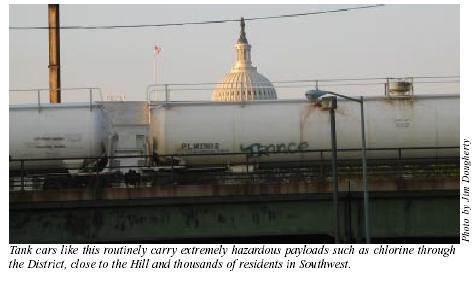
Chemical Fumes From Train Crash Kill Nearby Residents

WMD's In Our Back Yard

Now this is scary:
The collision of two freight trains released a plume of toxic fumes that killed an engineer and two people who lived nearby, investigators said Tuesday. Two others were left critically ill.

***

A tanker car carrying pressurized chlorine broke open in the collision, venting tons of gas into the air. A small amount of ammonium nitrate was also released from three UP cars.

The gas clouds dissipated by late Monday morning, after drifting up to 10 miles to San Antonio's SeaWorld amusement park, where six people were treated for minor respiratory irritation.

Jerry Leyva, an investigator with the Bexar County Medical Examiner's office, said Gene Hale, 85, and Lois Koerber, 59, died from the effects of breathing chlorine gas. Their bodies were found Monday afternoon in their home about a mile from the crash.

Also killed by the gas was Heath Pape, a 23-year-old conductor aboard the Union Pacific train.

Leyva said the deaths have been ruled accidental.

Two people who lived near the crash remained in critical condition. San Antonio Fire Department spokesman Randy Jenkins said more than 40 other people suffered mostly minor respiratory irritation.
This happened in a rural area killing two people about a mile from the crash. Imagine if it had happened in the center of a major city, say Washington D.C.?


UPDATE: Another incident here.

Workers Lose Third Popcorn Lung Trial

Is this any way to protect workers?

Three trials brought about by lawsuits filed by workers whose lungs were (allegedly) destroyed by exposure to diacetyl, a butter-flavoring for microwave popcorn. The first ended up in a $20 million verdict for the worker and his wife, while the second was settled minutes before the jury returned its verdict.

Now, the jury in the third trial has decided that the companies that manufactured the chemical, International Flavors and Fragrances Inc. and Bush Boake Allen Inc., were not to blame for the lung damage suffered by, former workers Dustin Smith, 25, Evelyn Standhardt, 60, and Marge Unruh 51, and current worker Velma Ingalls, 34.
The four sued the two companies, claiming that a butter flavoring used at the Jasper Popcorn Co. plant in Jasper contained a chemical known as diacetyl that health experts say caused the four to contract bronchiolitis obliterans, a rare lung disease that causes shortness of breath and progressively restricts the airways.

International Flavors purchased Bush Boake Allen in 2001. The butter flavoring that the workers contend caused their illness was made by Bush Boake Allen.

In closing arguments, Mike Patton, an attorney representing International Flavors, and Frank Woodside, an attorney representing Bush Boake Allen, told the jury that improper industrial hygiene at the Jasper popcorn plant was to blame for the workers' illnesses.

Neither the original owners of the popcorn plant nor Gilster-Mary Lee Corp., which purchased the plant in 1999, was named in the lawsuits.

Patton said that since workers have started wearing respirators and the plant has enclosed the mixing area, no one has gotten sick at the plant, which continues to use the same butter flavoring.

"Proper industrial hygiene solved the problem," Patton said.

Woodside told the jury that the Kansas City occupational physician who diagnosed the outbreak of bronchiolitis obliterans in 2000 described the condition as "a unique and previously unrecognized disease." Woodside said that before 2001, no one knew that diacetyl could damage the lungs.

"We're supposed to warn or know about a new disease that didn't exist before?" Woodside asked the jury.
Indeed, how would you? Unless...it's not entirely true. It was in 1993 that BASF found that “After breathing diacetyl vapors for just four hours, some rats gagged and gasped for breath. Half the rats in the study died within a day."

Meanwhile, in the early 1990's, International Flavors & Fragrances, one of the targets of the lawsuits, was distributing Material Safety Data Sheets that contained the phrases "no known health hazards" and "respiratory protection is not normally required," while at the same time eqipping their workers with respirators.

So, as I asked at the beginning, is this where the United States of America needs to be at the beginning of the 21st century -- waiting until guinea pigs workers are made ill or killed by unregulated (and often untested) toxic chemicals, then depending on the arbitrary whims of juries as our only means to compensate them (or their survivors)? And hopefully in the process warning chemical manufacturers to be a bit more careful in the future lest their shareholders get mad if they lose a lawsuit.

Pretty sad.


Bush Administration Reaches Out to Strangle European Chemical Initiative

Senators Object

The Bush administration has filed a formal comment with the World Trade Organization that (surprise, surprise) is critical of Europe's proposed system to regulate industrial chemicals, commonly known as REACH. Meanwhile, Senators Frank R. Lautenberg (D-NJ) and Jim Jeffords (I-VT) sent a letter to U.S. Trade Representative Robert Zoellick expressing their "concern that the Bush administration is catering to the U.S. chemical industry in its opposition to a proposed European environmental law."
Lautenberg and Jeffords called on Mr. Zoellick to explain in detail how the administration developed its position, what analysis it performed, and whether it allowed public health officials, labor, environmental or consumer groups to have a voice in developing the U.S. position.

***

The Senators wrote, "We are troubled by reports that the position of this administration on REACH may reflect the interests of a narrow segment of U.S. industry without consideration of the broader ramifications for the U.S. economy, national interest, public health, and the environment." They also requested the administration to specify, "which provisions of REACH you consider may be in conflict with provisions of the relevant WTO agreements."
The administration's complaint foretold the end of Western Civilization should the policy be implemented. In short, the complaint predicted "substantial potential adverse effects on European economic growth and employment," and that it could "adversely impact production and transatlantic trade worth tens of billions of dollars in chemicals and downstream products," "impact the majority of U.S. goods exported to the EU," cause "manufacturers of chemicals for many applications to halt production," force "some EU and foreign manufacturers of chemicals and downstream products [to] simply exit the EU market," [impose] "disruptions on importers of chemicals..., impact negatively innovation and hinder the introduction into the EU market of more effective and safer chemicals and downstream products," cause "uncertainty in the market," and "anti-competitive results."

Furthermore, according to the U.S. document, there are problems with workability, viability of small manufacturers, complex administrative coordination, needless duplication and a lack of consistency in implementation and enforcement.

In sum,
the draft regulation still appears to adopt a particularly costly, burdensome, and complex approach, which could prove unworkable in its implementation, disrupt global trade, and adversely impact innovation.
But never fear, the document assures the Europeans that
The United States shares the EU’s interest in ensuring robust protection of the environment and human health. Our societies demand that we achieve these objectives. These are objectives we achieve through our domestic regulation and through our active participation in activities to promote international regulatory cooperation and harmonization in the area of chemicals.
Of course, "our domestic regulation" that allegedly achieves "robust protection of the environment and human health" has a few problems as I've outlined before:

The Toxic Substances Control Act (TSCA), passed in 1976, does a fairly good job requiring chemical manufacturers to test and prove the safety of new chemicals.

The main problem with TSCA is that when it was passed, it “grandfathered” in chemicals in commerce prior to December 1979, which still make up 99% by volume of all chemicals used in the United States today. These chemicals are considered safe unless the Environmental Protection Agency can demonstrate that they present an “unreasonable risk” to human health and the environment on a chemical by chemical basis.

The ineffectiveness of TSCA was made clear in a 1994 Report by the U.S. Government Accounting Office that found that since TSCA was passed, EPA has only been able to restrict only five chemicals (PCBs, chlorofluorocarbons, dioxin, asbestos and hexavalent chromium.)

According to the Lowell Center for Sustainable Production
The U.S. Environmental Protection Agency found that less than ten percent of the approximately 2,800 high production volume chemicals (those produced over one million pounds per year) have a basic set of publicly available toxicity information;more than forty percent lack any toxicity information at all. Even less is known about chemicals produced in smaller volumes or mixtures of chemicals. Yet, this lack of evidence of toxicity is often misinterpreted as evidence of safety.
In May, Congressman Henry Waxman (D-CA) released a report detailing how the State Department and other US government agencies "planned a wide range of actions to build opposition to REACH." Among those actions were cables sent by US Secretary of State Colin Powell, drawing heavily on themes developed by industry representatives instructing US embassies to argue that REACH "appears to be a costly, burdensome, and complex regulatory system, which could prove unworkable in its implementation."

Waxman called on President Bush to make public details of the U.S. activities with regard to REACH and a clear statement that the U.S. will not work to undermine environmental protections in other countries. "Every sovereign nation should be permitted to enact legitimate public health and environmental protections as they see fit."

President Bush clearly feels that the right of a sovereign nation to enact public health and environmental regulations ends at the point where it affects the profits and prerogatives of the U.S. chemical industry. For that reason, it is vitally important that we support the European REACH initiative as it becomes increasingly (and depressingly) clear that until there is a major change in the political/power relationships in this country, we may never be able to achieve adequate protections against chemicals hazards threatening American workers, consumers and communities (despite recurring "popcorn lung" and other, less evident tragedies.) The European initiative may be the only tool with enough leverage to force changes in an American chemical industry that wants to keep doing business in Europe. It's good to see Congressman Waxman and Senators Lautenberg and Jeffords standing up to the administration. Let's see if we can't elect enough additional like-minded representatives (and a President, while we're at it) who will support the Europeans instead of undermining them.


Bert Seidman 1919 - 2004

Bert Seidman died earlier this week at the age of 84. Some of you old time union health and safety staffers will remember Bert's benevalent directorship of the AFL-CIO's health and safety program in the 1980's after the retirement of George Taylor who founded the AFL-CIO's health and safety department. When Taylor retired, the powers-that-be couldn't face turning the department over to the his obvious successor, a very young woman named Peg Seminario, who only a few years before had started at the AFL-CIO as an intern.

So, the Occupational Safety and Health Department was folded into the Department of Health, Safety and Social Security which addressed the federation's health care, pensions, social welfare and occupational health issues. When Bert retired in 1990, the Occupational Safety and Health Department again emerged, with Peg as the Director. The rest is history.

I didn't know Bert well, and he was already pretty old when I met him. So I was interested to read a bit of his early life in the Washington Post obituary:
Mr. Seidman was born in Brooklyn, N.Y., and enrolled in City College of New York, where he joined the Socialist Party. He transferred to the University of Wisconsin at Madison, from which he earned an undergraduate degree in economics in 1938.

After college he worked for the Works Progress Administration in New York on unemployment issues, then returned to Madison to obtain a master's degree in economics in 1941. While there, he was active in the Young People's Socialist League and the co-op movement and became associated with the two Socialist mayors of Milwaukee. He became a pacifist and an anti-communist. After leaving Madison, he worked for the Bureau of Labor Statistics in Washington.

Beginning in 1944, he performed alternative service as a conscientious objector. While clearing the path for the Blue Ridge Parkway, he held classes in industrial relations for his fellow workers. When the war ended and the government stopped paying conscientious objectors but would not release them from service, Mr. Seidman led a year-long strike against the federal government, working from Pasadena, Calif.

After the strike was settled, he moved back to New York, where he became the assistant executive secretary of the Workers' Defense League.

He joined the staff of the American Federation of Labor in Washington in 1948 and worked for the AFL, and then for the AFL-CIO, for more than four decades.
And even long after he retired, almost until the day he died, it was the rare demonstration that you didn't see Bert in the appropriate T-shirt carrying a sign and demanding justice.

We should all have such a life.

Workers Comp for Iraq Contractors

The 15,000 private contractors in Iraq make up the second largest army in the country. Being in Iraq, they tend to have a fairly high chance of getting injured -- or worse. And being workers, they get workers compensation, just like anyother worker. Workers Comp Insider has the whole story.
Insurers are not mandated to provide this coverage. As an inducement, the government reimburses insurers for war related claims:

"Labor Department officials said they had no cost estimate for reimbursements of Iraq-related claims, but given the maximum payment of $1,030.78 per week and the number of injuries and deaths, it could well climb into the multimillions. In past years, annual reimbursement costs under the War Hazards Act have ranged from $1 million to $2 million.

...Rates have ranged from an early low of $10 per $100 of an employer's payroll to as much as much as $40 per $100 of payroll in recent months, said Hartwig of the insurance institute. That means an employer with a million-dollar payroll would pay between $100,000 and $400,000 in premiums.

Monday, June 28, 2004

Industry: Blind Eye For The Injured Guy (or Gal)

In 1999, OSHA implemented its "Site Specific Targeting Program" that targeted inspections at workplaces with high injury and illness rates.Inside OSHA (subscription only) reports that industry is planning to propose alternative methods for OSHA's targeting system.

The problem?

The current system, based on recordable injuries illnesses, picks up too many ergonomics injuries.
"The formula tends to show sprains and strains rather than severe injuries in workplaces," an industry source says. "Those injuries usually fall under the musculoskeletal disorder category and there is not complete science to back those injuries up."

The source cited nursing homes as an example of an industry that is highly targeted for inspections but does not actually generate a high number of severe injuries
.
Of course, that all depends on what your definition of "severe" is. I've met more than a few nurses who can no longer work, who can no longer lift their children and can no longer live a pain-free life who would characterize their injuries as "severe."

That there are few severe injuries in nursing homes would also come as news to OSHA director John Henshaw who has stated that Nursing home workers have 2 1/2 times as many injuries and illnesses as private sector workers. And over half of those injuries are from overexertion and other ergonomic problems.

And as we all know, ergonomics citations under George Bush's OSHA are bringing the nursing home industry to its knees. In fact, according to OSHA's webpage, there have been a grand total of eight (8) federal OSHA citations against nursing homes during the entire 3 1/2 years of the Bush administration. And the grand total of all of the penalties? $10,550.

("Uh, Could you repeat that?" "Well, sure, I'd be glad to.")

Yes, $10,550 for all 8. That's an average of $1,319 per citation. In other words the grand total of all of the penalties for every ergonomics violation cited by federal OSHA during the entire Bush administration comes to far less than the cost of one (1) single surgery caused by a back injury.

OSHA is already shortchanging nursing homes. Nursing homes with high injury and illness numbers dominated OSHA's targeting list to such an extent that the agency recently announced that it would only inspect half of them.

Clearly there's a problem here, but it's not that the nursing home industry "does not actually generate a high number of severe injuries," but rather that the industry does not actually generate a high number of serious citations.

In other words, we seeing the failure of OSHA's COMPREHENSIVE APPROACH TO ERGONOMICS. It is, in fact nothing but crap: A total of 14 total citations by federal OSHA and two guidance documents in 3 1/2 years. The highest of the 14 was $6300 to Supervalue, while the average penalty was just over $2,500, hardly a figure that can be expected to strike fear into the hearts of employers whose workers are suffering one-third of all workplace injuries and illnesses every year.

The industry's solution seems to think that back injuries are all make-believe (or perhaps just a result of tennis and golf games that nurses are so fond of after work every day.) Stop paying so much attention to them and they'll go away.

Welcome to bizarro world.

Friday, June 25, 2004

Immigrant Worker Buried Alive in Two Story Deep Trench

This is outrageous.

This 23 year old kid was working in a 25 foot deep trench. His name was Ronal Jordan Perez and he was from Guatemala. (He was misidentified in an earlier article.)

The company, Delmarva Site Development Inc, had been inspected by Maryland OSHA in 2001 and cited as part of a special emphasis program focusing on trench safety.
The inspectors found "serious" violations of two federal standards. The first requires employers to instruct their workers on how to avoid unsafe conditions, records show. The second obliges employers to provide an adequate system to protect employees in an excavation from cave-ins.

State authorities also found less serious violations of four other standards, including rules mandating that employers train workers for the dangers of hazardous chemicals on their work site and that workers wear hard hats.

Delmarva Site Development initially was fined $1,800. However, federal records indicate that the penalty was reduced to $600 within weeks because the company had corrected the violations.
In other words, they knew what the law required. If they are cited with a willfull violation (which from what I know at this point, they should), the state should go after a criminal conviction -- and jail.
Jordan Barab, a former official with the federal Occupational Health and Safety Administration, said that deep trenches are one of the most dangerous work environments -- with collapses causing the deaths of 53 workers nationwide in 2003. "Soil, especially wet soil, is extremely heavy," said Barab, who maintains a Web site on worker safety issues. "A cubic yard weighs as much as a small car."
Someday, maybe articles like this will appear the front page of the paper instead buried in the "B" section.

jordan barab worker safety jordan barab worker safety worker safety jordan barab worker safety jordan barab worker safety jordan barab worker safety

Thursday, June 24, 2004

Chinese Worker Killed in NY Trench Identified

A Chinese immigrant construction worker who was killed June 7 when a wall collapsed into a trench in New York was identified by Chinese officials as Jian Guo Shen, 43.
After the accident, the Department of Buildings issued building code violations to the project's developer, Yong Fa Cai, and his company, USA Heng Tai Inc., for failing to provide any "sheeting, shoring or bracing" to protect their workers.

The project has since been aborted, and the site is expected to be backfilled soon, said Ilyse Fink, a spokeswoman for the buildings department. Meanwhile, investigations opened by the federal Occupational Safety and Health Administration and the Queens district attorney's office are continuing, and several elected officials have called for tougher penalties against contractors who flout safety rules.

Mr. Shen's death has also opened a window onto an often anonymous network in which workers from China depend on personal references and help-wanted ads to land risky work for which they may not even be trained.


Ergonomics Transformation in Notoriously Painful Industry

During the never-ending ergonomics debates, industry representatives delight in explaining how ergonomics success stories are just that -- just anecdotal stories signifying nothing.

The Sacramento Bee has yet another story (check here for previous story) about a group of garment factory workers and organizations in Oakland and Los Angeles that are proving the industry flaks wrong. Relatively simple and inexpensive interventions such as better factory chairs can not only relieve workers' knee, hand and foot pain, but "can achieve productivity gains by improving working conditions -sometimes as much as 20 percent"
The factories employ more than 140,000 people, most of them Chinese women in Northern California and Latina women in Southern California.

They complain of similar aches, pains and injuries: aching shoulders, backs and arms; pinched nerves; repetitive stress injuries to elbows, wrists and hands; and strained or even torn vertebral disks that may not heal, according to Ira Janowitz, an ergonomics expert with the University of California system.

Inside the crowded, narrow KC Sewing shop, about 30 women assemble designer evening gowns from piles of pink chiffon and black satin. Over the whir of sewing machines, Chinese opera music pours from mounted speakers.

Before workstations were transformed and metal chairs replaced, Lin said, her body ached almost constantly. After spending her days hunched over a sewing machine, sometimes she could barely lift her neck.

"It's like a pain inside the bone, every single bone," she said, speaking in Cantonese through a translator.
The University of California at San Francisco, the Asian Immigrant Women Advocates in Oakland, the California Department of Health Services and the University of California's Ergonomics Program formed a coalition to introduce modern ergonomic standards to garment shops. They began in the San Francisco bay area with federal, state and local funding, and inspired the US Centers for Disease Control to fund a similar program to replicate the study in an $850,000 project in 10 Los Angeles County garment shops.
Ergonomic experts descended on the three test shops - hammering extensions onto sewing tables, building footrests, padding the knee pedals used throughout the day, tilting the tables, pasting down a sticky surface to keep cloth from sliding, brightening the lighting, and making other small but significant changes.

The crowning enhancement was the padded, adjustable chair designed like one used by cello players, who also work in a forward-bending position.

The workers loved the upgrades, which cost about $250 per workstation. "They noticed the improvements within a week," said Kam Lin Chao, one of the owners of KC Sewing.

The ergonomics team estimated that nearly half the workers in the test shops reported that their neck, shoulder and back pains were gone, according to a 2002 study of the project. Almost all workers with knee, hand or foot pain reported it was gone or substantially reduced.
Just think. If we had an ergonomics standard, this story would be so normal that the press would be bored with it by now.

UMW Calls for Improved Safety Enforcement

United Mineworkers President Cecil Roberts has called on the Mine Safety and Health Administration to start providing better mine safety enforcement after four miners were killed within a one-week period this month.
On Tuesday, Roberts said that top MSHA officials have been traveling across the country recently to promote the agency's successes. But coal mining deaths actually increased last year, from 27 in 2002 to 30 in 2003, Roberts said.

The 14 fatalities so far in 2004 compare to 13 at the same point in 2003, according to MSHA data.

"The UMWA continues to remind people that coal mining is not getting safer," Roberts said.
  • UMW Local 93 member Robert Rice II was killed June 10 at the former Marrowbone Development coal preparation complex in Mingo County when he lost control of a truck, jumped from the vehicle and was run over by it, according to a preliminary MSHA report. Rice and other workers at the idled facility were trying to fix drainage control problems at a coal slurry impoundment, according to the state Department of Environmental Protection.

  • Local 2397 member Kenneth Battles was killed June 16 at the Jim Walters No. 7 mine near Brookwood, AL, when a piece of equipment began to move without warning. UMW member Gary Wayne Keeton was killed in April in a similar accident at Jim Walters No. 7, in Alabama.

  • Edwin Pennington, 25,of Bledsoe, KY was crushed June 16 when some 200 feet of rocks collapsed on top of him in a Bell County Coal Corp. underground mine at Coal Creek just outside of Middlesboro. Pennington was working with a crew that was performing retreat mining, a process used in played-out mines in which portions of coal pillars that support the roof are removed.

  • Eric Chaney, 26, of Kimper, KY, was killed June 17 at the Dags Branch Coal Corp. No. 6 mine at Feds Creek. He was moving cables near a mining machine when rocks fell on him. Chaney was assisting the operator of a continuous miner, a machine that loosens coal in underground mines and feeds it onto conveyors.


Wednesday, June 23, 2004

CWA Brings Safety Into The Presidential Campaign

The Communications Workers of America (CWA) seems to be the first (and as far as I've seen, only) labor union to make workplace health and safety an issue in the upcoming presidential campaign.

While educating its members about their health and safety rights, CWA's Occupational Safety and Health Bill of Rights Campaign seeks to integrate workplace safety into the campaign by also illuminating the crimes of George W. Bush and the promise of John Kerry.

Check it out, and if you're a union member, talk to your leadership about adding workplace safety and health to your union's election year agenda.

Tuesday, June 22, 2004

GAO Tells OSHA To Intimidate Workers

In 1996, in an effort to make its inspection efforts more efficient, OSHA introduced its "phone-fax" process where employees could phone or fax in a complaint, instead of sending in a written, signed complaint form. Although employees still retained the option to request an on-site inspection, the phone-fax procedure enabled OSHA to phone or fax the employer about less serious hazards, alerting him or her of the complaint and then request documentary evidence that the complaint had been addressed. At the request of Congressman Charlie Norwood (R-GA), the Government Accounting Office has investigated whether this policy is allowing OSHA to conserve its resources, respond to complaints and identify serious hazards.

I haven't studied the complete report too carefully, but one GAO recommendation is quite troubling.

Interviews conducted by GAO found that some inspections resulting from the phone-fax process were "not necessarily warranted because they have inadequately or inaccurately characterized the nature of he hazard." One reason was that complainants often have a "limited knowledge of OSHA's health and safety standards or may not completely understand what constitutes a violation."

In addition, about half of the OSHA area office directors and compliance officers reported receiving complaints from employees (and sometimes ex-employees) "as retribution" against their employers because they had been fired or were angry with their supervisors. "Some" compliance officers reported "an increase in the number of complaints during contract negotiations," but over half of those interviewed said that "almost all of the complaints they see warrant an inspection or investigation." According to another official, "managers seldom find that a complaint was filed to willfully harass an employer."

Overall, GAO found that in both inspections at workplaces that were "targeted" by OSHA (based on a high injury/illness rate in a high risk industry), as well as complaint-driven inspections, serious violations were found in only half of the worksites they inspected.

In order to increase the percentage of inspection that find serious hazards, GAO made three recommendations:
  • reminding complainants of the penalties for providing false information,

  • conducting outreach to employees regarding hazards, and

  • encouraging employers to have safety committees that would initially address complaints.
The second and third recommendations clearly make sense, although OSHA is going in the exact opposite direction of the second recommendation by attempting to eliminate the Susan Harwood worker training program.

The first recommendation, however, is very troublesome. First, although there are some anecdotal stories of workers deliberately filing false or exaggerated complaints, there is no indication that this is a major problem and many OSHA officials don't see it as a problem at all.

The law states that "Violations can be punished by a fine of not more than $10,000. or by imprisonment of not more than six months, or by both." When I was at OSHA working on the worker web page, early versions included the notice reminding complainants of these penalties on almost every page, in addition to the existing warning on the downloadable written complaint form, as well as the on-line complaint form.

After asking around, we found, first, that no one remembered a single instance where this sanction had ever been used against a worker. But most important, there was a general consensus that repeating this warning too many times would intimidate workers from filing complaints for fear that even an honest mistake could mean a $10,000 fine or jail time.

And anyone who reads this web page (especially the Weekly Toll) or knows anything about workplace safety conditions in this country knows that the last thing the federal government needs to do is to discourage more workers from filing complaints.

And what was OSHA's response? To his credit, Assistant Secretary John Henshaw protested that the law guarantees workers the right to request an inspection if they believe that a serious hazard exists.
As such, any action taken by the Agencythat discourages the exercise of this right could deter employees fro requesting workplace inspections and thus would need to be considered in recognition of the fundamental right established by the act. The challenge is to pursue administrative efficiency while assuring that the rights of workers, as provided by the statute, are not eroded.
GAO responded that they still "believe that the agency could take such actions without discouraging employees from filing legitimate complaints." If their belief is based on anything aside from wishful thinking, they aren't letting on.

Regarding the outreach recommendation, Henshaw stated that the agency was already conducting a "wide variety of outreach programs and activities through its extensive compliance assistance program."

As far as health and safety committees go, "OSHA does believe that labor-management cooperation should be encouraged. However, OSHA does not and should not, specify the manner in which such cooperation takes place."

What we have here is a failure by GAO to understand what goes on in an American workplace and the courage it takes for workers -- especially unorganized or immigrant workers -- to file an OSHA complaint. Part of this ignorance could be due to the fact that GAO only interviewed six workers as part of this investigation, and no union representatives.

CDC: Nurse's Death From TB "Shameful"

Last week, I reported that a Virginia nurse had died of TB.

Last year, when OSHA decided that the nation did notneed a standard to protect health care (and other) workers against TB, part of the reasoning was that hospitals were already generally knowledgeable about precautions and in compliance with CDC guidelines.

Somehow, I'm not too sure about that:
Dr. Nancy Welch, health director in Chesapeake, a community near Norfolk, ... said it is unknown how the nurse caught TB. Health care workers are known to be at high risk for the disease.

The nurse had been coughing since October, but continued to work at Chesapeake until April, officials said.
Testing will begin this week of hundreds of persons known to have been exposed to the nurse.
"In this day and age, it is shameful that people should be dying of an otherwise preventable and curable disease - such as tuberculosis," said Dr. Kenneth G. Castro, director of the tuberculosis elimination division for the Centers for Disease Control and Prevention in Atlanta.
Shameful, tragic and preventable...

Bullyed By Your Boss?

You're not alone.

Malpractice Misconduct

Bob Herbert in the NY Times has run two articles on the medical malpractice "crisis" in the country where the insurance industry is attempting to pass tort reform on the state and federal level that would limit the amount the patients can win through lawsuits. But as Herbert summarizes:
What is needed is a nationwide crackdown on malpractice, not a campaign to roll back the rights of patients who are injured. This is another utterly typical example of the Bush administration going to bat for those who are economically and politically powerful against those who are economically and politically weak.

Despite claims by the insurance industry, there is no evidence that soaring malpractice premiums are the result of sharp increases in the amounts of money paid out for malpractice claims. And, tellingly, industry executives are generally careful not to say that the tort reforms sought by the Bush administration will result in premium reductions.

This is all about greed. What tort reform will lead to, not surprisingly, is an unwarranted burst of additional profits for the insurance industry, which is why the industry is sinking so much money into its unrelenting campaign for "reform."
Last week, Herbert ran an article about an Ohio obstetrician/gynecologist that President Bush had singled out as a victim of frivolous lawsuits that had run him out of business.

But as Herbert describes, "Since the early 1990's, he has settled lawsuits and agreed to the payment of damages in a number of malpractice cases in which patients suffered horrible injuries."

I have covered the malpractice controversy here most recently.

After Texas passed legislation that limits malpractice awards, rates have not gone down, as the insurance companies had promised the legislature when lobbying for limits on malpractice awards.

The facts:
  • Malpractice insurance rates are way too high, although the number of doctors being driven out of business is debatable.

  • There is no explosion of "frivolous" lawsuits

  • Rates are rising because of bad investments by the insurance companies over the past several years. (They had invested heavily in a rising stock market while cutting rates to attract customers and cash flow. Then the stock market crashed and the needed to raise rates to help their bottom line.

  • The focus needs to be on regulating the insurance industry and malpractice itself, rather than malpractice awards.
Malpractice limits are only one part of a right-wing, business-led movement for general tort reform -- limiting awards for not just medical malpractice, but also for the manufacture of dangerous products and toxic chemicals. But as we've seen (most recently in the "popcorn lung" cases), with OSHA and EPA almost completely unable to adequately regulate the safety of chemicals, lawsuits are the only way to control the use of toxic chemicals.

Monday, June 21, 2004

Authors Boycott Scientific Journal

Authors of articles for a special edition of an international scientific journal, Clinics in Occupational and Environmental Medicine. have decided to withdraw their articles after the journal publisher, Elsevier, announced that it would block an article claiming that large numbers of IBM workers have died prematurely of cancers and other diseases due to their exposures at IBM facilities.
Dr Joe LaDou, of the University of California at San Francisco, who tried to publish the paper, said the study was an important work that reveals the serious health risks facing workers in the computing industry. He has bitterly attacked the decision to block the paper and has been backed by all other contributors to Clinics in Occupational and Environmental Medicine. They have demanded that all their papers for that issue be withdrawn until the publisher relents.

'By standing together we can bring attention to the heavy-handed tactics that industry employs to prevent the publication of important scientific discovery,' he said.
I have written previously (here, here and here) about trials of former IBM employees which sought to prove that the computer company was responsible for their diseases.

As a result of the lawsuits, IBM was forced to turn over its employee mortality records which were analyzed by Richard Clapp, of Boston University, and his colleague Rebecca Johnson. The judge would not allow their study to be admitted as evidence in the trial, which IBM won, but La Dou invited them to submit it for publication.
Their analysis showed IBM employees suffered significantly more deaths from several kinds of cancer than would be expected from the general population. This trend was particularly strong for workers at IBM's chip-manufacturing plants, the current issue of Nature reveals.


Workers (Acting Collectively) are Terrorists

Nathan Newman reports on a recent NLRB decision (where NLRB, which formerly stood for National Labor Relations Board, now stands for No Labor Rights Board). For the last 70 or so years, the National Labor Relations Act was supposed to protect the rights of all workers, not just those represented by unions. But no more.

As Nathan explains:
Here's the core of the decision. In 1975, the Supreme Court declared that anyone meeting with a supervisor where they thought they might be fired or disciplined had the right to a labor representative there to act as a witness. In 1982, the NLRB decided this right applied to workers in non-union settings who had a right to a fellow worker there in a similar role. Three years later, the now-Reagan dominated board reversed that decision. But in 2000, in what was called the Epilepsy Foundation decision, the Clinton labor board restored the original right non-union workers had to a witness when they may be fired. This interpretation of the labor law was upheld as valid even by the often anti-union DC Circuit Court of Appeals in 2001.

But the Bush board in a new decision, I.B.M. Corp., killed that right for non-union workers, allowing employers to discipline them without witnesses or moral support
.
What's most astonishing to me is one of the reasons the Board used to justify this decision:
We simply observe that some employers, faced with security concerns that are an out-growth of the troubled times in which we live, may seek to question employees on a private basis for a host of legitimate reasons...
Huh? In other words, so for security reasons (e.g. terrorism), employers have the right to "question employees on a private basis." In other words, because of 9/11, non-union employees must give up their right to be accompanied by a co-worker. Are al Qaeda cells lurking in American workplaces? Does the NLRB fear that critical national security information will be transmitted directly from a disciplinary meeting to Osama bin Laden?

Well if it's a threat to homeland security for a non-union employee to be accompanied by a co-worker, why isn't it a threat to the homeland for organized workers to be accompanied by a union representative?

In fact, it's not large step to deciding that unions themselves are a threat to national security. Oops, the Bush administration has already decided unions in some government agencies may be a security reisk "in these troubled times" and has even used the war on terrorism as an excuse not to give federal employees raises.

What's good for the (federal) goose, may also be good for the (private sector) gander.

The terrorists have won.

Sunday, June 20, 2004

The Weeky Toll: Fathers Day Edition

Lots of children growing up without fathers, fathers who will bury their sons.

Coroner: Chicken Plant Deaths From Heat, Heart Disease

Perry, GA -- Authorities say one of two men who died on the roof of a Perdue Farms chicken procession plant suffered a heat stroke, while the other died of heart disease.

Houston County Coroner Danny Galpin says 48-year-old Willie Gray -- an employee of Premium Roofing Services -- died Thursday of heat stroke while working on a re-roofing project for the plant.

He says 57-year-old Larry Bryant -- a safety supervisor for Perdue Farms -- died the same day of heart disease after he climbed on the roof and ran to Gray, who had collapsed.


One Officer Killed, Another Hurt in Standoff

GRAND PRAIRIE, Texas — A 20-year Navy veteran who received a medical discharge three years ago told his parents this week that they would never see him again. Two days later, Timothy Joe Irwin was dead after shooting two police officers who had gone to a Wal-Mart parking lot to check on a blue camper-style van that he was in.

Sgt. Gregory Hunter, 54, died Friday, but Officer Bruce Seix managed to fire a few rounds before he was wounded, and those shots killed Irwin, said Grand Prairie detective John Brimmer.


Electric shock kills 1 worker, hurts another at plastics plant

FREMONT, OH - An employee at a Fremont plastics plant was killed and another worker was hurt by electric shock yesterday as they worked on a piece of equipment, authorities said. Matthew von Eitzen, 31, of Fremont died at Fremont Memorial Hospital, where he was taken after the accident at Plastics Group Inc., 2101 Cedar St.

Fremont fire Capt. Marvin Wagner said the men were shocked by about 480 volts."They were working on changing the lower part of a mold and a top section fell out," he said.

Captain Wagner said a metal platform the men were standing on apparently became electrified during the incident. Fremont fire Capt. Marvin Wagner said the men were shocked by about 480 volts.

"They were working on changing the lower part of a mold and a top section fell out," he said. Captain Wagner said a metal platform the men were standing on apparently became electrified during the incident.


Construction worker killed at SeaTac Airport

A 52-year-old worker was killed yesterday in a construction area of the third runway at Seattle-Tacoma International Airport.

The Bellingham man, whose name was not released, was killed about 5:30 p.m. when a brush-cutting machine threw a piece of debris through the operator's shield, striking him in the head, said Bob Parker, airport spokesman.


Sheet Metal Worker Killed In Fall

Those who knew Ricky Sugg say they will always remember his winning smile, his caring way and, most of all, his pride in his family.

Sugg, 44, of 206 Nottingham Rd. in Dickson, was killed Tuesday when he fell about 70 feet at the TVA Fossil Plant in Cumberland City.

He was a sheet metal worker for NPS, a subsidiary of Day Zimmerman, when the accident occurred around 1:30 p.m. Tuesday, according to TVA spokesman Gil Francis.


Tennessee Police Officer Killed

Authorities in Jackson are preparing murder charges against a 20-year-old man who police say shot and killed a veteran city officer.

Fifty-two-year-old Sergeant Andy Bailey was fatally shot in the parking lot of a dry cleaning business at the end of a police chase yesterday.


Great America Employee Dies Of Ride Injuries

GURNEE, Ill. -- An employee of Six Flags Great America has died of injuries suffered on a ride at the theme park May 29.

Jack Brouse, 52, was from Zion, Ill. He had been a ride mechanic at the amusement park for six years.

A Six Flags security report said Brouse apparently "stepped into the path of one of the cars in an attempt to get to the other side" of the tracks, and a speeding roller coaster car hit him in the head.

More here.


Two miners killed in pair of incidents

After badly burning his hands in a coal-mining accident earlier this year in Perry County, Edwin Pennington said he was finished with mining work, but he returned for the money, his father said yesterday.

On Wednesday night, Pennington, 25, of Harlan County, was crushed to death in a rock fall at a Bell County Coal Corp. mine — one of two underground mining deaths hours apart in Eastern Kentucky.

Eric Chaney, 26, of Pike County, was crushed in a roof collapse early yesterday at a Dags Branch Coal Corp. mine in Fedscreek in Pike County, officials said.

The deaths were the second and third fatal mining accidents in Kentucky this year, and the first underground fatalities. Nationally, 14 miners have died in accidents this year.

***

Bill Caylor, president of the Kentucky Coal Association, an industry group, said the two deaths were unavoidable accidents. "We don't want things like this to happen, but they will," Caylor said. "Mining is very safe, but you have to be careful because you're working around big pieces of equipment."


3 Police Officers Shot to Death in Ala.

BIRMINGHAM, Ala. (AP) -- Three police officers were fatally shot at an apartment house as they tried to serve a warrant on a man who lived there.

The officers were killed Thursday when they went to the apartment house with a fourth officer to arrest Nathaniel Lauell Woods on a misdemeanor domestic assault warrant, said Police Chief Annetta Nunn. The fourth officer was not injured.

The deaths marked the third time in just over a year that two or more police officers have been gunned down in Alabama.

Chief deputy coroner Jay Glass identified the slain officers as Harley Chisholm III, 40; Charles Robert Bennett, 33; and Carlos Owen, 58. Owen had been on the force for 26 years.

Chisholm and Owen were found dead in the rear of the house, Glass said, and Bennett's body was outside the front of the home. All three officers were shot multiple times.


Landfill worker killed by truck

San Antonio -- An 18-year-old worker was killed Tuesday afternoon after the sweeper he was driving was struck by a trash truck.

David Torres, an employee of BFI Waste Systems, was sweeping the road to the Tessman Road landfill in the 7000 block of Interstate 10 when his sweeper was hit from behind. The driver of the Texas Waste Systems truck said dust kicked up from the sweeper obscured his view.

The sweeper went into a nearby ditch — throwing Torres into the road — and the truck driver told police he couldn't stop before running over the man.


2 Die in Tractor-Trailer Collision

Traffic was snarled for several hours yesterday on Interstate 81 south of Martinsburg, W.Va., after two tractor-trailers collided, exploded and caught fire, killing two people, the Berkeley County Sheriff's Department said.

The collision occurred about 8:15 a.m. when a tractor-trailer heading south crossed the median into the northbound lane and struck the other vehicle, Cpl. Willie Johnson said. The names of the victims were not immediately released.


Construction worker killed by falling slab

A Los Angeles construction worker died Thursday after a slab of concrete fell on him during an office renovation project in Oxnard, authorities said.

Jose Martinez, 53, was walking inside an office building in the 1900 block of Williams Drive near Gonzales Road about 11:30 a.m. Thursday when a 3-by-7-foot slab of concrete being cut by a co-worker from the outside fell on him, Oxnard police Sgt. Tim Lumas said. The slab's thickness and weight were not available Thursday.


Woodbridge construction worker killed by train

EAST HAVEN, Conn. (AP) _ A 47-year-old construction worker was killed early Wednesday when a piece of construction equipment was hit by a train that was testing the tracks, Amtrak said.

The accident occurred about 3:45 a.m. on the tracks about three miles east of Union Station in New Haven, according to Vernae Grahm, a spokeswoman for Amtrak.

The train was a Connecticut Department of Transportation test train with an Amtrak conductor and engineer on board.

The victim was identified as Gregory Roberts of Woodbridge.

The train struck a piece of construction equipment that was involved in a repair project on the nearby Interstate 95 overpass.


Hudson mechanic killed in explosion at his auto repair shop

HUDSON, MA -- A local mechanic died in an explosion at his repair shop Tuesday evening when a blowtorch he was using to cut sheet metal apparently ignited vapors from an empty drum of motor oil, officials said.

John Nelson, 48, sustained massive trauma to his head and neck and was pronounced dead at UMass Memorial Marlborough Hospital just after 8 p.m., about 90 minutes after the blast, police said.

Hudson police Captain David Stephens said Nelson was alone at the time of the accident. Paramedics found Nelson unconscious but with a faint pulse.

Stephens said Nelson's welding flame seemed to have cut through the top of the 55-gallon drum that the sheet metal was resting on, sparking the blast. It is unclear whether the pressure of the sealed drum or oil residue caused the explosion, Stephens said. More here.


One Dead At Jim Walter Mine In Alabama

Second Death At Mine In Past Two Months

BROOKWOOD, Ala. -- A veteran miner was killed Wednesday while working underground at Jim Walter Resources' Mine No. 7 in Brookwood, the second death at the mine in two months. Kenneth D. Battles, 45, of Vance, was near an underground coal storage area when he died at 9:50 a.m. Preliminary reports indicate he became trapped between a steel beam and a rail car used to transport coal, the company said in a statement.

Battles began working for Jim Walter Resources in 1981. He is survived by his wife, Deborah, and two sons. Co-workers who knew Battles best said they would miss the man they nicknamed "Son-in-Law."

Another fatality occurred at the mine two months ago. Gary Wayne Keeton, 57, of Nauvoo, was found dead April 23 after being carried to the surface of the mine by a conveyor, passing through a section that breaks down coal.


Hospital Worker Dies from T-B

Chesapeake, Virginia -- A hospital worker in Virginia has died of tuberculosis. State health officials said they're trying to reach people who may have come in contact with the Virginia Beach woman. She worked at Chesapeake General Hospital's orthopedic surgical unit from October 2003 through April sixth of this year.

According to the Centers for Disease Control, T-B is a disease caused by a bacteria and spreads through the air from one person to another when a person with T-B coughs or sneezes.

Health officials say several hundred people may have been exposed to the disease. So far two of the woman's relatives and two hospital employees have tested positive for T-B.


Worker Dies After Fall From Second-Story Window In Greenwich

GREENWICH, Conn. -- Federal safety officials are investigating the death of a construction worker who fell from a second-floor window at an unfinished house Tuesday morning.

Police declined to identify the worker.

The man was working near a window at the front of the unfinished stone mansion at about 10:30 a.m. when he fell about 20 feet and struck his head, police told the Greenwich Times.


Injured worker dies

Albany, NY -- A worker severely burned in an explosion in Malta last month has died.

Steven Comorski of Mechanicville died Sunday afternoon. He and three other employees of the Wright-Malta Corporation were dismantling a warehouse on May 17 when a torch they were using set off an explosion. They were taken to the burn unit at Westchester Medical Center.

State police said the men were using the torch to cut through a pipe that was believed to have contained wood grain alcohol residue. More here and here.


1 worker dies, 1 injured after fall at Radford pump station

RADFORD - One construction worker was killed and another injured Monday night when the pair fell at a Radford wastewater pump station.

The workers, whom authorities have not identified, were running new electrical cabling at the Peppers Ferry Regional Wastewater Treatment Authority's Radford pump station when the accident occurred. They worked for Greensboro, N.C.-based Bryant Electrical Co., whose officials declined to comment on the incident Tuesday afternoon. Authorities in Radford said it would be up to the company to release the victims' names.

The men fell an unspecified distance from the first floor of the pump station into the basement, which houses its pumps, according to wastewater authority director Clarke Wallcraft. Electrical companies are required to meet a variety of state safety regulations that cover everything from testing the air's oxygen content in confined spaces to maintaining and wearing proper fall protection equipment, according to Jim Mann, regional director of the labor and industry department


Steamroller accident kills worker

A state park worker is dead after the steamroller he was driving, rolled over. It happened Tuesday morning in Black River, Jefferson County.

While crushing stones into a new trail a steamroller got caught on the edge and rolled over pinning and killing the driver, 52-year-old Richard Parker. Now the Sheriff's Department is trying to figure out how the accident happened.


Man killed by train

EAST HAVEN, Conn. -- A construction worker was killed early Wednesday when his crane was hit by a train that was testing the tracks, Amtrak said.

The accident occurred about 3:45 a.m. on the tracks about three miles east of Union Station in New Haven, according to Vernae Grahm, a spokeswoman for Amtrak. Grahm said the train was a Connecticut Department of Transportation test train with an Amtrak conductor and engineer on board. The train struck a crane that was involved in a repair project on the nearby Interstate 95 overpass.


Worker dies in Wilder meat plant

NAMPA, ID -- A Homedale man died Monday morning at a food processing plant located on Highway 95 north of Wilder.

Police reported 31-year-old Florentino Sanchez died shortly after 7 a.m. Monday in an incident involving food processing equipment. The worker suffered fatal injuries when his body was caught in machinery at the plant.

Canyon County Coroner Vickie DeGeus-Morris examined the body Monday afternoon. She said Sanchez' death was the result of him being pinned in such a way that he could not breathe. Sanchez also suffered several cuts to the legs, back and back of the head.But DeGeus-Morris said some of those wounds were inflicted after Sanchez had already died.

An auger is a large cutting device used to channel meat in an upward motion from one area to another. It is set inside a half-tube about 18 inches wide and is placed at about a 30-degree angle. Meat is cut up as it is transferred.


Aquila Worker Electrocuted In St. Joseph

ST. JOSEPH, Mo. -- A worker with Aquila Inc. was killed Monday when he came into contact with a live power line, according to the power company. The incident happened around 3 p.m. in the 4200 block of Huntoon Road, where crews were working to restore power lost in recent storms.

The Aquila employee, Kit Randel, 32, had been with the company since 2002.


Officer killed on job praised

GRAPEVINE -- A Grapevine police officer who was hit and killed by a suspected drunken driver was remembered Monday as a man deeply committed to keeping the roads free of impaired drivers.

Darren Medlin's
death was captured on videotape just after 2:30 a.m. Saturday by a camera in his patrol car. Medlin was standing beside a Ford Mustang he had pulled over in Euless, near the Grapevine border, when he was hit by a car driven by Roy Alvin Adams Jr., 27, authorities said.

Medlin, the first Grapevine police officer killed on duty since the department was formed in 1956, was thrown about 50 yards and later pronounced dead.


Machinist Killed by 2-Ton Bearing

PHILADELPHIA - A two-ton bearing broke loose and struck a machinist at a northeastern Philadelphia plant, killing him, police said.

Officials said the 46-year-old machinist, whose name was being withheld, was cutting the bearing at Kingsbury Bearings Inc. shortly before 11 a.m. Sunday when it broke loose from the cutting machine, striking him on the chest and legs.

The victim was taken to Frankford-Torresdale Hospital, where he was pronounced dead at 11:42 a.m., police said.


Worker dies after falling into furnace

GREENVILLE, S.C. -- A worker at a Laurens County plant has died after he fell into a furnace while he was tossing in scrap wood to burn.

Raymond Lowman, 77, of Clinton, died Saturday morning after he fell into a furnace that powers steam machines at Anderson Hardwood Floors, Laurens County Coroner Nick Nichols said.

An autopsy Sunday indicated Lowman may have blacked out and suffered a heart attack before falling into the furnace, Nichols said.


Construction Worker Killed In Freak Accident

JACKSONVILLE, Fla. -- A construction worker was killed Friday in a freak accident while he was on the job.

The crew was working on private property at the 6000 block of San Jose Boulevard Friday morning when a truck got stuck in mud. Workers used a tractor to pull the truck out, and in the process, the truck was somehow pulled over the victim.


State And Federal Agencies Investigate Fatal Construction Accident

Rescue workers on the scene said they spent as much as 45 minutes trying to save William Shearn, who was pinned underneath the 1,500 pound bucket of a backhoe that was digging out the trench. The work was being done there to build new water pipe for Cincinnati water works.

Early Thursday afternoon, the Occupational Safety and Health Administration admitted it was looking into two major aspects of the accident.

"One would be whether the bucket came off the excavator. The other issue is whether the trench was adequately shored and sloped in accordance with OSHA regulations," said Richard Gilgrist, Safety and Health Administration.

Shearn was one of six men working on the trench for the water pipe. Indications are the backhoe's bucket somehow fell off and hit Shearn in the back, pinning him in the trench. OSHA said it is worried about the backhoe bucket becoming detached for some time even issuing special advisories about the problem. "Across the United States, there have been a number of fatalities in that past 3 to 5 years, that have involved separation of the bucket from the excavation arms," said Gilgrist.

A check of OSHA records from 1999 finds the company involved, Reynolds Complete Industrial of Orleans, Indiana has been fined thousands of dollars for numerous serious violations on its trench operations. More here.


Grader operator dies in Sandusky mishap

SANDUSKY - A 45-year-old northwest Ohio construction worker died after he was run over by the grader tractor he was operating at the new Cold Creek Crossing subdivision Wednesday evening.

Todd M. Jones, an employee of Underground Utilities Inc. in Monroeville, Ohio, jumped off the tractor to try to restart it after it stalled, according to Sandusky Police Chief Robert Runner.

But the tractor was still in gear and when it started, it felled him and passed over his chest, Dr. Tom Nesgoda, Erie County coroner, said.


Two fatal industrial accidents in two weeks

Harrisburg, PA -- Two men have died in industrial accidents in York County in the last two weeks and the Harrisburg office of the Occupational Safety and Health Administration is investigating the deaths, said Bob Fink, the area director.

The first industrial death this year in York County was May 26, when Bradley Dean Hahn, 43, of York, fell more than 30 feet onto a concrete floor at the site of a William Penn Senior High School construction project in York. He was a mason for Caretti Inc. of Camp Hill.

The second was Wednesday when William Oberdick III, 40, of North Codorus Township, was crushed in a conveyor system at W.R. Meadows of PA, Inc., in West Manchester Township.

The out-of-county death was at a Reading automotive battery manufacturing plant. A man there was splashed with sulfuric acid and died after a lengthy hospital stay, Fink said.


Television station employee dies

Funeral services will be Friday for a photojournalist for a Bryan-College Station television station who was electrocuted while covering a story about a gas well explosion.

Matt Moore, 23, of Temple, was setting up for a live shot about 6 p.m. Tuesday in Hearne when he was killed.

Moore ran up the mast on the TV van and it apparently came into contact with a power line, according to Hearne police.


Worker dies in 40-foot fall from Abilene billboard

ABILENE, Texas - A man died after falling about 40 feet from a billboard on which he was working in Abilene.

Relatives said strong winds probably contributed to Monday's death of Lonnie Jowers, 41, of Buffalo Gap. David Breneman, his brother-in-law and co-worker, said Jowers was working on a narrow catwalk at the time of the accident.


Cape construction worker killed by power saw

CAPE CORAL, FL — The U.S. Occupational Safety and Health Administration is expected to investigate the death of a Cape Coral construction worker.

Cape Coral police say 45-year-old Dale Alan Erb was killed Tuesday afternoon when his power saw bounced off a hard object and jerked back, slicing his neck.


Migrant workers' van flips, kills two on I-95 at Port St. Lucie

PORT ST. LUCIE, Fla. - Two migrant workers were killed and another was critically injured when an overcrowded van with 11 people rolled over on Interstate 95, the Florida Highway Patrol said. It was the second fatal crash involving an overcrowded farm van in Florida in the last two months.

Two men died at the scene, while another was flown to a Melbourne hospital with critical injuries, Frith said. A fourth man was in serious condition Wednesday afternoon at an area hospital. Frith said one of the men who died was thrown from the van, while another was apparently dragged from the wreck by other passengers when they thought the van might catch fire.

None of the men had driver's licenses and only a few had any identification. U.S immigration authorities will help sort out the men's identities. Most were from Guatemala but lived and worked in Palm Beach County, picking peppers and doing other agriculture work, Frith said. The victims' names were not released.

The accident came two months after a van rollover crash in nearby Fort Pierce killed nine migrant farmworkers on their way home from work in citrus groves. In that crash, a 15-passenger van with 19 men rolled over and ejected every passenger. Driver Salvador Leon was arrested May 20 by the Florida Highway Patrol on a charge of driving with a suspended license.


Construction Worker Killed in Train Collision

A highway construction worker is dead after he reportedly drove his truck into the path of an oncoming train at a rural crossing in Noble.

Twenty-seven-year-old Scotty Jason Gaskin, of Converse, was pronounced dead at Sabine Medical Center about an hour after the 6:19 a.m. accident Tuesday.

He suffered massive head trauma. Gaskin worked for Gilcrease Construction Company, which is doing highway construction in the area.

He reportedly was leaving the work site and traveling back to the company's office in Converse when the accident happened.


Funeral Service Wednesday For CHP Officer Killed In Crash

LOS ANGELES -- A memorial service is scheduled Wednesday morning for a California Highway Patrol motorcycle officer killed last week in a traffic crash in Redlands, Calif.

A huge crowd is expected as police agencies from across the state honor Officer James Goodman.

Goodman died after colliding head-on with a minivan in a Redlands intersection while pursuing a witness in a crash he was investigating.


DANGEROUS WORK TURNS DEADLY: Tree trimmer dies from injuries in accident

A tree-trimming contractor for Middle Tennessee Electric was pronounced dead on the scene Monday after he fell from a bucket truck and landed on a forked tree limb.

“Something gave way in the boom and the bucket toppled,” said Chief Deputy Dusty Rhodes of the Williamson County Sheriff’s Department. “He was wearing a safety harness and he was caught in the fork of the tree. That’s what kept him from falling all the way to the ground.”

The man, whose name has not been released, was working in a crew of three to cut several tree limbs that had grown too close to power lines near a group of four homes just off Clovercroft Road. The crew — which included the man’s younger brother, Tyrone — was employed through Seelbach and Company Inc. out of Lawrenceville, Ga.


Worker killed on Holly Springs construction site

A construction worker was killed Tuesday morning at a sewer project in Cherokee County, authorities said.

Emanuel Fuentes, 25, of Cumming, died in an accident about 8:30 a.m. on Old Highway 5 near Sixes Road, said Cherokee County sheriff's Deputy Nicole Combs.

"The City of Holly Springs is doing construction to lay a sewage line, and at the construction site, they have big excavators," Combs said. "One of excavator's claws dropped on the worker," Combs said.


Worker killed at construction site

New York -- A construction worker was killed in Elmhurst yesterday when a trench he and other workmen were digging collapsed, burying him under a mound of sand and crumbling concrete, authorities said.

Three other laborers were hospitalized.

Jennifer Givner, a spokeswoman for the city's Building Department, said the workers were digging a trench along a 6-foot-high foundation when the wall fell on top of them.

Building inspectors issued a violation to the owner and developer of the site, Yong Fa Chi, for failing to provide shoring, sheeting and bracing during an excavation, Givner said. She said the site had no previous violations. The owner could not be reached for comment.


Officer Shot In Line Of Duty Laid To Rest

MYERSTOWN, Pa. -- Hundreds of people turned out Tuesday for the funeral of a slain Reading policeman.

The funeral for Patrolman Michael Wise was held Tuesday at Grace Bretheren New Beginnings Church in Myerstown, Lebanon County. Wise, who was the son of a retired Lebanon police officer, who was shot in the course of his work Friday night and died early Saturday.


Local worker electrocuted

OPP, AL -A local Gallion resident was killed by electrocution on Thursday shortly before 7:50 a.m., while on the job in Opp, Alabama. William Charles Watt, 31, of Gallion was working with a company that was building a 350-foot cellular telephone tower when he was killed.

Investigator Junior Anderson of the Opp Police Department said Watt was working with a company called Webb Tower, who was in the process of building a new cellular telephone tower near the North Jackson Street extension.

"He was one of the men in a crew that was pulling some copper wire, when it struck an Alabama Power Transmission line delivering over 46,000 volts killing him instantly," Anderson said.


Officer killed in ambush

STERLING HEIGHTS, Mich. — A city police officer died Saturday, hours after he was struck by a shotgun blast as he sat in his car, authorities said.

Police had identified a suspect but didn’t know why Officer Mark Sawyers was shot, police Chief Barnett Jones said at a news conference in this Detroit suburb. No one had been arrested by midday Saturday.

“It was a very bold, calculated and cold murder,” said Capt. David Vinson.

Sawyers, 30, had just finished investigating a traffic accident Friday evening and had parked at a shopping center to complete his paperwork when a man fired a shotgun at him from another vehicle, Lt. Michael Reese said.


Man dies from Globe explosion

Selma, AL - Tony Bradley died Friday morning due to injuries sustained in an explosion at Globe Metallurgical last week.


Saturday, June 19, 2004

Exit Doors Locked; Lessons (Still) Unlearned

Those who cannot remember the past ...

March 25, 1911: Fire breaks out in Triangle Shirtwaist Factory in New York City. 146 workers, mostly young women, die because fire exits are locked to prevent workers from stealing materials.

September 3, 1991: A fire in the Imperial chicken processing plant in Hamlet, N.C., kills 25 workers, mostly women on minimum wage. Management had locked the fire escapes, fearing workers would steal chickens.

Lesson learned? Judge for yourself:
David Sandoval, who cleans the floors of the Met Foods Supermarket in Cobble Hill, Brooklyn, walks in through the front door most evenings around 8:30. But when the gates come down an hour later, he says, the door is locked, and he is unable to leave until the manager comes in the next morning.

Zeferino Arenas Abundez, who scrubs and waxes floors at a Pioneer supermarket in Clinton Hill, says much the same thing happens to him most nights.

Indeed, he said that when smoke set off the fire alarm at one supermarket he used to clean in the Bronx, firefighters had to saw through a large lock to get in.

Interviews with janitors, state officials and local organizers who work with immigrants indicate that the experiences of these men and many others are part of a hidden threat in dozens of stores across the city, where concerns about theft trump worries about the fate of workers.

To prevent workers from stealing merchandise, they say, many stores padlock their rear fire exits, even as the front doors are sealed behind steel gates.

***

The Fifth Avenue Committee, a community group in Brooklyn that has helped immigrants for years, says it has taken similar accounts from 11 immigrants who work in Brooklyn, Queens, Manhattan and the Bronx who say much the same thing goes on at some of the most familiar groceries in the city. The group has identified more than 30 stores that lock cleaning workers in at night.
The New York Times ran an article earlier this year about Wal-Mart locking in workers at night. Wal-Mart claimed that workers were locked in to protect them from crime in dangerous neighborhoods, but former Wal-Mart managers said the lock-ins were intended to prevent theft.

In this case, those who do not choose to remember the past should be condemned -- to prison.

Thursday, June 17, 2004

Glad We Got Rid of the TB Standard

Hospital Worker Dies from T-B

Chesapeake, Virginia-AP -- A hospital worker in Virginia has died of tuberculosis.

State health officials said they're trying to reach people who may have come in contact with the Virginia Beach woman. She worked at Chesapeake General Hospital's orthopedic surgical unit from October 2003 through April sixth of this year.

According to the Centers for Disease Control, T-B is a disease caused by a bacteria and spreads through the air from one person to another when a person with T-B coughs or sneezes.

Health officials say several hundred people may have been exposed to the disease. So far two of the woman's relatives and two hospital employees have tested positive for T-B.

Update here.

Wednesday, June 16, 2004

Immigrant Worker Fatalities in NYC

Good article in Newsday here on immigrant workers' deaths in New York after the death of Jian Quo Shen (yes, he did have a name) that I wrote about last week.
Shen was part of a growing cadre of Chinese workers who find work in construction by answering small newspaper ads or gather on Flushing street corners to wait for employers.

The list of the dead also includes several Mexicans, a Brazilian, an Ecuadoran and a Jamaican. The majority of day laborers whose main income comes from construction jobs are Latinos.

Most of the day laborers are undocumented immigrants and therefore are often forced to work in underground jobs under harsh conditions. Advocates say that sometimes, after a long work day, immigrants are not paid their agreed-upon wages or are abandoned by employers without pay.

Workers are Canaries

While researching the article on Ronald Reagan’s legacy, I ran across this excellent 1998 article from the Houston Chronicle about the almost insurmountable barriers to protecting workers against chemicals in this country.

What’s the problem?
Constrained by politics and often overmatched by industry, OSHA has managed to tighten standards for only 26 of an estimated 650,000 chemicals and chemical mixtures to which U.S. workers are exposed. Some on this long list are known to be dangerous; others have not been studied.

Industry challenges of proposed limits, backed by industry-funded science, are the norm. Proof is demanded, then more proof. Years, maybe decades, pass.

***

Chemical industry leaders say it's not necessarily a bad thing for regulation to take time, given the costs and difficulties of compliance.

"It is slow and cumbersome, but that's the way our system of government was established," said C. T. "Kip" Howlett Jr., a vice president with the Chemical Manufacturers Association and executive director of the Chlorine Chemistry Council.
OSHA Director Eula Bingham tried to address the problem in the 1970’s, but along came Ronald Reagan:
Carter brought in Eula Bingham, a university professor from Cincinnati, to run the agency, and Bingham was motivated. The 1970s already had seen two occupational health catastrophes, one involving asbestos, the other vinyl chloride.

Thousands of workers had developed cancers foretold by studies of the two substances. Warnings had been ignored, and more disease seemed inevitable if something wasn't done.

One of Bingham's main missions, as she saw it, was to adopt a workplace cancer policy that would enable OSHA to move quickly against a suspect chemical once a reasonable burden of proof had been met.

Supported by a young, aggressive staff - and a 1978 federal report estimating that 20 percent of all cancers were caused by on-the-job exposures - Bingham prevailed in January of 1980.

Under what became known as the OSHA generic carcinogen policy, companies that made or used toxic chemicals faced the prospect of swift, strict regulation. Gross epidemiological evidence - a body count - no longer would be necessary to elicit a government response. Convincing animal data would do.

"I took so much heat on that," Bingham, now back at the University of Cincinnati, recently recalled.

All for naught, as it happened. By 1981, Carter and Bingham were out, and so was the policy.

"It didn't go anywhere," Bingham said. "All activity stopped."
And, of course, workers are the first ones to suffer. Peter Infante, former director of OSHA's Office of Standards Review (also mentioned in the Reagan article below)
By and large, Infante believes, blue-collar workers - the men and women who develop most of the chronic diseases and suffer most of the traumatic injuries - generate little interest or sympathy.

"In the early 1900s," he wrote in a 1995 article, "canaries were routinely taken down into the mines. When the canaries passed out or died, the men knew that there was a problem with exposure to carbon monoxide and immediate action was needed. The analogy here is clear. Blue-collar workers appear to be the canaries in our society for identifying human chemical carcinogens in the general environment."

Infante noted in the article that 21 of 22 chemicals recognized as lung carcinogens by the International Agency for Research on Cancer were first identified through studies of workers. More than half of all IARC carcinogens were spotted in this fashion, he wrote, yet apathy persists.
The answer, of course is to stop treating all chemicals as if they’re innocent until proven guilty by the illness or death of workers. This is the goal of the European REACH initiative.

But of course, to do that we need to elect a President and Congress that doesn’t believe (or isn’t beholden to) the crap spewing out of the chemical industry.

Anyway, it’s a good article. Read it and save it.

Formaldehyde: See No Evil…

I reported yesterday that the International Agency for Research on Cancer and determined that formaldehyde causes cancer in humans. The Bush administration and the chemical industry are not impressed.

The L.A. Times reports that the IARC warning:
contrasts with the approach taken by the Bush administration in February, when the Environmental Protection Agency approved an industry-backed rule intended to spare timber-product plants from strict formaldehyde emission controls.

In doing so, the EPA adopted a far more lenient assessment of formaldehyde risk.

Administration critics Tuesday characterized the international health group's action as a rebuke to the EPA's handling of the matter. At the same time, an industry representative downplayed the international decision, noting that the reclassification of formaldehyde was not a finding of actual risk.
Some were critical of the Bush administration
The Bush administration is out of step with the international community on yet another important issue for public health and the environment," said Rep. Henry A. Waxman (D-Los Angeles). "It appears that EPA's recent plywood rule downplayed or disregarded scientific information that the World Health Organization finds to be credible and strong."

A prominent epidemiologist went further.

"If the leading international agency on cancer has reevaluated the data and declared formaldehyde to be a human carcinogen, it no longer seems right for the EPA and the White House to ignore these data," said David Michaels, who was assistant Energy secretary for environment, safety and health in the Clinton administration.

Misconduct Kills Yet Another Worker?

One worker killed and one injured in an apparent confined space incident and the first explanation our of the Virginia OSHA representative’s mouth is that it could have been “employee misconduct.” Sheesh!

It looks like a couple of contractors were running electrical cabling at a wastewater plant pump station when they were overcome by toxic vapors and fell from the first floor into the basement.

Here’s what Virginia OSHA said:
Electrical companies are required to meet a variety of state safety regulations that cover everything from testing the air's oxygen content in confined spaces to maintaining and wearing proper fall protection equipment, according to Jim Mann, regional director of the labor and industry department.

"Sometimes you can have all the required guards and someone can still circumvent them and have an accident," Mann said. "Employee misconduct is an affirmative defense if the company has met all the requirements."