Sunday, January 22, 2006

What We've Learned From The Miners' Deaths

We're only three weeks into the new year, and we've already lost 15 coal miners -- compared with 22 miners killed in all of 2005. At this rate,by the end of 2006...I don't even want to think about it.

As the nation once again attempts to deal with the preventable deaths of two more miners, we will once again be asked by Bush administration apologists not to "play the blame game" and "politicize the issue." Well, maybe it's time for all of us to look at some of the facts that we've learned over the past few weeks -- if we've been paying attention -- and then decide whether or not politics may have had some effect on the lives lost in America's mines over the past three weeks.
  • George Bush's Fiscal Year 2006 budget proposal for MSHA cuts $5 million in real dollars, requiring further cuts to an agency that already has reduced staffing by 170 workers since 2001. Since he took office, President Bush has not requested budgets for OSHA or MSHA that even keep up with the rate of inflation and mandatory pay increases over the past several years

  • The Bush Administration lied about having "proposed a fourfold increase in fines and penalties for violations of the Mine Safety and Health Administration rules." In fact, after two years of promises, legislation to increase penalties was just introduced last week.

  • During the past five years, the number of mines referred to the Justice Department for criminal prosecution has dropped steadily, from 38 in 2000 to 12 last year. The total number of hours spent by inspectors inside coal mines has gone up, but the percentage of violations classified by inspectors as serious -- "significant and substantial," in agency jargon -- has declined. And fines in general have gone down, despite MSHA's attempts to skew the data.

  • Amidst criticism of speed of the recue activities during the Sago mine disaster and overwhelming evidence that the nation's mine rescue system is deteriorating, it was revealed that the Bush administration had withdrawn a proposal that would have revised MSHA's 15-year old mine rescue regulation. In fact, under Bush, 17 of 26 regulations proposed by the Clinton administration were dropped or withdrawn.

  • As we begin the mourning process for the Alma mine workers, the Charleston Gazette reveals the the Bush administration, under coal industry pressure, killed a proposed regulation that would have helped prevent conveyor belt fires -- the fire that killed the Alma miners -- and adopted a change in mine ventilation rules that experts say allow such fires to spread more rapidly through the mine, cutting off miners' fresh air.

  • Locating the lost miners in a short period of time was a major problem in both mine incidents. Nevertheless, MSHA has refused to adopt a requirement for something called PEDS or Personal Emergency Device, which allows for constant contact with the miners, even those working in remote areas.

  • The communications fiasco that left Sago miners' families -- and the entire nation -- believing that the miners had been rescued -- was largely a result of MSHA leaving the communication responsibility to the mine company, instead of MSHA's traditional role of using its own experienced personnel to handle the difficult task of communicating to the families and the media.

  • Fines for serious mine violations are obscenely low. The largest fine among the more than 200 citations at the Sago mine in 2005 was $878, but most ranged from $60 to $250, mere pinpricks in the $110 million net profit reported last year by the mine's current owner, International Coal Group Inc. Most fines were hardly more than you'd pay for a speeding ticket out on the Beltway.

  • And speaking of International Coal Group....Despite company claims that it couldn't be blamed for all of the problems at the Sago mine, because it had purchased the mine only months before the explosion, the Charleston Gazette revealed New York billionaire Wilbur L. Ross Jr., has actually controlled ICG, the company that owns the Sago Mine, since at least early 2001

  • Out of $2.3 million in coal company contributions to federal candidates during the 2004 election cycle, 90 percent went to Republican candidates, according to the Center for Responsive Politics.
The lesson: Go forth and politicize. I wrote this a long two weeks ago, but it needs repeating:
But we also need to remember that by passing the Occupational Safety and Health Act and the Mine Safety and Health Act, this country made a solemn promise that everything possible would be done to ensure a safe workplace for American workers. These promises weren't made because a bunch of reasonable politicians thought it was a reasonable thing to do; they were a product of struggle and organizing. They were literally bathed in the blood of millions of American workers who were been maimed and killed building this country and putting food on the table for their families.

And if it takes embarrassing our current crop of politicians into doing their constitutional duty; if it takes "politicizing" the issue and "playing the blame game" to make people live up to their responsibilities, then so be it.
More 2006 Mine Disaster Stories

The Story Behind The Latest Mine Deaths: Bush Regulations To Blame?

As usual, the Charleston Gazette's Ken Ward -- a one man truth squad -- has the inside story of the mine fire that killed two West Virginia miners -- Don I. Bragg, 33, of Accoville, and Ellery "Elvis" Hatfield, 47.

I've already written about the Bush administration's withdrawal of a regulation that would have required underground coal mines to use improved flame-resistant materials on the type of conveyor belts that caused the fire in the Aracoma No. 1 mine. Ward reports today of another Bush era regulation that may have helped underground coal-mine fires spread. The rule, adopted by MSHA with strong support of the mine industry, allowed mines to use the conveyor belt --the same area where the fire broke out -- to draw fresh air to the working face where coal is actually mined. This arrangement, which had previously been illegal, could help carry flames and deadly gases directly to the miners’ work area, or to vital evacuation routes.

Davit McAteer, who headed OSHA during the Clinton administration had resisted this change, as had the Mineworkers union, but MSHA ignored these concerns.

Mines are complicated things, with elaborate ventilation systems and numerious passageways.

Entries are used for various purposes: Some for tracks that run vehicles in and out of the mine, others for fresh-air intakes, for bad-air returns or for conveyor belts that haul coal to the surface.

When Congress wrote the 1969 federal Coal Mine Health and Safety Act, lawmakers specifically stated that “belt entries” and “intake air courses” must be separate.

In its report on the legislation, the Senate said, “The objective of the section is to reduce high air velocities ... in belt haulage-ways where the coal is transported because such velocities fan and propagate mine fines, many of which originate along the haulage-ways.

“Rapid intake air currents also carry products of the fire to the working places quickly before the men know of the fire and lessen their time for escape,” the Senate report said. “If they use the return air-courses to escape, the air coursed through may contain these products and quickly overtake them.”

(Read this informative essay that appeared in Daily Kos by someone who works in the mine industry for an idea of how mines work.)

Despite MSHA's initial denials, the Aracoma mine had obtained MSHA approval for using the conveyor belt to draw fresh air into the mine.

As usual, the motivation behind MSHA's action to make it easier to get approval for these changes was based on the coal industry's desire to cut costs. The coal industry felt the the original process of petitioning the agency for such changes in mine design was to burdensome. MSHA proposed such a change in 1988, but it was so controversial that it didn't go anywhere until...
it was revived in January 2003 by Dave Lauriski, a longtime coal industry executive appointed by President Bush to run MSHA. When Lauriski proposed the change, MSHA officials argued that they were going along with recommendations from the agency’s earlier review and the advisory committee report.

In public comments on the proposal, UMW safety officer James Lamont argued that MSHA ignored contrary advice from the National Institute for Occupational Safety and Health. Lamont noted that NIOSH officials previously expressed concern that using belt entries as air intakes would push coal dust toward workers at the mine face.

Also, Lamont cited previous NIOSH comments that, “the practice of ventilating with belt air at any velocity is unsafe and unhealthy.” NIOSH also warned that “the use of high velocities would increase fire and explosion hazards from coal dust.”

Among those who commented in favor of the MSHA rule change was Kevin Tuttle, manager of health, safety and training for the Deer Creek Mine, owned by Lauriski’s former company, Energy West Mining.

In its comments, the National Mining Association said the rule, “once finalized and implemented, will reduce the administrative and paperwork burdens on both the industry and agency while enhancing the safety and health for miners where belt air ventilation is utilized.”

Dennis O’Dell, the UMW’s national safety director, said Friday the move toward using belt entries as air intakes is driven by the need for coal companies to more quickly develop mining sections for longwall machines, like the one used at the Aracoma Mine. If operators cannot use the belt entry to suck fresh air into the mine, they have to build another entry. That takes time and money.

“[The Aracoma fire] is exactly why you don’t want to do this,” O’Dell said. “The fire and the gases and the carbon monoxide go right to where the workers are.”

Joe Main, then the UMW’s top safety official, noted during the comment period that NIOSH also had said, “Belt-air usage represents the least expensive method of increasing ventilation to the face — not the best for worker health and safety.”
An old story -- regulated industry pressues Bush administration to relax "costly" and "burdensome" workplace safety and health rules. The only thing new here is that the truth is coming out before the workers have been laid to rest.

More 2006 Mine Disaster Stories

Saturday, January 21, 2006

Bush Administration Had Withdrawn Regulation Prevent Conveyor Belt Fires

In the wake of the tragic news that the two Aracoma No. 1 miners have been found dead, Ken Ward of the Charleston Gazette, reveals that MSHA dropped a plan that could have required underground coal mines to use improved flame-resistant materials on conveyor belts three and a half years ago.

The proposed regulation was first introduced in 1992 to address growing concerns about a string of belt fires in underground coal mines. It was withdrawn because the risk of such fires had allegedly decreased due to technological advances.
“The decision was made that the hazards of belt fires would be addressed through carbon monoxide monitoring systems, and information on this incident indicates that the system at Aracoma did provide the warning that was expected, and that’s why the miners were withdrawn,” [Bob Friend, acting deputy administrator of MSHA]said of the group of miners that escaped the mine.
Yeah, we only lost two out of ten. Personally, I think it's preferable to prevent fires in the first place than to put you energy into better alarms.

And these belts are no small things:
In 1992, MSHA estimated that there were about 3,000 feet of conveyor belts in a small underground mine and 28,000 feet — about five miles — of such belts in larger mines.

Conveyor belts are a potential cause of mine fires, in part because belts can slip and cause sparks....MSHA data shows that, in nearly a third of the belt fires, flames traveled for “hundreds of feet” — creating “a severe hazard to the health and safety of miners.”

“When belt fires reach the propagation stage, they produce more fire gases and spread faster than the fires of surrounding coal surfaces,” MSHA has said. “The belt fires that have occurred since 1970 have burned as much as 2,000 feet of belt before the fire was extinguished.”
And, of course there are alternatives the the current belts that tend to catch fire.
MSHA said the United Kingdom had developed conveyor belt tests that forced companies to use materials that were more resistant to fires. “Germany and the U.K. are currently involved with the other European nations to negotiate a common standard,” MSHA said.
But why spend money on new technology that can save workers' lives if you don't have to?

Or is that why God invented regulations?

More 2006 Mine Disaster Stories

Friday, January 20, 2006

Yet Another Mine Disaster?

It's hard to know what to say about yet another incident in West Virginia's mines. More than 20 miners were killed last year in the United States, without anyone really noticiing. Yet after the Sago disaster, the media has become hypersensitive to the issue and has woken up to the farce that our workplace safety agencies have become. Or at least to the farce MSHA has become; OSHA is somehow escaping scrutiny -- but more on that later.

At this point, two miners are still missing after a fire broke out at the Aracoma Alma No. 1 Mine in Melville, West Virginia. The mine is operated by Aracoma Coal Co., a subsidiary of Richmond, Va.-based Massey Energy Co. Officials were optimistic about the miners' survival because there is clean air in several sections of the mine, although it's been so long that hopes are starting to fade. Like the Sago mine, Alma No. 1 had its safety problems:
During its last complete inspection by MSHA, from October through December, the mine was cited for 28 violations. They included seven violations concerning the mine’s ventilation plan and three concerning accumulation of combustible materials, according to MSHA data.

In 2004, the mine’s nonfatal accident rate was significantly better than the national average. But in 2005, the number of accidents rose, and its rate was higher than the national average, according to MSHA records. In 2005, the mine’s nonfatal accident rate was 9.01 injuries per 200,000 hours worked, compared to the national average of 6.39 for similar mines, according to MSHA.

In 2004, the operation paid $17,500 in fines assessed by MSHA for mine safety violations. Last year, the operation was fined $28,268. So far, it has paid nearly $13,000 of those fines. Other assessments have been challenged or still are subject to appeal by the company

More than a dozen of the citations since June were related to inadequate firefighting equipment, MSHA records show.

Meanwhile, blogger Will Bunch already has the goods on the mine's owner, Massey Energy Co, and how this incident and the Sago disaster have awakened us to what's going on behind the scenes of this administration. Bunch notes that the fines are pittifully small, and the company hasn't even paid most of those yet:
It's not like the owners of the Aracoma Mine don't have the money. It is a subsidiary of Massey Energy Corp., the nation's fourth-largest coal company -- and the largest when it came to raising money for the election and re-election of George W. Bush.

One of the most successful of the Bush Pioneers -- donors, like Jack Abramoff, for example, who raised more than $100,000 for the president's campaign -- is a fellow named James W. "Buck" Harless. And Harless, according to the Boston Globe, is...

a major Bush fund-raiser --[who] would get hundreds of millions of dollars in loan guarantees for a coal gasification plant. [His grandson] served on President Bush's energy transition team, a precursor to Vice President Dick Cheney's Energy Task Force, which developed the critical blueprint for the energy package on Capitol Hill.

In 2000, Harless reportedly raised $275,000 for the Bush campaign and gave another $100,000 to his inaugural fund. He and another West Virginia were invited to a invitation-only briefing on the new president's energy policy. Shortly thereafter, Harless was named a director of Massey Energy.

Massey had actually been involved in quite a pickle with the federal government when Bush took the oath of office. A Massey subsidiary was on the hook for a 2000 coal slurry spill in Kentucky that dumped an estimated 306 million gallons of toxic sludge down 100 miles of waterways -- called by one EPA official the worst environmental disaster in the history of the eastern United States.

That would be the story of whistleblower Jack Spadaro, fired for blowing the whistle on a coverup of the disaster -- who I've written about here and here. Longer stories about Spadaro's fight can be found at Salon (which requires you to watch a short ad to read it) and in the Washington Monthly last year.

And once again within only a couple of weeks I go to bed wondering if I'll wake to good news or bad news from West Virginia.

More 2006 Mine Disaster Stories

Bush's MSHA: Talk Is Cheap

I shy away from using four-letter words on this blog -- unless it's well deserved. Two weeks ago I called White House press spokesman Scotty McClellan "full of shit" for saying that the Bush administration was a friend to mineworkers because they had "proposed a fourfold increase in fines and penalties for violations of the Mine Safety and Health Administration rules." In fact, I wrote, although Secretary of Labor Elaine Chao had testified about the Administrations alleged intention to raise fines, no such legislation had ever been submitted to Congress. MSHA has also highlighted they mysterious proposal on its Questions and Answers about Sago website (although the reference has since been removed).

Today, Charleston Gazette reporter Ken Ward elaborates on that story.
[MSHA spokesman Dirk]Fillpot said Thursday that the administration sent such legislation to the Senate on Wednesday and would send an identical bill to the House later this month.

Starting with the 2004 financial year, the Labor Department mentioned the fine increase in a short fact sheet that described its budget proposal.

Under the proposal, the maximum fine for major mine safety violations would increase from $60,000 to $220,000.

At the same time, though, the proposal was never outlined in the agency’s actual budget proposal, which is read by lawmakers and congressional staff.

Labor Secretary Elaine Chao did include the fine proposal in her prepared budget testimony to congressional appropriations committees in 2004 and 2005.

But MSHA chiefs Dave Lauriski and David Dye did not mention increasing fines in their own congressional statements.
Ward reports that the Bush administration has only raised maximum civil penalties once -- from $55,000 to $60,000.
When it announced that change, MSHA noted that the actions complied with a “Congressional mandate that agencies make periodic inflation adjustments in their civil penalties.”

MSHA did not mention the fact that it adjusted fines for inflation only after receiving a November 2002 letter from the General Accounting Office pointing out that the action should have been taken by June 2002.
OK, so the facts state that this administration lies (surprise, surprise). The problem is that Scotty McClellan lies to the national press, which dutifully reports it, and the truth is available only to those few who either read Confined Space, or who find their way -- two weeks later -- to the Charleston Gazette.

As Mark Twain said, "A lie can travel half way around the world while the truth is putting on its shoes."

MSHA Delays Diesel Regulation That Protects Miners From Cancer

Bush to Miners: If The Explosions Don't Get You Then The Cancer Will...

Americans have spent a lot of time consumed by fears and prayers over the fate of miners caught up in explosions and fires. Fears, prayers, and a lot of anger that this Administration's Mine Safety and Health Administration has let conditions in the mines deteriorate to the point where, if we don't hear some good news from West Virginia pretty soon, we will have already lost in the first three weeks of January over half of the miners killed in all of 2005.

But this administration and its lobbyist friends have more than one way to kill show their concern for miners. Congressman George Miller (D-CA), Major Owens (D-NY) and Dennis Kucinich (D-OH), sent a letter to Secretary of Labor Elaine Chao today condemning the administration's proposal to delay implementation of a federal regulation that would reduce mine workers’ risk of getting cancer or heart disease from diesel fumes.
Workers in underground metal and nonmetal mines – such as salt, limestone, gold, and silver mines – often use diesel-powered equipment that emits fumes containing fine particles known as “diesel particulate matter.” Researchers have concluded that exposure to these particles in the average metal or nonmetal mine over an eight-hour period can be anywhere from 27 to 162 times the level of exposure on the streets of Los Angeles over a one-year period. Research has also shown – overwhelmingly – that such exposure to diesel particulate matter can greatly increase the risk of a range of illnesses, from headaches to cancer and heart disease.

Near the end of its second term, the Clinton Administration had finalized regulations that included a critical provision to help reduce mine workers’ exposure to diesel particulate matter inside metal and nonmetal mines. The regulations, adopted in 2001, had a five-year phase-in, providing an interim exposure limit from 2002 to 2005 and a stronger final exposure limit to take effect in January 2006. The full implementation of these limits has been racked by delays. The interim rule took effect in 2003, after a one year delay.

The final phase-in, providing mines with exposure limits on par with those experienced by other workers, was not set to take effect until tomorrow, January 20, 2006, in order to give the industry ample time to prepare for it. But in September 2005, the Bush Administration placed a notice into the Federal Register (which tracks proposed federal regulations) that it proposed to delay implementation of the exposure provision until 2011. In order to consider the proposed five-year delay, the Bush Administration also chose to delay the January 20, 2006, effective date by four months.

“That’s four more months – and possibly five more years – of miners inhaling toxic fumes that they needn’t be inhaling. Unfortunately, the Bush Administration and mining industry lobbyists don’t seem to mind the wait,” said Representative George Miller (D-CA), the senior Democrat on the House Education and the Workforce Committee and one of the lawmakers who wrote to Chao yesterday.
The delay was first reported in Confined Space last September by guest blogger Celeste Monforton, who also wrote about another great idea from the Bush administration and mining indsutry lobbyists that would have expanded the situations where miners would have to wear respirators to protect themselves against diesel fumes and relaxed the requirement that miners would have to receive medical examinations before being forced to wear respirators.

Respirators are not as effective as engineering controls such as ventilation, which is why they are considered a last resort. Wearing a respirator can be deadly for workers with undiagnosed heart conditions. All OSHA standards require medical testing before workers wear respirators, and every major industrial hygiene and occupational health organization, as well as NIOSH, recommend such testing.

What was that that Scotty McClellan said about mine companies' safety being "a priority" for the Bush administration?

Update: More here.

Related Articles

MSHA: Let Them Breathe Diesel, September 7, 2005
Changes to MSHA Diesel Rules Threaten Miners' Health, June 7, 2005

Thursday, January 19, 2006

Worker Safety Under Siege: Read All About It

A new book covering a variety of different workplace safety issues -- Worker Safety Under Seige: Labor, Capital, and the Politics of Workplace Safety in a Deregulated World -- was published last month.

The premise of the publication, edited by Vernon Mogensen, associate professor of Political Science at Kingsborough Community College in New York, should be no surprise to Confined Space readers: "the rights of workers to safe and healthful workplaces are under attack to a greater extent now than at any time since the passage of the landmark Occupational Safety and Health Act in 1970."

The book contains 15 articles by a variety of workplace safety experts, first and foremost -- me -- with an article I wrote a few years ago entitled "Acts of God, Acts of Man: The Invisibility of Workplace Death."

But don't stop there. Rory O'Neill, editor of Hazards has an piece on how employers who kill manage to stay out of jail. Gerald Rosner and David Markowitz, who wrote the amazing book Deceit and Denial about the crimes of the lead and vinyl chloride industries, have an article about "Silicosis and the Ongoing Struggle to Protect Workers' Health." And, of course, the threat to worker safety is not just an American phenominon. Hunter College Professor David Kotelchuck and La Guardia Community College professor Joan Greenbaum contribute and piece about "The Campaign to Improve Indoor Air Quality at the City University of New York," and Mogensen adds a piece on the assassination of OSHA's ergonomics standard. And, of course, the attacks on worker safety don't end at our borders. A number of articles discuss problems in other countries, including University of Massachusetts at Lowell Assistant Professor Carlos Eduardo Siqueira's article on "The Sinking of the Neoliberal P-36 Platform in Brazil."

All in all a fascinating read, if I do say so myself.

First review from my son: "Dad, you don't have the longest article, but you have the first one. And no one reads past the first chapter anyway." Well, prove him wrong. But the book and read the whole thing.

Special Offer to Confined Space readers: $24.95 $23.95 $22.00 + 1.50 postage. You can pay using the PayPal button on the upper left-hand corner of this site. (Confirm your address with a follow-up e-mail to jbarab@starpower.net. If you can't (or don't want to) use PayPal, just e-mail me and we'll make other arrangements.

Full Contents

Introduction,Vernon Mogensen

I. Free-Market Ideology and the Evisceration of Workers' Safety Rights

  1. Acts of God, Acts of Man: The Invisibility of Workplace Death,Jordan Barab
  2. Criminal Neglect: How Dangerous Employers Stay Safe from Prosecution,Rory O'Neill
  3. Regulating Risk at Work: Is Expert Paternalism the Answer to Worker Irrationality? Peter Dorman

II. Old and New Challenges to Occupational Safety and Health in the United States

  1. Silicosis and the Ongoing Struggle to Protect Workers' Health,Gerald Markowitz and David Rosner
  2. How Safe Are U.S. Workplaces for Spanish Speaking Workers? Laura H. Rhodes
  3. Got Air? The Campaign to Improve Indoor Air Quality at the City University of New York,Joan Greenbaum and David Kotelchuck
  4. State or Society? The Rise and Repeal of OSHA's Ergonomics Standard,Vernon Mogensen

III. The Impact of Neoliberalism on Workers' Safety Rights Abroad: Selected Case Studies

  1. The 10 Percenters: Gender, Nationality, and Occupational Health in Canada,Penney Kome
  2. All That Is Solid Melts Into Air: Worker Participation and Occupational Health and Safety Regulation in Ontario, 1970-2000,Robert Storey and Eric Tucker
  3. The Sinking of the Neoliberal P-36 Platform in Brazil, Carlos Eduardo Siqueira and Nadia Haiama-Neurohr
  4. Health and Safety at Work in Russia and Hungary: Illusion and Reality in the Transition Crisis, Michael Haynes and Rumy Husan

Hospitals: Worker Safety = Patient Safety

An SEIU study links high rate of workplace injuries and illnesses in hospitals to the quality of patient care.
The greatest risks for hospital workers include strains or sprains from lifting or moving patients and needle sticks that can cause cuts and expose workers to contaminated blood. The union used federal injury logs to determine that support workers — those represented by SEIU — are injured more often than nurses or other licensed staff.

Nursing assistant Maxine Maxon said staffing on her rehabilitation unit at Fairview's Riverside hospital sometimes leaves her tending 10 patients at a time. She believes that isn't enough staff. "We move very fast and can't spend enough time caring for our patients and protecting them or our own safety," she said.

Good Riddance: Wal-Mart - Labor Dept. Sweetheart Deal Lapses

Remember the sweetheart deal between the Bush Administration and Wal-Mart Stores?

After Wal-Mart was found to have violated child labor laws in Connecticut, Arkansas and New Hampshire, a secret agreeement between the giant retailer and the Labor Department agreed "to give Wal-Mart 15 days' notice before the Labor Department investigates any other 'wage and hour' accusations, like failure to pay minimum wage or overtime." The agreement was later criticized by the Labor Department's Inspector General report which concluded that the Labor Department had entered “into an agreement that gave significant concessions to Wal-Mart…in exchange for little commitment from the employer beyond what it was already doing or required to do by law.”

Well, the agreement has been allowed to lapse.

According to Miller:
“The Bush Administration made a sweetheart deal with Wal-Mart that put workers’ lives and livelihoods at risk,” said Miller, the senior Democrat on the House Education and the Workforce Committee. “Because of the public scrutiny and controversy surrounding this agreement, the Bush Administration had no choice but to let it expire last week. That’s welcome news for Wal-Mart workers, who never should have had to put up with this in the first place.”
Related Articles

Happy Birthday MLK

As usual with birthdays, I'm late again. Happy Birthday Martin Luther King.

Nathan Newman, on the other hand, returns from his honeymoon just on time to remind us all that Martin Luther King died on a union picket line.

And Confined Space readers might be interested in knowing that the Memphis sanitation workers' strike was sparked by the deaths of two sanitation workers, Echol Cole and Robert Walker, when an electrical short started up the compressor and crushed them to death after they had been forced to take shelter from a storm in the back of a garbage truck.

Tuesday, January 17, 2006

Ho, Hum. Yet More Chem Plant Security Stuff

I write frequently about how, amidst all of the talk from this administration about defending this country from terrorism, there is still no legislation mandating better security in our nation's chemical facilities. In case you've forgotten, US News and World Report has now gotten on board, reminding its readers that weapons of mass destruction begin at home:
Nationwide, there are some 15,000 facilities--including oil refineries, water-treatment plants, and factories--that use hazardous chemicals to manufacture paints and fertilizers. Over 100 of those plants have reported that a worst-case scenario, like a terrorist attack, could endanger more than 1 million people, according to the Congressional Research Service.
The magazine also has some unkind things to say about the chemical industry:
Some larger companies have dramatically stepped up security on their own, but government efforts have been a series of false starts. Former Democratic Sen. Jon Corzine introduced a bill with strict plant regulations six weeks after 9/11, but it died in committee. Former Department of Homeland Security Secretary Tom Ridge, then an adviser, and then EPA Administrator Christine Todd Whitman hatched an oversight plan for a handful of the riskiest facilities in 2002, but administration officials quashed it. White House documents show that industry representatives met with White House adviser Karl Rove around the same time to express their disapproval for an expanded EPA role. "These guys fight dirty," says Andy Igrejas of the National Environmental Trust. According to the Center for Responsive Politics, the chemical industry and related manufacturers donated more than $27 million to campaigns over the past four election cycles, almost 80 percent of it to Republicans.

"Window dressing"? Robert Stephan, a DHS assistant secretary who oversees chemical facilities, says a small minority of plants won't let DHS officials on their premises and many more prohibit them from leaving with any written notes. The American Chemistry Council, the leading industry group, says its 2,000 chemical facilities have invested nearly $3 billion in security since 9/11 to adhere to an industry-developed set of voluntary security measures. But Sal DePasquale, a former security official with Georgia-Pacific Corp., who helped craft the code, calls it "window dressing." He says investments in cameras, fencing, and network security are "a sorry joke" compared with the highly armed teams that guard nuclear plants. DHS estimates 20 percent of the roughly 300 highest-risk plants aren't even signed up for a voluntary program.
As I reported recently, Senator Susan Collins has introduced "compromise" legislation that conserves states' rights to issue regulations more stringent than federal regulations. The chemical industry also has a problem with that provision:
Marty Durbin of the ACC says his organization hopes to eliminate a clause in the bill that allows states to be tougher on the industry than the feds; he says the ACC simply wants uniformity nationwide. New Jersey has already enacted stringent rules. Also sure to be revisited: whether especially hazardous chemicals, like chlorine gas, should be banned or restricted in plants when safer alternatives are available. For now, Collins's bill leaves that decision up to DHS.

Florida Public Employees Pay The Ultimate Price For No OSHA Coverage

Two Daytona Beach wastewater treatment plant employees were killed last week when a methanol tank exploded while they were using a cutting torch above the tank to remove a roof damaged in a hurricane. The tank at the Bethune Point water treatment facility had apparently been venting fumes during the warm weather. Eric Johnson, the 59-year-old lead plant mechanic at the Bethune Point Wastewater Treatment Plant was killed instantly, and maintenance worker Clyde Anthony Jones, 40, died the following day. Maintenance worker Michael Martin, 42, is in critical condition.

Just another couple of deaths in the American workplace? These were slightly different because public employees in Florida, like those in 26 other states, are not covered by OSHA. For that reason, the US Chemical Safety and Hazard Investigation Board has decided to investigate.
"The workers do need to have a fundamental understanding of the hazards they are working with," said Robert Hall, lead investigator with the U.S. Chemical Safety and Hazard Investigation Board in Washington, D.C., who is looking into the incident. His agency, which does not issue citations but makes recommendations to prevent future accidents, is investigating whether the employees knew about safety measures.

"Certainly when you work in the vicinity of flammable tanks, you have to take certain precautions," Hall said.

He said the chemical-safety board has requested training records for the employees. They had not been provided Friday afternoon.

The Bethune Point Wastewater Treatment Plant is not regulated by any state or federal agency for safety issues, and city officials said Friday they could not answer whose responsibility it was.

But if an agency similar to the Occupational Safety and Health Administration oversaw the plant, there would have been detailed regulations about what the workers could and could not do, Hall said. He said Florida, like about two dozen other states, falls into a legal loophole where municipalities are not regulated.
According to CSB Chairman Carolyn Merritt:
This was a serious incident involving the tragic loss of life at a government-owned facility where work activity is not overseen by any government entity. The wastewater treatment worksite was not subject to any outside safety inspections or regulations, a situation that is common in many states. We want to find out whether that was a factor in this accident and then decide what should be done about it.
There are currently bills in the US House of Representatives, H-2004 introduced by Congressman Major Owens (D-NY), and the Senate, S-5944, introduced by Senator Edward M. Kennedy (D-MA) that call for coverage of public employees. Similar bills are introduced every year, but are stopped by the Republicans who control Congress.

Related Articles

Public Employees: Live Like Slaves, Die Like Dogs (Part 5), August 30, 2005
Public Employee Safety and Health: Follow-Up, April 12, 2004
America's Most Mistreated Workers: Public Employees, April 08, 2004
Public Employees to Senator Graham: Go Forth and Agitate, December 12, 2003

Working With Your Hands; Whatever's Left Of Them

Is it just me, or does this John J. Steuby Co. webpage give anyone else the creeps, given their recent OSHA citation:
John J. Steuby Co. has many opportunities for mechanically inclined individuals with the desire to learn a secure machinist trade in the Precision Machine Products industry. We established our training program in the 1970's and have developed it into a formal program consisting of both a hands-on shop class and a Theory/Blueprint Reading class. Since 1990 we have been operating the hands-on shop class in our new training classroom equipped with lathes, grinders and other necessary equipment.

John J. Steuby Co. has helped many unskilled people establish themselves in a lifelong secure trade. If you are mechanically inclined and like to work with both your mind and your hands, then the John J. Steuby Co. may be right for you! (emphasis added)


John J. Steuby Company Cited for Alleged Workplace Safety and Health
Violations; OSHA Proposes $788,000 in Penalties

WASHINGTON -- The U.S. Department of Labor's Occupational Safety and Health Administration (OSHA) today cited John J. Steuby Co., located in St. Louis, for more than 50 alleged safety and health violations, and proposed penalties totaling $788,000.

The company received 12 willful, 37 serious, one repeat and three other-than-serious citations for alleged violations observed during an inspection of the Steuby plant that began on July 13, 2005, in response to an employee complaint. Many of the willful violations related to hazards caused by machine operation. During the inspection, OSHA discovered there had been numerous serious machine operation injuries, including seven finger amputations.

Monday, January 16, 2006

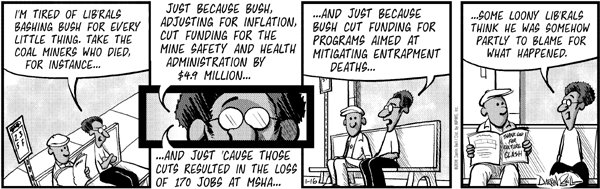
There They Go Again: Politicizing Sago

Candorville
by Darrin Bell
Click for larger size

Death In The Workplace: Companies Still Getting Away With Murder

James McNair of the Cincinnati Enquirer has picked up where the NY Times' David Barstow left off two years ago telling the story of the June 14, 2002 death of 22-year-old plumber's helper Patrick Walters in a 10 foot deep unshored trench. Barstow and McNair use Walters' death to illustrate OSHA's failure to seek criminal prosecutions even when the employer has been cited over and over again before finally killing someone.

In this case, Moeves Plumbing of Fairfield, Ohio, had been cited numerous times -- and had already killed one employee -- before killing Walters, yet OSHA dropped a willful citation and never sought criminal charges. After several additional citations following Walters' death, Moeves finally decided to get out of the trenching business.
OSHA regulations call for specific forms of protection for people working in trenches more than 5 feet deep. Companies can either lower an adjustable device called a trench box around workers or they can slope one of the trench walls in such a way that workers can readily climb out. Ladders must accompany trench boxes.

Four times in 15 years, OSHA cited Moeves Plumbing with willfully breaking those rules.

In 1989, OSHA fined the company $10,000 for willfully failing to take safety measures that might have spared Clint Daley from a fatal, 12-foot trench cave-in in Anderson Township. Thirteen years of compliance followed, but in May 2002 [weeks before Walters' death] an OSHA inspector dropped in on a Moeves work site in Montgomery and found company employees working outside of a trench box in a 15-foot-deep hole. OSHA called that a willful violation, too. It fined the company $24,000.

Two years later, in May 2004, it happened again, as OSHA cited Moeves with a "repeat" citation for sending workers into a trench with neither a trench box nor a ladder. Then, on Aug. 2, 2004, OSHA issued Moeves three "willful" violations after an inspector found a Moeves worker installing a pipe fitting while outside a trench box in a hole more than nine feet deep. OSHA proposed a fine of $150,000.

Moeves settled the case with OSHA in October. It agreed to leave the trench business in exchange for a lower fine of $52,000.
The lack of criminal prosecutions -- even in the face of clear evidence that the employer knew that the company's employees were working in a dangerous environment -- has always been a problem under the weak Occupational Safety and Health Act. But it's gotten even worse under this administration, according to data collected by McNair:
National data collected from 1995 through 2004 show a pattern of declining referrals - and prosecutions - of OSHA cases.

During the Bush administration's first term, for example, only seven OSHA cases were referred for prosecution, compared with 33 in the last four years of the Clinton presidency, according to data compiled by the Transactional Records Access Clearinghouse at Syracuse University. Of the six cases that were concluded in 2001-2004, five were dropped. One case resulted in a conviction.

By contrast, the Clinton administration closed out 39 cases in 1997-2000, resulting in 24 dropped prosecutions, 14 convictions and one acquittal, according to the Syracuse University data.
Michelle Marts (Walters' mother) and his father, Jeff Walters lobbied furiously -- but in vain -- for a criminal prosecution. Marts has also come to Washington D.C. to lobby for legislation, introduced by Congressman Major Owens, that would
make "corporate manslaughter" a felony punishable by a prison term of up to 10 years. His reasoning? The government is guilty of "gross negligence" in deterring the killing of American workers. Ninety-three percent of worker death cases in the last two decades, he said, resulted in no criminal prosecution.

"Every year," Owens said in April, "between 5,000 and 6,000 workers are killed on the job, often in gruesome circumstances due to inexcusable safety violations. This bill is aimed at holding such grossly negligent employers accountable."

***

Owens' bill went nowhere. Introduced as an amendment to other OSHA-related legislation, the measure was blocked by Rep. John Boehner, the West Chester (Ohio) Republican who is chairman of the House Committee on Education and the Workforce.
Marts notes that Boehner lives in the same community as Linda Moeves, owner of Moeves construction.

Finally, I just want to say something about Michelle Marts. On one hand, she's nothing special. Just one of the thousands of family member who lose loved ones in America's workplaces every year. To a certain extent, she was "lucky" in that the news media has picked up on Patrick's story and used it to move this government to more effectively confront workplace killing.

One the other hand, luck had nothing to do with it. As I mentioned above, Michelle and her ex-husband Jeff Walters, are determined not to let Jeff's story die. They have made the media aware of how many companies are getting away with murder, they have testified in Washington DC and they have vowed not to rest until our legislators and citizens wake up to terrorism in American workplaces. If every American who buried a loved one killed in the workplace did the same thing, we'd be seeing more activity in this country. But this kind of action takes educating and organizing. Those of you reading this -- when you hear of a workplace death in your community, educate the local media -- and take the opportunity, when appropriate, to see if the family is interested in doing something about the root causes of their loved one's death.

Related Stories

Won't Get Fooled Again -- and Again and Again? OSHA Cites Serial Violator Who Had Killed Twice Before, February 6, 2005
Charging My Batteries, May 14, 2004
Terrorism in the American Workplace, May 16, 2004
"You done killed my boy!" December 21, 2003

Everything You Ever Wanted To Know About The Sago Mine Disaster

Mine Safety and Health News editor Ellen Smith, who has been interviewed extensively about the Sago mine disaster, has put an MSHA and Sago Mine Q&A page on her website.

Wondering about the answers to these questions?

  • What was Sago’s accident rate and how does it compare to other mines?

  • What is the breakdown of Sago’s violations? How bad were they? Some industry people claim that Sago’s record wasn’t that bad.

  • How did the communication breakdown occur in which the world believed that these miners were alive?

  • Why did it take so long for the mine rescue teams to get into the mine? It was over 11 hours before they entered into the mine.

  • The Labor Dept. has said that it will investigate this accident. How confident are you of this investigation?

Check it out for Ellen's answers to these questions and many more.

C onfined Space Wins Bronze Medal In Labor Website Of Year Contest

Not bad, I suppose. Third place with well over 400 votes in the LabourStart's labor website of the year contest. According to LabourStart, "This marks the first appearance of a weblog in the top ten of the labour website of the year competition."

Of course it's always nice to win (or so past winners tell me), but considering that we were competing against major national unions with hundreds of thousands of members, I suppose I can't complain.

Thanks to all of you who went to the trouble to cast votes. Even obsessive bloggers need a little love.

Sunday, January 15, 2006

MSHA To America: You Can't Handle The Truth!

According to Ellen Smith, owner and managing editor of Mine Safety and Health News, after past mining incidents, the Mine Safety and Health Administration (MSHA) would make available to the public vital information including witness interviews, laboratory results, MSHA-approved mine plans, inspectors' notes and inspection memos from before the accident, even before the final investigation report was completed.

But no more. Consistent with their overall obsession with secrecy, this administration has apparently decided that we can't handle the truth:
The first time MSHA declined to release miner witness interviews was after the Sept. 24, 2001, explosion at a Jim Walters Resources mine in Alabama, which killed 13 miners -- a mine tragedy overshadowed by the Sept. 11 terrorist attacks. At that time, perhaps the media did not understand the change in MSHA's policy or what it would mean.

Then, two years ago, without public comment or input, MSHA secretly changed its longstanding policy of routinely releasing MSHA inspectors' notes and information from noise and dust surveys conducted at mine operations. While this secret policy change has drawn ire from both the mining industry and labor -- and, needless to say, the media -- MSHA refuses to change its policy, claiming that releasing this information would "interfere with law enforcement." MSHA has asserted that it can withhold this information "until all possibility of litigation has been exhausted." What this means is that concerned individuals outside MSHA will have no chance to examine raw evidence from the Sago disaster and reach their own conclusions.

But even if we wait until all legal proceedings have been concluded to see the full factual record, it still may not be made public, as the nation saw when the Labor Department blacked out 50 percent of an inspector general's report on issues surrounding an alleged coverup of the MSHA investigation of the Martin County coal impoundment failure. MSHA claims that it has changed its policy to conform with "what OSHA and other enforcement agencies" in the Labor Department do. Attorneys for the Occupational Safety and Health Administration, however, say that the kind of information MSHA withholds is in fact made available by OSHA.
Smith asks how people are expected to trust the government, or the legitimacy of MSHA's investigation of regular people, or even the experts can't see the factual records that might reveal the problems that caused the explosion.

Indeed

Saturday, January 14, 2006

Sloooow Bloggin'

On the road for work and on the road for pleasure. Stay tuned.

Sago Mine Disaster (and yours truly) on Air America

If you can break away from the football games this afternoon, Ring of Fire on Air America will be covering the Sago Mine disaster with mine expert Tony Oppegard and, as well as the famous editor of Confined Space -- me.

The show airs at 5:00 pm eastern time (so adjust according to your time zone.) You can find stations in your area here. If you can't break away from the football games, you can catch it again tomorrow at 3:00 pm eastern time. And if you miss that, the show will be archived next week at http://www.ringoffireradio.com/ .