Showing posts with label Foxes Guarding The Chickencoop. Show all posts

Friday, January 12, 2007

Of Foxes, Chickens and Chickencoops

In the continuing spirit of bi-partisanship, President Bush has renominated some of the worst of the worst nominees to head safety, environmental and regulatory agencies.

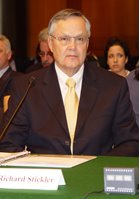
Former coal industry executive Richard Stickler was renominated for the -- hell, I can't even remember how many times the White House has sent him to the Senate (only to have him sent back again.) Stickler received a recess appointement last Fall.

Along with Stickler came the return of former Wal-Mart lawyer Paul DeCamp as wage and hour administrator at Labor. DeCamp has a record urging the weakening of the Fair Labor Standard Act’s (FLSA’s) overtime pay and other protections.

Also returning from the bureacratic dead is right-wing anti-regulatory zealot Susan Dudley, who we've written about here and here.

And then there's former mining industry executive John Correll who was re-nominated as director of the Interior Department’s Office of Mining Reclamation and Enforcement. Correll, you may remember, was involved improper contracting while at MSHA, and was instrumental in the firing of an MSHA whistleblower.

Needless to say, it's highly unlikely that any of these nominations will be confirmed by a Democratic Senate. (They were too controversial to even make it through a Republican Senate.)

But there is one piece of good news for the chickens. Steven Griles, a former mining lobbyist who was appointed Deputy Secretary of the Department of Interior (the number 2 position in the Departmetn) until he resigned in 2005, has apparently been notified by federal prosecutors that he will most likely be indicted for lying about his relationship with the corrupt lobbyist Jack Abramoff. Apparently Abramoff referred to Griles as “our guy” at the Interior Department.

Score one for the chickens.

Sunday, December 10, 2006

Senators Aim To Stop Another Industry Fox From Raiding The EPA Chicken Coop

A couple of Democratic Senators are trying to keep at least one more fox out of the regulatory chicken coop -- this time over at EPA. The fox? Alex Beehler, currently assistant deputy under secretary of defense for environment, safety and occupational health. The job he's being nominated for? Inspector General of the Environmental Protection Agency. What does the EPA's IG do?
We perform audits, evaluations, and investigations of EPA and its contractors, to promote economy and efficiency, and to prevent and detect fraud, waste, and abuse. We also provide public liaison (ombudsman) and hotline services to review public complaints about EPA programs and activities.
In other words, the Inspector General independently investigates EPA -- a challenging, but vital job in this administration that's filled the regulatory agencies with representatives of th windustries they're supposed to be regulating. For example, the IG has investigated whether the agency is misleading the public on the purity of the nation's drinking water. Last year, the IG found that officials writing an EPA rule appeared to show favoritism to Cintas corporation, a major fundraiser for President Bush, but that EPA rulewriters broke no laws or policies in doing so. In 2004, the IG investigated whether the chemical industry had an undue influence on the agency's proposed mercury rule. And a 2003 report of EPA's Inspector General found that after 9/11, EPA press releases were unclear about the safety of workers at the Ground Zero site -- one of the major factors contributing to the failure of many workers to wear respirators

So what's the problem with Beehler?

Senator Barbara Boxer, D-CA, who will chair the Senate Environment and Public Works Committee when Congress reconvenes next month has put a hold on Beeler's nomination. One problem is his current job at the Department of Defense,
where Mr. Beehler now has a lead environmental policy position, has sought to increase its role in the federal process for setting environmental standards, often advocating for less protective standards than many scientists think will adequately protect our communities. DOD has repeatedly sought to waive environmental laws without sound justification. The EPA IG will play a key part in auditing EPA and DOD environmental activities.

***

Unfortunately, Mr. Beehler was also unclear at best and evasive at worst when I questioned him at his nomination hearing on his role in DOD initiatives to affect standards for dangerous pollutants like perchlorate. He downplayed his role and led us to believe that industry was not a real part of the discussions with DOD and Mr. Beehler's key staff. The documents we received in answer to detailed questions on these matters lead us to a different conclusion.
Senator Max Baucus (D-MT) is also putting a hold on Beehler's nomination (and all other EPA nominations) because of the agency's failure to ensure that its cleanup of asbestos contamination in Libby, Montana is effective. Libby is the home of W.R. Grace whose executives have been indicted by the EPA for knowingly contaminating the entire community with asbestos-containing vermiculite. Last week, the an EPA IG report stated that “EPA cannot be sure that the ongoing Libby cleanup is sufficient to prevent humans from contracting asbestos-related diseases.”
"It's been seven years and the EPA can't tell us whether or not their cleanup activities are working," Baucus said. "That's a disgrace. And that's why nobody from EPA will move through the Senate until we get this fixed."
Oh, and then there's the little matter of Beehler's employer prior to the Department of Defense: Koch Industries Inc. Koch had the distinction, as of 2000, of being the recipient of $30 million civil penalty from EPA,
the largest civil fine ever imposed on a company under any federal environmental law to resolve claims related to more than 300 oil spills from its pipelines and oil facilities in six states.

***

The settlement filed in U.S. District Court in Houston resolves two lawsuits in Houston and Tulsa, Okla., which charge that Koch illegally discharged crude oil and petroleum products in Texas, Oklahoma, Kansas, Missouri, Louisiana and Alabama.
Beeler's nomination was aproved by the committee last week, but because of the holds, his final confirmation will need 60 votes in the Senate. If I was a betting man, I probably wouldn't be putting much money on him moving over to EPA.

Thursday, November 30, 2006

More Foxes Infest OSHA's Chicken Coop

The Bush administration is still being, well, the Bush administration.

We have a Deputy Assistant Secretary at the Occupational Safety and Health Administration who thinks that ergonomics hazards are caused by obesity, accidents are caused by negligent workers and we don't need OSHA investigations of farm deaths because the sheriff and country coroner can take care of the problems.

Last week, Assistant Secretary of Labor Ed Foulke (who came to OSHA directly from the notorious union-busting law firm Jackson-Lewis) appointed two new Deputy Assistant Secretaries at OSHA. Deputy Assistants are the next level down from the Assistant Secretary (just a heartbeat away). One of the new Deputies is C. Bryan Little. As the OSHA press release says, Little is
formerly of the Department of Labor's (DOL) Office of Congressional and Intergovernmental Affairs (OCIA).

Little served for more than four years as a senior legislative officer in OCIA managing Congressional contacts for activities of OSHA, the Mine Safety and Health Administration, and immigration-related issues relevant to DOL. Prior to arriving at the Labor Department, Little served for six years as senior director for government relations with the American Farm Bureau Federation.
The American Farm Bureau calls itself the "voice of agriculture." Its legislative priorities include exempting farms from environemental regulations, opposing action to address climate change, and supporting Rep. Charlie Norwood's OSHA deform legislation. Most recentlythe Farm Bureau has been known for strongly favoring repeal of the estate tax, claiming that it has dire consequences for family farms and small businesses. But as the Center For Budget and Policy Priorities reminds us:
the American Farm Bureau Federation acknowledged to the New York Times that it could not cite a single example of a farm having to be sold to pay estate taxes.
While at the Farm Bureau, Little was involved in issues closer to the hearts of Confined Space readers: opposing the ergonomics standard.

A press release issued by the Farm Bureau in 1997 repeated the tired old claim that there was no science to support an ergonomics rule and quoted Little about the National Academy of Science study that the Republican Congress mandated in an effort to stall the ergonomics rule:
"It is good news for farm employers, because there is no way to reasonably redesign dozens of jobs on farms across the country to eliminate what OSHA says are ergonomic hazards."
Little went on to minimize the hazard, saying:
"Until scientists can figure out how to give farmers eyes in the backs of their heads, those driving tractors will have to turn their heads in order to safely operate a variety of towed farm equipment. When the driver's neck gets sore from doing this, a standard like that envisioned by OSHA will require farmers to somehow redesign that job. This will not be possible at a price agricultural producers, and therefore consumers, can afford."
Little didn't have much good to say about the OSHA inspectors he'll be working with either. In a June 2000 interview, Little responded to a Congressional effort to pass an amendment that would have stopped OSHA from finishing the ergonomics standard.
Depending on what side of bed the OSHA inspector got out of in the morning, you might or might not be in compliance, and that's bad regulatory policy. You ought to give the regulated community an opportunity to know exactly what they need to do in order to be in compliance.
He then went on to claim that ergonomic problems are due to obesity. The ironic thing was that Clinton's ergonomics standard didn't even cover agriculture. But Little claimed that it did cover "agriculture" that didn't occur in the fields, "like packaging and processing and things like that" - in other words basic manufacturing processes.

The Farm Bureau went on to join a lawsuit against the standard after it was issued in November 2000, and actively supported efforts to repeal the standard in March 2001.

And it gets worse. Every year Congress adds language to OSHA's budget bill prohibiting the agency from conducting any enforcement activity on farms that employ fewer than 10 people. In 1998, following the death of Rhode Island teenager who was killed in a tractor accident, Rhode Island Senators Jack Reed (D) and John Chafee (R) proposed a change to law that would permit OSHA inspectors to investigate fatal accidents and prepare a report on the causes of the accident.

Predicting that an OSHA investigation (even without citations!) would certainly lead to the fall of Western Civilization, Little sympathetically explained that
Unfortunately, accidents are going to happen where you mix people with heavy machines and large animals.”
Hey, shit happens.

And anyway, we don't need no stinkin' OSHA inspectors. A little common sense and the local sheriff will do:
Little questions why the proposal is necessary when local authorities already conduct accident investigations. “No fatal accident is going to occur on a farm where the sheriff and the county coroner don’t look into it. Safety in agriculture is not complicated, and serious negligence will be clear to anyone with a little common sense. You don’t need someone from Washington to tell you to keep your loose clothing out of an auger or PTO shaft.”
Damn straight. And you don't need someone from Washington to tell you not to fall off a building or get crushed in a trench collapse or get electrocuted by a live wire or get poisoned by chemicals either.

Oh, incidentally, Bryan, they make shields for PTO shafts. They cost about $50. But I guess the local sheriff knew that already.

Anyway, welcome to OSHA. You'll fit right in.

Saturday, October 21, 2006

Who's Sleeping With The Secretary Of Labor?

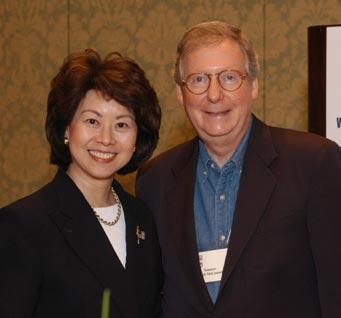
John Cheves at the Lexington Herald Leader has an fascinating article about Secretary of Labor Elaine Chao and the man she sleeps with, Kentucky Senator Mitch McConnell, who also happens to be her husband. Most of it has been reported before (much of it on Confined Space), but Cheves manages to pull it all together in a devastating package.

How does this relationship work in practice?
Millionaire coal magnate Bob Murray knew the name to drop in September 2002, when Mine Safety Health Administration inspectors confronted him about safety problems at his mines: Sen. Mitch McConnell.

Murray, a large man with a fierce temper, is a huge donor to Republican senators. McConnell, R-Ky., rose through the ranks by raising money for those senators. And McConnell is married to Labor Secretary Elaine Chao, whose agency oversees MSHA.

Shouting at a table full of MSHA officials at their district office in Morgantown, W.Va., Murray said: "Mitch McConnell calls me one of the five finest men in America, and the last I checked, he was sleeping with your boss," according to notes of the meeting. "They," Murray added, pointing at two MSHA men, "are gone."

Murray, in a recent interview, denied that he referred to McConnell "sleeping with" Chao.

But nobody disputes that district manager Tim Thompson, at one end of Murray's jabbing finger and the man whose notes recorded the meeting, was transferred to another region, away from Murray's mines. He appealed the transfer for three years until he grudgingly took retirement in January. Labor Department officials refuse to discuss his transfer.

"The ironic part is, I'm a Republican," said Thompson, now a private mine-safety consultant. "But I don't think you should bring up politics at a meeting like that, involving safety."
Probably not, but it was obviously effective.

The Chao-McConnell relationship is of particular interest for workers, particularly mineworkers and farmworkers:
When it comes to workplace-related issues such as mine safety, the McConnell-Chao marriage presents an intriguing target for industry donors. At the Labor Department, Chao has taken what some reports say is a relaxed attitude toward the regulation of coal mines and an approach that labor unions perceive as hostile.

Sometimes Chao achieves what her husband cannot in the Senate, such as a wage freeze her department instituted on certain farmworkers.
And her job has been a perfect vehicle to put her conservative political philosphy into action:
Chao is staunchly conservative. Speaking at a Washington event in May, she said, "Often, people come into public service with a zeal to take immediate action. But, sometimes it's not what you do but what you refrain from doing that is important."
And we've certainly seen plenty of "refraining" from doing anything over at OSHA and MSHA during her reign. But the important people are happy.
Few industries were happier to see Chao bring that philosophy to the Labor Department than mining, which has given more than $400,000 to McConnell's Senate campaigns, according to the Center for Responsive Politics.

In early 2001, industry magazine Coal Age listed the various mining executives invited to shape the agency's agenda and wrote that they were "benefitting from high-level access to policymakers in the new administration."

At the Mine Safety and Health Administration, Chao named Utah coal operator David Lauriski as director, assisted by former McConnell aide Andrew Rajec. (Lauriski resigned in 2004, citing family concerns, after the Labor Department's inspector general questioned no-bid MSHA contracts that went to firms connected to him.)

His deputies for policy and operations, John Caylor and John Correll, had been executives at Cyprus Amax Minerals Co. of Englewood, Colo. The company's PAC gave $17,000 to McConnell and $15,000 to the National Republican Senatorial Committee while McConnell and Law, now Chao's deputy, ran it.

"They stacked MSHA with executives who came straight from the coal and mining companies," said Tom Kiley, a Democratic aide to the House Education and Workforce Committee. "Sure, it's good to have some expertise, but there was no effort to balance that with people from the workers' side. It's totally the fox guarding the henhouse over there."
Other "accomplishments" of the dynamic duo?
The Food Marketing Institute lobbied the Senate and the Labor Department after President Bush took office in 2001 to kill the mandatory ergonomics rules that President Clinton had intended to protect workers from repetitive-stress injuries. The institute says it represents 26,000 grocery stores.

At the urging of the institute and other business groups, in 2001 McConnell and the GOP Senate narrowly approved a resolution declaring that Clinton's safety rules "shall have no force or effect."

But it was Chao, after the food institute's officials approached her, who sealed the deal by replacing Clinton's safety rules with "voluntary guidelines," the institute told its members in a newsletter.

"The proposed voluntary guidelines will give our member companies helpful suggestions," the group's chief executive, Tim Hammonds, said in a statement thanking Chao for "the new spirit of cooperation."

The institute, which had contributed at least $13,000 to McConnell in the 1990s, upped its donations, giving him nearly $13,000 more during Chao's first two years as labor secretary. Officials of the institute declined to comment
And then there's the firing of Jack Spadaro for blowing the whistle on Massey energy due to a massive coal slurry spill in Kentucky. (We've written about that before, here and here.)

The Chao/McConnell Team's philosophy even affects the front line workers who are supposed to be protecting workers' health and safety:
Some MSHA officials talk of being pressured to go soft even when they uncover serious problems.

In April, MSHA inspector Danny Woods told the Pittsburgh Post-Gazette that colleagues wanted to shut down part of a Massey coal mine in West Virginia in January because spilled coal and dust had accumulated along a belt line, raising the risk of a fire. The request was denied. Woods said inspectors were told "to back off and let them run coal, that there was too much demand for coal."

Days later, on Jan. 19, a fire in that part of the mine killed two miners. MSHA spokeswoman Amy Louviere recently said MSHA is investigating Woods' allegation, so she cannot discuss it.
And like any good marriage, when one partner drops the ball, the other one is there to pick it up and run:
Sometimes Chao picks up the ball and runs with it at the Labor Department when McConnell fails to reach a similar goal in the Senate.

For example, McConnell filed legislation for three years, starting in 1998, to curb the mandatory annual raise in wages of legal immigrant farmworkers under the government's H2A program. By 2001, the wage in Kentucky was $6.60 an hour, which struck some agricultural businesses as too high. (Agribusinesses have given McConnell more than $1 million for his campaigns -- out of $21 million from all donors over 22 years, according to the Center for Responsive Politics.) But the bills kept failing.

In 2001, Chao ordered an indefinite delay in the release of an annual Labor Department wage report that triggered the farmworker raise. It was an insider move, not noticed by most Americans, but praised by McConnell's Republican congressional colleagues and business groups in letters obtained from Chao's office.

Farmworker Justice sued Chao on behalf of immigrant workers, and in 2002, U.S. District Judge Gladys Kessler ordered her to resume publishing the wage report in a timely fashion.
And it's always a pleasure to see couples working together toward a shared goal:
In 2002, McConnell filed an amendment to a corporate ethics bill that would force unions -- whom McConnell criticizes for supporting Democrats over Republicans -- to file far more detailed public reports on their spending. His amendment drew protest from unions, and four Republicans joined with Democrats to defeat it.

The next year, Chao announced stricter rules on unions' expense disclosures through the Labor Department's mandatory reporting system. Unions now must itemize every expense of $5,000 or more. The unions protested, but her order was upheld.
What a team. Although Chao and Defense Secretary Donald Rumsfeld are Bush's only two original cabinet members, Chao is generally thought to be his least effective Cabinet secretary. But it helps to be married to the right people. McConnell is generally thought to be the next Senate Majority Leader when Bill Frist retires in January.

Thursday, October 19, 2006

Bush Appoints Stickler To Head MSHA. Expected To Do A Heck Of A Job

Yet another in a long line of unqualified industry foxes has been appointed to guard this country's henhouses. And miners will pay the price.

In deliberate defiance of Congress and the families of mineworkers killed on the job this year, President Bush has appointed Richard Stickler to head the Mine Safety and Health Administration. Because the Senate refused to confirm him, Bush made a recess appointment which he is allowed to do without Senate approval when Congress is out of session.

Stickler was nominated to the post in September 2005, before the Sago disaster and other mine incidents that have raised this year's number of deaths to levels not seen in years, but his nomination was blocked in the Senate and sent back to the White House twice. Forty coal miners have been killed on the job so far this year, compared with 22 in all of last year.

There is nothing in Stickler's work history or public statements that show him to be the man best qualified for this job. Stickler made an completely unimpressive impression at his confirmation hearing. His appearance was less than dynamic, to put it mildly. Some observers quipped that they were tempted to check his pulse to see if he was alive. But it wasn't just his style that was lacking. As Charleston Gazette editors wrote in an editorial opposing Stickler's confirmation:
Despite widespread belief that more communication equipment and better safety enforcement might have saved at least 11 of those men [lost at Sago], Stickler told U.S. senators that current mine safety laws are “adequate.” A day later, two more miners died in separate incidents in Boone County.
Senate Majority Leader Bill Frist was forced to cancel a vote on Stickler's confirmation last June due the lack of Senate support for Stickler's nomination. Then in August, in an unprecedented action, the Senate returned Stickler's nomination to the White House before it went on break. But refusing to take the hint, the President renominated Sticker at the beginning of September. The Senate was obviously not amused and again returned the nomination to the White House.

Senators Ted Kennedy and Robert Byrd have led the opposition to Stickler, citing his industry background and the lack of commitment to MSHA reform that he displayed at his confirmation hearing. The Mineworkers also called on Bush to withdraw the nomination, as did the AFL-CIO and the Charleston Gazette. In addition, widows of miners killed at Sago and other recent mine disasters wrote the White House opposing Stickler's nomination. At a signing ceremony for recent mine safety legislation, Deborah Hamner, whose husband, George Hamner, was killed at Sago, told the president in person that she opposed Stickler's nomination to head the Mine Safety and Health Administration.

Although the Labor Department boasts about Stickler's 37 years of mining experience, most of his career was spent in industry where the mines he managed had injury rates that were double the national average, according to government data assembled by the United Mineworkers. While managing mines for Bethlehem Steel, according to information assembled by the United Mineworkers union, the mines he managed had injury rates that were double the national average. According to former Mineworkers health and safety director Joe Main, the figures indicate “a very poor compliance record.”
“These figures would rank Stickler’s operations among the highest cited in the country,” Main wrote. “Collectively over the eight-year period, the federal government issued nearly 3,000 citations and closure orders at mines that Mr.
Stickler managed.”
In 1987, Stickler was appointed Director of the Pennsylvania Bureau of Deep Mine Safety and held that position when nine coal miners were trapped for three days in a flooded Quecreek mine until being rescued. The mine had flooded to to errors in mine maps. Despite White House boasts that Stickler "was one of the architects of the dramatic rescue," a grand jury determined after the flood that Stickler's bureau should have noticed the mapping problems sooner.

The Senators from West Virginia were not pleased with Bush's recess appointment:
Sens. Robert C. Byrd and Jay Rockefeller, West Virginia Democrats, said the appointment indicates that the administration does not consider mine safety a priority.

"We need a bulldog agency that will place miner safety over all other priorities, and not an agency that will continue to place a higher priority on mine production than on miner protection," Byrd said in a statement.

MSHA had been operating without a permanent Assistant Secretary for almost two years since David Lauriski resigned in November 2004.


Related Stories

Wednesday, September 13, 2006

Susan Dudley And Bush's War On Public Safeguards

While the nation and its media are consumed with the 9/11 anniversary, the deterioriating situation in Iraq, Afghanistan and the Middle East, and the upcoming elections, the Bush administration is intensifying its war on workers, citizens and the environment.

Public Citizen and OMB Watch launched a major campaign today designed to scuttle the nomination of anti-regulatory zealot Susan Dudley to be director of the the Office of Information and Regulatory Affairs (OIRA). OIRA is part of the White House Office of Management and Budget that controls the issuance of all protective regulations issued by agencies such as OSHA, and EPA.


In a telephone press conference conducted by Public Citizen, OMB Watch, the Natural Resources Defense Council and the AFL-CIO, the public interest groups outlined why Dudley is unfit to be the nation’s top regulatory czar. Throughout her career, Dudley has consistently fought against government safeguards and advocated a radical, hands-off approach to regulating corporations.

As director of regulatory studies at the industry-funded Mercatus Center, Dudley has sought to strike down countless environmental, health and safety rules. She has opposed such safeguards as the EPA’s attempts to keep arsenic out of drinking water and lower levels of disease-causing smog. She has questioned NHTSA’s life-saving air bag regulations and the Department of Transportation’s hours-of-service rules to keep sleep-deprived truck drivers off the roads. She has championed energy deregulation, which has led to skyrocketing prices and little consumer relief during record-setting heat waves.

“If confirmed as OIRA administrator, Dudley would continue her anti-regulatory agenda from a position with enormous power over federal health, safety and environmental protections,” said Robert Shull, Public Citizen’s deputy director for auto safety and regulatory policy, and a principal author of the report. “She would come to this office with a radical agenda that would destroy the federal government’s ability to protect the public. The public cannot afford to pay that price.”
Dudley was the director of the Regulatory Studies Program at the Mercatus Center, an industry-funded, antiregulatory advocacy organization. Mercatus' funders have included companies with long records of opposing government safeguards such as BP Amoco, Exxon Mobil Corporation, General Motors, JP Morgan Chase, Merrill Lynch, Pfizer, and State Farm Insurance Companies.

But Public Citizen and OMB Watch don't just issue press releases, they also do their homework. The groups released a 68 page report and a collection of fact sheets to support the campaign.

The report dismantles Dudley's arguments piece by piece, particularly the often circular and contradictory reasoning she uses to oppose every regulation she's ever met. For example, Dudley believes that regulations can only be justified to compensate for a "market failure." Other possible regulatory goals, suchas environmental justice, civil rights and fairness are not on her radar screen.

And how do you prove "market failure?"

You don't. If things like automobile safety or ergonomics protections were important, then the public would demand them and companies would supply them. The fact that companies aren't supplying them means the public isn't demanding them. Hence, the market works perfectly and no regulation is needed.

For example, EPA regulation require facilities that work with dangerous chemicals to create risk management plans for use in worst-case scenario disasters. Humbug! says Dudley.
“If there is a public demand for this information, as EPA’s benefit assessment argues, nongovernmental organizations would find value in deriving it. The fact that they don’t suggests that the value of the information to the public is less than the cost of the information. Certainly the public would value receiving a company’s products and services as well, but the quantity and price of those goods and services is determined by the market; the federal government doesn't simply require companies give products away. Information is a good, and like other goods, has associated costs as well as benefits.”
Companies have natural incentives to ensure their workers' safety.For example, ergonomics regulations designed to prevent workers from suffering from musculoskeletal disorders (MSDs):
“OSHA offers no evidence that employers and employees do not have adequate incentives to provide the optimal level of workplace protection against MSD hazards. On the contrary, OSHA provides evidence that (1) MSDs impose significant costs on employers, which should offer ample incentives to reduce their occurrence, (2) employers are, in fact, developing programs and other initiatives to reduce MSDs, and (3) MSDs are declining. Lack of knowledge on the causes of and remedies for MSDs, not lack of motivation, has hindered efforts to reduce MSDs.”
And then there's my personal favorite -- pollution is good for you:
“Due to ozone‘s screening effect on harmful ultraviolet-B radiation, the proposed reduction in ozone levels would increase malignant and nonmelanoma skin cancers and cataracts, as well as other UV-B-related health-risks. This doesn’t mean that more ozone is always better. It does mean that if the EPA really cares about public health it should take these trade-offs into account.”

I could go on and on, but then I'd rob you of the pleasure of reading the report yourselves.

But when you get done tsk-tsking and chuckling and shaking your head, remember that the Bush administration is dead serious about appointing this person to control, limit and abolish the safeguards that protect us and our children from the otherwise unsafe products and uncontrolled hazards in our workplaces, air, water, automobiles and anywhere else that corporate America can make a profit by neglecting the harmful effects of its products.

Related Stories

Thursday, August 24, 2006

Bush's Nomination For Regulatory Chief Is A Deadly Dud


Disaster in Iraq, war in the Middle East, Iranian nukes, anniversaries of 9/11 and Katrina, and on and on.

Meanwhile, back at home, virtually unnoticed, the Bush administration continues its deadly attacks on worker health.

Celeste Monforton, a senior research associate with the Project on Scientific Knowledge and Public Policy at George Washington University School of Public Health (and occasional Confined Space guest blogger), explains in the Louisville Courier Journal why President Bush's recent nomination of Susan Dudley to head the Office of Management and Budget's Office of Information and Regulatory Affairs (OIRA may end up killing workers.

As we've written before (here and here), Dudley currently directs the Mercatus Center's Regulatory Studies Program. According to Frank O'Donnell of Clean Air Watch, Dudley is "a true anti-regulatory zealot"-- exactly the type of person who would be a disaster as head of the agency that oversees the administration's regulatory policies.

Monforton focuses on Dudley's opinions on the deadly lung disease, silicosis and shows thatthat Dudley is simply
following the script first popularized many decades ago by the tobacco industry: When faced with regulation to protect the public health, always raise doubt and manufacture uncertainty about the scientific evidence.
She falsely claims that scientists don't really know how silica dust causes the disease:

This is not true. The cause of lung damage is exposure to respirable crystalline silica. Despite the authors' assertions, physicians, toxicologists and other experts have known for nearly a century that microscopic particles of SiO{-2} (silicon dioxide, or quartz), when inhaled, can penetrate deep into the lung's alveoli. The body's natural defense mechanisms attack the tiny silica particle, thereby creating scar tissue -- and with too much exposure and too much scar tissue, silicosis develops.

When materials containing SiO{-2}, such as cement, bricks or rock are drilled, sawed or otherwise disrupted and create dust, or when crystalline silica sand is used for abrasive blasting or in foundry processes, workers are at risk of breathing respirable particles containing quartz. This is all well-known, indisputable science.

She also claims that we don't know which types of silica are dangerous that the the evidence comes from limited sources.

Again,
Not true. The American Thoracic Society's 1997 official statement on the health effects of exposure to respirable crystalline silica includes more than 140 references, and the National Institute for Occupational Safety and Health's health hazard review lists nearly 500 scientific papers and documents to support its findings. Claims of scientific uncertainty by two law professors do not make it so.

Dudley also asserts in her article that epidemiological studies of silica-exposed workers may not be relevant because the studied workers "were exposed to silica of particular types, which may or may not be representative of silica found elsewhere."

Again, this tactic follows the uncertainty script, and, again, it is not true: SiO{-2} is SiO{-2}.
What would Dudley's appointment mean for workers, especially coal miners?
If confirmed to the White House post, is this how Dudley would interpret scientific evidence, even such settled science as the cause of silicosis or coal workers' pneumoconiosis?

Following her logic, might she declare that the coal mine dust from the Upper Harlan seam and the Pocahontas seam are substantially different? If so, would she require MSHA to develop "coal-seam specific" regulations before miners could be protected from the deadly dust?

Sounds ludicrous, but stranger things have happened when ill-qualified idealogues are appointed to decision-making posts for the sole purpose of delaying or stopping all regulations.
Dudley's nomination is yet another confirmation of the importance of taking back Congress this November. The Senate has to confirm the nomination of high-level Bush appointments like Dudley, and there is a critical need for Congress to get back into the oversight business -- to hold hearings that will reveal the damage this administration is causing to American workers. And the only way that will happen is if the Democrats take back at least one House of Congress.

So get out there and campaign. People's lungs and lives may depend on it.

Related Articles

Wednesday, August 02, 2006

Bush Foxes Overrun Chicken Coop

Last month I reported a rumor that President Bush was about to nominate Susan Dudley as the new director of the Office of Management and Budget's Office of Information and Regulatory Affairs, which approves all environmental, health and safety and other government regulations. director of the regulatory studies program at George Mason University's anti-regulatory Mercatus Center.

Yesterday, the nightmare came true as Bush officially nominated Dudley. As I wrote before, Dudley is known for conjuring up all kinds of reason why protective regulations are killing our country. She opposed OSHA the deceased ergonomics standard on the grounds that all employers really needed was more information and they would automatically do the right thing. Furthermore, OSHA's ergonomics standard would "discourage individual responsibility and hinder innovation into creative solutions."

Meanwhile, the AFL-CIO Today blog reports that the Bush Administration has nominated yet another fox to guard the already besieged chicken-coop. A hearing was held yesterday on the nomination of Paul DeCamp to head the Labor Department's Wage and Hour Division (WHD). And what better choice? DeCamp is a former lawyer for Wal-Mart—with a long paper trail outlining his opposition to the Fair Labor Standards Act’s (FLSA’s) overtime pay and other provisions.
During the debate on those new rules, Paul DeCamp, Bush’s WHD nominee, wrote that the proposed changes in overtime laws represented:
a window of opportunity, particularly in light of the federal elections of 2002, for the business community to achieve positive results that can bring the FLSA into the 21st century.
During this morning’s Senate Health, Education, Labor and Pensions Committee’s confirmation hearing, AFL-CIO Legislative Director Bill Samuel testified that DeCamp’s long legal career has been spent:
defending employers against workers in a wide range of employment matters, including FLSA collective actions and sexual harassment individual and class actions, and he has served as counsel to Wal-Mart appealing the certification of a nationwide class of 1.6 million women alleging systematic gender discrimination in pay and promotions.

The Wage and Hour Division is charged with protecting workers from employer violations of the minimum wage, child labor laws, the Family and Medical Leave Act, the Migrant and Seasonal Agricultural Worker Protection Act and prevailing wage requirements under the Davis-Bacon Act and the Service Contract Act.

The Wage and Hour Division is charged with protecting workers from employer violations of the minimum wage, child labor laws, the Family and Medical Leave Act, the Migrant and Seasonal Agricultural Worker Protection Act and prevailing wage requirements under the Davis-Bacon Act and the Service Contract Act.

At least that was its original mission.

The Washington Post reported today that DeCamp lucked out at yesterday's confirmation hearing, because most of the attention was focused on an even more controversial nominee, Bush's choice to be commissioner of the Food and Drug Administration. But he didn't escape totally unscathed. Republicans, of course, praised DeCamp " as a highly qualified expert in labor law."
But DeCamp conceded that, on his watch at the department, large numbers of temporary and immigrant workers were victimized by wage theft and other illegal practices -- in particular during the Gulf Coast cleanup after Hurricane Katrina.

"Why should we think you're going to do a better job as wage and hour administrator?" asked Sen. Edward M. Kennedy (D-Mass.), waving reports documenting recent wage scandals.

DeCamp also drew criticism for having represented Wal-Mart Stores Inc. in a class-action lawsuit by 1.6 million low-wage female workers over alleged sex discrimination.

"Have you ever defended a worker in a lawsuit against an employer?" asked Sen. Patty Murray (D-Wash.).

"I have not," DeCamp replied.
Oy.
Overtime Out, July 29, 2003

Sunday, May 21, 2006

Bush Should Withdraw Mine Safety Nominee

I'm not sure if anyone is reading this who matters, but after the deaths yesterday of five more coal miners, bringing this year's total to 31, it is clear to me that Richard Stickler's name should be withdrawn as Assistant Secretary of Labor for Mine Safety and Health.

I'm not saying that Richard Stickler is a bad person, or even that he doesn't care about the health and safety of mineworkers. In fact, let's assume that Richard Stickler is sincerely interested in improving the safety of American miners and has every intention of turning MSHA around. The fact is that he is clearly unsuited for this job, and I'm not basing this only on the fact that Stickler is yet another in a long line of Bush administration industry foxes that have been appointed to guard this country's henhouses.

The job of leading one of this country's workplace safety and health agencies is much more than just having good intentions and some safety experience in the industry. Moving the health and safety agenda forward requires fighting tough political battles on several fronts. The most obvious is the battle against those companies who seek to shortcut safety in order to maximize production, particularly when coal prices are at their highest level in 20 years.

It took this country over 200 years to figure out that leaving workplace safety in the hands of employers did not ensure safe working conditions. This lesson was ignored when George Bush came into office, but it's been painfully re-emphasized since January. Even with the best of intentions, the person who heads MSHA needs a healthy sense of skepticism, a clear sense of right and wrong and strong character in order to deal with what former mine safety official Tony Oppegard calls "the greed or indifference of mine operators." Most of all he or she needs to be independent of the companies that MSHA regulates.

Issuing unpopular and costly regulations and enforcing the law against the good buddies with whom you've spent your entire career is not easy even for the strongest, most principled individuals. Richard Stickler has given us no reason to believe that he has the strength, independence or character to do the job.

But the struggle against unsafe employers is only one of the battles that an MSHA director will need to fight in Washington DC. Two other major obstacles are the United States Congress and the Bush Administration. Even if we assume that Stickler is sincere about improving MSHA's effectiveness, it's highly doubtful that he is strong enough or experienced enough to effectively fight the all-important inside political battles.

Our Congressional representatives -- particularly those in control at this point -- like to talk a good line, but, like employers, don't always follow up with needed resources. Five and a half months after Sago, bi-partisan mine safety legislation was introduced into the Senate just last week. And only the Democrats have introduced legislation in the House of Representatives. One might think that an Republican agency director would not have a problem with a Republican Congress. But in reality, that only makes the job harder for someone who is sincerely interested in change. Bucking your own party is never easy, but it's even harder in this case where your boss (Secretary of Labor Elaine Chao), who is responsible for running the agency into the ground for five years, is married to the Senate Majority Whip (Mitch McConnell). Neither Chao nor McConnell has ever shown any sincere interest in workplace safety.

The most difficult barrier for any agency head sincerely interested in change is, of course, his own administration which may be concerned -- in the short term -- with limiting political fallout from mine disasters, but has no interest or motivation to do much of anything that might disturb their industry patrons once the headlines disappear and the photos of grieving widows fade from people's memories.

There is nothing in Stickler's history or testimony at his confirmation hearing that shows him to be the man best qualified for this job. Most of his career was spent in industry where the mines he managed had injury rates that were double the national average, according to government data assembled by the United Mineworkers. And while serving as Pennsylvania’s director of the Bureau of Deep Mine Safety, his role in not preventing the Quecreek mine near-disaster has been told. The mine had flooded to to errors in mine maps. Following the flood, which resulted in the amazing rescue of trapped miners, a grand jury determined that the bureau, which had been headed by Stickler for 5 years at that point, should have noticed the mapping problems sooner.

Stickler made an equally unimpressive impression at his confirmation hearing. His appearance was less than dynamic, to put it mildly. Some observers quipped that they were tempted to check his pulse to see if he was alive. But it wasn't just his style that was lacking. As Charleston Gazette editors wrote in an editorial opposing Stickler's confirmation:
Despite widespread belief that more communication equipment and better safety enforcement might have saved at least 11 of those men [lost at Sago], Stickler told U.S. senators that current mine safety laws are “adequate.” A day later, two more miners died in separate incidents in Boone County.
What this says is that although Richard Stickler may be a very nice man who may be sincerely interested in making sure more coal miners don't get killed, what this country needs in order to make serious change in this agency is someone not only knowledgeable and concerned, but someone with the vision, personal strength, independence, dynamic personality and political sophistication to navigate the treacherous shoals of corporate interests, public opinion, the media, and the internal politics of Congress, Elaine Chao's Department of Labor, the Office of Management and Budget and the Dick Cheney's energy industry friendly White House.

I don't think there there's anyone in either party who sincerely thinks that Richard Stickler is even close to the kind of person that is needed to lead MSHA. I honestly don't even think -- in his heart of hearts -- that Richard Stickler thinks that Richard Stickler is that man.

The fact is that Richard Stickler was nominated to head the Mine Safety and Health Administration in long forgotten, bygone era -- back in the days when almost no one knew what MSHA was, or cared much about what the agency did. That era ended on January 2, 2006 -- three and a half months after Stickler's nomination -- when the Sago coal mine exploded.

Sticker may have been an appropriate -- or at least typical -- choice of this administration in that bygone era. But today we sit and watch as the death toll in our nation's coal mines rises to crisis levels -- 31 already this year, compared to 5 at this time last year, 11 at this point in 2004, 13 at this date in 2003 and 12 at this time in 2002. And the carnage and shows no sign of slowing down. At this rate, we're heading toward the highest number coal mine fatalities in 20 years -- a time when we had over 60% more coal miners than we have today.

It is clear that the time has come -- even for a business dominated Republican administration -- to realize that doing anything less than appointing an individual who can credibly lead the charge for an overhaul of this nation's mine safety system is nothing less than condemning more miners to preventable and needless death.

President Bush should withdraw Stickler's name. And if Richard Stickler really wants to make a contribution to the safety of America's miners, he should do the right thing himself.


More stories on recent mine disasters here.

Wednesday, March 08, 2006

Foulke, Stickler Get Committee Approval To Head OSHA & MSHA

Signaling that they think everything's just fine in America's mines and other workplaces, Republicans on the Senate Committee on Health, Education, Labor and Pensions voted today to confirm Richard Stickler as Assistant Secretary of Labor for MSHA, and Edwin Foulke as Assistant Secretary of Labor for OSHA.

I'm don't know what the vote-count was on Foulke, but Stickler's confirmation was approved along party lines, with all of the Republicans voting in favor, and the Democrats voting against. The United Mineworkers, the AFL-CIO and the Charleston Gazette all opposed Stickler's confirmation.

The Mineworkers called the vote a "huge disappointment for all miners in America who are looking to their government to stand up for them instead of the coal companies."
"Since 2001, the coal operators have been in charge at MSHA," Roberts said, referring to Dave Lauriski, a coal company executive who was the Bush administration's first appointment to head the Mine Safety and Health Administration (MSHA). "Mr. Stickler would just be another fox guarding the henhouse.

"Career coal company managers and executives like Mr. Stickler spend their time figuring out how to get around safety rules and regulations in order to increase production," Robert said. "That's the last kind of person American coal miners need as our nation's top watchdog for safety."
Meanwhile, with Foulke at OSHA, we can expect more of the same -- emphasis on voluntary programs and not much else. Foulke is a labor relations and OSHA attorney at the Greenville, South Carolina union busting law-firm Jackson, Lewis LLP.

Inside OSHA (paid subscription) kindly provided Foulke's responses to the Democrats' written questions submitted after the hearing. (The Republicans refused to provide their questions.) Here's a sampling:

Senator Kennedy asked whether Foulke would support legislation to increase OSHA criminal penalties.
If confirmed, I would work with the DOL Solicitor to refer particularly egregious cases for criminal prosecution by the Department of Justice. I would have to review the current cases to see if the current criminal penalties need to be increased.
Translation: "When pigs fly."

Asked about steps he'll take to protect workers against the Avian Flu, Foulke responded that he'd "consult with the Centers for Disease Control, and recommend whatever actions are necessary to protect workers."

Well, considering the complicated issues involved in protecting workers, and the union petition to OSHA for a standard to protect health care workers against pandemic flu.taking "whatever actions are necessary," doesn't exactly inspire confidence.

When asked his opinion on using the General Duty Clause (Section 5(a)(1)) for ergonomics problems, considering that OSHA has only issued 17 ergonomics citations since the administration repealed the ergonomics standard in 2001, Foulke explained that he "will continue to cite employers for ergonomic hazards where action is warranted and the OSH Act Section 5(a)(1) criteria can be met." (emphasis added)

Senator Bingaman asked if there were any legislative reforms he would like to pursue that would help to improve OSHA’s enforcement record? In your dreams: "I believe OSHA’s legal authority is adequate to fulfill its mission of protecting the health and safety of American workers."

How's this for wishy, washy? Asked by Senator Patty Murray (D-WA) whether he would "support the release of a Personal Protective Equipment rule that says employers should pay for protective clothing for their workers while on the job?"
If I am confirmed, I will examine the agency’s efforts to protect Hispanic workers, and make any changes I feel are needed. I would also note that OSHA regulations in general require employers to ensure that employers assess the nature of hazards their employees face and ensure their employees are using appropriate PPE to protect them from those hazards. Many OSHA standards require the use of specific PPE in specific situations.

I am aware that OSHA is considering a PPE requirement. If I am confirmed,
I will review the rulemaking record on this proposal.
And finally, Senator Patty Murray asked him if he thought that perhaps increased inspections or enforcement were called for to address the $1 billion a week that we are spending as a nation on workplace deaths and injuries.

Not exactly,
We must vigorously enforce the law. We must inculcate a “culture of safety” among employers through outreach, education, and technical assistance efforts. In addition, we must continue to reach out to workers themselves.
Yeah, culture of safety and a maybe a little jail time....

In his defense, Foulke did commit to "do everything in my power to prevent the use of safety-related 'sting' operations" support the updating of OSHA's antiquated chemical permissible exposure limits, and that he would continue to use OSHA's egregious policy to generate high fines "when appropriate." OSHA's "egregious policy" had come under attack by the OSHA Review Commission and the business community.

The full Senate must now vote on the two nominations. The vote has not been scheduled.

Tuesday, September 20, 2005

OSHA Nominee Ed Foulke: A Gift to Workers From A Union Busting Law Firm

So it turns out that the nomination of Edwin Foulke as Assistant Secretary of Labor for OSHA last week is looking more and more like a typical Bush administration move: Appoint a Republican political operative to head an agency that he's spent most of his career working to undermine. Except in this case, there's an extra twist. Foulke is not just a Republican mover and shaker in South Carolina, he's also a partner at Jackson-Lewis, one of the most notorious union-busting lawfirms in the country. How appropriate for a Bush Administration Assistant Secretary of Labor.

I realized that when I wrote the original post that Jackson Lewis resided on the dark side, but I didn't have time to do much research that evening. Little did I know how easy the research would be. Just Google "Jackson Lewis" + "union busting" and you come up with 322 hits. Substitute "union busting" with the more polite phrase "union avoidance" and you get 304 hits.

Jackson Lewis publishes a newsletter called Preventive Strategies and one of their main Practice Areas is Labor Relations, including Preventive Practices"
Committed to the practice of preventive labor relations through issue assessment, supervisory training, policy development, and positive communications, Jackson Lewis has assisted many employers in winning NLRB elections or in avoiding union elections altogether. (emphasis added)
Much of Jackson-Lewis's evildoing, or "preventive labor relations" came to light nationally in a New York Times article last year that described how Enersys, a company that had hired Jackson Lewis to help it "avoid" a union, sued the law firm for malpractice, accusing Jackson Lewis of advising it to engage in illegal behavior.

You've really got to read the entire article. It's a nightmare about how the workers at the plant chose to organize with the International Union of Electrical Workers (IUE), despite the anti-union campaign organized by Jackson Lewis for the company. The company then fired a union steward and broke numerous other labor laws leading to an NLRB complaint citing 120 violations of federal law, among them wrongly firing union leaders, assisting the anti-union campaign, improperly withdrawing union recognition and moving production to nonunion plants as retaliation. The company then refused to sign a contract and threatened layoffs unless the union agreed to a "gainsharing program," that would provide bonuses based on productivity increases. The company never provided the bonuses and it was later discovered never had any intention to. (More on Enersys here.)

Even Tonight Show host Jay Leno doesn't think much of union busting firms like Jackson, Lewis:
Unionists have a good reason to watch "The Tonight Show". Its host, comedian Jay Leno, just busted the number-one union busting law firm, Jackson, Lewis, out of a lucrative deal.

Leno was scheduled to appear at the Society of Human Resource Management's annual convention in Las Vegas on June 25-28 - that is until union research Rick Rehberg found out about it. Rehberg, a corporate researcher for the Food & Allied Service Trades, an AFL-CIO department, kept coming across Jackson, Lewis in the 25 or so union campaigns he's worked on.

That's not surprising since the notorious law firm has defeated organizing drives in over 30 states. And they've done it mean and dirty. For example, the New York Daily News reported the law firm was responsible for setting up armed guards at factory gates in at least three states to stop union organizing campaigns. And Jackson, Lewis routinely advises companies to set up forced overtime when union meetings are scheduled, watch workers during break time to detect potential organizing drives, and prohibit workers' communication to thwart the distribution of union material.

Companies pay big money to Jackson, Lewis and other union busters for exactly that kind of information. In fact, union busting is a billion dollar industry. Jackson, Lewis charges $1,200 to $1,600 a person for running seminars titled, "How to Stay Union Free in Today's Era of Corporate Campaigns" and "Best Employer Practices to Stay Union Free in the Millennium". But thanks to Leno, Jackson, Lewis, won't be garnering a hefty check at this year's SHRM conference.
You can also find stories about J-L's participation in notorious campaigns against the unionization of Borders Bookstores, Berlin Health & Rehabilitation Center in Berlin, Vermont, Episcopal Church Home, nursing home in Rochester, NY, and Patient Care in New York City and many, many more. Infuriated after losing a 2002 election at Saint-Gobain Abrasives factory in Worcester, Massachusetts, Jackson Lewis even went so far as to file an unfair labor practice suit against Congressman Jim McGovern (D-MA) because he told workers that they should vote for the union (which they did.)

Foulke isn't directly part of J-L's union-busting practice. He belongs to the "Workplace Safety Compliance, including Violence Prevention" practice:
To assist in compliance efforts and to reduce the likelihood of a citation, we advise employers in developing safety programs and conducting preventive self-audits to pinpoint and remedy potential legal vulnerabilities.
Yes, you read that right. The purpose of Jackson Lewis's safety programs and self audits is not to protect workers from getting injured or killed, but to "pinpoint and prevent potential legal vulnerabilities." We all have our priorities.

And then there's the Violence Prevention part, which from J-L's perspective seems to be instruction in how to lay off troublesome employees without having them come back in and blow your head off. No mention is made of the overwhelming cause of workplace violence like retail store robberies and assaults of mental health and social service workers.

Foulke was also a member of J-L's Management Training practice, which includes programs on "maintaining union-free status."

Whether or not Foulke participated directly in Jackson Lewis's union busting activities, he certainly didn't have a whole lot of good things to say about one of labor's priorities throughout the 1990's, OSHA's ergonomics standard that was repealed by the Bush administration in 2001:

"It should be called the OSHA Lawyers' Full Employment Act," says Edwin Foulke, himself an attorney who specializes in OSHA-related issues for the Jackson Lewis law firm based in Washington, D.C. "I would have liked to have seen voluntary guidelines. Most employers want to do the right thing, but this will just be a big record-keeping exercise."

Foulke and other skeptics claim there isn't enough science yet to prescribe precise fixes for problems....

While Foulke was basically J-L's OSHA guy, questions need to be asked (preferably by Senators at his confirmation hearing) about what Foulke thinks about workers' right to organize. Was he in sync with the union busting activities of Jackson Lewis? Are union organizing campaigns that focus on health and safety issues a healthy sign of worker involvement or a sign of trouble? What does he think about behavioral safety programs that blame workers for accidents?

What does he think about the role of the "worker representative" as described in the OSHA law? Is it a good thing if workers exercise their rights to push management into improving safety conditions? Coming out of such a virulently anti-union firm, will he be able to work with unions? Unlike any other Republican administrations since OSHA was created in 1971, the Bush appointees have refused, with rare exceptions, to work seriously with unions. Will he continue this practice?

So what does all this mean for OSHA over the next 3 ½ years?

The bottom line is that we’re somewhat lacking in actual health and safety expertise in OSHA's front office. We now have attorneys in all of the top three jobs: Foulke, an attorney from a union busting lawfirm, a local Republican Party chairman and an officer in the Republican National Lawyer’s Association; Deputy Assistant Secretary Jonathan Snare, a former Texas political operative, member of the Republican National Lawyer’s Association and former lobbyist for Metabolife, maker of the killer drug ephedra; and Deputy Assistant Secretary Steve Witt, an attorney who has worked at a variety of positions in OSHA's Washington headquarters since 1985.

What all this means is no major regulations except those ordered by the courts, more emphasis (if that’s possible) on costly, unproven voluntary programs like VPP and alliances, continued frosty relations (or no relations) with labor unions, enforcement will continue muddle along increasingly strained for resources and there will be little, if any, Congressional oversight unless the Democrats take back one house of Congress next year.

In other words, status quo.

Monday, June 27, 2005

Attorney for Grace To Head EPA Enforcement

Fox Watching the Chicken Coop: Chapter 3,457

After four and a half years of this administration, you don't even get three guesses for this one.

If you were the Bush administration, who would you pick as the chief of enforcement for the Environmental Protection Agency? How about a partner from the lawfirm defending a company accused of (in the words of the special agent in charge of the EPA's environmental crime section in Denver) "one of the most significant criminal indictments for environmental crime in our history?"

According to the Baltimore Sun,
President Bush has nominated as chief of enforcement for the Environmental Protection Agency a partner in a law firm defending W.R. Grace & Co. against criminal charges in a major environmental case.

EPA employees were told late Thursday that Bush had nominated Granta Nakayama to lead the Office of Enforcement and Compliance Assurance, according to an EPA memo obtained by The Sun.

The Senate must approve the appointment.

Nakayama, 46, a specialist in environmental law, is a full partner in Kirkland & Ellis LLP.

The law firm is defending Grace against multiple criminal charges alleging that the Columbia-based company and seven of its current or former executives knowingly put their workers and the public in danger through exposure to vermiculite ore contaminated with asbestos from the company's mine in Libby, Mont.
But don't worry.
Brian Pitts, spokesman for the law firm, said: "Nakayama has had no involvement in [Grace's bankruptcy or indictment] during his tenure at Kirkland."

Thomas Skinner, the EPA's acting head of enforcement, said Nakayama would avoid any conflicts.

"Even if he hasn't worked on the Grace projects himself, he will have to recuse himself from Grace and a number of other matters that Kirkland & Ellis have handled over the years," said Skinner.

"I'm very confident that the first thing he's going to do when he walks in that door is to sign a formal recusal letter and to make clear to everyone in the agency that he's to have nothing to do with W.R. Grace or other clients represented by [Kirkland & Ellis] and nobody can talk to him about these matters.

"I guarantee you it will happen," Skinner added.
OK, I feel much better now.

Of course those nervous nellies who work for EPA need to chill:
Eleven EPA lawyers and investigators contacted yesterday refused to comment on the record, with most saying that any public comments would be "a career-ender."

However, they said the appearance of a conflict of interest involving EPA's top enforcement official is likely to have a chilling effect on pursuing investigations and actions involving Grace and any other companies represented by Nakayama's firm.

Skinner said he understands the concerns from those in the field, but added, "The agency has procedures for handling these potential conflicts."
I'm sure they do.

We have ways of making you behave...


Related Stories

Thursday, January 20, 2005

Molly Ivins on Jonathan Snare's OSHA

In an article entitled Henhouses Overstaffed with Foxes Molly Ivins takes on acting OSHA assistant secretary Jonathan Snare who I wrote about when he was appointed last month. (I sent her a copy of my post. I don't know if that's where she discovered him, but I'll be happy to take credit. It's tough being an unsung hero.)
Oh, goody, another Texan with a big job in Washington. We're so proud. Jonathan L. Snare has been named to head the Occupational Safety and Health Administration (OSHA). Just the guy we would have chosen ourselves, because his background is so relevant. No, he's not an expert in health or safety, but he used to be the lobbyist for Metabolife, the ephedra diet pill that attracted so much unpleasant attention. Ephedrine was finally barred in 2003 after the Food and Drug Administration (FDA) decided it had caused 155 deaths. I guess we're lucky Bush didn't put Snare at the FDA. According to the Washington Post, Metabolife spent more than $4 million lobbying the Texas Legislature between 1998 and 2000. Snare was also general counsel to the Republican Party of Texas from 1999 to '01 and has extensive experience in election law.

Exactly how this qualifies him to head OSHA is unclear -- maybe he's a quick learner. He did join the solicitor's office of the Department of Labor in June 2003, where the Labor Department's announcement says, "Snare focused on issues at OSHA, as well as the Wage and Hour Division and the Mine Safety and Health Administration." Wage and Hour, you may recall, has made what business considers a great leap forward by making overtime pay optional, whereas the Mine Safety people have just had their budget cut.

Snare was formerly with the Texas law firm Loeffler, Jonas & Tuggey. That would be W's close friend and big-time money-raiser Tom Loeffler, who ran for governor of Texas on the grounds that he was "tough as 'bob war.'" To prove it, he proudly claimed to have played football with two broken wrists. (Loeffler also wore shower caps on his feet while showering during a visit to San Francisco back in the '80s lest he get AIDS through his feet. (I tell this story not to make Snare ridiculous by association but just because it's a good story.)
Ivins also goes after recently resigned OSHA director (and former chemical industry executive) John Henshaw, as well as OSHA's ergonomics non-program and recordkeeping "accuracy."
This administration disdains the whole idea of ergonomic injuries, also called repetitive stress syndrome, despite the fact that millions of people have them. It's one thing to ignore ergonomic injuries since people seldom die of them, but chemical exposure and many other problems are life-threatening. Workplace deaths were up last year, but the agency claims illness and injuries were down. I hate to sound like a cynic, but I'd like to know how they changed the reporting requirements on the last two.

Tuesday, January 04, 2005

2004 In Review: Top Ten Workplace Safety & Health Stories of 2004

In no particular order....


  1. Attempted NIOSH Reorganization: Apparently fearing that occupational safety and health was becoming far too important, Centers for Disease Control Director Julie Gerberding reorganized the agency, burying NIOSH deeper down the CDC hierarchy. Being truly a uniter, not a divider, Gerberding managed for the first time in memory to bring the entire health and safety and public health establishment -- labor, management, and professional associations -- together in strong opposition to the move. The proposal didn't even make much sense to Congress which ordered the CDC to maintain the old reporting relationships for NIOSH.

  2. Terrorism: Meanwhile, not wanting to be outshown by John Ashcroft, the Centers for Disease Control (CDC) made its contribution to the war on terror by firing two veteran employees (who happened to be Iranian citizens). Seems they had failed a security screening. The reason? Well, no one would say exactly. They had been working in Morgantown, West Virginia on such high security issues as latex allergies.

    OSHA, meanwhile, despite the appalling health effects on unprotected World Trade Center workers, announced that it will enforce emergency safety measures -- except in actual emergencies, when it would, instead, provide technical assistance.

  3. John Henshaw Rides Into The Sunset: If John Henshaw’s primary objective was to steer OSHA into obscurity and irrelevance, he can happily retire with mission accomplished. His main achievement was the creation of the Alliance program -- partnerships with his “business buddies” (but not with unions) -- that has replaced the development of standards. Happy trails, John.

    The Government Accountability Office, meanwhile, is not quite so passionate about Henshaw's babies. The agency has warned OSHA to slow down on the voluntary programs that are eating up a growing percentage of OSHA’s miniscule budget until their effectiveness can be objectively assessed.

    No word yet on who will replace Henshaw, but acting (in the truest sense of the word) in his place is Jonathan Snare, a Texas Republican political operative who, before coming to Washington, played a major role in the infamous Texas re-redistricting and made money defending Metabolife, whose main product, ephedra, was finally banned by the FDA after killing more than 150 people.

  4. Hispanic "Summit:" In response to disproportionately high numbers of Hispanic worker deaths in American workplaces, OSHA staged a Hispanic Summit, but all we got was a Republican press opportunity in an important swing state. Meanwhile, Hispanic workers continue to die in high numbers.

  5. OSHA Sets New Record in Do-Nothingness: The Bush administration is finishing the first four-year term in the history of the Occupational Safety and Health Administration without issuing a single significant worker protection standard. In fact, the agency has gone backwards, not only repealing the ergonomics standard in 2001, but also removing from the regulatory agenda three dozen standards that were in progress, including a standard to protect workers against tuberculosis. And after four years, the agency has still not issued a standard requiring employers to pay for workers' personal protective equipment, four years after coming into office with the standard almost finished.

  6. Popcorn Lung: Several successful trials and settlements against the makers of diacetyl, a butter popcorn flavoring that disintegrated the lungs of untrained and unprotected workers, have once again proven the bankruptcy of our chemical regulation system which considers chemicals innocent until proven guilty and uses American workers as canaries.

  7. Asbestos Compensation: Despite good-faith efforts on the part of labor and trial attorneys to bring order to the chaos of compensation for victims of asbestos exposure, the insurance industry and responsible companies managed to persistently clutch failure from the jaws of success by trying to greedily suck every penny they can from any settlement. Or maybe they were just waiting to see if Senate Minority Leader Tom Daschle, who opposed the industry bailout, could be beaten.

    Hmm. Maybe they weren’t so dumb after all.

  8. Reactive Chemicals: The US Chemical Safety and Hazard Investigation Board (CSB) gave OSHA a big thumbs down for refusing to act on the CSB’s two year-old recommendation that OSHA revise its Process Safety Management standard to include reactive chemicals. The CSB recommendation was based on a study showing that reactive chemical incidents had led to 167 serious accidents over 20 years, causing 108 fatalities and hundreds of millions of dollars in property damage. Instead of revising the standard, OSHA formed an industry alliance and put more information on its website. The CSB was not amused, calling OSHA’s half-way measures an "Unacceptable Response."

  9. Hexavalent Chromium Proposal: At the 12th hour of the court-ordered deadline, OSHA issued a proposal for a standard to protect workers against cancer-causing hexavalent chromium. Construction unions are unhappy that the standard leaves out hexchrome in concrete leaving workers vulnerable to serious skin problems. Industry, on the other hand, is upset that OSHA is proposing a new permissible exposure limit that that might actually protect workers. They fear OSHA will run them out of business. Where have we heard that before?

    And finally

  10. ReElection of George W. Bush: Exploiting the emotional red-herring issues of “values” and fear (of matrimonial homosexuals and brown-skinned terrorists), while trashing John Kerry with lies, corporate American managed to narrowly reelect their puppet man, Dick Cheney Karl Rove George W. Bush.

    Meanwhile, hiding behind the fear & values curtain was a major victory for corporate America's traditional campaign to increase its profit margins, strengthen its control over American society and continue the same old attacks on workers, consumers and the environment. There are now so many foxes guarding the chicken coop that chickens may have to be added added to the endangered species list.

    Maybe Bush and John Kerry should have debated workplace safety and health issues.
Let's try to make some better news in 2005.


Thursday, November 18, 2004

Bush Version 2.2: A Chemical in Every Pot, an Oil Rig in Every Park

You know, I really need to read the newspapers more. I completely missed the fact that this election was fought over the Bush administration's environmental "philosophy and agenda." Nor did I catch anything about the American people giving them "a broad mandate to refashion the regulation of air and water pollution and wildlife protection in ways that will promote energy production and economic development."

Silly me. I really must be more observant in the future.

I guess I should have figured this out when I was in Ohio making phone calls and knocking on doors and person after person told me: I’m voting for Bush. I mean, terrorists scare the hell out of me, the war in Iraq really isn’t going too well, my kids will have to pay off the national debt (if the abortionists don’t get them first) and gay people are undermining my marriage, but the main reason I’m voting for Bush is that I fully support his plan to refashion the regulation of air and water pollution and wildlife protection in ways that will promote energy production and economic development. I’ve been wanting to get rid of that mountain behind my house and replace it with a vista of open pit mines and oil wells.

But seriously folks, we’re still two months from Bush’s second inauguration and this LA Times article is most infuriating thing I’ve read. If this doesn’t get your blood boiling, check your pulse. You may have passed on:
Environment Officials See a Chance to Shape Regulations

WASHINGTON — Emboldened by President Bush's victory, the nation's top environmental officials are claiming a broad mandate to refashion the regulation of air and water pollution and wildlife protection in ways that will promote energy production and economic development.

"The election was a validation of the philosophy and the agenda," said Mike Leavitt, administrator of the Environmental Protection Agency. Environmental protections, he said, must be done "in a way that maintains the economic competitiveness of the country."
A look at coming attractions:
  • James Connaughton, chairman of the White House Council on Environmental Quality, said President Bush would not reconsider regulating carbon dioxide emissions — despite scientific alarm over global warming — because such a policy would hurt the domestic coal industry and send jobs overseas.

  • The administration's top environmental officials, along with key allies in Congress, have made clear their intentions to push forward with controversial plans to open more of the Rocky Mountain region to gas development.

  • They have also expressed hope that a larger Republican majority in the Senate will allow proponents of energy production to prevail in their long-running battle to open Alaska's National Wildlife Refuge to oil drilling.

  • They also are geared up to make industry-inspired changes to the way the government regulates air pollution from power plants and decides whether hydroelectric dams need to be altered to allow fish to pass.

  • Republicans in Congress said they would try to relax laws that protect species from going extinct; that compel power plants to reduce smokestack pollutants; and that require the military to abide by air and toxic pollution laws during peacetime training exercises.
But don’t expect the battles to be fought where the public might actually find out what’s going on….
But industry lobbyists caution against excessive optimism, pointing out that the 55 Senate Republicans still need five votes to overcome a Democratic filibuster of bills.

William Kovacs, a vice president of the U.S. Chambers of Commerce, said it would be "very difficult" to pass pro-industry legislation and predicted that most efforts to ease restrictions on business would have to come through changes in the regulations.

On the other hand, four more years does give the administration a chance to make a lasting impact on environmental policy through lifetime appointments to the federal courts. During Bush's first term, the courts often sided with groups that sued the federal government to compel stricter enforcement of environmental laws. But the judicial climate could change dramatically with new appointments.

"It is close to the tipping point in a number of appeals courts, particularly on the U.S. Supreme Court and the D.C. Circuit [Court of Appeals]," said Glenn Sugameli of the environmental law firm Earthjustice.
And the mandate that Leavitt is claiming? Even the LA Times doesn’t buy it:
Despite unrelenting criticism of the president's policies by Democrats and activists, the environment did not emerge as a prominent issue in the presidential campaign. Nor did Bush say a word about the subject in his news conference last week outlining his second-term priorities.
Yup. Sounds like a mandate to me. Don't say you haven't been warned.